






Sen$nel	
  Lymph	
  node	
  in	
  
Gynecological	
  malignancies	
  
Khalid	
  Sait	
  	
  	
  FRCSC	
  
Professor,	
  Faculty	
  of	
  medicine,	
  King	
  
Abdulaziz	
  University	
  	
  
Jeddah,	
  Saudi	
  Arabia	
  
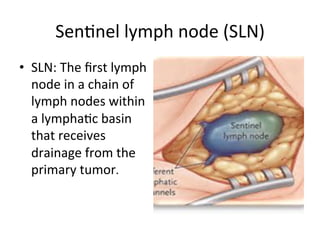
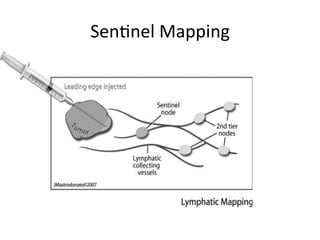
Sen$nel	
  lymph	
  node	
  (SLN)	
  
•  SLN:	
  The	
  first	
  lymph	
  
node	
  in	
  a	
  chain	
  of	
  
lymph	
  nodes	
  within	
  
a	
  lympha$c	
  basin	
  
that	
  receives	
  
drainage	
  from	
  the	
  
primary	
  tumor.	


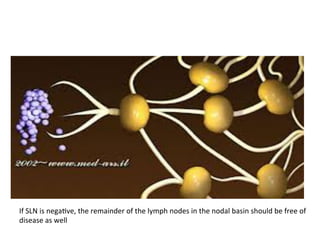
If	
  SLN	
  is	
  nega$ve,	
  the	
  remainder	
  of	
  the	
  lymph	
  nodes	
  in	
  the	
  nodal	
  basin	
  should	
  be	
  free	
  of	
  
disease	
  as	
  well	
  
Advantage	
  of	
  SLNS	
  
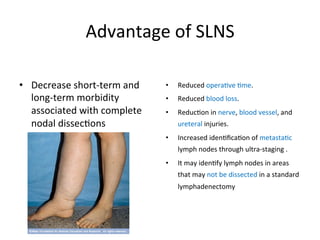
•  Decrease	
  short-­‐term	
  and	
  
long-­‐term	
  morbidity	
  
associated	
  with	
  complete	
  
nodal	
  dissec$ons	
  
•  Reduced	
  opera$ve	
  $me.	
  
•  Reduced	
  blood	
  loss.	
  	
  
•  Reduc$on	
  in	
  nerve,	
  blood	
  vessel,	
  and	
  
ureteral	
  injuries.	
  	
  
•  Increased	
  iden$fica$on	
  of	
  metasta$c	
  
lymph	
  nodes	
  through	
  ultra-­‐staging	
  .	
  
•  It	
  may	
  iden$fy	
  lymph	
  nodes	
  in	
  areas	
  
that	
  may	
  not	
  be	
  dissected	
  in	
  a	
  standard	
  
lymphadenectomy	
  
Sen$nel	
  Mapping	
  	
  
SLN	
  
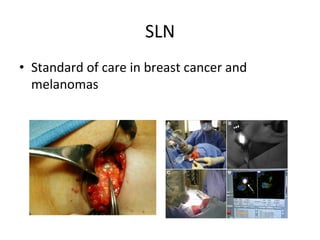
•  Standard	
  of	
  care	
  in	
  breast	
  cancer	
  and	
  
melanomas	
  
Vulva	
  Cancer	
  
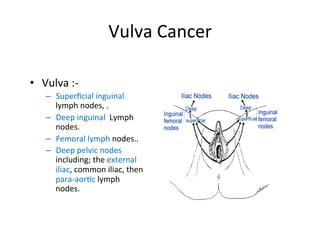
•  Vulva	
  :-­‐	
  
–  Superficial	
  inguinal	
  
lymph	
  nodes,	
  .	
  
–  Deep	
  inguinal	
  	
  Lymph	
  
nodes.	
  
–  Femoral	
  lymph	
  nodes..	
  
–  Deep	
  pelvic	
  nodes	
  
including;	
  the	
  external	
  
iliac,	
  common	
  iliac,	
  then	
  
para-­‐aor$c	
  lymph	
  
nodes.	
  
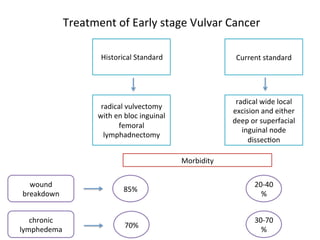
Current	
  standard	
  	
  
radical	
  wide	
  local	
  
excision	
  and	
  either	
  
deep	
  or	
  superfacial	
  
inguinal	
  node	
  
dissec$on	
  
radical	
  vulvectomy	
  
with	
  en	
  bloc	
  inguinal	
  
femoral	
  
lymphadnectomy	
  
wound	
  
breakdown	
  
chronic	
  
lymphedema	
  
85%	
  	
  
30-­‐70	
  
%	
  	
  
70%	
  	
  
20-­‐40	
  
%	
  	
  
Morbidity	
  
Historical	
  Standard	
  	
  
Treatment	
  of	
  Early	
  stage	
  Vulvar	
  Cancer	
  
Important	
  of	
  lymphadnectomy	


(	
  not	
  clinically	
  suspicious)	
  
•  Staging	
  
•  Prognosis	
  
Staging	
  
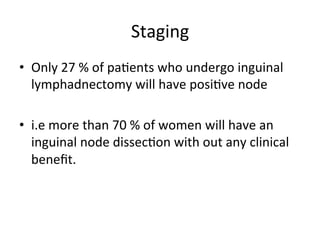
•  Only	
  27	
  %	
  of	
  pa$ents	
  who	
  undergo	
  inguinal	
  
lymphadnectomy	
  will	
  have	
  posi$ve	
  node	


•  i.e	
  more	
  than	
  70	
  %	
  of	
  women	
  will	
  have	
  an	
  
inguinal	
  node	
  dissec$on	
  with	
  out	
  any	
  clinical	
  
benefit.	
  
Prognosis	
  
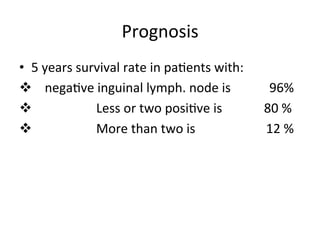
•  5	
  years	
  survival	
  rate	
  in	
  pa$ents	
  with:	
  	
  
v 	


  nega$ve	
  inguinal	
  lymph.	
  node	
  is	


  96%	
  
v 	


  Less	
  or	
  two	
  posi$ve	
  is	


  80	
  %	
  
v 	


  More	
  than	
  two	
  is	


  12	
  %	
  
Alterna$ve?	
  
Alterna$ve?	
  
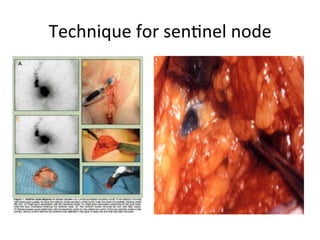
Technique	
  for	
  sen$nel	
  node	
  
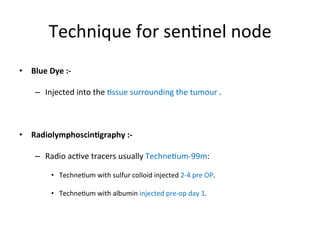
•  Blue	
  Dye	
  :-­‐	
  
–  Injected	
  into	
  the	
  $ssue	
  surrounding	
  the	
  tumour	
  .	
  
•  Radiolymphoscin5graphy	
  :-­‐	
  
–  Radio	
  ac$ve	
  tracers	
  usually	
  Techne$um-­‐99m:	
  
•  Techne$um	
  with	
  sulfur	
  colloid	
  injected	
  2-­‐4	
  pre	
  OP.	
  
•  Techne$um	
  with	
  albumin	
  injected	
  pre-­‐op	
  day	
  1.	
  
Technique	
  for	
  sen$nel	
  node	
  
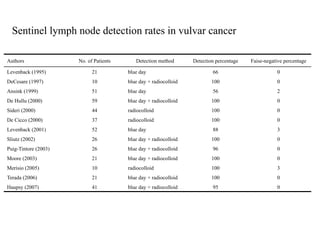
Authors No. of Patients Detection method Detection percentage Faise-negative percentage
Levenback (1995) 21 blue day 66 0
DeCesare (1997) 10 blue day + radiocolloid 100 0
Ansink (1999) 51 blue day 56 2
De Hullu (2000) 59 blue day + radiocolloid 100 0
Sideri (2000) 44 radiocolloid 100 0
De Cicco (2000) 37 radiocolloid 100 0
Levenback (2001) 52 blue day 88 3
Sliutz (2002) 26 blue day + radiocolloid 100 0
Puig-Tintore (2003) 26 blue day + radiocolloid 96 0
Moore (2003) 21 blue day + radiocolloid 100 0
Merisio (2005) 10 radiocolloid 100 3
Terada (2006) 21 blue day + radiocolloid 100 0
Haupsy (2007) 41 blue day + radiocolloid 95 0
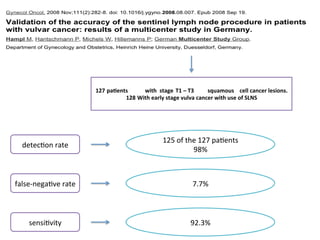
Sentinel lymph node detection rates in vulvar cancer
mul$center	
  study	
  
Hampl	
  et	
  al.	
  in	
  
2008.	
  	
  
127  pa5ents 	
  	
  with 	
  stage	
  T1	
  –	
  T3 	
  squamous 	
  cell	
  cancer	
  lesions.	
  
128  With	
  early	
  stage	
  vulva	
  cancer	
  with	
  use	
  of	
  SLNS	
  	
  
detec$on	
  rate	
  	
  
false-­‐nega$ve	
  rate	
  	
  
sensi$vity	
  
125	
  of	
  the	
  127	
  pa$ents	
  
98%	
  
7.7%	
  
92.3%	
  
•  GOG	
  173	


  RESULT	
  PENDING	
  
Criteria	
  for	
  SLNS	
  IN	
  VULVA	
  CANCER	
  
EXPERT	
  PANEL!	
  
•  Tumors	
  4	
  cm	
  or	
  less,	
  	
  
•  Clinically	
  nega$ve	
  groins,	
  and	
  tumor	
  invasion	
  
greater	
  than	
  1mm	
  	
  
•  midline	
  tumors	
  should	
  have	
  bilateral	
  SLN	
  biopsies	
  
performed.	
  	
  
•  Competency	
  :	
  An	
  expert	
  panel	
  recommended	
  an	
  
arbitrary	
  number	
  of	
  10	
  consecu$ve	
  cases	
  with	
  
successful	
  SLN	
  iden$fica$on	
  and	
  no	
  false-­‐
nega$ve	
  results	
  be	
  performed	
  prior	
  to	
  
performing	
  SLN	
  biopsy	
  without	
  
lymphadenectomy	
  
Vulvar	
  SLNS	
  protocol	
  
-­‐ve	
   +ve	
  
Complete	
  
lymphadenectomy	
  
Groin	
  radia$on	
  
No	
  further	
  
disec$on	
  
sixth	
  biennial	
  meet-­‐	
  ing	
  of	
  the	
  Interna$onal	
  Sen$nel	
  Lymph	
  Node	
  Society	
  an	
  expert	
  panel	
  issued	
  a	
  statement	
  	
  2008	
  
GROINSS-­‐V-­‐I(mul$center	
  observa$onal	
  study)	


radioac$ve	
  tracer	
  and	
  blue	
  dye,	
  in	
  pa$ents	
  with	
  unifocal	
  vulvar	
  squamous	
  cell	
  
carcinoma	
  less	
  than	
  4cm	
  in	
  diameter.	
  
-­‐ve	
  
276	
  
+ve	
  
No	
  pts	
  403	
  	
  
Follow	
  up	
   lymphadenectomy	
  
Recurrent	
  8	
  (2.9%)	
  
lymphodema	
   1.9%	
   25.2%	
  
(p<0.001)	
  
P	
  value	
  SLNS	
  lymphadenectomy	
  
p<0.001	
  0.4%	


16.2%	
  	
  Recurence	


  erysipelas	
  
p<0.001	
  4.5%	
  21.3%,	
  	
  	
  Celluli$ts	
  
p<0.001	
  11.7%	
  	
  34%	
  Wound	
  breakdown	
  	
  
p<0.001	


8.4	
  days	
  	
  13.7	
  days	
  	
  Hospital	
  stay	
  
97%	
  Disease-­‐specific	
  survival	
  rate	
  
for	
  pa$ents	
  with	
  unifocal	
  
vulvar	
  cancer	
  and	
  nega$ve	
  
SLN	


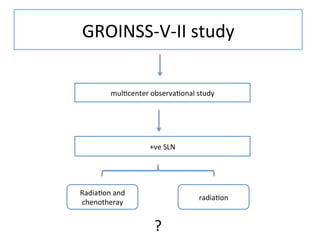
GROINSS-­‐V-­‐II	
  study	
  
mul$center	
  observa$onal	
  study	
  
+ve	
  SLN	
  
Radia$on	
  and	
  
chenotheray	
  
radia$on	
  
?	
  
Is	
  their	
  any	
  survival	
  benefit?	
  
•  in	
  summary,	
  SLN	
  biopsy	
  in	
  early-­‐stage	
  vulvar	
  
cancer	
  pa$ents	
  appears	
  to	
  be	
  a	
  reasonable	
  
alterna$ve	
  to	
  complete	
  inguinal	
  
lymphadenectomy.	
  
Cervical	
  cancer	
  
•  Standard	
  treatment	
  for	
  early	
  stage	
  radical	
  
hystrectomy	
  /trachlectomy	
  and	
  pelvic	
  
lymphadnectomy	
  
•  Complica$on	
  include	
  short	
  term	
  morbidity	
  	
  
and	
  long	
  term	
  
•  Lymphcyst	
  and	
  lymphoedema	
  and	
  nerve	
  and	
  
vascular	
  injury	
  
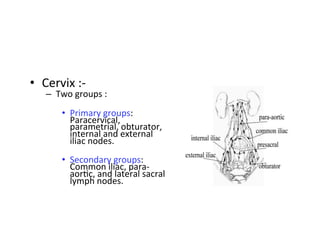
•  Cervix	
  :-­‐	
  
–  Two	
  groups	
  :	
  
•  Primary	
  groups:	
  
Paracervical,	
  
parametrial,	
  obturator,	
  
internal	
  and	
  external	
  
iliac	
  nodes.	
  
•  Secondary	
  groups:	
  
Common	
  iliac,	
  para-­‐
aor$c,	
  and	
  lateral	
  sacral	
  
lymph	
  nodes.	
  
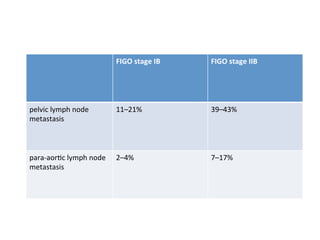
FIGO	
  stage	
  IIB	
  FIGO	
  stage	
  IB	
  
39–43%	
  11–21%	
  	
  pelvic	
  lymph	
  node	
  
metastasis	
  	
  
7–17%	
  2–4%	
  para-­‐aor$c	
  lymph	
  node	
  
metastasis	


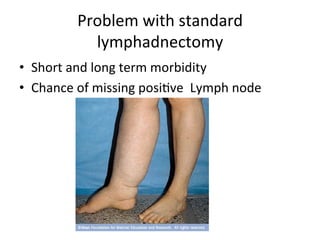
Problem	
  with	
  standard	
  
lymphadnectomy	
  
•  Short	
  and	
  long	
  term	
  morbidity	
  
•  Chance	
  of	
  missing	
  posi$ve	
  	
  Lymph	
  node	
  	
  
Alterna$ve?	
  
Alterna$ve?	
  
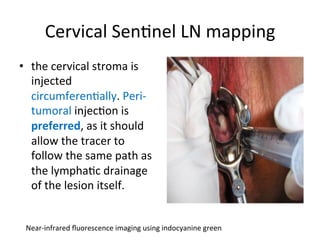
Cervical	
  Sen$nel	
  LN	
  mapping	
  
•  the	
  cervical	
  stroma	
  is	
  
injected	
  
circumferen$ally.	
  Peri-­‐
tumoral	
  injec$on	
  is	
  
preferred,	
  as	
  it	
  should	
  
allow	
  the	
  tracer	
  to	
  
follow	
  the	
  same	
  path	
  as	
  
the	
  lympha$c	
  drainage	
  
of	
  the	
  lesion	
  itself.	
  
Near-­‐infrared	
  fluorescence	
  imaging	
  using	
  indocyanine	
  green	


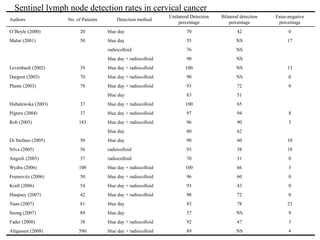
Authors No. of Patients Detection method
Unilateral Detection
percentage
Bilateral detection
percentage
Faise-negative
percentage
O’Boyle (2000) 20 blue day 70 42 0
Malur (2001) 50 blue day 55 NS 17
radiocolloid 76 NS
blue day + radiocolloid 90 NS
Levenback (2002) 39 blue day + radiocolloid 100 NS 13
Dargent (2003) 70 blue day + radiocolloid 90 NS 0
Plante (2003) 70 blue day + radiocolloid 93 72 0
blue day 83 51
Hubalewska (2003) 37 blue day + radiocolloid 100 65
Pijpers (2004) 37 blue day + radiocolloid 97 94 8
Rob (2005) 183 blue day + radiocolloid 96 90 3
blue day 80 62
Di Stefano (2005) 50 blue day 90 60 10
Silva (2005) 56 radiocolloid 93 38 18
Angioli (2005) 37 radiocolloid 70 31 0
Wydra (2006) 100 blue day + radiocolloid 100 66 3
Frumovitz (2006) 50 blue day + radiocolloid 96 60 0
Kraft (2006) 54 blue day + radiocolloid 93 43 0
Haupsey (2007) 42 blue day + radiocolloid 98 72 0
Yuan (2007) 81 blue day 83 78 23
Seong (2007) 89 blue day 57 NS 9
Fader (2008) 38 blue day + radiocolloid 92 47 3
Altgassen (2008) 590 blue day + radiocolloid 89 NS 4
Sentinel lymph node detection rates in cervical cancer
•  GOG	
  206,	
  an	
  ongoing,	
  mul$center	
  trial	
  
examining	
  the	
  u$lity	
  of	
  SLN	
  biopsy	
  in	
  early	
  
cervical	
  cancer	
  pa$ents.	
  	
  
•  Pending	
  result……..	
  
•  These	
  results	
  will	
  likely	
  direct	
  future	
  research	
  
on	
  this	
  topic.	
  
Is	
  their	
  any	
  survival	
  benefit?	
  
Endometrial	
  cancer	
  
•  Standard	
  management	
  hysterectomy	
  and	
  bso	
  
and	
  pelvic	
  and	
  para	
  aor$c	
  lymphadnectomy	
  
•  Lymphadnectomy	
  associated	
  with	
  increase	
  
morbidity	
  and	
  mortality	
  
•  Most	
  onen	
  all	
  node	
  be	
  nega$ve	
  especially	
  in	
  
early	
  stage	
  and	
  grade	
  1	
  
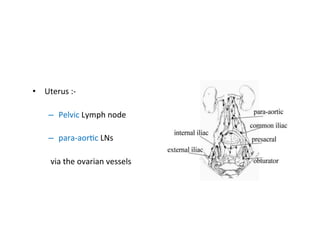
•  Uterus	
  :-­‐	
  
–  Pelvic	
  Lymph	
  node	
  
–  para-­‐aor$c	
  LNs	
  
	
  via	
  the	
  ovarian	
  vessels	
  
•  90%	
  of	
  pa$ents	
  with	
  stage	
  I	
  endometrium	
  
cancer	
  will	
  not	
  have	
  lymph	
  node	
  metastasis	
  at	
  
the	
  $me	
  of	
  diagnosis	
  	
  
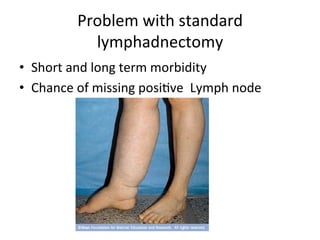
Problem	
  with	
  standard	
  
lymphadnectomy	
  
•  Short	
  and	
  long	
  term	
  morbidity	
  
•  Chance	
  of	
  missing	
  posi$ve	
  	
  Lymph	
  node	
  	
  
Alterna$ve?	
  
Alterna$ve?	
  
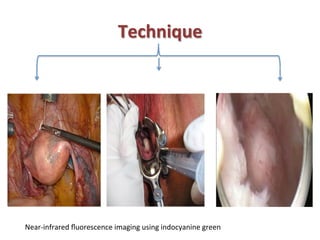
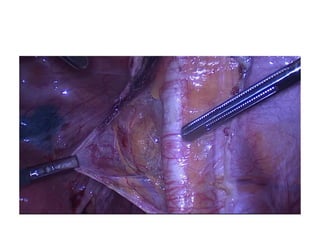
Technique	
  
Near-­‐infrared	
  fluorescence	
  imaging	
  using	
  indocyanine	
  green	
  
Authors
No. of
Patients
Injection site Detection method
Unilateral Detection
percentage
Bilateral detection
percentage
Faise-negative
percentage
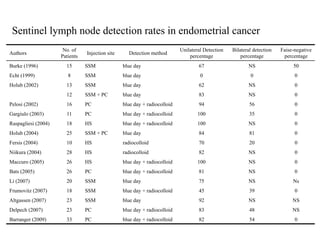
Burke (1996) 15 SSM blue day 67 NS 50
Echt (1999) 8 SSM blue day 0 0 0
Holub (2002) 13 SSM blue day 62 NS 0
12 SSM + PC blue day 83 NS 0
Pelosi (2002) 16 PC blue day + radiocolloid 94 56 0
Gargiulo (2003) 11 PC blue day + radiocolloid 100 35 0
Raspagliesi (2004) 18 HS blue day + radiocolloid 100 NS 0
Holub (2004) 25 SSM + PC blue day 84 81 0
Fersis (2004) 10 HS radiocolloid 70 20 0
Niikura (2004) 28 HS radiocolloid 82 NS 0
Maccuro (2005) 26 HS blue day + radiocolloid 100 NS 0
Bats (2005) 26 PC blue day + radiocolloid 81 NS 0
Li (2007) 20 SSM blue day 75 NS Ns
Frumovitz (2007) 18 SSM blue day + radiocolloid 45 39 0
Altgassen (2007) 23 SSM blue day 92 NS NS
Delpech (2007) 23 PC blue day + radiocolloid 83 48 NS
Barranger (2009) 33 PC blue day + radiocolloid 82 54 0
Sentinel lymph node detection rates in endometrial cancer
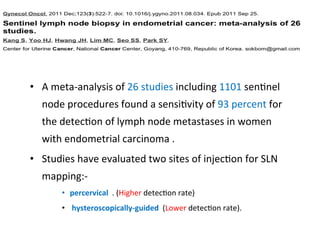
•  A	
  meta-­‐analysis	
  of	
  26	
  studies	
  including	
  1101	
  sen$nel	
  
node	
  procedures	
  found	
  a	
  sensi$vity	
  of	
  93	
  percent	
  for	
  
the	
  detec$on	
  of	
  lymph	
  node	
  metastases	
  in	
  women	
  
with	
  endometrial	
  carcinoma	
  .	
  
•  Studies	
  have	
  evaluated	
  two	
  sites	
  of	
  injec$on	
  for	
  SLN	
  
mapping:-­‐	
  
•  percervical	
  	
  .	
  (Higher	
  detec$on	
  rate)	
  
•  	
  hysteroscopically-­‐guided	
  	
  (Lower	
  detec$on	
  rate).	
  
Is	
  their	
  any	
  survival	
  benefit?	
  
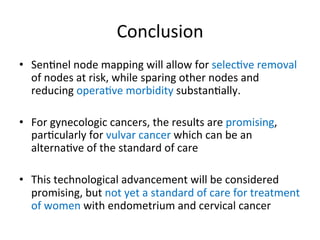
Conclusion	
  	
  
•  Sen$nel	
  node	
  mapping	
  will	
  allow	
  for	
  selec$ve	
  removal	
  
of	
  nodes	
  at	
  risk,	
  while	
  sparing	
  other	
  nodes	
  and	
  
reducing	
  opera$ve	
  morbidity	
  substan$ally.	


•  For	
  gynecologic	
  cancers,	
  the	
  results	
  are	
  promising,	
  
par$cularly	
  for	
  vulvar	
  cancer	
  which	
  can	
  be	
  an	
  
alterna$ve	
  of	
  the	
  standard	
  of	
  care	
  
•  This	
  technological	
  advancement	
  will	
  be	
  considered	
  
promising,	
  but	
  not	
  yet	
  a	
  standard	
  of	
  care	
  for	
  treatment	
  
of	
  women	
  with	
  endometrium	
  and	
  cervical	
  cancer	
  
Conclusion	
  	
  
•  The	
  safety	
  of	
  the	
  SLN	
  procedure	
  is	
  strongly	
  
associated	
  with	
  the	
  number	
  of	
  women	
  treated	
  
within	
  a	
  specific	
  center	
  and	
  the	
  presence	
  of	
  a	
  
well	
  trained	
  oncology	
  team	
  
•  Given	
  the	
  collec$ve	
  interest	
  in	
  the	
  less	
  morbid	
  
treatment	
  for	
  pa$ents	
  with	
  gynecological	
  
cancer,	
  sen$nel	
  node	
  mapping	
  deserves	
  
con$nued	
  development.	
  
Senteneal node 2

Senteneal node 2

  • 1.
    Sen$nel  Lymph  node  in   Gynecological  malignancies   Khalid  Sait      FRCSC   Professor,  Faculty  of  medicine,  King   Abdulaziz  University     Jeddah,  Saudi  Arabia  
  • 2.
    Sen$nel  lymph  node  (SLN)   •  SLN:  The  first  lymph   node  in  a  chain  of   lymph  nodes  within   a  lympha$c  basin   that  receives   drainage  from  the   primary  tumor.  
  • 3.
            If  SLN  is  nega$ve,  the  remainder  of  the  lymph  nodes  in  the  nodal  basin  should  be  free  of   disease  as  well  
  • 6.
    Advantage  of  SLNS   •  Decrease  short-­‐term  and   long-­‐term  morbidity   associated  with  complete   nodal  dissec$ons   •  Reduced  opera$ve  $me.   •  Reduced  blood  loss.     •  Reduc$on  in  nerve,  blood  vessel,  and   ureteral  injuries.     •  Increased  iden$fica$on  of  metasta$c   lymph  nodes  through  ultra-­‐staging  .   •  It  may  iden$fy  lymph  nodes  in  areas   that  may  not  be  dissected  in  a  standard   lymphadenectomy  
  • 7.
  • 8.
    SLN   •  Standard  of  care  in  breast  cancer  and   melanomas  
  • 9.
    Vulva  Cancer   • Vulva  :-­‐   –  Superficial  inguinal   lymph  nodes,  .   –  Deep  inguinal    Lymph   nodes.   –  Femoral  lymph  nodes..   –  Deep  pelvic  nodes   including;  the  external   iliac,  common  iliac,  then   para-­‐aor$c  lymph   nodes.  
  • 10.
    Current  standard     radical  wide  local   excision  and  either   deep  or  superfacial   inguinal  node   dissec$on   radical  vulvectomy   with  en  bloc  inguinal   femoral   lymphadnectomy   wound   breakdown   chronic   lymphedema   85%     30-­‐70   %     70%     20-­‐40   %     Morbidity   Historical  Standard     Treatment  of  Early  stage  Vulvar  Cancer  
  • 11.
    Important  of  lymphadnectomy                           (  not  clinically  suspicious)   •  Staging   •  Prognosis  
  • 12.
    Staging   •  Only  27  %  of  pa$ents  who  undergo  inguinal   lymphadnectomy  will  have  posi$ve  node                                   •  i.e  more  than  70  %  of  women  will  have  an   inguinal  node  dissec$on  with  out  any  clinical   benefit.  
  • 13.
    Prognosis   •  5  years  survival  rate  in  pa$ents  with:     v         nega$ve  inguinal  lymph.  node  is                        96%   v                                         Less  or  two  posi$ve  is                          80  %   v                                         More  than  two  is                                            12  %  
  • 14.
  • 15.
  • 16.
    Technique  for  sen$nel  node   •  Blue  Dye  :-­‐   –  Injected  into  the  $ssue  surrounding  the  tumour  .   •  Radiolymphoscin5graphy  :-­‐   –  Radio  ac$ve  tracers  usually  Techne$um-­‐99m:   •  Techne$um  with  sulfur  colloid  injected  2-­‐4  pre  OP.   •  Techne$um  with  albumin  injected  pre-­‐op  day  1.  
  • 17.
  • 18.
    Authors No. ofPatients Detection method Detection percentage Faise-negative percentage Levenback (1995) 21 blue day 66 0 DeCesare (1997) 10 blue day + radiocolloid 100 0 Ansink (1999) 51 blue day 56 2 De Hullu (2000) 59 blue day + radiocolloid 100 0 Sideri (2000) 44 radiocolloid 100 0 De Cicco (2000) 37 radiocolloid 100 0 Levenback (2001) 52 blue day 88 3 Sliutz (2002) 26 blue day + radiocolloid 100 0 Puig-Tintore (2003) 26 blue day + radiocolloid 96 0 Moore (2003) 21 blue day + radiocolloid 100 0 Merisio (2005) 10 radiocolloid 100 3 Terada (2006) 21 blue day + radiocolloid 100 0 Haupsy (2007) 41 blue day + radiocolloid 95 0 Sentinel lymph node detection rates in vulvar cancer
  • 19.
    mul$center  study   Hampl  et  al.  in   2008.     127  pa5ents    with  stage  T1  –  T3  squamous  cell  cancer  lesions.   128  With  early  stage  vulva  cancer  with  use  of  SLNS     detec$on  rate     false-­‐nega$ve  rate     sensi$vity   125  of  the  127  pa$ents   98%   7.7%   92.3%  
  • 20.
    •  GOG  173                                                            RESULT  PENDING  
  • 21.
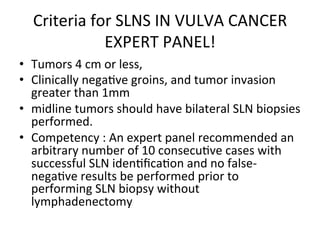
    Criteria  for  SLNS  IN  VULVA  CANCER   EXPERT  PANEL!   •  Tumors  4  cm  or  less,     •  Clinically  nega$ve  groins,  and  tumor  invasion   greater  than  1mm     •  midline  tumors  should  have  bilateral  SLN  biopsies   performed.     •  Competency  :  An  expert  panel  recommended  an   arbitrary  number  of  10  consecu$ve  cases  with   successful  SLN  iden$fica$on  and  no  false-­‐ nega$ve  results  be  performed  prior  to   performing  SLN  biopsy  without   lymphadenectomy  
  • 22.
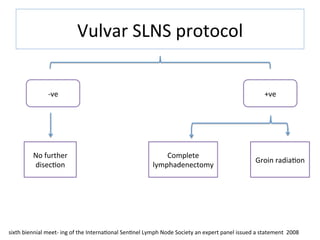
    Vulvar  SLNS  protocol   -­‐ve   +ve   Complete   lymphadenectomy   Groin  radia$on   No  further   disec$on   sixth  biennial  meet-­‐  ing  of  the  Interna$onal  Sen$nel  Lymph  Node  Society  an  expert  panel  issued  a  statement    2008  
  • 23.
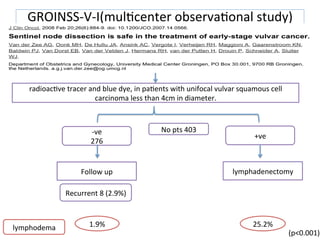
    GROINSS-­‐V-­‐I(mul$center  observa$onal  study)     radioac$ve  tracer  and  blue  dye,  in  pa$ents  with  unifocal  vulvar  squamous  cell   carcinoma  less  than  4cm  in  diameter.   -­‐ve   276   +ve   No  pts  403     Follow  up   lymphadenectomy   Recurrent  8  (2.9%)   lymphodema   1.9%   25.2%   (p<0.001)  
  • 24.
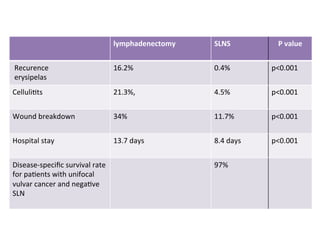
    P  value  SLNS  lymphadenectomy   p<0.001  0.4%     16.2%    Recurence      erysipelas   p<0.001  4.5%  21.3%,      Celluli$ts   p<0.001  11.7%    34%  Wound  breakdown     p<0.001     8.4  days    13.7  days    Hospital  stay   97%  Disease-­‐specific  survival  rate   for  pa$ents  with  unifocal   vulvar  cancer  and  nega$ve   SLN    
  • 25.
    GROINSS-­‐V-­‐II  study   mul$center  observa$onal  study   +ve  SLN   Radia$on  and   chenotheray   radia$on   ?  
  • 26.
    Is  their  any  survival  benefit?  
  • 27.
    •  in  summary,  SLN  biopsy  in  early-­‐stage  vulvar   cancer  pa$ents  appears  to  be  a  reasonable   alterna$ve  to  complete  inguinal   lymphadenectomy.  
  • 28.
    Cervical  cancer   • Standard  treatment  for  early  stage  radical   hystrectomy  /trachlectomy  and  pelvic   lymphadnectomy   •  Complica$on  include  short  term  morbidity     and  long  term   •  Lymphcyst  and  lymphoedema  and  nerve  and   vascular  injury  
  • 29.
    •  Cervix  :-­‐   –  Two  groups  :   •  Primary  groups:   Paracervical,   parametrial,  obturator,   internal  and  external   iliac  nodes.   •  Secondary  groups:   Common  iliac,  para-­‐ aor$c,  and  lateral  sacral   lymph  nodes.  
  • 30.
    FIGO  stage  IIB  FIGO  stage  IB   39–43%  11–21%    pelvic  lymph  node   metastasis     7–17%  2–4%  para-­‐aor$c  lymph  node   metastasis      
  • 31.
    Problem  with  standard   lymphadnectomy   •  Short  and  long  term  morbidity   •  Chance  of  missing  posi$ve    Lymph  node    
  • 32.
  • 33.
  • 34.
    Cervical  Sen$nel  LN  mapping   •  the  cervical  stroma  is   injected   circumferen$ally.  Peri-­‐ tumoral  injec$on  is   preferred,  as  it  should   allow  the  tracer  to   follow  the  same  path  as   the  lympha$c  drainage   of  the  lesion  itself.   Near-­‐infrared  fluorescence  imaging  using  indocyanine  green    
  • 35.
    Authors No. ofPatients Detection method Unilateral Detection percentage Bilateral detection percentage Faise-negative percentage O’Boyle (2000) 20 blue day 70 42 0 Malur (2001) 50 blue day 55 NS 17 radiocolloid 76 NS blue day + radiocolloid 90 NS Levenback (2002) 39 blue day + radiocolloid 100 NS 13 Dargent (2003) 70 blue day + radiocolloid 90 NS 0 Plante (2003) 70 blue day + radiocolloid 93 72 0 blue day 83 51 Hubalewska (2003) 37 blue day + radiocolloid 100 65 Pijpers (2004) 37 blue day + radiocolloid 97 94 8 Rob (2005) 183 blue day + radiocolloid 96 90 3 blue day 80 62 Di Stefano (2005) 50 blue day 90 60 10 Silva (2005) 56 radiocolloid 93 38 18 Angioli (2005) 37 radiocolloid 70 31 0 Wydra (2006) 100 blue day + radiocolloid 100 66 3 Frumovitz (2006) 50 blue day + radiocolloid 96 60 0 Kraft (2006) 54 blue day + radiocolloid 93 43 0 Haupsey (2007) 42 blue day + radiocolloid 98 72 0 Yuan (2007) 81 blue day 83 78 23 Seong (2007) 89 blue day 57 NS 9 Fader (2008) 38 blue day + radiocolloid 92 47 3 Altgassen (2008) 590 blue day + radiocolloid 89 NS 4 Sentinel lymph node detection rates in cervical cancer
  • 36.
    •  GOG  206,  an  ongoing,  mul$center  trial   examining  the  u$lity  of  SLN  biopsy  in  early   cervical  cancer  pa$ents.     •  Pending  result……..   •  These  results  will  likely  direct  future  research   on  this  topic.  
  • 37.
    Is  their  any  survival  benefit?  
  • 38.
    Endometrial  cancer   • Standard  management  hysterectomy  and  bso   and  pelvic  and  para  aor$c  lymphadnectomy   •  Lymphadnectomy  associated  with  increase   morbidity  and  mortality   •  Most  onen  all  node  be  nega$ve  especially  in   early  stage  and  grade  1  
  • 39.
    •  Uterus  :-­‐   –  Pelvic  Lymph  node   –  para-­‐aor$c  LNs    via  the  ovarian  vessels  
  • 40.
    •  90%  of  pa$ents  with  stage  I  endometrium   cancer  will  not  have  lymph  node  metastasis  at   the  $me  of  diagnosis    
  • 41.
    Problem  with  standard   lymphadnectomy   •  Short  and  long  term  morbidity   •  Chance  of  missing  posi$ve    Lymph  node    
  • 42.
  • 43.
  • 44.
    Technique   Near-­‐infrared  fluorescence  imaging  using  indocyanine  green  
  • 45.
    Authors No. of Patients Injection siteDetection method Unilateral Detection percentage Bilateral detection percentage Faise-negative percentage Burke (1996) 15 SSM blue day 67 NS 50 Echt (1999) 8 SSM blue day 0 0 0 Holub (2002) 13 SSM blue day 62 NS 0 12 SSM + PC blue day 83 NS 0 Pelosi (2002) 16 PC blue day + radiocolloid 94 56 0 Gargiulo (2003) 11 PC blue day + radiocolloid 100 35 0 Raspagliesi (2004) 18 HS blue day + radiocolloid 100 NS 0 Holub (2004) 25 SSM + PC blue day 84 81 0 Fersis (2004) 10 HS radiocolloid 70 20 0 Niikura (2004) 28 HS radiocolloid 82 NS 0 Maccuro (2005) 26 HS blue day + radiocolloid 100 NS 0 Bats (2005) 26 PC blue day + radiocolloid 81 NS 0 Li (2007) 20 SSM blue day 75 NS Ns Frumovitz (2007) 18 SSM blue day + radiocolloid 45 39 0 Altgassen (2007) 23 SSM blue day 92 NS NS Delpech (2007) 23 PC blue day + radiocolloid 83 48 NS Barranger (2009) 33 PC blue day + radiocolloid 82 54 0 Sentinel lymph node detection rates in endometrial cancer
  • 46.
    •  A  meta-­‐analysis  of  26  studies  including  1101  sen$nel   node  procedures  found  a  sensi$vity  of  93  percent  for   the  detec$on  of  lymph  node  metastases  in  women   with  endometrial  carcinoma  .   •  Studies  have  evaluated  two  sites  of  injec$on  for  SLN   mapping:-­‐   •  percervical    .  (Higher  detec$on  rate)   •   hysteroscopically-­‐guided    (Lower  detec$on  rate).  
  • 48.
    Is  their  any  survival  benefit?  
  • 49.
    Conclusion     • Sen$nel  node  mapping  will  allow  for  selec$ve  removal   of  nodes  at  risk,  while  sparing  other  nodes  and   reducing  opera$ve  morbidity  substan$ally.     •  For  gynecologic  cancers,  the  results  are  promising,   par$cularly  for  vulvar  cancer  which  can  be  an   alterna$ve  of  the  standard  of  care   •  This  technological  advancement  will  be  considered   promising,  but  not  yet  a  standard  of  care  for  treatment   of  women  with  endometrium  and  cervical  cancer  
  • 50.
    Conclusion     • The  safety  of  the  SLN  procedure  is  strongly   associated  with  the  number  of  women  treated   within  a  specific  center  and  the  presence  of  a   well  trained  oncology  team   •  Given  the  collec$ve  interest  in  the  less  morbid   treatment  for  pa$ents  with  gynecological   cancer,  sen$nel  node  mapping  deserves   con$nued  development.