OUTPUT DETERMINATION
By Srinivasulu Algaskhanpet (Sr. SAP SD Consultant) Page 1
An output is an outcome of the document. Output can be printout, email, fax, EDI, ALE
(Application Link Enabling).
Configuration of output is same as pricing in SAP, where we have condition tables, access
sequence, output type and output determination procedures.
So, output determination is also based on condition technique.
The standard business process is:
Inquiry > Quotation > Order > Delivery > Invoice
For "Inquiry" we don't need to configure output as it’s an internal document.
For "Quotation" we can have two types of outputs (Print out and Email). The output type for
quotation is "AN00".
For "Order" we can have two types of outputs (Print out and Email). The output type for order
is "BA00".
For "Delivery" we can have three types of outputs (Picking list, packing list, Delivery Challan)
* Packing list - PL00
* Delivery challan - LD00
For "Invoice" we can have two types of outputs (Print out and Email). The output type for
invoice is "RD00".
For "Cash Sale" output type is "RD03".
Return Order - Credit memo request - Debit memo request -
Returns - Credit memo - Debit memo -
Note:Likewise we can configure total of 16 output types including pro-forma invoice.
Configuration of Output Procedure:
Path: SPRO > S&D > Basic Functions > Output Control > Output determination > Output
determination using condition technique > Maintain output determination for sales
documents > Maintain conditions table
The common T. Code for output determination is "NACE"
OUTPUT DETERMINATION
By Srinivasulu Algaskhanpet (Sr. SAP SD Consultant) Page 2
1. Maintain Condition Table:
If output is same for all the customers then create condition table by using "Sales org" field. If
output is different for customers, for example, dealers, distributors, direct and institution then
create table using "Sales org/distribution channel".
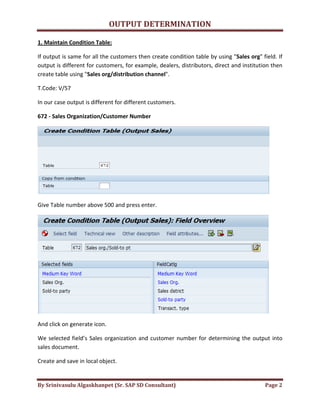
T.Code: V/57
In our case output is different for different customers.
672 - Sales Organization/Customer Number
Give Table number above 500 and press enter.
And click on generate icon.
We selected field’s Sales organization and customer number for determining the output into
sales document.
Create and save in local object.
OUTPUT DETERMINATION
By Srinivasulu Algaskhanpet (Sr. SAP SD Consultant) Page 3
2. Maintain Access Sequence:
Path: SPRO > S&D > Basic Functions > Output Control > Output determination > Output
determination using condition technique > Maintain output determination for sales
documents > Maintain access sequence
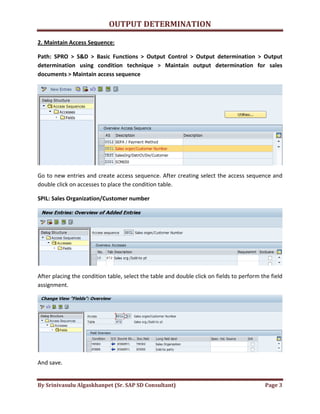
Go to new entries and create access sequence. After creating select the access sequence and
double click on accesses to place the condition table.
SPIL: Sales Organization/Customer number
After placing the condition table, select the table and double click on fields to perform the field
assignment.
And save.
OUTPUT DETERMINATION
By Srinivasulu Algaskhanpet (Sr. SAP SD Consultant) Page 4
3. Maintain Output Type:
Path: SPRO > S&D > Basic Functions > Output Control > Output determination > Output
determination using condition technique > Maintain output determination for sales
documents > Maintain output types
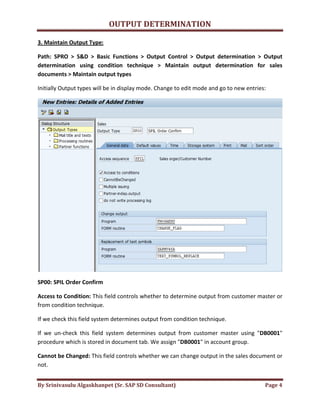
Initially Output types will be in display mode. Change to edit mode and go to new entries:
SP00: SPIL Order Confirm
Access to Condition: This field controls whether to determine output from customer master or
from condition technique.
If we check this field system determines output from condition technique.
If we un-check this field system determines output from customer master using "DB0001"
procedure which is stored in document tab. We assign "DB0001" in account group.
Cannot be Changed: This field controls whether we can change output in the sales document or
not.
OUTPUT DETERMINATION
By Srinivasulu Algaskhanpet (Sr. SAP SD Consultant) Page 5
If we check this we cannot change the output in sales document.
Multiple Issuing: This field controls whether we can issue output multiple times or not.
If we check this system allows to issue output multiple times.
Partner Independent Output: If we check this field system allows user to send output to all
partner functions irrespective of active partner.
If we un-check this then the output will be sent to active partner functions.
EX: Order confirmation will be sent to "SP"
Delivery challan will be sent to "SH"
Invoice will be sent to "BP"
Do not write processing log: If we check this field system will not display the log information
while processing outputs.
Change Output: We use this for mail configuration. Whenever changes happened to the sales
order, if we want to send different format of mail to customers then we use change output.
The standard program for standard output is "FM06AEND"
The standard form routine is "CHANGE_FLAG"
Replacement of Text Symbols: We use this for mail configuration.
Replacement of text symbols will help to send the subject and body text of the mail.
The standard program is "SAPMV45A"
The form routine is "TEXT_SYMBOL_REPLACE"
Note: The table for output is "NAST"
The common T. Code for output configuration is "NACE"
Dispatch Time: This field controls when to issue output i.e., immediately while saving the
transaction or with own transaction or with some background job.
Transmission medium: This field specifies the medium through which we issue output.
Print out, E-mail, fax, EDI etc.,
OUTPUT DETERMINATION
By Srinivasulu Algaskhanpet (Sr. SAP SD Consultant) Page 6
Partner Function: Here we need to assign active partner function.
Communication Strategy: We maintain this only for mail configuration. We maintain
communication strategy "CS01".
Communication strategy is the link between SAP server to mail server.
Mail Title and Text:
In this configuration step we maintain subject and body text.
Processing Routines:
"Program" will help to determine data from data base tables.
"Form Routine" will helps to take relevant data and to print it in relevant place in the output.
"Form" is an output design. We have two types of forms: i. Script forms ii. Smart form
Script form is old method of designing forms. Smart form is new method of designing forms.
Complex designs is not possible in script form where as it is possible in smart forms.
Developing script form is bit difficult whereas developing smart form is easy.
OUTPUT DETERMINATION
By Srinivasulu Algaskhanpet (Sr. SAP SD Consultant) Page 7
Now-a-days SAP is coming with "adobe forms"
Note: T. Code for smart forms is "SMARTFORMS"
T. Code for script forms is "SE71"
Note: Processing 1,2,3,4,5 are used to take the print outs like original, duplicate, triplicate,
quadrate etc.,
Partner Functions:
In this configuration step we assign medium and partner function.
OUTPUT DETERMINATION
By Srinivasulu Algaskhanpet (Sr. SAP SD Consultant) Page 8
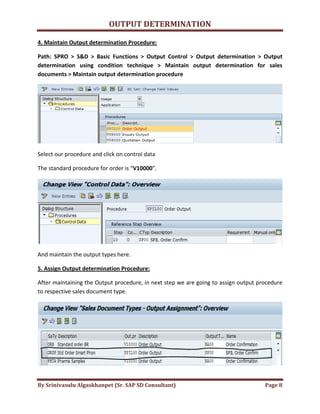
4. Maintain Output determination Procedure:
Path: SPRO > S&D > Basic Functions > Output Control > Output determination > Output
determination using condition technique > Maintain output determination for sales
documents > Maintain output determination procedure
Select our procedure and click on control data
The standard procedure for order is “V10000”.
And maintain the output types here.
5. Assign Output determination Procedure:
After maintaining the Output procedure, in next step we are going to assign output procedure
to respective sales document type.
OUTPUT DETERMINATION
By Srinivasulu Algaskhanpet (Sr. SAP SD Consultant) Page 9
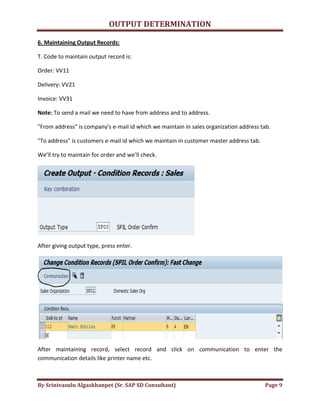
6. Maintaining Output Records:
T. Code to maintain output record is:
Order: VV11
Delivery: VV21
Invoice: VV31
Note: To send a mail we need to have from address and to address.
"From address" is company's e-mail id which we maintain in sales organization address tab.
"To address" is customers e-mail id which we maintain in customer master address tab.
We’ll try to maintain for order and we’ll check.
After giving output type, press enter.
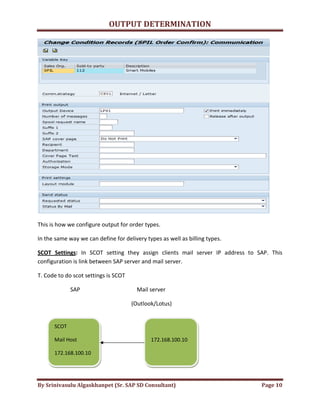
After maintaining record, select record and click on communication to enter the
communication details like printer name etc.
OUTPUT DETERMINATION
By Srinivasulu Algaskhanpet (Sr. SAP SD Consultant) Page 10
This is how we configure output for order types.
In the same way we can define for delivery types as well as billing types.
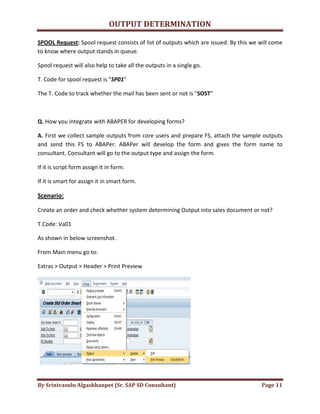
SCOT Settings: In SCOT setting they assign clients mail server IP address to SAP. This
configuration is link between SAP server and mail server.
T. Code to do scot settings is SCOT
SAP Mail server
(Outlook/Lotus)
SCOT
Mail Host
172.168.100.10
172.168.100.10
OUTPUT DETERMINATION
By Srinivasulu Algaskhanpet (Sr. SAP SD Consultant) Page 11
SPOOL Request: Spool request consists of list of outputs which are issued. By this we will come
to know where output stands in queue.
Spool request will also help to take all the outputs in a single go.
T. Code for spool request is "SP01"
The T. Code to track whether the mail has been sent or not is "SOST"
Q. How you integrate with ABAPER for developing forms?
A. First we collect sample outputs from core users and prepare FS, attach the sample outputs
and send this FS to ABAPer. ABAPer will develop the form and gives the form name to
consultant. Consultant will go to the output type and assign the form.
If it is script form assign it in form.
If it is smart for assign it in smart form.
Scenario:
Create an order and check whether system determining Output into sales document or not?
T.Code: Va01
As shown in below screenshot.
From Main menu go to:
Extras > Output > Header > Print Preview
OUTPUT DETERMINATION
By Srinivasulu Algaskhanpet (Sr. SAP SD Consultant) Page 12
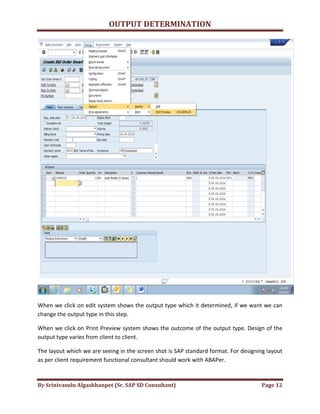
When we click on edit system shows the output type which it determined, if we want we can
change the output type in this step.
When we click on Print Preview system shows the outcome of the output type. Design of the
output type varies from client to client.
The layout which we are seeing in the screen shot is SAP standard format. For designing layout
as per client requirement functional consultant should work with ABAPer.
OUTPUT DETERMINATION
By Srinivasulu Algaskhanpet (Sr. SAP SD Consultant) Page 13

Output determination

  • 1.
    OUTPUT DETERMINATION By SrinivasuluAlgaskhanpet (Sr. SAP SD Consultant) Page 1 An output is an outcome of the document. Output can be printout, email, fax, EDI, ALE (Application Link Enabling). Configuration of output is same as pricing in SAP, where we have condition tables, access sequence, output type and output determination procedures. So, output determination is also based on condition technique. The standard business process is: Inquiry > Quotation > Order > Delivery > Invoice For "Inquiry" we don't need to configure output as it’s an internal document. For "Quotation" we can have two types of outputs (Print out and Email). The output type for quotation is "AN00". For "Order" we can have two types of outputs (Print out and Email). The output type for order is "BA00". For "Delivery" we can have three types of outputs (Picking list, packing list, Delivery Challan) * Packing list - PL00 * Delivery challan - LD00 For "Invoice" we can have two types of outputs (Print out and Email). The output type for invoice is "RD00". For "Cash Sale" output type is "RD03". Return Order - Credit memo request - Debit memo request - Returns - Credit memo - Debit memo - Note:Likewise we can configure total of 16 output types including pro-forma invoice. Configuration of Output Procedure: Path: SPRO > S&D > Basic Functions > Output Control > Output determination > Output determination using condition technique > Maintain output determination for sales documents > Maintain conditions table The common T. Code for output determination is "NACE"
  • 2.
    OUTPUT DETERMINATION By SrinivasuluAlgaskhanpet (Sr. SAP SD Consultant) Page 2 1. Maintain Condition Table: If output is same for all the customers then create condition table by using "Sales org" field. If output is different for customers, for example, dealers, distributors, direct and institution then create table using "Sales org/distribution channel". T.Code: V/57 In our case output is different for different customers. 672 - Sales Organization/Customer Number Give Table number above 500 and press enter. And click on generate icon. We selected field’s Sales organization and customer number for determining the output into sales document. Create and save in local object.
  • 3.
    OUTPUT DETERMINATION By SrinivasuluAlgaskhanpet (Sr. SAP SD Consultant) Page 3 2. Maintain Access Sequence: Path: SPRO > S&D > Basic Functions > Output Control > Output determination > Output determination using condition technique > Maintain output determination for sales documents > Maintain access sequence Go to new entries and create access sequence. After creating select the access sequence and double click on accesses to place the condition table. SPIL: Sales Organization/Customer number After placing the condition table, select the table and double click on fields to perform the field assignment. And save.
  • 4.
    OUTPUT DETERMINATION By SrinivasuluAlgaskhanpet (Sr. SAP SD Consultant) Page 4 3. Maintain Output Type: Path: SPRO > S&D > Basic Functions > Output Control > Output determination > Output determination using condition technique > Maintain output determination for sales documents > Maintain output types Initially Output types will be in display mode. Change to edit mode and go to new entries: SP00: SPIL Order Confirm Access to Condition: This field controls whether to determine output from customer master or from condition technique. If we check this field system determines output from condition technique. If we un-check this field system determines output from customer master using "DB0001" procedure which is stored in document tab. We assign "DB0001" in account group. Cannot be Changed: This field controls whether we can change output in the sales document or not.
  • 5.
    OUTPUT DETERMINATION By SrinivasuluAlgaskhanpet (Sr. SAP SD Consultant) Page 5 If we check this we cannot change the output in sales document. Multiple Issuing: This field controls whether we can issue output multiple times or not. If we check this system allows to issue output multiple times. Partner Independent Output: If we check this field system allows user to send output to all partner functions irrespective of active partner. If we un-check this then the output will be sent to active partner functions. EX: Order confirmation will be sent to "SP" Delivery challan will be sent to "SH" Invoice will be sent to "BP" Do not write processing log: If we check this field system will not display the log information while processing outputs. Change Output: We use this for mail configuration. Whenever changes happened to the sales order, if we want to send different format of mail to customers then we use change output. The standard program for standard output is "FM06AEND" The standard form routine is "CHANGE_FLAG" Replacement of Text Symbols: We use this for mail configuration. Replacement of text symbols will help to send the subject and body text of the mail. The standard program is "SAPMV45A" The form routine is "TEXT_SYMBOL_REPLACE" Note: The table for output is "NAST" The common T. Code for output configuration is "NACE" Dispatch Time: This field controls when to issue output i.e., immediately while saving the transaction or with own transaction or with some background job. Transmission medium: This field specifies the medium through which we issue output. Print out, E-mail, fax, EDI etc.,
  • 6.
    OUTPUT DETERMINATION By SrinivasuluAlgaskhanpet (Sr. SAP SD Consultant) Page 6 Partner Function: Here we need to assign active partner function. Communication Strategy: We maintain this only for mail configuration. We maintain communication strategy "CS01". Communication strategy is the link between SAP server to mail server. Mail Title and Text: In this configuration step we maintain subject and body text. Processing Routines: "Program" will help to determine data from data base tables. "Form Routine" will helps to take relevant data and to print it in relevant place in the output. "Form" is an output design. We have two types of forms: i. Script forms ii. Smart form Script form is old method of designing forms. Smart form is new method of designing forms. Complex designs is not possible in script form where as it is possible in smart forms. Developing script form is bit difficult whereas developing smart form is easy.
  • 7.
    OUTPUT DETERMINATION By SrinivasuluAlgaskhanpet (Sr. SAP SD Consultant) Page 7 Now-a-days SAP is coming with "adobe forms" Note: T. Code for smart forms is "SMARTFORMS" T. Code for script forms is "SE71" Note: Processing 1,2,3,4,5 are used to take the print outs like original, duplicate, triplicate, quadrate etc., Partner Functions: In this configuration step we assign medium and partner function.
  • 8.
    OUTPUT DETERMINATION By SrinivasuluAlgaskhanpet (Sr. SAP SD Consultant) Page 8 4. Maintain Output determination Procedure: Path: SPRO > S&D > Basic Functions > Output Control > Output determination > Output determination using condition technique > Maintain output determination for sales documents > Maintain output determination procedure Select our procedure and click on control data The standard procedure for order is “V10000”. And maintain the output types here. 5. Assign Output determination Procedure: After maintaining the Output procedure, in next step we are going to assign output procedure to respective sales document type.
  • 9.
    OUTPUT DETERMINATION By SrinivasuluAlgaskhanpet (Sr. SAP SD Consultant) Page 9 6. Maintaining Output Records: T. Code to maintain output record is: Order: VV11 Delivery: VV21 Invoice: VV31 Note: To send a mail we need to have from address and to address. "From address" is company's e-mail id which we maintain in sales organization address tab. "To address" is customers e-mail id which we maintain in customer master address tab. We’ll try to maintain for order and we’ll check. After giving output type, press enter. After maintaining record, select record and click on communication to enter the communication details like printer name etc.
  • 10.
    OUTPUT DETERMINATION By SrinivasuluAlgaskhanpet (Sr. SAP SD Consultant) Page 10 This is how we configure output for order types. In the same way we can define for delivery types as well as billing types. SCOT Settings: In SCOT setting they assign clients mail server IP address to SAP. This configuration is link between SAP server and mail server. T. Code to do scot settings is SCOT SAP Mail server (Outlook/Lotus) SCOT Mail Host 172.168.100.10 172.168.100.10
  • 11.
    OUTPUT DETERMINATION By SrinivasuluAlgaskhanpet (Sr. SAP SD Consultant) Page 11 SPOOL Request: Spool request consists of list of outputs which are issued. By this we will come to know where output stands in queue. Spool request will also help to take all the outputs in a single go. T. Code for spool request is "SP01" The T. Code to track whether the mail has been sent or not is "SOST" Q. How you integrate with ABAPER for developing forms? A. First we collect sample outputs from core users and prepare FS, attach the sample outputs and send this FS to ABAPer. ABAPer will develop the form and gives the form name to consultant. Consultant will go to the output type and assign the form. If it is script form assign it in form. If it is smart for assign it in smart form. Scenario: Create an order and check whether system determining Output into sales document or not? T.Code: Va01 As shown in below screenshot. From Main menu go to: Extras > Output > Header > Print Preview
  • 12.
    OUTPUT DETERMINATION By SrinivasuluAlgaskhanpet (Sr. SAP SD Consultant) Page 12 When we click on edit system shows the output type which it determined, if we want we can change the output type in this step. When we click on Print Preview system shows the outcome of the output type. Design of the output type varies from client to client. The layout which we are seeing in the screen shot is SAP standard format. For designing layout as per client requirement functional consultant should work with ABAPer.
  • 13.
    OUTPUT DETERMINATION By SrinivasuluAlgaskhanpet (Sr. SAP SD Consultant) Page 13