Text determination, account determination, partner determination, output determination, and storage location determination are used to transfer information throughout the order and delivery process. Account determination specifically maintains fields like sales organization, distribution channel, chart of accounts, and account assignment groups. Pricing determination calculates prices based on various factors like sales area, document type, and customer, with different pricing procedures controlling factors like condition types. A support consultant would maintain reports related to any issues customers are facing.
In this document
Powered by AI
Discusses definitions and purposes of text determination, account determination, and partner determination in SAP. Discusses definitions and purposes of text determination, account determination, and partner determination in SAP. Details processes related to delivery scheduling, shipping points, and managing deliveries in SAP.
Explains billing document types, processes for invoices, and the relationship with financial accounting.
1. What isthe purpose of text determination, account determination, partner determination,
output determination, storage location determination
Answer1:
Text determination: For transferring information from material or customer to order/delvery or
invoice (and anything inbetween)
Account determination: For transferring financial and costing information to proper financial docs
Partner determination: For determing who is is legally resposible for A/r, who the goods are going
to and whatever else you waana drive through this functionality.
Output determination: What kinda output does a sales/delivery/billing document create and who
gets it, where?. For example A partner might get an EDI notification for a sales order just
confirmed, whereas a financial/leasing company gets the invoice!
Answer2:
(a) Text Determination: Any Texts in Masterial Master/Material Determination/Order/Delivery ,
etc is meant to convey messages to the subsequent documents for compliance. e.g. "Give Top
Priority" message mentioned in Order is meant for Production Dept. (b) Account Determination :is
integration between Finance and SD. The A/P along with Account Keys need to be allocated
accordingly with combination of Account Determination Group for Customer and Material if
required. (c) Partner Determination: To identify which type of Partner it is so that if required for
same Customer different Partner Functions may be required e.g Only One Sold To Party per
Customer. More than One Ship to Party/ Bill to Party/ Payer possible. Accordingly different
Masters will have to be created. Useful for despatch of Material in casae of Ship to Party, sending
Bill in case of Bill to Party and payment followup/Dunning in case of Payer. (d) Output
Determination: What type of Output (Fax/Mail, etc) is required, where and in what Format(ABAP
Customisation may be required in some cases especially Invoices). (e) Storage Location
Determination: depends on Plant, Shipping Point and Storage Conditions
2. What are the five imp fields to be maintained in account determination
Account Determination: Sales View, Sales Organisation, Distribution Chanel, Chart of Accounts,
Account Assignment Group for Customer and Material and Account Keys.
4. What is meant by transfer of data from legacy code to sap Legacy Code ?
Answer1:
It should be legacy data to SAP. What it means is you want to transfer all the customer and
materials and all other information from Older (legacy system) to new SAP system. You can do it
using many tools, most noticeably MDMs.
Answer2:
Before installation of SAP, Data maintained by Company is called Legacy Data. At the time of
instalation, it is required to transfer Data from Legacy to SAP like Masters (Material/Customer,
etc). It can be done in various ways like BDC, LSMW, etc.
5. What do you do really in pricing determination, and what are the main deifferences
1
2.
between pricing procedures?
Answer1:
Pricingis determined by combination of Sales Organisation, Distribution Channel, Division,
Customer Pricing Procedure and Document Pricing Procedure.
Answer2:
We determine how the prices are calculated, taking into account sales area(sales org, distribution
channel, division), document type and customer(generally sold-to-party).
The main differences between pricing procedures would be the differences as we mentioned above,
from the point of view of field entries. Coming to the output and the procedure, Suppose the
condition types used will be different and hence the following whole procedure. One pricing
procedure determination to the others, which data control these differences
6. What type of reports generally a support consultant maintain and report
Depends on Customer requirements.
7. What are interfaces used generally an indian organisation which is in retail business and
and which is in banking business and oil business.
8. What is the purpose of shipping point determination not menu path
So that Shipping Point is determined automatically once the settings for the same are done.
9. What and where types of copy controls we change
Copy Control: is basically meant so that Data is copied from preceding Document to subsequent
one. What subsequent Document is required is to some extent determined by Customer
Requirements as well as Document Types. e.g. In general case of Standard Order, it will be Copy
Control (Order to Delivery) from OR to LF .
10. How to and where to maintain copy controls
Check for yourself in IMG (Sales Document types and Delivery Document Types)
11. What is purpose of maintaining common distribution channels and common divisions
Common Distribution Channel and Common Divison are maintained so that if any master data like
customer or material maintained with respect to one distribution channel can be used in other DCh.
It prevents the multiplication of master records.
Eg: A customer is created for say sales area 1000/20/00 then the same customer can be used in
sales area 1000/30/00 if we maintain 20 as common distribution channel. Hence no need for
extending the customers...the same for materials also.
12. What is the difference between the Avaialbility check 01 (Daily requirement) and 02
(Individual Requirement) in material master?
01 and 02 are the checking group. Availability check is carried out with the help of these checking
group and checking rule. Checking group 01 and 02 are maintained on the material master.
01 - Individual requirement -For this system generates transfers the requirement for each order to
2
3.
the MRP .Sothat MM can either produce or procure.
02- Collective requirement.-In this all the requirements in aday or in a wek are processed at a time.
System stores all req and passes on to the MRP in MRP run.In this system performance is high
however you can not do the backorder processing whereas in other you can do.
Read more: http://www.ittestpapers.com/articles/sap-sd-interview-
questions.html#ixzz1wXZFytMF
SAP SD stands for Sales and Distribution module. This handles all the sales activies of the
company. It is a part of the logistics module that enables to record all the information right from
quotations from the vendors, issuing a sales order and billing the customers. It updates all the
inventory information and keeps up-to date which in turn used by accountants to calculate the
revenues generated. It is integrated with MM (Materials Management) and PP (Production
Planning) modules. It lets companies to do their sales forecast, customer pricing etc.
Important functional features are
1. Pricing
2. Availability Check
3. Credit Management
4. Material Determination
5. Output Determination
6. Text Processing
7. Tax Determination
8. Account Determination
Read more: http://www.ittestpapers.com/sap-sd.html#ixzz1wXZgnX84
1) What are the Standard output types in SD?
Standard Output Types in SD are as under:
1. Sales Order Confirmation: BA00
2. Outbound Delivery Note: LD00
3. Billing Document: RD00
4. Inquiry: AF00
5. Quotation: AN00
3
4.
6. Contract: KO00
2)What is the difference between routine and requirements?
3) How variant is used in reporting?
4) What are the user exits?
a user exit is a place in a software program where a customer can arrange
for their own tailor-made program to be called. SAP creates user exits for
specific programs, screens, and menus within standard R/3 applications.
These exits do not contain any functionality. Instead, the customer exits
act as hooks. You can hang your own add-on functionality onto these
hooks.
5) What is ABAP debugging?
6) What are the routines?
7) What are the reports u have generated with help of ABAP?
8) How can we create user exits?
9) What are the reports u have generated with help of ABAP? What are all the
things we need to do configure?
10)What is the purpose of creating user exits?
To add specific business related functionality to standard SAP
11)What is ABAP query?
12)What is difference between SD account key and FI account key?
Account key is created and provided by FI. Account key determines the
G/L account to which the amount is to be posted. SD defines account key
in pricing and FI uses it for posting taxes.
4
5.
13)What are variantsand its use?
14)How is credit control determined?
15)What are the parameters in FD32?
16)What is the difference between milestone and periodic billing?
•
Milestone billing is used where a customer is charged on specific
activities which are completed. Eg. Excavation of a pit. The total
value of excavation of a pit is say $1000, and after every agreed
milestone (3 ft, 10 ft, 25ft and 100ft) a bill is raised based on the
activity completion.
•
Periodic billing is used when a customer is charged a specific fixed
amount for a period of time. Eg. Rent for Warehouse for 1 year is
$3600 split into $300 every month.
17)What is the functionality of negative posting in billing document?
A correspondingly set posting on the debit side reduces the credits side of
the account. A credit posting reduces the debit side of the account.
18)What is mean of Rebate processing?
Rebate is a special discount given to a specific customer for certain sales
volume within a specific period of time.
E.g., Customer A gets 5% discount if he buys 1000 kgs in April 2008
Customer A gets 7% discount if he buys 1500 kgs in April 2008
19)What are the differences between billing document and invoice?
5
6.
Invoice is sentto the customer along with the goods supplied. Invoice is
also a type of billing document. Credit memo, debit memo are other types
of billing documents
20)What is the difference between Static and Dynamic Credit Check?
21)What is the link between credit management and subtotals?
22)What is the difference between centralized credit management
23)What is Delivery group and what is its purpose?
24)How is shipping point determined?
25)What is difference between transport and task?
26)What is the use of pod?
27)When will you combine deliveries into one invoice?
28)What is batch split?
29)What is the relation between PGI and TOR?
30)How is route determined?
31)What is Returnable packaging processing means?
32)Where is shipping conditions stored?
33)What are the Steps in consignment processing?
34)What do you mean by POD (proof of delivery)?
35)How to configure partial deliveries?
36)What are the effects of PGI?
37)What are the Techniques in delivery scheduling?
38)What is a handling unit?
39)What are the statuses?
6
7.
40)What is thepurpose of sales document type?
41)Which delivery document type for STO process?
42)What are the issues u have faced in training?
43)What is an integration point between SD AND MM?
44)What is the difference between incomplete order and backorder
processing?
45)What is t-code for listing the blocked documents?
46)What is Product attributes?
47)What is the landscape?
48)What are the issues u have faced in integration testing?
49)What is a field catalog?
50)What is line item?
51)What is a Transfer order?
52)What is value SAP?
53)What is difference between listing and exclusion?
54)What happens when you overrate the customer?
55)What are the functions performed in a support client?
56)What are the highest organizational units in SD, MM, PP and FICO?
57)What is the client specific data?
58)How subtotal in pp is related to credit limit?
59)What are all the things we need to do configure
60)What is meant by Variant Configuration?
61)What is the relation ship between sales organization
7
8.
62)What are dependenciesin variant configuration?
63)How will be the Ticket process flow happens in a Production support
project?
64)What are the Standard output types in SD?
65)What are the issues u have faced in training?
66)What is the difference between plant and storage location?
67)What are the statuses?
68)What is Lean Warehouse Management?
69)What is the purpose of sales document type?
70)What is an integration point between SD AND MM?
71)What are MRP types?
72)What is the difference between incomplete order and backorder
processing?
73)What is Product attributes?
74)What is difference between SD account key and FI account key?
75)What will you do in blue print stage?
76)How will access the data in to production?
77)What is cut over strategy?
78)What is consumption based planning?
79)What is the relation ship between sales organization and plants?
80)What is IMG?
81)What is Replenishment lead time?
82)What is material determination?
8
9.
83)What is Backorderprocessing?
84)What is the central organizational element in purchasing?
85)How is plant determined?
86)What is the relationship between company code and sales organization?
87)How will be the Ticket process flow happens in a Production support
projectWhat is transfer order?
88)What is the link/control between sales and distribution and quality?
89)What is business item?
90)What is Lump sum payment?
91)What is the advantage of using the text as a reference
92)What is the landscape of the project?
93)What basic questions do they ask relating to order management?
94)How is storage location determined?
95)What is the difference between ATP check and availability check?
96)What is the purpose to differentiate the sales document type?
97)What will do in realization?
98)What is the importance of release status and dynamic field
99)What is the parent and child relationship?
100)How is item category determined?
101)What is the difference between item proposal
102)What are MRP types?
103)What is difference between the item proposal and dynamic proposal?
104)What is the Function of item category group?
9
10.
105)How is itemcategory determined?
106)What is the difference between item proposal
107)What is Item Category Control?
108)What does an item category control?
109)What is transfer order?
110)What is difference between delivery document & scheduling?
111)What is the difference between plant and storage location?
112)What is Lean Warehouse Management?
113)What is batch split?
114)What is use of customer group?
115)Why does the customer master have different views?
116)What is main purpose of maintaining the master data?
117)What is use of customer group?
118)Why does the customer master have different views?
119)What are the fields in pricing procedure?
120)What is Condition type?
121)What is Extract used in condition tech. in pricing?
122)What is condition supplement and why is it used?
123)What is the difference between condition type EK01 and EK02?
124)What is pricing procedure?
125)What is condition exclusion?
126)What is difference between the header level condition
127)What is the access sequence for header conditions?
10
11.
128)What is thedifference between discount and rebate?
129)What are the influencing factors for account determination
130)How alternate condition base value?
131)How revenue account is determined?
132)What is Condition type?
133)What is Extract used in condition tech. in pricing?
134)What is Group condition?
135)What is the use of pricing date in condition type?
136)What is difference between inclusive and exclusive?
137)How is access seq. controlled?
138)What is the difference between VK11 & VK31
139)What are 16 fields in pricing procedure?
140)How is step and counter differentiated?
141)What is condition supplement?
142)What is the difference between alternative calculation type
143)What is t-code for listing the blocked documents?
Read more: http://www.ittestpapers.com/articles/sap-sd-questions.html#ixzz1wXa8RgGv
1. What is the purpose of text determination, account determination, partner determination,
output
determination,storagelocation determination
2. What are the five imp fields to be maintained in account determination
3. How to create excise invoice and what is it
4. What is meant by transfer of data from legacy code to sap
5. What do you do really in pricing determination, and what are the main deifferences
between
one pricing procedure determination to the others, which data control these differences
6. What type of reports generally a support consultant maintain and report
11
12.
7. What areinterfaces used generally an indian organisation which is in retail business
and and which is in banking business and oil business.
8. What is the purpose of shipping point determination not menu path
9. What and where types of copy controls we change
10. How to and where to maintain copy controls
11. What is purpose of maintaining common distribution channels and common divisions
Read more: http://www.ittestpapers.com/articles/sd-interview-questions.html#ixzz1wXaIlwyp
12
13.
1 What isthe further Subdivision of a plant?
Ans: The further subdivision of a plant are the storage locations, which allows stocks of materials
to be broken down according to predefined criteria such as the location and materials
planning aspects. It can also be subdivided into locations and operational areas. They are
further subdivided into locations takes geographical criteria into account, operational areas
reflects responsibilities for production is also a subdivision.
2 In SD, MM, PP, FI/CO which are the highest organizational units?
Ans: The highest organizational units in SD, MM, PP, FI/CO are:
SD: Sales Organization.
MM: Plant.
PP: Plant.
FI: Company Code
CO: Controlling Area.
3 What is the definition of a Plant according to SAP?
Ans: According to SAP a plant is a place where either material is produced or goods and services
provided. Plant is classified into Business Object. In Organizational unit within Logistics,
serving to subdivide an enterprise according to production, procurement, maintenance, and
materials plan aspects. Coming to the Structure a plant can assume a variety of roles. As a
part of maintenance plant, it includes the maintenance objects that are spatially located within
this plant. The maintenance tasks that are to be performed are specified within a maintenance
planning plant. As a retail or wholesale site, it makes merchandise available for distribution
and sale. The plant is the organizational unit for material valuation, according to a rule. For
the placement of materials in storage (stock put-away), a storage location is assigned to a
plant. The storage location depends on the storage condition and the stock placement
situation. The preferred shipping point for a plant is defined as the default shipping point,
which depends on the shipping condition and the loading condition. The business area that is
responsible for a valuation area is determined as a function of the division. As a rule, a
valuation area corresponds to a plant.
4
Is it possible Sales Organization sell from a plant belonging to a different company
code?
Ans: It is possible for a sales organization sell from a plant belonging to a different company code.
5 For which the distribution channels and divisions are assigned and how many shipping
points can be assigned to a plant, sales organization and if there is a warehouse
management system active, where is warehouse number is assigned?
Ans: The Distribution Channels and Divisions are assigned to Sales Organization. A plant can be
assigned with many shipping points, coming to sales organization there will be shipping
points that are assigned to that. When a warehouse management system is active it would be
assigned with a Plant and Storage Location in a warehouse number.
6 Is it possible to assign two different sales organizations to the same company code?
Ans: Yes, it is possible to assign two different sales organizations to the same company code.
13
14.
7 Define towhich organizational element is central in shipping?
Ans: Organizational unit at a fixed location that carries out shipping activities is called Shipping
Point. A shipping point could, for instance it can be a company's mail department or a plant's
rail depot. Each delivery is processed by only one shipping point.
8 What would make the immediate delivery in cash sales?
Ans: When immediate delivery in cash sales is made the Order type delivery switch on
immediately.
9 Is it possible to create sales order for 40 items if the quotation is sent for 30 items?
Ans: Yes, it is possible to create sales order for 40 items if the quotation is sent for 30 items.
10
In Case of Third party Sales what would trigger for the automatic creation of PR or
PO?
Ans: It has to be set an item category as “automatic PO” so that PO and PR will automatically
generate after saving the order.
11 Briefly explain any three organizational elements make up a sales area and their function?
Ans: An organizational unit that sells and distributes products, negotiates terms of sale, and is
responsible for these transactions is known as Sales organization.
Channel through which the salable materials or services reach the customers, typical
distribution channels include wholesale, retail and direct sales. You can assign a distribution
channel to one or more sales organizations are known as Distribution channel.
Product groups can be defined for a wide-ranging spectrum of products. For every division you can
make customer-specific agreements on, for example, partial deliveries, pricing and terms of
payment. Within a division you can carry out statistical analyses or set up separate marketing is
known as Division.
12 In Access sequence what is the importance of requirement field?
Ans: In access sequence, the system will not go to access condition type system will reply through
formula.
13 What is the relation between credit control area and company codes and explain the
credit control area?
Ans: More than one credit control areas is not possible to assign to a company code, since a credit
control area can include one or more company codes. Credit control area is a n organizational
unit in an organization that specifies and checks credit limits for customers.
14
What are the steps included for the sales person as a partner function in the partner
determination?
Ans: The steps that are included for the sales person as a partner function in the partner
determination, that a partner function sales representative or person responsible for these two
we can add through partner function in partner procedure
15 What is the central organization element in purchasing and the relationship between
sales organization and plants, company codes, plants and company codes?
Ans: The Central Organizational element in purchasing is Purchasing Organization and the
relationship between sales organizations and plants is Many to Many, to Company codes its
Many to One and for Plants and Company codes its Many to Many to One.
14
15.
16 Which submodule of SAP could make business areas obsolete and can one business
area be assigned to several company codes? And what is Z transaction?
Ans: CO is the sub module of SAP that could make business area obsolete and it is possible that
one business area can be assigned to several company codes. Z transaction is a copied
standard transaction code or objects that rename it by Z which is basically standard name
which will stat from Z as user defined.
17 What is Business area and how is it used?
Ans: The costs and revenue according to the business area posted by the system is called as
Business Area. It is used in Sales Area if the accounts are to be posted according to sales and
Plant Division if the accounts are to be posted according to products. The business area is
defined in Customizing for Sales. A unit in an enterprise, grouping product and market
combinations as homogeneously as possible for the purpose of developing unified business
policy. Business Area according to Financial Accounting (FI) defines that the business area is
an organizational unit within financial accounting which represents a separate area of
operations or responsibilities within an organization. Financial accounting transactions can be
allocated to a specific business area.
18 What is a delivery group?
Ans: Basic grouping of all individual deliveries for Billing is called Delivery Group. It should have
the same Ship to Party, Shipping Point, etc.
19
Briefly explain the internal organizational elements within a sales organization and
their function?
Ans: The Geographical aspects of the organization in business development and sales are defined
using the term sales office. A sales office can be considered as a subsidiary. Sales offices are
assigned to sales areas. If a sales order is entered for a sales office within a certain sales area,
the sales office must be assigned to that area. The staff of a sales office may be subdivided
into sales groups. For example, sales groups can be defined for individual divisions.
Individual personnel master records are used to manage data about salespersons. A sales
person can be assigned to a sales group in the personnel master record.
20 What is Cumulative Condition Record?
Ans: Cumulative Condition Record is a field that Condition Update during configuration for a
condition type that has anything to do with the cumulative condition records.
21 How can a company's structure represent by defining and assigning corporate structure
elements in R/3 system and what is the purpose of doing that?
Ans: The Enterprise organization chart shows the organizational structure of an enterprise, its
organization units and how they are related. A combined structure can be created from the
point of view of accounting, MM, SD. This structure forms a framework in which all
business transactions can be processed.
22 What are the views in a material master?
Ans: The views in a material master are Basic data, Additional basic data, Accounting views, MRP
views, Purchasing views, Storage views, forecasting views, sales views and in IS Retail there
is also a Listing view and POS view.
23 What is a sales organization?
15
16.
Ans: Sales organizationis an organizational unit that sells, distributes products, negotiates terms of
sales and is responsible for all the transactions involved with a sale.
24 What is a legacy System and what is cut over strategy?
Ans: Migrating from the existing system on which currently working to the SAP system is called
the legacy system. Cutover strategy that depends upon how the organizations design their
data load strategies. Normally, it decide the sequence of Data loads for Configuration
settings, Master data, Transaction data which follows whom and then it make a copy of the
system as a Production system a day before and after checking the successful data loads, you
go-live 100% or partial again depending upon organizational setup and policies. Cutover
planning is highly site specific. There's no thumb rule. The stock data as on the date of going
live should be correctly entered. But stock being a highly dynamic quantity, the strategy for
loading should be crystal clear. Then you have to load all the back dated transaction on the
stock. Some stock comes into your plant/storage location as return and some stock is actually
delivered to your customer through sales orders of various kinds.
25
What is the transaction code for creating a material in SAP and what is the transaction
code to extend a material?
Ans: The transaction code for creating a material in SAP is MM41. MM01 is the transaction code
to extend a material.
26 In a material master what is the base unit?
Ans: The base unit is a measure which is used as a basis for all the transactions, all movements of
quantities will be converted to that base unit of measure which is specific to an article.
27 What happens when a value is not entered for a manual and mandatory condition type
and does a header condition type have an access sequence?
Ans: When a value is not entered for a manual and mandatory condition type the pricing procedure
will reject the conditions in the sales order. There would be no header condition type to have
an access sequence.
28 What are the examples of Global settings?
Ans: The examples of Global Settings are Currencies, Countries etc and this data is application
independent.
29 What is a one time customer?
Ans: A general customer that is created for those customers for which it do not want to create
separate records is called a one time customer. This customer can be reused.
30 In a customer master record who is a payer?
Ans: According to customer master record a Payer is the individual or company who will settle the
invoices for products or services sold.
31 Who defines the account groups and give some tables in SAP SD for customer master?
Ans: Normally account groups are defined by the finance team and some of the tables in SAP SD
for customer master are KNVV, RF02D, KNA 1 etc.
32 What is the procedure to know whether the customer is one-time or regular?
16
17.
Ans: The procedureto know the customer is one-time or regular since one can maintain Account
Group for One-time customers.
33 Is it possible to have specific customer material information entered in SAP?
Ans: Yes, it is possible to have specific customer material information entered in SAP since VD51
is the transaction or inside VA02 also you can add customer material information records.
34 Give the transaction code for creating a customer in SAP SD?
Ans: The transaction codes for creating a customer in SAP SD are VD01, VA01 and XD01.
35 What are inter-company customers?
Ans: This customer represents the sales customers within the same client but between different
company codes.
36 Briefly explain any three organizational elements make up a sales area and their function?
Ans: An organizational unit that sells and distributes products, negotiates terms of sale, and is
responsible for these transactions is known as Sales organization.
Channel through which the salable materials or services reach the customers, typical
distribution channels include wholesale, retail and direct sales. You can assign a distribution
channel to one or more sales organizations are known as Distribution channel.
Product groups can be defined for a wide-ranging spectrum of products. For every division
you can make customer-specific agreements on, for example, partial deliveries, pricing and
terms of payment. Within a division you can carry out statistical analyses or set up separate
marketing is known as Division.
37 What happens when the exclusive field was ticked in the access sequence?
Ans: When the exclusive field of all access sequences is ticked, it will try to get available data
from the first. Only in case, data is not available, will it move on to the next one.
38 In SAP SD what is a sales office?
Ans: According to SAP SD, a sales office is a geographically located unit of a sales organization.
39 What is the purpose of partner determination?
Ans: Partner determination is used to find out who is responsible for A/R process and where the
products are going.
BASIS KNOWLEDGE AND SYSTEM NAVIGATION
Name two ways to start a transaction.
Dynamic Menu
Command Field
Why do you create user-specific parameters?
They supply defaults to R/3 fields. If a field is indicated, the system automatically fills in
default value. Depending on the field definition, the entry can also be replaced with a value
entered by the user. (Concept of PARAMETER ID)
17
18.
Name the threedifferent kinds of messages in the R/3 system. What is the difference
between them?
A message can have five different types. These message types have the following effects
during list processing:
A (=Abend):
The system displays a message of this message type in a dialog window. After the user
confirms the message using ENTER, the system terminates the entire transaction (for
example SE38).
E (=Error) or W (=Warning):
The system displays a message of this message type in the status line. After the user
chooses ENTER, the system acts as follows:
While creating the basic list, the system terminates the report.
While creating a secondary list, the system terminates the corresponding processing block
and keeps displaying the previous list level.
I (=Information):
The system displays a message of this message type in a dialog window. After the user
chooses ENTER , the system resumes processing at the current program position.
S (=Success):
The system displays a message of this message type on the output screen in the status line
of the currently created list.
What is a data dictionary or repository?
Central catalog that contains the descriptions of an organization's data and provides
information about the relationships between the data and its use in programs and screens.
The data descriptions in a Data Dictionary is also called metadata, i.e., data that describes
other data.
The ABAP/4 Dictionary stores system-wide data definitions. When you create a new data
definition, the Dictionary tool does all the processing necessary to create the definition. You
can use the Dictionary tool to look up the "definition" of objects in your R/3 System.
What is a matchcode?
Comparsion key. A matchcode allows you to locate the key of a particular database record
(e.g. account number) by entering any field value contained in the record. The system then
displays a list of records matching the specifications.
If you want an end user to see a specific menu after logging on the R/3 system, how could
you do that?
User maintenance transactions allow the system administrator to create and maintain user
master records. This includes the generation and assignment of authorizations and
authorization profiles.
18
19.
II CORPORATE STRUCTURE
InR/3 you can represent a company's structure by defining and assigning corporate
structure elements. What is the purpose of doing that?
Enterprise organization diagram. Chart showing the organizational structure of an
enterprise, its organization units and how they are related. A combined structure can be
created from the point of view of accounting, MM, SD. This structure forms a framework in
which all business transactions can be processed.
Which three organizational elements make up a sales area and briefly explain their function?
Sales organization: An organizational unit that sells and distributes products, negotiates
terms of sale, and is responsible for these transactions.
Distribution channel: Channel through which salable materials or services reach customers.
Typical distribution channels include wholesale, retail and direct sales. You can assign a
distribution channel to one or more sales organizations.
Division: Product groups can be defined for a wide-ranging spectrum of products. For every
division you can make customer-specific agreements on, for example, partial deliveries,
pricing and terms of payment. Within a division you can carry out statistical analyses or set
up separate marketing.
Name the three internal organizational elements within a sales organization and briefly
explain their function.
Sales Office. Geographical aspects of the organization in business development and sales
are defined using the term sales office. A sales office can be considered as a subsidiary.
Sales offices are assigned to sales areas. If you enter a sales order for a sales office within a
certain sales area, the sales office must be assigned to that area.
Sales Group. The staff of a sales office may be subdivided into sales groups. For example,
sales groups can be defined for individual divisions.
Salespersons. Individual personnel master records are used to manage data about
salespersons. You can assign a sales person to a sales group in the personnel master
record.
What does the term "business area" refer to and how can it be used?
Business Area. The system posts costs and revenue according to the business area. The
business area can be equivalent to the:
19
20.
sales area (ifthe accounts are to be posted according to sales)
plant/division (if the accounts are to be posted according to products)
The business area is defined in Customizing for Sales.
o Business area. A unit in an enterprise, grouping product and market combinations as
homogeneously as possible for the purpose of developing unified business policy.
o Financial Accounting (FI). A business area is an organizational unit within financial
accounting which represents a separate area of operations or responsibilities within an
organization. Financial accounting transactions can be allocated to a specific business area.
Briefly explain the relationship between sales organizations and company codes.
Many to One.
What is the central organizational element in purchasing?
Purchasing Organization.
Explain the relationship between sales organizations and plants.
Many to Many.
Explain the relationship between sales organizations, plants and company codes.
Many to Many to One.
Can one business area be assigned to several company codes? Which (sub) module of SAP
could make business areas obsolete?
Yes in CO .
What is a credit control area? What relationship exists between credit control areas and
company codes?
Credit control area. Organizational unit in an organization that specifies and checks credit
limits for customers. A credit control area can include one or more company codes. It is not
possible to assign a company code to more than one credit control areas.
Which organizational element is central in shipping? Give a definition of it.
Shipping Point: Organizational unit at a fixed location that carries out shipping activities. A
shipping point could, for example, be a company's mail department or a plant's rail depot.
Each delivery is processed by only one shipping point.
20
21.
Give a definitionof plant (in SAP).
Organizational unit within Logistics, serving to subdivide an enterprise according to
production, procurement, maintenance, and materials planning aspects.
A plant is a place where either materials are produced or goods and services provided.
Classification: Business object
Structure: A plant can assume a variety of roles:
As a maintenance plant, it includes the maintenance objects that are spatially located within
this plant. The maintenance tasks that are to be performed are specified within a
maintenance planning plant.
As a retail or wholesale site, it makes merchandise available for distribution and sale.
As a rule, the plant is the organizational unit for material valuation.
The preferred shipping point for a plant is defined as the default shipping point, which
depends on the shipping condition and the loading condition.
For the placement of materials in storage (stock put-away), a storage location is assigned to
a plant. The storage location depends on the storage condition and the stock placement
situation.
The business area that is responsible for a valuation area is determined as a function of the
division. As a rule, a valuation area corresponds to a plant.
Can you assign two different sales organization to the same company code?
Yes.
To what do you assign distribution channels and divisions?
Sales Organizations.
What are the highest organizational units in SD, MM.PP,FI,CO?
SD: Sales Organizations.
M: Plant
PP: Plant
FI: Company Code
21
22.
CO: Controlling Area
Canyou further subdivide a plant? If yes into what ?
A plant can be subdivided into storage locations, allowing stocks of materials to be broken
down according to predefined criteria (e.g., location and materials planning aspects).
A plant can be subdivided into locations and operational areas. Subdivision into locations
takes geographical criteria into account, whereas subdivision into operational areas reflects
responsibilities for production.
Can a sales organization sell from a plant belonging to a different company code?
Yes.
How many shipping points can you assign to a plant?
Many.
How many shipping points can you assign to a sales organization?
None.
If you have a warehouse management system active, to what would you assign the
warehouse number?
Plant & Storage Location.
III MASTER DATA
Why does the customer master have different views?
In addition to the sales and distribution data, the accounting data is also important for a
payer. Therefore one can create a customer master record centrally for the following
partner functions:
For the payer
For the sold-to party who, in addition to the other partner functions, also takes on the
function of the payer.
Which different partner functions can a customer master record serve?
22
23.
Customer:
o sold-to party
oship-to party
o payer
o bill-to party
o One-time customer including all partner functions.
What is the structure of data in the customer master record?
Different data is maintained in each of the three areas:
General data, like address and telephone number, etc., is maintained for every customer.
This data is only identified by the customer number, not by company code or sales area.
Maintaining the data is possible from both the accounting view and the sales and
distribution view.
Company code data is only of interest for the accounting department. It includes, for
example, information on insurance or account management. This data applies to only one
company code.
Sales and distribution data is only of interest for the sales and distribution department. It
includes, for example, data on pricing or shipping. This data only applies to one sales area,
and therefore is dependent on the sales structure (sales organization, distribution channel,
division).
Would you have different customer numbers if your customer was serviced by more than
one company code?
No.
Would you have different customer numbers if your customer was serviced by more than
one sales organization?
No.
A material is produced in plant Boston, plant Dallas and in plant Chicago. How many
different material master number do you need?
Only one.
Is it possible to have different data for the same customer for different sales areas?
Yes.
Give examples of general data in the customer master record ?
23
24.
Address, Control data,Marketing, Payment transactions, Contact person, Unloading points.
Give examples of general data in the material master record ?
This level contains the data applicable to all individual group companies, all plants, and all
warehouses/stores belonging to an enterprise (corporate group). Examples of general data
are details on a material's design (CAD drawings, for instance) and storage conditions
(temperature range, whether the material is explosive or perishable, and so on).
Give examples of company -code-specific data in the customer master record?
This data is only of importance to the accounting department. It includes, for example, data
on insurance and account management. Company code data only applies to one company
code. If you edit the customer master record you must specify customer number and
company code in order to access the screens containing company code data.
Which plant-specific data do you find in the material master record?
This level contains the data for each branch or plant location within a certain company. The
data important to Purchasing is stored at this level. Examples of this data are the maximum
and minimum order quantities of a material and the reorder level. You access the plant data
by entering the plant key.
If a customer wishes to receive goods on Tuesdays only, how could you ensure that in the
SAP R/3 system?
This can be done by specifying goods receiving hours - Time schedule of ship-to party which
specifies the days and times that goods can be delivered.
Do you find any sales prices in the material master record?
Yes.
Name at least five different partner functions.
Examples of partner functions in Sales and Distribution:
sold-to party, ship-to party, bill-to party, payer.
Examples of partner functions (roles) in Materials Management:
ordering address, supplier of goods, invoicing party, different payee.
Which are the two partner functions in SD that have to be maintained in FI too ?
24
25.
sold-to party, payer.
Canyou assign a material to more than one division?
No.
If you want to create language specific sales texts for your material master, would you have
to create a new material master record?
No.
What is a material type and which material types do you know?
Raw materials, semi-finished products, finished products, trading goods, operating supplies.
Name the four standard industry sectors in SAP for the material master. For what do you
use them?
Branch of industry.
The industry sector groups together companies according to their activities (for example,
plant engineering and construction, mechanical engineering, the chemical industry, and the
pharmaceutical industry).
Table-driven program support is provided via the industry sector: for example, for the
selection of data fields on-screen, for the sequence of the screens, and for the allocation of
a material to a material type.
For what or why do you use the classification system in sales? Give examples of objects you
can classify in R/3.
For e.g., Variant Pricing of configurable products. Objects can be customers, products,
condition types.
Does storage-location specific data in the material master record apply for each plant?
This level contains the data specific to a storage location. Stock levels are an example of the
data maintained for each storage location. You access the storage location data by entering
the plant and storage location codes.
This data structure facilitates the organization of material-related information within the
entire enterprise. It prevents redundant storage of material data when the same material is
used in more than one plant or stored at more than one storage location.
Example: Suppose the same metal casting is stored at two different locations. The design
and purchasing data for this material would be identical. However, the data on the stock
25
26.
levels at eachlocation would differ.
Name at least four views of the material master record.
Accounting : Valuation and costing information. Examples: standard price, past and future
price, and current valuation.
Materials planning and control: Information for material requirements planning (MRP) and
consumption-based planning/inventory control. Examples: safety stock level, planned
delivery time, and reorder level for a material.
Purchasing: Data provided by Purchasing for a material. Examples: purchasing group
responsible for a material, over- and underdelivery tolerances, and the order unit.
Engineering: Engineering and design data on a material. Examples: CAD drawings, basic
dimensions, and design specifications.
Storage: Information relating to the storage/warehousing of a material. Examples: unit of
issue, storage conditions, and packaging dimensions.
Forecasting: Information for predicting material requirements. Examples: how the material
is procured, forecasting period, and past consumption/usage.
Sales and distribution: Information for sales orders and pricing. Examples: sales price,
minimum order quantity, and the name of the sales department responsible for a certain
material.
What are the possible units of measure for a material?
A material can be stored, transported and sold in various units of measure. In the SAP R/3
System, you can therefore define various units of measure which are maintained in the
sales and distribution screens. However, you only need to maintain the fields of the units of
measure if they deviate from the base unit of measure. If no other fields with units of
measure are maintained, the system automatically takes the base unit of measure as a
basis for its calculations. You can enter the following units of measure in the sales and
distribution screens:
Base unit of measure : Stocks of a material are managed in the base unit of measure. All
quantity movements in other units of measure are converted automatically by the system
into the base unit of measure.
Alternative unit of measure: If a product is managed in the base unit of measure "Piece" but
is sold in the sales unit "Box", you must define the conversion factor. The alternative unit of
measure can define, for example, that 1 box of this material contains 12 pieces.
Sales unit : The unit of measure in which materials are sold is referred to as a sales unit (for
26
27.
example, piece orbottle). The value you define in the material master record is proposed
during business transactions relevant for sales, such as the sales order. You can replace
them with other alternative units of measure in the sales order.
Delivery Unit : The delivery unit refers to the unit in which materials can be delivered. Only
exact multiples of the delivery unit can be delivered. For example, with a delivery unit of 30
bottles, 30, 60 or 90 bottles can be delivered, but not 100 bottles.
Quantity Specifications: Two different quantity specifications are used:
Minimum order quantity: The minimum order quantity refers to the minimum quantity the
customer must order. A warning message appears if the minimum order quantity is not
reached during order entry. The order can be entered in spite of the warning message.
Minimum delivery quantity : The minimum delivery quantity refers to the minimum quantity
you must deliver to the customer. The minimum delivery quantity is automatically checked
during delivery processing. A warning message appears during delivery processing if you
enter a delivery quantity lower than the minimum delivery quantity. The delivery can be
created in spite of this warning message.
What is a Bill of material?
A bill of material is a complete, formally structured list of the components that make up a
product or assembly. The list contains the object number of each component, together with
the quantity and unit of measure. The components are known as BOM items. A bill of
material can only refer to a quantity of at least 1 of an object.
Is the BOM used in the PP module only?
No. Also used in SD.
Explain what a routing is?
Routing contains the operations required in production, and the production resources/tools,
material components, and test equipment required to produce the product.
What is a work center?
A work center is an organizational unit where a work step is carried out, producing an
output. The work center defines where and by whom an operation is to be carried out. A
cost center is assigned to each work center in the work center master record. The work
center has a particular available capacity. The activities performed at or by the work center
are valuated by charge rates, which are determined by cost centers and activity types. Work
centers can be: Machines, People, Production lines, Groups of craftsmen .
IN Personnel Planning and Development (PD) work centers are the physical locations where
27
28.
tasks are carriedout. A work center can represent anything as general as a geographic
location, for example, the New York branch office. Or work centers can be very precisely
defined. For example, a work center could represent a specific workstation, with specific
tools and equipment, on a specific floor, of a specific building.
IN Workflow Management a work center is a particular place which has been set up
specifically so that employees can perform their duties within the corporate work system
using working materials.
What does the account group of the customer /vendor control?
A collection of properties of accounts which determine the creation of master records.
The account group determines the data that is relevant for the master record and a number
range from which numbers are selected for the master records.
Each master record must be assigned to an account group.
Changes to the account group and the accompanying partner functions can only be made
from a lower level to a higher level. For example, this means that a sold-to party cannot be
assigned the function of a payer as fields which have already been maintained for this sold-
to party would have to be masked. However, you can assign the sold-to party function to a
payer.
The account group ensures that for the different partner functions of a customer only the
necessary screens and fields are displayed for input.
What are the two possible ways of control for the cost of a material in the material master
record?
Standard Price, Moving Average Price.
What is a valuation class?
Allocation of a material to a group of G/L accounts.
Along with other factors, the valuation class determines the G/L accounts to be updated as
a result of a valuation-relevant transaction (for example, a goods movement).
Which valuation classes are valid depends on the material type. Several valuation classes
can be valid for one material type. A valuation class can be valid for several material types.
A customer master record in SD is also an A/R(accounts receivables)in FI. When you create
a customer master record you also have to specify the reconciliation account. For what is
the reconciliation account used?
28
29.
Account in G/Laccounting, to which automatic entries are posted during a business activity.
It is generally the case that several subledger accounts post to a common reconciliation
account. This ensures that the developments in the subledger accounts are accurately
reflected in the general ledger (i.e. in line with balance sheet conventions). You can set up a
reconciliation account for, say, all overseas customers.
IV INRTRODUCTION TO ORDER MANAGEMENT & SALES
Briefly describe the types and structure of the sales document and give examples of data
that you find on the different levels.
Sales-related business transactions are recorded in the system as sales documents. There
are, broadly speaking, four different groupings of sales documents:
Sales queries, such as inquiries and quotations
Sales orders
Outline agreements, such as contracts and scheduling agreements
Customer problems and complaints, such as free of charge deliveries and credit memo
requests.
Header Data
The general data that is valid for the entire document is recorded in the document header.
This data includes the:
number of the sold-to party
number of the ship-to party and the payer
document currency and exchange rate
pricing elements for the entire document
delivery date and shipping point
Item Data
Whereas data in the document header applies to all items in the document, some data
applies only to specific items. This data is stored at item level and includes the:
material number
target quantity for outline agreements
29
30.
number of theship-to party and the payer (an alternative ship-to party or payer can be
defined for a particular item)
plant and storage location specifications
pricing elements for the individual items
Schedule Line Data
An item consists of one or more schedule lines. The schedule line contains all the data that
is needed for a delivery. For example, a customer orders 20 pieces of a material and you
enter this as an item in the sales order. However, you can only deliver 10 pieces now and
the remaining 10 pieces next month. In other words, you need to schedule two deliveries.
The data for these deliveries (dates, confirmed quantities) are stored in two separate
schedule lines. In sales documents where delivery data is not relevant -for example:
contracts, credit and debit memo requests - the system does not create any schedule lines.
Data recorded in the schedule lines includes the:
schedule line quantity
delivery date
confirmed quantity
What is the difference between an inquiry and quotation ?
Inquiry: Request made to a vendor for a quotation for required materials or services.
No availability check is done for inquiry.
Quotation: Offer from a vendor to a purchasing organization regarding the supply of
materials or performance of services subject to predefined terms and conditions.
A quotation consists of a number of items, in which the total quantity and delivery date of
an offered material or service are specified.
The total quantity can be subdivided into several partial quantities with different delivery
dates in the lines of a delivery schedule.
Do you always have to have a material master record number when you enter an item on a
sales document (inquiry and quote)? If not what would you have to use to be able to enter
information at item level?
No. Customer Material Information or Material Description.
30
31.
If a customerdoesn't place an order with you after you have sent him a quotation, what
happens to the quotation document?
Remains active till the end of validity period.
Can you have alternative items in a sales order?
Yes.
If you reference an inquiry when creating a quotation ,would the inquiry be updated?
Yes.
Can you copy one inquiry to many quotations ?
No.
Can you copy several previous documents into one sales order?
Yes.
Do you always have to copy the entire quantities at item level when you reference a
previous document?
No.
Can you make sure that business data in a sales order is only possible to maintain at header
level?
Yes.
From where is the delivering plant transferred into the sales order?
Customer Master, Material Master.
Which partner function is relevant for the delivering plant? The sold-to-party , bill-to-party,
payer, carrier or the ship- to- party?
Ship-to party.
Can you manually change the delivering plant in the sales order once it was defaulted from
the master data?
Yes.
31
32.
For what orwhy do you use the incompletion log?
To have a complete document so that it doesn’t affect subsequent processes.
Can you have different incompletion logs for different item categories? Schedule line
categories?
Yes.
If a document is incomplete can you still save the document?
Yes.
Which reference statuses can a document have at item level? Which statuses at header
level?
Item level: Partial, Full.
Header level: Full.
What's the advantage of using text as a reference instead of duplicating it?
Can be modified if needed.
What three sources provide data for the creation of a sales document?
Material Master, Customer Master, Previous referenced documents.
Can you change addresses of partners manually in the sales document?
Yes.
Name several input tools that make order entry faster and give a definition of them?
Customer Material Information, Product Proposal , Referencing Documents.
In which business environment would you use only the single-line entry screen to create
and save the order?
Telephone Sales, Simple Business.
If you do not specify the delivering plant in the sales order, what could the system then not
do?
Delivery Scheduling.
32
33.
For what wouldyou use the fast change function in sales entry?
Alternate Plants, Delivery or Billing Blocks
Name two ways to control that customers can receive only certain materials?
Material Listing, Exclusion.
What does the item category control?
General Data
- Should pricing be carried out for the item?
- When should an item be regarded as completed? A quotation item, for example, can only
be regarded as completed if the entire quantity has been copied into a sales order.
- Is it an item that refers to a material or is it a text item?
- Are schedule lines allowed for the item?
- May general business data, for example, the terms of payment at the item level, deviate
from those at the header level?
- Should a system message appear if the item cannot be fully delivered?
- Which fields are relevant for the incompletion log?
- Which partner functions are allowed at the item level and which are mandatory?
- Which output (for example, an order confirmation) is allowed for the business transaction
and which output determination procedure is used?
Shipping Data
- Is an item relevant for delivery?
o Should the weight and the volume of an item be determined?
Billing Data
- Is an item relevant for billing?
- Should the cost of the item be determined?
- Is it a statistical item? Pricing is carried out for statistical items. However, they are not
33
34.
added to thevalue of the order, that is, the customer is not charged for them.
- Should a billing block be set automatically for an item? For example, this may be
important for items whose prices have to be clarified before billing.
* Is it a returns item?
Name the influencing factors for determining the item category in the sales document?
Sales Document type, Item Category Group, Higher Level Item, Item Usage.
Name the influencing factors for determining the scehdule line category in the sales
document?
Item Category, MRP Type.
What does the sales document type control?
General Data
- Can the document be entered only with reference to a preceding document?
- Should the existing customer-material info record be taken into consideration?
- Should the delivery date be proposed?
- Must a customer number be entered when creating a document? For example, product
proposals can be entered without reference to a particular customer.
- Which order probability is defined?
- Should the division be taken from the material master record for every item or should an
alternative division specified in the header take precedence over the item specifications?
- How should the system respond if the division entered in the header deviates from the
division in the items?
- Should a credit limit check be made?
- From which number range should the document number for internal or external number
assignment come?
- Which fields are relevant for the incompletion log? The validity period, for example, is
important for contracts and must therefore be specified in the document.
- Can an incomplete document be saved or must all data be complete?
34
35.
- Which partnerfunctions are allowed and which ones are mandatory?
Shipping Data
- Which delivery type should the delivery resulting from the order have?
- Should delivery scheduling be carried out?
- Should transportation scheduling be carried out?
- Should a delivery block be set automatically for a specific reason? For example, a delivery
block may be appropriate for a free-of-charge delivery.
- You can define shipping conditions for a sales document type. These are copied into the
document regardless of what is defined in the customer master record.
Billing Data
Which billing type should the invoice resulting from the order or the delivery have?
Should a billing block be set automatically for a specific reason? For example, a billing block
may be appropriate if a credit memo request should first be checked before it is used as the
basis for a credit memo.
Can the sales document type be determined by the system?
No.
In R/3, can you automatically substitute one product for another? How? What would you
have to create?
Yes. Product Selection / Material Determination.
Give a definition of replenishment lead time?
Total time for the in-house production or for the external procurement of a product. In in-
house production the replenishment lead time is determined to cover all BOM levels.
What's the difference between checking availability with or without replenishment lead time
(RLT)?
With RLT : Availability check is done only upto end of RLT. If material is not available the
date on which RLT ends is displayed as Material Availability Date.
Without RLT : Availability check is unrestricted. Displays Delivery Dates as on which partial
35
36.
deliveries can bemade with available stock.
Name at least three item categories?
Standard Items : AFN, AGN, TAN.
Free of charge Items: AFNN, AGNN, TANN.
Non-stock Items : AFX, AGX, TAX.
Text Items : AFTX, AGTX, TATX.
Why would you use different item and schedule line categories?
Item categories are defined to provide additional control functions for the sales documents
and thus meet the demands resulting from the different business transactions.
The items in a sales document are divided into one or more schedule lines. These schedule
lines differ from each other with respect to date and quantity. For some schedule lines,
material requirements planning is not carried out; for other schedule lines, it is carried out.
Also goods receipt, not goods issue, is posted for a schedule line defined in a returns
document.
Can you change existing standard item categories?
Yes.
Can you create new sales order types?
Yes.
Different dates will be calculated in order entry scheduling . Can you name the lead time
variables that will be taken into account?
Transportation lead time, Pick/pack time, Loading time, Transit time .
If you run out of stock in a specific plant can you check if there are quantities available in
other plants?
Yes.
When you carry out availability check, which quantities or movements can the system take
into consideration?
The following elements can be included in the availability check:
36
37.
Stocks : safetystock, stock in transfer, stock in quality inspection, blocked stock.
Inward and outward movements : purchase orders, purchase requisitions, planned orders,
production orders, reservations, dependent reservations, dependent requirements, sales
requirements, delivery requirements.
Give some examples of sales document types (description, not necessary the short code)
that already set up in the standard system?
Indicator used to control the processing of the various sales documents which are defined in
the system. E.g., OR, SO, BV, KR. Document types allow the system to process different
kinds of business transactions, such as standard orders and credit memo requests, in
different ways.
Can you maintain texts for a specific customer and store them in the system? If yes, where?
Yes. Customer Material Information.
When the system checks availability which scheduling would it use first?
Backward Scheduling.
Name the influencing factors for the determination of the availability date?
The following data is required for determining this date:
- Route from the shipping point to the ship-to party location
o Shipping point from which the goods are issued
o Loading group from the material master record
o Weight group determined from the order using the order quantity.
Name the three delivery possibilities when there is not enough stock available?
One Time Delivery, Complete Delivery, Partial Deliveries.
Can you think of an example why you would have to create a text for a customer and copy
it to the sales order?
Customer specific instructions.
What is the function of item category group?
The item category group determines how a material is processed in the sales order. It
defines, for example, that pricing does not take place for a free of charge item, such as a
business gift; or that inventory management is not carried out for a service. When
37
38.
processing sales anddistribution documents, the system uses the item category group to
determine the item category. The system determines the item category based on the item
category group of the material and the current business transaction, and proposes it in the
respective document.
When creating the material types non-stock material and services, DIEN is proposed in both
cases for the item category group, because the order processing for both material types is
identical: for example, pricing is carried out for both, but no availability check.
On sales order, when the system confirms 20 pieces to be available at a certain date, would
these 20 pieces still be available for other new sales order coming in later?
No.
What is a delivery group and why would you use it?
The complete delivery and delivery group functions enable you to combine some or all of
the items in a sales order so that they are delivered to the customer together. The system
determines automatically the latest delivery date possible for the delivery group and adjusts
the schedule lines accordingly. Corresponding requirements for material requirements
planning (MRP) are changed or re-determined.
What is backorder processing?
The backorder processing functions enable you to list relevant sales documents for specific
materials and process them from the point of view of availability. You can assign available
to promise (ATP) stock to outstanding order quantities. In addition, you can withdraw
already confirmed quantities and reassign them to different items.
Backorder processing is only available for materials with individual requirements.
Can you link items in a sales order? If yes, when would you do that?
Yes. Promotional Items.
For what would you use BOM’S in sales? What two methods of BOM processing do you
have in sales order entry? How can you control if the system should/should not explode a
BOM in the sales order.
A bill of material (BOM) describes the different components that together create a product.
A BOM for a bicycle, for example, consists of all the parts that make up the bicycle: the
frame, the saddle, wheels, and so on. When you enter the material number of a bill of
materials that is relevant for sales order processing, the system displays the material that
describes the whole bill of materials as a main item. The components are displayed as sub-
items.
38
39.
o Processing byMain Item : ERLA & Processing by Sub-Item : LUMF
o BOM explosion can be prevented by specifying Item Category Group as NORM.
Credit limit checks is an example of a very close link between which two SAP modules?
SD & FI.
What are the two techniques in delivery scheduling?
Backward Scheduling & Forward Scheduling.
How does a third party deal work? Do you use a special sales order type for that? How could
the system know that you want to process a third party deal?
By specifying item category as TAS using double-line entry in the sales order.
No special order type is available.
By the item category group and/or material type in Material Master .
Name the several steps in consignment processing.
Consignment fill-up, Consignment issue, Consignment pick-up, Consignment return.
What’s the difference between consignment pick-up and consignment return?
* In consignment pick-up, customer returns consignment stock. When goods issue is
posted, the relevant quantity is deducted from the customer's special stock and is added
back to regular stock at the plant where the goods are returned. Total valuated stock
remains the same since the returned stock was regarded as part of inventory even while it
was at the customer's premises.This transaction is not relevant for billing.
* In consignment return, customer wishes to claim on consignment goods which have
already been issued. When goods issue is posted, the relevant quantity is added to the
customer's special stock at the plant where the goods are returned. Since the ownership of
the goods is passed from the customer back to the company, the transaction is relevant for
billing. In this case, the customer receives a credit memo for the returned goods.
Can you control that an end user cannot copy a quote of customer A to a sales order for
customer B? If yes, where?
Yes. By customizing Copying Control for header data.
Give some example for data that is copied from the customer (sold-to, payer, ship-to) to
the sales order as well as for data that is copied from the material?
* General data, payment terms, shipping details, delivery agreements, delivering plant.
39
40.
What is returnablepackaging processing?
Returnable packaging consists of materials that are stored at the customer location but
which remain the property of the company. The customer is only required to pay for the
returnable packaging if he does not return it by a specified time.
Name the two outline agreements in R/3 standard and explain the difference between them.
Agreements are arrangements between business partners regarding the granting of
conditions over a specified time period. The agreement contains conditions which apply over
a particular time period and which are settled together at the same points in time. An
agreement can be settled once or periodically. The two outline agreements include
Contracts and Scheduling Agreements.
Unlike a contract - which only contains an overall target quantity or value - a scheduling
agreement also contains specific order quantities and delivery dates.
How many documents do you create when you release, deliver and invoice the first order
from a contract?
Three : Sales order, Delivery note, Invoice.
What types of output can you have in sales?
Printer, Telex, Fax, Mail, EDI.
Can you automate output processing ? Do you always have to specify it manually?
yes. No.
Where would you specify which data should be copied (at header, item and schedule line
level)when you copy from one document to another one?
Customizing Copy Control.
SHIPPING
Describe the flow of data from the sales order into the delivery for header and item and
schedule line level data?
Header Ã* Header
Item Ã* Header, Item.
40
41.
Schedule line Ã*Item.
Can you combine several sales orders into one delivery document ? If no, why not? If yes,
would the system check certain criteria? What criteria?
No. When ship-to party or plant is different.
Yes. Availability of all items are confirmed.
Name a few prerequisites that have to be fulfilled if you want to create a delivery for the
order.
Header Level
There cannot be a delivery block at header level.
The sales document must contain at least one item due for delivery before a delivery can be
created for this document.
Item Level and Schedule Line Level
The schedule line must be due for shipping on the specified selection date.
A schedule line becomes due for shipping as soon as the material availability date or the
transportation scheduling date is reached.
The schedule line cannot be blocked for delivery.
The delivery quantity must be greater than one.
The items in the order must be fully processed.
If they are incomplete, you must first edit the incompleteness log in the order. You will find
information on the incompleteness log in the R/3 SD online documentation on sales.
The product status of the material must permit delivery.
For example, the product status for new products which have not been released for delivery
does not allow them to be included in a delivery.
Sufficient quantity of the material must be available.
If you create a delivery, would this automatically update the sales order?
Yes. The delivery status of the entire order results from the delivery status of the items.
41
42.
Until all itemsin the order have been fully delivered, the order has the status "Partially
delivered". The entire document acquires the status of fully delivered once all the items
have been fully delivered.
Name the different ways of creating deliveries.
Partial Deliveries, Complete Deliveries, Deliveries without reference, Grouped Deliveries.
How does the system determine the shipping point and the route in the sales order?
A shipping point can be determined for each order item. How the shipping point is
determined depends on three factors:
The shipping conditions from the customer master record (Shipping screen). A condition
might be that the goods are to be delivered to the customer as soon as possible.
The loading group from the material master record (Sales/Plant Data screen).You could, for
example, specify a loading group that defines that the goods must always be loaded with a
crane or a fork lift.
The delivering plant. This plant is determined per order item either from the customer
master record or from the material master record. However, you can also enter it manually
for each order item. You will find detailed information on determining the delivering plant in
the sales order in the R/3 SD online documentation on sales.
Can you change the shipping point determined in the sales order manually?
Yes.
If you have several shipping points in a sales order at item level. What would that have on
the delivery?
Each item will individual deliveries.
Why would you carry out route determination in the delivery again?
To reconfirm the weight of the item.
At which different levels can you specify pick/pack and loading time?
Shipping point determination level : loading time.
Route determination level : pick/pack time.
Where do you specify the departure zone and the arrival zone for route determination?
42
43.
Shipping point, Ship-toparty.
How can the route influence the material availability date?
Transit time & Transportation lead time.
Why would you carry out availability check in the delivery?
The availability check is calculated using planned inward and outward movements of goods.
Therefore the delivery situation might have changed in the meantime due to unforeseen
circumstances, such as lost output. The availability check in the delivery takes any such
changes into account.
Where would you store partial/complete shipment agreements and over/under delivery
tolerances?
Customer Master and Customer Material Information.
Explain the effects of printing out the picking list.
Updates the picking quantity in the delivery.
How does the system automatically determine the picking storage location in the delivery?
Storage Condition.
Shipping Point.
Plant.
What is a transfer order and for what would you use it?
Document used to support every stock movement in the warehouse.
It contains all the important movement data, such as the material to be transferred, the
quantity to be transferred, the storage bins involved, and so on
Define a shipping unit?
Combination of materials which are packed together in a shipping material at a particular
time. Shipping units contain items which in turn are made up of shipping units or delivery
items.
What effects does goods issue have?
When the goods have left your plant, the business transaction is regarded as completed
43
44.
from the pointof view of shipping. When goods are issued, the following functions take
place in the system:
The material stock is reduced by the goods issue quantity and the corresponding value
changes take place in accounting. This ensures that the quantity and value flows are
parallel.
Material requirements for the delivery are reduced
The delivery status is updated
If you bill after goods issue, the delivery enters the billing work list
How can you delete a good issue?
You cannot cancel a goods issue posting in isolation. You are also unable to change goods
issue quantities. If you make a mistake when processing a delivery, or if the goods are
damaged leaving your plant and cannot be delivered, you must cancel the entire business
transaction.
Procedure
After you have invoiced the delivery, for which the incorrect goods issue posting was carried
out, proceed as follows:
1. Enter a returns order (order type RE) for the customer and the material involved.
2. Create a returns delivery for the returns order. The system proposes the delivery type.
The delivery quantities in the returns delivery must correspond to the goods issue quantities
in the incorrect goods issue document.
3. Post "goods issue" for the returns delivery. The system automatically recognizes the
returns delivery as goods receipt and clears the original goods issue posting by carrying out
reverse posting.
4. Invoice the business transaction with a returns credit memo. The system proposes billing
type. The original billing document for the incorrect goods issue document is cleared by this
credit memo.
Is it possible to work without specifying a pick/pack or loading time for a shipping point?
Yes.
When do you initiate packing activity-before or after goods issue? What is the material type
for shipping material?
44
45.
Before goods issue. VERP.
When you post goods issue after packing, which two documents do you create?
Picking List, Invoice.
Can the delivery quantity and the picking quantity in the delivery document be -different?
Yes.
PRICING
Could you explain what condition technique in SAP is?
Hierarchy of elements defining a data combination which leads to certain actions.
In pricing the condition technique refers to the method by which the system determines
prices from information stored in condition records. In Sales and Distribution, the various
elements used in the condition technique are set up and controlled in Customizing. During
sales order processing, the system uses the condition technique to determine a variety of
important pricing information.
Name three areas/processes which use condition technique in SD?
Material determination, Output determination, Account determination.
What are the four basic elements of condition technique?
Condition Types, Condition Tables, Access Sequences, Pricing Procedures.
Please explain graphically the relationship between the four basic elements in condition
techniques?
Procedures Ã* Condition Types Ã* Access Sequence Ã* Condition Tables Ã* Condition
Records.
Explain what a pricing procedure is?
The primary job of a pricing procedure is to define a group of condition types in a particular
sequence. The pricing procedure also determines:
- Which sub-totals appear during pricing
- To what extent pricing can be influenced manually
- Which method the system uses to calculate percentage discounts and surcharges
45
46.
- which requirementsfor a particular condition type must be fulfilled before the system
takes the condition into account.
Explain what a condition table and an access sequence is and the relationship between
them?
A condition table defines the combination of fields (the key) that identifies an individual
condition record. A condition record is how the system stores the specific condition data that
you enter in the system as condition records. For example, when you enter the price for a
product or a special discount for a good customer, you create individual condition records.
An access sequence is a search strategy that the system uses to find valid data for a
particular condition type. It determines the sequence in which the system searches for data.
The access sequence consists of one or more accesses. The sequence of the accesses
establishes which condition records have priority over others. The accesses tell the system
where to look first, second, and so on, until it finds a valid condition record. You specify an
access sequence for each condition type for which you create condition records.
What is a condition type? What are the two main groups of condition types?
A condition type is a representation in the system of some aspect of your daily pricing
activities. For example, you can define a different condition type for each kind of price,
discount, or surcharge that occurs in your business transactions.
Fixed Amount & Percentage.
Is SD the only module that uses condition technique?
No.
What is a condition supplement and why would you use it?
A condition supplement is a supplement for a particular condition type. For example, you
can include a supplement every time you apply a material price. The supplement can
contain various discounts. During pricing, the system automatically applies the discounts
defined in the supplement every time it accesses a material price. You define for which
condition types you want to use condition supplements in Customizing for Sales.
Which partner function is relevant when it comes to tax calculation in the sales order?
Ship-to party.
Name at least three different condition types in pricing?
Price, Discounts, Freight. PROO, K007, KF00.
46
47.
You can createscales for prices and discounts. Name the four possible scale basis in R/3.
Value, Quantity, Gross weight, Net weight, Volume.
Where would you specify that a condition type is a discount or a surcharge?
In Condition Type Details Screen.
If somebody adds price elements manually in the sales order or if somebody changes a
discount the system determined automatically, do you have a possibility to see that in the
sales order?
Yes.
You want to list all condition records for a certain material or a certain sales organization.
How would you do that?
By creating Pricing Reports.
Does the pricing procedure apply for the pricing data at item level or for the pricing data at
header level?
Both.
When you create a header condition manually in the sales order the system can copy the
values in different ways to the items. Where would you specify how the system should
process?
Condition Type.
Which data do you have to maintain in SD so that the system can determine the sales taxes
in the sales order automatically?
Tax rate with or without Jurisdiction.
What does the condition exclusion indicator do for you?
The system can exclude conditions so that they are not taken into account during pricing in
sales documents.
Can you explain what a statistical condition is? Give an example for a statistical condition?
VPRS.
For what do you use customer hierarchies?
47
48.
Pricing , Rebate.
Canyou track cumulative values in R/3? If yes, it could be based on what?
Yes. Maximum Value, Maximum Orders, Maximum Quantity.
If you want to make sure that conditions records apply for a certain time period only what
would you have to do?
Validity Period to be specified in condition record.
What is a group condition?
Condition which can be used to determine a scale value based on more than one item in a
document. The system groups the items using either the condition key for the appropriate
condition record or a separately defined condition key.
Name the influencing factors for pricing procedure determination during sales order entry?
Customer, Sales Document Type and Sales Area.
Can you copy condition records? If yes, are there any restrictions?
Yes. Field specific.
If you create a new condition type-do you also have to create a new condition table and a
new access sequence?
Yes.
Where can you specify that a condition is mandatory?
In Pricing Procedure.
Tax jurisdiction processing is a close link between which two modules?
FI & SD.
Do you have to create a condition record for taxes in the SD application?
Yes.
BILLING
Name several billing types?
48
49.
F1 : Orderrelated Invoice F2 : Delivery related invoice.
F5 : Proforma Invoice for Sales Order F8 : Proforma Invoice for Delivery.
Can you delete an invoice?
No. You can cancel it and create cancellation document.
When you create an invoice in SD, how do you post it to FI?
Select Billing document Ã* Release To Accounting.
The system displays a message that the accounting document has been saved. If the billing
document contains an error, the reason for not forwarding the document is displayed. If the
release was successful, the posting status in the billing document is set to C (accounting
document has been created). You find the posting status by selecting Header Ã* Details in
the billing document.
When you create an invoice can you carry out pricing again?
Yes.
From which documents can you create a proforma invoice?
Based on sales order or delivery.
Do you transfer a proforma invoice to FI ? If yes, how? If no, how do you customize the
system in a way that the proforma invoice is not transferred to FI?
No. Billing status not assigned to proforma invoice. Posting bock in the billing document.
When you create a credit memo request do you always have to refer to a sales order or any
other previous document?
Only sales order.
In R/3 how can you make sure that invoices for a customer are always created at a specific
date?
Billing Schedule.
Can you combine deliveries into one invoice? When would you do that?
Yes. If the header data and header partners for specified delivery or sales order are identical
and if requirements for splitting do not apply.
49
50.
Can you combineorders into one invoice?
Yes.
Can you split deliveries into several invoices? When would you do that?
Yes . If the data from the related reference documents differs in the header fields of the
billing document. The system will automatically split the invoice.
For what do you use the billing due list? What previous step in the process is necessary that
a delivery appears in the billing due list?
Selection criteria – sold-to party, billing date or receiving partner.
1. a) separate invoice for each delivery
2. b) split one sales order for delivery into several invoices.
c) combine several sales orders for delivery into one invoice.
Name the five possible influencing factors for account determination for invoices?
Chart of accounts of the company code
Sales organization
Account assignment group of the customer (from the customer master record, Billing
screen, Account group field)
Account assignment group of the material (from the material master record, Sales 2 screen,
Account assignment group field)
Account key (from the pricing procedure)
Can one business area be valid for several company codes?
Yes.
What are the two possible ways to transfer sales data to business areas? Where do you
specify which way you want to use?
sales area (if the accounts are to be posted according to sales)
plant/division (if the accounts are to be posted according to products)
There is an interface between SD and FI in invoicing . can you think of another interface
50
51.
between SD andFI?
Credit check, Tax calculation, Cost estimate.
What is rebate processing?
A rebate is a special discount which is paid retroactively to a customer. This discount is
based on the customer's sales volume over a specified time period
What is an invoice list? Which prerequisite are necessary to use an invoice list? How does an
invoice list differ from a collective invoice?
Invoice lists let you create, at specified time intervals or on specific dates, a list of billing
documents (invoices, credit and debit memos) to send to a particular payer.
The billing documents in the invoice list can be single or collective documents (collective
invoices combine items from more than one delivery).
The standard version of the SAP R/3 System includes two types of invoice lists:
- for invoices and debit memos
- for credit memos
If you wish, you can process invoices, debit memos, and credit memos at the same time.
The system automatically creates a separate invoice list for credit memos.
Prerequisites for Invoice Lists
You can process invoice lists providing that the following prerequisite data is defined by your
system administrator in Customizing for Sales:
- Condition type RL00 (factoring discount) must be maintained and, if required, condition
type MW15 (VAT: factoring discount tax)
- An invoice list type must be assigned to each billing type that you want to process in
invoice lists - the standard version of the SAP R/3 System includes two invoice list types: LR
for invoices and debit memos, LG for credit memos
- Copying requirements must be defined (for example, the payer, terms of payment, and
other fields that must be identical in the documents to be included in the invoice list)
In addition, before you process an invoice list, you must maintain the following master data:
- A customer calendar must be defined, specifying the time intervals or dates on which
invoice lists are to be processed
51
52.
- The customercalendar must be entered in the Billing view of the customer master record
of the payer (field: Inv. list sched.)
- Pricing condition records for the condition type RL00 and, if necessary, MW15
Output condition records for condition types LR00 (invoice list) and RD01 (single invoice)
Collective Invoice
If the header data and the header partners for the specified deliveries or sales orders are
identical and if the requirements for splitting do not apply, one billing document is created
for all the deliveries or sales orders.
What is a product hierarchy and for what can it be used?
Alphanumeric character string for grouping materials by combining various characteristics.
The product hierarchy is used for evaluation and pricing purposes.
In Product Cost Controlling (CO-PC) : Structure consisting of the plant, product group,
product, and order. Used for the interactive analysis of the product costs for each level of
the hierarchy.
Can you name the two types of billing plans in the standard R/3 system?
Periodic billing, Milestone billing.
Can you partially settle rebate accruals?
Yes.
For what would you use a lump sum payment?
A lump sum payment is a special condition which does not depend on sales volume but on a
promotional performance such as a front of store display or a local advertisement.
CUSTOMISING
Explain what the IMG is?
Tool for configuring the SAP System to meet customer requirements. Also referred to as the
'Implementation Guide'.
Explain how you can use the R/3 project Management in an implementation?
52
53.
For each businessapplication, the implementation guide
explains all the steps in the implementation process
tells you the SAP standard (factory) settings
describes system configuration work (activities) and opens the activities interactively.
Implementation guides are structured as hypertext. The hierarchical structure reflects the
structure of the R/3 business application components, and lists all the documentation to do
with implementing the R/3 System.
Once you have activated the company IMG can you still add modules/areas?
Yes.
If you deactivate the module CO in the company IMG could you still select the CO module in
a project you create?
No.
Is it possible to link R/3 projects to the MS project?
Yes.
What is the procedure model and how can it be used in an implementation?
The R/3 Procedure Model is both the methodological framework for the implementation and
upgrade processes and a powerful tool that supports you at every stage of the
implementation process.
The R/3 Procedure Model provides
all the fundamental understanding you need at the cross-application level for implementing
R/3 application components successfully,
a hierarchically-structured plan of the activities,
a correct sequence of the activities
the link to the system setting activities
Explain shortly what the SAP business Navigator is and how it can be used in an
implementation.
53
54.
The Reference Modelintegrated into the R/3 System
The various ways into Business Navigator (the views) help you call just the models and list
displays you need in the R/3 Reference Model
You can access other R/3 System components directly from the models,
for example: data models, transactions, documentation.
What two ways of number assignment for documents or master data do you know? Explain
the difference between them.
Internal & External.
Can you share master data between several sales areas?
Yes.
What does the account group of the customer control?
Number assignment, Screen Layout.
What are the two influence factors for field selection for customer master record
maintenance?
Account Group, Transactions.
Name at least five features that you can control for the sale document type?
Text, Partner, Pricing, Taxes, Output, Delivery.
Give an example of when you would specify that a sales document can only be created
referencing another sales document?
Returns can only be created referencing sales order.
Why do you have different sales document types in R/3?
For business transactions.
Name at least three features controlled by the sales document type?
Pricing, Taxes , Delivery.
Name at least five features that you can control for the item category?
54
55.
Pricing, Relevance fordelivery, Relevance for billing, Incompletion log, Partner, Tax.
Name at least five features that you can control for the schedule line category?
Relevance for delivery, Availability check, Transfer of Requirements, Goods Movement,
Purchasing and Incompletion log.
Explain how the system can automatically determine the item category in the sales order.
Sales document type + Higher level Item category + Item category group + Item Usage.
Explain how the system can automatically determine the schedule line category in the sales
order?
Item category + MRP type.
Once the system determined the item level schedule line category automatically in the sales
order, can you still change it manually?
Yes.
At which levels in the sales document can you have different incompletion procedures?
Sales Document Type, Item Category, Schedule Line Category, Partner Functions, Sales
Activities.
What is the item category group? Where do you maintain it?
The item category group determines how a material is processed in the sales order. It
defines, for example, that pricing does not take place for a free of charge item, such as a
business gift; or that inventory management is not carried out for a service. When
processing sales and distribution documents, the system uses the item category group to
determine the it
em category. The system determines the item category based on the item category group of
the material and the current business transaction, and proposes it in the respective
document.
When creating the material types non-stock material and services, DIEN is proposed in both
cases for the item category group, because the order processing for both material types is
identical: for example, pricing is carried out for both, but no availability check.
It is maintained in the material master.
What do you control at item category level in the delivery?
55
56.
Relevance for Picking,Determination of Picking Location, Minimum Delivery Quantity.
Do you have schedule lines in the delivery?
No.
Item categories from the sales order are copied into the delivery. What happens if you add
a new item in the delivery – how can the system still automatically determine the item
category for the delivery? If, yes, what do you have to do?
You can only enter an item that is not dependent on an order in a delivery if the delivery
permits the item category for that item. The item category is determined on the basis of the
delivery type and item category group in the material master record. Thus, items for which
an order has to be created first cannot be added to a delivery. Which materials can be
included in a delivery, depend on your system configuration. In the standard version of the
SAP R/3 System, only materials with the item category VERP can be added to a delivery.
What does the billing type control?
The document number
The partner functions allowed at header level
The partner functions allowed at item level
The billing type that can be used to cancel the billing document
The transfer status of the billing document:
Transferred to financial accounting
blocked from transfer
not transferred
The procedure for account assignment in Financial Accounting
The allowed output for a business transaction and the procedure for output.
When you think of the document flow – what do you control for it in customizing?
You can specify for a particular sales document type, which document type is to be assigned
to copied reference documents, and which item categories or schedule line categories are to
be copied.
You must also make specifications for copying requirements and data transfer, as well as
56
57.
quantity and valueupdates in document flow. This must be done for each copying
procedure at header, item and, if necessary, schedule line level on a detail screen.
You can specify partner procedures for the customer master (linked to the account group)
and you can specify partner procedures for the sales document. Can you have different
partner procedure at sales document type and item category level? If yes, why would you
want to have different procedures for the item category?
Yes. Different Ship-to party.
What is a partner type? Give some example?
The partner type is an indicator which informs you of the type of partner, for example,
partner type customer "KU".
You want to set up a new condition type. Name the necessary steps you have to do If you
want the system to determine the new condition type automatically during sales order
entry?
Check to what extent you can use the condition types contained in the standard SAP R/3
System.
Create new condition types by copying a similar conditions type and changing it according to
your requirements. One reason for creating a new condition type is you may require a
calculation rule for a discount which is not available in the standard system.
Specify an alphanumeric key which can have up to 4 digits, and a textual description.
Specify an access sequence for the condition types. You do not need to specify an access
sequence for header conditions.
- Maintain the detail screen of the condition type.
You can also assign a reference condition type if the condition types you are working with
are similar. Then you will only have to maintain condition records for the reference condition
type.
In addition, you can define the upper and lower limits for the value of a condition at
condition type level. This way, you limit the amounts or the scale values in the
corresponding condition records.
When you think of the five possible elements necessary for the account determining during
posting of a sales invoice – where from does the system get the information?
Chart of Accounts, Sales Organization, Payer, Material Master, Account Key.
57
58.
Name the necessarysteps to setup a route?
Define the transportation connection points which mark the beginning and end of a leg
Define the leg by specifying the transportation connection points at the beginning and end
Define the modes of transport and shipping types which are dependent upon the mode of
transport.
Define the routes by listing the individual legs one after another. The sequence of legs
constituting the route determines the itinerary. When you string together the individual legs
of the route, you must also specify the shipping type for each leg.
As a simple alternative you can also define routes without specifying them more precisely
by defining legs. Note that in this case the system cannot propose the office of exit for
export.
During route determination the system also needs to know the departure Zone of the goods
to be shipped. How does this information come into the sales order?
Customer Master.
What is the scope of check during availability check and what do you specify with it?
Stocks
Safety stock, stock in transfer, stock in quality inspection, blocked stock.
Inward and outward movements
purchase orders, purchase requisitions, planned orders, production orders, reservations,
dependent reservations, dependent requirements, sales requirements, delivery
requirements.
Where do you assign text determination procedures for customer master records and for
documents?
Account Group, Item Category.
Can you make texts mandatory for a customer master or a sales document?
Yes.
Give examples for standard output types in SD.
Order Confirmation, Delivery Note , Invoice.
58
59.
Can you specifywhen output should be created? If yes, what possibilities do you have?
Yes. Print out, Mail, EDI, Fax.
What does the material type control ?
The material type determines a material's procurement type. It also controls
- screen sequence
- field selection
- number assignment type in material master maintenance
- inventory management type
o account determination[/quote]
59
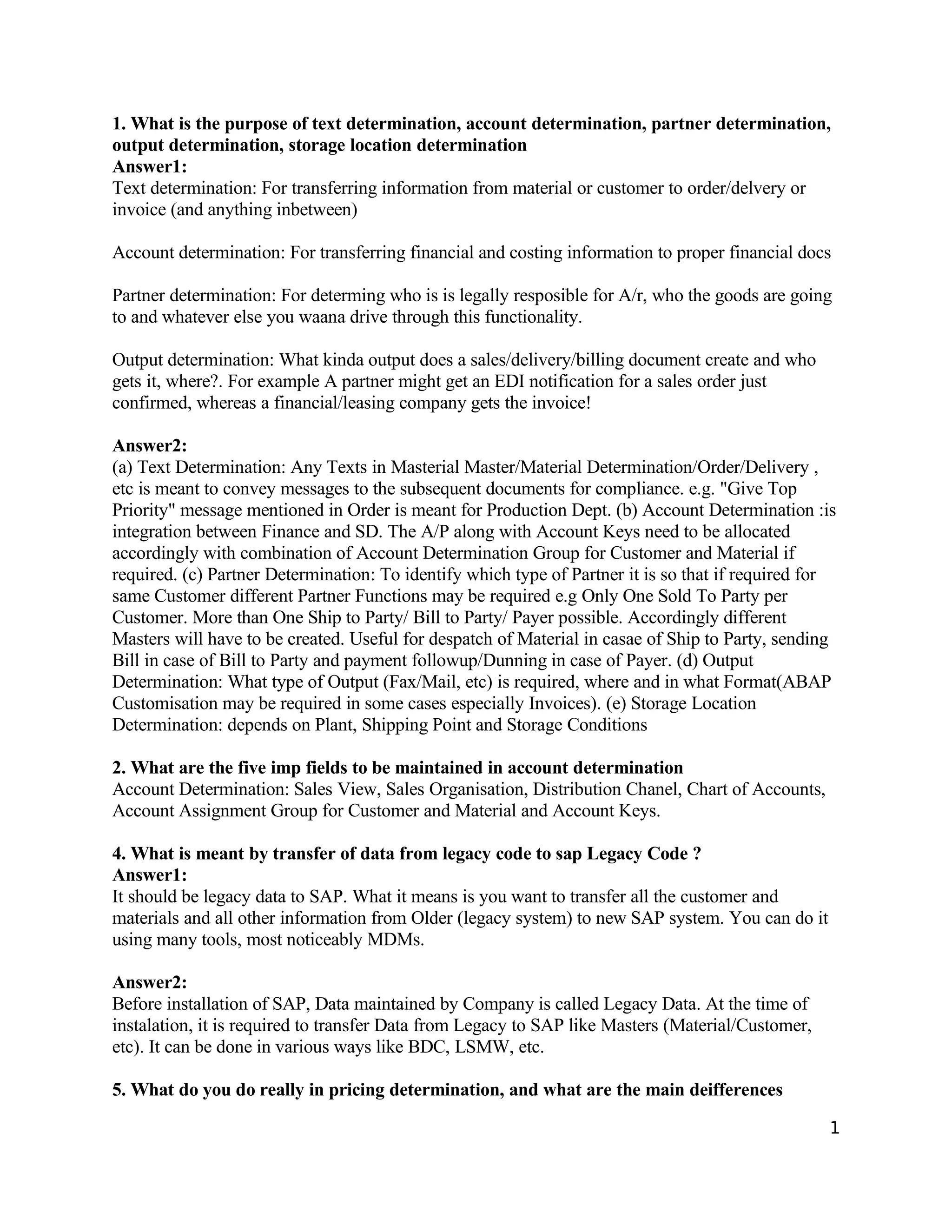


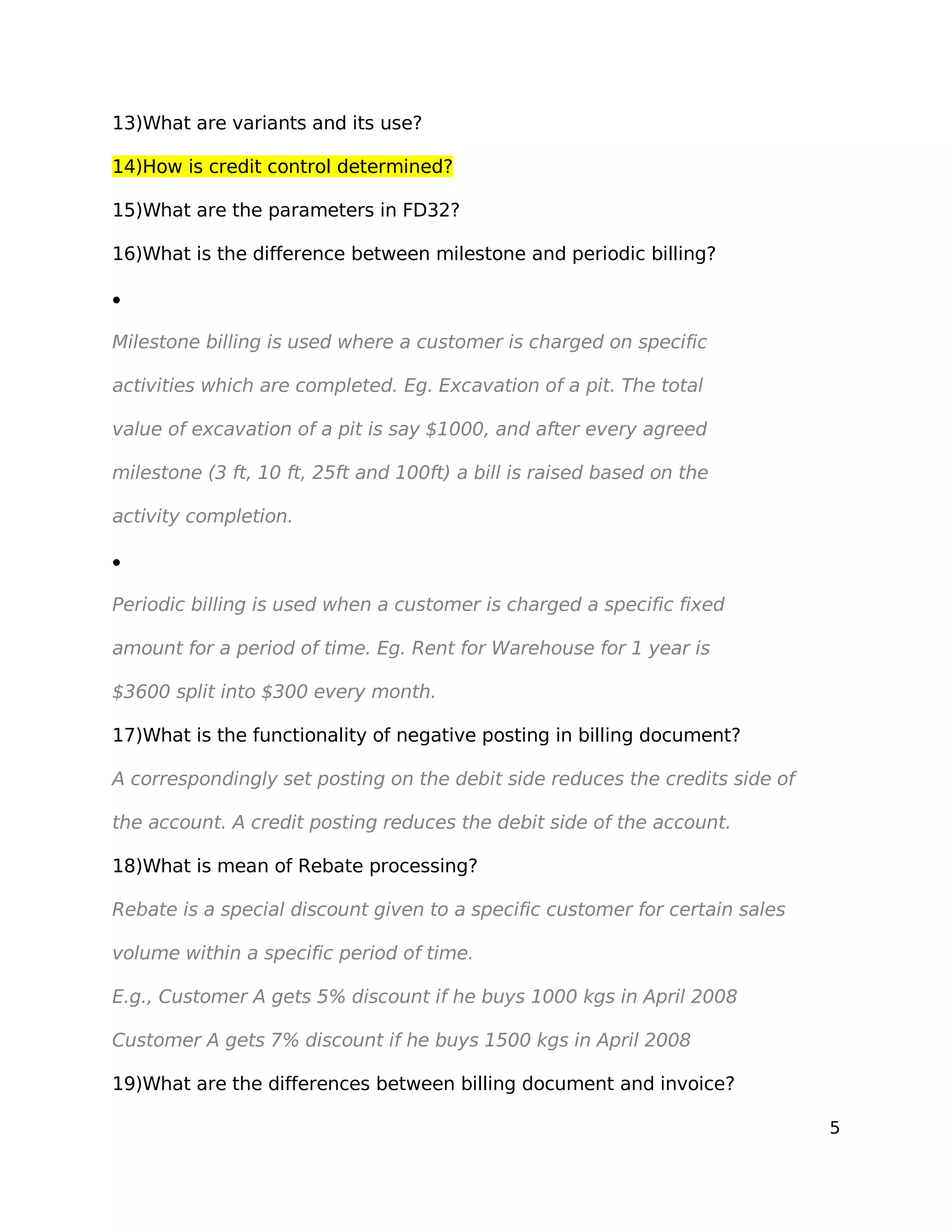
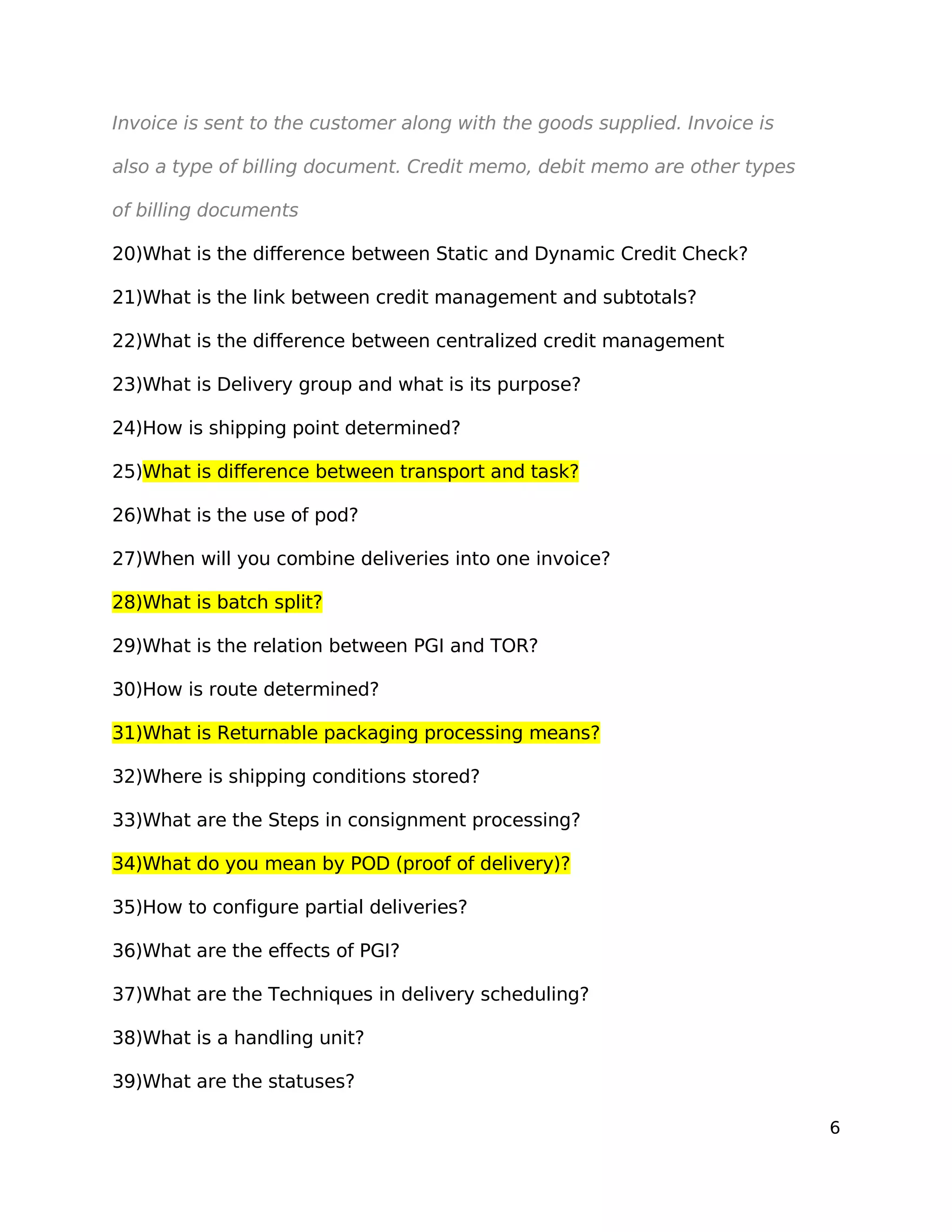

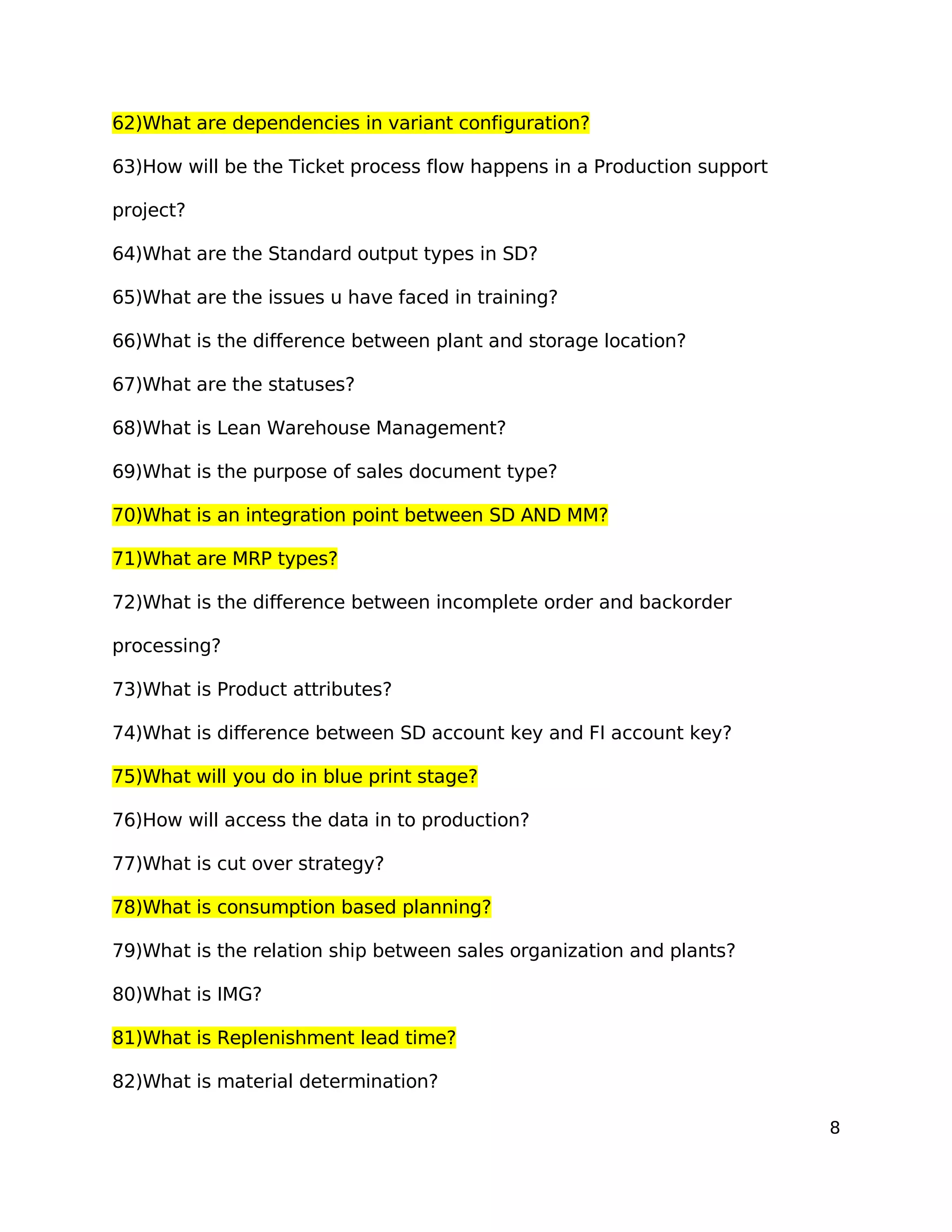
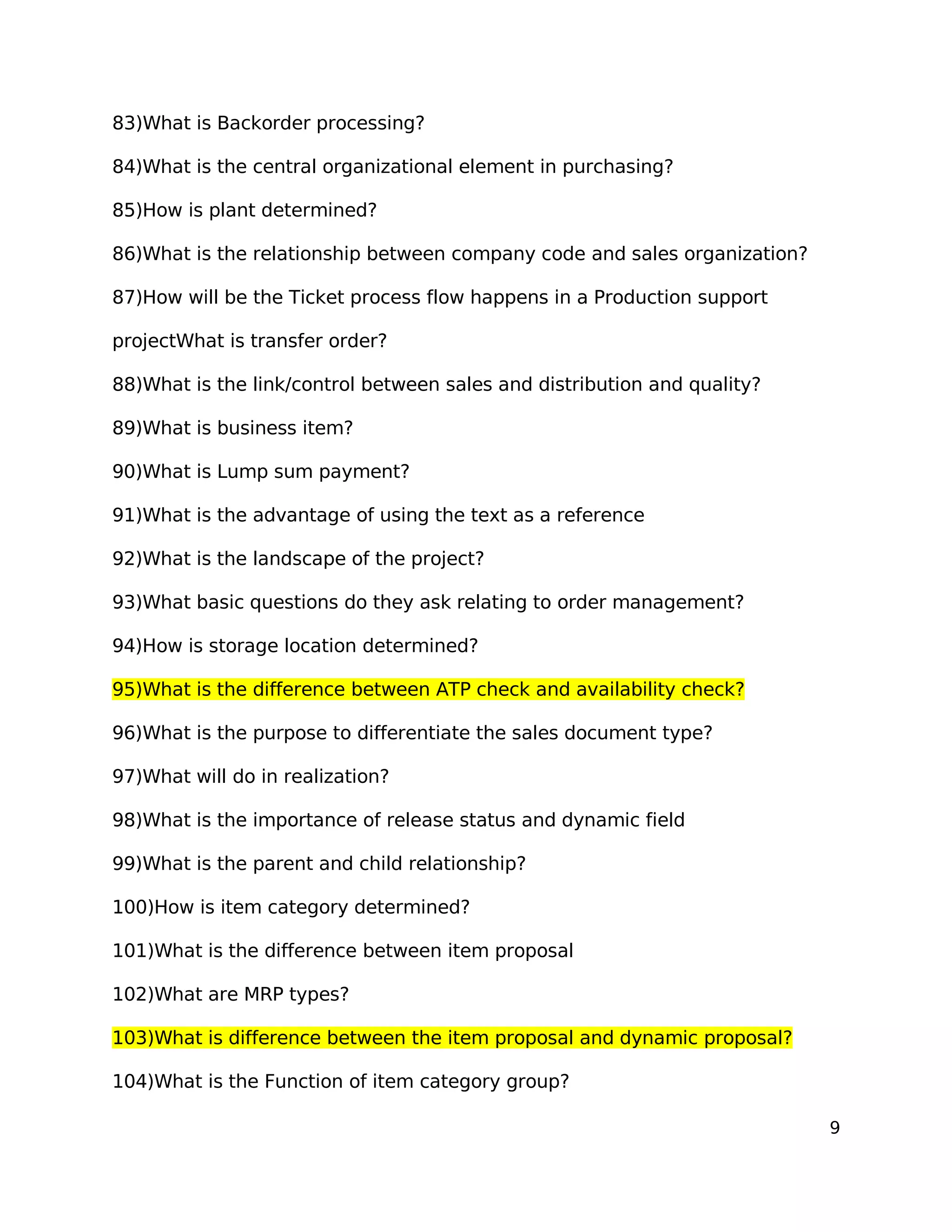
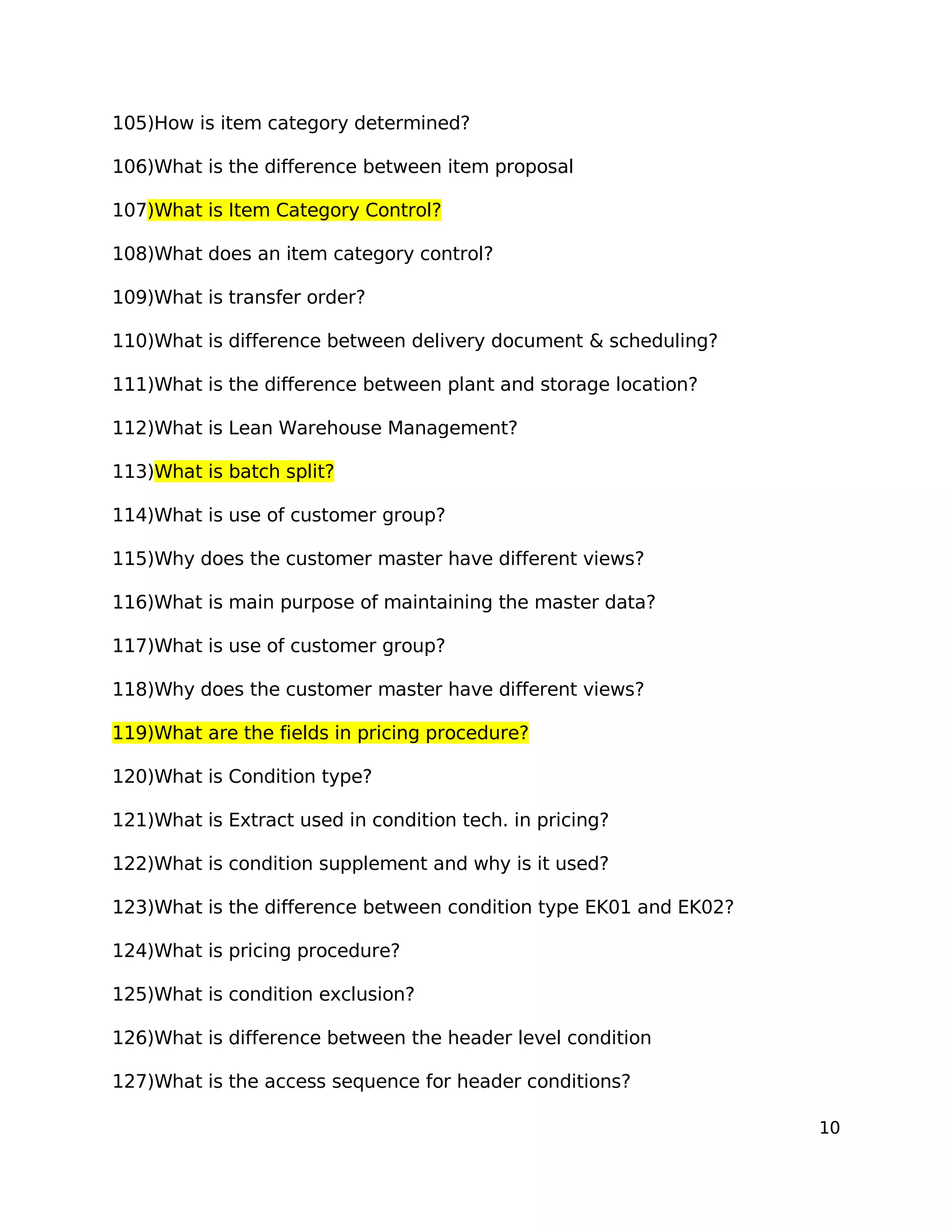
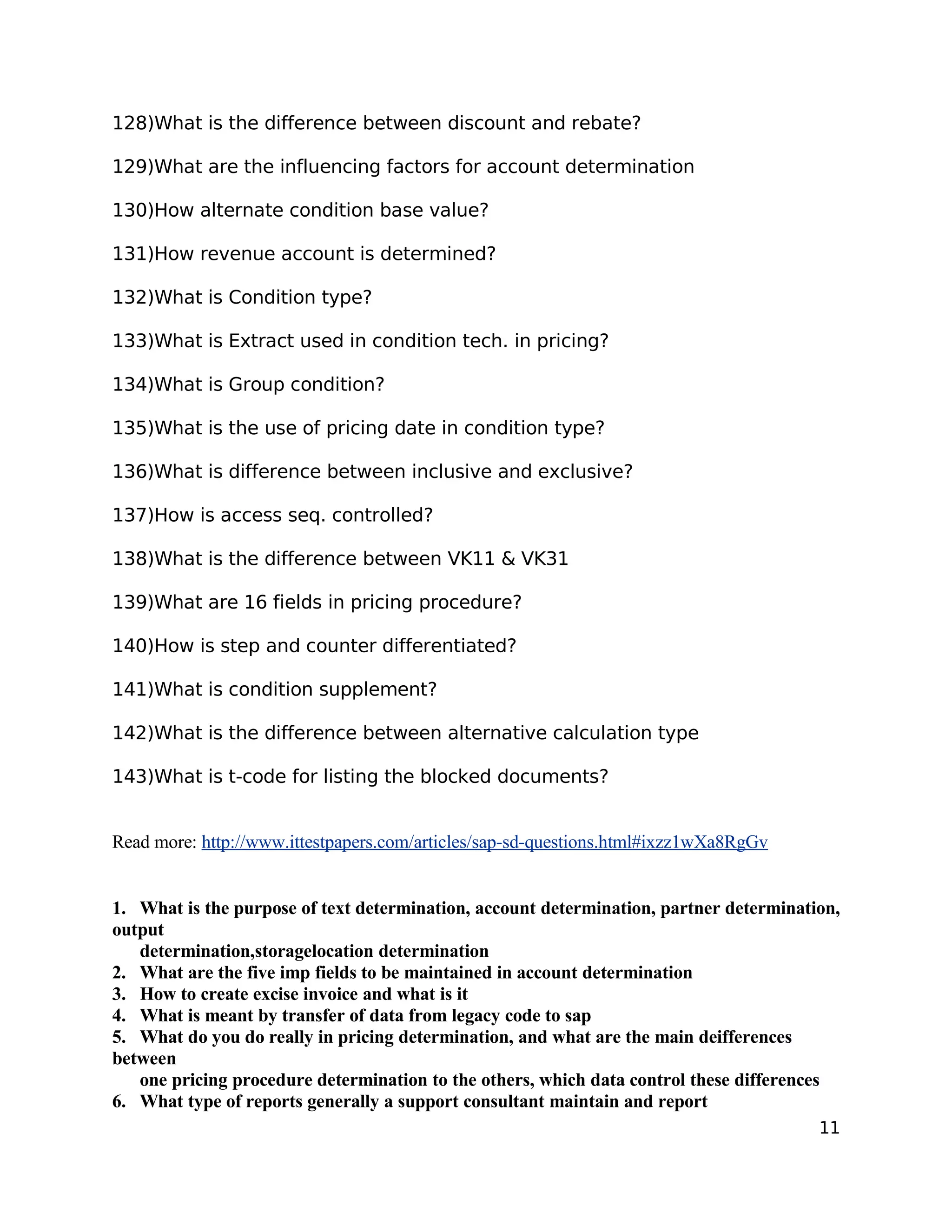
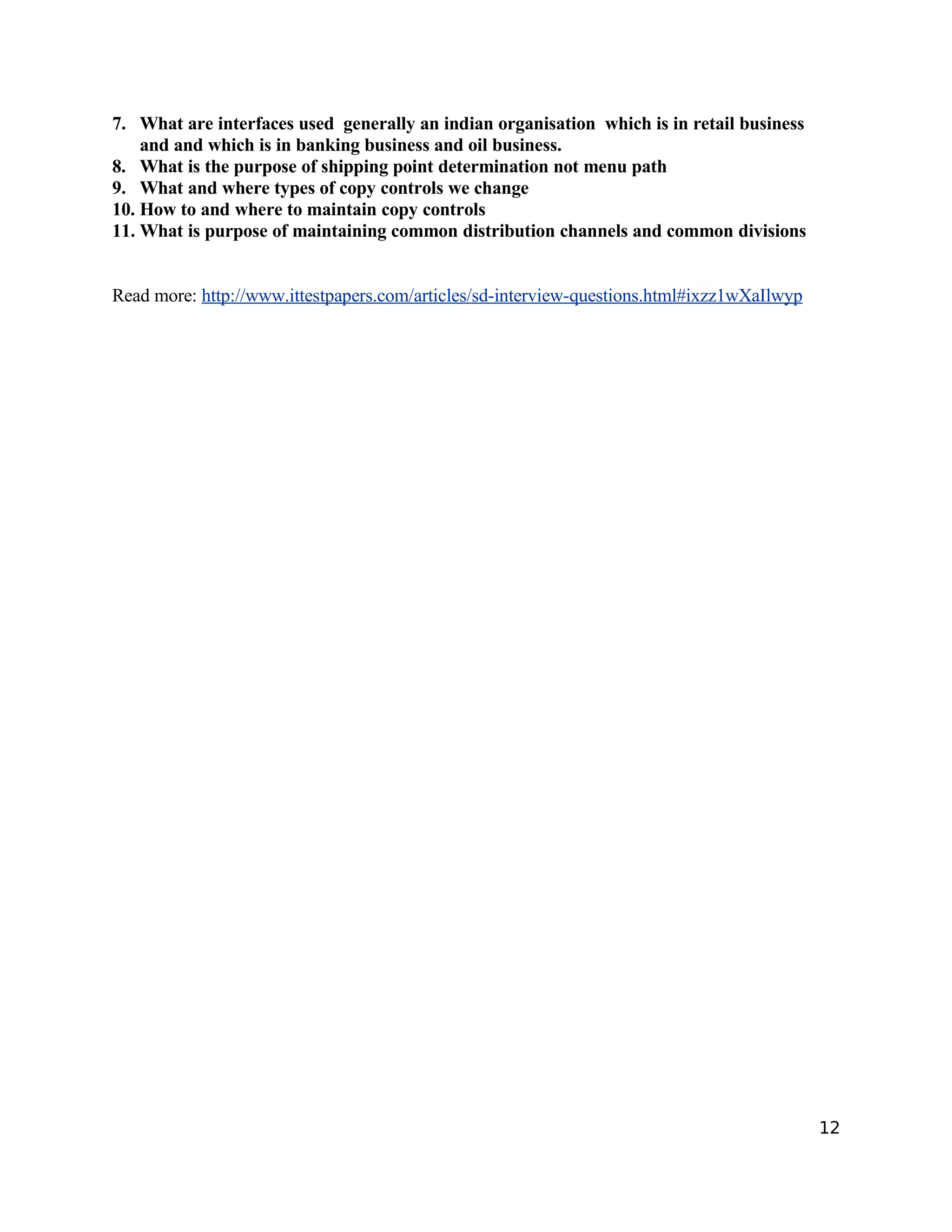
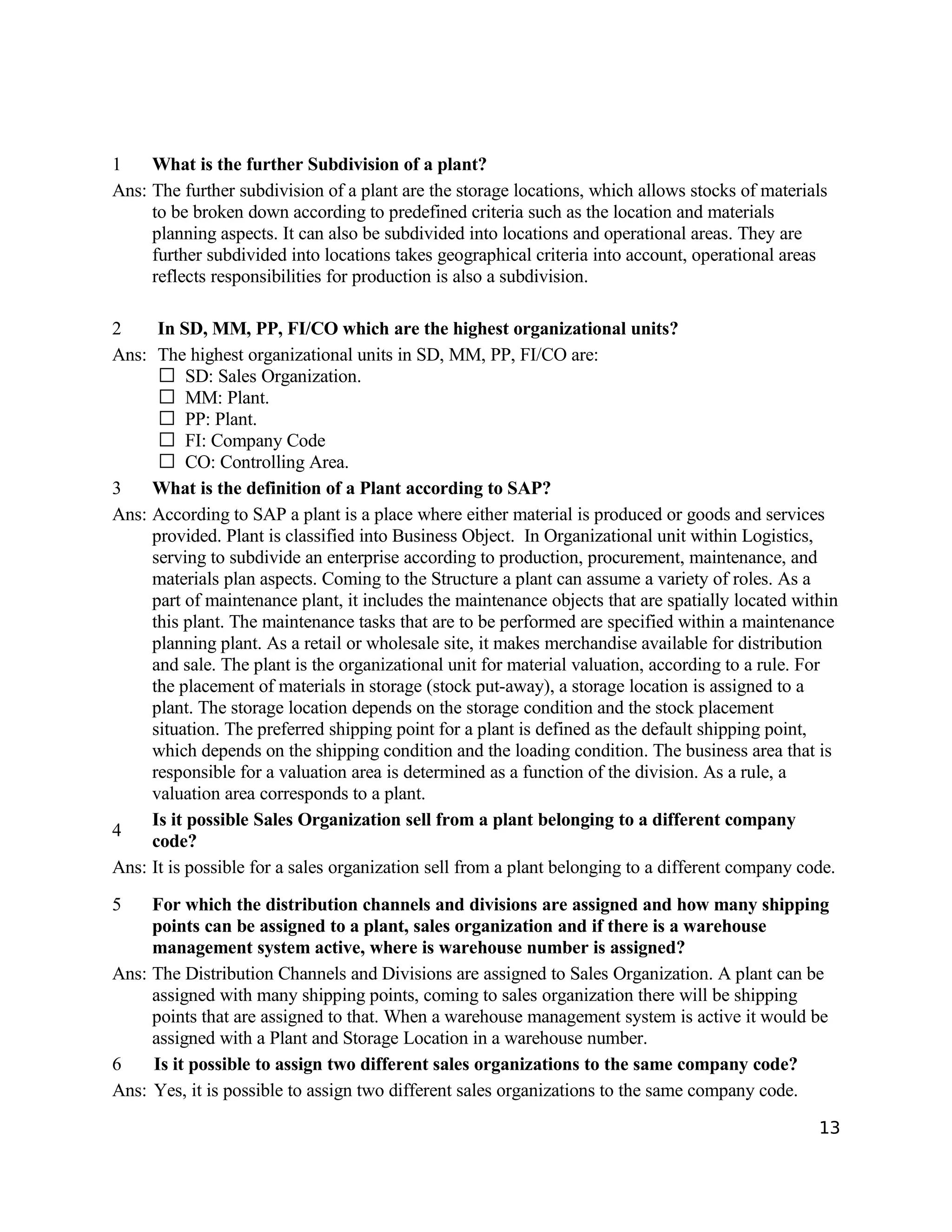
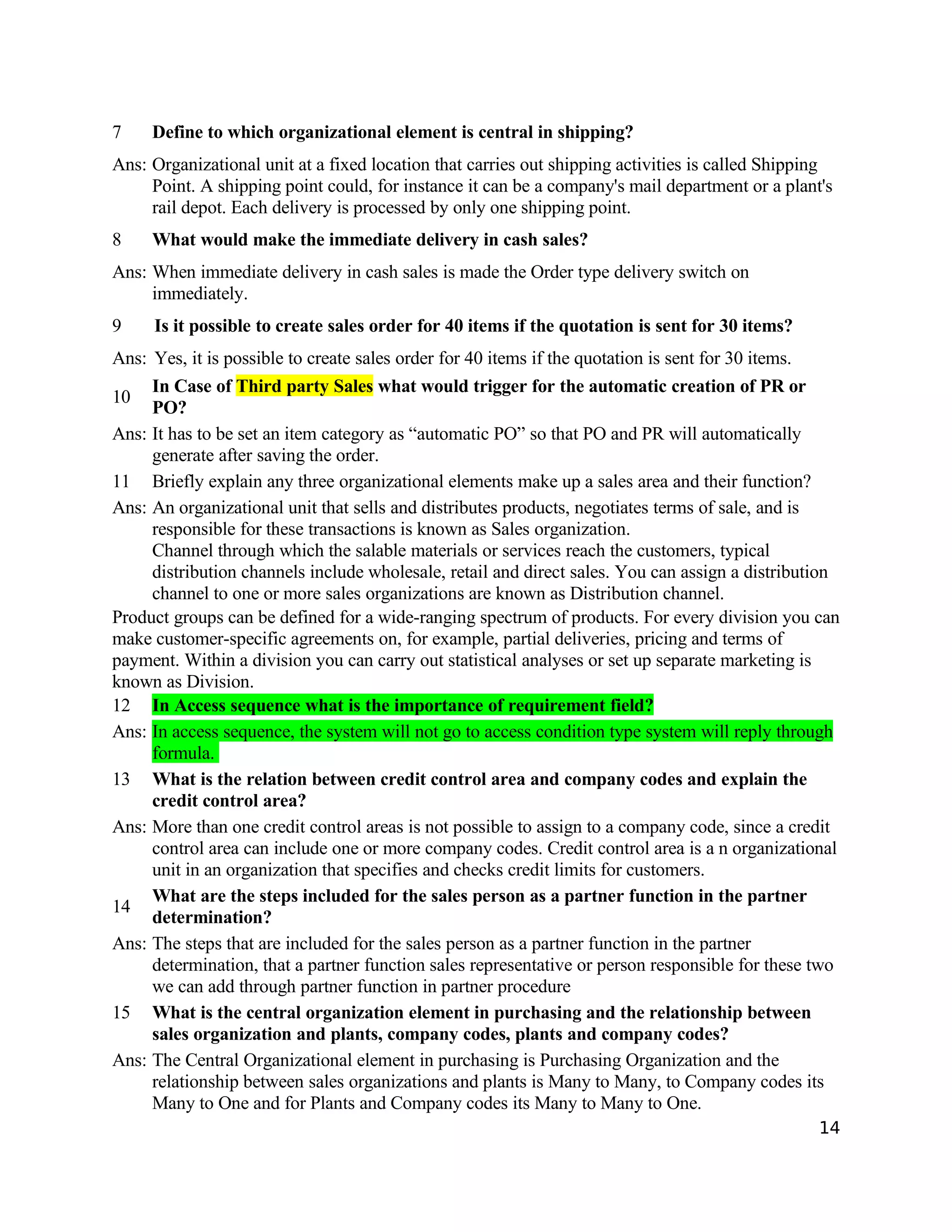
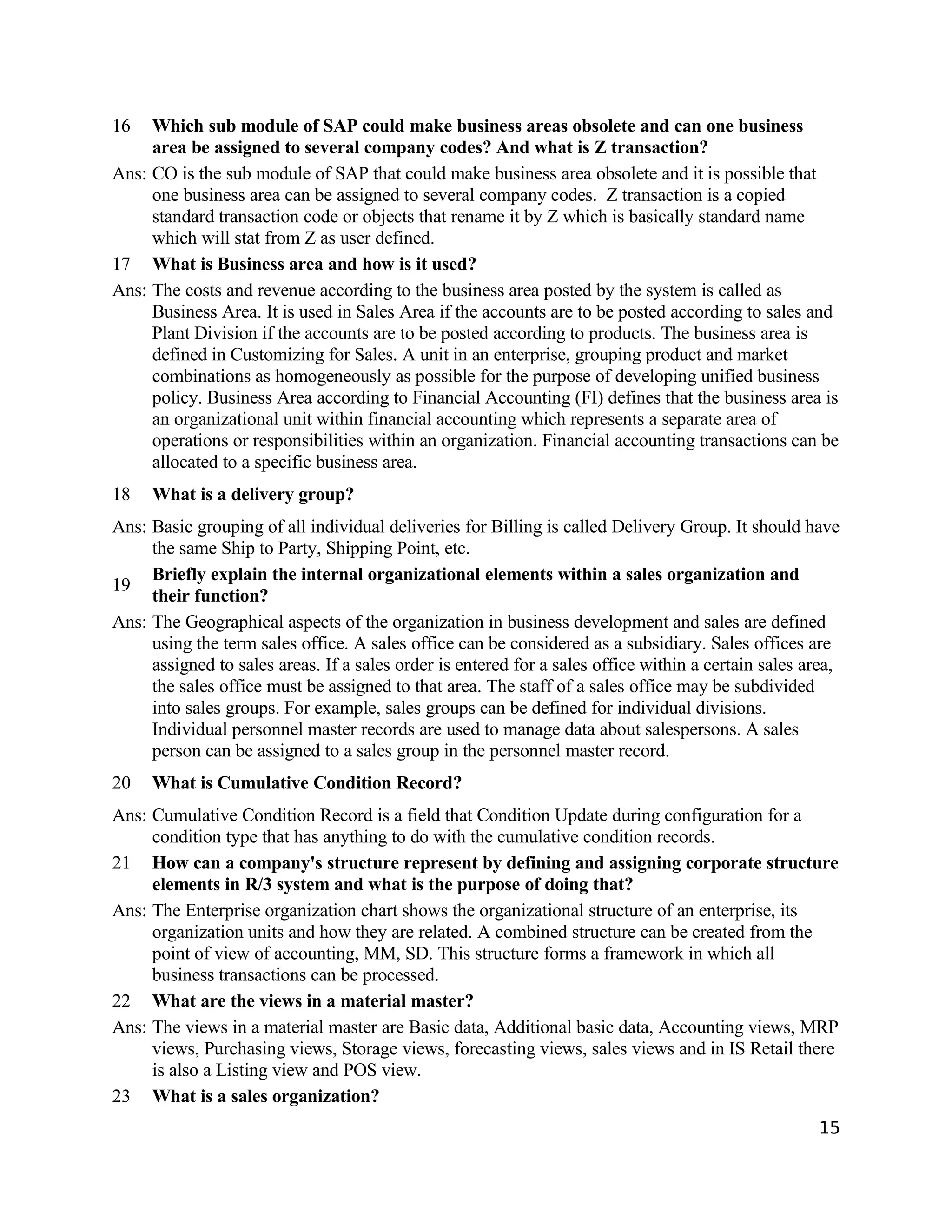
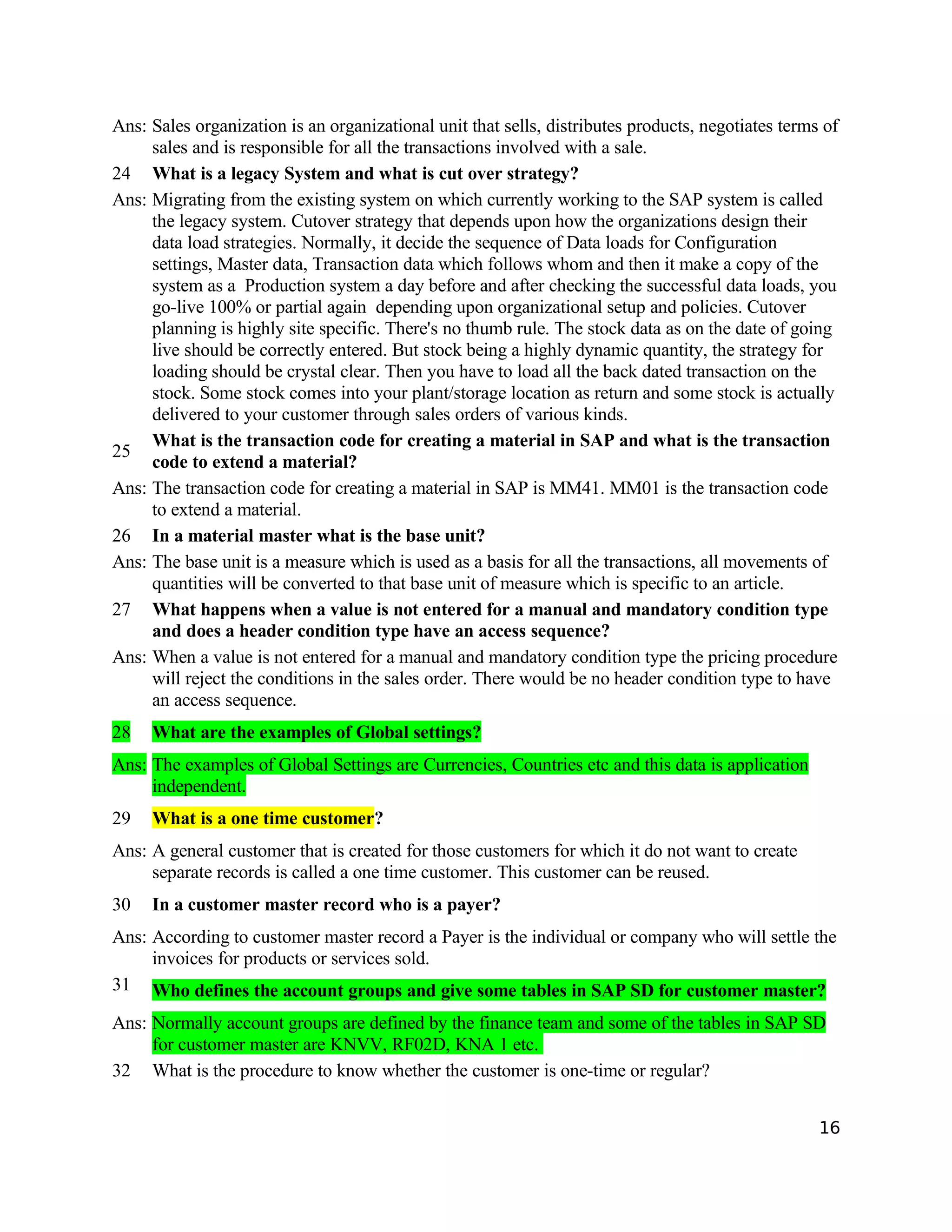

![Can you specify when output should be created? If yes, what possibilities do you have?
Yes. Print out, Mail, EDI, Fax.
What does the material type control ?
The material type determines a material's procurement type. It also controls
- screen sequence
- field selection
- number assignment type in material master maintenance
- inventory management type
o account determination[/quote]
59](https://image.slidesharecdn.com/96836801-sap-sd-interview-questions-130506011116-phpapp01/75/96836801-sap-sd-interview-questions-59-2048.jpg)


