Santoshi Poudel
MPH 2023
BPKIHS, Dharan, Nepal
MOLECULAR EPIDEMIOLOGY
TABLE OF CONTENTS
About the book
Emergence of molecular epidemiology
Goals of Molecular Epidemiology
Why Molecular Epidemiology
Traditional Vs molecular epidemiology
Molecular Vs Genetic Epidemiology
Uses of molecular epidemiology
Study design
Cancer Epidemiology
Molecular Epidemiology Tools
Reference 2
ABOUT THE BOOK
Editors: Chirs Wild (University of Leeds,
UK)
Paolo Vineis ( Imperial college,
London UK)
Seymour Garte (University of
Pittsburgh PA, USA)
Publications: John Wiley and sons, Ltd
Publication year: 2008
Total chapter: 26
3
Book Title: MOLECULAR EPIDEMIOLOGY OF CHRONIC DISEASES
EMERGENCE OF MOLECULAR
EPIDEMIOLOGY
• Epidemiology identifies factors influencing disease risk, aiding prevention strategies.
• Molecular epidemiology, integrating molecular techniques, offers new insights.
• Molecular epidemiologists are searching for genes of individuals that interact with
environment and lifestyle factors such that cancer risk is not equally elevated in all
persons exposed to an environmental factor (but not genetically susceptible), or all gene
carriers (but not exposed to the environmental factor).
• Not all exposed to an environmental factor or gene carriers face equal cancer risk.
4
GOALS OF MOLECULAR EPIDEMIOLOGY
• Better estimation of exposure, including ‘internal’ exposure, through the measurement of end-
points (chemical metabolities and adducts)
Eg: Haemoglobin adducts for acrylamide, DNA adducts for PAHs
• Genetic Susceptibility
-Between exposure and effect there is layer of metabolic reaction including activation
deactivation and DNA repair which affects dose-response relationship
• Reduce disease burden by identification of risk factors
-Eg: Association between Aromatic Amines and Bladder cancer
5
WHY MOLECULAR EPIDEMIOLOGY?
• Increase interest of public health workers, physicians, the press and the public at large on
‘environmental risk’ of disease?
• Traditional epidemiology established casual relationships between:
- tobacco smoking and lung cancer
-chronic hepatitis B virus infection and liver cancer
- Aromatic Amines and bladder cancer
• But not all issues of causality in human disease from environmental exposure are so clear.
• But not in case among these two example:
- casual association between dietary exposure to acrylamide and cancer in humans?
- Polycyclic Aromatic hydrocarbons (PAHs) and lung cancer?
6
WHY MOLECULAR EPIDEMIOLOGY?
• For this reason started at least in 1982 with a paper by Perera and Weinstein but probably
before with a paper by Lower (Vineis 2007),’molecular epidemiology’ was introduced
into ‘cancer research’ .
• This corresponds to one of the first definition of molecular epidemiology.
7
“Advanced laboratory methods are used in combination with analytic epidemiology to
identify at the biochemical or molecular level specific exogenous and/or host factors that
play a role in human cancer causation.”
-Perera and Weinstein 1982
• Molecular epidemiology refers to the use of molecular biology techniques in
epidemiologic research.
• The term was first popularized in the context of infectious diseases, and in the early 1980s
it was applied to chronic disease research.
• Schulte defined the term as “the incorporation of molecular, cellular, and other biologic
measurements into epidemiologic research”.
• With the introduction of genomics, proteomics and meta-bonomics ME started growing
8
ME- CONCEPT
• Molecular epidemiology can be defined as a focus on the contribution of potential genetic
and environmental risk factors (biomarkers), identified at the molecular level, to the
etiology, geographic distribution and prevention of disease within and across populations.
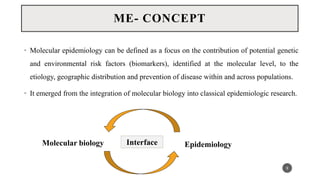
• It emerged from the integration of molecular biology into classical epidemiologic research.
9
ME- CONCEPT
Interface
Molecular biology Epidemiology
TRADITIONAL VS MOLECULAR
EPIDEMIOLOGY?
10
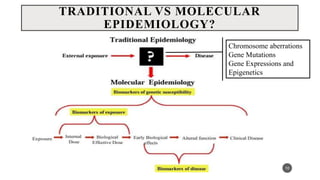
Chromosome aberrations
Gene Mutations
Gene Expressions and
Epigenetics
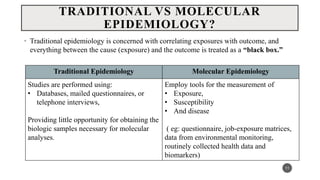
• Traditional epidemiology is concerned with correlating exposures with outcome, and
everything between the cause (exposure) and the outcome is treated as a “black box.”
11
TRADITIONAL VS MOLECULAR
EPIDEMIOLOGY?
Traditional Epidemiology Molecular Epidemiology
Studies are performed using:
• Databases, mailed questionnaires, or
telephone interviews,
Providing little opportunity for obtaining the
biologic samples necessary for molecular
analyses.
Employ tools for the measurement of
• Exposure,
• Susceptibility
• And disease
( eg: questionnaire, job-exposure matrices,
data from environmental monitoring,
routinely collected health data and
biomarkers)
SHIFT FROM INFECTIOUS TO
MOLECULAR EPIDEMIOLOGY
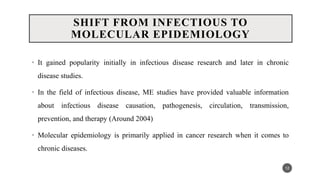
• It gained popularity initially in infectious disease research and later in chronic
disease studies.
• In the field of infectious disease, ME studies have provided valuable information
about infectious disease causation, pathogenesis, circulation, transmission,
prevention, and therapy (Around 2004)
• Molecular epidemiology is primarily applied in cancer research when it comes to
chronic diseases.
12
MOLECULAR EPIDEMIOLOGY
VS
GENETIC EPIDEMIOLOGY
• Molecular and genetic epidemiology represent two separate branches of epidemiology
whose boundaries are overlapping.
• Genetic Epidemiology: Inherited, Clustered in family; identify the unknown genes
that influence risk of malignancies
• Molecular Epidemiology: Finding Biomarkers to link exposure to event, Individual
response, Evaluates the association of variations in
known genes
13
STUDY DESIGN IN MOLECULAR
EPIDEMIOLOGY
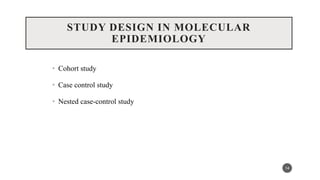
• Cohort study
• Case control study
• Nested case-control study
14
USES OF ME
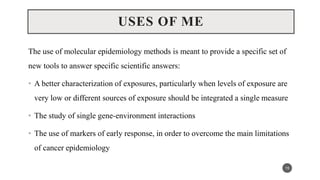
The use of molecular epidemiology methods is meant to provide a specific set of
new tools to answer specific scientific answers:
• A better characterization of exposures, particularly when levels of exposure are
very low or different sources of exposure should be integrated a single measure
• The study of single gene-environment interactions
• The use of markers of early response, in order to overcome the main limitations
of cancer epidemiology
15
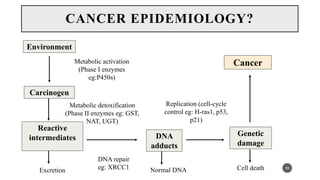
Environment
Carcinogen
DNA
adducts
Reactive
intermediates
Genetic
damage
Cancer
16
CANCER EPIDEMIOLOGY?
Metabolic detoxification
(Phase II enzymes eg: GST,
NAT, UGT)
Metabolic activation
(Phase I enzymes
eg:P450s)
Excretion Normal DNA
DNA repair
eg: XRCC1 Cell death
Replication (cell-cycle
control eg: H-ras1, p53,
p21)
MOLECULAR EPIDEMIOLOGY TOOLS
1. Conventional Methods
• Culture
• Enzyme-linked immunosorbent assay (ELISA)
• Enzyme immunosorbent assay (EIA)
• Antibodies & Monoclonal antibodies based assays, agglutination etc.
2. Nucleic acid based Methods
• DNA hybridization for known genes
• Direct sequencing of one or more regions
• Multilocus sequence typing (MLST)
17
MOLECULAR EPIDEMIOLOGY TOOLS
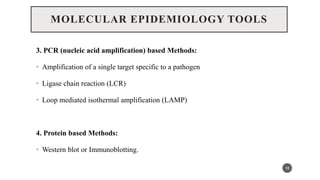
3. PCR (nucleic acid amplification) based Methods:
• Amplification of a single target specific to a pathogen
• Ligase chain reaction (LCR)
• Loop mediated isothermal amplification (LAMP)
4. Protein based Methods:
• Western blot or Immunoblotting.
18
MOLECULAR EPIDEMIOLOGY TOOLS
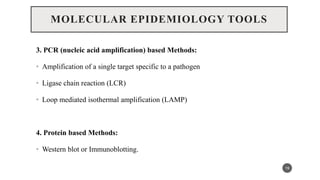
3. PCR (nucleic acid amplification) based Methods:
• Amplification of a single target specific to a pathogen
• Ligase chain reaction (LCR)
• Loop mediated isothermal amplification (LAMP)
4. Protein based Methods:
• Western blot or Immunoblotting.
19
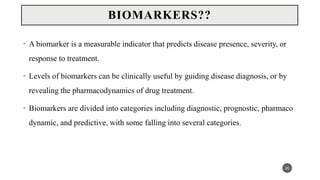
• A biomarker is a measurable indicator that predicts disease presence, severity, or
response to treatment.
• Levels of biomarkers can be clinically useful by guiding disease diagnosis, or by
revealing the pharmacodynamics of drug treatment.
• Biomarkers are divided into categories including diagnostic, prognostic, pharmaco
dynamic, and predictive, with some falling into several categories.
20
BIOMARKERS??
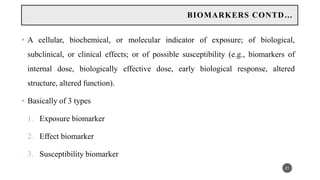
• A cellular, biochemical, or molecular indicator of exposure; of biological,
subclinical, or clinical effects; or of possible susceptibility (e.g., biomarkers of
internal dose, biologically effective dose, early biological response, altered
structure, altered function).
• Basically of 3 types
1. Exposure biomarker
2. Effect biomarker
3. Susceptibility biomarker
21
BIOMARKERS CONTD…
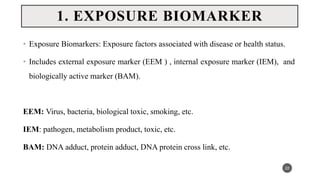
• Exposure Biomarkers: Exposure factors associated with disease or health status.
• Includes external exposure marker (EEM ) , internal exposure marker (IEM), and
biologically active marker (BAM).
EEM: Virus, bacteria, biological toxic, smoking, etc.
IEM: pathogen, metabolism product, toxic, etc.
BAM: DNA adduct, protein adduct, DNA protein cross link, etc.
22
1. EXPOSURE BIOMARKER
• Biological markers that produce functional or structural changes in the host
after exposure, and further cause disease sub clinical stages and disease processes.
Example includes:
Alpha fetoprotein (AFP)
Carcinoembryonic antigen (CEA)
Prostate specific antigen (PSA)
Serum aspartate aminotransferase (AST)
23
2. EFFECT BIOMARKER
• Biomarkers of susceptibility to disease occurrence and development Example
includes:
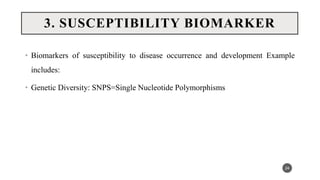
• Genetic Diversity: SNPS=Single Nucleotide Polymorphisms
24
3. SUSCEPTIBILITY BIOMARKER
25
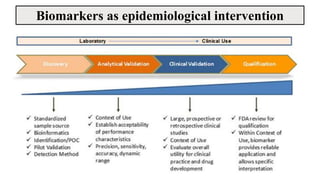
Biomarkers as epidemiological intervention
REFERENCES
1.Molecular epidemiology of chronic disease. Chris wild, Paolo Vineis, Seymour
Garte. 2008
2.https://acsjournals.onlinelibrary.wiley.com/doi/full/10.3322/canjclin.55.1.45
3.Molecular epidemiology of cancer
4.Toward an Integrated Approach to Molecular Epidemiology. American
Journal of Epidemiology, Volume 146, Issue 11, 1 December 1997, Pages 912–
918
5.https://www.ncbi.nlm.nih.gov/pmc/articles/PMC6880254/pdf/f1000research-8-
21700.pdf
26
27

Introduction Molecular Epidemiology .pptx

  • 1.
    Santoshi Poudel MPH 2023 BPKIHS,Dharan, Nepal MOLECULAR EPIDEMIOLOGY
  • 2.
    TABLE OF CONTENTS Aboutthe book Emergence of molecular epidemiology Goals of Molecular Epidemiology Why Molecular Epidemiology Traditional Vs molecular epidemiology Molecular Vs Genetic Epidemiology Uses of molecular epidemiology Study design Cancer Epidemiology Molecular Epidemiology Tools Reference 2
  • 3.
    ABOUT THE BOOK Editors:Chirs Wild (University of Leeds, UK) Paolo Vineis ( Imperial college, London UK) Seymour Garte (University of Pittsburgh PA, USA) Publications: John Wiley and sons, Ltd Publication year: 2008 Total chapter: 26 3 Book Title: MOLECULAR EPIDEMIOLOGY OF CHRONIC DISEASES
  • 4.
    EMERGENCE OF MOLECULAR EPIDEMIOLOGY •Epidemiology identifies factors influencing disease risk, aiding prevention strategies. • Molecular epidemiology, integrating molecular techniques, offers new insights. • Molecular epidemiologists are searching for genes of individuals that interact with environment and lifestyle factors such that cancer risk is not equally elevated in all persons exposed to an environmental factor (but not genetically susceptible), or all gene carriers (but not exposed to the environmental factor). • Not all exposed to an environmental factor or gene carriers face equal cancer risk. 4

  • 5.
    GOALS OF MOLECULAREPIDEMIOLOGY • Better estimation of exposure, including ‘internal’ exposure, through the measurement of end- points (chemical metabolities and adducts) Eg: Haemoglobin adducts for acrylamide, DNA adducts for PAHs • Genetic Susceptibility -Between exposure and effect there is layer of metabolic reaction including activation deactivation and DNA repair which affects dose-response relationship • Reduce disease burden by identification of risk factors -Eg: Association between Aromatic Amines and Bladder cancer 5
  • 6.
    WHY MOLECULAR EPIDEMIOLOGY? •Increase interest of public health workers, physicians, the press and the public at large on ‘environmental risk’ of disease? • Traditional epidemiology established casual relationships between: - tobacco smoking and lung cancer -chronic hepatitis B virus infection and liver cancer - Aromatic Amines and bladder cancer • But not all issues of causality in human disease from environmental exposure are so clear. • But not in case among these two example: - casual association between dietary exposure to acrylamide and cancer in humans? - Polycyclic Aromatic hydrocarbons (PAHs) and lung cancer? 6
  • 7.
    WHY MOLECULAR EPIDEMIOLOGY? •For this reason started at least in 1982 with a paper by Perera and Weinstein but probably before with a paper by Lower (Vineis 2007),’molecular epidemiology’ was introduced into ‘cancer research’ . • This corresponds to one of the first definition of molecular epidemiology. 7 “Advanced laboratory methods are used in combination with analytic epidemiology to identify at the biochemical or molecular level specific exogenous and/or host factors that play a role in human cancer causation.” -Perera and Weinstein 1982
  • 8.
    • Molecular epidemiologyrefers to the use of molecular biology techniques in epidemiologic research. • The term was first popularized in the context of infectious diseases, and in the early 1980s it was applied to chronic disease research. • Schulte defined the term as “the incorporation of molecular, cellular, and other biologic measurements into epidemiologic research”. • With the introduction of genomics, proteomics and meta-bonomics ME started growing 8 ME- CONCEPT
  • 9.
    • Molecular epidemiologycan be defined as a focus on the contribution of potential genetic and environmental risk factors (biomarkers), identified at the molecular level, to the etiology, geographic distribution and prevention of disease within and across populations. • It emerged from the integration of molecular biology into classical epidemiologic research. 9 ME- CONCEPT Interface Molecular biology Epidemiology
  • 10.
    TRADITIONAL VS MOLECULAR EPIDEMIOLOGY? 10 Chromosomeaberrations Gene Mutations Gene Expressions and Epigenetics
  • 11.
    • Traditional epidemiologyis concerned with correlating exposures with outcome, and everything between the cause (exposure) and the outcome is treated as a “black box.” 11 TRADITIONAL VS MOLECULAR EPIDEMIOLOGY? Traditional Epidemiology Molecular Epidemiology Studies are performed using: • Databases, mailed questionnaires, or telephone interviews, Providing little opportunity for obtaining the biologic samples necessary for molecular analyses. Employ tools for the measurement of • Exposure, • Susceptibility • And disease ( eg: questionnaire, job-exposure matrices, data from environmental monitoring, routinely collected health data and biomarkers)
  • 12.
    SHIFT FROM INFECTIOUSTO MOLECULAR EPIDEMIOLOGY • It gained popularity initially in infectious disease research and later in chronic disease studies. • In the field of infectious disease, ME studies have provided valuable information about infectious disease causation, pathogenesis, circulation, transmission, prevention, and therapy (Around 2004) • Molecular epidemiology is primarily applied in cancer research when it comes to chronic diseases. 12
  • 13.
    MOLECULAR EPIDEMIOLOGY VS GENETIC EPIDEMIOLOGY •Molecular and genetic epidemiology represent two separate branches of epidemiology whose boundaries are overlapping. • Genetic Epidemiology: Inherited, Clustered in family; identify the unknown genes that influence risk of malignancies • Molecular Epidemiology: Finding Biomarkers to link exposure to event, Individual response, Evaluates the association of variations in known genes 13
  • 14.
    STUDY DESIGN INMOLECULAR EPIDEMIOLOGY • Cohort study • Case control study • Nested case-control study 14
  • 15.
    USES OF ME Theuse of molecular epidemiology methods is meant to provide a specific set of new tools to answer specific scientific answers: • A better characterization of exposures, particularly when levels of exposure are very low or different sources of exposure should be integrated a single measure • The study of single gene-environment interactions • The use of markers of early response, in order to overcome the main limitations of cancer epidemiology 15
  • 16.
    Environment Carcinogen DNA adducts Reactive intermediates Genetic damage Cancer 16 CANCER EPIDEMIOLOGY? Metabolic detoxification (PhaseII enzymes eg: GST, NAT, UGT) Metabolic activation (Phase I enzymes eg:P450s) Excretion Normal DNA DNA repair eg: XRCC1 Cell death Replication (cell-cycle control eg: H-ras1, p53, p21)
  • 17.
    MOLECULAR EPIDEMIOLOGY TOOLS 1.Conventional Methods • Culture • Enzyme-linked immunosorbent assay (ELISA) • Enzyme immunosorbent assay (EIA) • Antibodies & Monoclonal antibodies based assays, agglutination etc. 2. Nucleic acid based Methods • DNA hybridization for known genes • Direct sequencing of one or more regions • Multilocus sequence typing (MLST) 17
  • 18.
    MOLECULAR EPIDEMIOLOGY TOOLS 3.PCR (nucleic acid amplification) based Methods: • Amplification of a single target specific to a pathogen • Ligase chain reaction (LCR) • Loop mediated isothermal amplification (LAMP) 4. Protein based Methods: • Western blot or Immunoblotting. 18
  • 19.
    MOLECULAR EPIDEMIOLOGY TOOLS 3.PCR (nucleic acid amplification) based Methods: • Amplification of a single target specific to a pathogen • Ligase chain reaction (LCR) • Loop mediated isothermal amplification (LAMP) 4. Protein based Methods: • Western blot or Immunoblotting. 19
  • 20.
    • A biomarkeris a measurable indicator that predicts disease presence, severity, or response to treatment. • Levels of biomarkers can be clinically useful by guiding disease diagnosis, or by revealing the pharmacodynamics of drug treatment. • Biomarkers are divided into categories including diagnostic, prognostic, pharmaco dynamic, and predictive, with some falling into several categories. 20 BIOMARKERS??
  • 21.
    • A cellular,biochemical, or molecular indicator of exposure; of biological, subclinical, or clinical effects; or of possible susceptibility (e.g., biomarkers of internal dose, biologically effective dose, early biological response, altered structure, altered function). • Basically of 3 types 1. Exposure biomarker 2. Effect biomarker 3. Susceptibility biomarker 21 BIOMARKERS CONTD…
  • 22.
    • Exposure Biomarkers:Exposure factors associated with disease or health status. • Includes external exposure marker (EEM ) , internal exposure marker (IEM), and biologically active marker (BAM). EEM: Virus, bacteria, biological toxic, smoking, etc. IEM: pathogen, metabolism product, toxic, etc. BAM: DNA adduct, protein adduct, DNA protein cross link, etc. 22 1. EXPOSURE BIOMARKER
  • 23.
    • Biological markersthat produce functional or structural changes in the host after exposure, and further cause disease sub clinical stages and disease processes. Example includes: Alpha fetoprotein (AFP) Carcinoembryonic antigen (CEA) Prostate specific antigen (PSA) Serum aspartate aminotransferase (AST) 23 2. EFFECT BIOMARKER
  • 24.
    • Biomarkers ofsusceptibility to disease occurrence and development Example includes: • Genetic Diversity: SNPS=Single Nucleotide Polymorphisms 24 3. SUSCEPTIBILITY BIOMARKER
  • 25.
  • 26.
    REFERENCES 1.Molecular epidemiology ofchronic disease. Chris wild, Paolo Vineis, Seymour Garte. 2008 2.https://acsjournals.onlinelibrary.wiley.com/doi/full/10.3322/canjclin.55.1.45 3.Molecular epidemiology of cancer 4.Toward an Integrated Approach to Molecular Epidemiology. American Journal of Epidemiology, Volume 146, Issue 11, 1 December 1997, Pages 912– 918 5.https://www.ncbi.nlm.nih.gov/pmc/articles/PMC6880254/pdf/f1000research-8- 21700.pdf 26
  • 27.

Editor's Notes

  • #14 Chronic disease epidemiology