DA010 - Professional Diploma in Public Relations - COMM6005EP


            Public Relations Presentation and
             Communication Skills (2011/10)

                        Lecture 5
                   Communication Planning


Developed and Presented by
Roy Ying, Msc., B.Comm.
Note: Pictures used in this power point file
is for academic Purpose only
Table of Content
• Planning communications under a 6-stop
  models
• Practice non-verbals
• Choosing your words:
  – 10 rules in effective language
Communications Planning
• Every piece of communication tool a PR
  practitioner produces should be done in
  conveying a message, including news
  release, speech, video, event, survey,
  award….even down to the souvenir

   Class discussion:
   Class discussion:
      How do you decide
       How do you decide
      what message to
       what message to
      convey? Who gives
       convey? Who gives
      you the instruction?
       you the instruction?
Step 1 - Identify your objectives
• Ask yourself the following types of
  questions:
  – What do I want to achieve?
  – What do I want the receiver to be able to do
    or think as a result of my communication?
  – In what ways am I trying to influence them?
Step 2 - Identify the recipients
• Who needs to know what you are
  communicating?
  – Who absolutely must be informed?
  – Who also needs to know?
  – Whom it would be courteous to keep informed?
  – Who do you think the message will be
    forwarded to?
Step 3 - Choose the method or
    channel of communication
• The method or channel must be suitable for the
  purpose. Face to face, telephone, report or
  email are the main considerations.
• If the wrong approach is taken then
  communication can be misunderstood or
  breakdown completely.
• Choosing an obvious channel or method may
  not be straightforward and may need
  consideration depending upon who you are
  communicating to eg. customers, senior
  management, colleagues.
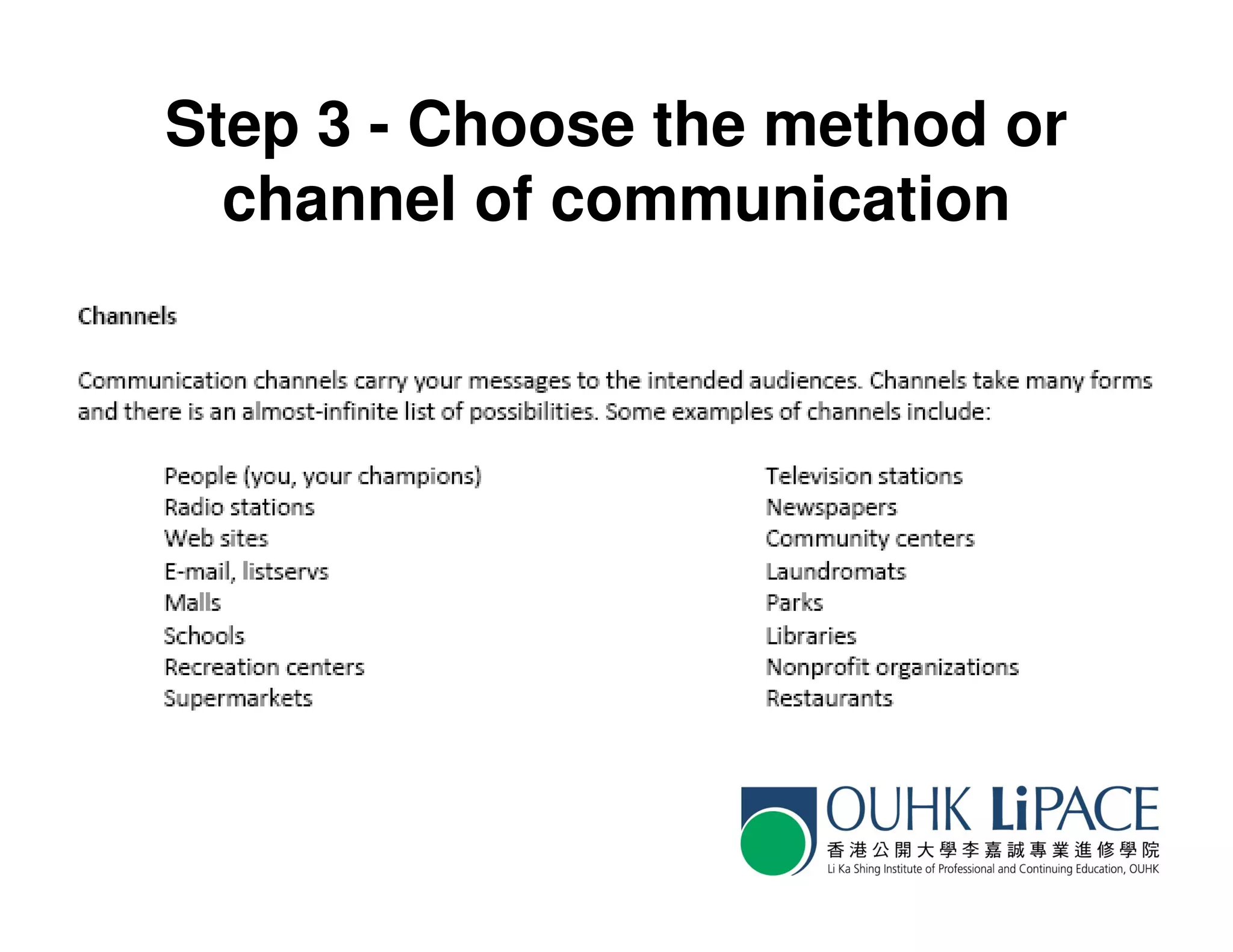
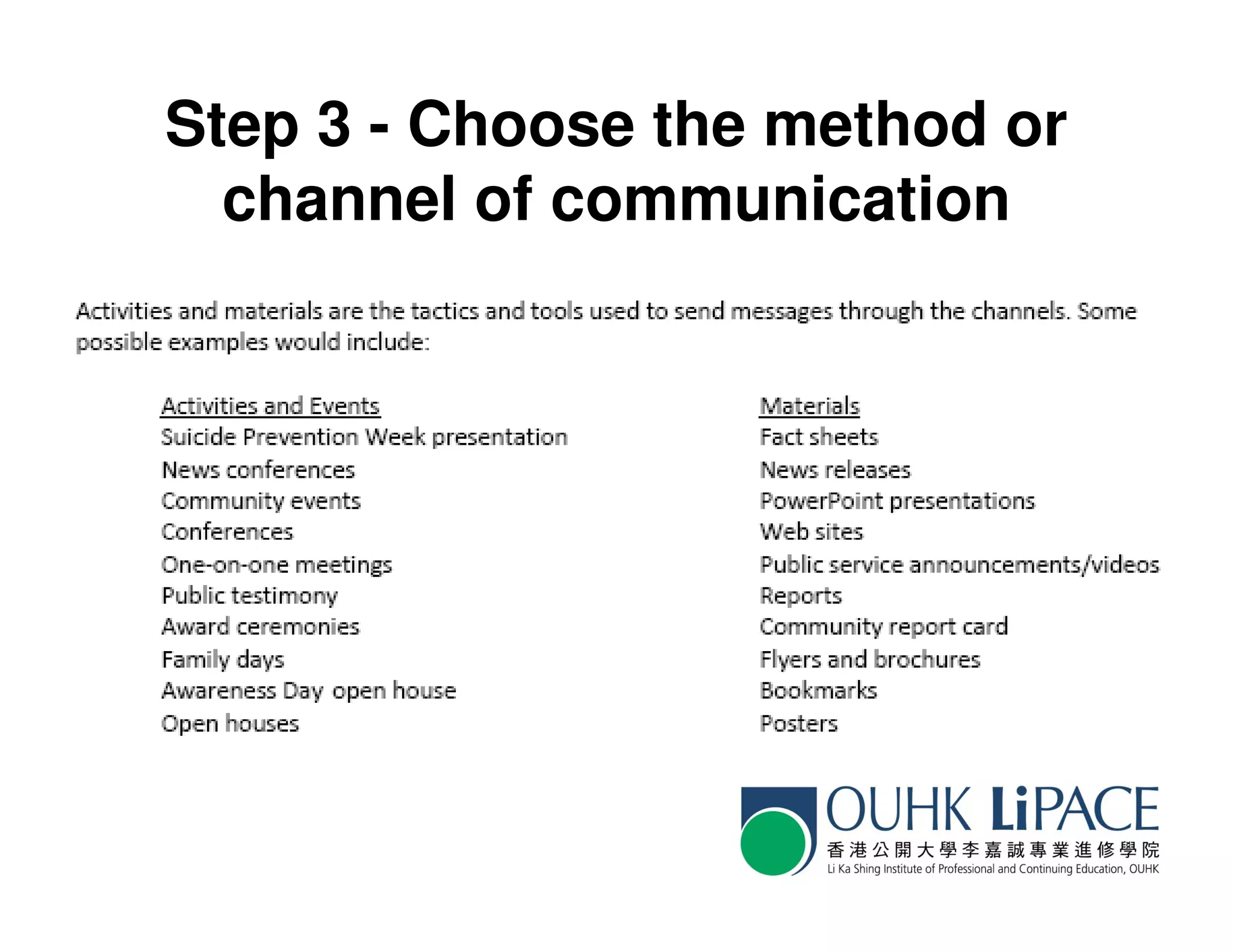
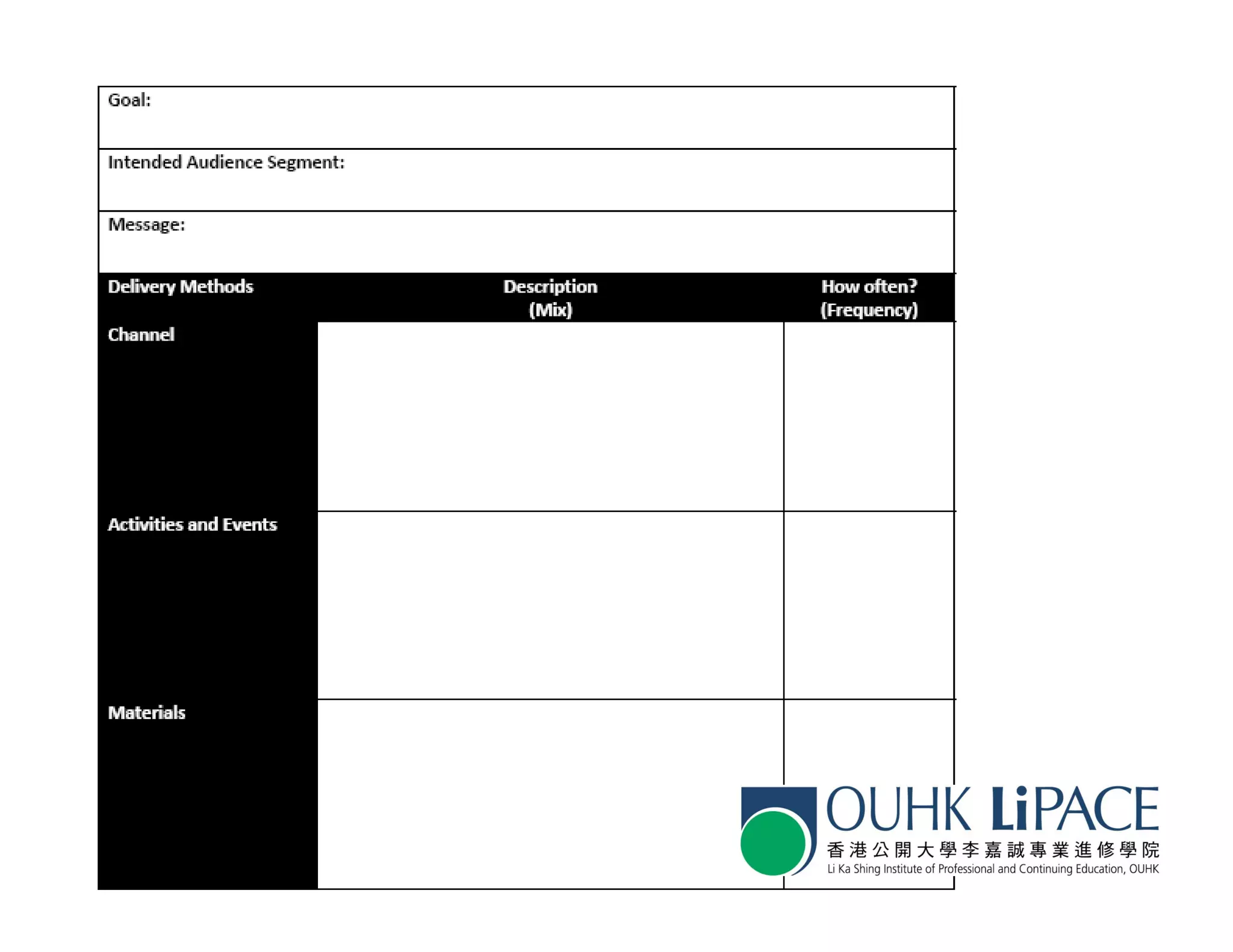
Step 3 - Choose the method or
  channel of communication
Step 3 - Choose the method or
  channel of communication
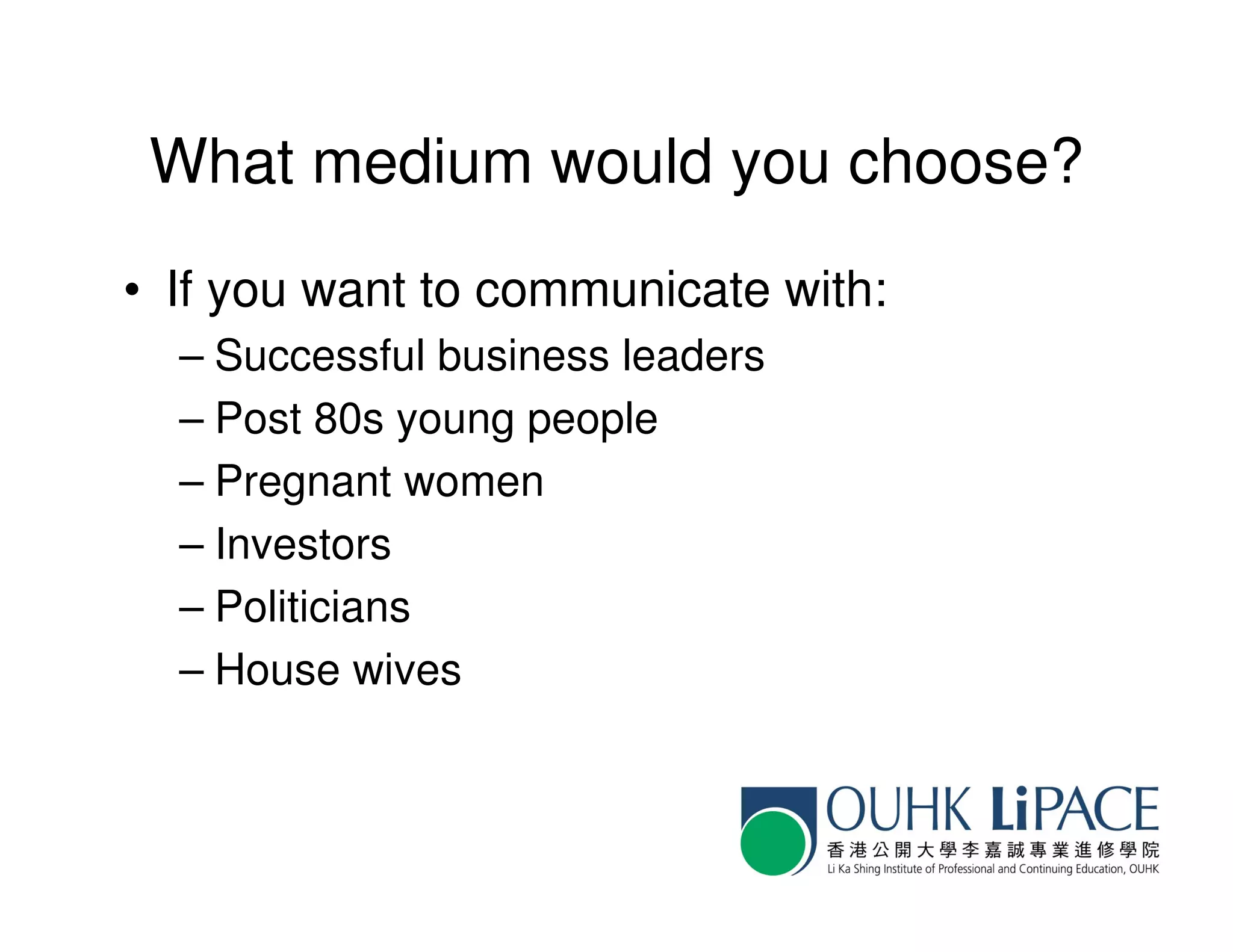
What medium would you choose?
• If you want to communicate with:
  – Successful business leaders
  – Post 80s young people
  – Pregnant women
  – Investors
  – Politicians
  – House wives
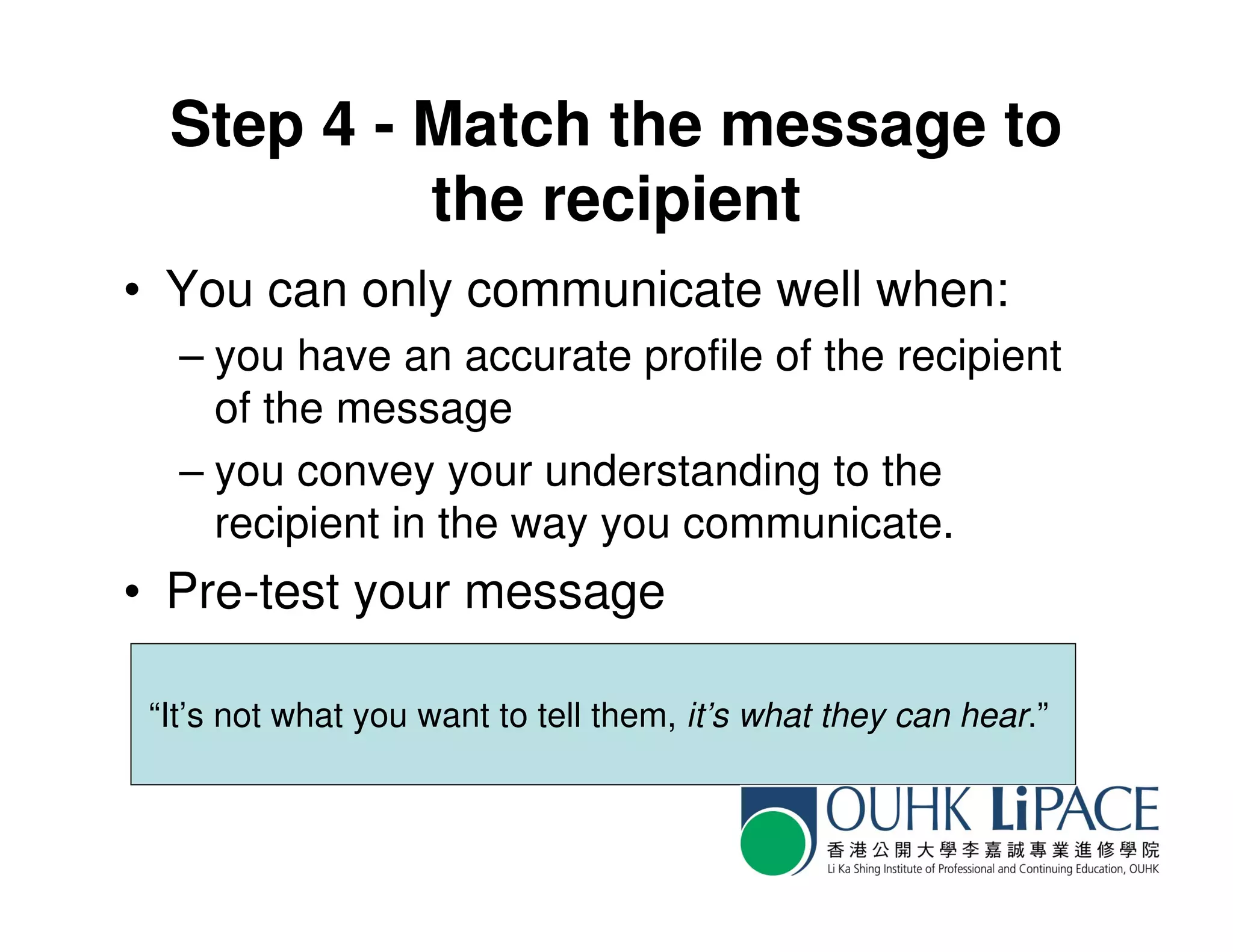
Step 4 - Match the message to
           the recipient
• You can only communicate well when:
   – you have an accurate profile of the recipient
     of the message
   – you convey your understanding to the
     recipient in the way you communicate.
• Pre-test your message

 “It’s not what you want to tell them, it’s what they can hear.”
Step 5 - Get feedback
• True communication involves a complete loop
  between sender and recipient.
• Before moving forward to develop materials or
  activities, we urge you to pretest your messages
  with your intended audiences to determine if they
  are persuasive.
• How?
  –   Surveys
  –   Focus Group
  –   Brainstorming
  –   Or simply ask few people in
      the target groups
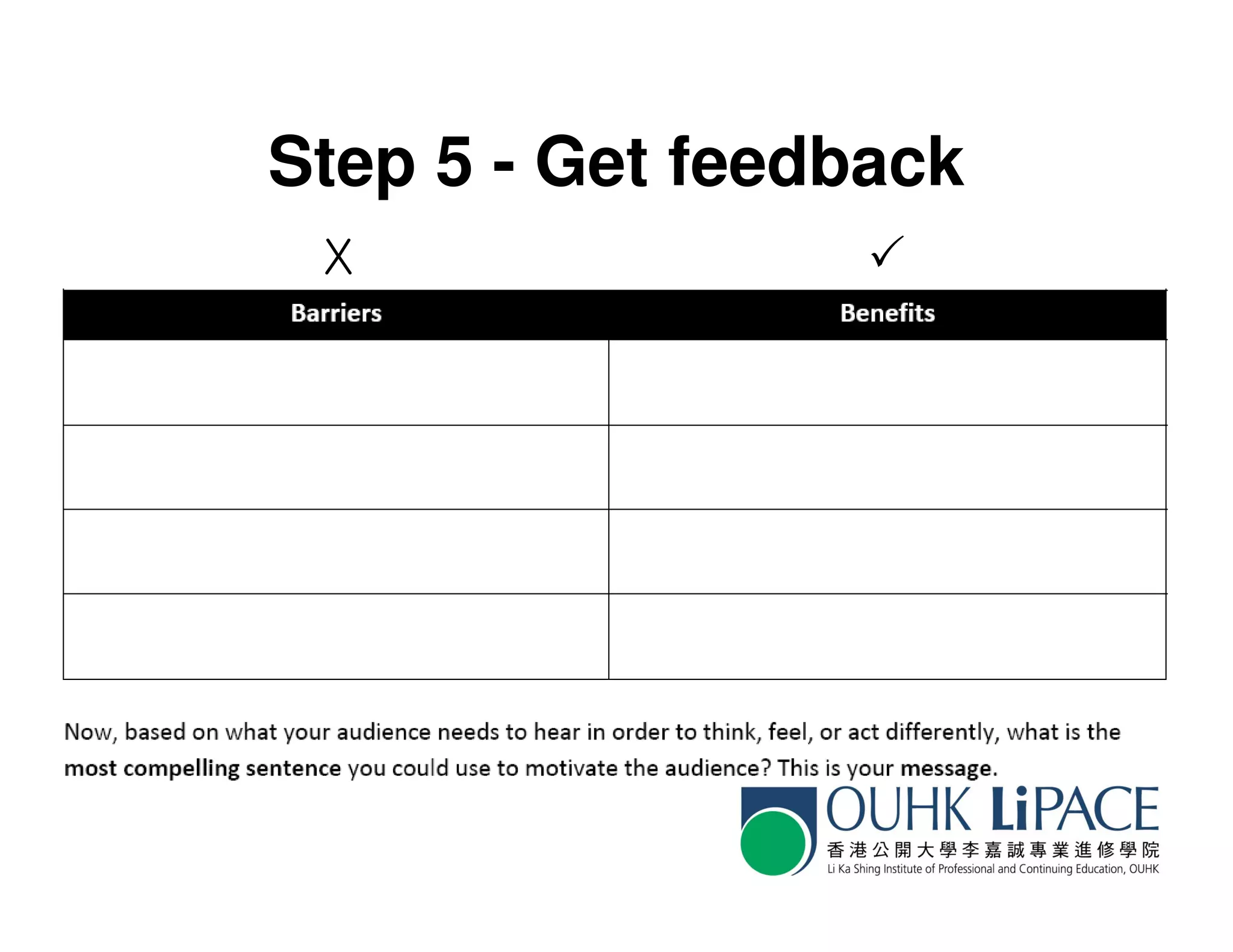
Step 5 - Get feedback
 Χ
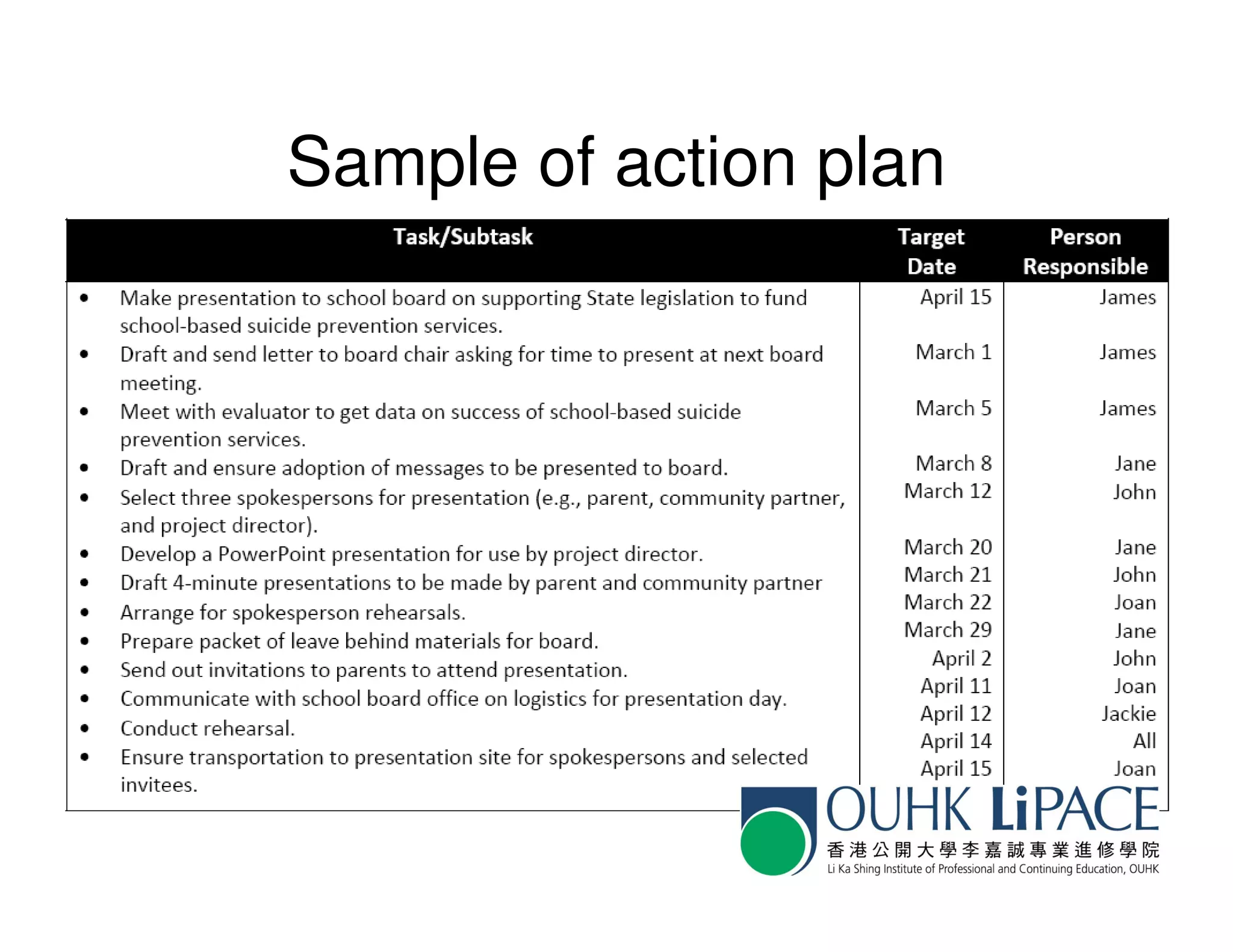
Step 6 – Develop Action Plan
• Purpose: To determine where, when, and how
  each task will be done to successfully implement
  your communication plan.
• Your action plan can be as simple or as complex
  as your needs require, but at least:
  – A listing of major activities, tasks, and subtasks
  – The target date for completing each task
  – The person responsible for ensuring each task is
    completed.
Sample of action plan
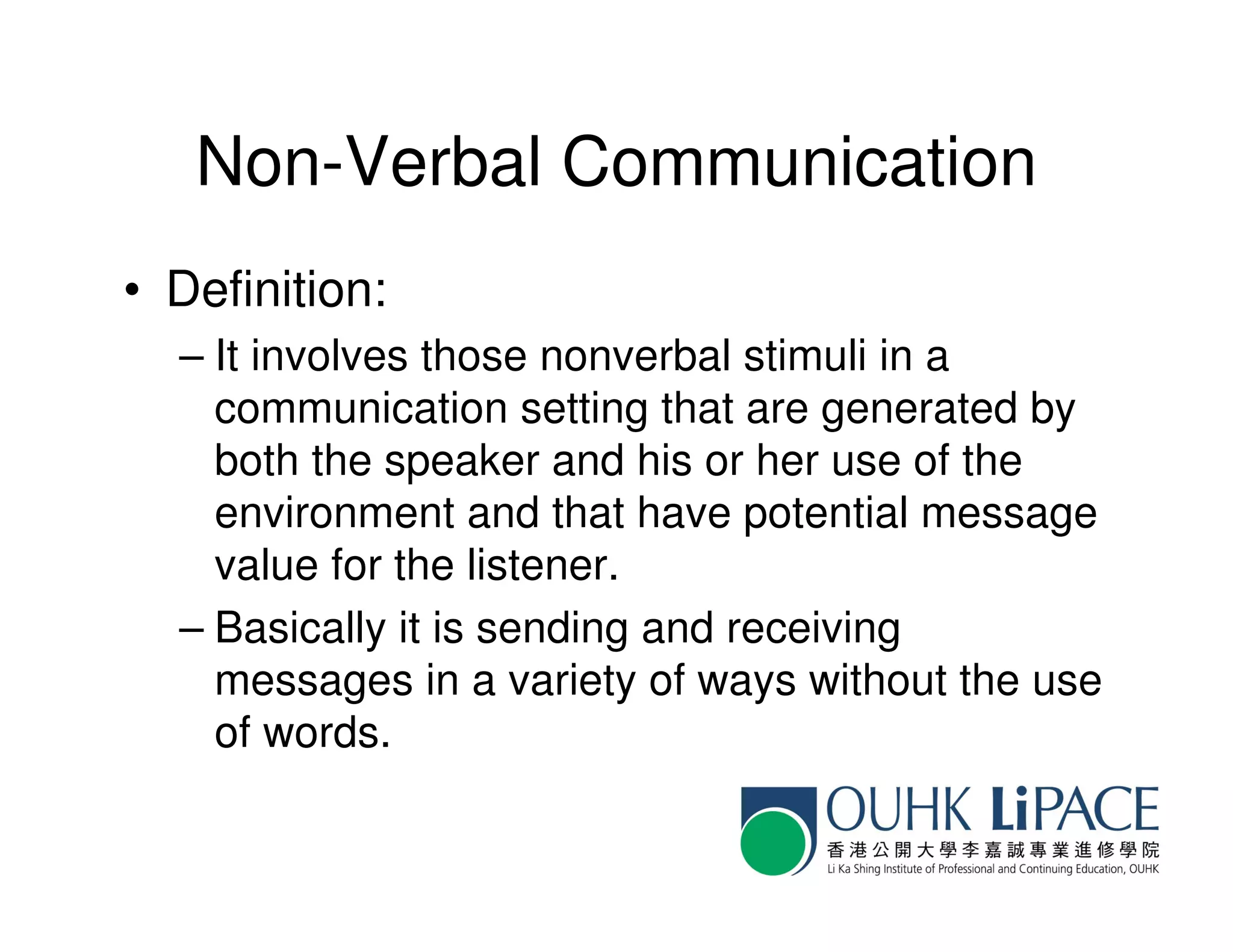
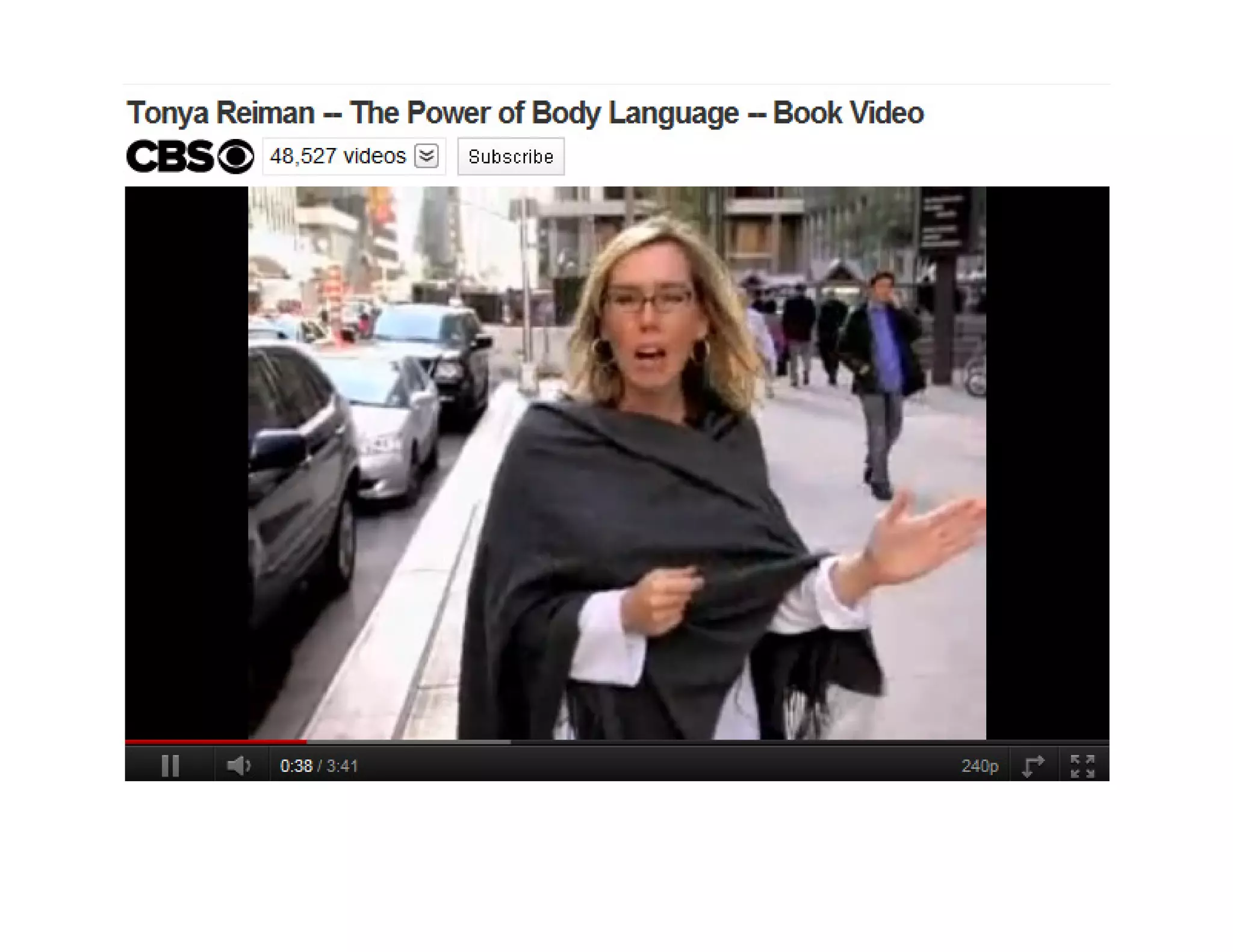
Non-Verbal Communication
• Definition:
  – It involves those nonverbal stimuli in a
    communication setting that are generated by
    both the speaker and his or her use of the
    environment and that have potential message
    value for the listener.
  – Basically it is sending and receiving
    messages in a variety of ways without the use
    of words.
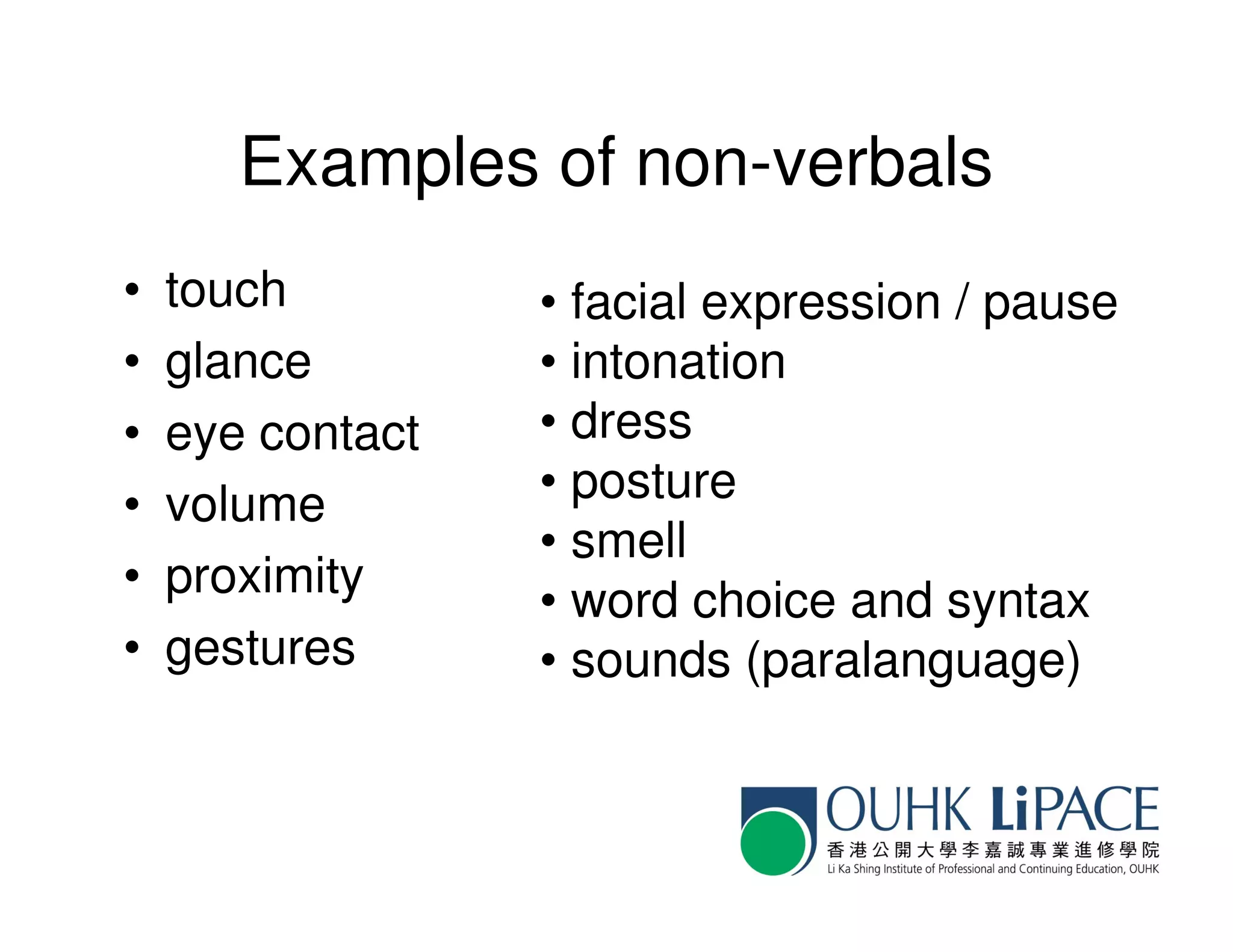
Examples of non-verbals
•   touch         • facial expression / pause
•   glance        • intonation
•   eye contact   • dress
•   volume        • posture
                  • smell
•   proximity     • word choice and syntax
•   gestures      • sounds (paralanguage)
Why is non-verbal
      communication important?
•   Used to repeat the verbal message
•   Often used to accent a verbal message
•   Often complement the verbal message
•   Regulate interactions
•   May substitute for the verbal message
Cultural Differences in Non-
     verbal Communication
• General Appearance and Dress
• Body Movement
• Posture
  – Bowing must be done right (Japan)
  – No hands in pocket (Turkey)
  – No hand shake to women (Arab)
• Eye contact
  – Arabic cultures make prolonged eye-contact.
  – Japan: avoid eye-contact to show respect
Cultural Differences in Non-
     verbal Communication
Touching – it’s culturally determined.
• Most African Americans touch on greeting
  but are annoyed if touched on the head
• Islamic and Hindu: typically don’t touch
  with the left hand as it is a social insult.
• Islamic cultures generally don’t approve of
  any touching between genders.
• Many Asians don’t touch the head
10 Rules of Effective Language
1. Simplicity: Use small words
  – PR communication is about trying to impress
    people with your wealth of vocab.
  – It’s about getting your message across

2. Brevity: Use short sentences
  – Better than a Post-it note
  – Less complex than a poem
  – Just somewhere in between depending on
    your audience
10 Rules of Effective Language
3. Credibility is as important as philosophy
  – Hillary Clinton never did the voice for her ads.
    She always had someone else talking about
    her. That just didn’t resonate with people
    because they wanted to hear what she had to
    say.
  – Barack Obama did exactly the opposite. All
    his ads featured him, and they had a much
    greater impact.
10 Rules of Effective Language
4. Consistency matters
  – People can get confused if you start mixing
    metric and imperial system.
  – When you start listing items, remember that
    you should never lose count or miscount

5. Novelty: Offer something new
  – When doing PR presentations, you want to
    catch the media’s attention. They are more
    likely to carry the novelty words or phrases
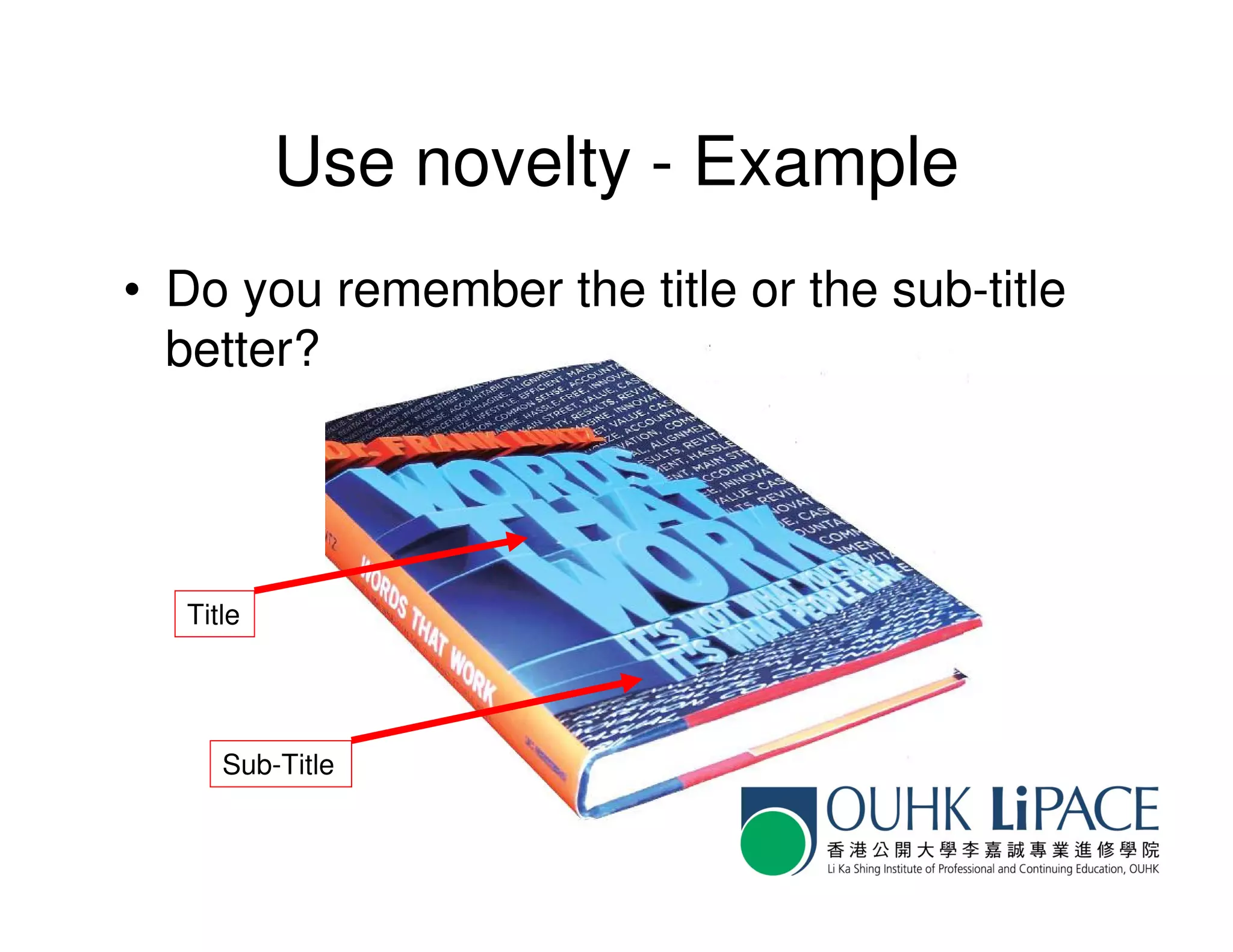
Use novelty - Example
• Do you remember the title or the sub-title
  better?


  Title


     Sub-Title
10 Rules of Effective Language
6. Sound and texture matter
  – Oil companies rarely use the word “drill” on
    their websites. Instead, the word “explore”
    has become popular.
  – What’s the difference?


7. Speak aspirationally
  – Unless you are Nelson Mendella, nobody is
    going to listen to your monotonic speeches
10 Rules of Effective Language
8. Visualize
   – Use it carefully. You don’t want people start focusing
     on the screen over your words
   – Generally, illustrations, graphs and tables are better
     presented using visual aids
9. Ask a question
   – Rhetorical questions will make the audience murmur
     to themselves to arrive at the message you want to
     deliver.
   – Instead of you declaring to them, they declare to
     themselves
Ask a question - Example
• Start off by asking “Are you better off today than
  your parents were at your age?”
• Then follow-up by asking “Are your kids going to
  better off when they reach your age?”
• The answer to the first one is yes; the answer to
  the second one is likely to be no
• It’s much better than a boring lecture on the
  generation Y problems, wealth poverty gap,
  education system, etc…….
10 Rules of Effective Language
10. Provide context and explain relevance
  – If I simply list down these 10 rules without any
    context or examples, how much can you
    understand?
  – This is why you are coming to listen to
    lectures instead of self study at home.
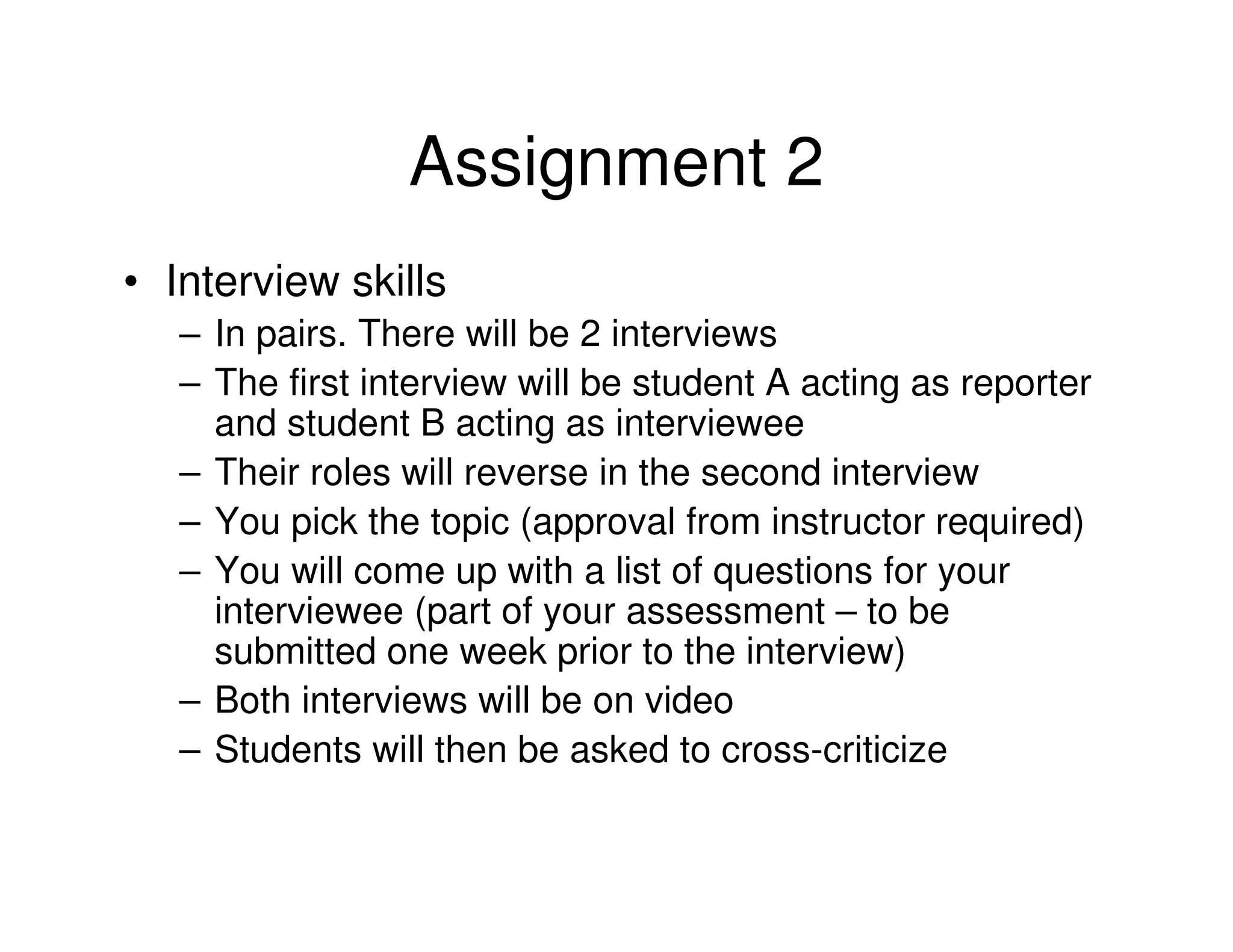
Assignment 2
• Interview skills
   – In pairs. There will be 2 interviews
   – The first interview will be student A acting as reporter
     and student B acting as interviewee
   – Their roles will reverse in the second interview
   – You pick the topic (approval from instructor required)
   – You will come up with a list of questions for your
     interviewee (part of your assessment – to be
     submitted one week prior to the interview)
   – Both interviews will be on video
   – Students will then be asked to cross-criticize
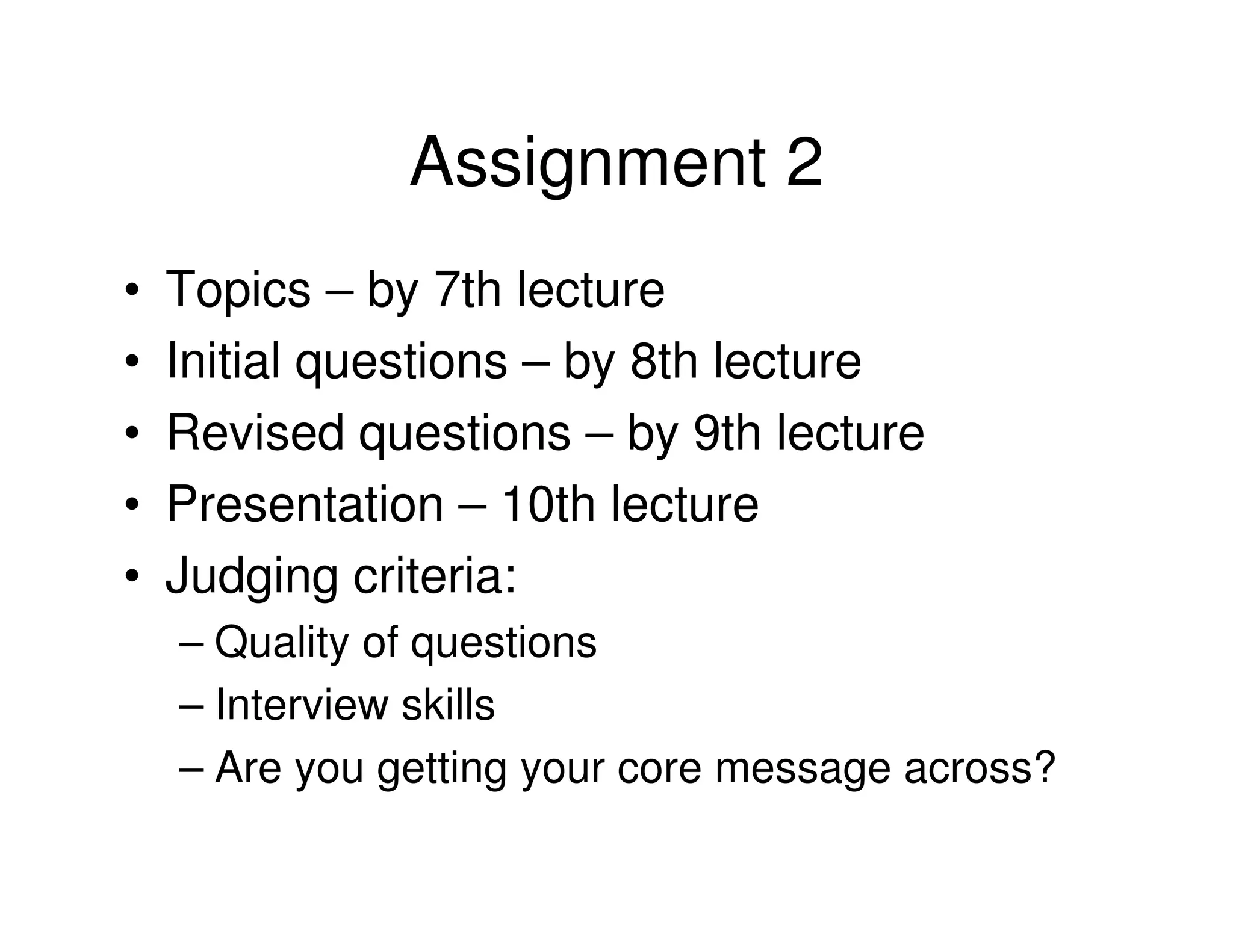
Assignment 2
•   Topics – by 7th lecture
•   Initial questions – by 8th lecture
•   Revised questions – by 9th lecture
•   Presentation – 10th lecture
•   Judging criteria:
    – Quality of questions
    – Interview skills
    – Are you getting your core message across?

Ouhk comm6005 lecture 5 communication planning

  • 1.
    DA010 - ProfessionalDiploma in Public Relations - COMM6005EP Public Relations Presentation and Communication Skills (2011/10) Lecture 5 Communication Planning Developed and Presented by Roy Ying, Msc., B.Comm. Note: Pictures used in this power point file is for academic Purpose only
  • 2.
    Table of Content •Planning communications under a 6-stop models • Practice non-verbals • Choosing your words: – 10 rules in effective language
  • 3.
    Communications Planning • Everypiece of communication tool a PR practitioner produces should be done in conveying a message, including news release, speech, video, event, survey, award….even down to the souvenir Class discussion: Class discussion: How do you decide How do you decide what message to what message to convey? Who gives convey? Who gives you the instruction? you the instruction?
  • 4.
    Step 1 -Identify your objectives • Ask yourself the following types of questions: – What do I want to achieve? – What do I want the receiver to be able to do or think as a result of my communication? – In what ways am I trying to influence them?
  • 7.
    Step 2 -Identify the recipients • Who needs to know what you are communicating? – Who absolutely must be informed? – Who also needs to know? – Whom it would be courteous to keep informed? – Who do you think the message will be forwarded to?
  • 10.
    Step 3 -Choose the method or channel of communication • The method or channel must be suitable for the purpose. Face to face, telephone, report or email are the main considerations. • If the wrong approach is taken then communication can be misunderstood or breakdown completely. • Choosing an obvious channel or method may not be straightforward and may need consideration depending upon who you are communicating to eg. customers, senior management, colleagues.
  • 11.
    Step 3 -Choose the method or channel of communication
  • 12.
    Step 3 -Choose the method or channel of communication
  • 14.
    What medium wouldyou choose? • If you want to communicate with: – Successful business leaders – Post 80s young people – Pregnant women – Investors – Politicians – House wives
  • 15.
    Step 4 -Match the message to the recipient • You can only communicate well when: – you have an accurate profile of the recipient of the message – you convey your understanding to the recipient in the way you communicate. • Pre-test your message “It’s not what you want to tell them, it’s what they can hear.”
  • 16.
    Step 5 -Get feedback • True communication involves a complete loop between sender and recipient. • Before moving forward to develop materials or activities, we urge you to pretest your messages with your intended audiences to determine if they are persuasive. • How? – Surveys – Focus Group – Brainstorming – Or simply ask few people in the target groups
  • 17.
    Step 5 -Get feedback Χ
  • 19.
    Step 6 –Develop Action Plan • Purpose: To determine where, when, and how each task will be done to successfully implement your communication plan. • Your action plan can be as simple or as complex as your needs require, but at least: – A listing of major activities, tasks, and subtasks – The target date for completing each task – The person responsible for ensuring each task is completed.
  • 20.
  • 21.
    Non-Verbal Communication • Definition: – It involves those nonverbal stimuli in a communication setting that are generated by both the speaker and his or her use of the environment and that have potential message value for the listener. – Basically it is sending and receiving messages in a variety of ways without the use of words.
  • 23.
    Examples of non-verbals • touch • facial expression / pause • glance • intonation • eye contact • dress • volume • posture • smell • proximity • word choice and syntax • gestures • sounds (paralanguage)
  • 24.
    Why is non-verbal communication important? • Used to repeat the verbal message • Often used to accent a verbal message • Often complement the verbal message • Regulate interactions • May substitute for the verbal message
  • 25.
    Cultural Differences inNon- verbal Communication • General Appearance and Dress • Body Movement • Posture – Bowing must be done right (Japan) – No hands in pocket (Turkey) – No hand shake to women (Arab) • Eye contact – Arabic cultures make prolonged eye-contact. – Japan: avoid eye-contact to show respect
  • 26.
    Cultural Differences inNon- verbal Communication Touching – it’s culturally determined. • Most African Americans touch on greeting but are annoyed if touched on the head • Islamic and Hindu: typically don’t touch with the left hand as it is a social insult. • Islamic cultures generally don’t approve of any touching between genders. • Many Asians don’t touch the head
  • 28.
    10 Rules ofEffective Language 1. Simplicity: Use small words – PR communication is about trying to impress people with your wealth of vocab. – It’s about getting your message across 2. Brevity: Use short sentences – Better than a Post-it note – Less complex than a poem – Just somewhere in between depending on your audience
  • 29.
    10 Rules ofEffective Language 3. Credibility is as important as philosophy – Hillary Clinton never did the voice for her ads. She always had someone else talking about her. That just didn’t resonate with people because they wanted to hear what she had to say. – Barack Obama did exactly the opposite. All his ads featured him, and they had a much greater impact.
  • 30.
    10 Rules ofEffective Language 4. Consistency matters – People can get confused if you start mixing metric and imperial system. – When you start listing items, remember that you should never lose count or miscount 5. Novelty: Offer something new – When doing PR presentations, you want to catch the media’s attention. They are more likely to carry the novelty words or phrases
  • 31.
    Use novelty -Example • Do you remember the title or the sub-title better? Title Sub-Title
  • 32.
    10 Rules ofEffective Language 6. Sound and texture matter – Oil companies rarely use the word “drill” on their websites. Instead, the word “explore” has become popular. – What’s the difference? 7. Speak aspirationally – Unless you are Nelson Mendella, nobody is going to listen to your monotonic speeches
  • 33.
    10 Rules ofEffective Language 8. Visualize – Use it carefully. You don’t want people start focusing on the screen over your words – Generally, illustrations, graphs and tables are better presented using visual aids 9. Ask a question – Rhetorical questions will make the audience murmur to themselves to arrive at the message you want to deliver. – Instead of you declaring to them, they declare to themselves
  • 34.
    Ask a question- Example • Start off by asking “Are you better off today than your parents were at your age?” • Then follow-up by asking “Are your kids going to better off when they reach your age?” • The answer to the first one is yes; the answer to the second one is likely to be no • It’s much better than a boring lecture on the generation Y problems, wealth poverty gap, education system, etc…….
  • 35.
    10 Rules ofEffective Language 10. Provide context and explain relevance – If I simply list down these 10 rules without any context or examples, how much can you understand? – This is why you are coming to listen to lectures instead of self study at home.
  • 36.
    Assignment 2 • Interviewskills – In pairs. There will be 2 interviews – The first interview will be student A acting as reporter and student B acting as interviewee – Their roles will reverse in the second interview – You pick the topic (approval from instructor required) – You will come up with a list of questions for your interviewee (part of your assessment – to be submitted one week prior to the interview) – Both interviews will be on video – Students will then be asked to cross-criticize
  • 37.
    Assignment 2 • Topics – by 7th lecture • Initial questions – by 8th lecture • Revised questions – by 9th lecture • Presentation – 10th lecture • Judging criteria: – Quality of questions – Interview skills – Are you getting your core message across?