Wednesbury Business Solution


                Abraham Bautista
Introduction

 This PowerPoint is about the aids and barriers to effective
  communication. This will explain you what makes an effective
  communication and what makes it bad.
‘Effective Communication’
 Being an effective communicator takes real skill. Communication skills have
  to be developed, honed and added to on an on-going basis. They are the
  heart of interpersonal skills and the greater your awareness of how it all
  works, the more effective your communication will be.


 To be effective in business, you have to communicate well. To be a good
  manager, you have to communicate exceptionally well.


 Here we look at basic communication dynamics, learning skills to improve
  your communication, using effective communication to improve and
  promote interpersonal relationships, creating an effective communication
  strategy.
Verbal Communication and Non-Verbal
Communication
 Interpersonal skills. Everything communicates. Remember, If you aren't clear
  about what you mean and what your intention is, the other person (or people)
  could easily (and sometimes deliberately), misinterpret what you mean.
 What you do matters as much as what you say. It's now accepted that the words
  account for only 7-11% of a communication. Your behaviour will 'read'
  unconsciously to other people and you can certainly be more in charge of the
  reading matter!
 Language is one of the most powerful reflections of how we think and feel about
  ourselves and others. You need to be aware of the padding, justifications and
  excuses you use and whether they are appropriate. You can make a big impact
  simply by changing some of your language and developing your verbal skills,
  This way you can significantly improve your communication skills.
Writing Communication
   To have a good writing communication you need to start by knowing who your audience
    is. Then create an outline to help you write a longer document such as a report,
    presentation or speech. Outlines help you identify which steps to take in which order, and
    they help you break the task up into manageable pieces of information.
   If you’re writing something that must inspire action in the reader, follow the Attention-
    Interest-Desire-Action formula. These will guide you through your writing process.
   If you're writing a sales letter for prospective clients, why should they care about your
    product or sales pitch? What's the benefit for them? Remember your audience's needs at
    all times.
   If you're trying to persuade someone to do something, make sure that you communicate
    why people should listen to you, pitch your message in a way that engages your audience,
    and present information rationally and coherently.
   If you're having trouble defining the main theme of your message, pretend that you have
    15 seconds to explain your position. What do you say? This is likely to be your main
    theme.
   Unless you're writing a scholarly article, it's usually best to use simple, direct language.
    Don't use long words just to impress people.
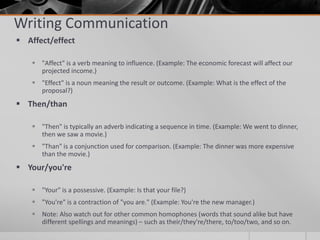
Writing Communication
 Affect/effect

     "Affect" is a verb meaning to influence. (Example: The economic forecast will affect our
      projected income.)
     "Effect" is a noun meaning the result or outcome. (Example: What is the effect of the
      proposal?)
 Then/than

     "Then" is typically an adverb indicating a sequence in time. (Example: We went to dinner,
      then we saw a movie.)
     "Than" is a conjunction used for comparison. (Example: The dinner was more expensive
      than the movie.)
 Your/you're

     "Your" is a possessive. (Example: Is that your file?)
     "You're" is a contraction of "you are." (Example: You're the new manager.)
     Note: Also watch out for other common homophones (words that sound alike but have
      different spellings and meanings) – such as their/they're/there, to/too/two, and so on.
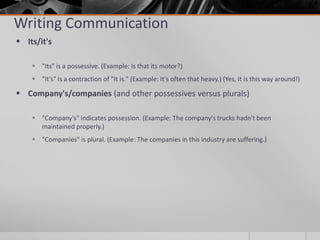
Writing Communication
 Its/it's

     "Its" is a possessive. (Example: Is that its motor?)
     "It's" is a contraction of "It is." (Example: It's often that heavy.) (Yes, it is this way around!)

 Company's/companies (and other possessives versus plurals)

     "Company's" indicates possession. (Example: The company's trucks hadn't been
      maintained properly.)
     "Companies" is plural. (Example: The companies in this industry are suffering.)
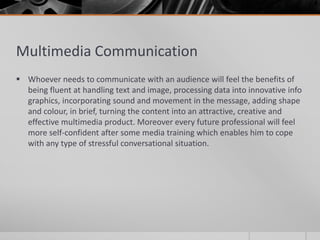
Multimedia Communication
 Whoever needs to communicate with an audience will feel the benefits of
  being fluent at handling text and image, processing data into innovative info
  graphics, incorporating sound and movement in the message, adding shape
  and colour, in brief, turning the content into an attractive, creative and
  effective multimedia product. Moreover every future professional will feel
  more self-confident after some media training which enables him to cope
  with any type of stressful conversational situation.
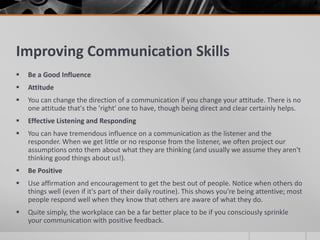
Improving Communication Skills
   Be a Good Influence
   Attitude
   You can change the direction of a communication if you change your attitude. There is no
    one attitude that's the 'right' one to have, though being direct and clear certainly helps.
   Effective Listening and Responding
   You can have tremendous influence on a communication as the listener and the
    responder. When we get little or no response from the listener, we often project our
    assumptions onto them about what they are thinking (and usually we assume they aren't
    thinking good things about us!).
   Be Positive
   Use affirmation and encouragement to get the best out of people. Notice when others do
    things well (even if it's part of their daily routine). This shows you're being attentive; most
    people respond well when they know that others are aware of what they do.
   Quite simply, the workplace can be a far better place to be if you consciously sprinkle
    your communication with positive feedback.
Source
 http://www.impactfactory.com
 http://www.mindtools.com
 http://www.howest.be

Task 3 effective communication in business

  • 1.
  • 2.
    Introduction  This PowerPointis about the aids and barriers to effective communication. This will explain you what makes an effective communication and what makes it bad.
  • 3.
    ‘Effective Communication’  Beingan effective communicator takes real skill. Communication skills have to be developed, honed and added to on an on-going basis. They are the heart of interpersonal skills and the greater your awareness of how it all works, the more effective your communication will be.  To be effective in business, you have to communicate well. To be a good manager, you have to communicate exceptionally well.  Here we look at basic communication dynamics, learning skills to improve your communication, using effective communication to improve and promote interpersonal relationships, creating an effective communication strategy.
  • 4.
    Verbal Communication andNon-Verbal Communication  Interpersonal skills. Everything communicates. Remember, If you aren't clear about what you mean and what your intention is, the other person (or people) could easily (and sometimes deliberately), misinterpret what you mean.  What you do matters as much as what you say. It's now accepted that the words account for only 7-11% of a communication. Your behaviour will 'read' unconsciously to other people and you can certainly be more in charge of the reading matter!  Language is one of the most powerful reflections of how we think and feel about ourselves and others. You need to be aware of the padding, justifications and excuses you use and whether they are appropriate. You can make a big impact simply by changing some of your language and developing your verbal skills, This way you can significantly improve your communication skills.
  • 5.
    Writing Communication  To have a good writing communication you need to start by knowing who your audience is. Then create an outline to help you write a longer document such as a report, presentation or speech. Outlines help you identify which steps to take in which order, and they help you break the task up into manageable pieces of information.  If you’re writing something that must inspire action in the reader, follow the Attention- Interest-Desire-Action formula. These will guide you through your writing process.  If you're writing a sales letter for prospective clients, why should they care about your product or sales pitch? What's the benefit for them? Remember your audience's needs at all times.  If you're trying to persuade someone to do something, make sure that you communicate why people should listen to you, pitch your message in a way that engages your audience, and present information rationally and coherently.  If you're having trouble defining the main theme of your message, pretend that you have 15 seconds to explain your position. What do you say? This is likely to be your main theme.  Unless you're writing a scholarly article, it's usually best to use simple, direct language. Don't use long words just to impress people.
  • 6.
    Writing Communication  Affect/effect  "Affect" is a verb meaning to influence. (Example: The economic forecast will affect our projected income.)  "Effect" is a noun meaning the result or outcome. (Example: What is the effect of the proposal?)  Then/than  "Then" is typically an adverb indicating a sequence in time. (Example: We went to dinner, then we saw a movie.)  "Than" is a conjunction used for comparison. (Example: The dinner was more expensive than the movie.)  Your/you're  "Your" is a possessive. (Example: Is that your file?)  "You're" is a contraction of "you are." (Example: You're the new manager.)  Note: Also watch out for other common homophones (words that sound alike but have different spellings and meanings) – such as their/they're/there, to/too/two, and so on.
  • 7.
    Writing Communication  Its/it's  "Its" is a possessive. (Example: Is that its motor?)  "It's" is a contraction of "It is." (Example: It's often that heavy.) (Yes, it is this way around!)  Company's/companies (and other possessives versus plurals)  "Company's" indicates possession. (Example: The company's trucks hadn't been maintained properly.)  "Companies" is plural. (Example: The companies in this industry are suffering.)
  • 8.
    Multimedia Communication  Whoeverneeds to communicate with an audience will feel the benefits of being fluent at handling text and image, processing data into innovative info graphics, incorporating sound and movement in the message, adding shape and colour, in brief, turning the content into an attractive, creative and effective multimedia product. Moreover every future professional will feel more self-confident after some media training which enables him to cope with any type of stressful conversational situation.
  • 9.
    Improving Communication Skills  Be a Good Influence  Attitude  You can change the direction of a communication if you change your attitude. There is no one attitude that's the 'right' one to have, though being direct and clear certainly helps.  Effective Listening and Responding  You can have tremendous influence on a communication as the listener and the responder. When we get little or no response from the listener, we often project our assumptions onto them about what they are thinking (and usually we assume they aren't thinking good things about us!).  Be Positive  Use affirmation and encouragement to get the best out of people. Notice when others do things well (even if it's part of their daily routine). This shows you're being attentive; most people respond well when they know that others are aware of what they do.  Quite simply, the workplace can be a far better place to be if you consciously sprinkle your communication with positive feedback.
  • 10.