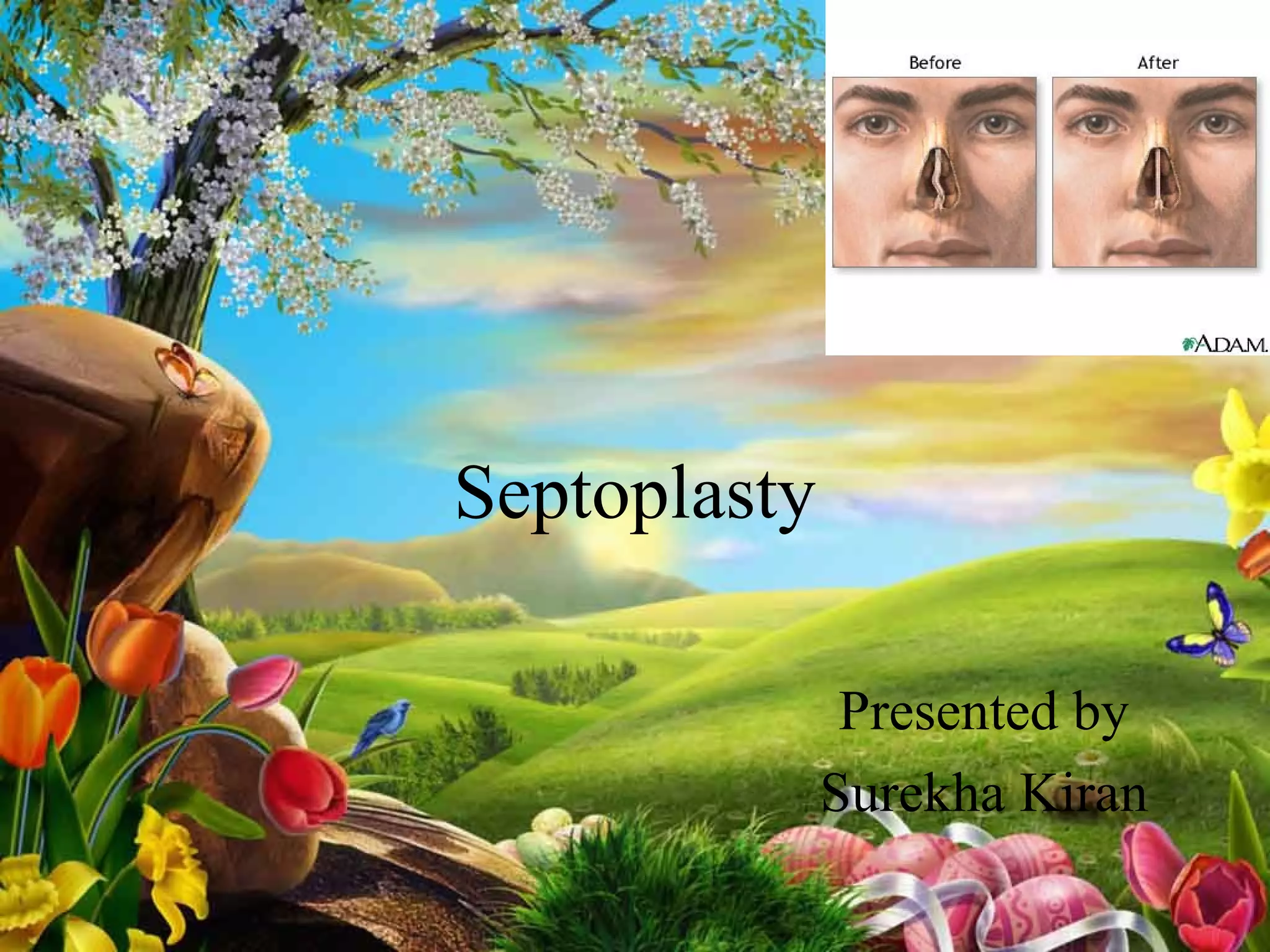
Septoplasty
Presented by
Surekha Kiran
Definition
• Excision and resection of the septum to correct any
deviation as a result of injury or a congenital nasal
deformity; to improve the functioning capabilities of the
nose—to improve breathing
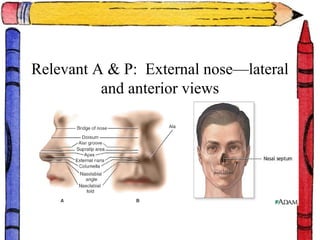
Relevant A & P: External nose—lateral
and anterior views
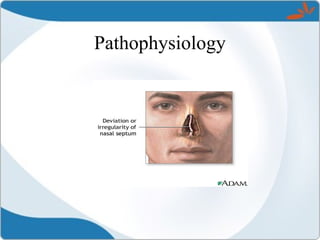
Pathophysiology
Indications
• Nasal airway obstruction - Can lead to
mouth breathing, chronic nasal
infection, or obstructive sleep apnea.
• Nasal septal deformity
• Headaches caused by septal spurs
• Chronic and uncontrolled nosebleeds
• Chronic sinusitis associated with a
deviated septum
• Tumor excision
Goals of Septoplasty
• To improve breathing through the nose
and also to prevent sinus infections.
• The procedure usually involves an
excision of a portion of the cartilage and
bone.
• An incision is made in the lining of the
septum to reach the cartilage.
• The septum may then be stabilized with
small plastic tubes, splints or nasal packs
to prevent bleeding.
Diagnostics
• Exams
– Rhinoscopy: Direct
vision

• Preoperative Testing
Preoperative Care
• Consent for surgery checked and confirmed.
• Routine evening care done.
• Anesthesia evaluation with pre-anesthesia
checklist completed.
• Preoperative Blood Works and investigations
• Pre-op V/S checked and recorded.
• Nil by mouth
• Patient reassured
• Preoperative Medication
Post operative care
•
•
•
•
•
•
•
•
•
•
•

Patient was propped in reclined position.
V/S checked as per protocol.
Patient was instructed not to blow in the nose.
Dressing was assessed for further bleeding.
Sips of water served and when tolerated, normal diet served.
Pain assessed and analgesic given as prescribed.
Kept rested with siderails up in comfortable position.
Nasal pack and ice Pack
Prophylactic antibiotics and Pain Medications
Dressing was changed and noted for further bleeding.
Discharged with home meds instructions given.
Postoperative Complication
• Potential complications
– Hemorrhage
– Infection
– Other: Damage to….perforate septum, cause
weakened septum which could lead to future
deformity
Nursing Diagnosis
• Fear and anxiety r/t upcoming invasive
procedure
• Alteration in comfort; pain r/t post
septoplasty
• Potential for bleeding r/t post-op procedure
Discharge Instruction
•
•
•
•
•
•
•
•

To expect blood stained/ pinkish discharge for a few days
That will be breathing through mouth until swelling is
gone.
Not to hit or move any part of the nose.
Not to hold back a sneeze. Sneeze with the mouth open.
To expect a crusting in the nose for not more than 6 weeks
while the incision is healing.
To avoid all moderate and heavy physical activity,
including sport for ten days after the operation and avoid
bending.
Avoid smoky, dusty, hot and dry atmospheres
Follow Up with appointment

nursing care of Septoplasty

  • 1.
  • 2.
    Definition • Excision andresection of the septum to correct any deviation as a result of injury or a congenital nasal deformity; to improve the functioning capabilities of the nose—to improve breathing
  • 3.
    Relevant A &P: External nose—lateral and anterior views
  • 4.
  • 5.
    Indications • Nasal airwayobstruction - Can lead to mouth breathing, chronic nasal infection, or obstructive sleep apnea. • Nasal septal deformity • Headaches caused by septal spurs • Chronic and uncontrolled nosebleeds • Chronic sinusitis associated with a deviated septum • Tumor excision
  • 6.
    Goals of Septoplasty •To improve breathing through the nose and also to prevent sinus infections. • The procedure usually involves an excision of a portion of the cartilage and bone. • An incision is made in the lining of the septum to reach the cartilage. • The septum may then be stabilized with small plastic tubes, splints or nasal packs to prevent bleeding.
  • 7.
    Diagnostics • Exams – Rhinoscopy:Direct vision • Preoperative Testing
  • 8.
    Preoperative Care • Consentfor surgery checked and confirmed. • Routine evening care done. • Anesthesia evaluation with pre-anesthesia checklist completed. • Preoperative Blood Works and investigations • Pre-op V/S checked and recorded. • Nil by mouth • Patient reassured • Preoperative Medication
  • 9.
    Post operative care • • • • • • • • • • • Patientwas propped in reclined position. V/S checked as per protocol. Patient was instructed not to blow in the nose. Dressing was assessed for further bleeding. Sips of water served and when tolerated, normal diet served. Pain assessed and analgesic given as prescribed. Kept rested with siderails up in comfortable position. Nasal pack and ice Pack Prophylactic antibiotics and Pain Medications Dressing was changed and noted for further bleeding. Discharged with home meds instructions given.
  • 10.
    Postoperative Complication • Potentialcomplications – Hemorrhage – Infection – Other: Damage to….perforate septum, cause weakened septum which could lead to future deformity
  • 11.
    Nursing Diagnosis • Fearand anxiety r/t upcoming invasive procedure • Alteration in comfort; pain r/t post septoplasty • Potential for bleeding r/t post-op procedure
  • 12.
    Discharge Instruction • • • • • • • • To expectblood stained/ pinkish discharge for a few days That will be breathing through mouth until swelling is gone. Not to hit or move any part of the nose. Not to hold back a sneeze. Sneeze with the mouth open. To expect a crusting in the nose for not more than 6 weeks while the incision is healing. To avoid all moderate and heavy physical activity, including sport for ten days after the operation and avoid bending. Avoid smoky, dusty, hot and dry atmospheres Follow Up with appointment

Editor's Notes

  • #2 STST p. 609: Procedures of the nose are most often done to improve breathing—restore function. Sometimes septoplasty is accompanied by turbinectomy and for cosmetic reasons, rhinoplasty.
  • #3 Alexander: Objective: to establish an adequate partition between left and right nasal cavities, thereby producing a clear airway through both the internal and external cavities of the nose. The name SMR tells us that the mucous membrane lining the nasal cavity will be incised, and the underlying perichondrium or periosteum lifted. Then the structures underneath the mucous membrane will be removed to help restore normal breathing.
  • #4 STST p. 601
  • #5 Alexander: Septal deviations tend to cause sinus disease and nasal polyps. Allrefer.com: The main indications for nasal surgery are: nasal airway obstruction septal spur headache uncontrollable nosebleeds nasal septal deformity in the presence of other intranasal surgery Nasal airway obstruction is usually the result of a septal deformity that causes breathing by mouth, sleep apnea, or recurrent nasal infections that are slow to respond to antibiotics. A septal spur headache is defined as a headache secondary to pressure from the nasal septum on the linings in side the nose (septal impaction) and relieved by topical (applied to a localized area of the skin) anesthesia on the septal impaction. Other intranasal surgery indicating septoplasty includes polypectomy (removal of a polyp), ethmoidectomy (operation on the ethmoid bone at the superior part of the nasal cavity), turbinate surgery (operation on the concha nasalis), and tumor removal. Also done in conjunction—surgeon may perform a Turbinectomy: Removal of portions of the inferior and middle turbinates to increase aeration and drainage and to relieve pressure against the floor of the nose.
  • #8 STST p. 605: Will use special illumination equipment—headlamp and nasal speculum