Ahmad Nawaz Ahmad
Associate Professor & HOD
LNH & LNHMC
Otitis Media
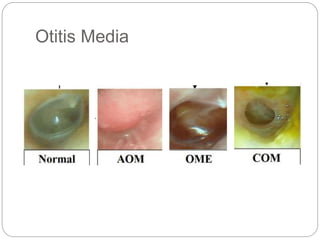
Otitis Media
Clasification Suppurative Otitis
Media
Acute Otitis media infection of middle
ear cleft for short period of time less
than 3 months)
Chronic Otitis media is middle ear
infection for 3 months or more
characterized by recurrent middle ear
discharge and permanent perforation
> 3 months : Ballanger,1996
> 2 months : Djaafar, 2001
> 6 weeks : Rolland, 2002
INTRODUCTION
 Most common diseases of the middle ear are
inflammations and infections play a major role
 Otitis media is the most common reason for an
illness-related medical visit in preschool age
children.
(Bailey, 2006)
 Second most common diagnosis made by
pediatricians
(Linsk R et al,2002)
INTRODUCTION
 70% of children will have had one or
more episodes of acute otitis media by
their third birthday.
 Occurs mainly in children : newborn
period - 7 years
 Occurs equally in males and females
(Healy&Rosbe,Ballenger’s,2002)
INTRODUCTION
 Bondy et al : the proportion of children
with a diagnosis of otitis media was
highest (42% to 60%) in the 7 to 36
months range
 Other studies have shown the highest
incidence of acute otitis media, for both
sexes, was in the 6 to 11 months
(Bailey,2006)
INTRODUCTION
 Epidemiologic studies at the University
of Pittsburgh : 90% incidence of otitis
media in urban children within the first 2
years of life.
(Clinical Otology,2007)
 Children who live in crowded
households,low socioeconomic
conditions, poor medical care increasing
incidence of acute otitis media
(Bailey,2006)
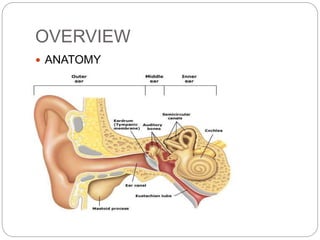
OVERVIEW
 ANATOMY
Innervation
 The nerves that innervate tympanic cavity is
tympanic plexus.
 Derives from the tympanic branch of the
glossopharyngeal nerve and the caroticotympanic
nerves.
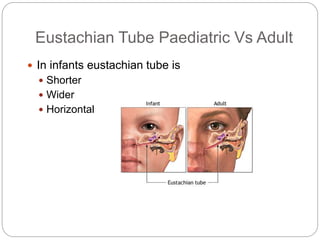
Eustachian Tube Paediatric Vs Adult
 In infants eustachian tube is
 Shorter
 Wider
 Horizontal
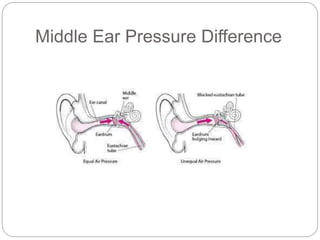
Middle Ear Pressure Difference
Acute Otitis Media
 Acute otitis media (AOM) represents the rapid
onset of an inflammatory process of the middle
ear space associated with one or more symptoms
or local or systemic signs
(Healy and Rosbe,2002)
 Acute otitis media (AOM) is an infection that
involves the middle ear. The tympanic membrane
becomes inflamed and opaque. Blood vessels to
the area dilate. Fluid accumulates in the middle
ear space. AOM is usually associated with
infection by viruses or bacteria.
- (http://www.utmb.edu/pedi_ed/AOM-Otitis/default.htm)
OVERVIEW
ETIOLOGY
 Most common bacterial pathogens:
- Streptococcus pneumonia (35%)
- Haemophilis influenza (23%)
 Less Frequent
- Moraxella catarrhalis
- Group A Streptococcus
- Branhamella catarrhalis
- Staphylococcus aureu
- gram-negative enteric bacteria
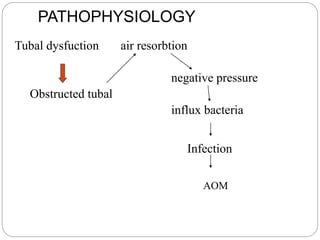
PATHOPHYSIOLOGY
Infection
Tubal dysfuction air resorbtion
negative pressure
Obstructed tubal
influx bacteria
AOM
Clinical Features
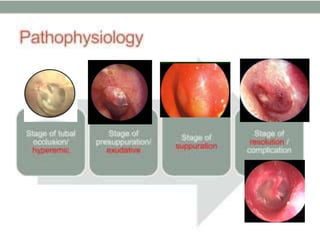
 Occlusion tube stage
- Performing tympanic membrane retraction due to
negative pressure inside the middle ear due to
air.
- Sometimes the color of tympanic membrane
normal or pale.
Clinical Features
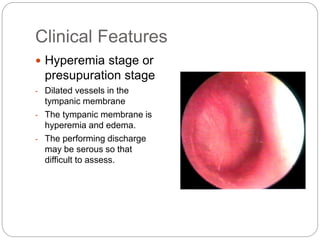
 Hyperemia stage or
presupuration stage
- Dilated vessels in the
tympanic membrane
- The tympanic membrane is
hyperemia and edema.
- The performing discharge
may be serous so that
difficult to assess.
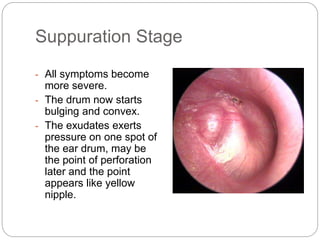
Suppuration Stage
- All symptoms become
more severe.
- The drum now starts
bulging and convex.
- The exudates exerts
pressure on one spot of
the ear drum, may be
the point of perforation
later and the point
appears like yellow
nipple.
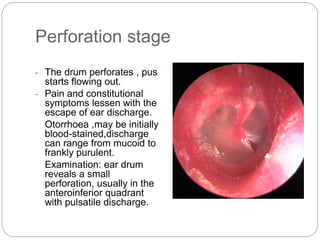
Perforation stage
- The drum perforates , pus
starts flowing out.
- Pain and constitutional
symptoms lessen with the
escape of ear discharge.
Otorrhoea ,may be initially
blood-stained,discharge
can range from mucoid to
frankly purulent.
Examination: ear drum
reveals a small
perforation, usually in the
anteroinferior quadrant
with pulsatile discharge.
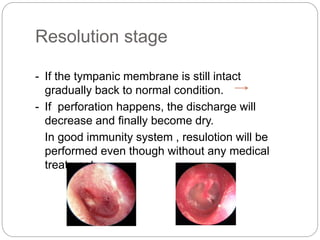
Resolution stage
- If the tympanic membrane is still intact
gradually back to normal condition.
- If perforation happens, the discharge will
decrease and finally become dry.
In good immunity system , resulotion will be
performed even though without any medical
treatment
Risk Factors For AOM
Risk Factors:
- Exposure to group day care with subsequent
increase in respiratory infections.
- Exposure to environmental smoke or other
respiratory irritants and allergens that interfere
with
- Eustachian tube function.
- Lack of breast feeding & Supine feeding position
SIGN and SYMPTOM
Common signs and symptoms
 Fever
 Otalgia
 Otorhea
 Fullness in the ear
 Irritability
 Crying/shouting (child)
 Eardrum : light reflect (-),hyperemia, bulging, perforation
Less common signs and symptoms
 Tinnitus
 Vertigo
 Facial paralysis
 Swelling behind the ear
Treatment
- Watchful waiting without antibiotic therapy
healthy 2-year-olds or older children with non
severe illness
- Antibiotic therapy
First line therapy: Amoxicillin 80mg-90mg/kg/24
hours in three divided doses , for 10 days
- The adjunctive therapy
include analgesics and antipyretics.
- Myringotomy
Diagnosis
 Careful history (fulfilled/fullness ear,otalgia, fever)
and physical examination will lead to the accurate
diagnosis of acute otitis media
 The ultimate diagnostic test to confirm the
presence of AOM involves aspiration of middle
ear contents
Use of Antibiotics?
According to Guidelines & Protocols Advisory
Commitee :
If older than 24 months, most cases of AOM
resolve with systemic analgesics alone and do
not require antibiotics.
If signs and symptoms of AOM persist in spite of
systemic analgesics after 48 to 72 hours, treat
with antibiotics
Risk Factors For AOM
 High Risk Factors
Craniofacial abnormalities.
Immune deficiency.
Gastro-esophageal reflux.
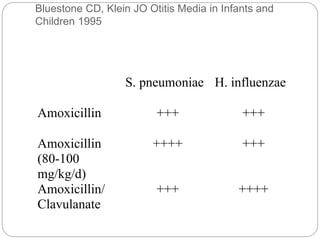
Bluestone CD, Klein JO Otitis Media in Infants and
Children 1995
S. pneumoniae H. influenzae
Amoxicillin +++ +++
Amoxicillin
(80-100
mg/kg/d)
++++ +++
Amoxicillin/
Clavulanate
+++ ++++
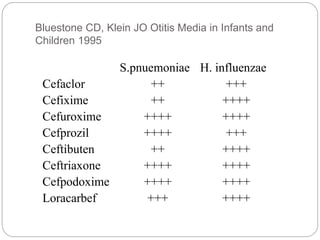
Bluestone CD, Klein JO Otitis Media in Infants and
Children 1995
S.pnuemoniae H. influenzae
Cefaclor ++ +++
Cefixime ++ ++++
Cefuroxime ++++ ++++
Cefprozil ++++ +++
Ceftibuten ++ ++++
Ceftriaxone ++++ ++++
Cefpodoxime ++++ ++++
Loracarbef +++ ++++
Treatment
 Analgesia
 Antibiotics
 Decongestant/
 Anti histamine
 No role of ear drops
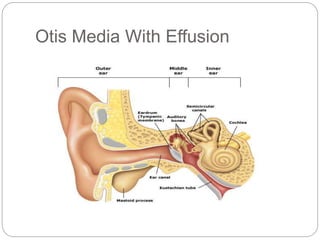
Otis Media With Effusion
Otitis Media with Effusion
(Chronic non-suppurative Otitis Media)
Diagnosis :
 History.
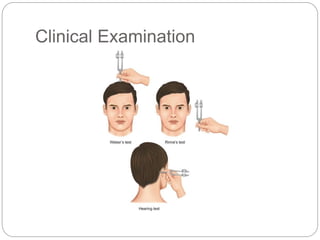
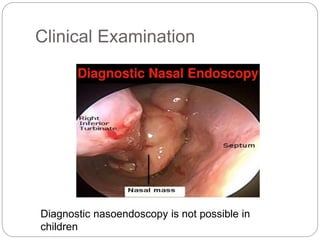
 Clinical Examination.
 Tuning fork tests.
 Audiological assessment.
History
 Decrease hearing
 Ear pain
 Inactive/ dull
 Decreasing school grades
 Mouth breathing
 Snoring
 Nasal obstruction
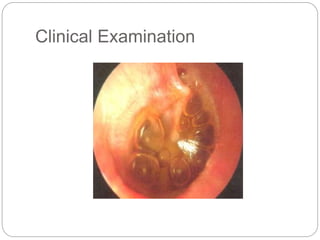
Clinical Examination
Diagnostic nasoendoscopy is not possible in
children
Otitis Media with Effusion
(Chronic non-suppurative Otitis Media)
 Tuning fork test ( Weber and Renine test)
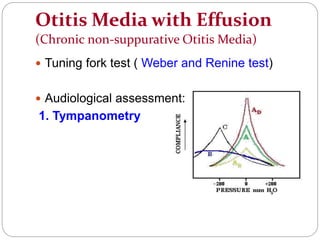
 Audiological assessment:
1. Tympanometry
Otitis Media with Effusion
(Chronic non-suppurative Otitis Media)
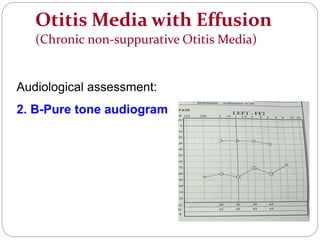
Audiological assessment:
2. B-Pure tone audiogram
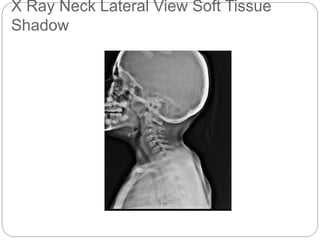
X Ray Neck Lateral View Soft Tissue
Shadow
Otitis Media with Effusion
(Chronic non-suppurative Otitis Media)
 Medical Treatment of OME :
 Observation – many European countries wait 6-
9 months prior to placement of ear tubes.
 Antibiotics????
 Meta-analysis shows beneficial short-term resolution
of OME
 Audiogram at 3 months with persistent effusion
to determine impact on hearing
Otitis Media with Effusion
(Chronic non-suppurative Otitis Media)
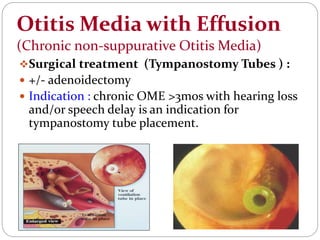
Surgical treatment (Tympanostomy Tubes ) :
 +/- adenoidectomy
 Indication : chronic OME >3mos with hearing loss
and/or speech delay is an indication for
tympanostomy tube placement.
Case
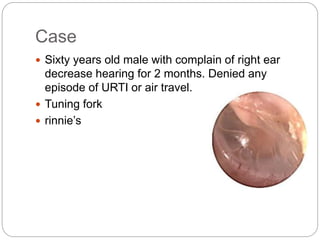
 Sixty years old male with complain of right ear
decrease hearing for 2 months. Denied any
episode of URTI or air travel.
 Tuning fork
 rinnie’s
Questions ?

AOM & OME.pptx

  • 1.
    Ahmad Nawaz Ahmad AssociateProfessor & HOD LNH & LNHMC Otitis Media
  • 2.
  • 3.
    Clasification Suppurative Otitis Media AcuteOtitis media infection of middle ear cleft for short period of time less than 3 months) Chronic Otitis media is middle ear infection for 3 months or more characterized by recurrent middle ear discharge and permanent perforation > 3 months : Ballanger,1996 > 2 months : Djaafar, 2001 > 6 weeks : Rolland, 2002
  • 4.
    INTRODUCTION  Most commondiseases of the middle ear are inflammations and infections play a major role  Otitis media is the most common reason for an illness-related medical visit in preschool age children. (Bailey, 2006)  Second most common diagnosis made by pediatricians (Linsk R et al,2002)
  • 5.
    INTRODUCTION  70% ofchildren will have had one or more episodes of acute otitis media by their third birthday.  Occurs mainly in children : newborn period - 7 years  Occurs equally in males and females (Healy&Rosbe,Ballenger’s,2002)
  • 6.
    INTRODUCTION  Bondy etal : the proportion of children with a diagnosis of otitis media was highest (42% to 60%) in the 7 to 36 months range  Other studies have shown the highest incidence of acute otitis media, for both sexes, was in the 6 to 11 months (Bailey,2006)
  • 7.
    INTRODUCTION  Epidemiologic studiesat the University of Pittsburgh : 90% incidence of otitis media in urban children within the first 2 years of life. (Clinical Otology,2007)  Children who live in crowded households,low socioeconomic conditions, poor medical care increasing incidence of acute otitis media (Bailey,2006)
  • 8.
  • 9.
    Innervation  The nervesthat innervate tympanic cavity is tympanic plexus.  Derives from the tympanic branch of the glossopharyngeal nerve and the caroticotympanic nerves.
  • 10.
    Eustachian Tube PaediatricVs Adult  In infants eustachian tube is  Shorter  Wider  Horizontal
  • 12.
  • 13.
    Acute Otitis Media Acute otitis media (AOM) represents the rapid onset of an inflammatory process of the middle ear space associated with one or more symptoms or local or systemic signs (Healy and Rosbe,2002)  Acute otitis media (AOM) is an infection that involves the middle ear. The tympanic membrane becomes inflamed and opaque. Blood vessels to the area dilate. Fluid accumulates in the middle ear space. AOM is usually associated with infection by viruses or bacteria. - (http://www.utmb.edu/pedi_ed/AOM-Otitis/default.htm)
  • 14.
    OVERVIEW ETIOLOGY  Most commonbacterial pathogens: - Streptococcus pneumonia (35%) - Haemophilis influenza (23%)  Less Frequent - Moraxella catarrhalis - Group A Streptococcus - Branhamella catarrhalis - Staphylococcus aureu - gram-negative enteric bacteria
  • 15.
    PATHOPHYSIOLOGY Infection Tubal dysfuction airresorbtion negative pressure Obstructed tubal influx bacteria AOM
  • 17.
    Clinical Features  Occlusiontube stage - Performing tympanic membrane retraction due to negative pressure inside the middle ear due to air. - Sometimes the color of tympanic membrane normal or pale.
  • 18.
    Clinical Features  Hyperemiastage or presupuration stage - Dilated vessels in the tympanic membrane - The tympanic membrane is hyperemia and edema. - The performing discharge may be serous so that difficult to assess.
  • 19.
    Suppuration Stage - Allsymptoms become more severe. - The drum now starts bulging and convex. - The exudates exerts pressure on one spot of the ear drum, may be the point of perforation later and the point appears like yellow nipple.
  • 20.
    Perforation stage - Thedrum perforates , pus starts flowing out. - Pain and constitutional symptoms lessen with the escape of ear discharge. Otorrhoea ,may be initially blood-stained,discharge can range from mucoid to frankly purulent. Examination: ear drum reveals a small perforation, usually in the anteroinferior quadrant with pulsatile discharge.
  • 21.
    Resolution stage - Ifthe tympanic membrane is still intact gradually back to normal condition. - If perforation happens, the discharge will decrease and finally become dry. In good immunity system , resulotion will be performed even though without any medical treatment
  • 22.
    Risk Factors ForAOM Risk Factors: - Exposure to group day care with subsequent increase in respiratory infections. - Exposure to environmental smoke or other respiratory irritants and allergens that interfere with - Eustachian tube function. - Lack of breast feeding & Supine feeding position
  • 23.
    SIGN and SYMPTOM Commonsigns and symptoms  Fever  Otalgia  Otorhea  Fullness in the ear  Irritability  Crying/shouting (child)  Eardrum : light reflect (-),hyperemia, bulging, perforation Less common signs and symptoms  Tinnitus  Vertigo  Facial paralysis  Swelling behind the ear
  • 24.
    Treatment - Watchful waitingwithout antibiotic therapy healthy 2-year-olds or older children with non severe illness - Antibiotic therapy First line therapy: Amoxicillin 80mg-90mg/kg/24 hours in three divided doses , for 10 days - The adjunctive therapy include analgesics and antipyretics. - Myringotomy
  • 25.
    Diagnosis  Careful history(fulfilled/fullness ear,otalgia, fever) and physical examination will lead to the accurate diagnosis of acute otitis media  The ultimate diagnostic test to confirm the presence of AOM involves aspiration of middle ear contents
  • 26.
    Use of Antibiotics? Accordingto Guidelines & Protocols Advisory Commitee : If older than 24 months, most cases of AOM resolve with systemic analgesics alone and do not require antibiotics. If signs and symptoms of AOM persist in spite of systemic analgesics after 48 to 72 hours, treat with antibiotics
  • 27.
    Risk Factors ForAOM  High Risk Factors Craniofacial abnormalities. Immune deficiency. Gastro-esophageal reflux.
  • 28.
    Bluestone CD, KleinJO Otitis Media in Infants and Children 1995 S. pneumoniae H. influenzae Amoxicillin +++ +++ Amoxicillin (80-100 mg/kg/d) ++++ +++ Amoxicillin/ Clavulanate +++ ++++
  • 29.
    Bluestone CD, KleinJO Otitis Media in Infants and Children 1995 S.pnuemoniae H. influenzae Cefaclor ++ +++ Cefixime ++ ++++ Cefuroxime ++++ ++++ Cefprozil ++++ +++ Ceftibuten ++ ++++ Ceftriaxone ++++ ++++ Cefpodoxime ++++ ++++ Loracarbef +++ ++++
  • 30.
    Treatment  Analgesia  Antibiotics Decongestant/  Anti histamine  No role of ear drops
  • 31.
  • 32.
    Otitis Media withEffusion (Chronic non-suppurative Otitis Media) Diagnosis :  History.  Clinical Examination.  Tuning fork tests.  Audiological assessment.
  • 33.
    History  Decrease hearing Ear pain  Inactive/ dull  Decreasing school grades  Mouth breathing  Snoring  Nasal obstruction
  • 34.
  • 35.
  • 36.
  • 37.
    Otitis Media withEffusion (Chronic non-suppurative Otitis Media)  Tuning fork test ( Weber and Renine test)  Audiological assessment: 1. Tympanometry
  • 38.
    Otitis Media withEffusion (Chronic non-suppurative Otitis Media) Audiological assessment: 2. B-Pure tone audiogram
  • 39.
    X Ray NeckLateral View Soft Tissue Shadow
  • 40.
    Otitis Media withEffusion (Chronic non-suppurative Otitis Media)  Medical Treatment of OME :  Observation – many European countries wait 6- 9 months prior to placement of ear tubes.  Antibiotics????  Meta-analysis shows beneficial short-term resolution of OME  Audiogram at 3 months with persistent effusion to determine impact on hearing
  • 41.
    Otitis Media withEffusion (Chronic non-suppurative Otitis Media) Surgical treatment (Tympanostomy Tubes ) :  +/- adenoidectomy  Indication : chronic OME >3mos with hearing loss and/or speech delay is an indication for tympanostomy tube placement.
  • 42.
    Case  Sixty yearsold male with complain of right ear decrease hearing for 2 months. Denied any episode of URTI or air travel.  Tuning fork  rinnie’s
  • 43.