SEMI -DETAILED SCIENCE LESSON PLAN
GRADE LEVEL
10
QUARTER / DOMAIN
First Quarter
WEEK & DAY NO.
8, 1
PAGE NO.
1
I. OBJECTIVES
At the endof the one – hour period,the studentsshouldbe able to:
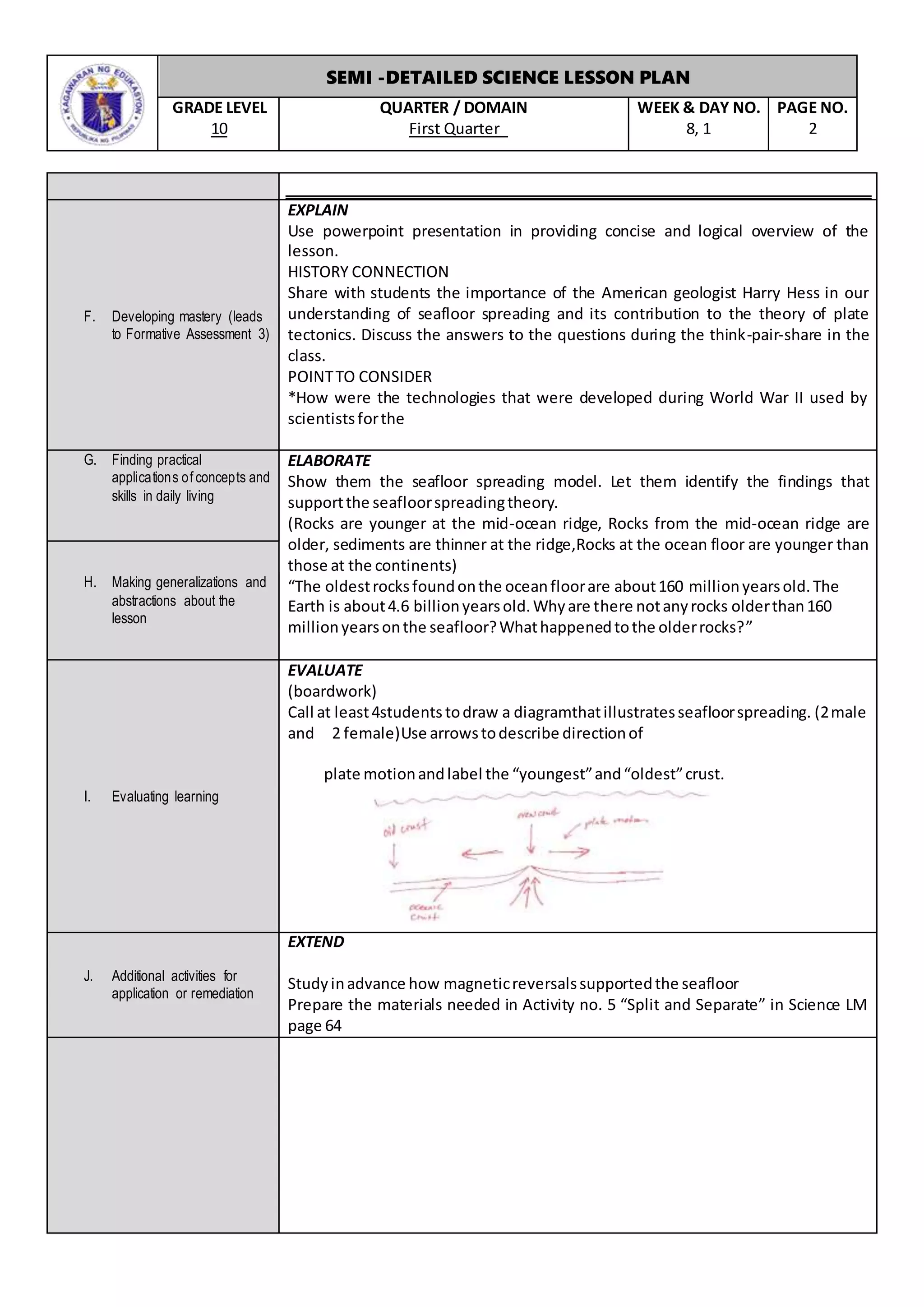
• Describe how seafloorspreadinghappens
• Explainhow drill samplesprovedthatseafloorisspreading.
A. Content Standards
The learnersdemonstrate anunderstandingof the relationshipamongthe
locationsof volcanoes,earthquake epicentersandmountainranges
B. Performance Standards
C. Learning Competencies/
Objectives
(Write the LC code)
The learnersshouldbe able to;
describe the possible causesof plate movementand
enumerate the linesof evidence thatsupportplate movement.
S10ES-Ia-j-36.5
S10ES-Ia-j-36.6
II. CONTENT SEAFLOORSPREADINGTHEORY
III. LEARNING RESOURCES
A. References
1. Teacher’s Guide pages
2. Learner’s Materials pages pp.61-62
3. Textbook pages
4. Additional Materials from
Learning Resource (LR)
portal
Plate TectonicsModule downloadedfromLRMDS( page 7)
B. Other Learning Resources
http://education.sdsc.edu/optiputer/flash/seafloorspread.htm
https://www.youtube.com/watch?v=ZzvDlP6xd9o
https://www.nationalgeographic.org/encyclopedia/seafloor-spreading/
IV. PROCEDURES
A. Reviewing previous lesson
or presenting the new
lesson
ELICIT
Whatis divergentplateboundary?
When does subduction occur?
Differentiatemid-oceanicridgefromdeep sea trenches.
Tell studentsthatthediscovery of these physicalfeatureshelped provethat
seaflooris spreading.
B. Establishing a purpose for
the lesson
ENGAGE
Introduce seafloor spreading by showing students the animation at the following
URL. http://education.sdsc.edu/optiputer/flash/seafloorspread.htm
Challenge students to describe what they are observing. (Magma is erupting onto
the ocean floor and the ocean floor is moving away from both sides of the
eruption)
C. Presenting
examples/instances of the
new lesson
D. Discussing new concepts
and practicing new skills #1
EXPLORE
Showa videoaboutseafloorspreading.
Do a think-pair-share activityforseafloorspreading.Ask studentstothinkabout
the ff.questionswhile watchingthe video
(https://www.youtube.com/watch?v=ZzvDlP6xd9o)
Askpartnersto share theirideasaboutthe answers.
1. What is seafloorspreading?
2. What is formedat the mid-oceanridges?
3. Where is the oceaniccrust destroyed?
4. How many inchesdoesthe seafloorspreadseveryyear?
Give them5-10 minutestodiscuss.
E. Discussing new concepts
and practicing new skills #2
SEMI -DETAILED SCIENCE LESSON PLAN
GRADE LEVEL
10
QUARTER / DOMAIN
First Quarter
WEEK & DAY NO.
8, 1
PAGE NO.
2
F. Developing mastery (leads
to Formative Assessment 3)
EXPLAIN
Use powerpoint presentation in providing concise and logical overview of the
lesson.
HISTORY CONNECTION
Share with students the importance of the American geologist Harry Hess in our
understanding of seafloor spreading and its contribution to the theory of plate
tectonics. Discuss the answers to the questions during the think-pair-share in the
class.
POINTTO CONSIDER
*How were the technologies that were developed during World War II used by
scientistsforthe
G. Finding practical
applications of concepts and
skills in daily living
ELABORATE
Show them the seafloor spreading model. Let them identify the findings that
supportthe seafloorspreadingtheory.
(Rocks are younger at the mid-ocean ridge, Rocks from the mid-ocean ridge are
older, sediments are thinner at the ridge,Rocks at the ocean floor are younger than
those at the continents)
“The oldestrocksfoundonthe oceanfloorare about160 millionyearsold.The
Earth is about4.6 billionyearsold.Whyare there notanyrocks olderthan160
millionyearsonthe seafloor?Whathappenedtothe olderrocks?”
H. Making generalizations and
abstractions about the
lesson
I. Evaluating learning
EVALUATE
(boardwork)
Call at least4students todraw a diagramthatillustratesseafloorspreading. (2male
and 2 female)Use arrowstodescribe directionof
plate motionandlabel the “youngest”and“oldest”crust.
J. Additional activities for
application or remediation
EXTEND
Studyinadvance how magneticreversalssupportedthe seafloor
Prepare the materials needed in Activity no. 5 “Split and Separate” in Science LM
page 64
SEMI -DETAILED SCIENCE LESSON PLAN
GRADE LEVEL
10
QUARTER / DOMAIN
First Quarter
WEEK & DAY NO.
8, 1
PAGE NO.
3
V. REMARKS
VI. REFLECTION
A. No. of learners who earned 80% in the evaluation
B. No. of learners who require additional activities for remediation
C. Did the remedial lessons work? No. of learners who have caught up with the
lesson
D. No. of learners who continue to require remediation
E. Which of my teaching strategies worked well? Why did these work?
F. What difficulties did I encounter which my principal or supervisor can help me
solve?
G. What innovation or localized materials did I use/discover which I wish to share
with other teachers?
DEMONSTRATION TEACHER:
DARYL F. CADANILLA
TeacherII
Noted:
JACQUELINEB. BETE
Master TeacherII –Science
SEMI -DETAILED SCIENCE LESSON PLAN
GRADE LEVEL
10
QUARTER / DOMAIN
First Quarter
WEEK & DAY NO.
8, 1
PAGE NO.
4
“DriftedSupercontinent”
Objective: Reconstruct Pangaea
Procedure:
1.) Refer to the displayedpresent worldmap.
2.) Each cut-outcontinents has already labelinit.
3.)Pastethecut-outcontinents in a long
bondpaper in their respectivepositions.
4.) Continents mustbe closer toeachother torecreatea
Pangaea.
5.) Questionprovidedmust bediscussed within the group.
*Which continentdo youthink wereneighbors before?
6.)Write your group number , members , andanswerto the
question on the space availableat thefrontofbondpaper.
“DriftedSupercontinent”
Objective: Reconstruct Pangaea
Procedure:
1.) Refer to the displayedpresent worldmap.
2.) Each cut-outcontinents has already labelinit.
3.)Pastethecut-outcontinents in a long
bondpaper in their respectivepositions.
4.) Continents mustbe closer toeachother torecreatea
Pangaea.
5.) Questionprovidedmust bediscussed within the group.
*Which continentdo youthink wereneighbors before?
6.)Write your group number , members , andanswerto the
question on the space availableat thefrontofbondpaper.
“DriftedSupercontinent”
Objective: Reconstruct Pangaea
Procedure:
1.) Refer to the displayedpresent worldmap.
2.) Each cut-outcontinents has already labelinit.
3.)Pastethecut-outcontinents in a long
bondpaper in their respectivepositions.
4.) Continents mustbe closer toeachother torecreatea
Pangaea.
5.) Questionprovidedmust bediscussed within the group.
*Which continentdo youthink wereneighbors before?
6.)Write your group number , members , andanswerto the
question on the space availableat thefrontofbondpaper.
“DriftedSupercontinent”
Objective: Reconstruct Pangaea
Procedure:
1.) Refer to the displayedpresent worldmap.
2.) Each cut-outcontinents has already labelinit.
3.)Pastethecut-outcontinents in a long
bondpaper in their respectivepositions.
4.) Continents mustbe closer toeachother torecreatea
Pangaea.
5.) Questionprovidedmust bediscussed within the group.
*Which continentdo youthink wereneighbors before?
6.)Write your group number , members , andanswerto the
question on the space availableat thefrontofbondpaper.
“DriftedSupercontinent”
Objective: Reconstruct Pangaea
Procedure:
1.) Refer to the displayedpresent worldmap.
2.) Each cut-outcontinents has already labelinit.
3.)Pastethecut-outcontinents in a long
bondpaper in their respectivepositions.
4.) Continents mustbe closer toeachother torecreatea
Pangaea.
5.) Questionprovidedmust bediscussed within the group.
What does the presence of Mesosaurus, Cynognathus and
Lystrosaurus tells about the initial location and positioning of
South America and Africa?
6.)Write your group number , members , andanswerto the
question on the space availableat thefrontofbondpaper.
“DriftedSupercontinent”
Objective: Reconstruct Pangaea
Procedure:
1.) Refer to the displayedpresent worldmap.
2.) Each cut-outcontinents has already labelinit.
3.)Pastethecut-outcontinents in a long
bondpaper in their respectivepositions.
4.) Continents mustbe closer toeachother torecreatea
Pangaea.
5.) Questionprovidedmust bediscussed within the group.
What does the presence of Mesosaurus, Cynognathus and
Lystrosaurus tells about the initial location and positioning of
South America and Africa?
6.)Write your group number , members , andanswerto the
question on the space availableat thefrontofbondpaper.
“DriftedSupercontinent”
Objective: Reconstruct Pangaea
Procedure:
1.) Refer to the displayedpresent worldmap.
2.) Each cut-outcontinents has already labelinit.
3.)Pastethecut-outcontinents in a long
bondpaper in their respectivepositions.
4.) Continents mustbe closer toeachother torecreatea
Pangaea.
5.) Questionprovidedmust bediscussed within the group.
What does the presence of Mesosaurus, Cynognathus and
Lystrosaurus tells about the initial location and positioning of
South America and Africa?
6.)Write your group number , members , andanswerto the
question on the space availableat thefrontofbondpaper.
“DriftedSupercontinent”
Objective: Reconstruct Pangaea
Procedure:
1.) Refer to the displayedpresent worldmap.
2.) Each cut-outcontinents has already labelinit.
3.)Pastethecut-outcontinents in a long
bondpaper in their respectivepositions.
4.) Continents mustbe closer toeachother torecreatea
Pangaea.
5.) Questionprovidedmust bediscussed within the group.
What does the presence of Mesosaurus, Cynognathus and
Lystrosaurus tells about the initial location and positioning of
South America and Africa?
6.)Write your group number , members , andanswerto the
question on the space availableat thefrontofbondpaper.
SEMI -DETAILED SCIENCE LESSON PLAN
GRADE LEVEL
10
QUARTER / DOMAIN
First Quarter
WEEK & DAY NO.
8, 1
PAGE NO.
5
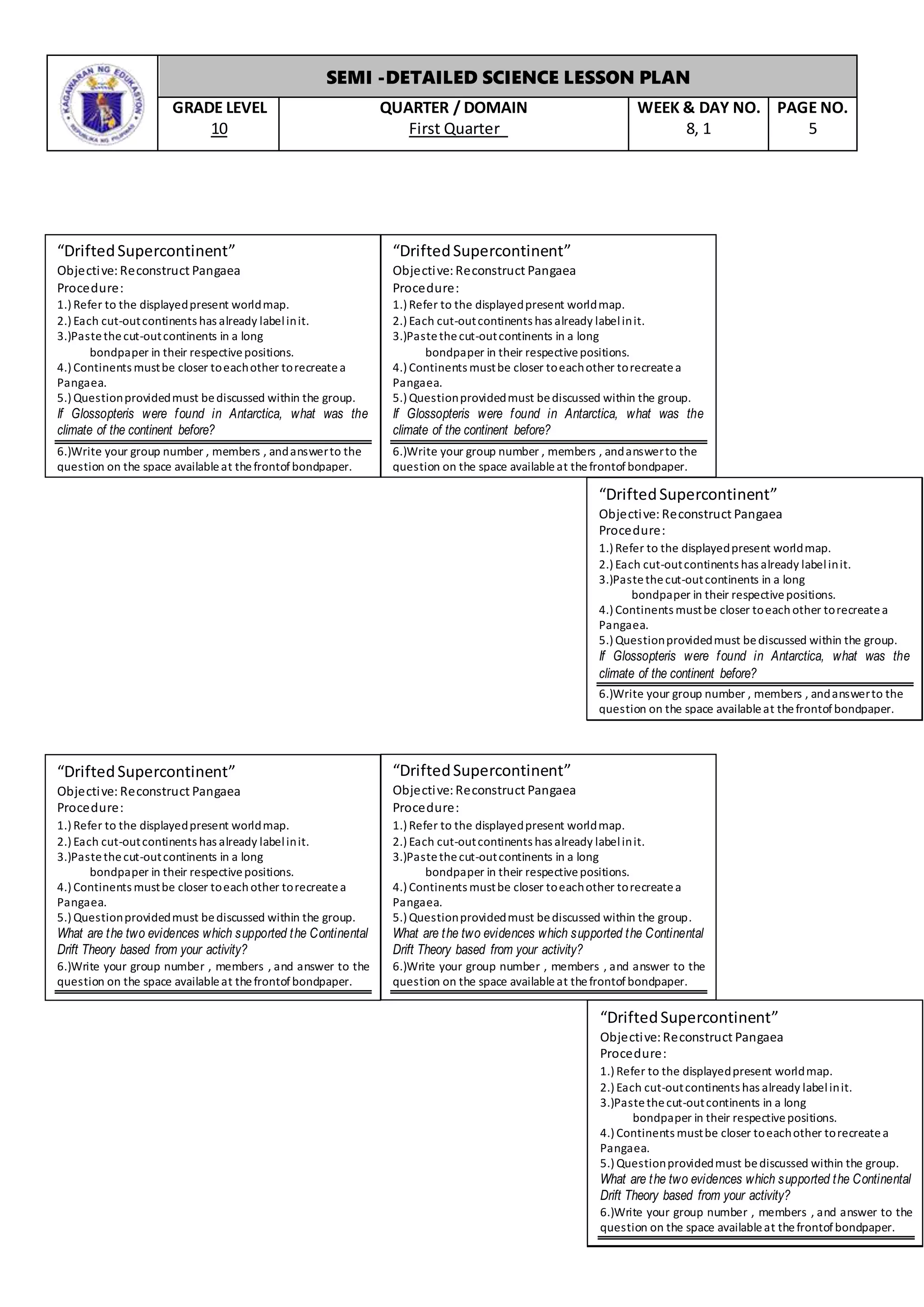
“DriftedSupercontinent”
Objective: Reconstruct Pangaea
Procedure:
1.) Refer to the displayedpresent worldmap.
2.) Each cut-outcontinents has already labelinit.
3.)Pastethecut-outcontinents in a long
bondpaper in their respectivepositions.
4.) Continents mustbe closer toeachother torecreatea
Pangaea.
5.) Questionprovidedmust bediscussed within the group.
If Glossopteris were found in Antarctica, what was the
climate of the continent before?
6.)Write your group number , members , andanswerto the
question on the space availableat thefrontofbondpaper.
“DriftedSupercontinent”
Objective: Reconstruct Pangaea
Procedure:
1.) Refer to the displayedpresent worldmap.
2.) Each cut-outcontinents has already labelinit.
3.)Pastethecut-outcontinents in a long
bondpaper in their respectivepositions.
4.) Continents mustbe closer toeachother torecreatea
Pangaea.
5.) Questionprovidedmust bediscussed within the group.
If Glossopteris were found in Antarctica, what was the
climate of the continent before?
6.)Write your group number , members , andanswerto the
question on the space availableat thefrontofbondpaper.
“DriftedSupercontinent”
Objective: Reconstruct Pangaea
Procedure:
1.) Refer to the displayedpresent worldmap.
2.) Each cut-outcontinents has already labelinit.
3.)Pastethecut-outcontinents in a long
bondpaper in their respectivepositions.
4.) Continents mustbe closer toeachother torecreatea
Pangaea.
5.) Questionprovidedmust bediscussed within the group.
If Glossopteris were found in Antarctica, what was the
climate of the continent before?
6.)Write your group number , members , andanswerto the
question on the space availableat thefrontofbondpaper.
“DriftedSupercontinent”
Objective: Reconstruct Pangaea
Procedure:
1.) Refer to the displayedpresent worldmap.
2.) Each cut-outcontinents has already labelinit.
3.)Pastethecut-outcontinents in a long
bondpaper in their respectivepositions.
4.) Continents mustbe closer toeachother torecreatea
Pangaea.
5.) Questionprovidedmust bediscussed within the group.
If Glossopteris were found in Antarctica, what was the
climate of the continent before?
6.)Write your group number , members , andanswerto the
question on the space availableat thefrontofbondpaper.
“DriftedSupercontinent”
Objective: Reconstruct Pangaea
Procedure:
1.) Refer to the displayedpresent worldmap.
2.) Each cut-outcontinents has already labelinit.
3.)Pastethecut-outcontinents in a long
bondpaper in their respectivepositions.
4.) Continents mustbe closer toeachother torecreatea
Pangaea.
5.) Questionprovidedmust bediscussed within the group.
What are the two evidences which supported the Continental
Drift Theory based from your activity?
6.)Write your group number , members , and answer to the
question on the space availableat thefrontofbondpaper.
“DriftedSupercontinent”
Objective: Reconstruct Pangaea
Procedure:
1.) Refer to the displayedpresent worldmap.
2.) Each cut-outcontinents has already labelinit.
3.)Pastethecut-outcontinents in a long
bondpaper in their respectivepositions.
4.) Continents mustbe closer toeachother torecreatea
Pangaea.
5.) Questionprovidedmust bediscussed within the group.
What are the two evidences which supported the Continental
Drift Theory based from your activity?
6.)Write your group number , members , and answer to the
question on the space availableat thefrontofbondpaper.
“DriftedSupercontinent”
Objective: Reconstruct Pangaea
Procedure:
1.) Refer to the displayedpresent worldmap.
2.) Each cut-outcontinents has already labelinit.
3.)Pastethecut-outcontinents in a long
bondpaper in their respectivepositions.
4.) Continents mustbe closer toeachother torecreatea
Pangaea.
5.) Questionprovidedmust bediscussed within the group.
What are the two evidences which supported the Continental
Drift Theory based from your activity?
6.)Write your group number , members , and answer to the
question on the space availableat thefrontofbondpaper.
“DriftedSupercontinent”
Objective: Reconstruct Pangaea
Procedure:
1.) Refer to the displayedpresent worldmap.
2.) Each cut-outcontinents has already labelinit.
3.)Pastethecut-outcontinents in a long
bondpaper in their respectivepositions.
4.) Continents mustbe closer toeachother torecreatea
Pangaea.
5.) Questionprovidedmust bediscussed within the group.
What are the two evidences which supported the Continental
Drift Theory based from your activity?
6.)Write your group number , members , and answer to the
question on the space availableat thefrontofbondpaper.
SEMI -DETAILED SCIENCE LESSON PLAN
GRADE LEVEL
10
QUARTER / DOMAIN
First Quarter
WEEK & DAY NO.
8, 1
PAGE NO.
6
SEMI -DETAILED SCIENCE LESSON PLAN
GRADE LEVEL
10
QUARTER / DOMAIN
First Quarter
WEEK & DAY NO.
8, 1
PAGE NO.
7
SEMI -DETAILED SCIENCE LESSON PLAN
GRADE LEVEL
10
QUARTER / DOMAIN
First Quarter
WEEK & DAY NO.
8, 1
PAGE NO.
8
I. OBJECTIVES
At the endof the one – hour period,the studentsshouldbe able to:
• Describe the qualitative and quantitative relationships between
the pressure and temperature of a gas.
•Calculate pressure and temperature values when a gas is kept at a constant
volume.
• ApplyGay-Lussac’sLaw to real life situations
D. Content Standards
The learnersdemonstrate anunderstandingof how gasesbehave basedonthe
motionandrelative distancesbetweengasparticles
E. Performance Standards
The learnersshall be able tosolve problemsusingthe equationof Gay -Lussac’s
Law
F. Learning Competencies/
Objectives
(Write the LC code)
The learnersshouldbe able toinvestigatethe relationshipbetweenpressure and
temperature of gasparticleswhenvolumeisconstant
S10ES-Ia-j-36.5
II. CONTENT GAY-LUSSAC’SLAW
III. LEARNING RESOURCES
C. References
1. Teacher’s Guide pages pp.38-39
2. Learner’s Materials pages pp.53-61
3. Textbook pages
4. Additional Materials from
Learning Resource (LR)
portal
D. Other Learning Resources https://betterlesson.com/lesson/631791/gay-lussac-s-law
IV. PROCEDURES
K. Reviewing previous lesson
or presenting the new
lesson
ELICIT
Show videos about real-life applications of Gay-Lussac’s Law.
Firing a bullet.
Heating a closed aerosol can.
A burning automobile tire.
Tell them that all of these shows a correlation between pressure
SEMI -DETAILED SCIENCE LESSON PLAN
GRADE LEVEL
10
QUARTER / DOMAIN
First Quarter
WEEK & DAY NO.
8, 1
PAGE NO.
9
and temperature and can be explained using the next Gas Law;
Gay Lussac’s Law.
L. Establishing a purpose for
the lesson
ENGAGE
Students observe a demonstration of Gay-Lussac’s law. A
hard-boiled egg is forced into an Erlenmeyer flask by cooling the air
inside to alter the air pressure inside the flask. Teacher will discuss
the effects of flexible and rigid containers on the pressure, volume,
and temperature of a gas sample.
Materials:
 hard-boiled egg, shelled
 1000 mL Erlenmeyer flask
 water
 hot plate
 bunsen burner or hair dryer (optional)
Set up(Teacher)
Prepare hard-boiled eggs the night before class. . Place a bit of
water in the flask and the shelled egg on top of the opening before
students walk in.
Before students enter the class, have the egg and bottle set up in
front and the following prompt on the board,
"Examine the egg and bottle setup. How could you use gas pressure
to get the egg into the bottle? What variables would you change:
pressure, volume, and/or temperature? Draw an image of the
egg/bottle set up and annotate your drawing to support your
ideas."
Give students 8-10 minutes think, write/draw and then call on
students to share their ideas on how to get the egg in the bottle.
Some questions may be asked to push student thinking could be:
*How would you get the egg into the bottle using gas pressure?
* *What happens to the gas inside the bottle when it is cooled?
* *What force might push the egg into the bottle?
M. Presenting
examples/instances of the
new lesson
N. Discussing new concepts EXPLORE
SEMI -DETAILED SCIENCE LESSON PLAN
GRADE LEVEL
10
QUARTER / DOMAIN
First Quarter
WEEK & DAY NO.
8, 1
PAGE NO.
10
and practicing new skills #1 (Teacher)
Demonstrate how differences in gas pressure canbe used to force
an egg into a bottle.
Add 5ml of water to the flask and heat the flask on the hot plate for
several minutes. Be sure to add enough water so it does not all
evaporate. Take the flask off of the hot plate with beaker tongs
when you see steam coming out of the flask.
Place the hard-boiled egg on the opening of the flask so it makes a
seal. Observe what happens as the air inside the flask cools (the egg
gets pushed into the flask).
Speed up the process by placing the flask in cool water or ice
water.
Ask students to explain what they think happened.
Ask students how they could use gas pressure to get the egg back
out of the flask. Listen to their suggestions. Then turn the flask
upside down so that the egg falls into the opening. Hold the flask so
that it is tipped sideways, and reheat the flask on the bottom until
the egg is pushed back out of the flask. A Bunsen burner works best
for this last procedure, but hot plate or a blow dryer canbe used.
O. Discussing new concepts
and practicing new skills #2
P. Developing mastery (leads
to Formative Assessment 3)
EXPLAIN
Ask students to explain what is happening. Have them explain what
they think caused the egg to go into the flask. The egg was pushed,
not sucked, into the flask. Explain what this means.
As the gas inside the flask cools,the pressure of the gas inside the
flask decreases. Because the air pressure decreases inside the flask,
the force onthe egg exerted by the air outside the flask is greater
than the force exerted on the egg by the air inside the flask. When
the difference becomes great enough, the egg is pushed into the
flask. The change in gas pressure happens both because gas
pressure is proportional to temperature and because some of the
water vapor in the flask becomes a liquid. Notice that the egg is not
“sucked” into the flask. It is pushed into the flask by the higher air
pressure outside the flask. Gaseous molecules cannot “suck.”
A key point to stress here is that pressure is proportional to
temperature if the volume and amount of gas are not changed and
SEMI -DETAILED SCIENCE LESSON PLAN
GRADE LEVEL
10
QUARTER / DOMAIN
First Quarter
WEEK & DAY NO.
8, 1
PAGE NO.
11
if the temperature is expressed in kelvins. This is Gay-Lussac's law.
k=P/T
P1T2=P2T1
Give students some an opportunity to practice working with the formula for
Gay-Lussac's Law.
Hand out the student worksheet and work together to solve the first few
problems as a class before turning them loose to work independently.
Q. Finding practical
applications of concepts and
skills in daily living
ELABORATE
Let the students recall the videos shown at the start of the class. Call students to
discussthe conceptineach videos.
*Firinga bullet
HOwdoesthe bulletforcesoutfrombarrel of the gun?
*Heatinga closedaerosol can
Why doesthe aerosol canscarry “Do notincinerate.”warninglabel?
R. Making generalizations and
abstractions about the
lesson
S. Evaluating learning
EVALUATE
1. If a gas with a pressure of 6 atmospheres is cooled
from 500 K to 250 K, what happens to its final
pressure? (halved)
2. What should remain constant to use Gay-Lussac’s
Law?
3.
T. Additional activities for
application or remediation
EXTEND
Unfortunately, Wegener’s theory was not accepted until 1960’s because he had not
explained the reason behind the drifting of the continents. Why do continents
move then?
V. REMARKS
VI. REFLECTION
H. No. of learners who earned 80% in the evaluation
I. No. of learners who require additional activities for remediation
J. Did the remedial lessons work? No. of learners who have caught up with the
lesson
K. No. of learners who continue to require remediation
L. Which of my teaching strategies worked well? Why did these work?
M. What difficulties did I encounter which my principal or supervisor can help me
solve?
N. What innovation or localized materials did I use/discover which I wish to share
with other teachers?
SEMI -DETAILED SCIENCE LESSON PLAN
GRADE LEVEL
10
QUARTER / DOMAIN
First Quarter
WEEK & DAY NO.
8, 1
PAGE NO.
12
DEMONSTRATION TEACHER:
DARYL F. CADANILLA
TeacherII
Noted:
JACQUELINEB. BETE
Master TeacherII -Science
P1T2=P2T1
SEMI -DETAILED SCIENCE LESSON PLAN
GRADE LEVEL
10
QUARTER / DOMAIN
First Quarter
WEEK & DAY NO.
8, 1
PAGE NO.
13
I. OBJECTIVES
At the endof the one – hour period,the studentsshouldbe able to:
• Describe the qualitative and quantitative relationships between
the pressure and temperature of a gas.
•Calculate pressure and temperature values when a gas is kept at a constant
volume.
• ApplyGay-Lussac’sLaw to real life situations
G. Content Standards
The learnersdemonstrate anunderstanding of how gasesbehave basedonthe
motionandrelative distancesbetweengasparticles
H. Performance Standards
The learnersshall be able tosolve problemsusingthe equationof Gay -Lussac’s
Law
I. Learning Competencies/
Objectives
(Write the LC code)
The learnersshouldbe able toinvestigatethe relationshipbetweenpressure and
temperature of gasparticleswhenvolumeisconstant
S10ES-Ia-j-36.5
II. CONTENT GAY-LUSSAC’SLAW
SEMI -DETAILED SCIENCE LESSON PLAN
GRADE LEVEL
10
QUARTER / DOMAIN
First Quarter
WEEK & DAY NO.
8, 1
PAGE NO.
14
III. LEARNING RESOURCES
E. References
1. Teacher’s Guide pages pp. 38-39
2. Learner’s Materials pages pp.53-61
3. Textbook pages
4. Additional Materials from
Learning Resource (LR)
portal
F. Other Learning Resources https://betterlesson.com/lesson/631791/gay-lussac-s-law
IV. PROCEDURES
U. Reviewing previous lesson
or presenting the new
lesson
ELICIT
Show videos about real-life applications of Gay-Lussac’s Law.
Firing a bullet.
Heating a closed aerosol can.
A burning automobile tire.
Tell them that all of these shows a correlation between pressure
and temperature and can be explained using the next Gas Law;
Gay Lussac’s Law.
V. Establishing a purpose for
the lesson
ENGAGE
Students observe a demonstration of Gay-Lussac’s law. A
hard-boiled egg is forced into an Erlenmeyer flask by cooling the air
inside to alter the air pressure inside the flask. Teacher will discuss
the effects of flexible and rigid containers on the pressure, volume,
and temperature of a gas sample.
Materials:
 hard-boiled egg, shelled
 1000 mL Erlenmeyer flask
 water
 hot plate
 bunsen burner or hair dryer (optional)
Set up(Teacher)
Prepare hard-boiled eggs the night before class. . Place a bit of
water in the flask and the shelled egg on top of the opening before
students walk in.
Before students enter the class, have the egg and bottle set up in
W. Presenting
examples/instances of the
new lesson
SEMI -DETAILED SCIENCE LESSON PLAN
GRADE LEVEL
10
QUARTER / DOMAIN
First Quarter
WEEK & DAY NO.
8, 1
PAGE NO.
15
front and the following prompt on the board,
"Examine the egg and bottle setup. How could you use gas pressure
to get the egg into the bottle? What variables would you change:
pressure, volume, and/or temperature? Draw an image of the
egg/bottle set up and annotate your drawing to support your
ideas."
Give students 8-10 minutes think, write/draw and then call on
students to share their ideas on how to get the egg in the bottle.
Some questions may be asked to push student thinking could be:
*How would you get the egg into the bottle using gas pressure?
* *What happens to the gas inside the bottle when it is cooled?
* *What force might push the egg into the bottle?
X. Discussing new concepts
and practicing new skills #1
EXPLORE
(Teacher)
Demonstrate how differences in gas pressure canbe used to force
an egg into a bottle.
Add 5ml of water to the flask and heat the flask on the hot plate for
several minutes. Be sure to add enough water so it does not all
evaporate. Take the flask off of the hot plate with beaker tongs
when you see steam coming out of the flask.
Place the hard-boiled egg on the opening of the flask so it makes a
seal. Observe what happens as the air inside the flask cools (the egg
gets pushed into the flask).
Speed up the process by placing the flask in cool water or ice
water.
Ask students to explain what they think happened.
Ask students how they could use gas pressure to get the egg back
out of the flask. Listen to their suggestions. Then turn the flask
upside down so that the egg falls into the opening. Hold the flask so
that it is tipped sideways, and reheat the flask on the bottom until
the egg is pushed back out of the flask. A Bunsen burner works best
for this last procedure, but hot plate or a blow dryer canbe used.
Y. Discussing new concepts
and practicing new skills #2
Z. Developing mastery (leads
to Formative Assessment 3)
EXPLAIN
SEMI -DETAILED SCIENCE LESSON PLAN
GRADE LEVEL
10
QUARTER / DOMAIN
First Quarter
WEEK & DAY NO.
8, 1
PAGE NO.
16
Ask students to explain what is happening. Have them explain what
they think caused the egg to go into the flask. The egg was pushed,
not sucked, into the flask. Explain what this means.
As the gas inside the flask cools,the pressure of the gas inside the
flask decreases. Because the air pressure decreases inside the flask,
the force onthe egg exerted by the air outside the flask is greater
than the force exerted on the egg by the air inside the flask. When
the difference becomes great enough, the egg is pushed into the
flask. The change in gas pressure happens both because gas
pressure is proportional to temperature and because some of the
water vapor in the flask becomes a liquid. Notice that the egg is not
“sucked” into the flask. It is pushed into the flask by the higher air
pressure outside the flask. Gaseous molecules cannot “suck.”
A key point to stress here is that pressure is proportional to
temperature if the volume and amount of gas are not changed and
if the temperature is expressed in kelvins. This is Gay-Lussac's law.
k=P/T
P1T2=P2T1
Give students some an opportunity to practice working with the formula for
Gay-Lussac's Law.
Hand out the student worksheet and work together to solve the first few
problems as a class before turning them loose to work independently.
AA. Finding practical
applications of concepts and
skills in daily living
ELABORATE
Let the students recall the videos shown at the start of the class. Call students to
discussthe conceptineach videos.
*Firinga bullet
HOwdoesthe bulletforcesoutfrombarrel of the gun?
*Heatinga closedaerosol can
Why doesthe aerosol canscarry “Do notincinerate.”warninglabel?
BB. Making generalizations and
abstractions about the
lesson
CC. Evaluating learning
EVALUATE
4. If a gas with a pressure of 6 atmospheres is cooled
from 500 K to 250 K, what happens to its final
pressure? (halved)
5. What should remain constant to use Gay-Lussac’s
Law?
SEMI -DETAILED SCIENCE LESSON PLAN
GRADE LEVEL
10
QUARTER / DOMAIN
First Quarter
WEEK & DAY NO.
8, 1
PAGE NO.
17
6.
DD. Additional activities for
application or remediation
EXTEND
Unfortunately, Wegener’s theory was not accepted until 1960’s because he had not
explained the reason behind the drifting of the continents. Why do continents
move then?
V. REMARKS
VI. REFLECTION
O. No. of learners who earned 80% in the evaluation
P. No. of learners who require additional activities for remediation
Q. Did the remedial lessons work? No. of learners who have caught up with the
lesson
R. No. of learners who continue to require remediation
S. Which of my teaching strategies worked well? Why did these work?
T. What difficulties did I encounter which my principal or supervisor can help me
solve?
U. What innovation or localized materials did I use/discover which I wish to share
with other teachers?
DEMONSTRATION TEACHER:
DARYL F. CADANILLA
TeacherII
Noted:
JACQUELINEB. BETE
Master TeacherII -Science
P1T2=P2T1
SEMI -DETAILED SCIENCE LESSON PLAN
GRADE LEVEL
10
QUARTER / DOMAIN
First Quarter
WEEK & DAY NO.
8, 1
PAGE NO.
18

seafloor spreading theory LP

  • 1.
    SEMI -DETAILED SCIENCELESSON PLAN GRADE LEVEL 10 QUARTER / DOMAIN First Quarter WEEK & DAY NO. 8, 1 PAGE NO. 1 I. OBJECTIVES At the endof the one – hour period,the studentsshouldbe able to: • Describe how seafloorspreadinghappens • Explainhow drill samplesprovedthatseafloorisspreading. A. Content Standards The learnersdemonstrate anunderstandingof the relationshipamongthe locationsof volcanoes,earthquake epicentersandmountainranges B. Performance Standards C. Learning Competencies/ Objectives (Write the LC code) The learnersshouldbe able to; describe the possible causesof plate movementand enumerate the linesof evidence thatsupportplate movement. S10ES-Ia-j-36.5 S10ES-Ia-j-36.6 II. CONTENT SEAFLOORSPREADINGTHEORY III. LEARNING RESOURCES A. References 1. Teacher’s Guide pages 2. Learner’s Materials pages pp.61-62 3. Textbook pages 4. Additional Materials from Learning Resource (LR) portal Plate TectonicsModule downloadedfromLRMDS( page 7) B. Other Learning Resources http://education.sdsc.edu/optiputer/flash/seafloorspread.htm https://www.youtube.com/watch?v=ZzvDlP6xd9o https://www.nationalgeographic.org/encyclopedia/seafloor-spreading/ IV. PROCEDURES A. Reviewing previous lesson or presenting the new lesson ELICIT Whatis divergentplateboundary? When does subduction occur? Differentiatemid-oceanicridgefromdeep sea trenches. Tell studentsthatthediscovery of these physicalfeatureshelped provethat seaflooris spreading. B. Establishing a purpose for the lesson ENGAGE Introduce seafloor spreading by showing students the animation at the following URL. http://education.sdsc.edu/optiputer/flash/seafloorspread.htm Challenge students to describe what they are observing. (Magma is erupting onto the ocean floor and the ocean floor is moving away from both sides of the eruption) C. Presenting examples/instances of the new lesson D. Discussing new concepts and practicing new skills #1 EXPLORE Showa videoaboutseafloorspreading. Do a think-pair-share activityforseafloorspreading.Ask studentstothinkabout the ff.questionswhile watchingthe video (https://www.youtube.com/watch?v=ZzvDlP6xd9o) Askpartnersto share theirideasaboutthe answers. 1. What is seafloorspreading? 2. What is formedat the mid-oceanridges? 3. Where is the oceaniccrust destroyed? 4. How many inchesdoesthe seafloorspreadseveryyear? Give them5-10 minutestodiscuss. E. Discussing new concepts and practicing new skills #2
  • 2.
    SEMI -DETAILED SCIENCELESSON PLAN GRADE LEVEL 10 QUARTER / DOMAIN First Quarter WEEK & DAY NO. 8, 1 PAGE NO. 2 F. Developing mastery (leads to Formative Assessment 3) EXPLAIN Use powerpoint presentation in providing concise and logical overview of the lesson. HISTORY CONNECTION Share with students the importance of the American geologist Harry Hess in our understanding of seafloor spreading and its contribution to the theory of plate tectonics. Discuss the answers to the questions during the think-pair-share in the class. POINTTO CONSIDER *How were the technologies that were developed during World War II used by scientistsforthe G. Finding practical applications of concepts and skills in daily living ELABORATE Show them the seafloor spreading model. Let them identify the findings that supportthe seafloorspreadingtheory. (Rocks are younger at the mid-ocean ridge, Rocks from the mid-ocean ridge are older, sediments are thinner at the ridge,Rocks at the ocean floor are younger than those at the continents) “The oldestrocksfoundonthe oceanfloorare about160 millionyearsold.The Earth is about4.6 billionyearsold.Whyare there notanyrocks olderthan160 millionyearsonthe seafloor?Whathappenedtothe olderrocks?” H. Making generalizations and abstractions about the lesson I. Evaluating learning EVALUATE (boardwork) Call at least4students todraw a diagramthatillustratesseafloorspreading. (2male and 2 female)Use arrowstodescribe directionof plate motionandlabel the “youngest”and“oldest”crust. J. Additional activities for application or remediation EXTEND Studyinadvance how magneticreversalssupportedthe seafloor Prepare the materials needed in Activity no. 5 “Split and Separate” in Science LM page 64
  • 3.
    SEMI -DETAILED SCIENCELESSON PLAN GRADE LEVEL 10 QUARTER / DOMAIN First Quarter WEEK & DAY NO. 8, 1 PAGE NO. 3 V. REMARKS VI. REFLECTION A. No. of learners who earned 80% in the evaluation B. No. of learners who require additional activities for remediation C. Did the remedial lessons work? No. of learners who have caught up with the lesson D. No. of learners who continue to require remediation E. Which of my teaching strategies worked well? Why did these work? F. What difficulties did I encounter which my principal or supervisor can help me solve? G. What innovation or localized materials did I use/discover which I wish to share with other teachers? DEMONSTRATION TEACHER: DARYL F. CADANILLA TeacherII Noted: JACQUELINEB. BETE Master TeacherII –Science
  • 4.
    SEMI -DETAILED SCIENCELESSON PLAN GRADE LEVEL 10 QUARTER / DOMAIN First Quarter WEEK & DAY NO. 8, 1 PAGE NO. 4 “DriftedSupercontinent” Objective: Reconstruct Pangaea Procedure: 1.) Refer to the displayedpresent worldmap. 2.) Each cut-outcontinents has already labelinit. 3.)Pastethecut-outcontinents in a long bondpaper in their respectivepositions. 4.) Continents mustbe closer toeachother torecreatea Pangaea. 5.) Questionprovidedmust bediscussed within the group. *Which continentdo youthink wereneighbors before? 6.)Write your group number , members , andanswerto the question on the space availableat thefrontofbondpaper. “DriftedSupercontinent” Objective: Reconstruct Pangaea Procedure: 1.) Refer to the displayedpresent worldmap. 2.) Each cut-outcontinents has already labelinit. 3.)Pastethecut-outcontinents in a long bondpaper in their respectivepositions. 4.) Continents mustbe closer toeachother torecreatea Pangaea. 5.) Questionprovidedmust bediscussed within the group. *Which continentdo youthink wereneighbors before? 6.)Write your group number , members , andanswerto the question on the space availableat thefrontofbondpaper. “DriftedSupercontinent” Objective: Reconstruct Pangaea Procedure: 1.) Refer to the displayedpresent worldmap. 2.) Each cut-outcontinents has already labelinit. 3.)Pastethecut-outcontinents in a long bondpaper in their respectivepositions. 4.) Continents mustbe closer toeachother torecreatea Pangaea. 5.) Questionprovidedmust bediscussed within the group. *Which continentdo youthink wereneighbors before? 6.)Write your group number , members , andanswerto the question on the space availableat thefrontofbondpaper. “DriftedSupercontinent” Objective: Reconstruct Pangaea Procedure: 1.) Refer to the displayedpresent worldmap. 2.) Each cut-outcontinents has already labelinit. 3.)Pastethecut-outcontinents in a long bondpaper in their respectivepositions. 4.) Continents mustbe closer toeachother torecreatea Pangaea. 5.) Questionprovidedmust bediscussed within the group. *Which continentdo youthink wereneighbors before? 6.)Write your group number , members , andanswerto the question on the space availableat thefrontofbondpaper. “DriftedSupercontinent” Objective: Reconstruct Pangaea Procedure: 1.) Refer to the displayedpresent worldmap. 2.) Each cut-outcontinents has already labelinit. 3.)Pastethecut-outcontinents in a long bondpaper in their respectivepositions. 4.) Continents mustbe closer toeachother torecreatea Pangaea. 5.) Questionprovidedmust bediscussed within the group. What does the presence of Mesosaurus, Cynognathus and Lystrosaurus tells about the initial location and positioning of South America and Africa? 6.)Write your group number , members , andanswerto the question on the space availableat thefrontofbondpaper. “DriftedSupercontinent” Objective: Reconstruct Pangaea Procedure: 1.) Refer to the displayedpresent worldmap. 2.) Each cut-outcontinents has already labelinit. 3.)Pastethecut-outcontinents in a long bondpaper in their respectivepositions. 4.) Continents mustbe closer toeachother torecreatea Pangaea. 5.) Questionprovidedmust bediscussed within the group. What does the presence of Mesosaurus, Cynognathus and Lystrosaurus tells about the initial location and positioning of South America and Africa? 6.)Write your group number , members , andanswerto the question on the space availableat thefrontofbondpaper. “DriftedSupercontinent” Objective: Reconstruct Pangaea Procedure: 1.) Refer to the displayedpresent worldmap. 2.) Each cut-outcontinents has already labelinit. 3.)Pastethecut-outcontinents in a long bondpaper in their respectivepositions. 4.) Continents mustbe closer toeachother torecreatea Pangaea. 5.) Questionprovidedmust bediscussed within the group. What does the presence of Mesosaurus, Cynognathus and Lystrosaurus tells about the initial location and positioning of South America and Africa? 6.)Write your group number , members , andanswerto the question on the space availableat thefrontofbondpaper. “DriftedSupercontinent” Objective: Reconstruct Pangaea Procedure: 1.) Refer to the displayedpresent worldmap. 2.) Each cut-outcontinents has already labelinit. 3.)Pastethecut-outcontinents in a long bondpaper in their respectivepositions. 4.) Continents mustbe closer toeachother torecreatea Pangaea. 5.) Questionprovidedmust bediscussed within the group. What does the presence of Mesosaurus, Cynognathus and Lystrosaurus tells about the initial location and positioning of South America and Africa? 6.)Write your group number , members , andanswerto the question on the space availableat thefrontofbondpaper.
  • 5.
    SEMI -DETAILED SCIENCELESSON PLAN GRADE LEVEL 10 QUARTER / DOMAIN First Quarter WEEK & DAY NO. 8, 1 PAGE NO. 5 “DriftedSupercontinent” Objective: Reconstruct Pangaea Procedure: 1.) Refer to the displayedpresent worldmap. 2.) Each cut-outcontinents has already labelinit. 3.)Pastethecut-outcontinents in a long bondpaper in their respectivepositions. 4.) Continents mustbe closer toeachother torecreatea Pangaea. 5.) Questionprovidedmust bediscussed within the group. If Glossopteris were found in Antarctica, what was the climate of the continent before? 6.)Write your group number , members , andanswerto the question on the space availableat thefrontofbondpaper. “DriftedSupercontinent” Objective: Reconstruct Pangaea Procedure: 1.) Refer to the displayedpresent worldmap. 2.) Each cut-outcontinents has already labelinit. 3.)Pastethecut-outcontinents in a long bondpaper in their respectivepositions. 4.) Continents mustbe closer toeachother torecreatea Pangaea. 5.) Questionprovidedmust bediscussed within the group. If Glossopteris were found in Antarctica, what was the climate of the continent before? 6.)Write your group number , members , andanswerto the question on the space availableat thefrontofbondpaper. “DriftedSupercontinent” Objective: Reconstruct Pangaea Procedure: 1.) Refer to the displayedpresent worldmap. 2.) Each cut-outcontinents has already labelinit. 3.)Pastethecut-outcontinents in a long bondpaper in their respectivepositions. 4.) Continents mustbe closer toeachother torecreatea Pangaea. 5.) Questionprovidedmust bediscussed within the group. If Glossopteris were found in Antarctica, what was the climate of the continent before? 6.)Write your group number , members , andanswerto the question on the space availableat thefrontofbondpaper. “DriftedSupercontinent” Objective: Reconstruct Pangaea Procedure: 1.) Refer to the displayedpresent worldmap. 2.) Each cut-outcontinents has already labelinit. 3.)Pastethecut-outcontinents in a long bondpaper in their respectivepositions. 4.) Continents mustbe closer toeachother torecreatea Pangaea. 5.) Questionprovidedmust bediscussed within the group. If Glossopteris were found in Antarctica, what was the climate of the continent before? 6.)Write your group number , members , andanswerto the question on the space availableat thefrontofbondpaper. “DriftedSupercontinent” Objective: Reconstruct Pangaea Procedure: 1.) Refer to the displayedpresent worldmap. 2.) Each cut-outcontinents has already labelinit. 3.)Pastethecut-outcontinents in a long bondpaper in their respectivepositions. 4.) Continents mustbe closer toeachother torecreatea Pangaea. 5.) Questionprovidedmust bediscussed within the group. What are the two evidences which supported the Continental Drift Theory based from your activity? 6.)Write your group number , members , and answer to the question on the space availableat thefrontofbondpaper. “DriftedSupercontinent” Objective: Reconstruct Pangaea Procedure: 1.) Refer to the displayedpresent worldmap. 2.) Each cut-outcontinents has already labelinit. 3.)Pastethecut-outcontinents in a long bondpaper in their respectivepositions. 4.) Continents mustbe closer toeachother torecreatea Pangaea. 5.) Questionprovidedmust bediscussed within the group. What are the two evidences which supported the Continental Drift Theory based from your activity? 6.)Write your group number , members , and answer to the question on the space availableat thefrontofbondpaper. “DriftedSupercontinent” Objective: Reconstruct Pangaea Procedure: 1.) Refer to the displayedpresent worldmap. 2.) Each cut-outcontinents has already labelinit. 3.)Pastethecut-outcontinents in a long bondpaper in their respectivepositions. 4.) Continents mustbe closer toeachother torecreatea Pangaea. 5.) Questionprovidedmust bediscussed within the group. What are the two evidences which supported the Continental Drift Theory based from your activity? 6.)Write your group number , members , and answer to the question on the space availableat thefrontofbondpaper. “DriftedSupercontinent” Objective: Reconstruct Pangaea Procedure: 1.) Refer to the displayedpresent worldmap. 2.) Each cut-outcontinents has already labelinit. 3.)Pastethecut-outcontinents in a long bondpaper in their respectivepositions. 4.) Continents mustbe closer toeachother torecreatea Pangaea. 5.) Questionprovidedmust bediscussed within the group. What are the two evidences which supported the Continental Drift Theory based from your activity? 6.)Write your group number , members , and answer to the question on the space availableat thefrontofbondpaper.
  • 6.
    SEMI -DETAILED SCIENCELESSON PLAN GRADE LEVEL 10 QUARTER / DOMAIN First Quarter WEEK & DAY NO. 8, 1 PAGE NO. 6
  • 7.
    SEMI -DETAILED SCIENCELESSON PLAN GRADE LEVEL 10 QUARTER / DOMAIN First Quarter WEEK & DAY NO. 8, 1 PAGE NO. 7
  • 8.
    SEMI -DETAILED SCIENCELESSON PLAN GRADE LEVEL 10 QUARTER / DOMAIN First Quarter WEEK & DAY NO. 8, 1 PAGE NO. 8 I. OBJECTIVES At the endof the one – hour period,the studentsshouldbe able to: • Describe the qualitative and quantitative relationships between the pressure and temperature of a gas. •Calculate pressure and temperature values when a gas is kept at a constant volume. • ApplyGay-Lussac’sLaw to real life situations D. Content Standards The learnersdemonstrate anunderstandingof how gasesbehave basedonthe motionandrelative distancesbetweengasparticles E. Performance Standards The learnersshall be able tosolve problemsusingthe equationof Gay -Lussac’s Law F. Learning Competencies/ Objectives (Write the LC code) The learnersshouldbe able toinvestigatethe relationshipbetweenpressure and temperature of gasparticleswhenvolumeisconstant S10ES-Ia-j-36.5 II. CONTENT GAY-LUSSAC’SLAW III. LEARNING RESOURCES C. References 1. Teacher’s Guide pages pp.38-39 2. Learner’s Materials pages pp.53-61 3. Textbook pages 4. Additional Materials from Learning Resource (LR) portal D. Other Learning Resources https://betterlesson.com/lesson/631791/gay-lussac-s-law IV. PROCEDURES K. Reviewing previous lesson or presenting the new lesson ELICIT Show videos about real-life applications of Gay-Lussac’s Law. Firing a bullet. Heating a closed aerosol can. A burning automobile tire. Tell them that all of these shows a correlation between pressure
  • 9.
    SEMI -DETAILED SCIENCELESSON PLAN GRADE LEVEL 10 QUARTER / DOMAIN First Quarter WEEK & DAY NO. 8, 1 PAGE NO. 9 and temperature and can be explained using the next Gas Law; Gay Lussac’s Law. L. Establishing a purpose for the lesson ENGAGE Students observe a demonstration of Gay-Lussac’s law. A hard-boiled egg is forced into an Erlenmeyer flask by cooling the air inside to alter the air pressure inside the flask. Teacher will discuss the effects of flexible and rigid containers on the pressure, volume, and temperature of a gas sample. Materials:  hard-boiled egg, shelled  1000 mL Erlenmeyer flask  water  hot plate  bunsen burner or hair dryer (optional) Set up(Teacher) Prepare hard-boiled eggs the night before class. . Place a bit of water in the flask and the shelled egg on top of the opening before students walk in. Before students enter the class, have the egg and bottle set up in front and the following prompt on the board, "Examine the egg and bottle setup. How could you use gas pressure to get the egg into the bottle? What variables would you change: pressure, volume, and/or temperature? Draw an image of the egg/bottle set up and annotate your drawing to support your ideas." Give students 8-10 minutes think, write/draw and then call on students to share their ideas on how to get the egg in the bottle. Some questions may be asked to push student thinking could be: *How would you get the egg into the bottle using gas pressure? * *What happens to the gas inside the bottle when it is cooled? * *What force might push the egg into the bottle? M. Presenting examples/instances of the new lesson N. Discussing new concepts EXPLORE
  • 10.
    SEMI -DETAILED SCIENCELESSON PLAN GRADE LEVEL 10 QUARTER / DOMAIN First Quarter WEEK & DAY NO. 8, 1 PAGE NO. 10 and practicing new skills #1 (Teacher) Demonstrate how differences in gas pressure canbe used to force an egg into a bottle. Add 5ml of water to the flask and heat the flask on the hot plate for several minutes. Be sure to add enough water so it does not all evaporate. Take the flask off of the hot plate with beaker tongs when you see steam coming out of the flask. Place the hard-boiled egg on the opening of the flask so it makes a seal. Observe what happens as the air inside the flask cools (the egg gets pushed into the flask). Speed up the process by placing the flask in cool water or ice water. Ask students to explain what they think happened. Ask students how they could use gas pressure to get the egg back out of the flask. Listen to their suggestions. Then turn the flask upside down so that the egg falls into the opening. Hold the flask so that it is tipped sideways, and reheat the flask on the bottom until the egg is pushed back out of the flask. A Bunsen burner works best for this last procedure, but hot plate or a blow dryer canbe used. O. Discussing new concepts and practicing new skills #2 P. Developing mastery (leads to Formative Assessment 3) EXPLAIN Ask students to explain what is happening. Have them explain what they think caused the egg to go into the flask. The egg was pushed, not sucked, into the flask. Explain what this means. As the gas inside the flask cools,the pressure of the gas inside the flask decreases. Because the air pressure decreases inside the flask, the force onthe egg exerted by the air outside the flask is greater than the force exerted on the egg by the air inside the flask. When the difference becomes great enough, the egg is pushed into the flask. The change in gas pressure happens both because gas pressure is proportional to temperature and because some of the water vapor in the flask becomes a liquid. Notice that the egg is not “sucked” into the flask. It is pushed into the flask by the higher air pressure outside the flask. Gaseous molecules cannot “suck.” A key point to stress here is that pressure is proportional to temperature if the volume and amount of gas are not changed and
  • 11.
    SEMI -DETAILED SCIENCELESSON PLAN GRADE LEVEL 10 QUARTER / DOMAIN First Quarter WEEK & DAY NO. 8, 1 PAGE NO. 11 if the temperature is expressed in kelvins. This is Gay-Lussac's law. k=P/T P1T2=P2T1 Give students some an opportunity to practice working with the formula for Gay-Lussac's Law. Hand out the student worksheet and work together to solve the first few problems as a class before turning them loose to work independently. Q. Finding practical applications of concepts and skills in daily living ELABORATE Let the students recall the videos shown at the start of the class. Call students to discussthe conceptineach videos. *Firinga bullet HOwdoesthe bulletforcesoutfrombarrel of the gun? *Heatinga closedaerosol can Why doesthe aerosol canscarry “Do notincinerate.”warninglabel? R. Making generalizations and abstractions about the lesson S. Evaluating learning EVALUATE 1. If a gas with a pressure of 6 atmospheres is cooled from 500 K to 250 K, what happens to its final pressure? (halved) 2. What should remain constant to use Gay-Lussac’s Law? 3. T. Additional activities for application or remediation EXTEND Unfortunately, Wegener’s theory was not accepted until 1960’s because he had not explained the reason behind the drifting of the continents. Why do continents move then? V. REMARKS VI. REFLECTION H. No. of learners who earned 80% in the evaluation I. No. of learners who require additional activities for remediation J. Did the remedial lessons work? No. of learners who have caught up with the lesson K. No. of learners who continue to require remediation L. Which of my teaching strategies worked well? Why did these work? M. What difficulties did I encounter which my principal or supervisor can help me solve? N. What innovation or localized materials did I use/discover which I wish to share with other teachers?
  • 12.
    SEMI -DETAILED SCIENCELESSON PLAN GRADE LEVEL 10 QUARTER / DOMAIN First Quarter WEEK & DAY NO. 8, 1 PAGE NO. 12 DEMONSTRATION TEACHER: DARYL F. CADANILLA TeacherII Noted: JACQUELINEB. BETE Master TeacherII -Science P1T2=P2T1
  • 13.
    SEMI -DETAILED SCIENCELESSON PLAN GRADE LEVEL 10 QUARTER / DOMAIN First Quarter WEEK & DAY NO. 8, 1 PAGE NO. 13 I. OBJECTIVES At the endof the one – hour period,the studentsshouldbe able to: • Describe the qualitative and quantitative relationships between the pressure and temperature of a gas. •Calculate pressure and temperature values when a gas is kept at a constant volume. • ApplyGay-Lussac’sLaw to real life situations G. Content Standards The learnersdemonstrate anunderstanding of how gasesbehave basedonthe motionandrelative distancesbetweengasparticles H. Performance Standards The learnersshall be able tosolve problemsusingthe equationof Gay -Lussac’s Law I. Learning Competencies/ Objectives (Write the LC code) The learnersshouldbe able toinvestigatethe relationshipbetweenpressure and temperature of gasparticleswhenvolumeisconstant S10ES-Ia-j-36.5 II. CONTENT GAY-LUSSAC’SLAW
  • 14.
    SEMI -DETAILED SCIENCELESSON PLAN GRADE LEVEL 10 QUARTER / DOMAIN First Quarter WEEK & DAY NO. 8, 1 PAGE NO. 14 III. LEARNING RESOURCES E. References 1. Teacher’s Guide pages pp. 38-39 2. Learner’s Materials pages pp.53-61 3. Textbook pages 4. Additional Materials from Learning Resource (LR) portal F. Other Learning Resources https://betterlesson.com/lesson/631791/gay-lussac-s-law IV. PROCEDURES U. Reviewing previous lesson or presenting the new lesson ELICIT Show videos about real-life applications of Gay-Lussac’s Law. Firing a bullet. Heating a closed aerosol can. A burning automobile tire. Tell them that all of these shows a correlation between pressure and temperature and can be explained using the next Gas Law; Gay Lussac’s Law. V. Establishing a purpose for the lesson ENGAGE Students observe a demonstration of Gay-Lussac’s law. A hard-boiled egg is forced into an Erlenmeyer flask by cooling the air inside to alter the air pressure inside the flask. Teacher will discuss the effects of flexible and rigid containers on the pressure, volume, and temperature of a gas sample. Materials:  hard-boiled egg, shelled  1000 mL Erlenmeyer flask  water  hot plate  bunsen burner or hair dryer (optional) Set up(Teacher) Prepare hard-boiled eggs the night before class. . Place a bit of water in the flask and the shelled egg on top of the opening before students walk in. Before students enter the class, have the egg and bottle set up in W. Presenting examples/instances of the new lesson
  • 15.
    SEMI -DETAILED SCIENCELESSON PLAN GRADE LEVEL 10 QUARTER / DOMAIN First Quarter WEEK & DAY NO. 8, 1 PAGE NO. 15 front and the following prompt on the board, "Examine the egg and bottle setup. How could you use gas pressure to get the egg into the bottle? What variables would you change: pressure, volume, and/or temperature? Draw an image of the egg/bottle set up and annotate your drawing to support your ideas." Give students 8-10 minutes think, write/draw and then call on students to share their ideas on how to get the egg in the bottle. Some questions may be asked to push student thinking could be: *How would you get the egg into the bottle using gas pressure? * *What happens to the gas inside the bottle when it is cooled? * *What force might push the egg into the bottle? X. Discussing new concepts and practicing new skills #1 EXPLORE (Teacher) Demonstrate how differences in gas pressure canbe used to force an egg into a bottle. Add 5ml of water to the flask and heat the flask on the hot plate for several minutes. Be sure to add enough water so it does not all evaporate. Take the flask off of the hot plate with beaker tongs when you see steam coming out of the flask. Place the hard-boiled egg on the opening of the flask so it makes a seal. Observe what happens as the air inside the flask cools (the egg gets pushed into the flask). Speed up the process by placing the flask in cool water or ice water. Ask students to explain what they think happened. Ask students how they could use gas pressure to get the egg back out of the flask. Listen to their suggestions. Then turn the flask upside down so that the egg falls into the opening. Hold the flask so that it is tipped sideways, and reheat the flask on the bottom until the egg is pushed back out of the flask. A Bunsen burner works best for this last procedure, but hot plate or a blow dryer canbe used. Y. Discussing new concepts and practicing new skills #2 Z. Developing mastery (leads to Formative Assessment 3) EXPLAIN
  • 16.
    SEMI -DETAILED SCIENCELESSON PLAN GRADE LEVEL 10 QUARTER / DOMAIN First Quarter WEEK & DAY NO. 8, 1 PAGE NO. 16 Ask students to explain what is happening. Have them explain what they think caused the egg to go into the flask. The egg was pushed, not sucked, into the flask. Explain what this means. As the gas inside the flask cools,the pressure of the gas inside the flask decreases. Because the air pressure decreases inside the flask, the force onthe egg exerted by the air outside the flask is greater than the force exerted on the egg by the air inside the flask. When the difference becomes great enough, the egg is pushed into the flask. The change in gas pressure happens both because gas pressure is proportional to temperature and because some of the water vapor in the flask becomes a liquid. Notice that the egg is not “sucked” into the flask. It is pushed into the flask by the higher air pressure outside the flask. Gaseous molecules cannot “suck.” A key point to stress here is that pressure is proportional to temperature if the volume and amount of gas are not changed and if the temperature is expressed in kelvins. This is Gay-Lussac's law. k=P/T P1T2=P2T1 Give students some an opportunity to practice working with the formula for Gay-Lussac's Law. Hand out the student worksheet and work together to solve the first few problems as a class before turning them loose to work independently. AA. Finding practical applications of concepts and skills in daily living ELABORATE Let the students recall the videos shown at the start of the class. Call students to discussthe conceptineach videos. *Firinga bullet HOwdoesthe bulletforcesoutfrombarrel of the gun? *Heatinga closedaerosol can Why doesthe aerosol canscarry “Do notincinerate.”warninglabel? BB. Making generalizations and abstractions about the lesson CC. Evaluating learning EVALUATE 4. If a gas with a pressure of 6 atmospheres is cooled from 500 K to 250 K, what happens to its final pressure? (halved) 5. What should remain constant to use Gay-Lussac’s Law?
  • 17.
    SEMI -DETAILED SCIENCELESSON PLAN GRADE LEVEL 10 QUARTER / DOMAIN First Quarter WEEK & DAY NO. 8, 1 PAGE NO. 17 6. DD. Additional activities for application or remediation EXTEND Unfortunately, Wegener’s theory was not accepted until 1960’s because he had not explained the reason behind the drifting of the continents. Why do continents move then? V. REMARKS VI. REFLECTION O. No. of learners who earned 80% in the evaluation P. No. of learners who require additional activities for remediation Q. Did the remedial lessons work? No. of learners who have caught up with the lesson R. No. of learners who continue to require remediation S. Which of my teaching strategies worked well? Why did these work? T. What difficulties did I encounter which my principal or supervisor can help me solve? U. What innovation or localized materials did I use/discover which I wish to share with other teachers? DEMONSTRATION TEACHER: DARYL F. CADANILLA TeacherII Noted: JACQUELINEB. BETE Master TeacherII -Science P1T2=P2T1
  • 18.
    SEMI -DETAILED SCIENCELESSON PLAN GRADE LEVEL 10 QUARTER / DOMAIN First Quarter WEEK & DAY NO. 8, 1 PAGE NO. 18