Dementia & Alzheimer ’s Disease Dementia  syndrome of progressive  change in cognitive function  memory loss and at least one other type of cognitive deficit.  Senile Dementia of the Alzheimer ’s Type one cause of dementia insidious onset
Cognitive Impairment  a range of disturbances in cognitive functioning.  diagnosis depends on assessment of cognitive function and a complete mental status examination
Cognitive Impairment Problem Areas Attention span Concentration Intelligence Judgment Learning ability Memory  Orientation Perception Problem solving Psychomotor ability Reaction time Social intactness
Confusion Non clinical term to describe acute onset of inability to understand cir cumstances without loss of consciousness.  Acute onset is over hours or days.
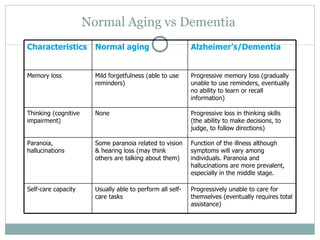
Normal Aging vs Dementia  Characteristics Normal aging Alzheimer ’s/Dementia Memory loss Mild forgetfulness (able to use reminders) Progressive memory loss (gradually unable to use reminders, eventually no ability to learn or recall information) Thinking (cognitive impairment) None  Progressive loss in thinking skills (the ability to make decisions, to judge, to follow directions) Paranoia, hallucinations Some paranoia related to vision & hearing loss (may think others are talking about them) Function of the illness although symptoms will vary among individuals. Paranoia and hallucinations are more prevalent, especially in the middle stage. Self-care capacity Usually able to perform all self-care tasks Progressively unable to care for themselves (eventually requires total assistance)
Dementia Causes Reversible Irreversible
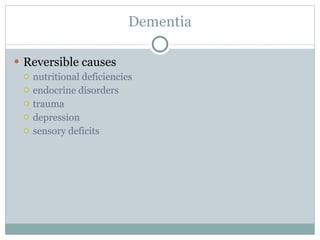
Dementia Reversible causes nutritional deficiencies endocrine disorders trauma depression sensory deficits
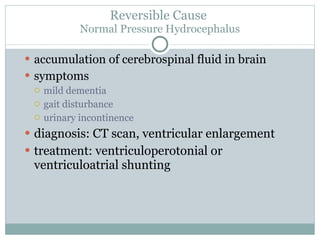
Reversible Cause  Normal Pressure Hydrocephalus accumulation of cerebrospinal fluid in brain symptoms mild dementia gait disturbance urinary incontinence diagnosis: CT scan, ventricular enlargement treatment: ventriculoperotonial or ventriculoatrial shunting
Irreversible Causes Arteriosclerosis changes Multiple infarctions Alzheimer ’s disease Pick ’s disease Parkinson ’s disease Huntington ’s disease Alcohol abuse
What is Alzheimer ’s Disease? amyloid ß peptide (Aß) that accumulates in the AD brain is deposited within senile plaques and cerebral vessels  Aß accumulation initiates AD pathology
Classic triad of AD pathology senile plaques containing Aß neurofibrillary tangles (NFTs) widespread neuronal loss in the hippocampus and select cortical and subcortical areas
Alzheimer ’s Disease Characteristics Memory problems the first sign Language difficulties  early in the illness Attention  intact for most of illness Motor and seizure disorders occur late if at all Slowly but steadily progressive over 10-15 years
Early Warning Signs of AD  Developing memory loss Losing things, repetitive  questions Suspiciousness of others Less active Trouble driving Difficulty with finances Self-neglects —not eating, bathing Irritability, stubbornness, anxiety
Importance of Early Detection of Alzheimer ’s Disease Safety Family understanding Early education of caregiver Advanced planning Patient ’s family right to know Stabilizing treatments now available
The Challenges Patients with dementia  do  not recognize that they need help. If a patient suspects he/she has a problem can go to great lengths to try and hide it.  Social skills are often preserved in early stages.
Diffuse Lewy Body Dementia Second most common cause  of dementia Name comes from the presence of abnormal lumps which develop inside nerve cells called Lewy bodies.
Diffuse Lewy Body Disease Dementia Early problems with attention, executive function, and visuospacial abilities even preceding memory impairment Fluctuating cognitive ability (day to day changes) Visual (93%) and auditory (50%) hallucinations are common and not always troubling to patients Early Parkinson-like motor abnormalities and falls
Diffuse Lewy Body Disease Dementia At risk for  exaggerated Parkinsonian drug side effects from haloperidol and risperidone psychosis with dopaminergic drugs
Vascular Dementia Dementia related to strokes Variety of presenting signs with attention disturbances, memory loss and changes in social behavior being common Course is progressive, commonly with a step-wise decline being related to each new stroke Focal neurologic signs are often present Patients have other vascular diseases such as DM, HTN, High Cholesterol and a history of smoking Commonly occurs with Alzheimer ’s Disease (10-15%)
Frontotemporal Dementia & Pick ’s Disease Early Behavioral changes: lack of social skills, poor hygiene, sexual disinhibition, constant touching and rearranging objects, putting objects in mouth Age of onset earlier than Alzheimer ’s Calculation and visuospacial skills intact until late in illness Slow and steady progression
Parkinson ’s Dementia Dementia occurs late in the history of Parkinson ’s Disease (different pattern than DLBD) Steadily progressive
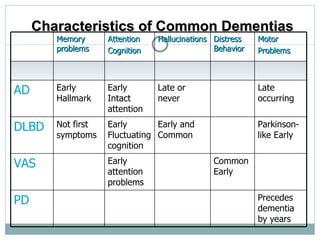
Characteristics of Common Dementias Memory problems Attention Cognition Hallucinations Distress Behavior Motor Problems AD Early Hallmark Early Intact attention Late or never Late occurring DLBD Not first symptoms Early Fluctuating cognition Early and Common Parkinson-like Early VAS Early attention problems Common Early PD Precedes dementia by years
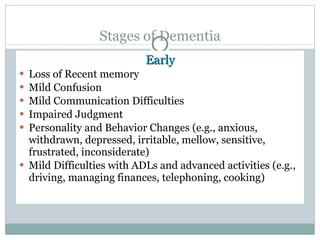
Stages of Dementia Early Loss of Recent memory Mild Confusion Mild Communication Difficulties Impaired Judgment Personality and Behavior Changes (e.g., anxious, withdrawn, depressed, irritable, mellow, sensitive, frustrated, inconsiderate) Mild Difficulties with ADLs and advanced activities (e.g., driving, managing finances, telephoning, cooking)
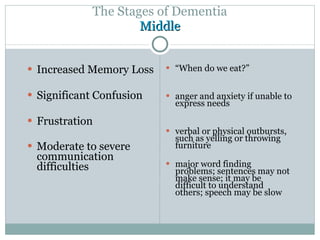
The Stages of Dementia Middle Increased Memory Loss  Significant Confusion Frustration  Moderate to severe communication difficulties   “ When do we eat?” anger and anxiety if unable to express needs verbal or physical outbursts, such as yelling or throwing furniture major word finding problems; sentences may not make sense; it may be difficult to understand others; speech may be slow
Stages of Dementia   Middle Poor Judgment  Increased personality and behavior problems Difficulty in completing activities of daily living inappropriate comments to friends, questions to strangers, or an attempt to undress in a public place restlessness, fidgeting, pacing, aimless wandering, hallucinations or delusions bathing, toileting, grooming, dressing.
Symptoms of Dementia Middle loss of impulse control  agnosia  apraxia perceptual disturbances yells out when disturbed or strikes out when awoken unable to recognize a fork forgets how to use a fork thinks the person in the mirror is someone else
Stages of Dementia Late Limited memory  Extremely limited ability to perform any activities of daily living including feeding. Loss of bowel and/or bladder control Limited communication  Increasing vulnerability and frailty May not recognize family or friends; May not recognize self in the mirror;  may think spouse is a stranger Dependent on 24 hour assistance.  Often no longer ambulatory. May be mute or unable to understand words More susceptible to infections, physical illnesses More nutritional problems
Stages of Dementia Late urinary incontinence delusions  hallucinations inability to control bladder functions mistakenly accuses a spouse of affairs sees people or things that are not there
Dementia Diagnostic Criteria Characterized by multiple cognitive deficits orientation memory judgment abstract thinking problem solving Fluctuations in mood Shallowness of affective range
Dementia Diagnostic Criteria loss of intellectual abilities-interference with functioning at least one: impaired abstract thinking impaired judgment personality change disturbed cortical functioning
Dementia Diagnostic Criteria disturbed cortical functioning aphasia: impaired language apraxia: impaired motor activity agnosia: failure to recognize constructional difficulty no clouded consciousness
Diagnostic Workup History: from patient and family Physical exam & vital signs Mental status exam Neurological exam CT scan & EEG Thyroid function tests
Diagnostic Workup Serum B12 and folic acid Chest Xray, ECG CBC, Urinalysis, Glucose, BUN, serum albumin, electrolytes, VDRL
Diagnostic Work up Rule out treatable causes of cognitive impairment common co-occuring conditions  Brain imaging studies can rule out  vascular disease  tumor subdural hematoma  normal pressure hydrocephalus
Delirium Diffuse disruption of cognitive state Prevalence 10-30% in the hospitalized medically ill 10-15% hospitalized elders on admission 10-40% elders while in the hospital 60% of nursing home residents over 75 experience delirium 80% with terminal illness
Delirium Causes drugs fever dehydration anesthesia sleep deprivation medical problems: CHF, CVA, renal failure, anemia psychosis tumors
Delirium Suspect delirium when Prodromal symptoms develop Anxiety Restlessness Irritability Disorientaion Distractibility Sleep disturbance Condition changes throughout the day Familiar figures unable to soothe
Delirium May progress to Stupor Coma Seizures Death
Delirium Diagnostic Criteria Disturbance of consciousness Reduced clarity of awareness of the environment Reduced ability to focus, sustain, or shift attention
Delirium Diagnostic Criteria At least two of the following: 1. Perceptual disturbances Misinterpretations Illusions Hallucinations-usually visual
Delirium Diagnostic Criteria At least two of the following: 1. Speech Rambling Irrelevant Pressured Incoherent Switching from subject to subject
Delirium Diagnostic Criteria 2. Disorientation 3. Short onset-hours to days
Delirium Associated Features Sleep disturbance Daytime sleepiness Night time agitation Difficulty falling asleep Wakefulness during the night Reversal of day-night sleep cycle
Delirium Associated Features Disturbed psychomotor behavior Restless Hyperactive Picking at bed clothes Attempting to get out of bed when it is unsafe to do so
Delirium Associated Features Disturbed psychomotor behavior Sluggishness Lethargy
Delirium Associated Features Emotional disturbance Anxiety Fear Depression Irritability Anger Euphoria Apathy
Delirium Associated Features Behaviors accompanying emotional disturbance Screaming Cursing Muttering Moaning
Delirium Treatment Manage the causative  e.g.  hypoxia and pain  Comfort measures to calm patient  Antipsychotics for psychotic behavior Ativan for excessive anxiety
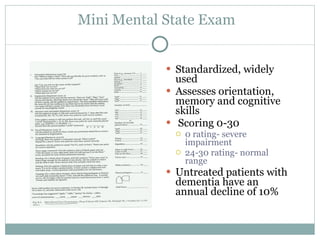
Mini Mental State Exam  Standardized, widely used Assesses orientation, memory and cognitive skills Scoring 0-30 0 rating- severe impairment 24-30 rating- normal range Untreated patients with dementia have an annual decline of 10%
Secondary Dementia Alcoholism Parkinson ’s disease Huntington ’s disease
Depression in Dementia Harder to diagnose in the older adults especially with dementia. May not exhibit sadness
Depression in  Dementia Harder to diagnose in the older adults especially with dementia. May not exhibit sadness
Causes of Depression in Dementia Psychosocial factors inability to communicate loss of function loss of pleasurable activities loss of home loss of independence loss of relationships Biological factors
Consequences of Depression in Dementia Accelerates decline increases memory loss causes delusions causes agitation causes giving up Excessive disability loss of functional abilities
Clinical Cues of Depression in Dementia irritability somatic complaints no tears ruminating critical refusing to eat low self-esteem
Supportive Therapy One to one very helpful Conversation to reduce isolation Exercise Group approaches can also be effective Combination of support and drugs most effective for major depression
Primary Prevention Healthy lifestyle preserves cardiovascular health and subsequently brain health

Cognitive lecture3(1)

  • 1.
    Dementia & Alzheimer’s Disease Dementia syndrome of progressive change in cognitive function memory loss and at least one other type of cognitive deficit. Senile Dementia of the Alzheimer ’s Type one cause of dementia insidious onset
  • 2.
    Cognitive Impairment a range of disturbances in cognitive functioning. diagnosis depends on assessment of cognitive function and a complete mental status examination
  • 3.
    Cognitive Impairment ProblemAreas Attention span Concentration Intelligence Judgment Learning ability Memory Orientation Perception Problem solving Psychomotor ability Reaction time Social intactness
  • 4.
    Confusion Non clinicalterm to describe acute onset of inability to understand cir cumstances without loss of consciousness. Acute onset is over hours or days.
  • 5.
    Normal Aging vsDementia Characteristics Normal aging Alzheimer ’s/Dementia Memory loss Mild forgetfulness (able to use reminders) Progressive memory loss (gradually unable to use reminders, eventually no ability to learn or recall information) Thinking (cognitive impairment) None Progressive loss in thinking skills (the ability to make decisions, to judge, to follow directions) Paranoia, hallucinations Some paranoia related to vision & hearing loss (may think others are talking about them) Function of the illness although symptoms will vary among individuals. Paranoia and hallucinations are more prevalent, especially in the middle stage. Self-care capacity Usually able to perform all self-care tasks Progressively unable to care for themselves (eventually requires total assistance)
  • 6.
  • 7.
    Dementia Reversible causesnutritional deficiencies endocrine disorders trauma depression sensory deficits
  • 8.
    Reversible Cause Normal Pressure Hydrocephalus accumulation of cerebrospinal fluid in brain symptoms mild dementia gait disturbance urinary incontinence diagnosis: CT scan, ventricular enlargement treatment: ventriculoperotonial or ventriculoatrial shunting
  • 9.
    Irreversible Causes Arteriosclerosischanges Multiple infarctions Alzheimer ’s disease Pick ’s disease Parkinson ’s disease Huntington ’s disease Alcohol abuse
  • 10.
    What is Alzheimer’s Disease? amyloid ß peptide (Aß) that accumulates in the AD brain is deposited within senile plaques and cerebral vessels Aß accumulation initiates AD pathology
  • 11.
    Classic triad ofAD pathology senile plaques containing Aß neurofibrillary tangles (NFTs) widespread neuronal loss in the hippocampus and select cortical and subcortical areas
  • 12.
    Alzheimer ’s DiseaseCharacteristics Memory problems the first sign Language difficulties early in the illness Attention intact for most of illness Motor and seizure disorders occur late if at all Slowly but steadily progressive over 10-15 years
  • 13.
    Early Warning Signsof AD Developing memory loss Losing things, repetitive questions Suspiciousness of others Less active Trouble driving Difficulty with finances Self-neglects —not eating, bathing Irritability, stubbornness, anxiety
  • 14.
    Importance of EarlyDetection of Alzheimer ’s Disease Safety Family understanding Early education of caregiver Advanced planning Patient ’s family right to know Stabilizing treatments now available
  • 15.
    The Challenges Patientswith dementia do not recognize that they need help. If a patient suspects he/she has a problem can go to great lengths to try and hide it. Social skills are often preserved in early stages.
  • 16.
    Diffuse Lewy BodyDementia Second most common cause of dementia Name comes from the presence of abnormal lumps which develop inside nerve cells called Lewy bodies.
  • 17.
    Diffuse Lewy BodyDisease Dementia Early problems with attention, executive function, and visuospacial abilities even preceding memory impairment Fluctuating cognitive ability (day to day changes) Visual (93%) and auditory (50%) hallucinations are common and not always troubling to patients Early Parkinson-like motor abnormalities and falls
  • 18.
    Diffuse Lewy BodyDisease Dementia At risk for exaggerated Parkinsonian drug side effects from haloperidol and risperidone psychosis with dopaminergic drugs
  • 19.
    Vascular Dementia Dementiarelated to strokes Variety of presenting signs with attention disturbances, memory loss and changes in social behavior being common Course is progressive, commonly with a step-wise decline being related to each new stroke Focal neurologic signs are often present Patients have other vascular diseases such as DM, HTN, High Cholesterol and a history of smoking Commonly occurs with Alzheimer ’s Disease (10-15%)
  • 20.
    Frontotemporal Dementia &Pick ’s Disease Early Behavioral changes: lack of social skills, poor hygiene, sexual disinhibition, constant touching and rearranging objects, putting objects in mouth Age of onset earlier than Alzheimer ’s Calculation and visuospacial skills intact until late in illness Slow and steady progression
  • 21.
    Parkinson ’s DementiaDementia occurs late in the history of Parkinson ’s Disease (different pattern than DLBD) Steadily progressive
  • 22.
    Characteristics of CommonDementias Memory problems Attention Cognition Hallucinations Distress Behavior Motor Problems AD Early Hallmark Early Intact attention Late or never Late occurring DLBD Not first symptoms Early Fluctuating cognition Early and Common Parkinson-like Early VAS Early attention problems Common Early PD Precedes dementia by years
  • 23.
    Stages of DementiaEarly Loss of Recent memory Mild Confusion Mild Communication Difficulties Impaired Judgment Personality and Behavior Changes (e.g., anxious, withdrawn, depressed, irritable, mellow, sensitive, frustrated, inconsiderate) Mild Difficulties with ADLs and advanced activities (e.g., driving, managing finances, telephoning, cooking)
  • 24.
    The Stages ofDementia Middle Increased Memory Loss Significant Confusion Frustration Moderate to severe communication difficulties “ When do we eat?” anger and anxiety if unable to express needs verbal or physical outbursts, such as yelling or throwing furniture major word finding problems; sentences may not make sense; it may be difficult to understand others; speech may be slow
  • 25.
    Stages of Dementia Middle Poor Judgment Increased personality and behavior problems Difficulty in completing activities of daily living inappropriate comments to friends, questions to strangers, or an attempt to undress in a public place restlessness, fidgeting, pacing, aimless wandering, hallucinations or delusions bathing, toileting, grooming, dressing.
  • 26.
    Symptoms of DementiaMiddle loss of impulse control agnosia apraxia perceptual disturbances yells out when disturbed or strikes out when awoken unable to recognize a fork forgets how to use a fork thinks the person in the mirror is someone else
  • 27.
    Stages of DementiaLate Limited memory Extremely limited ability to perform any activities of daily living including feeding. Loss of bowel and/or bladder control Limited communication Increasing vulnerability and frailty May not recognize family or friends; May not recognize self in the mirror; may think spouse is a stranger Dependent on 24 hour assistance. Often no longer ambulatory. May be mute or unable to understand words More susceptible to infections, physical illnesses More nutritional problems
  • 28.
    Stages of DementiaLate urinary incontinence delusions hallucinations inability to control bladder functions mistakenly accuses a spouse of affairs sees people or things that are not there
  • 29.
    Dementia Diagnostic CriteriaCharacterized by multiple cognitive deficits orientation memory judgment abstract thinking problem solving Fluctuations in mood Shallowness of affective range
  • 30.
    Dementia Diagnostic Criterialoss of intellectual abilities-interference with functioning at least one: impaired abstract thinking impaired judgment personality change disturbed cortical functioning
  • 31.
    Dementia Diagnostic Criteriadisturbed cortical functioning aphasia: impaired language apraxia: impaired motor activity agnosia: failure to recognize constructional difficulty no clouded consciousness
  • 32.
    Diagnostic Workup History:from patient and family Physical exam & vital signs Mental status exam Neurological exam CT scan & EEG Thyroid function tests
  • 33.
    Diagnostic Workup SerumB12 and folic acid Chest Xray, ECG CBC, Urinalysis, Glucose, BUN, serum albumin, electrolytes, VDRL
  • 34.
    Diagnostic Work upRule out treatable causes of cognitive impairment common co-occuring conditions Brain imaging studies can rule out vascular disease tumor subdural hematoma normal pressure hydrocephalus
  • 35.
    Delirium Diffuse disruptionof cognitive state Prevalence 10-30% in the hospitalized medically ill 10-15% hospitalized elders on admission 10-40% elders while in the hospital 60% of nursing home residents over 75 experience delirium 80% with terminal illness
  • 36.
    Delirium Causes drugsfever dehydration anesthesia sleep deprivation medical problems: CHF, CVA, renal failure, anemia psychosis tumors
  • 37.
    Delirium Suspect deliriumwhen Prodromal symptoms develop Anxiety Restlessness Irritability Disorientaion Distractibility Sleep disturbance Condition changes throughout the day Familiar figures unable to soothe
  • 38.
    Delirium May progressto Stupor Coma Seizures Death
  • 39.
    Delirium Diagnostic CriteriaDisturbance of consciousness Reduced clarity of awareness of the environment Reduced ability to focus, sustain, or shift attention
  • 40.
    Delirium Diagnostic CriteriaAt least two of the following: 1. Perceptual disturbances Misinterpretations Illusions Hallucinations-usually visual
  • 41.
    Delirium Diagnostic CriteriaAt least two of the following: 1. Speech Rambling Irrelevant Pressured Incoherent Switching from subject to subject
  • 42.
    Delirium Diagnostic Criteria2. Disorientation 3. Short onset-hours to days
  • 43.
    Delirium Associated FeaturesSleep disturbance Daytime sleepiness Night time agitation Difficulty falling asleep Wakefulness during the night Reversal of day-night sleep cycle
  • 44.
    Delirium Associated FeaturesDisturbed psychomotor behavior Restless Hyperactive Picking at bed clothes Attempting to get out of bed when it is unsafe to do so
  • 45.
    Delirium Associated FeaturesDisturbed psychomotor behavior Sluggishness Lethargy
  • 46.
    Delirium Associated FeaturesEmotional disturbance Anxiety Fear Depression Irritability Anger Euphoria Apathy
  • 47.
    Delirium Associated FeaturesBehaviors accompanying emotional disturbance Screaming Cursing Muttering Moaning
  • 48.
    Delirium Treatment Managethe causative e.g. hypoxia and pain Comfort measures to calm patient Antipsychotics for psychotic behavior Ativan for excessive anxiety
  • 49.
    Mini Mental StateExam Standardized, widely used Assesses orientation, memory and cognitive skills Scoring 0-30 0 rating- severe impairment 24-30 rating- normal range Untreated patients with dementia have an annual decline of 10%
  • 50.
    Secondary Dementia AlcoholismParkinson ’s disease Huntington ’s disease
  • 51.
    Depression in DementiaHarder to diagnose in the older adults especially with dementia. May not exhibit sadness
  • 52.
    Depression in Dementia Harder to diagnose in the older adults especially with dementia. May not exhibit sadness
  • 53.
    Causes of Depressionin Dementia Psychosocial factors inability to communicate loss of function loss of pleasurable activities loss of home loss of independence loss of relationships Biological factors
  • 54.
    Consequences of Depressionin Dementia Accelerates decline increases memory loss causes delusions causes agitation causes giving up Excessive disability loss of functional abilities
  • 55.
    Clinical Cues ofDepression in Dementia irritability somatic complaints no tears ruminating critical refusing to eat low self-esteem
  • 56.
    Supportive Therapy Oneto one very helpful Conversation to reduce isolation Exercise Group approaches can also be effective Combination of support and drugs most effective for major depression
  • 57.
    Primary Prevention Healthylifestyle preserves cardiovascular health and subsequently brain health

Editor's Notes

  • #6 UNIVERSITY OF MIAMI School of Nursing NUR 624: Lecture Oct. 17, 2003 Dementia and Cognition Page
  • #15 UNIVERSITY OF MIAMI School of Nursing NUR 624: Lecture Oct. 17, 2003 Dementia and Cognition Page Safety== home safety, driving, compliance Families often blame themselves or blame patient for behavior they cannot control. Caregivers need to get into education of what to expect. They need to have time to grieve and accept this sudden change in normalcy. Advance planning of wills, proxies appointed, advance directives of care—living wills etc. Patient ’s family has the right to know what is happening and what to expect. The burden of care directly and indirectly will fall on them. New medications do allow for care.
  • #18 UNIVERSITY OF MIAMI School of Nursing NUR 624: Lecture Oct. 17, 2003 Dementia and Cognition Page
  • #19 UNIVERSITY OF MIAMI School of Nursing NUR 624: Lecture Oct. 17, 2003 Dementia and Cognition Page
  • #20 UNIVERSITY OF MIAMI School of Nursing NUR 624: Lecture Oct. 17, 2003 Dementia and Cognition Page
  • #21 UNIVERSITY OF MIAMI School of Nursing NUR 624: Lecture Oct. 17, 2003 Dementia and Cognition Page
  • #22 UNIVERSITY OF MIAMI School of Nursing NUR 624: Lecture Oct. 17, 2003 Dementia and Cognition Page
  • #23 UNIVERSITY OF MIAMI School of Nursing NUR 624: Lecture Oct. 17, 2003 Dementia and Cognition Page
  • #24 UNIVERSITY OF MIAMI School of Nursing NUR 624: Lecture Oct. 17, 2003 Dementia and Cognition Page
  • #25 UNIVERSITY OF MIAMI School of Nursing NUR 624: Lecture Oct. 17, 2003 Dementia and Cognition Page
  • #26 UNIVERSITY OF MIAMI School of Nursing NUR 624: Lecture Oct. 17, 2003 Dementia and Cognition Page
  • #28 UNIVERSITY OF MIAMI School of Nursing NUR 624: Lecture Oct. 17, 2003 Dementia and Cognition Page
  • #49 UNIVERSITY OF MIAMI School of Nursing NUR 624: Lecture Oct. 17, 2003 Dementia and Cognition Page Comfortt measure: Companionship, light, reassurance, warmth, and reorientation.
  • #52 UNIVERSITY OF MIAMI School of Nursing NUR 624: Lecture Oct. 17, 2003 Dementia and Cognition Page Suicide::80% visited their physician within a month of the act.
  • #53 UNIVERSITY OF MIAMI School of Nursing NUR 624: Lecture Oct. 17, 2003 Dementia and Cognition Page Suicide::80% visited their physician within a month of the act.