Delayed Union and Nonunion of FracturesDr Samir D Bhirud,Dept of OrthopedicsESIPGIMSR MGM HOSPITAL
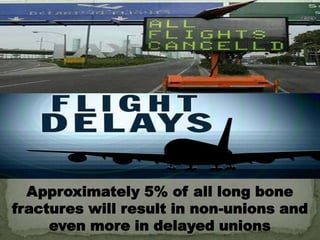
Approximately 5% of all long bone fractures will result in non-unions and even more in delayed unions
The exact time when a given fracture should be united cannot be definedUnion is delayed when healing has not advanced at the average rate for the location and type of fracture	(Between 3-6 months)Delayed Union
FDA defined nonunion as “established when a minimum of 9 months has elapsed since fracture with no visible progressive signs of healing for 3 months”Every fracture has its own timetable (long bone shaft fracture 6 months, femoral neck fracture 3 months) Nonunion
Factors contributing :SystemicLocalDelayed/Nonunion
SystemicfactorsNutritional status- MalnutritionMetabolic - Diabetes (neurovascular)Smoking Tobacco and alcohol useGeneral healthActivity levelUse of NSAIDs (have been found to decrease fracture healing in multiple animal studies)THE LITERATURE IS STILL CONFLICTING CONCERNING THE INFLUENCE OF NSAIDS ON FRACTURE HEALING
Fracture characteristics-OpenInfectedsegmentalComminuted by severe traumaAnatomic Location of FracturesLocal factors
Soft tissue injuryTraumaticIatrogenicTreatment relatedInsecure fixationInsufficient immobilizationFixation in distractionIrradiated bone
Based on viability of the bone endsHypervascular  non-unionsAvascular  nonunionClassification
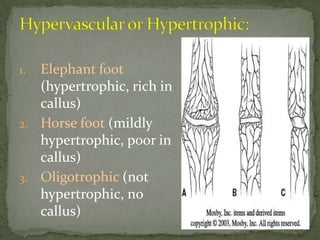
Hypervascular or Hypertrophic:Elephant foot (hypertrophic, rich in callus)Horse foot (mildly hypertrophic, poor in callus)Oligotrophic (not hypertrophic, no callus)
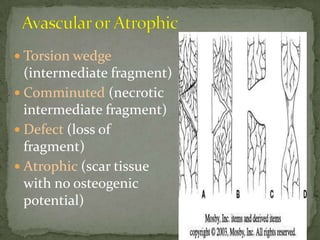
Avascular or AtrophicTorsion wedge (intermediate fragment)Comminuted (necrotic intermediate fragment)Defect (loss of fragment)Atrophic (scar tissue with no osteogenic potential)
Classification (Paley et al)Type A<2cm of bone loss          A1 (Mobile deformity)           A2 (fixed deformity)                A2-1 stiff w/o deformity                A2-2 stiff w/ fixed  deformityType B>2cm of bone loss            B1 w/ bony defect            B2 loss of bone length            B3 both
ElectricalElectro-magneticUltrasoundSurgicalTreatmentPREVENTION IS ALWAYS BETTER THAN CURE
General Treatment principalsVast number of surgical and nonsurgical methods available but…. Rarely - one method successful .Simplest, most easily tolerated.Should allow potential use of other methods
Autogenouscancellous boneremains the “gold standard” in grafting materialOther optionsallograft bonesynthetic bone substituteVascularised bone graftingBoneGrafting
Theoriesstimulates the genes involved in inflammation and bone regeneration. increases blood flow through dilation of capillaries and enhancement of angiogenesis, increasing the flow of nutrients to the fracture site. chondrocyte stimulation is enhanced, which leads to an increase in enchondral bone formation.PROTOCOL IS TO USE THE ULTRASOUND EQUIPMENT FOR 20 MINUTES ONCE A DAYLow intensty ultrasound
Bone growth stimulators - used in conjunction.External electrical stimulation -advantageous in infected nonunion.Electrical and electromagnetic stimulation.EXTERNAL ELECTRICAL STIMULATION IS ESPECIALLY ADVANTAGEOUS IN INFECTED NONUNION MANAGEMENT OR WHEN SURGICAL INTERVENTION IS CONTRAINDICATED
Systemic and local fracture management must be considered in the treatment of non-unions.Metabolic and nutritional factors should be optimized. Patients should be encouraged to discontinue tobacco use. Activity levels of patients may require alteration before treatment for  non-unions.Considerations before Surgery
Status of Soft Tissues and Neurovascular Structures –Unyielding scar tissues, Deep scarring may prevent bone transport or grafting.Soft-tissue contractures must be considered Considerations before Surgery
Hypertrophic (hypervascular) non-unionsstable fixation. Atrophic (avascular) non-unions decortication and bone graftingStatusofBonesConsideration to the factors responsible for non or delayed union is desired before proceeding to further treatment
According to the classification of Paley et alType A non-unions can be treated with 	restoration of alignment, followed by compression. Type B non-unions may require 	additional cortical osteotomy and either internal bone transport or overall lengthening to obtain the original bone length.
The fragments are mobilized, preserving their normal soft-tissue attachments as much as possible.Extensive dissection is avoided, resecting only the scar tissue and the rounded ends of the bones so that contact is maximalMedullary canals are cleared of fibrous tissue to aid in medullaryosteogenesis and they are apposed ReductionofFragments
Adequate stabilization obtained by -        Plates and screws.       Intra-medullary nails.        External fixation.Provide sufficient stability – without excessive rigidity.Stabilizationoffragments.

Delayed Union and non union fractures

  • 1.
    Delayed Union andNonunion of FracturesDr Samir D Bhirud,Dept of OrthopedicsESIPGIMSR MGM HOSPITAL
  • 2.
    Approximately 5% ofall long bone fractures will result in non-unions and even more in delayed unions
  • 3.
    The exact timewhen a given fracture should be united cannot be definedUnion is delayed when healing has not advanced at the average rate for the location and type of fracture (Between 3-6 months)Delayed Union
  • 4.
    FDA defined nonunionas “established when a minimum of 9 months has elapsed since fracture with no visible progressive signs of healing for 3 months”Every fracture has its own timetable (long bone shaft fracture 6 months, femoral neck fracture 3 months) Nonunion
  • 5.
  • 6.
    SystemicfactorsNutritional status- MalnutritionMetabolic- Diabetes (neurovascular)Smoking Tobacco and alcohol useGeneral healthActivity levelUse of NSAIDs (have been found to decrease fracture healing in multiple animal studies)THE LITERATURE IS STILL CONFLICTING CONCERNING THE INFLUENCE OF NSAIDS ON FRACTURE HEALING
  • 7.
    Fracture characteristics-OpenInfectedsegmentalComminuted bysevere traumaAnatomic Location of FracturesLocal factors
  • 8.
    Soft tissue injuryTraumaticIatrogenicTreatmentrelatedInsecure fixationInsufficient immobilizationFixation in distractionIrradiated bone
  • 9.
    Based on viabilityof the bone endsHypervascular non-unionsAvascular nonunionClassification
  • 10.
    Hypervascular or Hypertrophic:Elephantfoot (hypertrophic, rich in callus)Horse foot (mildly hypertrophic, poor in callus)Oligotrophic (not hypertrophic, no callus)
  • 11.
    Avascular or AtrophicTorsionwedge (intermediate fragment)Comminuted (necrotic intermediate fragment)Defect (loss of fragment)Atrophic (scar tissue with no osteogenic potential)
  • 12.
    Classification (Paley etal)Type A<2cm of bone loss A1 (Mobile deformity) A2 (fixed deformity) A2-1 stiff w/o deformity A2-2 stiff w/ fixed deformityType B>2cm of bone loss B1 w/ bony defect B2 loss of bone length B3 both
  • 14.
  • 15.
    General Treatment principalsVastnumber of surgical and nonsurgical methods available but…. Rarely - one method successful .Simplest, most easily tolerated.Should allow potential use of other methods
  • 16.
    Autogenouscancellous boneremains the“gold standard” in grafting materialOther optionsallograft bonesynthetic bone substituteVascularised bone graftingBoneGrafting
  • 17.
    Theoriesstimulates the genesinvolved in inflammation and bone regeneration. increases blood flow through dilation of capillaries and enhancement of angiogenesis, increasing the flow of nutrients to the fracture site. chondrocyte stimulation is enhanced, which leads to an increase in enchondral bone formation.PROTOCOL IS TO USE THE ULTRASOUND EQUIPMENT FOR 20 MINUTES ONCE A DAYLow intensty ultrasound
  • 18.
    Bone growth stimulators- used in conjunction.External electrical stimulation -advantageous in infected nonunion.Electrical and electromagnetic stimulation.EXTERNAL ELECTRICAL STIMULATION IS ESPECIALLY ADVANTAGEOUS IN INFECTED NONUNION MANAGEMENT OR WHEN SURGICAL INTERVENTION IS CONTRAINDICATED
  • 19.
    Systemic and localfracture management must be considered in the treatment of non-unions.Metabolic and nutritional factors should be optimized. Patients should be encouraged to discontinue tobacco use. Activity levels of patients may require alteration before treatment for non-unions.Considerations before Surgery
  • 20.
    Status of SoftTissues and Neurovascular Structures –Unyielding scar tissues, Deep scarring may prevent bone transport or grafting.Soft-tissue contractures must be considered Considerations before Surgery
  • 21.
    Hypertrophic (hypervascular) non-unionsstablefixation. Atrophic (avascular) non-unions decortication and bone graftingStatusofBonesConsideration to the factors responsible for non or delayed union is desired before proceeding to further treatment
  • 22.
    According to theclassification of Paley et alType A non-unions can be treated with restoration of alignment, followed by compression. Type B non-unions may require additional cortical osteotomy and either internal bone transport or overall lengthening to obtain the original bone length.
  • 23.
    The fragments aremobilized, preserving their normal soft-tissue attachments as much as possible.Extensive dissection is avoided, resecting only the scar tissue and the rounded ends of the bones so that contact is maximalMedullary canals are cleared of fibrous tissue to aid in medullaryosteogenesis and they are apposed ReductionofFragments
  • 24.
    Adequate stabilization obtainedby - Plates and screws. Intra-medullary nails. External fixation.Provide sufficient stability – without excessive rigidity.Stabilizationoffragments.