Osteogenesis imperfecta (OI)


Maria Carmela L. Domocmat, RN, MSN
Instructor
Northern Luzon Adventist College
http://www.oif.org/images/content/pagebuilder/94682.jpg


2   Maria Carmela L. Domocmat, RN, MSN
Osteogenesis imperfecta (OI)
    • AKA: Brittle bone disease
    • rare genetic disorder in which bone are fragile and
      fracture easily resulting in bone deformity
    • an autosomal dominant disease
       • A person with OI has a 50% chance of passing on the
            gene and the disease to their children.
    • involves errors in synthesis of collagen, a
        connective tissue


3   Maria Carmela L. Domocmat, RN, MSN
Types according to Silence classification
    system
      o has four types based on inheritance as autosomal
        dominant or autosomal recessive and clinical findings
        of each type
      o Types I and IV – more mild manifestations of
        disease; can persist into adulthood
      o Types II and III – more severe and can result in
        fracture in utero, during the birthing process, or in
        early childhood; associated with high mortality rate


4   Maria Carmela L. Domocmat, RN, MSN
Type 1 osteogenesis
        most common.
       People who have type 1 disease generally reach normal
       height and have few obvious skeletal deformities.
       typically causes more fractures during childhood than in
       adulthood.
       Hearing loss is pronounced and begins early in childhood.


5   Maria Carmela L. Domocmat, RN, MSN
Type 2 osteogenesis imperfecta
        most rare and the most severe.
       produces numerous deformities of the skeleton
       often is fatal in infancy.
       abnormal collagen formation also profoundly affects the
       lungs, causing significant breathing problems.


6   Maria Carmela L. Domocmat, RN, MSN
Type 4 osteogenesis imperfecta
       more severe than type 1 but less severe than type 3.
       Fractures are most common before puberty.
       Hearing loss begins in early childhood and is often profound


7   Maria Carmela L. Domocmat, RN, MSN
Type 3 osteogenesis imperfecta
                 produces obvious skeletal deformities. Fractures before birth
                 are common;
                 UTZ can detect them in the fetus.
                 also affects the lungs and muscles.
                 Hearing loss begins in early childhood and often becomes
                 complete by adolescence.


    http://www.beltina.org/health-dictionary/osteogenesis-imperfecta-types-treatment.html


8          Maria Carmela L. Domocmat, RN, MSN
s/s
       All people with OI have weak bones, which makes them
       susceptible to fractures. Persons with OI are usually below average
       height (short stature). However, the severity of the disease varies
       greatly


9   Maria Carmela L. Domocmat, RN, MSN
s/s
        The classic symptoms include:
            osteoporosis
            history of multiple fractures
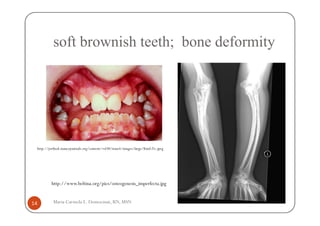
            bone deformity
            poor skeletal development
            soft brownish teeth
            hearing loss
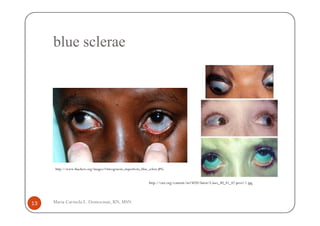
            Blue tint to the whites of their eyes (blue sclera)
            Because type I collagen is also found in ligaments, persons with
            OI often have loose joints (hypermobility) and flat feet.


10   Maria Carmela L. Domocmat, RN, MSN
s/s
        Symptoms of more severe forms of OI may include:
            Bowed legs and arms
            Kyphosis
            Scoliosis (S-curve spine)


11   Maria Carmela L. Domocmat, RN, MSN
bone deformity


12   Maria Carmela L. Domocmat, RN, MSN
blue sclerae


     http://www.thachers.org/images/Osteogenesis_imperfecta_blue_sclera.JPG


                                                                 http://cnx.org/content/m15020/latest/Cases_40_41_42-pres1-1.jpg


13   Maria Carmela L. Domocmat, RN, MSN
soft brownish teeth; bone deformity


 http://jorthod.maneyjournals.org/content/vol30/issue4/images/large/Kind.f1c.jpeg


          http://www.beltina.org/pics/osteogenesis_imperfecta.jpg


14         Maria Carmela L. Domocmat, RN, MSN
This baby's extremities are positioned oddly because there have been multiple fractures due
     to osteogenesis imperfecta (OI). This disease leads to multiple fractures. The basic problem
     is a defect in the formation of type 1 collagen that forms bone matrix. There are several
     types of OI with different inheritance patterns.
                                              http://medgen.genetics.utah.edu/photographs/diseases/high/peri021.jpg


15   Maria Carmela L. Domocmat, RN, MSN
Dx:
        serum alkaline phosphatase – increased


16   Maria Carmela L. Domocmat, RN, MSN
Treatment
        Treatment for fracture is generally conservative, targeting a
        balance between immobilizing the fracture long enough for it
        to heal and allowing normal muscle function as quickly as
        possible.
        Physical activity helps strengthen muscles and bone, which in
        turn minimizes fractures.
        The most numerous fractures occur during childhood when
        the bones are growing and thus have lower mineral content.
        The risk for fracture is lifelong, however, and may increase in
        women after menopause when bone density naturally
        declines.

17   Maria Carmela L. Domocmat, RN, MSN
Treatment
       o palliative
       o steroids
       o calcium
       o vit C
       o sodium fluoride
       o PT
       o casting
       o bracing
       o telescoping intramedullary rods – to maintain mobility
         and promote ambulation
       o research ongoing – Biphophonates


18   Maria Carmela L. Domocmat, RN, MSN
Expectations (prognosis)
        How well a person does depends on the type of OI they have.
        Type I, or mild OI, is the most common form. Persons with
        this type can live a normal lifespan.
        Type II is a severe form that is usually leads to death in the
        first year of life.
        Type III is also called severe OI. Persons with this type have many
        fractures starting very early in life and can have severe bone
        deformities. Many become wheelchair bound and usually have a
        somewhat shortened life expectancy.


19   Maria Carmela L. Domocmat, RN, MSN
Expectations (prognosis)
        Type IV, or moderately severe OI, is similar to type I, although
        persons with type IV often need braces or crutches to walk. Life
        expectancy is normal or near normal.

        There are other types of OI, but they occur very infrequently and
        most are considered subtypes of the moderately severe form (type
        IV).


20   Maria Carmela L. Domocmat, RN, MSN
Complications
        Complications are largely based on the type of OI present.
        They are often directly related to the problems with weak
        bones and multiple fractures.
        Hearing loss (common in type I and type III)
        Heart failure (type II)
        Respiratory problems and pneumonias due to chest wall
        deformities
        Spinal cord or brain stem problems
        Permanent deformity


21   Maria Carmela L. Domocmat, RN, MSN
http://jorthod.maneyjournals.org/content/vol30/issue4/images/large/Kind.f1c.jpeg


22   Maria Carmela L. Domocmat, RN, MSN
Resources
        Ignatavicius and Workman (2006). MS Nursing [5th ed].
        Singapore: Elsevier.
        http://www.ncbi.nlm.nih.gov/pubmedhealth/PMH000254
        0/
        http://www.beltina.org/health-dictionary/osteogenesis-
        imperfecta-types-treatment.html
        http://www.oif.org/site/PageServer
        http://www.umm.edu/ency/article/001573.htm


23   Maria Carmela L. Domocmat, RN, MSN

Osteogenesis imperfecta (OI)

  • 1.
    Osteogenesis imperfecta (OI) MariaCarmela L. Domocmat, RN, MSN Instructor Northern Luzon Adventist College
  • 2.
  • 3.
    Osteogenesis imperfecta (OI) • AKA: Brittle bone disease • rare genetic disorder in which bone are fragile and fracture easily resulting in bone deformity • an autosomal dominant disease • A person with OI has a 50% chance of passing on the gene and the disease to their children. • involves errors in synthesis of collagen, a connective tissue 3 Maria Carmela L. Domocmat, RN, MSN
  • 4.
    Types according toSilence classification system o has four types based on inheritance as autosomal dominant or autosomal recessive and clinical findings of each type o Types I and IV – more mild manifestations of disease; can persist into adulthood o Types II and III – more severe and can result in fracture in utero, during the birthing process, or in early childhood; associated with high mortality rate 4 Maria Carmela L. Domocmat, RN, MSN
  • 5.
    Type 1 osteogenesis most common. People who have type 1 disease generally reach normal height and have few obvious skeletal deformities. typically causes more fractures during childhood than in adulthood. Hearing loss is pronounced and begins early in childhood. 5 Maria Carmela L. Domocmat, RN, MSN
  • 6.
    Type 2 osteogenesisimperfecta most rare and the most severe. produces numerous deformities of the skeleton often is fatal in infancy. abnormal collagen formation also profoundly affects the lungs, causing significant breathing problems. 6 Maria Carmela L. Domocmat, RN, MSN
  • 7.
    Type 4 osteogenesisimperfecta more severe than type 1 but less severe than type 3. Fractures are most common before puberty. Hearing loss begins in early childhood and is often profound 7 Maria Carmela L. Domocmat, RN, MSN
  • 8.
    Type 3 osteogenesisimperfecta produces obvious skeletal deformities. Fractures before birth are common; UTZ can detect them in the fetus. also affects the lungs and muscles. Hearing loss begins in early childhood and often becomes complete by adolescence. http://www.beltina.org/health-dictionary/osteogenesis-imperfecta-types-treatment.html 8 Maria Carmela L. Domocmat, RN, MSN
  • 9.
    s/s All people with OI have weak bones, which makes them susceptible to fractures. Persons with OI are usually below average height (short stature). However, the severity of the disease varies greatly 9 Maria Carmela L. Domocmat, RN, MSN
  • 10.
    s/s The classic symptoms include: osteoporosis history of multiple fractures bone deformity poor skeletal development soft brownish teeth hearing loss Blue tint to the whites of their eyes (blue sclera) Because type I collagen is also found in ligaments, persons with OI often have loose joints (hypermobility) and flat feet. 10 Maria Carmela L. Domocmat, RN, MSN
  • 11.
    s/s Symptoms of more severe forms of OI may include: Bowed legs and arms Kyphosis Scoliosis (S-curve spine) 11 Maria Carmela L. Domocmat, RN, MSN
  • 12.
    bone deformity 12 Maria Carmela L. Domocmat, RN, MSN
  • 13.
    blue sclerae http://www.thachers.org/images/Osteogenesis_imperfecta_blue_sclera.JPG http://cnx.org/content/m15020/latest/Cases_40_41_42-pres1-1.jpg 13 Maria Carmela L. Domocmat, RN, MSN
  • 14.
    soft brownish teeth;bone deformity http://jorthod.maneyjournals.org/content/vol30/issue4/images/large/Kind.f1c.jpeg http://www.beltina.org/pics/osteogenesis_imperfecta.jpg 14 Maria Carmela L. Domocmat, RN, MSN
  • 15.
    This baby's extremitiesare positioned oddly because there have been multiple fractures due to osteogenesis imperfecta (OI). This disease leads to multiple fractures. The basic problem is a defect in the formation of type 1 collagen that forms bone matrix. There are several types of OI with different inheritance patterns. http://medgen.genetics.utah.edu/photographs/diseases/high/peri021.jpg 15 Maria Carmela L. Domocmat, RN, MSN
  • 16.
    Dx: serum alkaline phosphatase – increased 16 Maria Carmela L. Domocmat, RN, MSN
  • 17.
    Treatment Treatment for fracture is generally conservative, targeting a balance between immobilizing the fracture long enough for it to heal and allowing normal muscle function as quickly as possible. Physical activity helps strengthen muscles and bone, which in turn minimizes fractures. The most numerous fractures occur during childhood when the bones are growing and thus have lower mineral content. The risk for fracture is lifelong, however, and may increase in women after menopause when bone density naturally declines. 17 Maria Carmela L. Domocmat, RN, MSN
  • 18.
    Treatment o palliative o steroids o calcium o vit C o sodium fluoride o PT o casting o bracing o telescoping intramedullary rods – to maintain mobility and promote ambulation o research ongoing – Biphophonates 18 Maria Carmela L. Domocmat, RN, MSN
  • 19.
    Expectations (prognosis) How well a person does depends on the type of OI they have. Type I, or mild OI, is the most common form. Persons with this type can live a normal lifespan. Type II is a severe form that is usually leads to death in the first year of life. Type III is also called severe OI. Persons with this type have many fractures starting very early in life and can have severe bone deformities. Many become wheelchair bound and usually have a somewhat shortened life expectancy. 19 Maria Carmela L. Domocmat, RN, MSN
  • 20.
    Expectations (prognosis) Type IV, or moderately severe OI, is similar to type I, although persons with type IV often need braces or crutches to walk. Life expectancy is normal or near normal. There are other types of OI, but they occur very infrequently and most are considered subtypes of the moderately severe form (type IV). 20 Maria Carmela L. Domocmat, RN, MSN
  • 21.
    Complications Complications are largely based on the type of OI present. They are often directly related to the problems with weak bones and multiple fractures. Hearing loss (common in type I and type III) Heart failure (type II) Respiratory problems and pneumonias due to chest wall deformities Spinal cord or brain stem problems Permanent deformity 21 Maria Carmela L. Domocmat, RN, MSN
  • 22.
  • 23.
    Resources Ignatavicius and Workman (2006). MS Nursing [5th ed]. Singapore: Elsevier. http://www.ncbi.nlm.nih.gov/pubmedhealth/PMH000254 0/ http://www.beltina.org/health-dictionary/osteogenesis- imperfecta-types-treatment.html http://www.oif.org/site/PageServer http://www.umm.edu/ency/article/001573.htm 23 Maria Carmela L. Domocmat, RN, MSN