Osteogenisis Imperfecta
Presentation by:
Christopher Lim
Central Problem of the Case
Foreground: Excruciating right arm pain in a
5 y/o male status post “fell off the couch”
as reported by parents of the child.
Central Problem of Case cont.
Background: Sequelae of fractures shortly after bipedal
mobility (from crawling to walking stance). Biological
father has also has a history of several broken bones as
a child and has recently begun to develop bilateral
hearing loss. Patient is 75th percentile for weight and
height for his age and has a slight bluish gray tint to the
sclera.
Patient Exam Results
General - WD/WN, 75th percentile for weight and height
for his age. Distraught and crying, but appropriately
seeking out parents for comfort.
Head - NC/AT
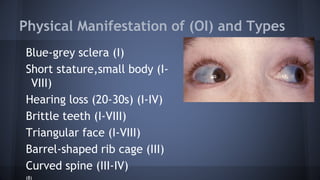
Eyes - PERRLA, slight bluish gray tint to sclera
Mouth - normal dentition
Patient Exam Results cont.
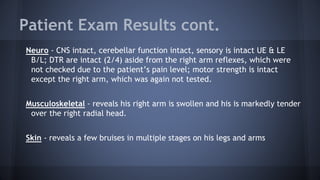
Neuro - CNS intact, cerebellar function intact, sensory is intact UE & LE
B/L; DTR are intact (2/4) aside from the right arm reflexes, which were
not checked due to the patient’s pain level; motor strength is intact
except the right arm, which was again not tested.
Musculoskeletal - reveals his right arm is swollen and his is markedly tender
over the right radial head.
Skin - reveals a few bruises in multiple stages on his legs and arms
Differential Diagnosis
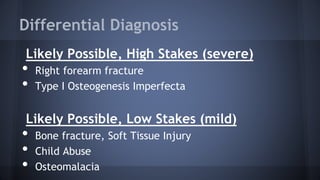
Likely Possible, High Stakes (severe)
• Right forearm fracture
• Type I Osteogenesis Imperfecta
Likely Possible, Low Stakes (mild)
• Bone fracture, Soft Tissue Injury
• Child Abuse
• Osteomalacia
Differential Diagnosis cont.
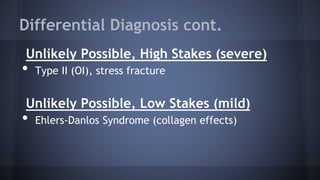
Unlikely Possible, High Stakes (severe)
• Type II (OI), stress fracture
Unlikely Possible, Low Stakes (mild)
• Ehlers-Danlos Syndrome (collagen effects)
Working Diagnosis
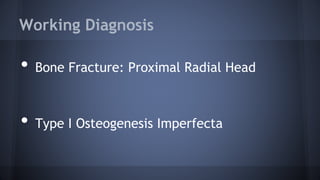
• Bone Fracture: Proximal Radial Head
• Type I Osteogenesis Imperfecta
Physical Manifestation of (OI) and Types
Blue-grey sclera (I)
Short stature,small body (I-
VIII)
Hearing loss (20-30s) (I-IV)
Brittle teeth (I-VIII)
Triangular face (I-VIII)
Barrel-shaped rib cage (III)
Curved spine (III-IV)
(8)
Acute Fracture observed in OI
Frontal radiograph of the leg
in a patient with osteogenesis
imperfecta (OI)
Hypertrophic callus formation
six weeks after femoral shaft
fracture at age 9 month
A). A radiograph taken 1.5 yr
later shows remodeling of the
callus
(B).multiple white bands
[zebra stripes] parallel to the
physis
(11)
Type I Osteogenesis
Imperfecta, Acute fracture
observed in the radius and
ulna. Old healing humeral
fracture with callus
formation is observed.
Working Diagnosis: (most likely to least likely)
8 Types of Osteogenesis Imperfecta3
Type I - Mild forms, normal quality of collagen but insufficient
quantities, Bones fracture easily, blue-gray discoloration of
sclera, hearing loss
Type III - considered progressive and deforming
Type IV - deforming, but with normal sclerae
Type V - shares the same clinical features of IV, but has
unique histologic findings ("mesh-like")
Working Diagnosis: Types (least likely)
Type VI - shares the same clinical features of IV, but has
unique histologic findings ("fish scale bone appearance")
Type VII - related to cartilage associated protein
Type VIII - severe to lethal, associated with the protein
leprecan
Type II - severe and usually lethal in the perinatal period
(around the time of birth), Severe bone deformity and small
stature
Tests to rule out diagnosis
• X-Ray of the upper R. extremity (Anterior Posterior/ Lateral), including
Proximal Radius
• Test for blood levels of Vit D, Calcium, and Phosphate
• DNA Test: COL1A1 and COL1A2 specificity for Type I-IV Osteogenisis
Imperfecta (9)
• Collagen Biochemical Test (9,10)
• DNA Test: Gene Specific LEPRE1 to r/o Type VIII (if COL1A1 and COL1A2
test normal--unlikely) (9)
• EKG, CBC
• CT or MRI (to rule out stress fracture)
Treatment Options
Discuss with and obtain agreement (Parental Consent) the
following possible plans of treatment:
Treatment of Soft Tissue Injury: (RICE) Rest, Ice, Compression
Elevation5
Treatment of Stress Fracture: nonweight-bearing rest of the
extremity. Bracing or casting the limb with a hard plastic,
air cast or arm splint may also prove beneficial by taking
some stress off the stress fracture.
Treatment cont.
Treatment of Bone Fracture: Restore fractured pieces of bone
to natural positions by aligning bone (reduction). Immobilize
with cast or splint. When swelling reduced, fracture may be
placed in a removable brace or orthosis.
Pain management: In arm fractures in children, ibuprofen has
been found to be equally effective as the combination of
acetaminophen and codeine.4
Based on treatment option - follow up with physician in 2 wks
to ensure bone has set and for additional complaints
Pathophysiology
• People with OI are born with defective connective tissue, or without the
ability to make it, usually because of a deficiency of Type-I collagen.1
• This deficiency arises from an amino acid substitution of glycine to
bulkier amino acids in the collagen triple helix structure which
compromises interactions with other molecules. The body responds by
hydrolyzing the improper collagen structure,however, if this doesnt
happen then improper association between collagen fibers and
hydroxyapettite crystals ensues resulting in brittle bones. Another theory
explains the stress state of collagen fibrils at mutation sites are altered
leading to structural failure. These recent findings suggest that the
disease is a multi level phenomenon occuring at the genetic, macro,
micro and nano levels.
Pathophysiology cont.
• As a genetic disorder, OI has historically been viewed
as an autosomal dominant disorder, however, recently
autosomal recessive forms have been identified.
• Most cases have been caused by mutations in the
COL1A1 and COL1A2 genes. Most people with OI
receive it from a parent but in 35% of cases it is an
individual (de novo or "sporadic") mutation.
Epidemiology: Bone Fracture
• Bone Fractures are the most common orthopedic
injury with over 7 million incidents per year in the
United States.
• The average person can expect to sustain 2 fractures
over the course of their lifetime.
• 10% of all Bone Fractures incidents are elbow related
• 8% of elbow fractures occur at the proximal end of the
Radius in children.
Prognosis: Bone Fracture
• Type I and II are less severe and may heal well without surgical intervention.
o (Type I: No displacement & minimal joint involvement, Type II: bone
fragments 2mm displaced)
• Type II and Type III proximal radius fractures, good results obtained with ORIF
(Open Reduction Internal Fixation) in over 90% of individuals.
o (Type III: Head of Radius broken into many separate fragments)
• Type III fractures receiving radial head arthroplasty, good results are achieved in
over 70% of individuals.
Regardless of treatment approach, early mobilization of the elbow is critical.
Epidemiology: Osteogenesis Imperfecta
• Osteogenisis Imperfecta is also known as “Brittle Bone Disease”,
“Lobstein Syndrome” or “glass bone disease”
• In the United States, the incidence of osteogenesis imperfecta is
estimated to be one per 20,000 live births.2
• Prevalence: An estimated 20,000 to 50,000 people are affected by
the disease in the United States.
• Type I is the most Common, mildest form
Prognosis: Osteogenesis Imperfecta
• The lifespan of people with OI types I, III
and IV are generally similar to the average
lifespan of a healthy individual.
• Type II is more lethal:
50% of all babies are stillborn, the other
half die within a short time after birth
•
• Despite severity of the diagnosis and probable
disability, individual quality of life is still achievable.
• Many actors, Olympic medalists, journalists, and
musicians have been living with this disease and it has
not prevented them from achieving personal success.
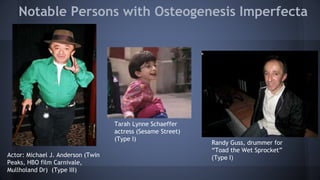
Notable Persons with Osteogenesis Imperfecta
Actor: Michael J. Anderson (Twin
Peaks, HBO film Carnivale,
Mullholand Dr) (Type III)
Tarah Lynne Schaeffer
actress (Sesame Street)
(Type I)
Randy Guss, drummer for
“Toad the Wet Sprocket”
(Type I)
Patient Education & Counseling
• There is no cure for Osteogenesis Imperfecta
• Treatment is aimed at increasing overall bone strength
to prevent fracture and maintain mobility.
• Bisphosphonates can increase bone mass, and reduce
bone pain and fracture.
• In severe cases, bones are surgically corrected, and
rods are placed inside the bones, particularly to
enable infants to learn to walk.
• Promising Clinical Trials
Promising Clinical Trials (current 12 year study)
Research sponsored by Eunice Kennedy Shriver of
Child Health and Human Development:
• Drug in Phase 3 Clinical trials: GRH Nutropin
Study from Nov 1991-Feb 2014 completion date
• current study on children beginning at age 5 with
50% showing growth rate increase.
Prior Clinical Trials (1yr study)
Journal of Pediatrics 1996 Sep;129(3):432-9.
Growth hormone treatment in osteogenesis imperfecta with quantitative defect of type I collagen synthesis.
Abstract
OBJECTIVES:
We studied growth rate, bone density, and bone metabolism in patients affected by type I osteogenesis
imperfecta (OI) with quantitative defect in type I collagen synthesis during treatment with human growth
hormone (hGH), being aware of its collagen-stimulating synthesis activity in vitro.
STUDY DESIGN:
Fourteen patients (6 boys; ages 4.8 to 10.8 years) were studied
RESULTS:
After 12 months, linear growth velocity in treated patients increased significantly in comparison with the
pretreatment period (from 3.57 +/- 0.55 to 6.04 +/- 0.69 cm/yr; p < 0.05) and with the untreated group (p <
0.05)
Results Clinical Trials (1 yr study)
CONCLUSIONS:
From our results, we conclude that hGH treatment in moderate OI does not
increase the fracture risk in treated patients in the short term, significantly
increases the rate of linear growth velocity, and increases bone turnover and
mineral content in trabecular bone at the lumber spine. (13)
Patient Education & Counseling
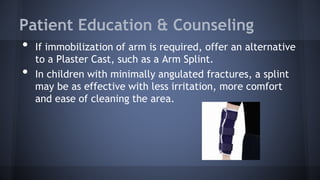
• If immobilization of arm is required, offer an alternative
to a Plaster Cast, such as a Arm Splint.
• In children with minimally angulated fractures, a splint
may be as effective with less irritation, more comfort
and ease of cleaning the area.
Patient Education & Counseling
• Offer some words of encouragement to the young child if
he does have this debilitating bone disease.
• for example: “Many actors, Olympic medalists,
journalists, and musicians have this brittle bone disease
and it has not prevented them from achieving personal
success.”
Referrals
• In the case of Osteogenesis Imperfecta a referral to a
Physical Therapist would be beneficial.
• Physical Therapy is used to strengthen muscles and
improve motility in a gentle manner, while minimizing
the risk of fracture.
• Geneticist
• Child Psychologist
Rationale
Susceptibility to fracture, blue-grey discoloration of sclera, hearing loss in
biological father, all point to the diagnosis of Type I Osteogenisis
Imperfecta. r/o Type II which is severe and usually lethal at time of birth,
survivors showing gross bone deformities. Type VIII can be determined by
the results of Genetic test specific for protein leprecan.
Treatment for Proximal Radial Bone Fracture or Elbow Stress Fracture (If
required), in accordance with standard practice so as to provide reduction
and adequate healing of bone fragments. Patient was informed of
alternative palliative treatment including Arm Splint, Bisphosphates,
surgical correction and Physical Therapy to strengthen bones.7
References1. Rauch F. Glourieux FH (2004) “Osteogenesis imperfect”. Lancet 363 (9418): 1377-1387.
2. Osteogenesis Imperfecta Author: Horacio Plotkin. Updated: March 2, 2010
3. Steiner, RD; Pepin, MG, Byers, PH, Pagon, RA, Bird, TD, Dolan, CR, Stephens, K, Adam, MP (January 28, 2005).
Osteogenesis Imperfecta. PMID 2030147
4. Drendel AL, Gorelick MH, Weisman SJ, Lyon R, Brousseau DC, Kim MK (October 2009). "A randomized clinical trial
of ibuprofen versus acetaminophen with codeine for acute pediatric arm fracture pain". Ann Emerg Med 54 (4):
553–60.
5. "Sports Medicine Advisor 2005.4: RICE: Rest, Ice, Compression, and Elevation for Injuries".
6. Glorieux FH, Bishop NJ, Plotkin H, Chabot G, Lanoue G, Travers R (1998). "Cyclic administration of pamidronate in
children with severe osteogenesis imperfecta". N. Engl.
7. Steiner RD, MD, Donald Basel MD, Pepin, MG, Byeres PH, Pargon RA, Stephens K.
Adam MP (January 28, 2005). Osteogenisis Imperfecta PMID 20301472
8. www.niams.nih.gov/Health_Info/Bone/Osteogenesis_Imperfecta
9. http://www.pathology.washington.edu/clinical/collagen/index.php/disorders/osteogenesis-imper/
10. http://www.oif.org/site/PageServer?pagename=Testing
11. Lee DY, Cho Tea-Joon, Cho IH, Chung CY, Yoo JY, Kim HJ, Park YK (Augues 2006). “Clinical Manifestations of
Osteogenesis Imperfecta.” J Korena Med. Sci doi: 10.3346/jkms.2006.21.4.709
12. http://www.ncbi.nlm.nih.gov/pmc/articles/PMC2729895/
13. J Pediatr. 1996 Sep;129(3):432-9.
Thank-you for Attendance & Support
Osteogenisis Imperfecta
Presentation by:
Christopher Lim

Osteogenesis imperfecta

  • 1.
  • 2.
    Central Problem ofthe Case Foreground: Excruciating right arm pain in a 5 y/o male status post “fell off the couch” as reported by parents of the child.
  • 3.
    Central Problem ofCase cont. Background: Sequelae of fractures shortly after bipedal mobility (from crawling to walking stance). Biological father has also has a history of several broken bones as a child and has recently begun to develop bilateral hearing loss. Patient is 75th percentile for weight and height for his age and has a slight bluish gray tint to the sclera.
  • 4.
    Patient Exam Results General- WD/WN, 75th percentile for weight and height for his age. Distraught and crying, but appropriately seeking out parents for comfort. Head - NC/AT Eyes - PERRLA, slight bluish gray tint to sclera Mouth - normal dentition
  • 5.
    Patient Exam Resultscont. Neuro - CNS intact, cerebellar function intact, sensory is intact UE & LE B/L; DTR are intact (2/4) aside from the right arm reflexes, which were not checked due to the patient’s pain level; motor strength is intact except the right arm, which was again not tested. Musculoskeletal - reveals his right arm is swollen and his is markedly tender over the right radial head. Skin - reveals a few bruises in multiple stages on his legs and arms
  • 6.
    Differential Diagnosis Likely Possible,High Stakes (severe) • Right forearm fracture • Type I Osteogenesis Imperfecta Likely Possible, Low Stakes (mild) • Bone fracture, Soft Tissue Injury • Child Abuse • Osteomalacia
  • 7.
    Differential Diagnosis cont. UnlikelyPossible, High Stakes (severe) • Type II (OI), stress fracture Unlikely Possible, Low Stakes (mild) • Ehlers-Danlos Syndrome (collagen effects)
  • 8.
    Working Diagnosis • BoneFracture: Proximal Radial Head • Type I Osteogenesis Imperfecta
  • 9.
    Physical Manifestation of(OI) and Types Blue-grey sclera (I) Short stature,small body (I- VIII) Hearing loss (20-30s) (I-IV) Brittle teeth (I-VIII) Triangular face (I-VIII) Barrel-shaped rib cage (III) Curved spine (III-IV) (8)
  • 10.
    Acute Fracture observedin OI Frontal radiograph of the leg in a patient with osteogenesis imperfecta (OI) Hypertrophic callus formation six weeks after femoral shaft fracture at age 9 month A). A radiograph taken 1.5 yr later shows remodeling of the callus (B).multiple white bands [zebra stripes] parallel to the physis (11) Type I Osteogenesis Imperfecta, Acute fracture observed in the radius and ulna. Old healing humeral fracture with callus formation is observed.
  • 11.
    Working Diagnosis: (mostlikely to least likely) 8 Types of Osteogenesis Imperfecta3 Type I - Mild forms, normal quality of collagen but insufficient quantities, Bones fracture easily, blue-gray discoloration of sclera, hearing loss Type III - considered progressive and deforming Type IV - deforming, but with normal sclerae Type V - shares the same clinical features of IV, but has unique histologic findings ("mesh-like")
  • 12.
    Working Diagnosis: Types(least likely) Type VI - shares the same clinical features of IV, but has unique histologic findings ("fish scale bone appearance") Type VII - related to cartilage associated protein Type VIII - severe to lethal, associated with the protein leprecan Type II - severe and usually lethal in the perinatal period (around the time of birth), Severe bone deformity and small stature
  • 13.
    Tests to ruleout diagnosis • X-Ray of the upper R. extremity (Anterior Posterior/ Lateral), including Proximal Radius • Test for blood levels of Vit D, Calcium, and Phosphate • DNA Test: COL1A1 and COL1A2 specificity for Type I-IV Osteogenisis Imperfecta (9) • Collagen Biochemical Test (9,10) • DNA Test: Gene Specific LEPRE1 to r/o Type VIII (if COL1A1 and COL1A2 test normal--unlikely) (9) • EKG, CBC • CT or MRI (to rule out stress fracture)
  • 14.
    Treatment Options Discuss withand obtain agreement (Parental Consent) the following possible plans of treatment: Treatment of Soft Tissue Injury: (RICE) Rest, Ice, Compression Elevation5 Treatment of Stress Fracture: nonweight-bearing rest of the extremity. Bracing or casting the limb with a hard plastic, air cast or arm splint may also prove beneficial by taking some stress off the stress fracture.
  • 15.
    Treatment cont. Treatment ofBone Fracture: Restore fractured pieces of bone to natural positions by aligning bone (reduction). Immobilize with cast or splint. When swelling reduced, fracture may be placed in a removable brace or orthosis. Pain management: In arm fractures in children, ibuprofen has been found to be equally effective as the combination of acetaminophen and codeine.4 Based on treatment option - follow up with physician in 2 wks to ensure bone has set and for additional complaints
  • 16.
    Pathophysiology • People withOI are born with defective connective tissue, or without the ability to make it, usually because of a deficiency of Type-I collagen.1 • This deficiency arises from an amino acid substitution of glycine to bulkier amino acids in the collagen triple helix structure which compromises interactions with other molecules. The body responds by hydrolyzing the improper collagen structure,however, if this doesnt happen then improper association between collagen fibers and hydroxyapettite crystals ensues resulting in brittle bones. Another theory explains the stress state of collagen fibrils at mutation sites are altered leading to structural failure. These recent findings suggest that the disease is a multi level phenomenon occuring at the genetic, macro, micro and nano levels.
  • 17.
    Pathophysiology cont. • Asa genetic disorder, OI has historically been viewed as an autosomal dominant disorder, however, recently autosomal recessive forms have been identified. • Most cases have been caused by mutations in the COL1A1 and COL1A2 genes. Most people with OI receive it from a parent but in 35% of cases it is an individual (de novo or "sporadic") mutation.
  • 18.
    Epidemiology: Bone Fracture •Bone Fractures are the most common orthopedic injury with over 7 million incidents per year in the United States. • The average person can expect to sustain 2 fractures over the course of their lifetime. • 10% of all Bone Fractures incidents are elbow related • 8% of elbow fractures occur at the proximal end of the Radius in children.
  • 19.
    Prognosis: Bone Fracture •Type I and II are less severe and may heal well without surgical intervention. o (Type I: No displacement & minimal joint involvement, Type II: bone fragments 2mm displaced) • Type II and Type III proximal radius fractures, good results obtained with ORIF (Open Reduction Internal Fixation) in over 90% of individuals. o (Type III: Head of Radius broken into many separate fragments) • Type III fractures receiving radial head arthroplasty, good results are achieved in over 70% of individuals. Regardless of treatment approach, early mobilization of the elbow is critical.
  • 20.
    Epidemiology: Osteogenesis Imperfecta •Osteogenisis Imperfecta is also known as “Brittle Bone Disease”, “Lobstein Syndrome” or “glass bone disease” • In the United States, the incidence of osteogenesis imperfecta is estimated to be one per 20,000 live births.2 • Prevalence: An estimated 20,000 to 50,000 people are affected by the disease in the United States. • Type I is the most Common, mildest form
  • 21.
    Prognosis: Osteogenesis Imperfecta •The lifespan of people with OI types I, III and IV are generally similar to the average lifespan of a healthy individual. • Type II is more lethal: 50% of all babies are stillborn, the other half die within a short time after birth
  • 22.
    • • Despite severityof the diagnosis and probable disability, individual quality of life is still achievable. • Many actors, Olympic medalists, journalists, and musicians have been living with this disease and it has not prevented them from achieving personal success.
  • 23.
    Notable Persons withOsteogenesis Imperfecta Actor: Michael J. Anderson (Twin Peaks, HBO film Carnivale, Mullholand Dr) (Type III) Tarah Lynne Schaeffer actress (Sesame Street) (Type I) Randy Guss, drummer for “Toad the Wet Sprocket” (Type I)
  • 24.
    Patient Education &Counseling • There is no cure for Osteogenesis Imperfecta • Treatment is aimed at increasing overall bone strength to prevent fracture and maintain mobility. • Bisphosphonates can increase bone mass, and reduce bone pain and fracture. • In severe cases, bones are surgically corrected, and rods are placed inside the bones, particularly to enable infants to learn to walk. • Promising Clinical Trials
  • 25.
    Promising Clinical Trials(current 12 year study) Research sponsored by Eunice Kennedy Shriver of Child Health and Human Development: • Drug in Phase 3 Clinical trials: GRH Nutropin Study from Nov 1991-Feb 2014 completion date • current study on children beginning at age 5 with 50% showing growth rate increase.
  • 26.
    Prior Clinical Trials(1yr study) Journal of Pediatrics 1996 Sep;129(3):432-9. Growth hormone treatment in osteogenesis imperfecta with quantitative defect of type I collagen synthesis. Abstract OBJECTIVES: We studied growth rate, bone density, and bone metabolism in patients affected by type I osteogenesis imperfecta (OI) with quantitative defect in type I collagen synthesis during treatment with human growth hormone (hGH), being aware of its collagen-stimulating synthesis activity in vitro. STUDY DESIGN: Fourteen patients (6 boys; ages 4.8 to 10.8 years) were studied RESULTS: After 12 months, linear growth velocity in treated patients increased significantly in comparison with the pretreatment period (from 3.57 +/- 0.55 to 6.04 +/- 0.69 cm/yr; p < 0.05) and with the untreated group (p < 0.05)
  • 27.
    Results Clinical Trials(1 yr study) CONCLUSIONS: From our results, we conclude that hGH treatment in moderate OI does not increase the fracture risk in treated patients in the short term, significantly increases the rate of linear growth velocity, and increases bone turnover and mineral content in trabecular bone at the lumber spine. (13)
  • 28.
    Patient Education &Counseling • If immobilization of arm is required, offer an alternative to a Plaster Cast, such as a Arm Splint. • In children with minimally angulated fractures, a splint may be as effective with less irritation, more comfort and ease of cleaning the area.
  • 29.
    Patient Education &Counseling • Offer some words of encouragement to the young child if he does have this debilitating bone disease. • for example: “Many actors, Olympic medalists, journalists, and musicians have this brittle bone disease and it has not prevented them from achieving personal success.”
  • 30.
    Referrals • In thecase of Osteogenesis Imperfecta a referral to a Physical Therapist would be beneficial. • Physical Therapy is used to strengthen muscles and improve motility in a gentle manner, while minimizing the risk of fracture. • Geneticist • Child Psychologist
  • 31.
    Rationale Susceptibility to fracture,blue-grey discoloration of sclera, hearing loss in biological father, all point to the diagnosis of Type I Osteogenisis Imperfecta. r/o Type II which is severe and usually lethal at time of birth, survivors showing gross bone deformities. Type VIII can be determined by the results of Genetic test specific for protein leprecan. Treatment for Proximal Radial Bone Fracture or Elbow Stress Fracture (If required), in accordance with standard practice so as to provide reduction and adequate healing of bone fragments. Patient was informed of alternative palliative treatment including Arm Splint, Bisphosphates, surgical correction and Physical Therapy to strengthen bones.7
  • 32.
    References1. Rauch F.Glourieux FH (2004) “Osteogenesis imperfect”. Lancet 363 (9418): 1377-1387. 2. Osteogenesis Imperfecta Author: Horacio Plotkin. Updated: March 2, 2010 3. Steiner, RD; Pepin, MG, Byers, PH, Pagon, RA, Bird, TD, Dolan, CR, Stephens, K, Adam, MP (January 28, 2005). Osteogenesis Imperfecta. PMID 2030147 4. Drendel AL, Gorelick MH, Weisman SJ, Lyon R, Brousseau DC, Kim MK (October 2009). "A randomized clinical trial of ibuprofen versus acetaminophen with codeine for acute pediatric arm fracture pain". Ann Emerg Med 54 (4): 553–60. 5. "Sports Medicine Advisor 2005.4: RICE: Rest, Ice, Compression, and Elevation for Injuries". 6. Glorieux FH, Bishop NJ, Plotkin H, Chabot G, Lanoue G, Travers R (1998). "Cyclic administration of pamidronate in children with severe osteogenesis imperfecta". N. Engl. 7. Steiner RD, MD, Donald Basel MD, Pepin, MG, Byeres PH, Pargon RA, Stephens K. Adam MP (January 28, 2005). Osteogenisis Imperfecta PMID 20301472 8. www.niams.nih.gov/Health_Info/Bone/Osteogenesis_Imperfecta 9. http://www.pathology.washington.edu/clinical/collagen/index.php/disorders/osteogenesis-imper/ 10. http://www.oif.org/site/PageServer?pagename=Testing 11. Lee DY, Cho Tea-Joon, Cho IH, Chung CY, Yoo JY, Kim HJ, Park YK (Augues 2006). “Clinical Manifestations of Osteogenesis Imperfecta.” J Korena Med. Sci doi: 10.3346/jkms.2006.21.4.709 12. http://www.ncbi.nlm.nih.gov/pmc/articles/PMC2729895/ 13. J Pediatr. 1996 Sep;129(3):432-9.
  • 33.
  • 34.

Editor's Notes

  • #5 pupils equal round reactive to light and accommodation
  • #6 deep tendon reflex ROS (Unremarkable and Non-Contributory)
  • #14 Collagen Molecular Testing:The first step in the lab evaluation of any form of OI is genomic sequencing of COL1A1 and COL1A2. ---10 to 30 days to complete depending on nature of test 2nd-ly perform Deletion/duplication analysis is then done once genomic sequencing of COL1A1 and COL1A2 is completed and tests normal=no mutation sequenced. It requires either a blood sample or a skin sample. 3rd: Recessive gene testing(LEPRE1; 1 of 12 additional recessive genes determined to cause recessive OI) should be considered when COL1A1 and COL1A2 genomic DNA sequencing is normal, duplication/deletion analysis is normal and A severe to lethal OI phenotype is present Familial consanguinity is reported (relationship between two people who share a common ancestor with consistent symptomatology) Last step:Collagen Biochemical Test. btwn 5&8 wks to complete growth of the cells and analysis.This test, sometimes referred to as a “skin biopsy,” examines collagen proteins(type 1 procollagen) produced by dermal fibroblasts and requires a dermal punch biopsy sample (a small circle of skin). two type I collagen genes, COL1A1 and COL1A2 and account for all but a few of the dominant forms of OI. This test could recognize alterations in the amount of type I procollagen made (seen in OI type I) and alterations in the structure of type I procollagen molecules (see in OI type II, OI type III, and OI type IV). Thus the testing could distinguish OI type I from other forms of OI, but could not distinguish among OI type II, OI type III, and OI type IV or some of the recessive forms of OI.