Osteogenesis Imperfecta 
Dr.Ijaz Wazir
Historical Background 
Osteogenesis means formation of bone 
Imperfecta is Spanish for not perfect 
Found in Ancient Egyptian Mummy from 
1000 BC 
Osteogenesis Imperfecta first used in 1895 
Also called 
Brittle Bone disease 
Glass Bone disease 
Ekman Lobstein syndrome
Epidemiology 
• OI is defined as a congenital disorder of type 1 
collagen.The gene for OI is located on 
chromosome 17.There is amino acid 
substitution which makes the collagen 
defective. 
• About 85 to 90 % cases are autosomal 
dominent and 10 to 15 % cases are autosomal 
recessive. 
• Bones,teeth,ligaments,skin and sclera are 
affected.
Epidemiology 
• In OI, defective collagen means that the 
bones are extremely fragile and can 
fracture as a result of everyday 
movements. 
• Simple movements such as opening a door 
or turning over in one’s sleep can cause 
these fractures.
Inheritance of OI 
The pattern of inheritance in many 
families with OI is autosomal dominant. 
Each and every child of an affected parent 
has a 50% chance of inheriting the faulty 
gene and of having OI. 
However, there are several hundred 
different mutations which can give rise to 
OI and many people with OI have no family 
history of the condition. This can be a result 
of spontaneous genetic mutation or been 
inherited in a different way
Inheritance continued 
35% of OI cases are a result of 
spontaneous mutations, while the others 
come from parents affected by OI or 
parents who are carriers. 
About 85%-90% of OI cases that are 
inherited are inherited in dominant 
manner. There are some rare instances 
where the disorder is recessive an 
autosomal however. The different 
inheritance patterns may also deal with 
slightly different genes.
Incidence of OI 
• The world wide incidence of OI is 1 in 20,000 
live births per year. 
• Its incidence is higher in certain areas of 
Zimbabwe,Nigeria and South Africa.
Clinical Features 
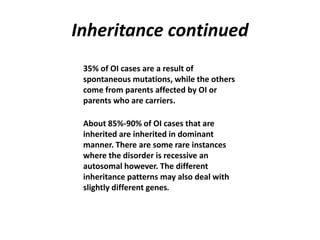
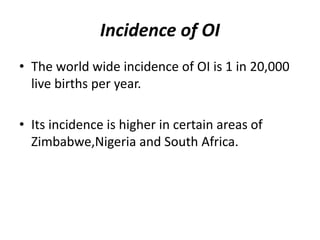
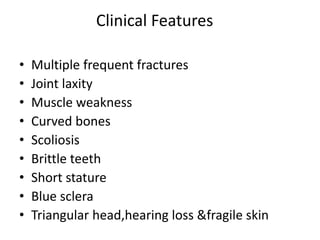
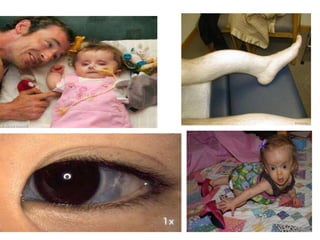
• Multiple frequent fractures 
• Joint laxity 
• Muscle weakness 
• Curved bones 
• Scoliosis 
• Brittle teeth 
• Short stature 
• Blue sclera 
• Triangular head,hearing loss &fragile skin
Classification 
• OI has been classified in eight different types; 
• TYPE 1 
• Mild,autosomal dominent 
• Divided in type 1A and 1B on the presence of 
dentinogenesis imperfecta 
• Life expectancy is slightly reduced due to fatal 
fractures like basilar invagination
Type 2 
• Severe and usually lethal in perinatal period 
• Autosomal dominent 
• Fetal death & death in first year of life 
• Divided in types A,B &C subtypes on 
radilogical basis
Type 3 
• Progressive & deforming 
• Autosomal dominent 
• Life span may be normal but with severe 
handicapping
Type 4 
• Deforming with normal sclera 
• Autosomal dominent 
• Subtypes A & B on the presence of 
dentinogenesis imperfecta
Type 5 
• Autosomal dominent 
• Same features as type 4 
• Different histologically ( bone appears mesh 
like) 
• Calcification of radio ulnar interosseous 
membrane
Type 6 
• Same features as type 4 
• Autosomal dominent 
• Different histologiclly ( fish scale like bone)
Types 7 & 8 
• Discovered in 2006 
• Autosomal recessive 
• severe to lethel
Methods of testing 
1. x-rays 
• Osteopenia,multiple fractures and malunion 
2. DNA sequencing using a collagen sample 
from blood 
3. Biochemical testing using a collagen sample 
from skin 
4.Testing during pregnency ultrasonography and 
amniocentesis 
5.DXA scan
Treatment 
• There is no cure for OI 
• Aims of treatment 
Increasing overall bone strength & 
density to prevent fractures & 
maintain mobility.
Non operative treatment 
1. Biphosphonates are used to increase bone 
mass 
2. Calcium and vitamin D 
3. Phsiotherapy 
4. Physical aids like cruthes,wheelchairs
Physical Therapy for Osteogenesis 
Imperfecta 
• Regardless of the type of treatment they receive, 
maintaining or improving muscle and bone strength are 
goals for all children with osteogenesis imperfecta. 
• In addition to improving the quality of daily life, 
physicaltherapy is an especially important component 
of care following rodding surgery or other procedures 
resulting from fractures. 
• As OI patients reach adolescence there tends to be a 
reduction in fractures, although the reason for this is 
not yet clearly understood.
Operative treatment 
1. Intramedullary rods 
2. Osteotomies 
3. Spinal fusion
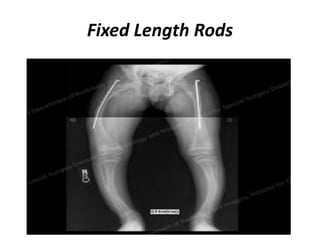
Intramedullary Fixation 
Historically, orthopedists used rods of a fixed 
length to help fractures heal and avoid or 
correct deformity. However, as the child 
grew, he or she was at risk for fracturing the 
leg immediately below the rod.
Fixed Length Rods
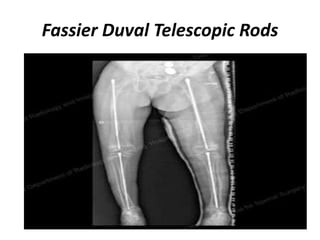
Fassier-Duval Telescopic 
Intramedullary System 
Fassier-Duval rods are secured on the far end of each 
growth plate and telescope, or extend, as growth in the 
bone occurs. Following the initial placement, there is often 
no need for surgical adjustment while the child grows. The 
patient is therefore less likely to develop the type of 
fractures associated with older, non-telescoping rods, and 
may require fewer surgeries as well. 
The development of the Fassier Duval nails have helped 
transform the nature of surgery, as these telescoping rods 
“grow” along with the child.
Fassier Duval Telescopic Rods
Looking to the Future of Osteogenesis 
Imperfecta 
• over the last ten years the prognosis for children 
with osteogenesis imperfecta has improved 
considerably, 
• Taking the longer view, stem cell therapy and gene 
manipulation may eventually lead to dramatic 
advances in OI treatment. 
• Lauren Davidson, a patient with osteogenesis 
imperfecta who went on to become a swimming 
medalist
OI & MEDIA 
• (2000) The film Unbreakable features a 
character played by Samuel L. Jackson named 
Elijah Price who suffers from OI and is 
nicknamed "Mr. Glass" due to the brittleness 
of his bones. 
• (2005) The movie Fragile features a child with 
this condition.
Thanks

Osteogenesis imperfecta

  • 1.
  • 2.
    Historical Background Osteogenesismeans formation of bone Imperfecta is Spanish for not perfect Found in Ancient Egyptian Mummy from 1000 BC Osteogenesis Imperfecta first used in 1895 Also called Brittle Bone disease Glass Bone disease Ekman Lobstein syndrome
  • 3.
    Epidemiology • OIis defined as a congenital disorder of type 1 collagen.The gene for OI is located on chromosome 17.There is amino acid substitution which makes the collagen defective. • About 85 to 90 % cases are autosomal dominent and 10 to 15 % cases are autosomal recessive. • Bones,teeth,ligaments,skin and sclera are affected.
  • 4.
    Epidemiology • InOI, defective collagen means that the bones are extremely fragile and can fracture as a result of everyday movements. • Simple movements such as opening a door or turning over in one’s sleep can cause these fractures.
  • 5.
    Inheritance of OI The pattern of inheritance in many families with OI is autosomal dominant. Each and every child of an affected parent has a 50% chance of inheriting the faulty gene and of having OI. However, there are several hundred different mutations which can give rise to OI and many people with OI have no family history of the condition. This can be a result of spontaneous genetic mutation or been inherited in a different way
  • 6.
    Inheritance continued 35%of OI cases are a result of spontaneous mutations, while the others come from parents affected by OI or parents who are carriers. About 85%-90% of OI cases that are inherited are inherited in dominant manner. There are some rare instances where the disorder is recessive an autosomal however. The different inheritance patterns may also deal with slightly different genes.
  • 7.
    Incidence of OI • The world wide incidence of OI is 1 in 20,000 live births per year. • Its incidence is higher in certain areas of Zimbabwe,Nigeria and South Africa.
  • 8.
    Clinical Features •Multiple frequent fractures • Joint laxity • Muscle weakness • Curved bones • Scoliosis • Brittle teeth • Short stature • Blue sclera • Triangular head,hearing loss &fragile skin
  • 10.
    Classification • OIhas been classified in eight different types; • TYPE 1 • Mild,autosomal dominent • Divided in type 1A and 1B on the presence of dentinogenesis imperfecta • Life expectancy is slightly reduced due to fatal fractures like basilar invagination
  • 11.
    Type 2 •Severe and usually lethal in perinatal period • Autosomal dominent • Fetal death & death in first year of life • Divided in types A,B &C subtypes on radilogical basis
  • 12.
    Type 3 •Progressive & deforming • Autosomal dominent • Life span may be normal but with severe handicapping
  • 13.
    Type 4 •Deforming with normal sclera • Autosomal dominent • Subtypes A & B on the presence of dentinogenesis imperfecta
  • 14.
    Type 5 •Autosomal dominent • Same features as type 4 • Different histologically ( bone appears mesh like) • Calcification of radio ulnar interosseous membrane
  • 15.
    Type 6 •Same features as type 4 • Autosomal dominent • Different histologiclly ( fish scale like bone)
  • 16.
    Types 7 &8 • Discovered in 2006 • Autosomal recessive • severe to lethel
  • 17.
    Methods of testing 1. x-rays • Osteopenia,multiple fractures and malunion 2. DNA sequencing using a collagen sample from blood 3. Biochemical testing using a collagen sample from skin 4.Testing during pregnency ultrasonography and amniocentesis 5.DXA scan
  • 18.
    Treatment • Thereis no cure for OI • Aims of treatment Increasing overall bone strength & density to prevent fractures & maintain mobility.
  • 19.
    Non operative treatment 1. Biphosphonates are used to increase bone mass 2. Calcium and vitamin D 3. Phsiotherapy 4. Physical aids like cruthes,wheelchairs
  • 20.
    Physical Therapy forOsteogenesis Imperfecta • Regardless of the type of treatment they receive, maintaining or improving muscle and bone strength are goals for all children with osteogenesis imperfecta. • In addition to improving the quality of daily life, physicaltherapy is an especially important component of care following rodding surgery or other procedures resulting from fractures. • As OI patients reach adolescence there tends to be a reduction in fractures, although the reason for this is not yet clearly understood.
  • 21.
    Operative treatment 1.Intramedullary rods 2. Osteotomies 3. Spinal fusion
  • 22.
    Intramedullary Fixation Historically,orthopedists used rods of a fixed length to help fractures heal and avoid or correct deformity. However, as the child grew, he or she was at risk for fracturing the leg immediately below the rod.
  • 23.
  • 24.
    Fassier-Duval Telescopic IntramedullarySystem Fassier-Duval rods are secured on the far end of each growth plate and telescope, or extend, as growth in the bone occurs. Following the initial placement, there is often no need for surgical adjustment while the child grows. The patient is therefore less likely to develop the type of fractures associated with older, non-telescoping rods, and may require fewer surgeries as well. The development of the Fassier Duval nails have helped transform the nature of surgery, as these telescoping rods “grow” along with the child.
  • 25.
  • 26.
    Looking to theFuture of Osteogenesis Imperfecta • over the last ten years the prognosis for children with osteogenesis imperfecta has improved considerably, • Taking the longer view, stem cell therapy and gene manipulation may eventually lead to dramatic advances in OI treatment. • Lauren Davidson, a patient with osteogenesis imperfecta who went on to become a swimming medalist
  • 27.
    OI & MEDIA • (2000) The film Unbreakable features a character played by Samuel L. Jackson named Elijah Price who suffers from OI and is nicknamed "Mr. Glass" due to the brittleness of his bones. • (2005) The movie Fragile features a child with this condition.
  • 28.