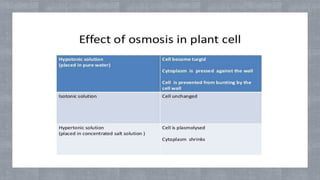
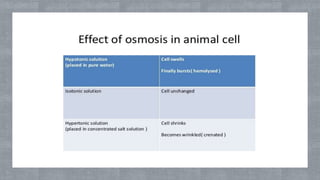
By
Ananya Pathak Ojha
IX C
Roll no -6
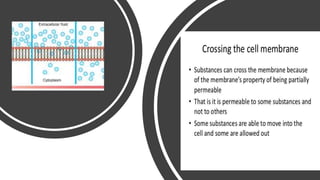
 The cell membrane, also known as
the plasma membrane, is a double layer of
lipids and proteins that surrounds
a cell and separates the cytoplasm (the
contents of the cell) from its surrounding
environment. It is selectively permeable,
which means that it only lets certain
molecules enter and exit.
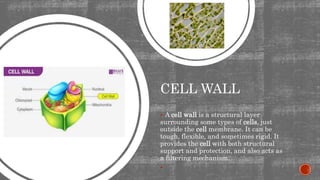
CELL WALL
 A cell wall is a structural layer
surrounding some types of cells, just
outside the cell membrane. It can be
tough, flexible, and sometimes rigid. It
provides the cell with both structural
support and protection, and also acts as
a filtering mechanism.

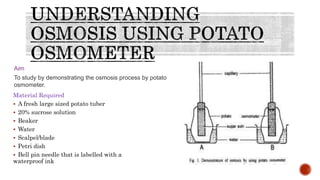
Material Required
 A fresh large sized potato tuber
 20% sucrose solution
 Beaker
 Water
 Scalpel/blade
 Petri dish
 Bell pin needle that is labelled with a
waterproof ink
Aim
To study by demonstrating the osmosis process by potato
osmometer.
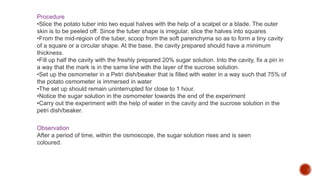
Procedure
•Slice the potato tuber into two equal halves with the help of a scalpel or a blade. The outer
skin is to be peeled off. Since the tuber shape is irregular, slice the halves into squares
•From the mid-region of the tuber, scoop from the soft parenchyma so as to form a tiny cavity
of a square or a circular shape. At the base, the cavity prepared should have a minimum
thickness.
•Fill up half the cavity with the freshly prepared 20% sugar solution. Into the cavity, fix a pin in
a way that the mark is in the same line with the layer of the sucrose solution.
•Set up the osmometer in a Petri dish/beaker that is filled with water in a way such that 75% of
the potato osmometer is immersed in water
•The set up should remain uninterrupted for close to 1 hour.
•Notice the sugar solution in the osmometer towards the end of the experiment
•Carry out the experiment with the help of water in the cavity and the sucrose solution in the
petri dish/beaker.
Observation
After a period of time, within the osmoscope, the sugar solution rises and is seen
coloured.
Conclusion
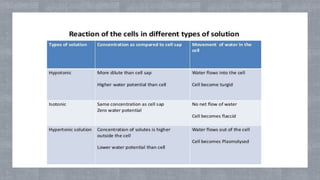
•An increase in the level of sucrose solution is observed in the osmometer. It is because of the
entrance of water due to endosmosis from the beaker
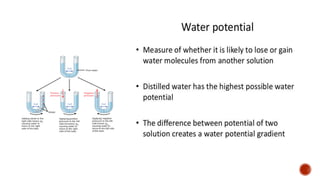
•Also, a water potential gradient is built between the sucrose solution in the external water
and the osmometer
•Though both the liquids are divided by living cells of the potato tuber, they allow the entrance
of water into the sugar solution.
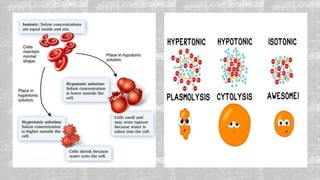
•This demonstrates the entrance of water into the sugar solution through the tissues of potato
serving as a selectively permeable membrane.
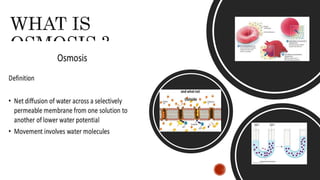
Osmosis

Osmosis

  • 1.
  • 8.
     The cellmembrane, also known as the plasma membrane, is a double layer of lipids and proteins that surrounds a cell and separates the cytoplasm (the contents of the cell) from its surrounding environment. It is selectively permeable, which means that it only lets certain molecules enter and exit.
  • 15.
    CELL WALL  Acell wall is a structural layer surrounding some types of cells, just outside the cell membrane. It can be tough, flexible, and sometimes rigid. It provides the cell with both structural support and protection, and also acts as a filtering mechanism. 
  • 18.
    Material Required  Afresh large sized potato tuber  20% sucrose solution  Beaker  Water  Scalpel/blade  Petri dish  Bell pin needle that is labelled with a waterproof ink Aim To study by demonstrating the osmosis process by potato osmometer.
  • 19.
    Procedure •Slice the potatotuber into two equal halves with the help of a scalpel or a blade. The outer skin is to be peeled off. Since the tuber shape is irregular, slice the halves into squares •From the mid-region of the tuber, scoop from the soft parenchyma so as to form a tiny cavity of a square or a circular shape. At the base, the cavity prepared should have a minimum thickness. •Fill up half the cavity with the freshly prepared 20% sugar solution. Into the cavity, fix a pin in a way that the mark is in the same line with the layer of the sucrose solution. •Set up the osmometer in a Petri dish/beaker that is filled with water in a way such that 75% of the potato osmometer is immersed in water •The set up should remain uninterrupted for close to 1 hour. •Notice the sugar solution in the osmometer towards the end of the experiment •Carry out the experiment with the help of water in the cavity and the sucrose solution in the petri dish/beaker. Observation After a period of time, within the osmoscope, the sugar solution rises and is seen coloured.
  • 20.
    Conclusion •An increase inthe level of sucrose solution is observed in the osmometer. It is because of the entrance of water due to endosmosis from the beaker •Also, a water potential gradient is built between the sucrose solution in the external water and the osmometer •Though both the liquids are divided by living cells of the potato tuber, they allow the entrance of water into the sugar solution. •This demonstrates the entrance of water into the sugar solution through the tissues of potato serving as a selectively permeable membrane.