1
Dr. Govinda Navale
Dept. of Chemistry, IIT-Roorkee
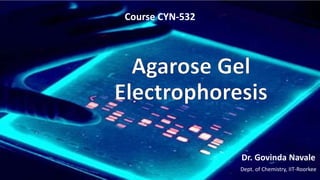
Course CYN-532
Why electrophoresis ?
 To separate DNA/protein fragments from each other
 To determine the sizes of DNA/proteins fragments
 To determine the presence or amount of DNA/protein
 To analyse the restriction digestion
products
 Agarose (for DNA/RNA),
PAGE (for Proteins)
2
Agarose Gel Electrophoresis
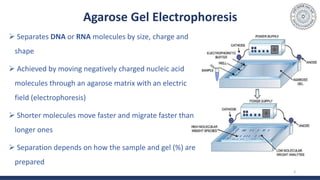
 Separates DNA or RNA molecules by size, charge and
shape
 Achieved by moving negatively charged nucleic acid
molecules through an agarose matrix with an electric
field (electrophoresis)
 Shorter molecules move faster and migrate faster than
longer ones
 Separation depends on how the sample and gel (%) are
prepared
3
4
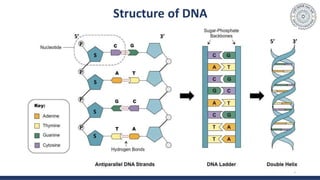
Structure of DNA
5
S
S
S
S
P
P
P
P
5’ 3’
5’ 3’
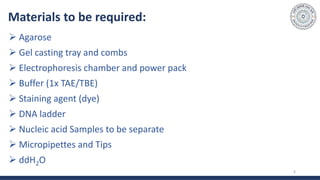
Materials to be required:
 Agarose
 Gel casting tray and combs
 Electrophoresis chamber and power pack
 Buffer (1x TAE/TBE)
 Staining agent (dye)
 DNA ladder
 Nucleic acid Samples to be separate
 Micropipettes and Tips
 ddH2O
6
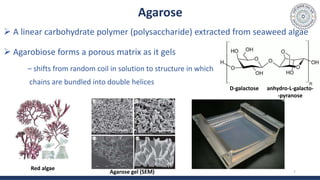
Agarose
 A linear carbohydrate polymer (polysaccharide) extracted from seaweed algae
 Agarobiose forms a porous matrix as it gels
– shifts from random coil in solution to structure in which
chains are bundled into double helices
7
D-galactose anhydro-L-galacto-
-pyranose
Red algae
Agarose gel (SEM)
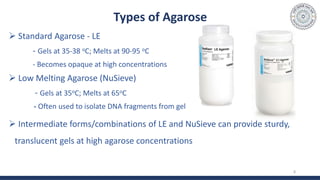
Types of Agarose
 Standard Agarose - LE
- Gels at 35-38 oC; Melts at 90-95 oC
- Becomes opaque at high concentrations
 Low Melting Agarose (NuSieve)
- Gels at 35oC; Melts at 65oC
- Often used to isolate DNA fragments from gel
 Intermediate forms/combinations of LE and NuSieve can provide sturdy,
translucent gels at high agarose concentrations
8
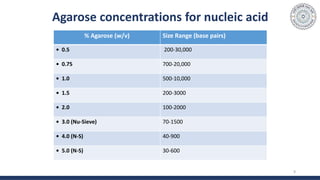
Agarose concentrations for nucleic acid
9
% Agarose (w/v) Size Range (base pairs)
• 0.5 200-30,000
• 0.75 700-20,000
• 1.0 500-10,000
• 1.5 200-3000
• 2.0 100-2000
• 3.0 (Nu-Sieve) 70-1500
• 4.0 (N-S) 40-900
• 5.0 (N-S) 30-600
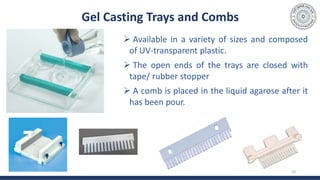
Gel Casting Trays and Combs
 Available in a variety of sizes and composed
of UV-transparent plastic.
 The open ends of the trays are closed with
tape/ rubber stopper
 A comb is placed in the liquid agarose after it
has been pour.
10
11
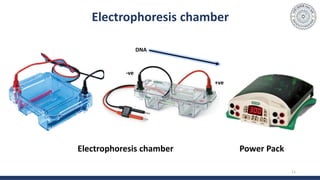
Electrophoresis chamber
Electrophoresis chamber Power Pack
+ve
-ve
DNA
Buffer
 During electrophoresis water undergoes hydrolysis :
H2O H+ + OH-
 Buffers prevent the pH from changing by reacting with the H+ or OH- products
 Components of buffer (TBE or TAE) used :
- TRIS [tris(hydroxymethyl)aminomethane]
- Boric Acid or acetic acid
- EDTA (Ethylenediamine tetra-acetic acid)
-for chelating the Mg2+ ions which are cofactors for DNA nucleases
12
Tris is a strong base and borate/AA is an
acid, combination of both maintains the
pH nearly 8 to 8.5
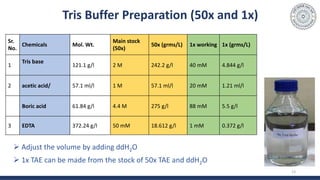
Tris Buffer Preparation (50x and 1x)
13
Sr.
No.
Chemicals Mol. Wt.
Main stock
(50x)
50x (grms/L) 1x working 1x (grms/L)
1
Tris base
121.1 g/l 2 M 242.2 g/l 40 mM 4.844 g/l
2 acetic acid/ 57.1 ml/l 1 M 57.1 ml/l 20 mM 1.21 ml/l
Boric acid 61.84 g/l 4.4 M 275 g/l 88 mM 5.5 g/l
3 EDTA 372.24 g/l 50 mM 18.612 g/l 1 mM 0.372 g/l
 Adjust the volume by adding ddH2O
 1x TAE can be made from the stock of 50x TAE and ddH2O
Staining of DNA
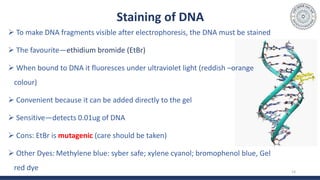
 To make DNA fragments visible after electrophoresis, the DNA must be stained
 The favourite—ethidium bromide (EtBr)
 When bound to DNA it fluoresces under ultraviolet light (reddish –orange
colour)
 Convenient because it can be added directly to the gel
 Sensitive—detects 0.01ug of DNA
 Cons: EtBr is mutagenic (care should be taken)
 Other Dyes: Methylene blue: syber safe; xylene cyanol; bromophenol blue, Gel
red dye 14
Ethidium bromide
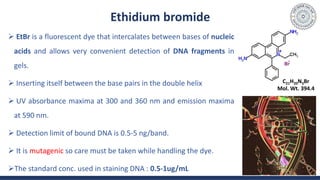
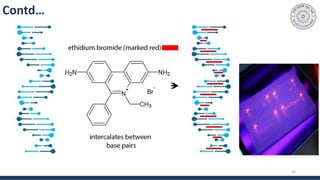
 EtBr is a fluorescent dye that intercalates between bases of nucleic
acids and allows very convenient detection of DNA fragments in
gels.
 Inserting itself between the base pairs in the double helix
 UV absorbance maxima at 300 and 360 nm and emission maxima
at 590 nm.
 Detection limit of bound DNA is 0.5-5 ng/band.
 It is mutagenic so care must be taken while handling the dye.
The standard conc. used in staining DNA : 0.5-1ug/mL 15
C21H20N3Br
Mol. Wt. 394.4
16
Contd…
DNA ladder
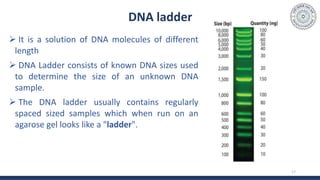
 It is a solution of DNA molecules of different
length
 DNA Ladder consists of known DNA sizes used
to determine the size of an unknown DNA
sample.
 The DNA ladder usually contains regularly
spaced sized samples which when run on an
agarose gel looks like a "ladder".
17
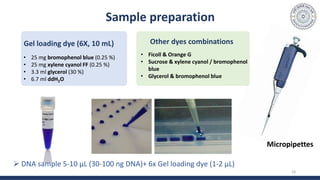
Sample preparation
 DNA sample 5-10 µL (30-100 ng DNA)+ 6x Gel loading dye (1-2 µL)
18
Gel loading dye (6X, 10 mL)
• 25 mg bromophenol blue (0.25 %)
• 25 mg xylene cyanol FF (0.25 %)
• 3.3 ml glycerol (30 %)
• 6.7 ml ddH2O
Other dyes combinations
• Ficoll & Orange G
• Sucrose & xylene cyanol / bromophenol
blue
• Glycerol & bromophenol blue
Micropipettes
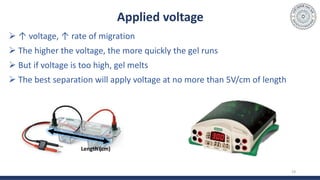
Applied voltage
 ↑ voltage, ↑ rate of migration
 The higher the voltage, the more quickly the gel runs
 But if voltage is too high, gel melts
 The best separation will apply voltage at no more than 5V/cm of length
19
Length (cm)
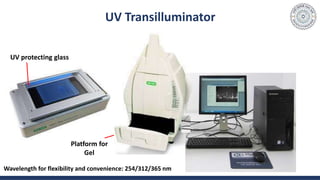
UV Transilluminator
Platform for
Gel
UV protecting glass
Wavelength for flexibility and convenience: 254/312/365 nm
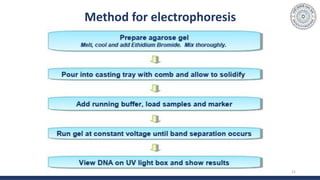
Method for electrophoresis
21
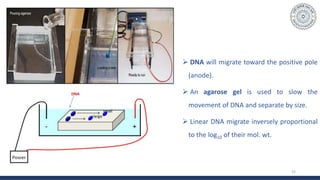
 DNA will migrate toward the positive pole
(anode).
 An agarose gel is used to slow the
movement of DNA and separate by size.
 Linear DNA migrate inversely proportional
to the log10 of their mol. wt.
22
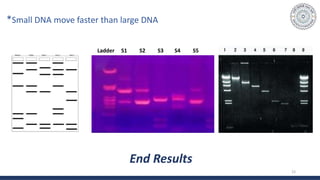
End Results
*Small DNA move faster than large DNA
23
Ladder S1 S2 S3 S4 S5
Experimental
• Check Video at:
https://www.youtube.com/watch?v=_AhL2jKo3tI
References
 Sambrook J, Russel DW (2001). Molecular Cloning: A Laboratory Manual 3rd Ed. Cold Spring Harbor Laboratory
Press. Cold Spring Harbor, NY.
 Leonard G. D, and James F. B. Basic Methods in Molecular Biology, 1986
 Joseph Sambrook; David Russell. "Chapter 5, protocol 1". Molecular Cloning - A Laboratory Manual. 1 (3rd
ed.). p. 5.4. ISBN 978-0-87969-577-4
 Zimm BH, Levene SD (May 1992). "Problems and prospects in the theory of gel electrophoresis of DNA“.
Quarterly Reviews of Biophysics. 25 (2): 171–204
 Jean-Louis Viovy (2000). "Electrophoresis of DNA and other polyelectrolytes: Physical mechanisms". Reviews
of Modern Physics. 72 (3): 813–872. Bibcode:2000RvMP...72..813V
 https://en.wikipedia.org/wiki/Agarose_gel_electrophoresis
 https://www.slideshare.net/harshit172/agarose-gel-electrophoresis-25523393
26

Gel electrophoresis practical

  • 1.
    1 Dr. Govinda Navale Dept.of Chemistry, IIT-Roorkee Course CYN-532
  • 2.
    Why electrophoresis ? To separate DNA/protein fragments from each other  To determine the sizes of DNA/proteins fragments  To determine the presence or amount of DNA/protein  To analyse the restriction digestion products  Agarose (for DNA/RNA), PAGE (for Proteins) 2
  • 3.
    Agarose Gel Electrophoresis Separates DNA or RNA molecules by size, charge and shape  Achieved by moving negatively charged nucleic acid molecules through an agarose matrix with an electric field (electrophoresis)  Shorter molecules move faster and migrate faster than longer ones  Separation depends on how the sample and gel (%) are prepared 3
  • 4.
  • 5.
  • 6.
    Materials to berequired:  Agarose  Gel casting tray and combs  Electrophoresis chamber and power pack  Buffer (1x TAE/TBE)  Staining agent (dye)  DNA ladder  Nucleic acid Samples to be separate  Micropipettes and Tips  ddH2O 6
  • 7.
    Agarose  A linearcarbohydrate polymer (polysaccharide) extracted from seaweed algae  Agarobiose forms a porous matrix as it gels – shifts from random coil in solution to structure in which chains are bundled into double helices 7 D-galactose anhydro-L-galacto- -pyranose Red algae Agarose gel (SEM)
  • 8.
    Types of Agarose Standard Agarose - LE - Gels at 35-38 oC; Melts at 90-95 oC - Becomes opaque at high concentrations  Low Melting Agarose (NuSieve) - Gels at 35oC; Melts at 65oC - Often used to isolate DNA fragments from gel  Intermediate forms/combinations of LE and NuSieve can provide sturdy, translucent gels at high agarose concentrations 8
  • 9.
    Agarose concentrations fornucleic acid 9 % Agarose (w/v) Size Range (base pairs) • 0.5 200-30,000 • 0.75 700-20,000 • 1.0 500-10,000 • 1.5 200-3000 • 2.0 100-2000 • 3.0 (Nu-Sieve) 70-1500 • 4.0 (N-S) 40-900 • 5.0 (N-S) 30-600
  • 10.
    Gel Casting Traysand Combs  Available in a variety of sizes and composed of UV-transparent plastic.  The open ends of the trays are closed with tape/ rubber stopper  A comb is placed in the liquid agarose after it has been pour. 10
  • 11.
  • 12.
    Buffer  During electrophoresiswater undergoes hydrolysis : H2O H+ + OH-  Buffers prevent the pH from changing by reacting with the H+ or OH- products  Components of buffer (TBE or TAE) used : - TRIS [tris(hydroxymethyl)aminomethane] - Boric Acid or acetic acid - EDTA (Ethylenediamine tetra-acetic acid) -for chelating the Mg2+ ions which are cofactors for DNA nucleases 12 Tris is a strong base and borate/AA is an acid, combination of both maintains the pH nearly 8 to 8.5
  • 13.
    Tris Buffer Preparation(50x and 1x) 13 Sr. No. Chemicals Mol. Wt. Main stock (50x) 50x (grms/L) 1x working 1x (grms/L) 1 Tris base 121.1 g/l 2 M 242.2 g/l 40 mM 4.844 g/l 2 acetic acid/ 57.1 ml/l 1 M 57.1 ml/l 20 mM 1.21 ml/l Boric acid 61.84 g/l 4.4 M 275 g/l 88 mM 5.5 g/l 3 EDTA 372.24 g/l 50 mM 18.612 g/l 1 mM 0.372 g/l  Adjust the volume by adding ddH2O  1x TAE can be made from the stock of 50x TAE and ddH2O
  • 14.
    Staining of DNA To make DNA fragments visible after electrophoresis, the DNA must be stained  The favourite—ethidium bromide (EtBr)  When bound to DNA it fluoresces under ultraviolet light (reddish –orange colour)  Convenient because it can be added directly to the gel  Sensitive—detects 0.01ug of DNA  Cons: EtBr is mutagenic (care should be taken)  Other Dyes: Methylene blue: syber safe; xylene cyanol; bromophenol blue, Gel red dye 14
  • 15.
    Ethidium bromide  EtBris a fluorescent dye that intercalates between bases of nucleic acids and allows very convenient detection of DNA fragments in gels.  Inserting itself between the base pairs in the double helix  UV absorbance maxima at 300 and 360 nm and emission maxima at 590 nm.  Detection limit of bound DNA is 0.5-5 ng/band.  It is mutagenic so care must be taken while handling the dye. The standard conc. used in staining DNA : 0.5-1ug/mL 15 C21H20N3Br Mol. Wt. 394.4
  • 16.
  • 17.
    DNA ladder  Itis a solution of DNA molecules of different length  DNA Ladder consists of known DNA sizes used to determine the size of an unknown DNA sample.  The DNA ladder usually contains regularly spaced sized samples which when run on an agarose gel looks like a "ladder". 17
  • 18.
    Sample preparation  DNAsample 5-10 µL (30-100 ng DNA)+ 6x Gel loading dye (1-2 µL) 18 Gel loading dye (6X, 10 mL) • 25 mg bromophenol blue (0.25 %) • 25 mg xylene cyanol FF (0.25 %) • 3.3 ml glycerol (30 %) • 6.7 ml ddH2O Other dyes combinations • Ficoll & Orange G • Sucrose & xylene cyanol / bromophenol blue • Glycerol & bromophenol blue Micropipettes
  • 19.
    Applied voltage  ↑voltage, ↑ rate of migration  The higher the voltage, the more quickly the gel runs  But if voltage is too high, gel melts  The best separation will apply voltage at no more than 5V/cm of length 19 Length (cm)
  • 20.
    UV Transilluminator Platform for Gel UVprotecting glass Wavelength for flexibility and convenience: 254/312/365 nm
  • 21.
  • 22.
     DNA willmigrate toward the positive pole (anode).  An agarose gel is used to slow the movement of DNA and separate by size.  Linear DNA migrate inversely proportional to the log10 of their mol. wt. 22
  • 23.
    End Results *Small DNAmove faster than large DNA 23 Ladder S1 S2 S3 S4 S5
  • 24.
    Experimental • Check Videoat: https://www.youtube.com/watch?v=_AhL2jKo3tI
  • 25.
    References  Sambrook J,Russel DW (2001). Molecular Cloning: A Laboratory Manual 3rd Ed. Cold Spring Harbor Laboratory Press. Cold Spring Harbor, NY.  Leonard G. D, and James F. B. Basic Methods in Molecular Biology, 1986  Joseph Sambrook; David Russell. "Chapter 5, protocol 1". Molecular Cloning - A Laboratory Manual. 1 (3rd ed.). p. 5.4. ISBN 978-0-87969-577-4  Zimm BH, Levene SD (May 1992). "Problems and prospects in the theory of gel electrophoresis of DNA“. Quarterly Reviews of Biophysics. 25 (2): 171–204  Jean-Louis Viovy (2000). "Electrophoresis of DNA and other polyelectrolytes: Physical mechanisms". Reviews of Modern Physics. 72 (3): 813–872. Bibcode:2000RvMP...72..813V  https://en.wikipedia.org/wiki/Agarose_gel_electrophoresis  https://www.slideshare.net/harshit172/agarose-gel-electrophoresis-25523393
  • 26.

Editor's Notes

  • #6 DNA strand is composed of nucleotides—units made up of a sugar (deoxyribose), a phosphate group, and a nitrogenous base. Each strand of DNA is a polynucleotide composed of units called nucleotides. A nucleotide has three components: a sugar molecule, a phosphate group, and a nitrogenous base.
  • #11 Gel caster
  • #16  Ethidium Similar to most of the fluorescent compounds, the EtBr is an aromatic molecule. It's core can be defined as phenanthridine – an isomer of acridine. ligand binds mainly stacked on, or intercalated between, the terminal base pairs of the  DNA with little to no interaction with the inner base pairs. vander waal interaction in RNA
  • #19 Role of dyes: tracking dyes to check how fast DNA samples are running, glycerol gives density to settle in the well.