OSI MODEL


     By : Alok Pareek, Satish Solanki
                        &
            Harsh Vardhan Sikhwal
WHAT IS OSI?

   The Open Systems Interconnection model (OSI model) is a product
    of the Open Systems Interconnection effort at the International
    Organization for Standardization. It is a prescription of characterizing
    and standardizing the functions of a communications system in terms
    of abstraction layers. Similar communication functions are grouped
    into logical layers. An instance of a layer provides services to its
    upper layer instances while receiving services from the layer below.
   For example, a layer that provides error-free communications across
    a network provides the path needed by applications above it, while it
    calls the next lower layer to send and receive packets that make up
    the contents of that path. Two instances at one layer are connected
    by a horizontal connection on that layer.
HISTORY

   Work on a layered model of network architecture was started and the
    International Organization for Standardization (ISO) began to
    develop its OSI framework architecture. OSI had two major
    components: an abstract model of networking, called the Basic
    Reference Model or seven-layer model, and a set of specific
    protocols.
   The concept of a seven-layer model was provided by the work of
    Charles Bachman, Honeywell Information Services. Various aspects
    of OSI design evolved from experiences with the ARPANET, the
    fledgling Internet, NPLNET, EIN, CYCLADES network and the work
    in IFIP WG6.1. The new design was documented in ISO 7498 and its
    various addenda. In this model, a networking system was divided
    into layers. Within each layer, one or more entities implement its
    functionality. Each entity interacted directly only with the layer
    immediately beneath it, and provided facilities for use by the layer
    above it
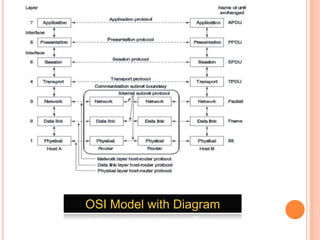
OSI Model with Diagram
DESCRIPTION OF OSI LAYERS

According to recommendation X.200, there are seven layers. These
  Seven layers are

   Layer 1: Physical layer
         The physical layer defines electrical and physical
         specifications for devices. In particular, it     defines the
         relationship     between a device and a transmission
         medium, such as a copper or optical cable. This includes the
    layout
         of pins, voltages, cable specifications, hubs,repeaters, network
         adapters, host bus adapters(HBA used in storage area
         networks) and more.
         The major functions and services performed by the physical
         layer are:
         Establishment and termination of a connection to
         a communications medium.
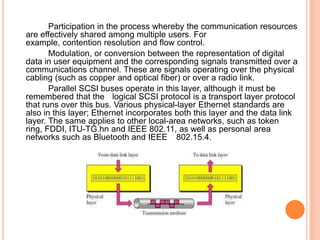
Participation in the process whereby the communication resources
are effectively shared among multiple users. For
example, contention resolution and flow control.
       Modulation, or conversion between the representation of digital
data in user equipment and the corresponding signals transmitted over a
communications channel. These are signals operating over the physical
cabling (such as copper and optical fiber) or over a radio link.
       Parallel SCSI buses operate in this layer, although it must be
remembered that the logical SCSI protocol is a transport layer protocol
that runs over this bus. Various physical-layer Ethernet standards are
also in this layer; Ethernet incorporates both this layer and the data link
layer. The same applies to other local-area networks, such as token
ring, FDDI, ITU-TG.hn and IEEE 802.11, as well as personal area
networks such as Bluetooth and IEEE 802.15.4.
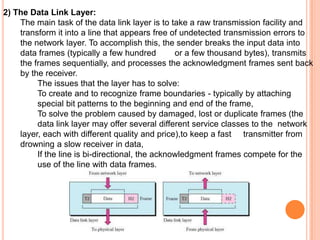
2) The Data Link Layer:
    The main task of the data link layer is to take a raw transmission facility and
    transform it into a line that appears free of undetected transmission errors to
    the network layer. To accomplish this, the sender breaks the input data into
    data frames (typically a few hundred         or a few thousand bytes), transmits
    the frames sequentially, and processes the acknowledgment frames sent back
    by the receiver.
         The issues that the layer has to solve:
         To create and to recognize frame boundaries - typically by attaching
         special bit patterns to the beginning and end of the frame,
         To solve the problem caused by damaged, lost or duplicate frames (the
         data link layer may offer several different service classes to the network
    layer, each with different quality and price),to keep a fast transmitter from
    drowning a slow receiver in data,
         If the line is bi-directional, the acknowledgment frames compete for the
         use of the line with data frames.
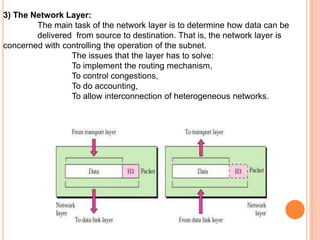
3) The Network Layer:
        The main task of the network layer is to determine how data can be
        delivered from source to destination. That is, the network layer is
concerned with controlling the operation of the subnet.
                 The issues that the layer has to solve:
                 To implement the routing mechanism,
                 To control congestions,
                 To do accounting,
                 To allow interconnection of heterogeneous networks.
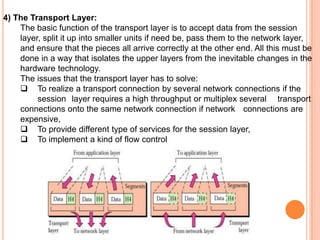
4) The Transport Layer:
    The basic function of the transport layer is to accept data from the session
    layer, split it up into smaller units if need be, pass them to the network layer,
    and ensure that the pieces all arrive correctly at the other end. All this must be
    done in a way that isolates the upper layers from the inevitable changes in the
    hardware technology.
    The issues that the transport layer has to solve:
     To realize a transport connection by several network connections if the
         session layer requires a high throughput or multiplex several transport
    connections onto the same network connection if network connections are
    expensive,
     To provide different type of services for the session layer,
     To implement a kind of flow control
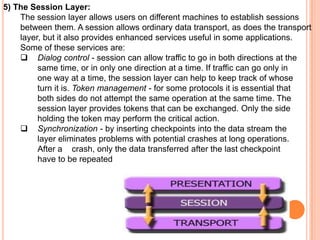
5) The Session Layer:
    The session layer allows users on different machines to establish sessions
    between them. A session allows ordinary data transport, as does the transport
    layer, but it also provides enhanced services useful in some applications.
    Some of these services are:
     Dialog control - session can allow traffic to go in both directions at the
         same time, or in only one direction at a time. If traffic can go only in
         one way at a time, the session layer can help to keep track of whose
         turn it is. Token management - for some protocols it is essential that
         both sides do not attempt the same operation at the same time. The
         session layer provides tokens that can be exchanged. Only the side
         holding the token may perform the critical action.
     Synchronization - by inserting checkpoints into the data stream the
         layer eliminates problems with potential crashes at long operations.
         After a crash, only the data transferred after the last checkpoint
         have to be repeated
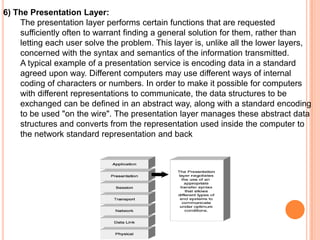
6) The Presentation Layer:
    The presentation layer performs certain functions that are requested
    sufficiently often to warrant finding a general solution for them, rather than
    letting each user solve the problem. This layer is, unlike all the lower layers,
    concerned with the syntax and semantics of the information transmitted.
    A typical example of a presentation service is encoding data in a standard
    agreed upon way. Different computers may use different ways of internal
    coding of characters or numbers. In order to make it possible for computers
    with different representations to communicate, the data structures to be
    exchanged can be defined in an abstract way, along with a standard encoding
    to be used "on the wire". The presentation layer manages these abstract data
    structures and converts from the representation used inside the computer to
    the network standard representation and back
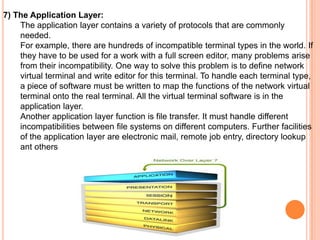
7) The Application Layer:
    The application layer contains a variety of protocols that are commonly
    needed.
    For example, there are hundreds of incompatible terminal types in the world. If
    they have to be used for a work with a full screen editor, many problems arise
    from their incompatibility. One way to solve this problem is to define network
    virtual terminal and write editor for this terminal. To handle each terminal type,
    a piece of software must be written to map the functions of the network virtual
    terminal onto the real terminal. All the virtual terminal software is in the
    application layer.
    Another application layer function is file transfer. It must handle different
    incompatibilities between file systems on different computers. Further facilities
    of the application layer are electronic mail, remote job entry, directory lookup
    ant others
Problem’s in OSI Model
   Seven layers not widely accepted
   Standardized before implemented
   Top three layers fuzzy
   Internet or TCP/IP layering widespread

Osi model

  • 1.
    OSI MODEL By : Alok Pareek, Satish Solanki & Harsh Vardhan Sikhwal
  • 2.
    WHAT IS OSI?  The Open Systems Interconnection model (OSI model) is a product of the Open Systems Interconnection effort at the International Organization for Standardization. It is a prescription of characterizing and standardizing the functions of a communications system in terms of abstraction layers. Similar communication functions are grouped into logical layers. An instance of a layer provides services to its upper layer instances while receiving services from the layer below.  For example, a layer that provides error-free communications across a network provides the path needed by applications above it, while it calls the next lower layer to send and receive packets that make up the contents of that path. Two instances at one layer are connected by a horizontal connection on that layer.
  • 3.
    HISTORY  Work on a layered model of network architecture was started and the International Organization for Standardization (ISO) began to develop its OSI framework architecture. OSI had two major components: an abstract model of networking, called the Basic Reference Model or seven-layer model, and a set of specific protocols.  The concept of a seven-layer model was provided by the work of Charles Bachman, Honeywell Information Services. Various aspects of OSI design evolved from experiences with the ARPANET, the fledgling Internet, NPLNET, EIN, CYCLADES network and the work in IFIP WG6.1. The new design was documented in ISO 7498 and its various addenda. In this model, a networking system was divided into layers. Within each layer, one or more entities implement its functionality. Each entity interacted directly only with the layer immediately beneath it, and provided facilities for use by the layer above it
  • 4.
  • 5.
    DESCRIPTION OF OSILAYERS According to recommendation X.200, there are seven layers. These Seven layers are  Layer 1: Physical layer The physical layer defines electrical and physical specifications for devices. In particular, it defines the relationship between a device and a transmission medium, such as a copper or optical cable. This includes the layout of pins, voltages, cable specifications, hubs,repeaters, network adapters, host bus adapters(HBA used in storage area networks) and more. The major functions and services performed by the physical layer are: Establishment and termination of a connection to a communications medium.
  • 6.
    Participation in theprocess whereby the communication resources are effectively shared among multiple users. For example, contention resolution and flow control. Modulation, or conversion between the representation of digital data in user equipment and the corresponding signals transmitted over a communications channel. These are signals operating over the physical cabling (such as copper and optical fiber) or over a radio link. Parallel SCSI buses operate in this layer, although it must be remembered that the logical SCSI protocol is a transport layer protocol that runs over this bus. Various physical-layer Ethernet standards are also in this layer; Ethernet incorporates both this layer and the data link layer. The same applies to other local-area networks, such as token ring, FDDI, ITU-TG.hn and IEEE 802.11, as well as personal area networks such as Bluetooth and IEEE 802.15.4.
  • 7.
    2) The DataLink Layer: The main task of the data link layer is to take a raw transmission facility and transform it into a line that appears free of undetected transmission errors to the network layer. To accomplish this, the sender breaks the input data into data frames (typically a few hundred or a few thousand bytes), transmits the frames sequentially, and processes the acknowledgment frames sent back by the receiver. The issues that the layer has to solve: To create and to recognize frame boundaries - typically by attaching special bit patterns to the beginning and end of the frame, To solve the problem caused by damaged, lost or duplicate frames (the data link layer may offer several different service classes to the network layer, each with different quality and price),to keep a fast transmitter from drowning a slow receiver in data, If the line is bi-directional, the acknowledgment frames compete for the use of the line with data frames.
  • 8.
    3) The NetworkLayer: The main task of the network layer is to determine how data can be delivered from source to destination. That is, the network layer is concerned with controlling the operation of the subnet. The issues that the layer has to solve: To implement the routing mechanism, To control congestions, To do accounting, To allow interconnection of heterogeneous networks.
  • 9.
    4) The TransportLayer: The basic function of the transport layer is to accept data from the session layer, split it up into smaller units if need be, pass them to the network layer, and ensure that the pieces all arrive correctly at the other end. All this must be done in a way that isolates the upper layers from the inevitable changes in the hardware technology. The issues that the transport layer has to solve:  To realize a transport connection by several network connections if the session layer requires a high throughput or multiplex several transport connections onto the same network connection if network connections are expensive,  To provide different type of services for the session layer,  To implement a kind of flow control
  • 10.
    5) The SessionLayer: The session layer allows users on different machines to establish sessions between them. A session allows ordinary data transport, as does the transport layer, but it also provides enhanced services useful in some applications. Some of these services are:  Dialog control - session can allow traffic to go in both directions at the same time, or in only one direction at a time. If traffic can go only in one way at a time, the session layer can help to keep track of whose turn it is. Token management - for some protocols it is essential that both sides do not attempt the same operation at the same time. The session layer provides tokens that can be exchanged. Only the side holding the token may perform the critical action.  Synchronization - by inserting checkpoints into the data stream the layer eliminates problems with potential crashes at long operations. After a crash, only the data transferred after the last checkpoint have to be repeated
  • 11.
    6) The PresentationLayer: The presentation layer performs certain functions that are requested sufficiently often to warrant finding a general solution for them, rather than letting each user solve the problem. This layer is, unlike all the lower layers, concerned with the syntax and semantics of the information transmitted. A typical example of a presentation service is encoding data in a standard agreed upon way. Different computers may use different ways of internal coding of characters or numbers. In order to make it possible for computers with different representations to communicate, the data structures to be exchanged can be defined in an abstract way, along with a standard encoding to be used "on the wire". The presentation layer manages these abstract data structures and converts from the representation used inside the computer to the network standard representation and back
  • 12.
    7) The ApplicationLayer: The application layer contains a variety of protocols that are commonly needed. For example, there are hundreds of incompatible terminal types in the world. If they have to be used for a work with a full screen editor, many problems arise from their incompatibility. One way to solve this problem is to define network virtual terminal and write editor for this terminal. To handle each terminal type, a piece of software must be written to map the functions of the network virtual terminal onto the real terminal. All the virtual terminal software is in the application layer. Another application layer function is file transfer. It must handle different incompatibilities between file systems on different computers. Further facilities of the application layer are electronic mail, remote job entry, directory lookup ant others
  • 13.
    Problem’s in OSIModel  Seven layers not widely accepted  Standardized before implemented  Top three layers fuzzy  Internet or TCP/IP layering widespread