NEXT
29 CFR 1910.1026
Hexavalent Chromium, Cr(VI)
References BACK NEXT
OCCUPATIONAL HEALTH AND
SAFETY STANDARDS
29 CFR 1910.1026
HEXAVALENT CHROMIUM, Cr(VI)
This training has been tailored for:
Armament
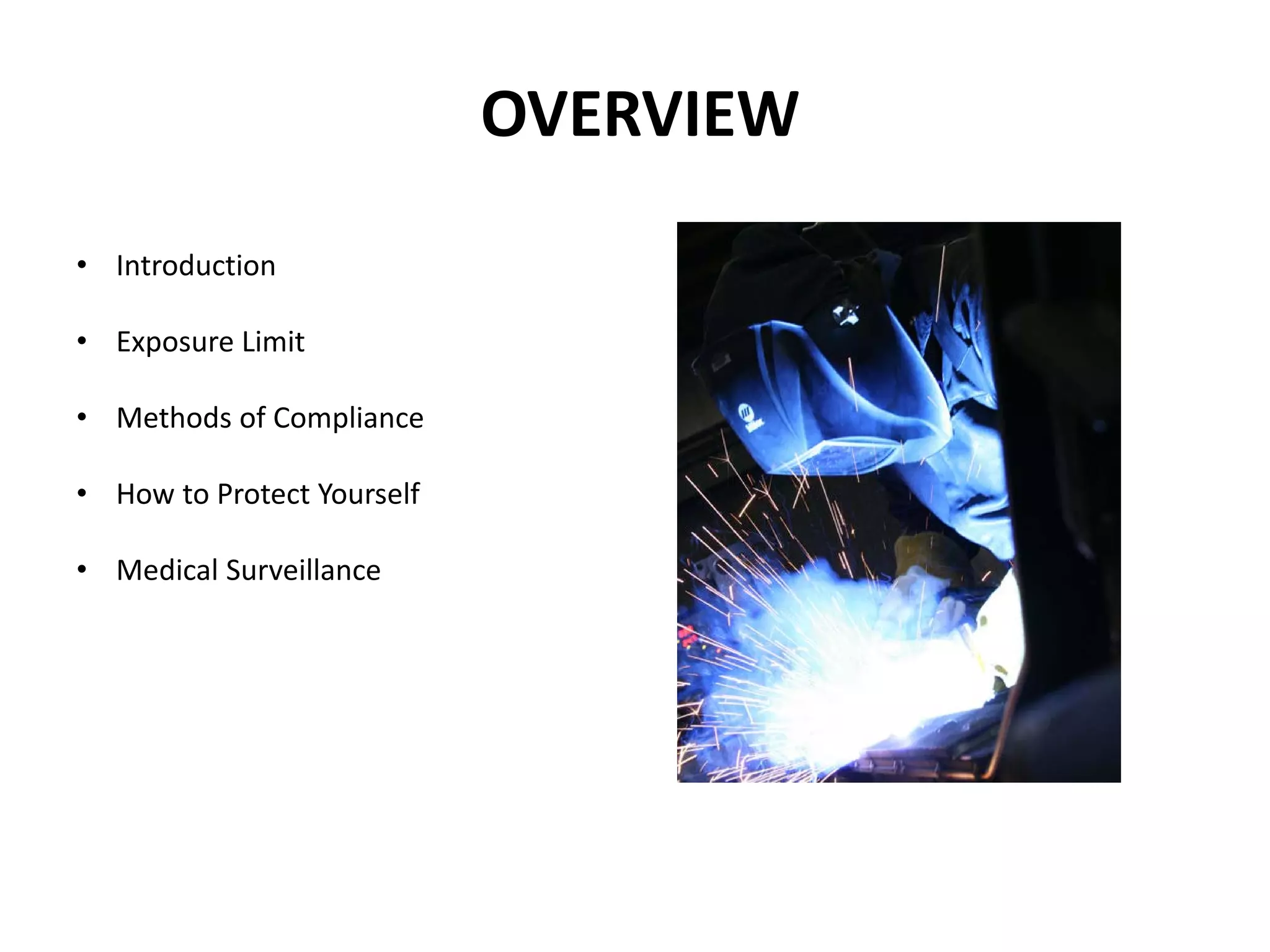
OVERVIEW
• Introduction
• Exposure Limit
• Methods of Compliance
• How to Protect Yourself
• Medical Surveillance
Cr(VI) shall be incorporated in the shop
Hazard Communication program
OVERVIEW
TRAINING AND COMMUNICATION
This training is required for all Armament personnel upon initial assignment and
annually thereafter. Record all shop-specific training on your AF Form 55 or
equivalent.
Cr(VI) is a toxic form of the element chromium
Cr(VI) compounds are man-made and widely used in many different industries
WHAT IS CR(VI)?
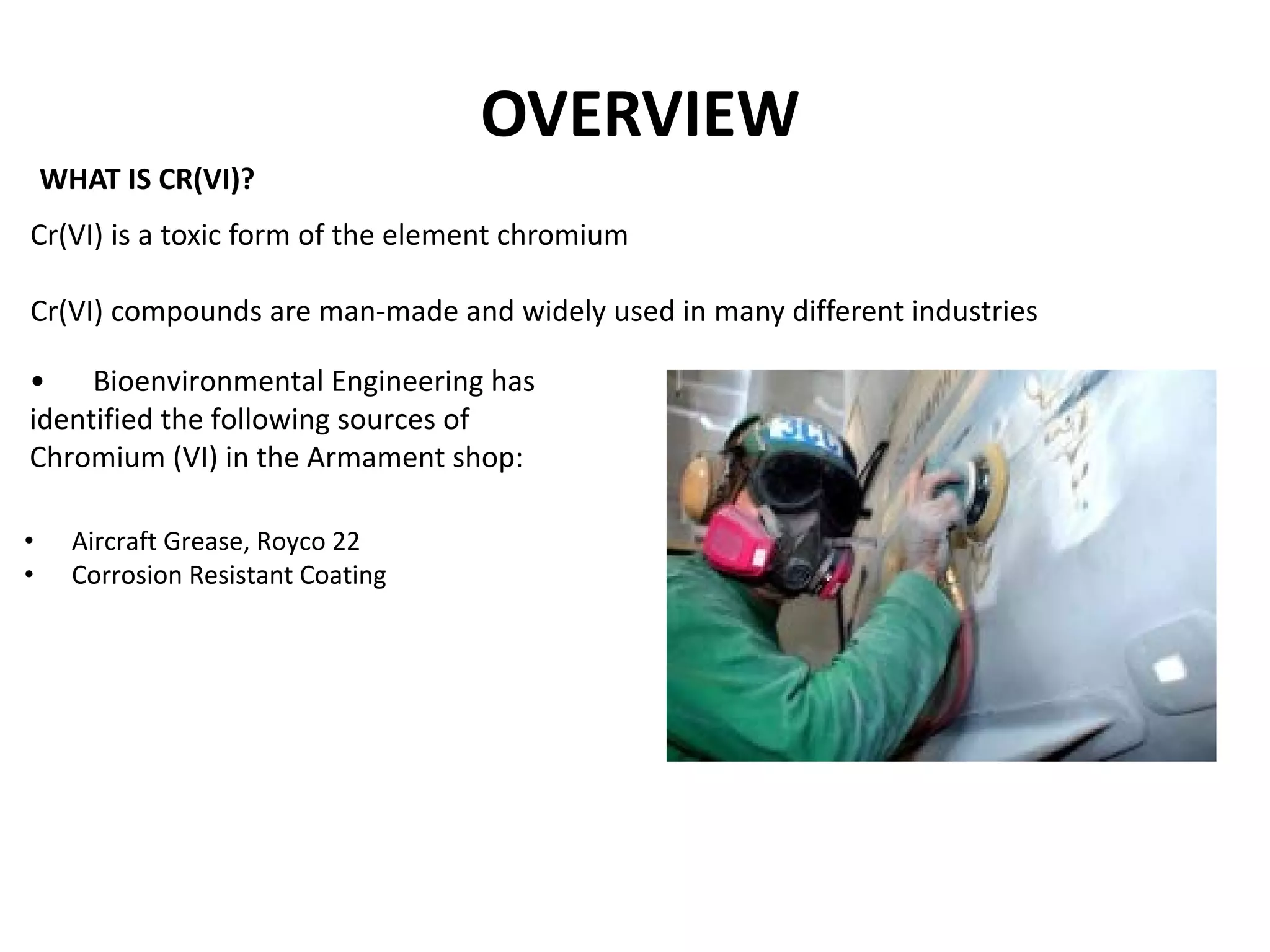
• Bioenvironmental Engineering has
identified the following sources of
Chromium (VI) in the Armament shop:
• Aircraft Grease, Royco 22
• Corrosion Resistant Coating
OVERVIEW
To prevent workers from adverse health effects, the following exposure limits have been
established for Cr(VI):
EXPOSURE LIMIT
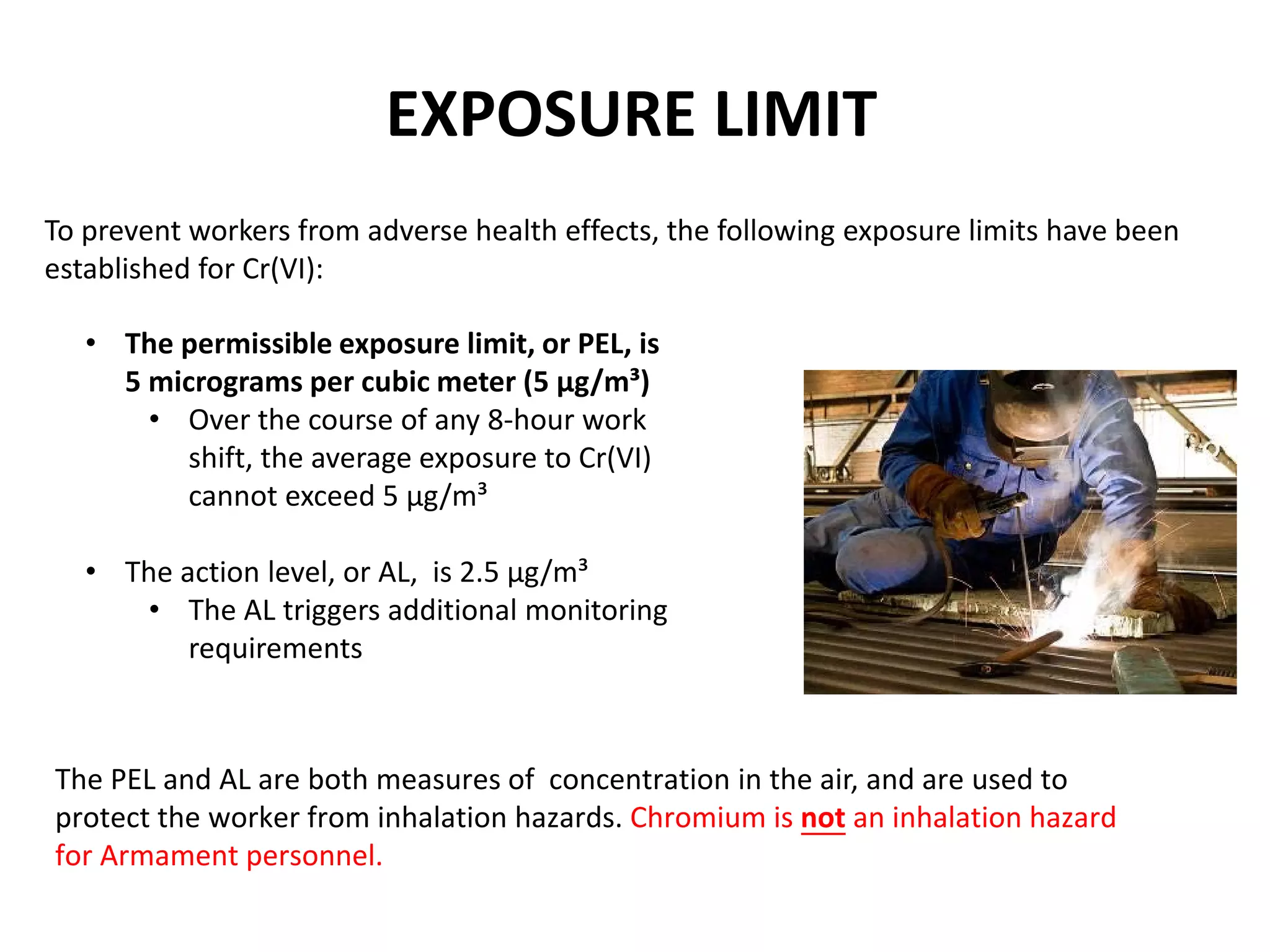
• The permissible exposure limit, or PEL, is
5 micrograms per cubic meter (5 µg/m³)
• Over the course of any 8-hour work
shift, the average exposure to Cr(VI)
cannot exceed 5 µg/m³
• The action level, or AL, is 2.5 µg/m³
• The AL triggers additional monitoring
requirements
The PEL and AL are both measures of concentration in the air, and are used to
protect the worker from inhalation hazards. Chromium is not an inhalation hazard
for Armament personnel.
Short term – acute
• High levels of exposure in a short amount of time
• Within days of exposure
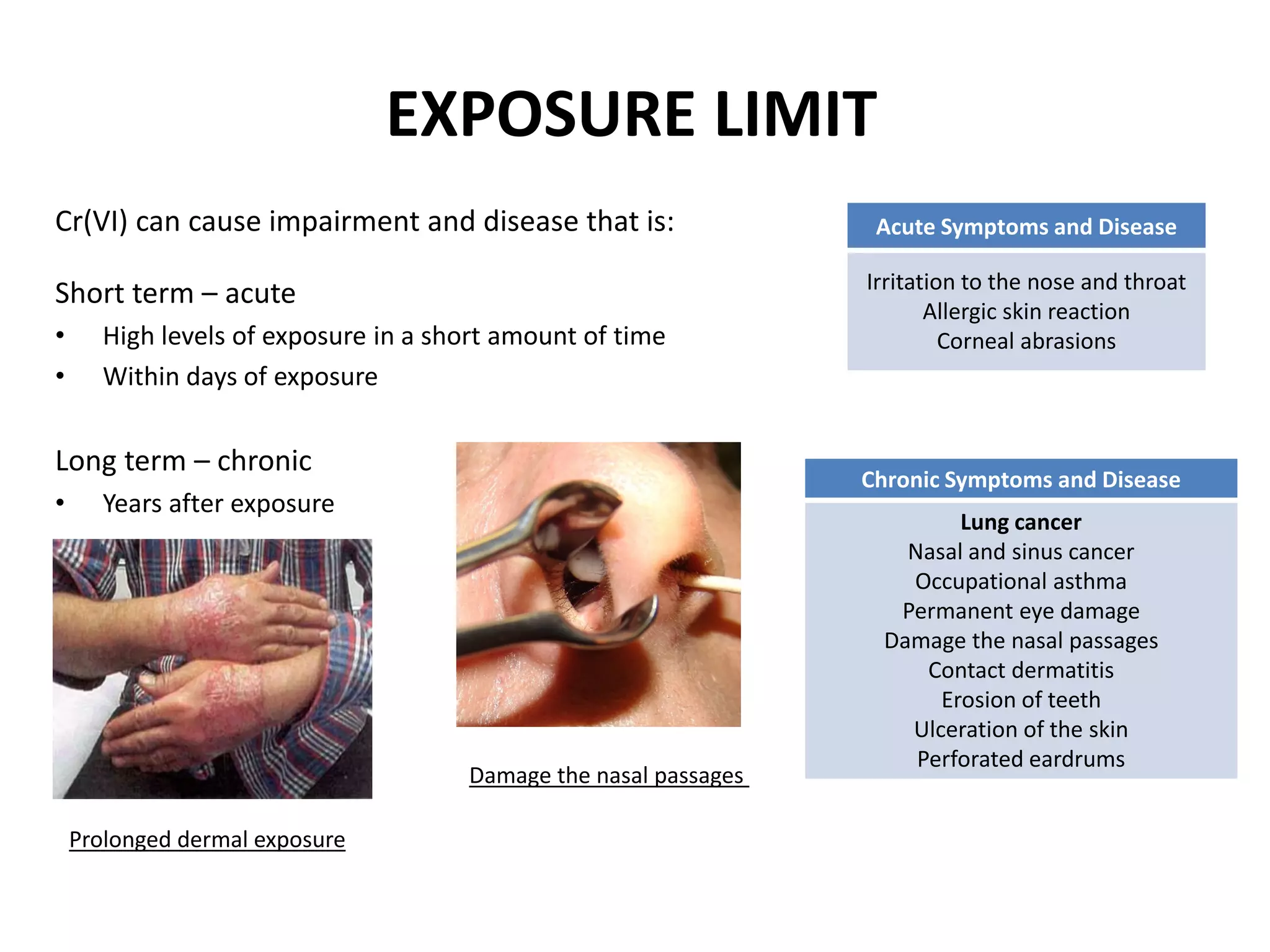
Long term – chronic
• Years after exposure
Damage the nasal passages
Prolonged dermal exposure
Acute Symptoms and Disease
Irritation to the nose and throat
Allergic skin reaction
Corneal abrasions
Chronic Symptoms and Disease
Lung cancer
Nasal and sinus cancer
Occupational asthma
Permanent eye damage
Damage the nasal passages
Contact dermatitis
Erosion of teeth
Ulceration of the skin
Perforated eardrums
Cr(VI) can cause impairment and disease that is:
EXPOSURE LIMIT
ROUTES OF EXPOSURE
Cr(VI) can enter the body through:
• Inhalation (breathe)
• Ingestion (swallow)
It is critically important that you recognize
potential pathways and understand the
measures you can take to protect yourself
It does not matter if a person breathes-in
or swallows Cr(VI), the health effects can
be serious
EXPOSURE LIMIT
METHODS OF COMPLIANCE
Employers must use engineering and work practice controls as the primary means
to reduce and maintain employee Cr(VI) airborne exposures at or below the PEL
Controls include:
• Elimination or substitution of the source
• Minimize exposure through engineering controls
• Good work practices and training
• Use personal protective equipment
Which control methods should you use to eliminate
or minimize exposure to Cr(VI) while performing
your work?
ENGINEERING CONTROLS
Engineering controls include:
• Substitution
• Using a less toxic material
• Substituting a process
• Isolation
• Enclosing the source of exposure
• Placing a barrier between employees and
the source of exposure
• Ventilation
• Local exhaust systems such as welding
hood or paint booth
METHODS OF COMPLIANCE
WORK PRACTICE CONTROLS
Some fundamental work practice controls are:
• Good housekeeping
• Appropriate personal hygiene practices
• Periodic inspection and maintenance of process and control equipment
• Proper procedures to perform a task
• Appropriate supervision to ensure that the proper procedures are followed
METHODS OF COMPLIANCE
• Required where Cr(VI) levels exceed the PEL
• Marked to ensure worker know the boundaries
• Workers must not eat, drink, smoke, chew tobacco/gum, or apply cosmetics (or
carry/store these items) in regulated areas or in areas where skin or eye contact
with Cr(VI) occurs
METHODS OF COMPLIANCE
REGULATED AREAS
There is no need for a regulated area within Armament
HOW TO PROTECT YOURSELF
Your supervisor will ensure you receive additional work area specific training on the
following topic areas to minimize your exposure to Cr(VI):
• Work Area Specific HAZCOM Training
• PPE when performing work
• Adherence to local industrial housekeeping and hygiene procedures
• Communicate exposure symptoms to your supervisor
immediately
It is important that workers recognize the harmful health effects associated with
Cr(VI) exposure and understand measures they can take to protect themselves
PROTECTIVE CLOTHING AND EQUIPMENT
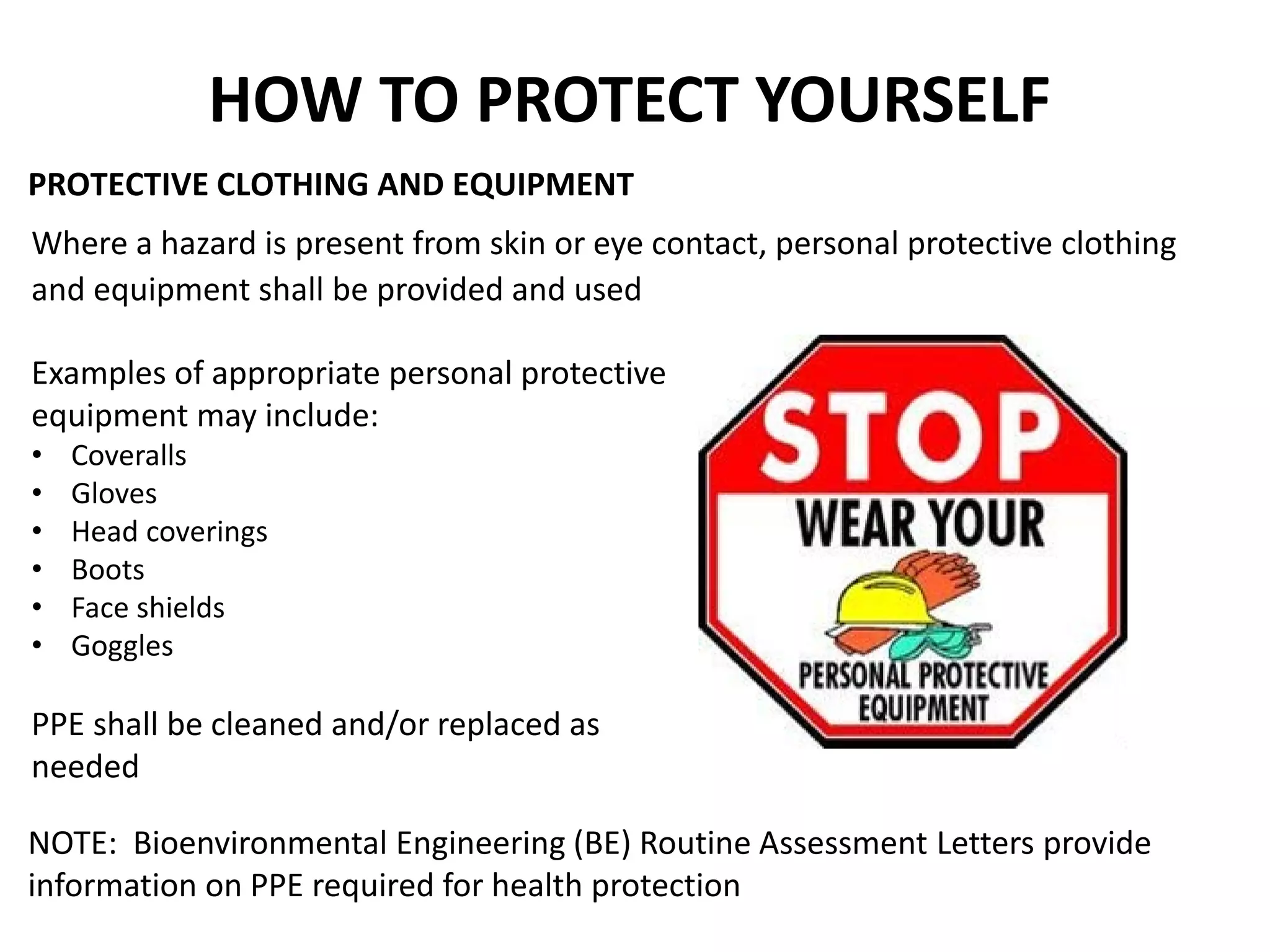
Where a hazard is present from skin or eye contact, personal protective clothing
and equipment shall be provided and used
Examples of appropriate personal protective
equipment may include:
• Coveralls
• Gloves
• Head coverings
• Boots
• Face shields
• Goggles
PPE shall be cleaned and/or replaced as
needed
NOTE: Bioenvironmental Engineering (BE) Routine Assessment Letters provide
information on PPE required for health protection
HOW TO PROTECT YOURSELF
PROTECTIVE CLOTHING AND EQUIPMENT
Know precisely what protection is needed for each job task
• Certain tasks may only require gloves while others may require a higher
level of protection
• Additional training will be provided on how to properly use and care for
PPE
• If you must change out of your street clothes to use protective clothing
and equipment, you are required to use a designated change room
HOW TO PROTECT YOURSELF
PROTECTIVE CLOTHING AND EQUIPMENT
Safe Removal Of Contaminated Clothing
• Employees shall doff contaminated PPE at the end of the work shift or at the
completion of their processes/tasks
• No employee shall remove contaminated PPE from workplace, except for those
employees whose job it is to launder, clean, maintain, or dispose of PPE
• Contaminated PPE shall be stored and transported in sealed, impermeable bags or
closed, impermeable containers
• Employer shall clean, launder, repair and replace all PPE
• Employer shall prohibit the removal of Cr(VI) by shaking PPE or using compressed air to
blow it off
• Employer shall inform any person who launders or cleans PPE of the harmful effects of
Cr(VI)
HOW TO PROTECT YOURSELF
HYGIENE AREAS AND PRACTICES
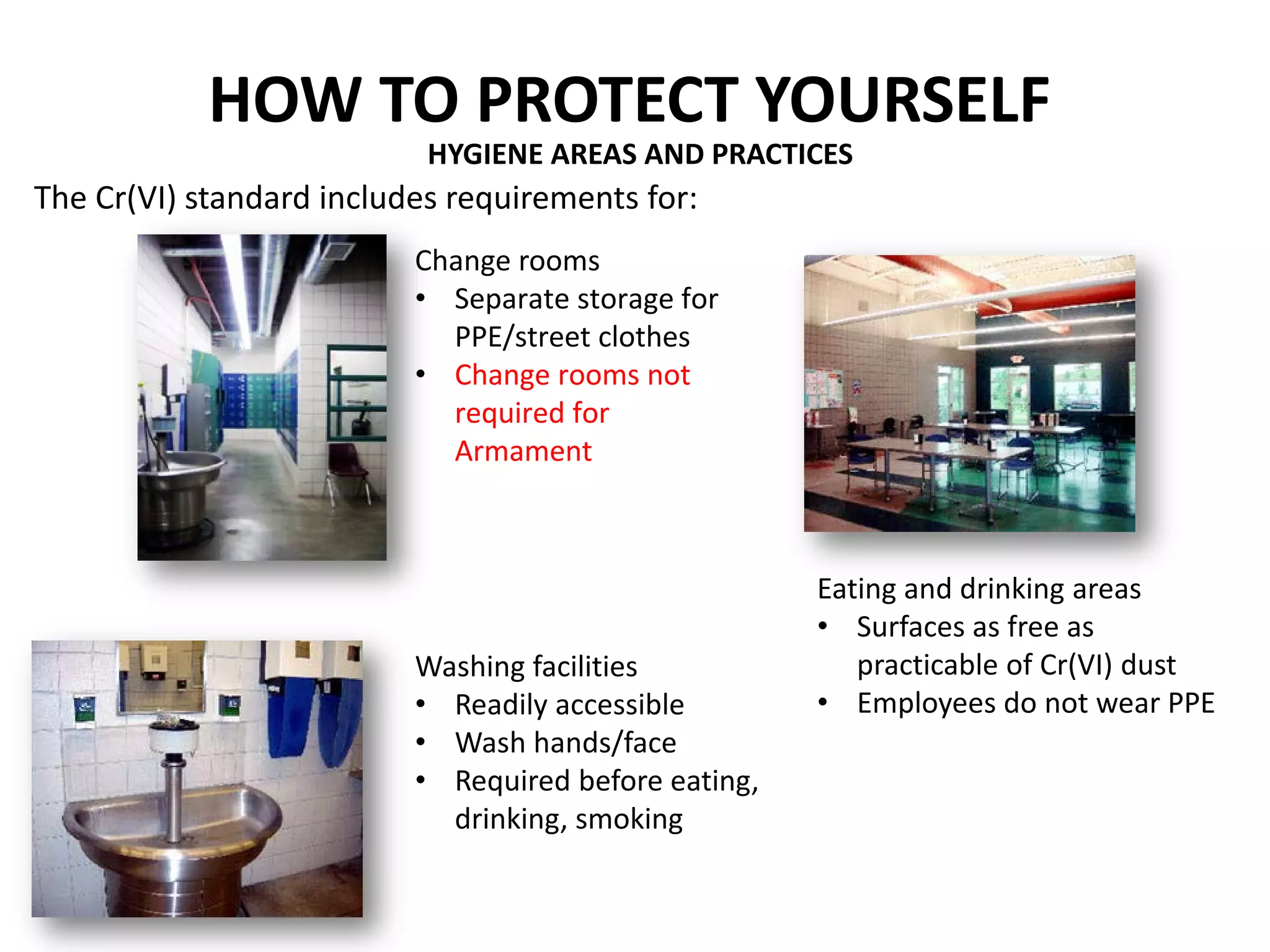
The Cr(VI) standard includes requirements for:
Change rooms
• Separate storage for
PPE/street clothes
• Change rooms not
required for
Armament
Washing facilities
• Readily accessible
• Wash hands/face
• Required before eating,
drinking, smoking
Eating and drinking areas
• Surfaces as free as
practicable of Cr(VI) dust
• Employees do not wear PPE
HOW TO PROTECT YOURSELF
HOUSEKEEPING
Engineering controls are designed to reduce airborne hazards (inhalation)
below the PEL, while housekeeping requirements reduce surface dust
accumulation (inhalation and ingestion)
• Surfaces shall be maintained as free as practicable of Cr(VI) dust
• Spills shall be cleaned promptly
HOW TO PROTECT YOURSELF
HOUSEKEEPING
Cleaning methods
• HEPA-filter vacuum surfaces
• Only use dry shoveling, dry sweeping, and dry brushing when HEPA-filtered
vacuuming or other methods that minimize the likelihood of exposure to Cr(VI)
have been tried and found not to be effective
• Do not use compressed air
• Handle cleaning equipment in a manner that minimizes the reentry of Cr(VI) into
the workplace
HOW TO PROTECT YOURSELF
MEDICAL SURVEILLANCE
Medical surveillance will be made available for employees that are:
• Exposed, or may be exposed, at or above the action level (AL) for 30 or more days per
year
• Experiencing signs or symptoms of health effects associated with Cr(VI) exposure
• Exposed in an emergency
Medical surveillance:
• Is a second line of defense
• Enhances worker protection
• When required, must be provided at no cost to workers
• Must be provided at a reasonable time and place
• Employer must pay travel costs and time
Level of Exposure does not require medical surveillance
SUMMARY
• Introduction
• Exposure Limit
• Methods of Compliance
• How to Protect Yourself
• Medical Surveillance

OSHA Chromium A - Initial/Amp/Annual

  • 1.
    NEXT 29 CFR 1910.1026 HexavalentChromium, Cr(VI) References BACK NEXT OCCUPATIONAL HEALTH AND SAFETY STANDARDS 29 CFR 1910.1026 HEXAVALENT CHROMIUM, Cr(VI) This training has been tailored for: Armament
  • 2.
    OVERVIEW • Introduction • ExposureLimit • Methods of Compliance • How to Protect Yourself • Medical Surveillance
  • 3.
    Cr(VI) shall beincorporated in the shop Hazard Communication program OVERVIEW TRAINING AND COMMUNICATION This training is required for all Armament personnel upon initial assignment and annually thereafter. Record all shop-specific training on your AF Form 55 or equivalent.
  • 4.
    Cr(VI) is atoxic form of the element chromium Cr(VI) compounds are man-made and widely used in many different industries WHAT IS CR(VI)? • Bioenvironmental Engineering has identified the following sources of Chromium (VI) in the Armament shop: • Aircraft Grease, Royco 22 • Corrosion Resistant Coating OVERVIEW
  • 5.
    To prevent workersfrom adverse health effects, the following exposure limits have been established for Cr(VI): EXPOSURE LIMIT • The permissible exposure limit, or PEL, is 5 micrograms per cubic meter (5 µg/m³) • Over the course of any 8-hour work shift, the average exposure to Cr(VI) cannot exceed 5 µg/m³ • The action level, or AL, is 2.5 µg/m³ • The AL triggers additional monitoring requirements The PEL and AL are both measures of concentration in the air, and are used to protect the worker from inhalation hazards. Chromium is not an inhalation hazard for Armament personnel.
  • 6.
    Short term –acute • High levels of exposure in a short amount of time • Within days of exposure Long term – chronic • Years after exposure Damage the nasal passages Prolonged dermal exposure Acute Symptoms and Disease Irritation to the nose and throat Allergic skin reaction Corneal abrasions Chronic Symptoms and Disease Lung cancer Nasal and sinus cancer Occupational asthma Permanent eye damage Damage the nasal passages Contact dermatitis Erosion of teeth Ulceration of the skin Perforated eardrums Cr(VI) can cause impairment and disease that is: EXPOSURE LIMIT
  • 7.
    ROUTES OF EXPOSURE Cr(VI)can enter the body through: • Inhalation (breathe) • Ingestion (swallow) It is critically important that you recognize potential pathways and understand the measures you can take to protect yourself It does not matter if a person breathes-in or swallows Cr(VI), the health effects can be serious EXPOSURE LIMIT
  • 8.
    METHODS OF COMPLIANCE Employersmust use engineering and work practice controls as the primary means to reduce and maintain employee Cr(VI) airborne exposures at or below the PEL Controls include: • Elimination or substitution of the source • Minimize exposure through engineering controls • Good work practices and training • Use personal protective equipment Which control methods should you use to eliminate or minimize exposure to Cr(VI) while performing your work?
  • 9.
    ENGINEERING CONTROLS Engineering controlsinclude: • Substitution • Using a less toxic material • Substituting a process • Isolation • Enclosing the source of exposure • Placing a barrier between employees and the source of exposure • Ventilation • Local exhaust systems such as welding hood or paint booth METHODS OF COMPLIANCE
  • 10.
    WORK PRACTICE CONTROLS Somefundamental work practice controls are: • Good housekeeping • Appropriate personal hygiene practices • Periodic inspection and maintenance of process and control equipment • Proper procedures to perform a task • Appropriate supervision to ensure that the proper procedures are followed METHODS OF COMPLIANCE
  • 11.
    • Required whereCr(VI) levels exceed the PEL • Marked to ensure worker know the boundaries • Workers must not eat, drink, smoke, chew tobacco/gum, or apply cosmetics (or carry/store these items) in regulated areas or in areas where skin or eye contact with Cr(VI) occurs METHODS OF COMPLIANCE REGULATED AREAS There is no need for a regulated area within Armament
  • 12.
    HOW TO PROTECTYOURSELF Your supervisor will ensure you receive additional work area specific training on the following topic areas to minimize your exposure to Cr(VI): • Work Area Specific HAZCOM Training • PPE when performing work • Adherence to local industrial housekeeping and hygiene procedures • Communicate exposure symptoms to your supervisor immediately It is important that workers recognize the harmful health effects associated with Cr(VI) exposure and understand measures they can take to protect themselves
  • 13.
    PROTECTIVE CLOTHING ANDEQUIPMENT Where a hazard is present from skin or eye contact, personal protective clothing and equipment shall be provided and used Examples of appropriate personal protective equipment may include: • Coveralls • Gloves • Head coverings • Boots • Face shields • Goggles PPE shall be cleaned and/or replaced as needed NOTE: Bioenvironmental Engineering (BE) Routine Assessment Letters provide information on PPE required for health protection HOW TO PROTECT YOURSELF
  • 14.
    PROTECTIVE CLOTHING ANDEQUIPMENT Know precisely what protection is needed for each job task • Certain tasks may only require gloves while others may require a higher level of protection • Additional training will be provided on how to properly use and care for PPE • If you must change out of your street clothes to use protective clothing and equipment, you are required to use a designated change room HOW TO PROTECT YOURSELF
  • 15.
    PROTECTIVE CLOTHING ANDEQUIPMENT Safe Removal Of Contaminated Clothing • Employees shall doff contaminated PPE at the end of the work shift or at the completion of their processes/tasks • No employee shall remove contaminated PPE from workplace, except for those employees whose job it is to launder, clean, maintain, or dispose of PPE • Contaminated PPE shall be stored and transported in sealed, impermeable bags or closed, impermeable containers • Employer shall clean, launder, repair and replace all PPE • Employer shall prohibit the removal of Cr(VI) by shaking PPE or using compressed air to blow it off • Employer shall inform any person who launders or cleans PPE of the harmful effects of Cr(VI) HOW TO PROTECT YOURSELF
  • 16.
    HYGIENE AREAS ANDPRACTICES The Cr(VI) standard includes requirements for: Change rooms • Separate storage for PPE/street clothes • Change rooms not required for Armament Washing facilities • Readily accessible • Wash hands/face • Required before eating, drinking, smoking Eating and drinking areas • Surfaces as free as practicable of Cr(VI) dust • Employees do not wear PPE HOW TO PROTECT YOURSELF
  • 17.
    HOUSEKEEPING Engineering controls aredesigned to reduce airborne hazards (inhalation) below the PEL, while housekeeping requirements reduce surface dust accumulation (inhalation and ingestion) • Surfaces shall be maintained as free as practicable of Cr(VI) dust • Spills shall be cleaned promptly HOW TO PROTECT YOURSELF
  • 18.
    HOUSEKEEPING Cleaning methods • HEPA-filtervacuum surfaces • Only use dry shoveling, dry sweeping, and dry brushing when HEPA-filtered vacuuming or other methods that minimize the likelihood of exposure to Cr(VI) have been tried and found not to be effective • Do not use compressed air • Handle cleaning equipment in a manner that minimizes the reentry of Cr(VI) into the workplace HOW TO PROTECT YOURSELF
  • 19.
    MEDICAL SURVEILLANCE Medical surveillancewill be made available for employees that are: • Exposed, or may be exposed, at or above the action level (AL) for 30 or more days per year • Experiencing signs or symptoms of health effects associated with Cr(VI) exposure • Exposed in an emergency Medical surveillance: • Is a second line of defense • Enhances worker protection • When required, must be provided at no cost to workers • Must be provided at a reasonable time and place • Employer must pay travel costs and time Level of Exposure does not require medical surveillance
  • 20.
    SUMMARY • Introduction • ExposureLimit • Methods of Compliance • How to Protect Yourself • Medical Surveillance