Introduction to
Industrial Hygiene
Presented by:
Bernard L. Fontaine, Jr., CIH, CSP, FAIHA
The Windsor Consulting Group, Inc.
March 8, 2022
Copyright © (2022) – The Windsor Consulting Group, Inc.
Introduction
• Health hazard and risk
vary by industry or market
• Risk varies between host
developed and developing
countries
• Protect yourself at work
• Protect your family
• Protect your community
and the environment
Source: OSHA
Copyright © (2022) – The Windsor Consulting Group, Inc.
Introduction
Lesson objectives:
1. Identify health hazards in the workplace
2. Describe strategies to control chemical hazards
3. Describe strategies to control biological hazards
4. Describe strategies to control physical hazards
5. Describe strategies to control ergonomic hazards
6. Review health hazards in oil/gas extraction and
construction industries
Copyright © (2022) – The Windsor Consulting Group, Inc.
Introduction
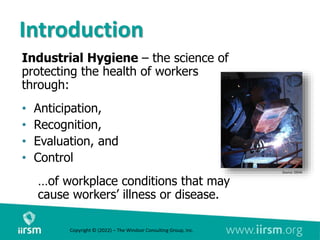
Industrial Hygiene – the science of
protecting the health of workers
through:
• Anticipation,
• Recognition,
• Evaluation, and
• Control
…of workplace conditions that may
cause workers’ illness or disease.
Source: OSHA
Copyright © (2022) – The Windsor Consulting Group, Inc.
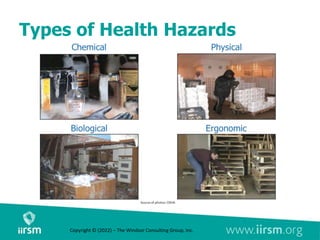
Types of Health Hazards
Copyright © (2022) – The Windsor Consulting Group, Inc.
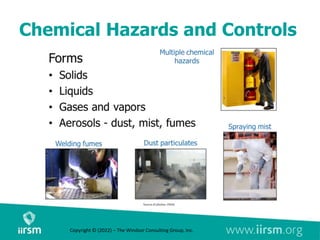
Chemical Hazards and Controls
Copyright © (2022) – The Windsor Consulting Group, Inc.
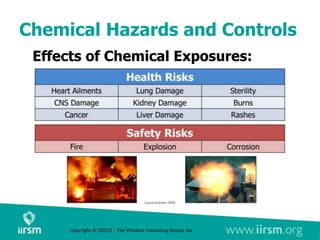
Chemical Hazards and Controls
Effects of Chemical Exposures:
Copyright © (2022) – The Windsor Consulting Group, Inc.
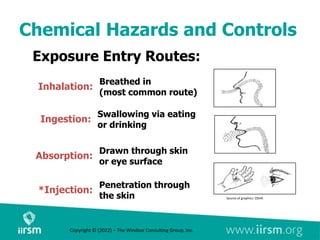
Chemical Hazards and Controls
Inhalation:
Breathed in
(most common route)
Ingestion:
Swallowing via eating
or drinking
Absorption:
Drawn through skin
or eye surface
*Injection:
Penetration through
the skin
Exposure Entry Routes:
Source of graphics: OSHA
Copyright © (2022) – The Windsor Consulting Group, Inc.
Chemical Hazards and Controls
Warning Signs of Potential Chemical
Exposure:
• Dust, mist, smoke in the air
• Accumulation of particulates (dust) on
surfaces
• Unusual tastes and/or smells
• Eye, nose, throat, upper respiratory, and/or
skin irritation
Copyright © (2022) – The Windsor Consulting Group, Inc.
Chemical Hazards and Controls
Chemical Exposure Symptoms:
• Eye, nose, throat, upper respiratory, skin irritation
• Flu-like symptoms
• Difficulty breathing
• Fatigue
• Loss of coordination
• Memory difficulties
• Sleeplessness
• Mental confusion
Copyright © (2022) – The Windsor Consulting Group, Inc.
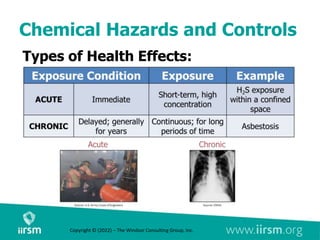
Chemical Hazards and Controls
Types of Health Effects:
Copyright © (2022) – The Windsor Consulting Group, Inc.
Chemical Hazards and Controls
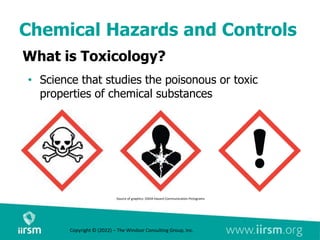
What is Toxicology?
Source of graphics: OSHA Hazard Communication Pictograms
• Science that studies the poisonous or toxic
properties of chemical substances
Copyright © (2022) – The Windsor Consulting Group, Inc.
Chemical Hazards and Controls
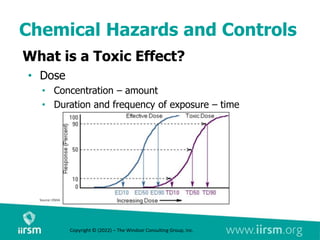
What is a Toxic Effect?
• Dose
• Concentration – amount
• Duration and frequency of exposure – time
Copyright © (2022) – The Windsor Consulting Group, Inc.
Chemical Hazards and Controls
What is a Toxic Effect?
• Toxic chemical disrupt the normal body function.
Effects can be:
• Local – at the site of the exposure like direct contact
with skin, eyes, and upper respiratory tract
• Systemic – affecting the entire body or targeting
organs or organ systems where symptoms of exposure
appear
Copyright © (2022) – The Windsor Consulting Group, Inc.
Chemical Hazards and Controls
Local (Direct) Effects:
• Irritation (dryness, redness, cracking) –
petroleum products, alkali, abrasives
• Corrosion (chemical burn) - acid or base
• Upper Respiratory Track Infection –
inhaling dust or fume particles, biological
organisms, airborne mists, gases and vapors
• Allergens – chemicals, bacteria or fungi
Copyright © (2022) – The Windsor Consulting Group, Inc.
Chemical Hazards and Controls
Factors Affecting Exposure:
• Hepatotoxins – cause liver damage like
carbon tetrachloride and nitrosamines
• Nephrotoxins – cause kidney damage like
uranium and halogenated hydrocarbons
• Neurotoxins – cause nerve damage like
mercury, inorganic lead and carbon disulfide
Copyright © (2022) – The Windsor Consulting Group, Inc.
Chemical Hazards and Controls
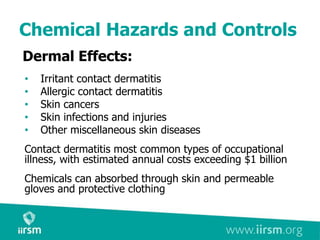
Dermal Effects:
• Irritant contact dermatitis
• Allergic contact dermatitis
• Skin cancers
• Skin infections and injuries
• Other miscellaneous skin diseases
Contact dermatitis most common types of occupational
illness, with estimated annual costs exceeding $1 billion
Chemicals can absorbed through skin and permeable
gloves and protective clothing
Chemical Hazards and Controls
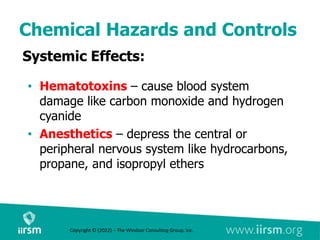
Systemic Effects:
• Hematotoxins – cause blood system
damage like carbon monoxide and hydrogen
cyanide
• Anesthetics – depress the central or
peripheral nervous system like hydrocarbons,
propane, and isopropyl ethers
Copyright © (2022) – The Windsor Consulting Group, Inc.
Chemical Hazards and Controls
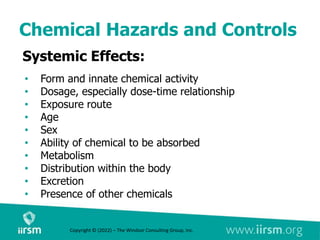
Systemic Effects:
• Form and innate chemical activity
• Dosage, especially dose-time relationship
• Exposure route
• Age
• Sex
• Ability of chemical to be absorbed
• Metabolism
• Distribution within the body
• Excretion
• Presence of other chemicals
Copyright © (2022) – The Windsor Consulting Group, Inc.
Chemical Hazards and Controls
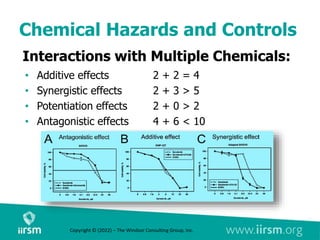
Interactions with Multiple Chemicals:
• Additive effects 2 + 2 = 4
• Synergistic effects 2 + 3 > 5
• Potentiation effects 2 + 0 > 2
• Antagonistic effects 4 + 6 < 10
Copyright © (2022) – The Windsor Consulting Group, Inc.
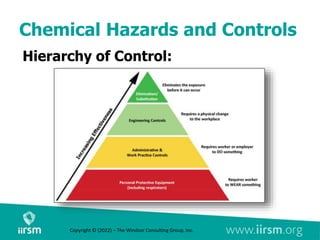
Chemical Hazards and Controls
Hierarchy of Control:
Copyright © (2022) – The Windsor Consulting Group, Inc.
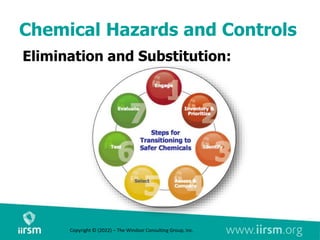
Chemical Hazards and Controls
Elimination and Substitution:
Copyright © (2022) – The Windsor Consulting Group, Inc.
Chemical Hazards and Controls
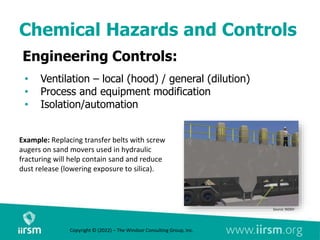
Engineering Controls:
• Ventilation – local (hood) / general (dilution)
• Process and equipment modification
• Isolation/automation
Source: NIOSH
Example: Replacing transfer belts with screw
augers on sand movers used in hydraulic
fracturing will help contain sand and reduce
dust release (lowering exposure to silica).
Copyright © (2022) – The Windsor Consulting Group, Inc.
Chemical Hazards and Controls
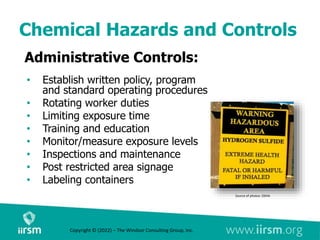
Administrative Controls:
• Establish written policy, program
and standard operating procedures
• Rotating worker duties
• Limiting exposure time
• Training and education
• Monitor/measure exposure levels
• Inspections and maintenance
• Post restricted area signage
• Labeling containers
Source of photos: OSHA
Copyright © (2022) – The Windsor Consulting Group, Inc.
Chemical Hazards and Controls
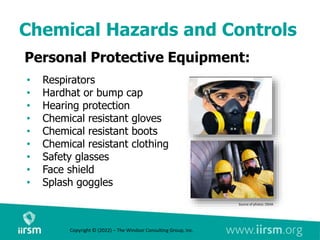
Personal Protective Equipment:
• Respirators
• Hardhat or bump cap
• Hearing protection
• Chemical resistant gloves
• Chemical resistant boots
• Chemical resistant clothing
• Safety glasses
• Face shield
• Splash goggles
Source of photos: OSHA
Copyright © (2022) – The Windsor Consulting Group, Inc.
Chemical Hazards and Controls
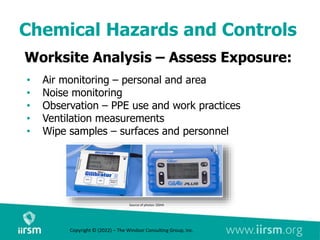
Worksite Analysis – Assess Exposure:
• Air monitoring – personal and area
• Noise monitoring
• Observation – PPE use and work practices
• Ventilation measurements
• Wipe samples – surfaces and personnel
Source of photos: OSHA
Copyright © (2022) – The Windsor Consulting Group, Inc.
Chemical Hazards and Controls
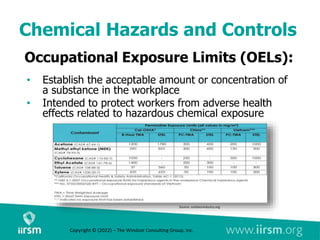
Occupational Exposure Limits (OELs):
• Establish the acceptable amount or concentration of
a substance in the workplace
• Intended to protect workers from adverse health
effects related to hazardous chemical exposure
Source: outdoorindustry.org
Copyright © (2022) – The Windsor Consulting Group, Inc.
Chemical Hazards and Controls
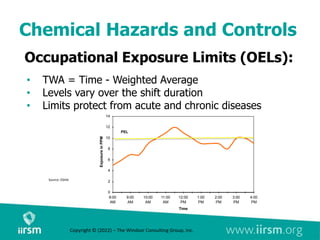
Occupational Exposure Limits (OELs):
• TWA = Time - Weighted Average
• Levels vary over the shift duration
• Limits protect from acute and chronic diseases
Source: OSHA
0
2
4
6
8
10
12
14
8:00
AM
9:00
AM
10:00
AM
11:00
AM
12:00
PM
1:00
PM
2:00
PM
3:00
PM
4:00
PM
Time
Exposure
in
PPM
T
PEL
Copyright © (2022) – The Windsor Consulting Group, Inc.
Chemical Hazards and Controls
Occupational Exposure Limits (OELs):
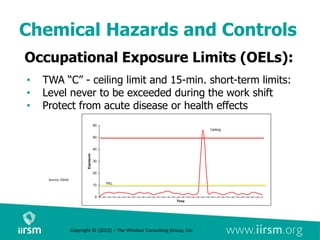
• TWA “C” - ceiling limit and 15-min. short-term limits:
• Level never to be exceeded during the work shift
• Protect from acute disease or health effects
Source: OSHA
0
10
20
30
40
50
60
Time
Exposure
Ceiling
PEL
Copyright © (2022) – The Windsor Consulting Group, Inc.
Chemical Hazards and Controls
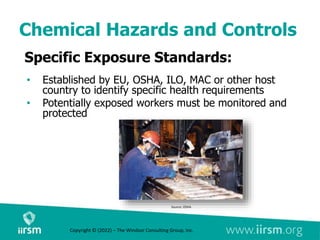
Specific Exposure Standards:
• Established by EU, OSHA, ILO, MAC or other host
country to identify specific health requirements
• Potentially exposed workers must be monitored and
protected
Source: OSHA
Copyright © (2022) – The Windsor Consulting Group, Inc.
Chemical Hazards and Controls
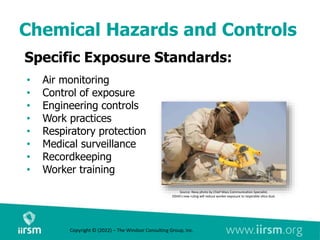
Specific Exposure Standards:
• Air monitoring
• Control of exposure
• Engineering controls
• Work practices
• Respiratory protection
• Medical surveillance
• Recordkeeping
• Worker training
Source: Navy photo by Chief Mass Communication Specialist.
OSHA's new ruling will reduce worker exposure to respirable silica dust.
Copyright © (2022) – The Windsor Consulting Group, Inc.
Chemical Hazards and Controls
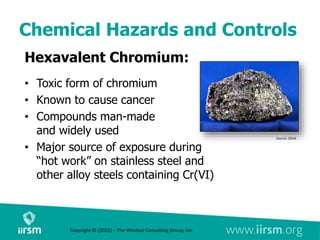
Hexavalent Chromium:
• Toxic form of chromium
• Known to cause cancer
• Compounds man-made
and widely used
• Major source of exposure during
“hot work” on stainless steel and
other alloy steels containing Cr(VI)
Source: OSHA
Copyright © (2022) – The Windsor Consulting Group, Inc.
Chemical Hazards and Controls
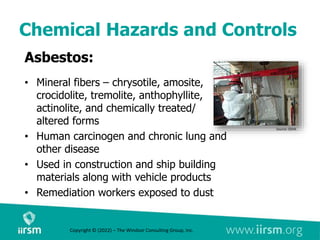
Asbestos:
• Mineral fibers – chrysotile, amosite,
crocidolite, tremolite, anthophyllite,
actinolite, and chemically treated/
altered forms
• Human carcinogen and chronic lung and
other disease
• Used in construction and ship building
materials along with vehicle products
• Remediation workers exposed to dust
Source: OSHA
Copyright © (2022) – The Windsor Consulting Group, Inc.
Chemical Hazards and Controls
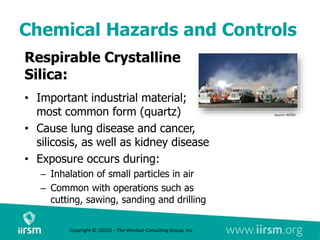
Respirable Crystalline
Silica:
• Important industrial material;
most common form (quartz)
• Cause lung disease and cancer,
silicosis, as well as kidney disease
• Exposure occurs during:
– Inhalation of small particles in air
– Common with operations such as
cutting, sawing, sanding and drilling
Source: NIOSH
Copyright © (2022) – The Windsor Consulting Group, Inc.
Chemical Hazards and Controls
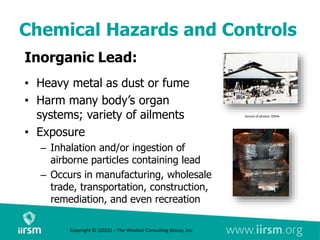
Inorganic Lead:
• Heavy metal as dust or fume
• Harm many body’s organ
systems; variety of ailments
• Exposure
– Inhalation and/or ingestion of
airborne particles containing lead
– Occurs in manufacturing, wholesale
trade, transportation, construction,
remediation, and even recreation
Source of photos: OSHA
Copyright © (2022) – The Windsor Consulting Group, Inc.
Chemical Hazards and Controls
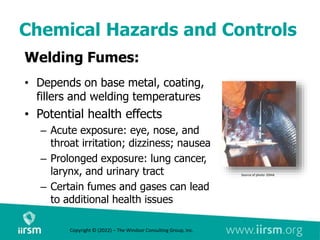
Welding Fumes:
• Depends on base metal, coating,
fillers and welding temperatures
• Potential health effects
– Acute exposure: eye, nose, and
throat irritation; dizziness; nausea
– Prolonged exposure: lung cancer,
larynx, and urinary tract
– Certain fumes and gases can lead
to additional health issues
Source of photo: OSHA
Copyright © (2022) – The Windsor Consulting Group, Inc.
Chemical Hazards and Controls
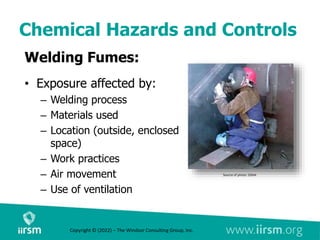
Welding Fumes:
• Exposure affected by:
– Welding process
– Materials used
– Location (outside, enclosed
space)
– Work practices
– Air movement
– Use of ventilation
Source of photo: OSHA
Copyright © (2022) – The Windsor Consulting Group, Inc.
Chemical Hazards and Controls
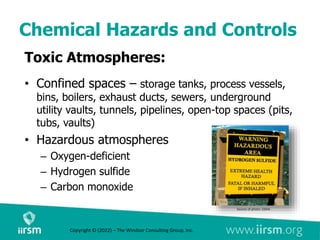
Toxic Atmospheres:
• Confined spaces – storage tanks, process vessels,
bins, boilers, exhaust ducts, sewers, underground
utility vaults, tunnels, pipelines, open-top spaces (pits,
tubs, vaults)
• Hazardous atmospheres
– Oxygen-deficient
– Hydrogen sulfide
– Carbon monoxide
Source of photo: OSHA
Copyright © (2022) – The Windsor Consulting Group, Inc.
Chemical Hazards and Controls
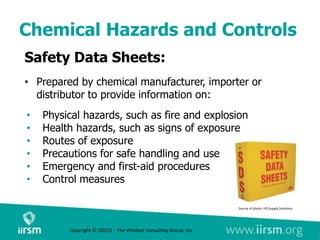
Safety Data Sheets:
• Prepared by chemical manufacturer, importer or
distributor to provide information on:
• Physical hazards, such as fire and explosion
• Health hazards, such as signs of exposure
• Routes of exposure
• Precautions for safe handling and use
• Emergency and first-aid procedures
• Control measures
Copyright © (2022) – The Windsor Consulting Group, Inc.
Source of photo: HD Supply Solutions
Biological Hazards and Controls
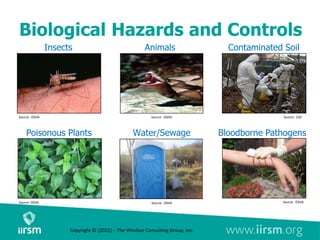
Bloodborne Pathogens
Animals
Source: OSHA
Water/Sewage
Source: OSHA
Source: OSHA
Poisonous Plants
Contaminated Soil
Source: CDC
Source: OSHA
Insects
Source: OSHA
Copyright © (2022) – The Windsor Consulting Group, Inc.
Biological Hazards and Controls
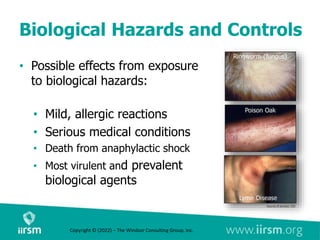
• Possible effects from exposure
to biological hazards:
• Mild, allergic reactions
• Serious medical conditions
• Death from anaphylactic shock
• Most virulent and prevalent
biological agents
Copyright © (2022) – The Windsor Consulting Group, Inc.
Biological Hazards and Controls
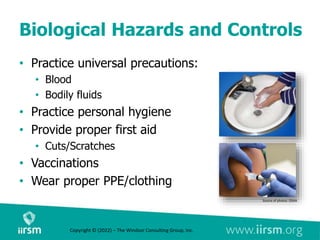
• Practice universal precautions:
• Blood
• Bodily fluids
• Practice personal hygiene
• Provide proper first aid
• Cuts/Scratches
• Vaccinations
• Wear proper PPE/clothing
Source of photos: OSHA
Copyright © (2022) – The Windsor Consulting Group, Inc.
Biological Hazards and Controls
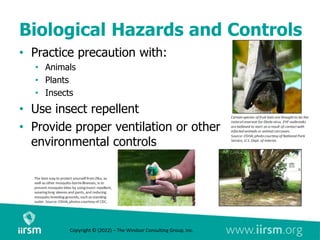
• Practice precaution with:
• Animals
• Plants
• Insects
• Use insect repellent
• Provide proper ventilation or other
environmental controls
Copyright © (2022) – The Windsor Consulting Group, Inc.
Physical Hazards and Controls
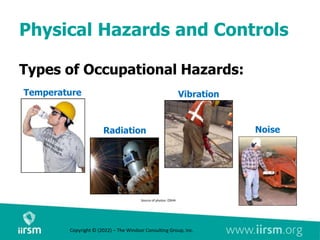
Types of Occupational Hazards:
Vibration
Radiation
Temperature
Source of photos: OSHA
Noise
Copyright © (2022) – The Windsor Consulting Group, Inc.
Physical Hazards and Controls
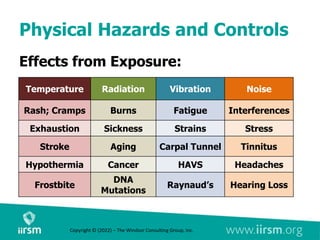
Effects from Exposure:
Temperature Radiation Vibration Noise
Rash; Cramps Burns Fatigue Interferences
Exhaustion Sickness Strains Stress
Stroke Aging Carpal Tunnel Tinnitus
Hypothermia Cancer HAVS Headaches
Frostbite
DNA
Mutations
Raynaud’s Hearing Loss
Copyright © (2022) – The Windsor Consulting Group, Inc.
Physical Hazards and Controls
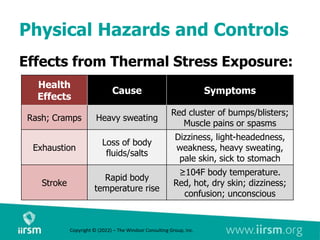
Effects from Thermal Stress Exposure:
Health
Effects
Cause Symptoms
Rash; Cramps Heavy sweating
Red cluster of bumps/blisters;
Muscle pains or spasms
Exhaustion
Loss of body
fluids/salts
Dizziness, light-headedness,
weakness, heavy sweating,
pale skin, sick to stomach
Stroke
Rapid body
temperature rise
≥104F body temperature.
Red, hot, dry skin; dizziness;
confusion; unconscious
Copyright © (2022) – The Windsor Consulting Group, Inc.
Physical Hazards and Controls
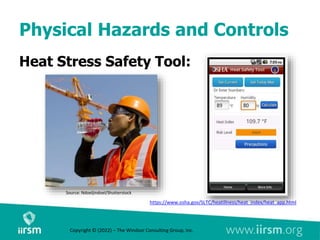
Heat Stress Safety Tool:
https://www.osha.gov/SLTC/heatillness/heat_index/heat_app.html
Source: Ndoeljindoel/Shutterstock
Copyright © (2022) – The Windsor Consulting Group, Inc.
Physical Hazards and Controls
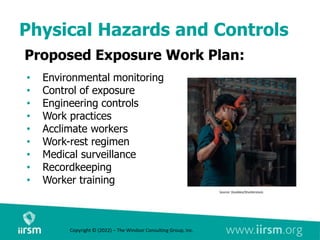
Proposed Exposure Work Plan:
• Environmental monitoring
• Control of exposure
• Engineering controls
• Work practices
• Acclimate workers
• Work-rest regimen
• Medical surveillance
• Recordkeeping
• Worker training
Source: Doubleo/Shutterstock.
Copyright © (2022) – The Windsor Consulting Group, Inc.
Physical Hazards and Controls
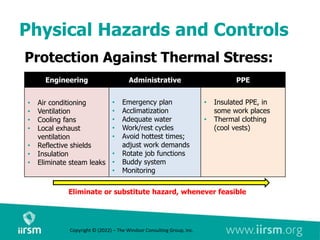
Protection Against Thermal Stress:
Engineering Administrative PPE
• Air conditioning
• Ventilation
• Cooling fans
• Local exhaust
ventilation
• Reflective shields
• Insulation
• Eliminate steam leaks
• Emergency plan
• Acclimatization
• Adequate water
• Work/rest cycles
• Avoid hottest times;
adjust work demands
• Rotate job functions
• Buddy system
• Monitoring
• Insulated PPE, in
some work places
• Thermal clothing
(cool vests)
Eliminate or substitute hazard, whenever feasible
Copyright © (2022) – The Windsor Consulting Group, Inc.
Physical Hazards and Controls
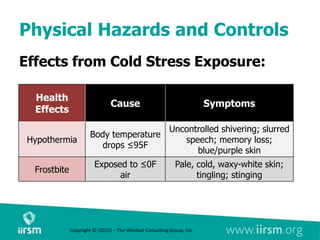
Effects from Cold Stress Exposure:
Health
Effects
Cause Symptoms
Hypothermia
Body temperature
drops ≤95F
Uncontrolled shivering; slurred
speech; memory loss;
blue/purple skin
Frostbite
Exposed to ≤0F
air
Pale, cold, waxy-white skin;
tingling; stinging
Copyright © (2022) – The Windsor Consulting Group, Inc.
Physical Hazards and Controls
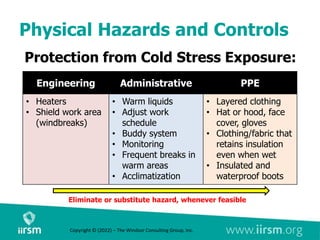
Protection from Cold Stress Exposure:
Eliminate or substitute hazard, whenever feasible
Engineering Administrative PPE
• Heaters
• Shield work area
(windbreaks)
• Warm liquids
• Adjust work
schedule
• Buddy system
• Monitoring
• Frequent breaks in
warm areas
• Acclimatization
• Layered clothing
• Hat or hood, face
cover, gloves
• Clothing/fabric that
retains insulation
even when wet
• Insulated and
waterproof boots
Copyright © (2022) – The Windsor Consulting Group, Inc.
Physical Hazards and Controls
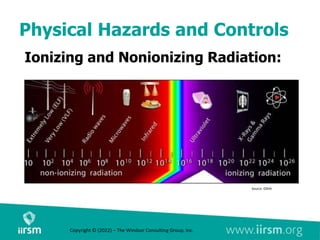
Ionizing and Nonionizing Radiation:
Copyright © (2022) – The Windsor Consulting Group, Inc.
Source: OSHA
Physical Hazards and Controls
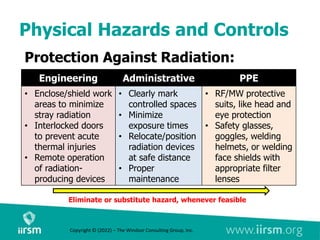
Protection Against Radiation:
Engineering Administrative PPE
• Enclose/shield work
areas to minimize
stray radiation
• Interlocked doors
to prevent acute
thermal injuries
• Remote operation
of radiation-
producing devices
• Clearly mark
controlled spaces
• Minimize
exposure times
• Relocate/position
radiation devices
at safe distance
• Proper
maintenance
• RF/MW protective
suits, like head and
eye protection
• Safety glasses,
goggles, welding
helmets, or welding
face shields with
appropriate filter
lenses
Eliminate or substitute hazard, whenever feasible
Copyright © (2022) – The Windsor Consulting Group, Inc.
Physical Hazards and Controls
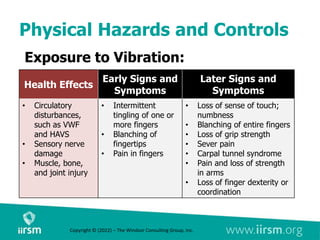
Exposure to Vibration:
Health Effects
Early Signs and
Symptoms
Later Signs and
Symptoms
• Circulatory
disturbances,
such as VWF
and HAVS
• Sensory nerve
damage
• Muscle, bone,
and joint injury
• Intermittent
tingling of one or
more fingers
• Blanching of
fingertips
• Pain in fingers
• Loss of sense of touch;
numbness
• Blanching of entire fingers
• Loss of grip strength
• Sever pain
• Carpal tunnel syndrome
• Pain and loss of strength
in arms
• Loss of finger dexterity or
coordination
Copyright © (2022) – The Windsor Consulting Group, Inc.
Physical Hazards and Controls
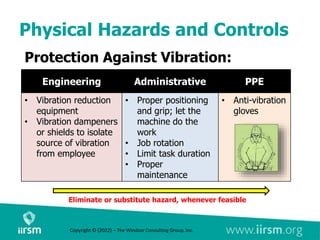
Protection Against Vibration:
Eliminate or substitute hazard, whenever feasible
Engineering Administrative PPE
• Vibration reduction
equipment
• Vibration dampeners
or shields to isolate
source of vibration
from employee
• Proper positioning
and grip; let the
machine do the
work
• Job rotation
• Limit task duration
• Proper
maintenance
• Anti-vibration
gloves
Copyright © (2022) – The Windsor Consulting Group, Inc.
Physical Hazards and Controls
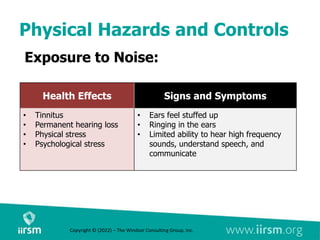
Exposure to Noise:
Health Effects Signs and Symptoms
• Tinnitus
• Permanent hearing loss
• Physical stress
• Psychological stress
• Ears feel stuffed up
• Ringing in the ears
• Limited ability to hear high frequency
sounds, understand speech, and
communicate
Copyright © (2022) – The Windsor Consulting Group, Inc.
Physical Hazards and Controls
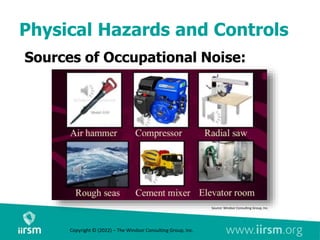
Sources of Occupational Noise:
Copyright © (2022) – The Windsor Consulting Group, Inc.
Source: Windsor Consulting Group, Inc.
Physical Hazards and Controls
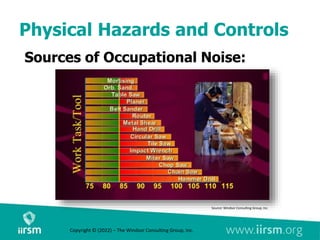
Sources of Occupational Noise:
Copyright © (2022) – The Windsor Consulting Group, Inc.
Source: Windsor Consulting Group, Inc.
Physical Hazards and Controls
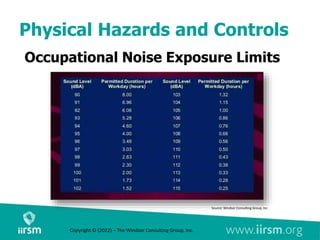
Occupational Noise Exposure Limits
Copyright © (2022) – The Windsor Consulting Group, Inc.
Source: Windsor Consulting Group, Inc.
Physical Hazards and Controls
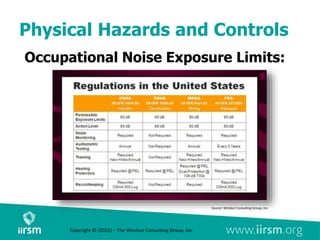
Occupational Noise Exposure Limits:
Copyright © (2022) – The Windsor Consulting Group, Inc.
Source: Windsor Consulting Group, Inc.
Physical Hazards and Controls
Exposure to Occupational Noise:
Health Effects Signs and Symptoms
• Tinnitus
• Permanent hearing loss
• Physical stress
• Psychological stress
• Ears feel stuffed up
• Ringing in the ears
• Limited ability to hear high frequency
sounds, understand speech, and
communicate
Copyright © (2022) – The Windsor Consulting Group, Inc.
Physical Hazards and Controls
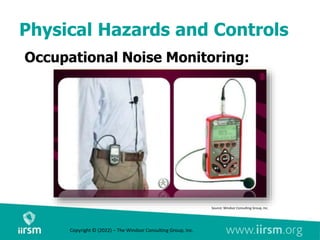
Occupational Noise Monitoring:
Copyright © (2022) – The Windsor Consulting Group, Inc.
Source: Windsor Consulting Group, Inc.
Physical Hazards and Controls
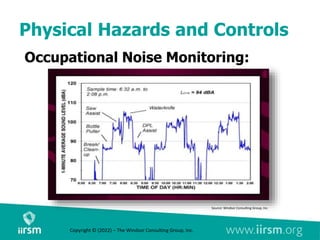
Occupational Noise Monitoring:
Copyright © (2022) – The Windsor Consulting Group, Inc.
Source: Windsor Consulting Group, Inc.
Physical Hazards and Controls
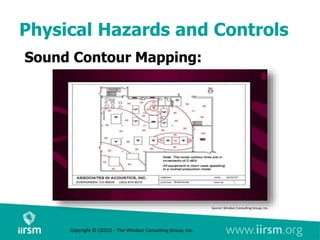
Sound Contour Mapping:
Copyright © (2022) – The Windsor Consulting Group, Inc.
Source: Windsor Consulting Group, Inc.
Physical Hazards and Controls
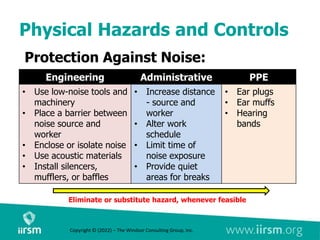
Protection Against Noise:
Eliminate or substitute hazard, whenever feasible
Engineering Administrative PPE
• Use low-noise tools and
machinery
• Place a barrier between
noise source and
worker
• Enclose or isolate noise
• Use acoustic materials
• Install silencers,
mufflers, or baffles
• Increase distance
- source and
worker
• Alter work
schedule
• Limit time of
noise exposure
• Provide quiet
areas for breaks
• Ear plugs
• Ear muffs
• Hearing
bands
Copyright © (2022) – The Windsor Consulting Group, Inc.
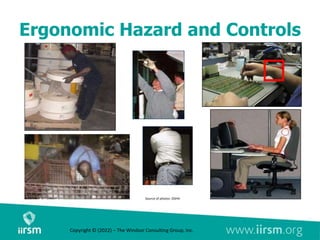
Ergonomic Hazard and Controls
Source of photos: OSHA
Copyright © (2022) – The Windsor Consulting Group, Inc.
Ergonomic Hazard and Controls
Effects from Eergonomic Hazards:
• Musculoskeletal Disorders (MSDs)
– Exposure to ergonomic risk factors for MSDs
increases a worker's risk of injury
• Repetition
• High force
• Awkward postures
– Work-related MSDs are among the most
frequently reported causes of lost or restricted
work time.
Copyright © (2022) – The Windsor Consulting Group, Inc.
Ergonomic Hazard and Controls
Musculosketal Disorder Risk Factors:
• Musculoskeletal Disorders (MSDs)
– Exposure to MSDs increases worker's risk of injury
• Repetitive work tasks
• High force, localized pressure, or overexertion
• Awkward postures/positions
• Whole body or segmental vibration
• Combination of ergonomic exposure
– Work-related MSDs are frequently causes of lost or
restricted work time.
Copyright © (2022) – The Windsor Consulting Group, Inc.
Ergonomic Hazard and Controls
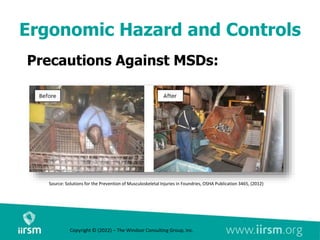
Precautions Against MSDs:
Source: Solutions for the Prevention of Musculoskeletal Injuries in Foundries, OSHA Publication 3465, (2012)
Copyright © (2022) – The Windsor Consulting Group, Inc.
Ergonomic Hazard and Controls
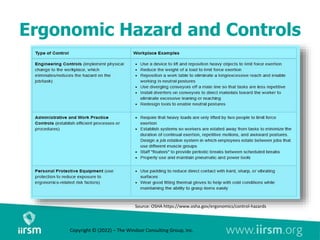
Source: OSHA https://www.osha.gov/ergonomics/control-hazards
Copyright © (2022) – The Windsor Consulting Group, Inc.
Training and Education
Source: OSHA https://www.osha.gov/ergonomics/control-hazards
Copyright © (2022) – The Windsor Consulting Group, Inc.
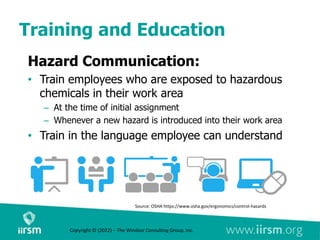
Hazard Communication:
• Train employees who are exposed to hazardous
chemicals in their work area
– At the time of initial assignment
– Whenever a new hazard is introduced into their work area
• Train in the language employee can understand
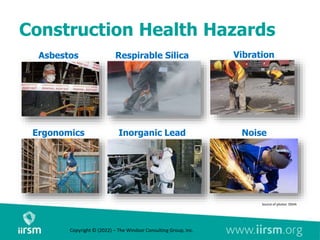
Construction Health Hazards
Asbestos
Noise
Respirable Silica Vibration
Ergonomics Inorganic Lead
Source of photos: OSHA
Copyright © (2022) – The Windsor Consulting Group, Inc.
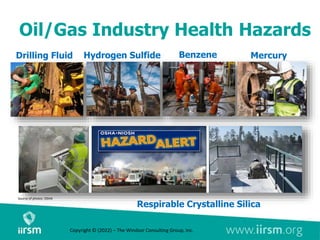
Oil/Gas Industry Health Hazards
Drilling Fluid
Respirable Crystalline Silica
Hydrogen Sulfide Benzene Mercury
Source of photos: OSHA
Copyright © (2022) – The Windsor Consulting Group, Inc.
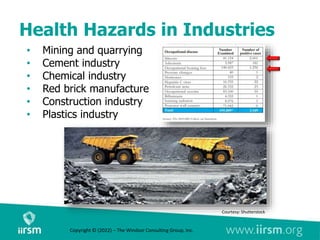
Health Hazards in Industries
Copyright © (2022) – The Windsor Consulting Group, Inc.
• Mining and quarrying
• Cement industry
• Chemical industry
• Red brick manufacture
• Construction industry
• Plastics industry
Courtesy: Shutterstock
Questions and Discussion
Copyright © (2022) – The Windsor Consulting Group, Inc.

IIRSM IIndustrial_Hygiene

  • 1.
    Introduction to Industrial Hygiene Presentedby: Bernard L. Fontaine, Jr., CIH, CSP, FAIHA The Windsor Consulting Group, Inc. March 8, 2022 Copyright © (2022) – The Windsor Consulting Group, Inc.
  • 2.
    Introduction • Health hazardand risk vary by industry or market • Risk varies between host developed and developing countries • Protect yourself at work • Protect your family • Protect your community and the environment Source: OSHA Copyright © (2022) – The Windsor Consulting Group, Inc.
  • 3.
    Introduction Lesson objectives: 1. Identifyhealth hazards in the workplace 2. Describe strategies to control chemical hazards 3. Describe strategies to control biological hazards 4. Describe strategies to control physical hazards 5. Describe strategies to control ergonomic hazards 6. Review health hazards in oil/gas extraction and construction industries Copyright © (2022) – The Windsor Consulting Group, Inc.
  • 4.
    Introduction Industrial Hygiene –the science of protecting the health of workers through: • Anticipation, • Recognition, • Evaluation, and • Control …of workplace conditions that may cause workers’ illness or disease. Source: OSHA Copyright © (2022) – The Windsor Consulting Group, Inc.
  • 5.
    Types of HealthHazards Copyright © (2022) – The Windsor Consulting Group, Inc.
  • 6.
    Chemical Hazards andControls Copyright © (2022) – The Windsor Consulting Group, Inc.
  • 7.
    Chemical Hazards andControls Effects of Chemical Exposures: Copyright © (2022) – The Windsor Consulting Group, Inc.
  • 8.
    Chemical Hazards andControls Inhalation: Breathed in (most common route) Ingestion: Swallowing via eating or drinking Absorption: Drawn through skin or eye surface *Injection: Penetration through the skin Exposure Entry Routes: Source of graphics: OSHA Copyright © (2022) – The Windsor Consulting Group, Inc.
  • 9.
    Chemical Hazards andControls Warning Signs of Potential Chemical Exposure: • Dust, mist, smoke in the air • Accumulation of particulates (dust) on surfaces • Unusual tastes and/or smells • Eye, nose, throat, upper respiratory, and/or skin irritation Copyright © (2022) – The Windsor Consulting Group, Inc.
  • 10.
    Chemical Hazards andControls Chemical Exposure Symptoms: • Eye, nose, throat, upper respiratory, skin irritation • Flu-like symptoms • Difficulty breathing • Fatigue • Loss of coordination • Memory difficulties • Sleeplessness • Mental confusion Copyright © (2022) – The Windsor Consulting Group, Inc.
  • 11.
    Chemical Hazards andControls Types of Health Effects: Copyright © (2022) – The Windsor Consulting Group, Inc.
  • 12.
    Chemical Hazards andControls What is Toxicology? Source of graphics: OSHA Hazard Communication Pictograms • Science that studies the poisonous or toxic properties of chemical substances Copyright © (2022) – The Windsor Consulting Group, Inc.
  • 13.
    Chemical Hazards andControls What is a Toxic Effect? • Dose • Concentration – amount • Duration and frequency of exposure – time Copyright © (2022) – The Windsor Consulting Group, Inc.
  • 14.
    Chemical Hazards andControls What is a Toxic Effect? • Toxic chemical disrupt the normal body function. Effects can be: • Local – at the site of the exposure like direct contact with skin, eyes, and upper respiratory tract • Systemic – affecting the entire body or targeting organs or organ systems where symptoms of exposure appear Copyright © (2022) – The Windsor Consulting Group, Inc.
  • 15.
    Chemical Hazards andControls Local (Direct) Effects: • Irritation (dryness, redness, cracking) – petroleum products, alkali, abrasives • Corrosion (chemical burn) - acid or base • Upper Respiratory Track Infection – inhaling dust or fume particles, biological organisms, airborne mists, gases and vapors • Allergens – chemicals, bacteria or fungi Copyright © (2022) – The Windsor Consulting Group, Inc.
  • 16.
    Chemical Hazards andControls Factors Affecting Exposure: • Hepatotoxins – cause liver damage like carbon tetrachloride and nitrosamines • Nephrotoxins – cause kidney damage like uranium and halogenated hydrocarbons • Neurotoxins – cause nerve damage like mercury, inorganic lead and carbon disulfide Copyright © (2022) – The Windsor Consulting Group, Inc.
  • 17.
    Chemical Hazards andControls Dermal Effects: • Irritant contact dermatitis • Allergic contact dermatitis • Skin cancers • Skin infections and injuries • Other miscellaneous skin diseases Contact dermatitis most common types of occupational illness, with estimated annual costs exceeding $1 billion Chemicals can absorbed through skin and permeable gloves and protective clothing
  • 18.
    Chemical Hazards andControls Systemic Effects: • Hematotoxins – cause blood system damage like carbon monoxide and hydrogen cyanide • Anesthetics – depress the central or peripheral nervous system like hydrocarbons, propane, and isopropyl ethers Copyright © (2022) – The Windsor Consulting Group, Inc.
  • 19.
    Chemical Hazards andControls Systemic Effects: • Form and innate chemical activity • Dosage, especially dose-time relationship • Exposure route • Age • Sex • Ability of chemical to be absorbed • Metabolism • Distribution within the body • Excretion • Presence of other chemicals Copyright © (2022) – The Windsor Consulting Group, Inc.
  • 20.
    Chemical Hazards andControls Interactions with Multiple Chemicals: • Additive effects 2 + 2 = 4 • Synergistic effects 2 + 3 > 5 • Potentiation effects 2 + 0 > 2 • Antagonistic effects 4 + 6 < 10 Copyright © (2022) – The Windsor Consulting Group, Inc.
  • 21.
    Chemical Hazards andControls Hierarchy of Control: Copyright © (2022) – The Windsor Consulting Group, Inc.
  • 22.
    Chemical Hazards andControls Elimination and Substitution: Copyright © (2022) – The Windsor Consulting Group, Inc.
  • 23.
    Chemical Hazards andControls Engineering Controls: • Ventilation – local (hood) / general (dilution) • Process and equipment modification • Isolation/automation Source: NIOSH Example: Replacing transfer belts with screw augers on sand movers used in hydraulic fracturing will help contain sand and reduce dust release (lowering exposure to silica). Copyright © (2022) – The Windsor Consulting Group, Inc.
  • 24.
    Chemical Hazards andControls Administrative Controls: • Establish written policy, program and standard operating procedures • Rotating worker duties • Limiting exposure time • Training and education • Monitor/measure exposure levels • Inspections and maintenance • Post restricted area signage • Labeling containers Source of photos: OSHA Copyright © (2022) – The Windsor Consulting Group, Inc.
  • 25.
    Chemical Hazards andControls Personal Protective Equipment: • Respirators • Hardhat or bump cap • Hearing protection • Chemical resistant gloves • Chemical resistant boots • Chemical resistant clothing • Safety glasses • Face shield • Splash goggles Source of photos: OSHA Copyright © (2022) – The Windsor Consulting Group, Inc.
  • 26.
    Chemical Hazards andControls Worksite Analysis – Assess Exposure: • Air monitoring – personal and area • Noise monitoring • Observation – PPE use and work practices • Ventilation measurements • Wipe samples – surfaces and personnel Source of photos: OSHA Copyright © (2022) – The Windsor Consulting Group, Inc.
  • 27.
    Chemical Hazards andControls Occupational Exposure Limits (OELs): • Establish the acceptable amount or concentration of a substance in the workplace • Intended to protect workers from adverse health effects related to hazardous chemical exposure Source: outdoorindustry.org Copyright © (2022) – The Windsor Consulting Group, Inc.
  • 28.
    Chemical Hazards andControls Occupational Exposure Limits (OELs): • TWA = Time - Weighted Average • Levels vary over the shift duration • Limits protect from acute and chronic diseases Source: OSHA 0 2 4 6 8 10 12 14 8:00 AM 9:00 AM 10:00 AM 11:00 AM 12:00 PM 1:00 PM 2:00 PM 3:00 PM 4:00 PM Time Exposure in PPM T PEL Copyright © (2022) – The Windsor Consulting Group, Inc.
  • 29.
    Chemical Hazards andControls Occupational Exposure Limits (OELs): • TWA “C” - ceiling limit and 15-min. short-term limits: • Level never to be exceeded during the work shift • Protect from acute disease or health effects Source: OSHA 0 10 20 30 40 50 60 Time Exposure Ceiling PEL Copyright © (2022) – The Windsor Consulting Group, Inc.
  • 30.
    Chemical Hazards andControls Specific Exposure Standards: • Established by EU, OSHA, ILO, MAC or other host country to identify specific health requirements • Potentially exposed workers must be monitored and protected Source: OSHA Copyright © (2022) – The Windsor Consulting Group, Inc.
  • 31.
    Chemical Hazards andControls Specific Exposure Standards: • Air monitoring • Control of exposure • Engineering controls • Work practices • Respiratory protection • Medical surveillance • Recordkeeping • Worker training Source: Navy photo by Chief Mass Communication Specialist. OSHA's new ruling will reduce worker exposure to respirable silica dust. Copyright © (2022) – The Windsor Consulting Group, Inc.
  • 32.
    Chemical Hazards andControls Hexavalent Chromium: • Toxic form of chromium • Known to cause cancer • Compounds man-made and widely used • Major source of exposure during “hot work” on stainless steel and other alloy steels containing Cr(VI) Source: OSHA Copyright © (2022) – The Windsor Consulting Group, Inc.
  • 33.
    Chemical Hazards andControls Asbestos: • Mineral fibers – chrysotile, amosite, crocidolite, tremolite, anthophyllite, actinolite, and chemically treated/ altered forms • Human carcinogen and chronic lung and other disease • Used in construction and ship building materials along with vehicle products • Remediation workers exposed to dust Source: OSHA Copyright © (2022) – The Windsor Consulting Group, Inc.
  • 34.
    Chemical Hazards andControls Respirable Crystalline Silica: • Important industrial material; most common form (quartz) • Cause lung disease and cancer, silicosis, as well as kidney disease • Exposure occurs during: – Inhalation of small particles in air – Common with operations such as cutting, sawing, sanding and drilling Source: NIOSH Copyright © (2022) – The Windsor Consulting Group, Inc.
  • 35.
    Chemical Hazards andControls Inorganic Lead: • Heavy metal as dust or fume • Harm many body’s organ systems; variety of ailments • Exposure – Inhalation and/or ingestion of airborne particles containing lead – Occurs in manufacturing, wholesale trade, transportation, construction, remediation, and even recreation Source of photos: OSHA Copyright © (2022) – The Windsor Consulting Group, Inc.
  • 36.
    Chemical Hazards andControls Welding Fumes: • Depends on base metal, coating, fillers and welding temperatures • Potential health effects – Acute exposure: eye, nose, and throat irritation; dizziness; nausea – Prolonged exposure: lung cancer, larynx, and urinary tract – Certain fumes and gases can lead to additional health issues Source of photo: OSHA Copyright © (2022) – The Windsor Consulting Group, Inc.
  • 37.
    Chemical Hazards andControls Welding Fumes: • Exposure affected by: – Welding process – Materials used – Location (outside, enclosed space) – Work practices – Air movement – Use of ventilation Source of photo: OSHA Copyright © (2022) – The Windsor Consulting Group, Inc.
  • 38.
    Chemical Hazards andControls Toxic Atmospheres: • Confined spaces – storage tanks, process vessels, bins, boilers, exhaust ducts, sewers, underground utility vaults, tunnels, pipelines, open-top spaces (pits, tubs, vaults) • Hazardous atmospheres – Oxygen-deficient – Hydrogen sulfide – Carbon monoxide Source of photo: OSHA Copyright © (2022) – The Windsor Consulting Group, Inc.
  • 39.
    Chemical Hazards andControls Safety Data Sheets: • Prepared by chemical manufacturer, importer or distributor to provide information on: • Physical hazards, such as fire and explosion • Health hazards, such as signs of exposure • Routes of exposure • Precautions for safe handling and use • Emergency and first-aid procedures • Control measures Copyright © (2022) – The Windsor Consulting Group, Inc. Source of photo: HD Supply Solutions
  • 40.
    Biological Hazards andControls Bloodborne Pathogens Animals Source: OSHA Water/Sewage Source: OSHA Source: OSHA Poisonous Plants Contaminated Soil Source: CDC Source: OSHA Insects Source: OSHA Copyright © (2022) – The Windsor Consulting Group, Inc.
  • 41.
    Biological Hazards andControls • Possible effects from exposure to biological hazards: • Mild, allergic reactions • Serious medical conditions • Death from anaphylactic shock • Most virulent and prevalent biological agents Copyright © (2022) – The Windsor Consulting Group, Inc.
  • 42.
    Biological Hazards andControls • Practice universal precautions: • Blood • Bodily fluids • Practice personal hygiene • Provide proper first aid • Cuts/Scratches • Vaccinations • Wear proper PPE/clothing Source of photos: OSHA Copyright © (2022) – The Windsor Consulting Group, Inc.
  • 43.
    Biological Hazards andControls • Practice precaution with: • Animals • Plants • Insects • Use insect repellent • Provide proper ventilation or other environmental controls Copyright © (2022) – The Windsor Consulting Group, Inc.
  • 44.
    Physical Hazards andControls Types of Occupational Hazards: Vibration Radiation Temperature Source of photos: OSHA Noise Copyright © (2022) – The Windsor Consulting Group, Inc.
  • 45.
    Physical Hazards andControls Effects from Exposure: Temperature Radiation Vibration Noise Rash; Cramps Burns Fatigue Interferences Exhaustion Sickness Strains Stress Stroke Aging Carpal Tunnel Tinnitus Hypothermia Cancer HAVS Headaches Frostbite DNA Mutations Raynaud’s Hearing Loss Copyright © (2022) – The Windsor Consulting Group, Inc.
  • 46.
    Physical Hazards andControls Effects from Thermal Stress Exposure: Health Effects Cause Symptoms Rash; Cramps Heavy sweating Red cluster of bumps/blisters; Muscle pains or spasms Exhaustion Loss of body fluids/salts Dizziness, light-headedness, weakness, heavy sweating, pale skin, sick to stomach Stroke Rapid body temperature rise ≥104F body temperature. Red, hot, dry skin; dizziness; confusion; unconscious Copyright © (2022) – The Windsor Consulting Group, Inc.
  • 47.
    Physical Hazards andControls Heat Stress Safety Tool: https://www.osha.gov/SLTC/heatillness/heat_index/heat_app.html Source: Ndoeljindoel/Shutterstock Copyright © (2022) – The Windsor Consulting Group, Inc.
  • 48.
    Physical Hazards andControls Proposed Exposure Work Plan: • Environmental monitoring • Control of exposure • Engineering controls • Work practices • Acclimate workers • Work-rest regimen • Medical surveillance • Recordkeeping • Worker training Source: Doubleo/Shutterstock. Copyright © (2022) – The Windsor Consulting Group, Inc.
  • 49.
    Physical Hazards andControls Protection Against Thermal Stress: Engineering Administrative PPE • Air conditioning • Ventilation • Cooling fans • Local exhaust ventilation • Reflective shields • Insulation • Eliminate steam leaks • Emergency plan • Acclimatization • Adequate water • Work/rest cycles • Avoid hottest times; adjust work demands • Rotate job functions • Buddy system • Monitoring • Insulated PPE, in some work places • Thermal clothing (cool vests) Eliminate or substitute hazard, whenever feasible Copyright © (2022) – The Windsor Consulting Group, Inc.
  • 50.
    Physical Hazards andControls Effects from Cold Stress Exposure: Health Effects Cause Symptoms Hypothermia Body temperature drops ≤95F Uncontrolled shivering; slurred speech; memory loss; blue/purple skin Frostbite Exposed to ≤0F air Pale, cold, waxy-white skin; tingling; stinging Copyright © (2022) – The Windsor Consulting Group, Inc.
  • 51.
    Physical Hazards andControls Protection from Cold Stress Exposure: Eliminate or substitute hazard, whenever feasible Engineering Administrative PPE • Heaters • Shield work area (windbreaks) • Warm liquids • Adjust work schedule • Buddy system • Monitoring • Frequent breaks in warm areas • Acclimatization • Layered clothing • Hat or hood, face cover, gloves • Clothing/fabric that retains insulation even when wet • Insulated and waterproof boots Copyright © (2022) – The Windsor Consulting Group, Inc.
  • 52.
    Physical Hazards andControls Ionizing and Nonionizing Radiation: Copyright © (2022) – The Windsor Consulting Group, Inc. Source: OSHA
  • 53.
    Physical Hazards andControls Protection Against Radiation: Engineering Administrative PPE • Enclose/shield work areas to minimize stray radiation • Interlocked doors to prevent acute thermal injuries • Remote operation of radiation- producing devices • Clearly mark controlled spaces • Minimize exposure times • Relocate/position radiation devices at safe distance • Proper maintenance • RF/MW protective suits, like head and eye protection • Safety glasses, goggles, welding helmets, or welding face shields with appropriate filter lenses Eliminate or substitute hazard, whenever feasible Copyright © (2022) – The Windsor Consulting Group, Inc.
  • 54.
    Physical Hazards andControls Exposure to Vibration: Health Effects Early Signs and Symptoms Later Signs and Symptoms • Circulatory disturbances, such as VWF and HAVS • Sensory nerve damage • Muscle, bone, and joint injury • Intermittent tingling of one or more fingers • Blanching of fingertips • Pain in fingers • Loss of sense of touch; numbness • Blanching of entire fingers • Loss of grip strength • Sever pain • Carpal tunnel syndrome • Pain and loss of strength in arms • Loss of finger dexterity or coordination Copyright © (2022) – The Windsor Consulting Group, Inc.
  • 55.
    Physical Hazards andControls Protection Against Vibration: Eliminate or substitute hazard, whenever feasible Engineering Administrative PPE • Vibration reduction equipment • Vibration dampeners or shields to isolate source of vibration from employee • Proper positioning and grip; let the machine do the work • Job rotation • Limit task duration • Proper maintenance • Anti-vibration gloves Copyright © (2022) – The Windsor Consulting Group, Inc.
  • 56.
    Physical Hazards andControls Exposure to Noise: Health Effects Signs and Symptoms • Tinnitus • Permanent hearing loss • Physical stress • Psychological stress • Ears feel stuffed up • Ringing in the ears • Limited ability to hear high frequency sounds, understand speech, and communicate Copyright © (2022) – The Windsor Consulting Group, Inc.
  • 57.
    Physical Hazards andControls Sources of Occupational Noise: Copyright © (2022) – The Windsor Consulting Group, Inc. Source: Windsor Consulting Group, Inc.
  • 58.
    Physical Hazards andControls Sources of Occupational Noise: Copyright © (2022) – The Windsor Consulting Group, Inc. Source: Windsor Consulting Group, Inc.
  • 59.
    Physical Hazards andControls Occupational Noise Exposure Limits Copyright © (2022) – The Windsor Consulting Group, Inc. Source: Windsor Consulting Group, Inc.
  • 60.
    Physical Hazards andControls Occupational Noise Exposure Limits: Copyright © (2022) – The Windsor Consulting Group, Inc. Source: Windsor Consulting Group, Inc.
  • 61.
    Physical Hazards andControls Exposure to Occupational Noise: Health Effects Signs and Symptoms • Tinnitus • Permanent hearing loss • Physical stress • Psychological stress • Ears feel stuffed up • Ringing in the ears • Limited ability to hear high frequency sounds, understand speech, and communicate Copyright © (2022) – The Windsor Consulting Group, Inc.
  • 62.
    Physical Hazards andControls Occupational Noise Monitoring: Copyright © (2022) – The Windsor Consulting Group, Inc. Source: Windsor Consulting Group, Inc.
  • 63.
    Physical Hazards andControls Occupational Noise Monitoring: Copyright © (2022) – The Windsor Consulting Group, Inc. Source: Windsor Consulting Group, Inc.
  • 64.
    Physical Hazards andControls Sound Contour Mapping: Copyright © (2022) – The Windsor Consulting Group, Inc. Source: Windsor Consulting Group, Inc.
  • 65.
    Physical Hazards andControls Protection Against Noise: Eliminate or substitute hazard, whenever feasible Engineering Administrative PPE • Use low-noise tools and machinery • Place a barrier between noise source and worker • Enclose or isolate noise • Use acoustic materials • Install silencers, mufflers, or baffles • Increase distance - source and worker • Alter work schedule • Limit time of noise exposure • Provide quiet areas for breaks • Ear plugs • Ear muffs • Hearing bands Copyright © (2022) – The Windsor Consulting Group, Inc.
  • 66.
    Ergonomic Hazard andControls Source of photos: OSHA Copyright © (2022) – The Windsor Consulting Group, Inc.
  • 67.
    Ergonomic Hazard andControls Effects from Eergonomic Hazards: • Musculoskeletal Disorders (MSDs) – Exposure to ergonomic risk factors for MSDs increases a worker's risk of injury • Repetition • High force • Awkward postures – Work-related MSDs are among the most frequently reported causes of lost or restricted work time. Copyright © (2022) – The Windsor Consulting Group, Inc.
  • 68.
    Ergonomic Hazard andControls Musculosketal Disorder Risk Factors: • Musculoskeletal Disorders (MSDs) – Exposure to MSDs increases worker's risk of injury • Repetitive work tasks • High force, localized pressure, or overexertion • Awkward postures/positions • Whole body or segmental vibration • Combination of ergonomic exposure – Work-related MSDs are frequently causes of lost or restricted work time. Copyright © (2022) – The Windsor Consulting Group, Inc.
  • 69.
    Ergonomic Hazard andControls Precautions Against MSDs: Source: Solutions for the Prevention of Musculoskeletal Injuries in Foundries, OSHA Publication 3465, (2012) Copyright © (2022) – The Windsor Consulting Group, Inc.
  • 70.
    Ergonomic Hazard andControls Source: OSHA https://www.osha.gov/ergonomics/control-hazards Copyright © (2022) – The Windsor Consulting Group, Inc.
  • 71.
    Training and Education Source:OSHA https://www.osha.gov/ergonomics/control-hazards Copyright © (2022) – The Windsor Consulting Group, Inc. Hazard Communication: • Train employees who are exposed to hazardous chemicals in their work area – At the time of initial assignment – Whenever a new hazard is introduced into their work area • Train in the language employee can understand
  • 72.
    Construction Health Hazards Asbestos Noise RespirableSilica Vibration Ergonomics Inorganic Lead Source of photos: OSHA Copyright © (2022) – The Windsor Consulting Group, Inc.
  • 73.
    Oil/Gas Industry HealthHazards Drilling Fluid Respirable Crystalline Silica Hydrogen Sulfide Benzene Mercury Source of photos: OSHA Copyright © (2022) – The Windsor Consulting Group, Inc.
  • 74.
    Health Hazards inIndustries Copyright © (2022) – The Windsor Consulting Group, Inc. • Mining and quarrying • Cement industry • Chemical industry • Red brick manufacture • Construction industry • Plastics industry Courtesy: Shutterstock
  • 75.
    Questions and Discussion Copyright© (2022) – The Windsor Consulting Group, Inc.