PERSONAL PROTECTION
EQUIPMENT
COURSE OBJECTIVES
Have a basic understanding of:
• The purpose and basic concepts of PPE
• When PPE is necessary
• Different kinds of PPE available
• How to wear and maintain PPE
• Limitations of PPE
• How PPE can protect from on-the-job hazards
1
SELECTION OF PPE
• Hazard Evaluation
– Identify hazards
– Determine route of entry
– Quantify hazards
• Engineering Controls
• Select the appropriate PPE
– Consider flexibility, dexterity, mobility
– Consider type of material required
– Potential for heat stress, etc.
2
3
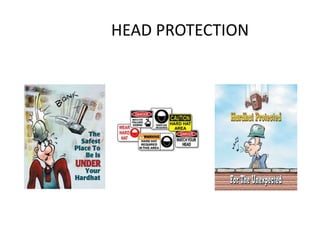
HEAD PROTECTION
HEAD PROTECTION (cont.)
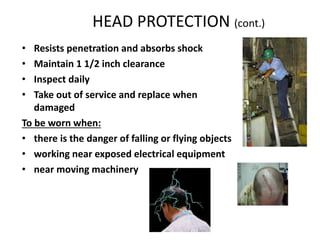
• Resists penetration and absorbs shock
• Maintain 1 1/2 inch clearance
• Inspect daily
• Take out of service and replace when
damaged
To be worn when:
• there is the danger of falling or flying objects
• working near exposed electrical equipment
• near moving machinery
4
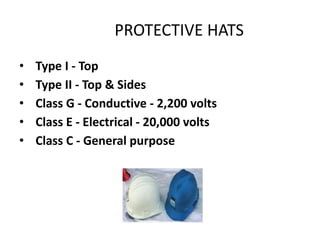
PROTECTIVE HATS
• Type I - Top
• Type II - Top & Sides
• Class G - Conductive - 2,200 volts
• Class E - Electrical - 20,000 volts
• Class C - General purpose
5
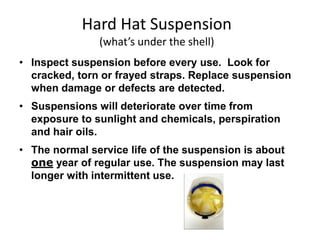
Hard Hat Suspension
(what’s under the shell)
• Inspect suspension before every use. Look for
cracked, torn or frayed straps. Replace suspension
when damage or defects are detected.
• Suspensions will deteriorate over time from
exposure to sunlight and chemicals, perspiration
and hair oils.
• The normal service life of the suspension is about
one year of regular use. The suspension may last
longer with intermittent use.
6
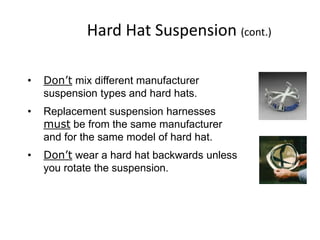
Hard Hat Suspension (cont.)
• Don’t mix different manufacturer
suspension types and hard hats.
• Replacement suspension harnesses
must be from the same manufacturer
and for the same model of hard hat.
• Don’t wear a hard hat backwards unless
you rotate the suspension.
7
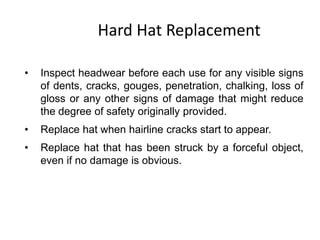
Hard Hat Replacement
• Inspect headwear before each use for any visible signs
of dents, cracks, gouges, penetration, chalking, loss of
gloss or any other signs of damage that might reduce
the degree of safety originally provided.
• Replace hat when hairline cracks start to appear.
• Replace hat that has been struck by a forceful object,
even if no damage is obvious.
8
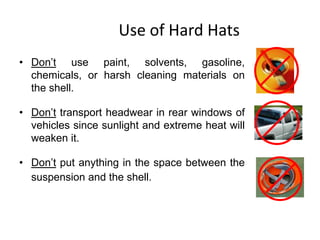
Use of Hard Hats
• Don’t use paint, solvents, gasoline,
chemicals, or harsh cleaning materials on
the shell.
• Don’t transport headwear in rear windows of
vehicles since sunlight and extreme heat will
weaken it.
• Don’t put anything in the space between the
suspension and the shell.
9
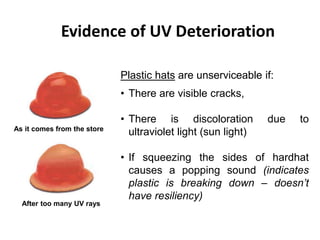
Evidence of UV Deterioration
As it comes from the store
After too many UV rays
Plastic hats are unserviceable if:
• There are visible cracks,
• There is discoloration due to
ultraviolet light (sun light)
• If squeezing the sides of hardhat
causes a popping sound (indicates
plastic is breaking down – doesn’t
have resiliency)
10
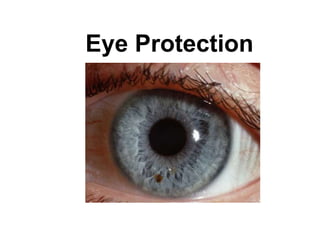
Eye Protection
11
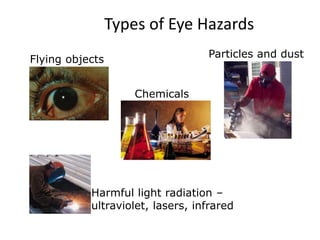
Types of Eye Hazards
Chemicals
Flying objects
Particles and dust
Harmful light radiation –
ultraviolet, lasers, infrared
12
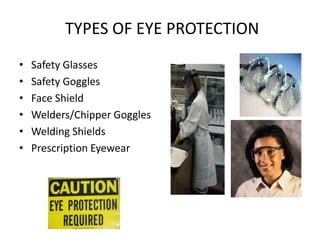
TYPES OF EYE PROTECTION
• Safety Glasses
• Safety Goggles
• Face Shield
• Welders/Chipper Goggles
• Welding Shields
• Prescription Eyewear
13
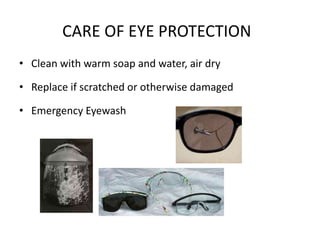
CARE OF EYE PROTECTION
• Clean with warm soap and water, air dry
• Replace if scratched or otherwise damaged
• Emergency Eyewash
14
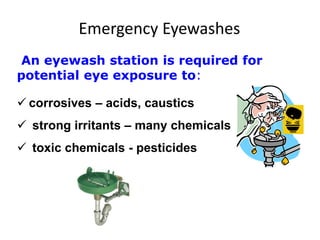
Emergency Eyewashes
An eyewash station is required for
potential eye exposure to:
 corrosives – acids, caustics
 strong irritants – many chemicals
 toxic chemicals - pesticides
15
Hand Protection
16
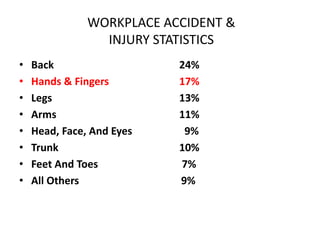
WORKPLACE ACCIDENT &
INJURY STATISTICS
• Back 24%
• Hands & Fingers 17%
• Legs 13%
• Arms 11%
• Head, Face, And Eyes 9%
• Trunk 10%
• Feet And Toes 7%
• All Others 9%
17
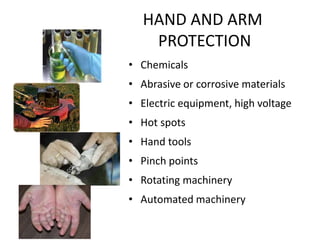
HAND AND ARM
PROTECTION
• Chemicals
• Abrasive or corrosive materials
• Electric equipment, high voltage
• Hot spots
• Hand tools
• Pinch points
• Rotating machinery
• Automated machinery
18
GLOVE SELECTION
Based on:
• Performance characteristics
• Conditions of use
• Duration of use
• Other hazards present, such as moving
machinery
19
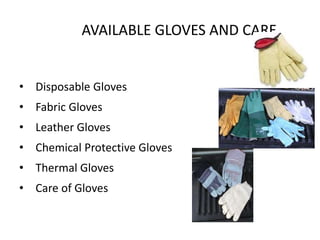
AVAILABLE GLOVES AND CARE
• Disposable Gloves
• Fabric Gloves
• Leather Gloves
• Chemical Protective Gloves
• Thermal Gloves
• Care of Gloves
20
HAND PROTECTION
BARRIER CREAMS
• Water-repellant cream
• Sunscreen
• Solvent repellent cream
– Apply to clean & dry hands
– Reapply frequently
– Wash off after work, before eating, and when dirty
21
Before you use…
• Use the proper glove for the task.
• Remove rings & bracelets.
• Do not wear gloves if they can be caught in
machinery.
• Ensure proper fit - Gloves too large or too small
can lead to injuries
• Check gloves for wear and damage.
22
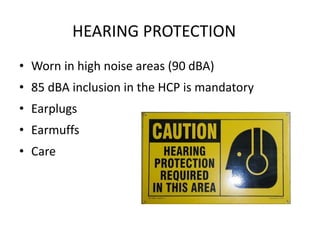
HEARING PROTECTION
• Worn in high noise areas (90 dBA)
• 85 dBA inclusion in the HCP is mandatory
• Earplugs
• Earmuffs
• Care
23
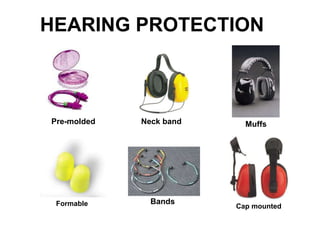
HEARING PROTECTION
Pre-molded
Formable Bands
Neck band
Cap mounted
Muffs
24
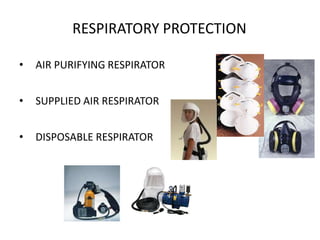
RESPIRATORY PROTECTION
• AIR PURIFYING RESPIRATOR
• SUPPLIED AIR RESPIRATOR
• DISPOSABLE RESPIRATOR
25
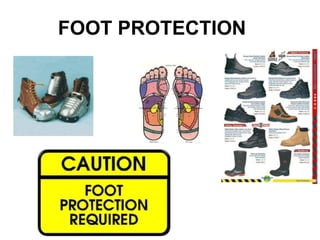
FOOT PROTECTION
26
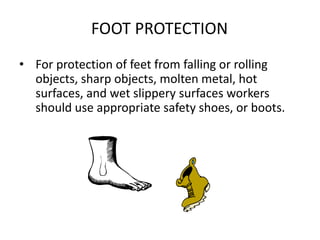
FOOT PROTECTION
• For protection of feet from falling or rolling
objects, sharp objects, molten metal, hot
surfaces, and wet slippery surfaces workers
should use appropriate safety shoes, or boots.
27
TYPES OF FOOT PROTECTION
• Steel-reinforced shoe
• Safety boots
• Neoprene or nitrile boots
• Gaiter style boots
• Electrical boots
Care of Foot Protection
28
What Should I Know When I Buy
Footwear for Work?
• The inner side of the shoe must be straight from
the heel to the end of the big toe.
• The shoe must grip the heel firmly.
• The forepart must allow freedom of movement
for the toes.
• The shoe must have a fastening across the instep
to prevent the foot from slipping when walking.
29
• Do not expect that footwear which is too tight
will stretch with wear.
• Have both feet measured. Feet normally differ in
size.
• Buy shoes to fit the bigger foot.
• Buy shoes late in the afternoon when feet are
likely to be swollen to their maximum size.
30
What Should I Know When I Buy
Footwear for Work? (cont.)
LEG PROTECTION
• Full Leg Protection
• Knee Protection
• Shin Protection
• Ankle Protection
31
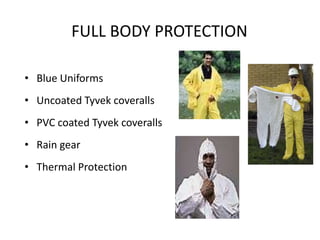
FULL BODY PROTECTION
• Blue Uniforms
• Uncoated Tyvek coveralls
• PVC coated Tyvek coveralls
• Rain gear
• Thermal Protection
32
CARE OF PPE
• Keep all protective equipment clean
• Ensure PPE is not scratched or damaged
• Replace when damaged
33
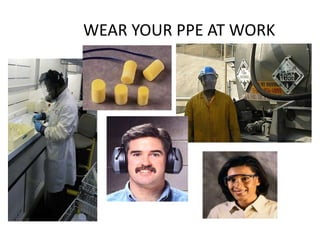
WEAR YOUR PPE AT WORK
34
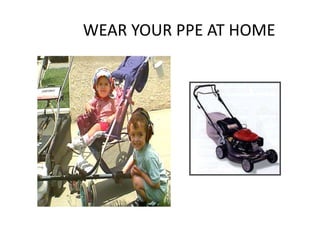
WEAR YOUR PPE AT HOME
35

Personal Protective Equipment.pptx useful for construction

  • 1.
  • 2.
    COURSE OBJECTIVES Have abasic understanding of: • The purpose and basic concepts of PPE • When PPE is necessary • Different kinds of PPE available • How to wear and maintain PPE • Limitations of PPE • How PPE can protect from on-the-job hazards 1
  • 3.
    SELECTION OF PPE •Hazard Evaluation – Identify hazards – Determine route of entry – Quantify hazards • Engineering Controls • Select the appropriate PPE – Consider flexibility, dexterity, mobility – Consider type of material required – Potential for heat stress, etc. 2
  • 4.
  • 5.
    HEAD PROTECTION (cont.) •Resists penetration and absorbs shock • Maintain 1 1/2 inch clearance • Inspect daily • Take out of service and replace when damaged To be worn when: • there is the danger of falling or flying objects • working near exposed electrical equipment • near moving machinery 4
  • 6.
    PROTECTIVE HATS • TypeI - Top • Type II - Top & Sides • Class G - Conductive - 2,200 volts • Class E - Electrical - 20,000 volts • Class C - General purpose 5
  • 7.
    Hard Hat Suspension (what’sunder the shell) • Inspect suspension before every use. Look for cracked, torn or frayed straps. Replace suspension when damage or defects are detected. • Suspensions will deteriorate over time from exposure to sunlight and chemicals, perspiration and hair oils. • The normal service life of the suspension is about one year of regular use. The suspension may last longer with intermittent use. 6
  • 8.
    Hard Hat Suspension(cont.) • Don’t mix different manufacturer suspension types and hard hats. • Replacement suspension harnesses must be from the same manufacturer and for the same model of hard hat. • Don’t wear a hard hat backwards unless you rotate the suspension. 7
  • 9.
    Hard Hat Replacement •Inspect headwear before each use for any visible signs of dents, cracks, gouges, penetration, chalking, loss of gloss or any other signs of damage that might reduce the degree of safety originally provided. • Replace hat when hairline cracks start to appear. • Replace hat that has been struck by a forceful object, even if no damage is obvious. 8
  • 10.
    Use of HardHats • Don’t use paint, solvents, gasoline, chemicals, or harsh cleaning materials on the shell. • Don’t transport headwear in rear windows of vehicles since sunlight and extreme heat will weaken it. • Don’t put anything in the space between the suspension and the shell. 9
  • 11.
    Evidence of UVDeterioration As it comes from the store After too many UV rays Plastic hats are unserviceable if: • There are visible cracks, • There is discoloration due to ultraviolet light (sun light) • If squeezing the sides of hardhat causes a popping sound (indicates plastic is breaking down – doesn’t have resiliency) 10
  • 12.
  • 13.
    Types of EyeHazards Chemicals Flying objects Particles and dust Harmful light radiation – ultraviolet, lasers, infrared 12
  • 14.
    TYPES OF EYEPROTECTION • Safety Glasses • Safety Goggles • Face Shield • Welders/Chipper Goggles • Welding Shields • Prescription Eyewear 13
  • 15.
    CARE OF EYEPROTECTION • Clean with warm soap and water, air dry • Replace if scratched or otherwise damaged • Emergency Eyewash 14
  • 16.
    Emergency Eyewashes An eyewashstation is required for potential eye exposure to:  corrosives – acids, caustics  strong irritants – many chemicals  toxic chemicals - pesticides 15
  • 17.
  • 18.
    WORKPLACE ACCIDENT & INJURYSTATISTICS • Back 24% • Hands & Fingers 17% • Legs 13% • Arms 11% • Head, Face, And Eyes 9% • Trunk 10% • Feet And Toes 7% • All Others 9% 17
  • 19.
    HAND AND ARM PROTECTION •Chemicals • Abrasive or corrosive materials • Electric equipment, high voltage • Hot spots • Hand tools • Pinch points • Rotating machinery • Automated machinery 18
  • 20.
    GLOVE SELECTION Based on: •Performance characteristics • Conditions of use • Duration of use • Other hazards present, such as moving machinery 19
  • 21.
    AVAILABLE GLOVES ANDCARE • Disposable Gloves • Fabric Gloves • Leather Gloves • Chemical Protective Gloves • Thermal Gloves • Care of Gloves 20
  • 22.
    HAND PROTECTION BARRIER CREAMS •Water-repellant cream • Sunscreen • Solvent repellent cream – Apply to clean & dry hands – Reapply frequently – Wash off after work, before eating, and when dirty 21
  • 23.
    Before you use… •Use the proper glove for the task. • Remove rings & bracelets. • Do not wear gloves if they can be caught in machinery. • Ensure proper fit - Gloves too large or too small can lead to injuries • Check gloves for wear and damage. 22
  • 24.
    HEARING PROTECTION • Wornin high noise areas (90 dBA) • 85 dBA inclusion in the HCP is mandatory • Earplugs • Earmuffs • Care 23
  • 25.
  • 26.
    RESPIRATORY PROTECTION • AIRPURIFYING RESPIRATOR • SUPPLIED AIR RESPIRATOR • DISPOSABLE RESPIRATOR 25
  • 27.
  • 28.
    FOOT PROTECTION • Forprotection of feet from falling or rolling objects, sharp objects, molten metal, hot surfaces, and wet slippery surfaces workers should use appropriate safety shoes, or boots. 27
  • 29.
    TYPES OF FOOTPROTECTION • Steel-reinforced shoe • Safety boots • Neoprene or nitrile boots • Gaiter style boots • Electrical boots Care of Foot Protection 28
  • 30.
    What Should IKnow When I Buy Footwear for Work? • The inner side of the shoe must be straight from the heel to the end of the big toe. • The shoe must grip the heel firmly. • The forepart must allow freedom of movement for the toes. • The shoe must have a fastening across the instep to prevent the foot from slipping when walking. 29
  • 31.
    • Do notexpect that footwear which is too tight will stretch with wear. • Have both feet measured. Feet normally differ in size. • Buy shoes to fit the bigger foot. • Buy shoes late in the afternoon when feet are likely to be swollen to their maximum size. 30 What Should I Know When I Buy Footwear for Work? (cont.)
  • 32.
    LEG PROTECTION • FullLeg Protection • Knee Protection • Shin Protection • Ankle Protection 31
  • 33.
    FULL BODY PROTECTION •Blue Uniforms • Uncoated Tyvek coveralls • PVC coated Tyvek coveralls • Rain gear • Thermal Protection 32
  • 34.
    CARE OF PPE •Keep all protective equipment clean • Ensure PPE is not scratched or damaged • Replace when damaged 33
  • 35.
    WEAR YOUR PPEAT WORK 34
  • 36.
    WEAR YOUR PPEAT HOME 35