CEP – complex event processing OSDC, Brisbane, November 2009 Michael Neale JBoss/Red Hat R&D
Michael Neale R&D w. JBoss (specialise in drools, now “cloud research”) Open source history (user -> fulltime developer “acquired” by jboss 2005). Thanks OSDC organisers ! me on the web:  www.michaelneale.net, twitter.com/michaelneale,   michaelneale.blogspot.com
Outline Define CEP?  Where is it used  Events and patterns  Sliding windows Temporal reasoning Defining an event “object” Libraries: Drools, Esper Sample scenario
Definition Treat “inputs” as “events” (time based) Look for patterns/correlations to extract some meaning (“an inferred event/fact”) Act on these patterns (return a result, perform a calculation, send a message etc) Sometimes also called:  Event Stream Processing Temporal correlation
eg Event: [Hand In Air] Pattern: Lots of [Hand In Air] (possibly waving, as if they didn't care), happening in close (time and space) quarters... Infer: A party
Huge number of events, but only a few of real interest Usually events are immutable Usually queries/rules have to run in reactive mode Strong temporal relationships between events Individual events are usually not important The composition and aggregation of events is important
Where is it used?  Logistics: Package en-route tracking/warning Stock market events/trades Provide real time alerts to end users Any where you have “needle in a haystack” problem, involving time based events
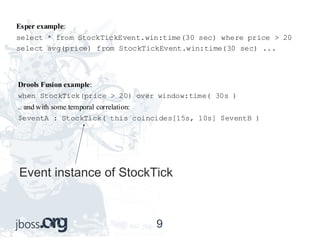
Events and patterns Events immutable** facts (objects/records) Eg a reading from a sensor, a stock value, a “fact-oid”  Patterns are logic constraints (predicate/higher order statements) Think like the “where” part of a SQL query Patterns search for particular events...
Event instance of StockTick
Patterns Are used to detect specific events (using constraints and higher order logic) Are used to detect co-incidences (over time periods) Allow you to be declarative (once again, think SQL, but involving time)
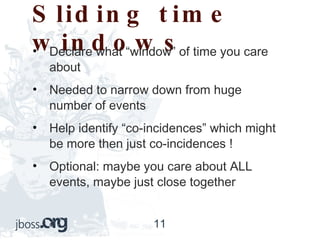
Sliding time windows Declare what “window” of time you care about Needed to narrow down from huge number of events Help identify “co-incidences” which might be more then just co-incidences ! Optional: maybe you care about ALL events, maybe just close together
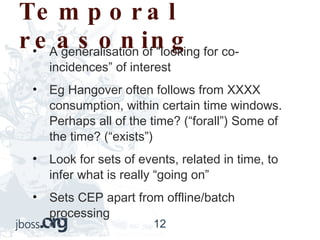
Temporal reasoning A generalisation of “looking for co-incidences” of interest Eg Hangover often follows from XXXX consumption, within certain time windows. Perhaps all of the time? (“forall”) Some of the time? (“exists”) Look for sets of events, related in time, to infer what is really “going on” Sets CEP apart from offline/batch processing
Event and Time semantics: Point in Time Interval-based Unified semantics for event correlation over time Temporal Constraints: Set of operators to express temporal relationship between events Event semantics
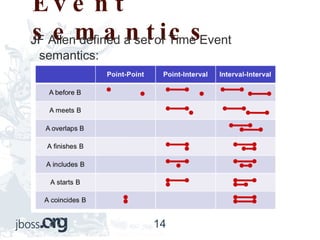
Event semantics JF Allen defined a set of Time Event semantics:
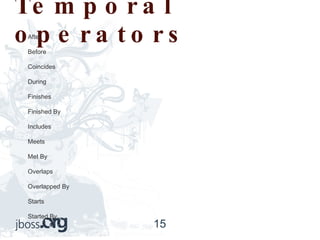
Temporal operators After Before Coincides During Finishes Finished By Includes Meets Met By Overlaps Overlapped By Starts Started By
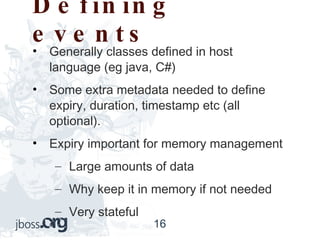
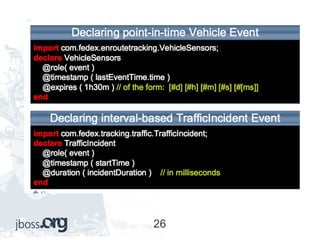
Defining events Generally classes defined in host language (eg java, C#) Some extra metadata needed to define expiry, duration, timestamp etc (all optional). Expiry important for memory management Large amounts of data Why keep it in memory if not needed Very stateful
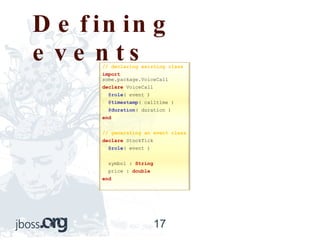
Defining events // declaring existing class import  some.package.VoiceCall declare  VoiceCall @role ( event ) @timestamp ( calltime ) @duration ( duration ) end // generating an event class declare  StockTick @role ( event ) symbol :  String price :  double end
Drools Fusion jboss.org/drools Submodule of Drools project Uses rule language to express CEP patterns Same “drl” language as normal rules Rules can take action directly, or be queries to return results
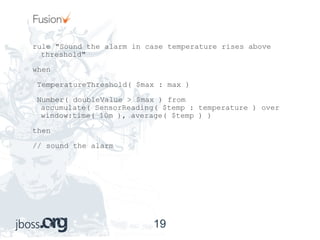
rule "Sound the alarm in case temperature rises above threshold" when TemperatureThreshold( $max : max ) Number( doubleValue > $max ) from accumulate( SensorReading( $temp : temperature ) over window:time( 10m ), average( $temp ) ) then // sound the alarm
Esper esper.codehaus.org Takes “temporal SQL” approach Return results for matches, a la SQL database (but its realtime events) SQL skill portability ?
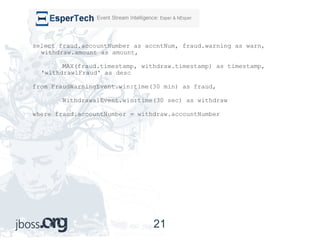
select fraud.accountNumber as accntNum, fraud.warning as warn,  withdraw.amount as amount, MAX(fraud.timestamp, withdraw.timestamp) as timestamp,  'withdrawlFraud' as desc from FraudWarningEvent.win:time(30 min) as fraud, WithdrawalEvent.win:time(30 sec) as withdraw where fraud.accountNumber = withdraw.accountNumber
Deployment Usually a dedicated server/service endpoint (but could be embedded in your app if JVM friendly) (eg wrapped around a REST servlet, or MQ) Sits there, gobbling up messages as fast as it can
Concurrency... Need for “realtime” performance  Need to make use of threads/processes Use of “rulebase partitioning” to separate less coupled data to allow this So:  User doesn't have to worry
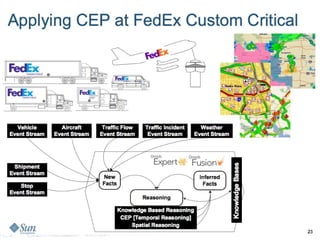
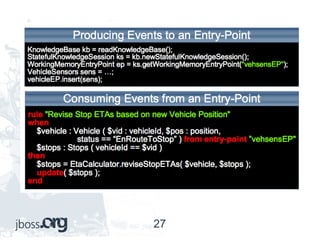
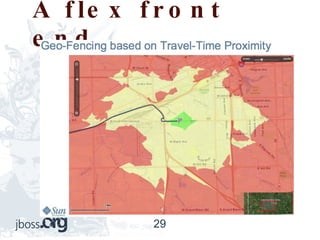
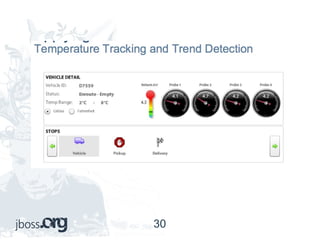
FedEx example Presented at JavaOne, Adobe MAX etc.. FedEx Custom Critical: 1: En-Route Tracking Situational Awareness  2: Capacity Allocation Management http://developers.sun.com/learning/javaoneonline/sessions/2009/pdf/TS-4475.pdf


A flex front end
 
Thanks, Q&A

Osdc Complex Event Processing

  • 1.
    CEP – complexevent processing OSDC, Brisbane, November 2009 Michael Neale JBoss/Red Hat R&D
  • 2.
    Michael Neale R&Dw. JBoss (specialise in drools, now “cloud research”) Open source history (user -> fulltime developer “acquired” by jboss 2005). Thanks OSDC organisers ! me on the web: www.michaelneale.net, twitter.com/michaelneale, michaelneale.blogspot.com
  • 3.
    Outline Define CEP? Where is it used Events and patterns Sliding windows Temporal reasoning Defining an event “object” Libraries: Drools, Esper Sample scenario
  • 4.
    Definition Treat “inputs”as “events” (time based) Look for patterns/correlations to extract some meaning (“an inferred event/fact”) Act on these patterns (return a result, perform a calculation, send a message etc) Sometimes also called: Event Stream Processing Temporal correlation
  • 5.
    eg Event: [HandIn Air] Pattern: Lots of [Hand In Air] (possibly waving, as if they didn't care), happening in close (time and space) quarters... Infer: A party
  • 6.
    Huge number ofevents, but only a few of real interest Usually events are immutable Usually queries/rules have to run in reactive mode Strong temporal relationships between events Individual events are usually not important The composition and aggregation of events is important
  • 7.
    Where is itused? Logistics: Package en-route tracking/warning Stock market events/trades Provide real time alerts to end users Any where you have “needle in a haystack” problem, involving time based events
  • 8.
    Events and patternsEvents immutable** facts (objects/records) Eg a reading from a sensor, a stock value, a “fact-oid” Patterns are logic constraints (predicate/higher order statements) Think like the “where” part of a SQL query Patterns search for particular events...
  • 9.
  • 10.
    Patterns Are usedto detect specific events (using constraints and higher order logic) Are used to detect co-incidences (over time periods) Allow you to be declarative (once again, think SQL, but involving time)
  • 11.
    Sliding time windowsDeclare what “window” of time you care about Needed to narrow down from huge number of events Help identify “co-incidences” which might be more then just co-incidences ! Optional: maybe you care about ALL events, maybe just close together
  • 12.
    Temporal reasoning Ageneralisation of “looking for co-incidences” of interest Eg Hangover often follows from XXXX consumption, within certain time windows. Perhaps all of the time? (“forall”) Some of the time? (“exists”) Look for sets of events, related in time, to infer what is really “going on” Sets CEP apart from offline/batch processing
  • 13.
    Event and Timesemantics: Point in Time Interval-based Unified semantics for event correlation over time Temporal Constraints: Set of operators to express temporal relationship between events Event semantics
  • 14.
    Event semantics JFAllen defined a set of Time Event semantics:
  • 15.
    Temporal operators AfterBefore Coincides During Finishes Finished By Includes Meets Met By Overlaps Overlapped By Starts Started By
  • 16.
    Defining events Generallyclasses defined in host language (eg java, C#) Some extra metadata needed to define expiry, duration, timestamp etc (all optional). Expiry important for memory management Large amounts of data Why keep it in memory if not needed Very stateful
  • 17.
    Defining events //declaring existing class import some.package.VoiceCall declare VoiceCall @role ( event ) @timestamp ( calltime ) @duration ( duration ) end // generating an event class declare StockTick @role ( event ) symbol : String price : double end
  • 18.
    Drools Fusion jboss.org/droolsSubmodule of Drools project Uses rule language to express CEP patterns Same “drl” language as normal rules Rules can take action directly, or be queries to return results
  • 19.
    rule "Sound thealarm in case temperature rises above threshold" when TemperatureThreshold( $max : max ) Number( doubleValue > $max ) from accumulate( SensorReading( $temp : temperature ) over window:time( 10m ), average( $temp ) ) then // sound the alarm
  • 20.
    Esper esper.codehaus.org Takes“temporal SQL” approach Return results for matches, a la SQL database (but its realtime events) SQL skill portability ?
  • 21.
    select fraud.accountNumber asaccntNum, fraud.warning as warn, withdraw.amount as amount, MAX(fraud.timestamp, withdraw.timestamp) as timestamp, 'withdrawlFraud' as desc from FraudWarningEvent.win:time(30 min) as fraud, WithdrawalEvent.win:time(30 sec) as withdraw where fraud.accountNumber = withdraw.accountNumber
  • 22.
    Deployment Usually adedicated server/service endpoint (but could be embedded in your app if JVM friendly) (eg wrapped around a REST servlet, or MQ) Sits there, gobbling up messages as fast as it can
  • 23.
    Concurrency... Need for“realtime” performance Need to make use of threads/processes Use of “rulebase partitioning” to separate less coupled data to allow this So: User doesn't have to worry
  • 24.
    FedEx example Presentedat JavaOne, Adobe MAX etc.. FedEx Custom Critical: 1: En-Route Tracking Situational Awareness 2: Capacity Allocation Management http://developers.sun.com/learning/javaoneonline/sessions/2009/pdf/TS-4475.pdf
  • 25.
  • 26.
  • 27.
  • 28.
  • 29.
  • 30.
  • 31.