Complex Event Processing 
Budapesti Műszaki és Gazdaságtudományi Egyetem 
Méréstechnika és Információs Rendszerek Tanszék 
A brief overview 
Dávid István 
davidi@inf.mit.bme.hu
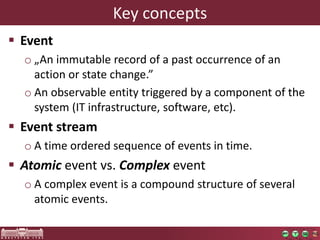
Key concepts 
 Event 
o „An immutable record of a past occurrence of an 
action or state change.” 
o An observable entity triggered by a component of the 
system (IT infrastructure, software, etc). 
 Event stream 
o A time ordered sequence of events in time. 
 Atomic event vs. Complex event 
o A complex event is a compound structure of several 
atomic events.
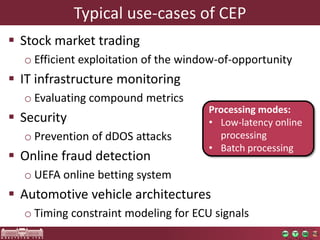
Typical use-cases of CEP 
 Stock market trading 
o Efficient exploitation of the window-of-opportunity 
 IT infrastructure monitoring 
o Evaluating compound metrics 
 Security 
o Prevention of dDOS attacks 
 Online fraud detection 
o UEFA online betting system 
Processing modes: 
• Low-latency online 
• Batch processing 
 Automotive vehicle architectures 
processing 
o Timing constraint modeling for ECU signals
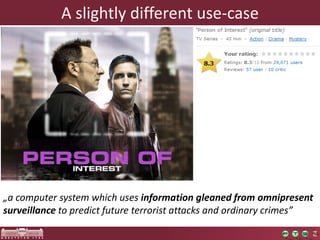
A slightly different use-case 
„a computer system which uses information gleaned from omnipresent 
surveillance to predict future terrorist attacks and ordinary crimes”
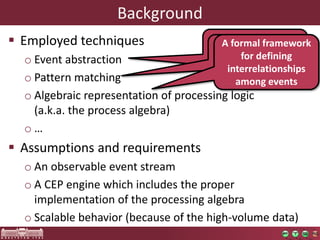
Background 
 Employed techniques 
A formal framework 
Event representation 
(POJO, JSON, XML…) 
Detecting matches 
for defining 
on the event stream 
o Event abstraction 
o Pattern matching 
o Algebraic representation of processing logic 
(a.k.a. the process algebra) 
o … 
 Assumptions and requirements 
interrelationships 
among events 
o An observable event stream 
o A CEP engine which includes the proper 
implementation of the processing algebra 
o Scalable behavior (because of the high-volume data)
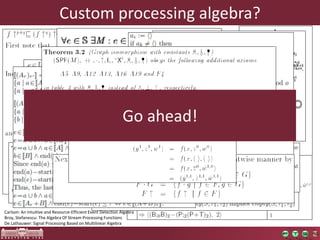
Custom processing algebra? 
Go ahead! 
Carlson: An Intuitive and Resource-Efficient Event Detection Algebra 
Broy, Stefanescu: The Algebra Of Stream Processing Functions 
De Lathauwer: Signal Processing Based on Multilinear Algebra
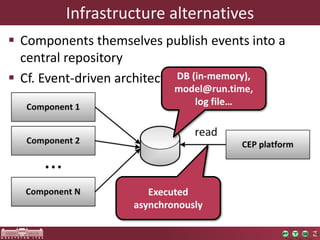
Infrastructure alternatives 
 Components themselves publish events into a 
central repository 
 Cf. Event-driven architectureDB (in-memory), 
model@run.time, 
log file… 
Executed 
asynchronously
Infrastructure alternatives 
 A monitoring framework is employed to collect 
events from components (instrumentation) 
Monitoring 
framework with 
agents (e.g. Nagios)
Infrastructure alternatives 
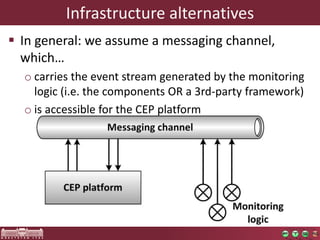
 In general: we assume a messaging channel, 
which… 
o carries the event stream generated by the monitoring 
logic (i.e. the components OR a 3rd-party framework) 
o is accessible for the CEP platform
Notable implementations 
 ESPER 
 Drools Fusion (JBoss) 
 IBM InfoSphere Streams (formerly: System S) 
 Oracle CEP 
 Microsoft StreamInsight 
 StreamBase 
 Lots of academic frameworks
Typical objection #1 
 Q: „I’m a coder guy. Can’t I just implement the 
event processing logic in my source code?” 
 A: Yes, you can, but: 
o you will have to implement a custom processing 
algebra 
o as your event processing component evolves, first you 
will encounter the benefits of using business rules over 
if-else structures, then you will employ business roles 
with timing extensions for event processing 
this is exactly how JBoss Drools Fusion works
Typical objection #2 
 Q: „I’m all about databases. Can’t I just put my 
events into a DB and write some queries and 
triggers to handle the event stream?” 
 A: Yes, you can, but: 
o you will have to implement a custom processing 
algebra 
o in order to allow low-latency on-line processing, you 
will have to employ an in-memory DB and explore the 
benefits of the active database model 
this is exactly how Esper works
Examples 
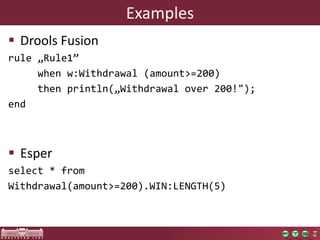
 Drools Fusion 
rule „Rule1” 
when w:Withdrawal (amount>=200) 
then println(„Withdrawal over 200!"); 
end 
 Esper 
select * from 
Withdrawal(amount>=200).WIN:LENGTH(5)
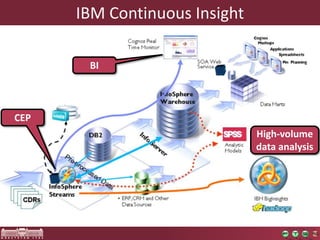
IBM Continuous Insight 
CEP 
BI 
High-volume 
data analysis
ESPER 
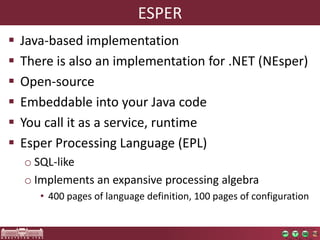
 Java-based implementation 
 There is also an implementation for .NET (NEsper) 
 Open-source 
 Embeddable into your Java code 
 You call it as a service, runtime 
 Esper Processing Language (EPL) 
o SQL-like 
o Implements an expansive processing algebra 
• 400 pages of language definition, 100 pages of configuration
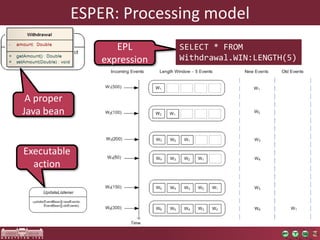
ESPER: Processing model 
EPL 
expression 
A proper 
Java bean 
SELECT * FROM 
Withdrawal.WIN:LENGTH(5) 
Executable 
action
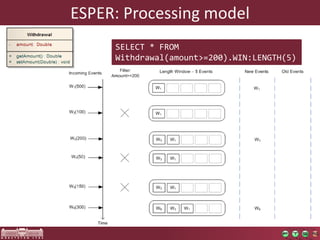
ESPER: Processing model 
SELECT * FROM 
Withdrawal(amount>=200).WIN:LENGTH(5)
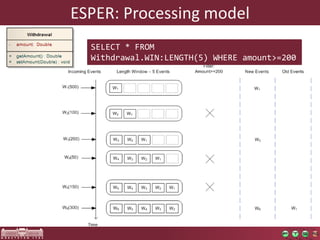
ESPER: Processing model 
SELECT * FROM 
Withdrawal.WIN:LENGTH(5) WHERE amount>=200
Further Esper Pointers 
The full documentation: 
http://esper.codehaus.org/esper/documentation/documentation.html 
Clauses, subqueries, patterns: 
http://esper.codehaus.org/esper-4.7.0/doc/reference/en- 
US/html/epl_clauses.html 
Complex patterns: http://esper.codehaus.org/esper- 
4.7.0/doc/reference/en-US/html/event_patterns.html 
EPL operators in depth: http://esper.codehaus.org/esper- 
4.7.0/doc/reference/en-US/html/epl-operator.html 
Design patterns: 
http://esper.codehaus.org/tutorials/solution_patterns/solution_patterns.ht 
ml (see section „EPL Questions”)
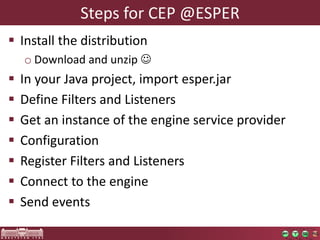
Steps for CEP @ESPER 
 Install the distribution 
o Download and unzip  
 In your Java project, import esper.jar 
 Define Filters and Listeners 
 Get an instance of the engine service provider 
 Configuration 
 Register Filters and Listeners 
 Connect to the engine 
 Send events
ESPER 
DEMO
Emerging problems 
 No modeling support 
 Inconvenient coding 
 Hard to maintain the codebase 
 No validation for the defined patterns 
o Possible interference, overlaps, correlations, etc. 
 Lack of traceability
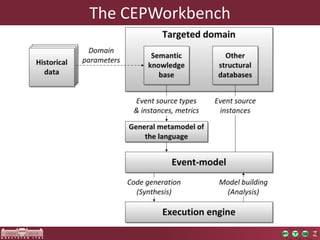
The CEPWorkbench
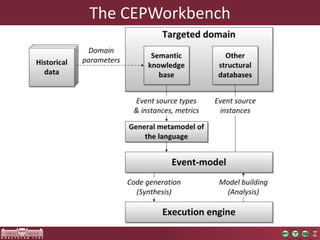
The CEPWorkbench
The CEPWorkbench
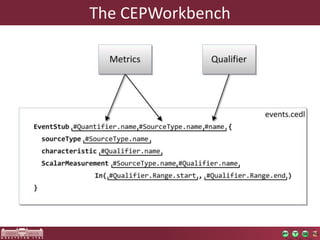
The CEPWorkbench
CEPWorkbench 
DEMO
Future directions 
 Models@run.time 
 Enormous amount of data is produced day by day 
o The last 50 years: processing data at rest 
o The next 50 years: processing information in motion 
(Mark Palmer) 
 “The world is changing fast. Big will not beat small 
anymore. It will be the fast beating the slow.” 
(Rupert Murdoch)

Complex Event Processing - A brief overview

  • 1.
    Complex Event Processing Budapesti Műszaki és Gazdaságtudományi Egyetem Méréstechnika és Információs Rendszerek Tanszék A brief overview Dávid István davidi@inf.mit.bme.hu
  • 2.
    Key concepts Event o „An immutable record of a past occurrence of an action or state change.” o An observable entity triggered by a component of the system (IT infrastructure, software, etc).  Event stream o A time ordered sequence of events in time.  Atomic event vs. Complex event o A complex event is a compound structure of several atomic events.
  • 3.
    Typical use-cases ofCEP  Stock market trading o Efficient exploitation of the window-of-opportunity  IT infrastructure monitoring o Evaluating compound metrics  Security o Prevention of dDOS attacks  Online fraud detection o UEFA online betting system Processing modes: • Low-latency online • Batch processing  Automotive vehicle architectures processing o Timing constraint modeling for ECU signals
  • 4.
    A slightly differentuse-case „a computer system which uses information gleaned from omnipresent surveillance to predict future terrorist attacks and ordinary crimes”
  • 5.
    Background  Employedtechniques A formal framework Event representation (POJO, JSON, XML…) Detecting matches for defining on the event stream o Event abstraction o Pattern matching o Algebraic representation of processing logic (a.k.a. the process algebra) o …  Assumptions and requirements interrelationships among events o An observable event stream o A CEP engine which includes the proper implementation of the processing algebra o Scalable behavior (because of the high-volume data)
  • 6.
    Custom processing algebra? Go ahead! Carlson: An Intuitive and Resource-Efficient Event Detection Algebra Broy, Stefanescu: The Algebra Of Stream Processing Functions De Lathauwer: Signal Processing Based on Multilinear Algebra
  • 7.
    Infrastructure alternatives Components themselves publish events into a central repository  Cf. Event-driven architectureDB (in-memory), model@run.time, log file… Executed asynchronously
  • 8.
    Infrastructure alternatives A monitoring framework is employed to collect events from components (instrumentation) Monitoring framework with agents (e.g. Nagios)
  • 9.
    Infrastructure alternatives In general: we assume a messaging channel, which… o carries the event stream generated by the monitoring logic (i.e. the components OR a 3rd-party framework) o is accessible for the CEP platform
  • 10.
    Notable implementations ESPER  Drools Fusion (JBoss)  IBM InfoSphere Streams (formerly: System S)  Oracle CEP  Microsoft StreamInsight  StreamBase  Lots of academic frameworks
  • 11.
    Typical objection #1  Q: „I’m a coder guy. Can’t I just implement the event processing logic in my source code?”  A: Yes, you can, but: o you will have to implement a custom processing algebra o as your event processing component evolves, first you will encounter the benefits of using business rules over if-else structures, then you will employ business roles with timing extensions for event processing this is exactly how JBoss Drools Fusion works
  • 12.
    Typical objection #2  Q: „I’m all about databases. Can’t I just put my events into a DB and write some queries and triggers to handle the event stream?”  A: Yes, you can, but: o you will have to implement a custom processing algebra o in order to allow low-latency on-line processing, you will have to employ an in-memory DB and explore the benefits of the active database model this is exactly how Esper works
  • 13.
    Examples  DroolsFusion rule „Rule1” when w:Withdrawal (amount>=200) then println(„Withdrawal over 200!"); end  Esper select * from Withdrawal(amount>=200).WIN:LENGTH(5)
  • 14.
    IBM Continuous Insight CEP BI High-volume data analysis
  • 15.
    ESPER  Java-basedimplementation  There is also an implementation for .NET (NEsper)  Open-source  Embeddable into your Java code  You call it as a service, runtime  Esper Processing Language (EPL) o SQL-like o Implements an expansive processing algebra • 400 pages of language definition, 100 pages of configuration
  • 16.
    ESPER: Processing model EPL expression A proper Java bean SELECT * FROM Withdrawal.WIN:LENGTH(5) Executable action
  • 17.
    ESPER: Processing model SELECT * FROM Withdrawal(amount>=200).WIN:LENGTH(5)
  • 18.
    ESPER: Processing model SELECT * FROM Withdrawal.WIN:LENGTH(5) WHERE amount>=200
  • 19.
    Further Esper Pointers The full documentation: http://esper.codehaus.org/esper/documentation/documentation.html Clauses, subqueries, patterns: http://esper.codehaus.org/esper-4.7.0/doc/reference/en- US/html/epl_clauses.html Complex patterns: http://esper.codehaus.org/esper- 4.7.0/doc/reference/en-US/html/event_patterns.html EPL operators in depth: http://esper.codehaus.org/esper- 4.7.0/doc/reference/en-US/html/epl-operator.html Design patterns: http://esper.codehaus.org/tutorials/solution_patterns/solution_patterns.ht ml (see section „EPL Questions”)
  • 20.
    Steps for CEP@ESPER  Install the distribution o Download and unzip   In your Java project, import esper.jar  Define Filters and Listeners  Get an instance of the engine service provider  Configuration  Register Filters and Listeners  Connect to the engine  Send events
  • 21.
  • 22.
    Emerging problems No modeling support  Inconvenient coding  Hard to maintain the codebase  No validation for the defined patterns o Possible interference, overlaps, correlations, etc.  Lack of traceability
  • 23.
  • 24.
  • 25.
  • 26.
  • 27.
  • 28.
    Future directions Models@run.time  Enormous amount of data is produced day by day o The last 50 years: processing data at rest o The next 50 years: processing information in motion (Mark Palmer)  “The world is changing fast. Big will not beat small anymore. It will be the fast beating the slow.” (Rupert Murdoch)