Semantic
    Complex Event Processing
    „The Future of Dynamic IT“

    Paul Vincent
    Adrian Paschke
    Harold Boley


1
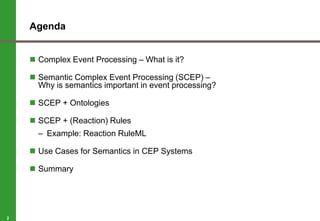
Agenda


     Complex Event Processing – What is it?

     Semantic Complex Event Processing (SCEP) –
      Why is semantics important in event processing?

     SCEP + Ontologies

     SCEP + (Reaction) Rules
      – Example: Reaction RuleML

     Use Cases for Semantics in CEP Systems

     Summary


2
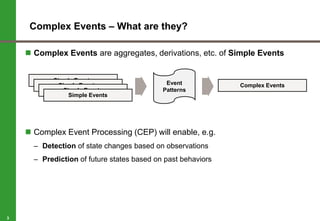
Complex Events – What are they?

     Complex Events are aggregates, derivations, etc. of Simple Events


           Simple Events                     Event
             Simple Events                                    Complex Events
               Simple Events                Patterns
                 Simple Events


     Complex Event Processing (CEP) will enable, e.g.
      – Detection of state changes based on observations
      – Prediction of future states based on past behaviors


3
Complex Event Processing – What is it?

     CEP is about complex event detection and reaction to complex events
       – Efficient (near real-time) processing of large numbers of events
       – Detection, prediction and exploitation of relevant complex events
       – Situation awareness, track & trace, sense & respond


                   new auto pay
        logout deposit
                                                account login               Continuous Event Queries
                              withdrawal              new auto pay
                   transfer                                                 INSERT INTO OrdersMatch_s
                                    book         logout     account login    SELECT B.ID, S.ID, B.Price
    deposit


                                                                                                                               Complex Events
              enquiry
                        Event Cloud                                          FROM BuyOrders_s B, Trades_s T, SellOrders_s S,
                                                                             MATCHING [30 SECONDS: B, !T, S]
                          (unordered events)                    enquiry      ON B.Price = S.Price = T.Price;
     account balance                             request
                              incident
         new auto pay                                        enquiry
                                         account login

        deposit         withdrawal            new auto pay                  Patterns, Rules
         transfer                                   account login
                                           logout
         enquiry         deposit
                                   activity history
                                                                                                         B

                        Event Streams                                                    A                             C
                              (ordered events)
4
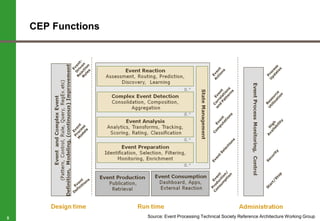
CEP Functions


5                   Source: Event Processing Technical Society Reference Architecture Working Group
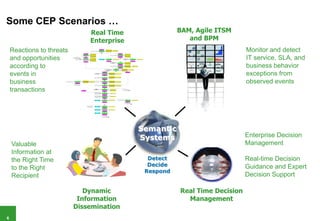
Some CEP Scenarios …
                               Real Time               BAM, Agile ITSM
                               Enterprise                 and BPM
    Reactions to threats                                                    Monitor and detect
    and opportunities                                                       IT service, SLA, and
    according to                                                            business behavior
    events in                                                               exceptions from
    business                                                                observed events
    transactions


                                            Semantic
                                            Systems                         Enterprise Decision
    Valuable                                                                Management
    Information at
    the Right Time                            Detect                        Real-time Decision
                                              Decide                        Guidance and Expert
    to the Right                             Respond
    Recipient                                                               Decision Support

                              Dynamic                  Real Time Decision
                            Information                  Management
                           Dissemination
6
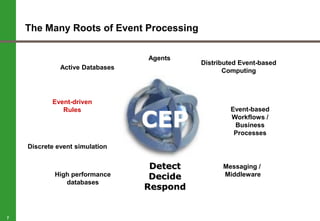
The Many Roots of Event Processing

                                 Agents
                                           Distributed Event-based
              Active Databases                    Computing


           Event-driven


                                 CEP
              Rules                                 Event-based
                                                    Workflows /
                                                     Business
                                                     Processes

    Discrete event simulation


                                  Detect         Messaging /
            High performance      Decide         Middleware
               databases
                                 Respond


7
Semantic CEP: The Combination


    Semantic CEP (or SCEP) combines approaches of


     (Complex) Event Processing: events, complex events, patterns, …

      +
     Semantic technologies: ontologies, definitions + behavior rules


8
Semantic CEP: The Benefits

     Event data becomes meaningful information / declarative knowledge
      while conforming to an underlying formal semantics
      – e.g., automated mediation between different heterogeneous domains and
        abstraction levels

     Better understanding of situations (states) by machines (agents)
      – e.g., a process is executing when it has been started and not ended

     Better understanding of the relationships between events
      e.g., temporal, spatial, causal, .., relations between events, states, activities,
      processes
      – e.g., a service is unavailable when the service response time is longer than X
        seconds and the service is not in maintenance state

     Declarative processing of events and reaction to situations
      – Semantically grounded event-driven rules (= reaction rules)
9
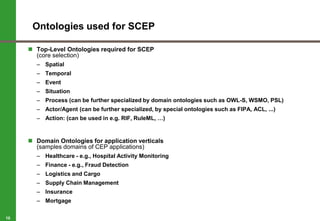
Ontologies used for SCEP

      Top-Level Ontologies required for SCEP
       (core selection)
       – Spatial
       – Temporal
       – Event
       – Situation
       – Process (can be further specialized by domain ontologies such as OWL-S, WSMO, PSL)
       – Actor/Agent (can be further specialized, by special ontologies such as FIPA, ACL, ...)
       – Action: (can be used in e.g. RIF, RuleML, …)


      Domain Ontologies for application verticals
       (samples domains of CEP applications)
       – Healthcare - e.g., Hospital Activity Monitoring
       – Finance - e.g., Fraud Detection
       – Logistics and Cargo
       – Supply Chain Management
       – Insurance
       – Mortgage

10
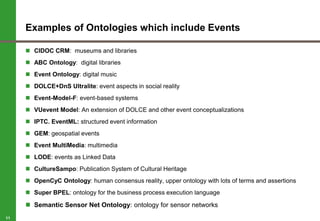
Examples of Ontologies which include Events

      CIDOC CRM: museums and libraries
      ABC Ontology: digital libraries
      Event Ontology: digital music
      DOLCE+DnS Ultralite: event aspects in social reality
      Event-Model-F: event-based systems
      VUevent Model: An extension of DOLCE and other event conceptualizations
      IPTC. EventML: structured event information
      GEM: geospatial events
      Event MultiMedia: multimedia
      LODE: events as Linked Data
      CultureSampo: Publication System of Cultural Heritage
      OpenCyC Ontology: human consensus reality, upper ontology with lots of terms and assertions
      Super BPEL: ontology for the business process execution language

      Semantic Sensor Net Ontology: ontology for sensor networks
11
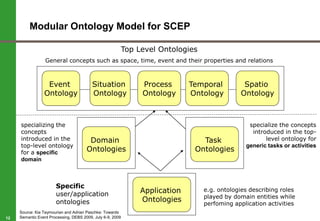
Modular Ontology Model for SCEP

                                                            Top Level Ontologies
                  General concepts such as space, time, event and their properties and relations


                  Event                   Situation              Process       Temporal         Spatio
                 Ontology                 Ontology               Ontology      Ontology        Ontology


     specializing the                                                                             specialize the concepts
     concepts                                                                                      introduced in the top-
     introduced in the                  Domain                                    Task                  level ontology for
     top-level ontology                                                                          generic tasks or activities
     for a specific                    Ontologies                               Ontologies
     domain


                       Specific
                       user/application                          Application       e.g. ontologies describing roles
                                                                                   played by domain entities while
                       ontologies                                Ontologies        perfoming application activities
     Source: Kia Teymourian and Adrian Paschke: Towards
12   Semantic Event Processing, DEBS 2009, July 6-9, 2009
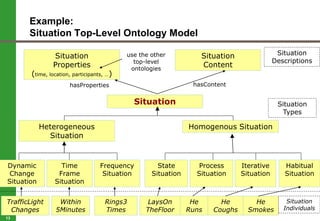
Example:
       Situation Top-Level Ontology Model

                Situation                   use the other          Situation                 Situation
                                              top-level                                     Descriptions
                Properties                   ontologies
                                                                   Content
        (time, location, participants, …)
                       hasProperties                             hasContent


                                               Situation                                     Situation
                                                                                               Types

            Heterogeneous                                       Homogenous Situation
              Situation


Dynamic            Time             Frequency         State        Process      Iterative      Habitual
 Change           Frame              Situation      Situation     Situation     Situation      Situation
Situation        Situation


TrafficLight      Within              Rings3       LaysOn        He      He         He          Situation
 Changes         5Minutes             Times       TheFloor      Runs   Coughs     Smokes       Individuals
13
Summary of Ontology Benefits for SCEP


     Ontologies can be applied to CEP application
      domains as in any other IT system

     Ontologies for time-based events + event
      operations etc can also improve formalisation
      of CEP


15
Rule-based Complex Event Processing

      CEP complex event detection can use reaction rules
       – e.g. event-condition-action rule:
         incoming event +
         conditions over situations (effects + context)         (re)action

      Detected Complex (aggregated) events and
       their effects (situations) trigger
       reaction rules for decision + behavioral reaction logic
       – e.g. CEP event-condition-action rule:
         complex event + decisioning conditions           response actions

      Rule-based Event Processing Languages (EPLs)
       – e.g. Reaction RuleML, IBM Amit Situation Manager Rule,
16
         TIBCO BusinessEvents, ...
Production Rules and CEP

      Production Rules react to fact changes (facts = data)

      However, PR systems typically use an object model + events:
       can represent external fact updates  extensible for use in CEP
       – Event types and object classes are defined in the rule declarations
       – New events are added to the fact base / working memory
         – might become an event channel (such as an event queue)
           (facts = events and data)
       – Instance tuples are filtered and joined in the rule conditions
         and for valid tuples the action part of the rule is executed

      Can be further extended with mechanisms such as query languages,
       state models and temporal constraints

      Examples: TIBCO BusinessEvents, Red Hat Drools
17
Event Condition Action Rules and CEP

      ECA Rule
             “on Event if Condition do Action”
       – Explicit event part (trigger) + separate data conditions       actions
         – e.g. on customer order (event) + check if credit card is valid (condition)
           process order (action)

      Evolved from active databases
       – extend databases with trigger-type reactions,
         e.g. HiPac, Chimera, ADL, COMPOSE, NAOS
       – Composite event algebras, e.g. SAMOS, COMPOSE, Snoop
         – Sequence | Disjunction | Xor | Conjunction |
           Concurrent | Not | Any | Aperiodic | Periodic


18
Research Standards Area: Reaction RuleML

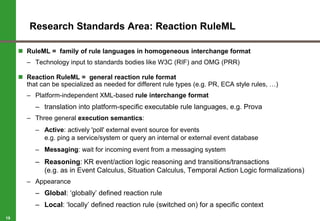
      RuleML = family of rule languages in homogeneous interchange format
        – Technology input to standards bodies like W3C (RIF) and OMG (PRR)

      Reaction RuleML = general reaction rule format
       that can be specialized as needed for different rule types (e.g. PR, ECA style rules, …)
        – Platform-independent XML-based rule interchange format
          – translation into platform-specific executable rule languages, e.g. Prova
        – Three general execution semantics:
          – Active: actively 'poll' external event source for events
            e.g. ping a service/system or query an internal or external event database
          – Messaging: wait for incoming event from a messaging system
          – Reasoning: KR event/action logic reasoning and transitions/transactions
            (e.g. as in Event Calculus, Situation Calculus, Temporal Action Logic formalizations)
        – Appearance
          – Global: „globally‟ defined reaction rule
          – Local: „locally‟ defined reaction rule (switched on) for a specific context
19
General Syntax for Reaction Rules

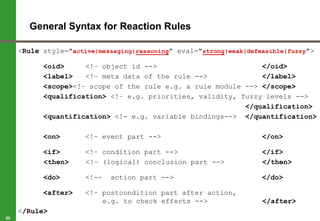
     <Rule style="active|messaging|reasoning" eval="strong|weak|defeasible|fuzzy">

           <oid>     <!– object id -->                         </oid>
           <label>   <!– meta data of the rule -->             </label>
           <scope><!– scope of the rule e.g. a rule module --> </scope>
           <qualification> <!– e.g. priorities, validity, fuzzy levels -->
                                                           </qualification>
           <quantification> <!- e.g. variable bindings--> </quantification>

           <on>       <!– event part -->                            </on>

           <if>       <!– condition part -->                        </if>
           <then>     <!– (logical) conclusion part -->             </then>

           <do>       <!--   action part -->                        </do>

           <after>    <!– postcondition part after action,
                          e.g. to check effects -->                 </after>
     </Rule>
20
Reaction RuleML – Example Rule Types

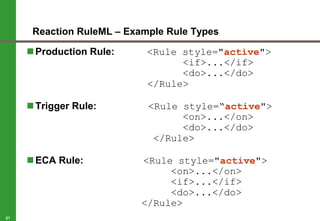
      Production Rule:     <Rule style="active">
                                  <if>...</if>
                                  <do>...</do>
                            </Rule>

      Trigger Rule:        <Rule style=“active">
                                  <on>...</on>
                                  <do>...</do>
                             </Rule>

      ECA Rule:           <Rule style="active">
                                <on>...</on>
                                <if>...</if>
                                <do>...</do>
                           </Rule>
21
Reaction RuleML Features

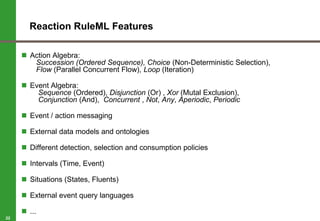
      Action Algebra:
        Succession (Ordered Sequence), Choice (Non-Deterministic Selection),
        Flow (Parallel Concurrent Flow), Loop (Iteration)

      Event Algebra:
         Sequence (Ordered), Disjunction (Or) , Xor (Mutal Exclusion),
         Conjunction (And), Concurrent , Not, Any, Aperiodic, Periodic

      Event / action messaging

      External data models and ontologies

      Different detection, selection and consumption policies

      Intervals (Time, Event)

      Situations (States, Fluents)

      External event query languages

      ...
22
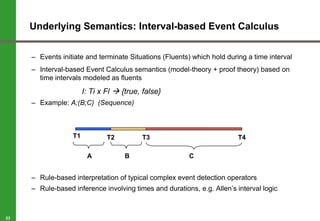
Underlying Semantics: Interval-based Event Calculus


     – Events initiate and terminate Situations (Fluents) which hold during a time interval
     – Interval-based Event Calculus semantics (model-theory + proof theory) based on
       time intervals modeled as fluents
                       I: Ti x Fl  {true, false}
     – Example: A;(B;C) (Sequence)


                  T1           T2         T3                             T4

                        A            B                   C


     – Rule-based interpretation of typical complex event detection operators
     – Rule-based inference involving times and durations, e.g. Allen‟s interval logic


23
CEP Use Cases

      Current CEP technologies and applications mostly concentrate on
       performance (vs knowledge, semantics, provable correctness )

      CEP technologies like TIBCO BusinessEvents provide certain level of
       semantics:
       – UML-level for class, event relationships (inheritance, containment, reference)
       – UML-level for state behaviors
       – BPMN-level for process behaviors
       – UML PRR-level for declarative rule behaviors
       – etc.

      Utilize essentially fixed-schema data representations (e.g. object
       definitions)

      Machine learning, currently limited to rule / query parameterization (etc.)
24
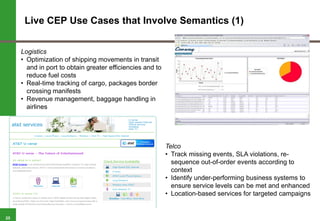
Live CEP Use Cases that Involve Semantics (1)


     Logistics
     • Optimization of shipping movements in transit
       and in port to obtain greater efficiencies and to
       reduce fuel costs
     • Real-time tracking of cargo, packages border
       crossing manifests
     • Revenue management, baggage handling in
       airlines


                                                           Telco
                                                           • Track missing events, SLA violations, re-
                                                             sequence out-of-order events according to
                                                             context
                                                           • Identify under-performing business systems to
                                                             ensure service levels can be met and enhanced
                                                           • Location-based services for targeted campaigns


25
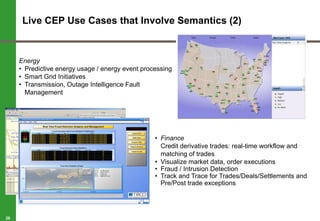
Live CEP Use Cases that Involve Semantics (2)


     Energy
     • Predictive energy usage / energy event processing
     • Smart Grid Initiatives
     • Transmission, Outage Intelligence Fault
       Management


                                                  • Finance
                                                    Credit derivative trades: real-time workflow and
                                                    matching of trades
                                                  • Visualize market data, order executions
                                                  • Fraud / Intrusion Detection
                                                  • Track and Trace for Trades/Deals/Settlements and
                                                    Pre/Post trade exceptions


26
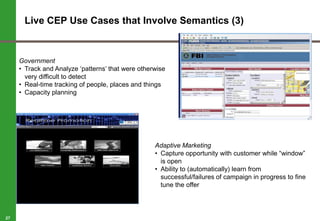
Live CEP Use Cases that Involve Semantics (3)


     Government
     • Track and Analyze „patterns‟ that were otherwise
       very difficult to detect
     • Real-time tracking of people, places and things
     • Capacity planning


                                                   Adaptive Marketing
                                                   • Capture opportunity with customer while “window”
                                                     is open
                                                   • Ability to (automatically) learn from
                                                     successful/failures of campaign in progress to fine
                                                     tune the offer


27
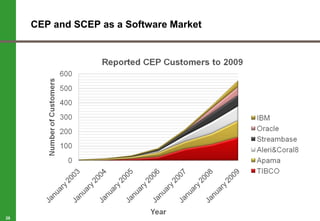
CEP and SCEP as a Software Market


28
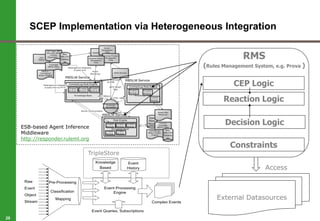
SCEP Implementation via Heterogeneous Integration


                                                           RMS
                                             (Rules Management System, e.g. Prova )

                                                        CEP Logic
                                                    Reaction Logic


     ESB-based Agent Inference
                                                     Decision Logic
     Middleware
     http://responder.ruleml.org
                                                       Constraints
                               TripleStore

                                                                    Access


                                                  External Datasources


29
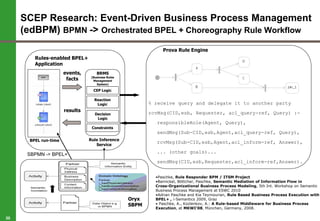
SCEP Research: Event-Driven Business Process Management
     (edBPM) BPMN -> Orchestrated BPEL + Choreography Rule Workflow
                                                               Prova Rule Engine
        Rules-enabled BPEL+
        Application
                      events,       BRMS
                                 (Business Rules
                       facts      Management
                                    System)

                                  CEP Logic

                                  Reaction
                                   Logic                  % receive query and delegate it to another party
                      results                             rcvMsg(CID,esb, Requester, acl_query-ref, Query) :-
                                   Decision
                                    Logic
                                                            responsibleRole(Agent, Query),
                                 Constraints
                                                            sendMsg(Sub-CID,esb,Agent,acl_query-ref, Query),
      BPEL run-time             Rule Inference
                                                            rcvMsg(Sub-CID,esb,Agent,acl_inform-ref, Answer),
                                   Service
                                                            ... (other goals)...
      SBPMN -> BPEL+
                                                            sendMsg(CID,esb,Requester,acl_inform-ref,Answer).


                                                            •Paschke, Rule Responder BPM / ITSM Project
                                                            •Barnickel, Böttcher, Paschke, Semantic Mediation of Information Flow in
                                                            Cross-Organizational Business Process Modeling, 5th Int. Workshop on Semantic
                                                            Business Process Management at ESWC 2010
                                                            •Adrian Paschke and Kia Teymourian, Rule Based Business Process Execution with
                                                   Oryx     BPEL+ , i-Semantics 2009, Graz
                                                   SBPM     • Paschke, A., Kozlenkov, A.: A Rule-based Middleware for Business Process
                                                            Execution, at MKWI'08, München, Germany, 2008.

30
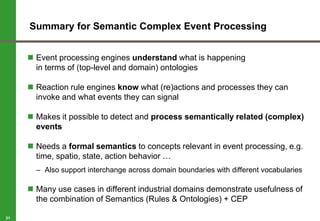
Summary for Semantic Complex Event Processing


      Event processing engines understand what is happening
       in terms of (top-level and domain) ontologies

      Reaction rule engines know what (re)actions and processes they can
       invoke and what events they can signal

      Makes it possible to detect and process semantically related (complex)
       events

      Needs a formal semantics to concepts relevant in event processing, e.g.
       time, spatio, state, action behavior …
       – Also support interchange across domain boundaries with different vocabularies

      Many use cases in different industrial domains demonstrate usefulness of
       the combination of Semantics (Rules & Ontologies) + CEP

31
Thank you …


32

Semantic Complex Event Processing at Sem Tech 2010

  • 1.
    Semantic Complex Event Processing „The Future of Dynamic IT“ Paul Vincent Adrian Paschke Harold Boley 1
  • 2.
    Agenda  Complex Event Processing – What is it?  Semantic Complex Event Processing (SCEP) – Why is semantics important in event processing?  SCEP + Ontologies  SCEP + (Reaction) Rules – Example: Reaction RuleML  Use Cases for Semantics in CEP Systems  Summary 2
  • 3.
    Complex Events –What are they?  Complex Events are aggregates, derivations, etc. of Simple Events Simple Events Event Simple Events Complex Events Simple Events Patterns Simple Events  Complex Event Processing (CEP) will enable, e.g. – Detection of state changes based on observations – Prediction of future states based on past behaviors 3
  • 4.
    Complex Event Processing– What is it?  CEP is about complex event detection and reaction to complex events – Efficient (near real-time) processing of large numbers of events – Detection, prediction and exploitation of relevant complex events – Situation awareness, track & trace, sense & respond new auto pay logout deposit account login Continuous Event Queries withdrawal new auto pay transfer INSERT INTO OrdersMatch_s book logout account login SELECT B.ID, S.ID, B.Price deposit Complex Events enquiry Event Cloud FROM BuyOrders_s B, Trades_s T, SellOrders_s S, MATCHING [30 SECONDS: B, !T, S] (unordered events) enquiry ON B.Price = S.Price = T.Price; account balance request incident new auto pay enquiry account login deposit withdrawal new auto pay Patterns, Rules transfer account login logout enquiry deposit activity history B Event Streams A C (ordered events) 4
  • 5.
    CEP Functions 5 Source: Event Processing Technical Society Reference Architecture Working Group
  • 6.
    Some CEP Scenarios… Real Time BAM, Agile ITSM Enterprise and BPM Reactions to threats Monitor and detect and opportunities IT service, SLA, and according to business behavior events in exceptions from business observed events transactions Semantic Systems Enterprise Decision Valuable Management Information at the Right Time Detect Real-time Decision Decide Guidance and Expert to the Right Respond Recipient Decision Support Dynamic Real Time Decision Information Management Dissemination 6
  • 7.
    The Many Rootsof Event Processing Agents Distributed Event-based Active Databases Computing Event-driven CEP Rules Event-based Workflows / Business Processes Discrete event simulation Detect Messaging / High performance Decide Middleware databases Respond 7
  • 8.
    Semantic CEP: TheCombination Semantic CEP (or SCEP) combines approaches of  (Complex) Event Processing: events, complex events, patterns, … +  Semantic technologies: ontologies, definitions + behavior rules 8
  • 9.
    Semantic CEP: TheBenefits  Event data becomes meaningful information / declarative knowledge while conforming to an underlying formal semantics – e.g., automated mediation between different heterogeneous domains and abstraction levels  Better understanding of situations (states) by machines (agents) – e.g., a process is executing when it has been started and not ended  Better understanding of the relationships between events e.g., temporal, spatial, causal, .., relations between events, states, activities, processes – e.g., a service is unavailable when the service response time is longer than X seconds and the service is not in maintenance state  Declarative processing of events and reaction to situations – Semantically grounded event-driven rules (= reaction rules) 9
  • 10.
    Ontologies used forSCEP  Top-Level Ontologies required for SCEP (core selection) – Spatial – Temporal – Event – Situation – Process (can be further specialized by domain ontologies such as OWL-S, WSMO, PSL) – Actor/Agent (can be further specialized, by special ontologies such as FIPA, ACL, ...) – Action: (can be used in e.g. RIF, RuleML, …)  Domain Ontologies for application verticals (samples domains of CEP applications) – Healthcare - e.g., Hospital Activity Monitoring – Finance - e.g., Fraud Detection – Logistics and Cargo – Supply Chain Management – Insurance – Mortgage 10
  • 11.
    Examples of Ontologieswhich include Events  CIDOC CRM: museums and libraries  ABC Ontology: digital libraries  Event Ontology: digital music  DOLCE+DnS Ultralite: event aspects in social reality  Event-Model-F: event-based systems  VUevent Model: An extension of DOLCE and other event conceptualizations  IPTC. EventML: structured event information  GEM: geospatial events  Event MultiMedia: multimedia  LODE: events as Linked Data  CultureSampo: Publication System of Cultural Heritage  OpenCyC Ontology: human consensus reality, upper ontology with lots of terms and assertions  Super BPEL: ontology for the business process execution language  Semantic Sensor Net Ontology: ontology for sensor networks 11
  • 12.
    Modular Ontology Modelfor SCEP Top Level Ontologies General concepts such as space, time, event and their properties and relations Event Situation Process Temporal Spatio Ontology Ontology Ontology Ontology Ontology specializing the specialize the concepts concepts introduced in the top- introduced in the Domain Task level ontology for top-level ontology generic tasks or activities for a specific Ontologies Ontologies domain Specific user/application Application e.g. ontologies describing roles played by domain entities while ontologies Ontologies perfoming application activities Source: Kia Teymourian and Adrian Paschke: Towards 12 Semantic Event Processing, DEBS 2009, July 6-9, 2009
  • 13.
    Example: Situation Top-Level Ontology Model Situation use the other Situation Situation top-level Descriptions Properties ontologies Content (time, location, participants, …) hasProperties hasContent Situation Situation Types Heterogeneous Homogenous Situation Situation Dynamic Time Frequency State Process Iterative Habitual Change Frame Situation Situation Situation Situation Situation Situation Situation TrafficLight Within Rings3 LaysOn He He He Situation Changes 5Minutes Times TheFloor Runs Coughs Smokes Individuals 13
  • 14.
    Summary of OntologyBenefits for SCEP Ontologies can be applied to CEP application domains as in any other IT system Ontologies for time-based events + event operations etc can also improve formalisation of CEP 15
  • 15.
    Rule-based Complex EventProcessing  CEP complex event detection can use reaction rules – e.g. event-condition-action rule: incoming event + conditions over situations (effects + context) (re)action  Detected Complex (aggregated) events and their effects (situations) trigger reaction rules for decision + behavioral reaction logic – e.g. CEP event-condition-action rule: complex event + decisioning conditions response actions  Rule-based Event Processing Languages (EPLs) – e.g. Reaction RuleML, IBM Amit Situation Manager Rule, 16 TIBCO BusinessEvents, ...
  • 16.
    Production Rules andCEP  Production Rules react to fact changes (facts = data)  However, PR systems typically use an object model + events: can represent external fact updates extensible for use in CEP – Event types and object classes are defined in the rule declarations – New events are added to the fact base / working memory – might become an event channel (such as an event queue) (facts = events and data) – Instance tuples are filtered and joined in the rule conditions and for valid tuples the action part of the rule is executed  Can be further extended with mechanisms such as query languages, state models and temporal constraints  Examples: TIBCO BusinessEvents, Red Hat Drools 17
  • 17.
    Event Condition ActionRules and CEP  ECA Rule “on Event if Condition do Action” – Explicit event part (trigger) + separate data conditions actions – e.g. on customer order (event) + check if credit card is valid (condition) process order (action)  Evolved from active databases – extend databases with trigger-type reactions, e.g. HiPac, Chimera, ADL, COMPOSE, NAOS – Composite event algebras, e.g. SAMOS, COMPOSE, Snoop – Sequence | Disjunction | Xor | Conjunction | Concurrent | Not | Any | Aperiodic | Periodic 18
  • 18.
    Research Standards Area:Reaction RuleML  RuleML = family of rule languages in homogeneous interchange format – Technology input to standards bodies like W3C (RIF) and OMG (PRR)  Reaction RuleML = general reaction rule format that can be specialized as needed for different rule types (e.g. PR, ECA style rules, …) – Platform-independent XML-based rule interchange format – translation into platform-specific executable rule languages, e.g. Prova – Three general execution semantics: – Active: actively 'poll' external event source for events e.g. ping a service/system or query an internal or external event database – Messaging: wait for incoming event from a messaging system – Reasoning: KR event/action logic reasoning and transitions/transactions (e.g. as in Event Calculus, Situation Calculus, Temporal Action Logic formalizations) – Appearance – Global: „globally‟ defined reaction rule – Local: „locally‟ defined reaction rule (switched on) for a specific context 19
  • 19.
    General Syntax forReaction Rules <Rule style="active|messaging|reasoning" eval="strong|weak|defeasible|fuzzy"> <oid> <!– object id --> </oid> <label> <!– meta data of the rule --> </label> <scope><!– scope of the rule e.g. a rule module --> </scope> <qualification> <!– e.g. priorities, validity, fuzzy levels --> </qualification> <quantification> <!- e.g. variable bindings--> </quantification> <on> <!– event part --> </on> <if> <!– condition part --> </if> <then> <!– (logical) conclusion part --> </then> <do> <!-- action part --> </do> <after> <!– postcondition part after action, e.g. to check effects --> </after> </Rule> 20
  • 20.
    Reaction RuleML –Example Rule Types  Production Rule: <Rule style="active"> <if>...</if> <do>...</do> </Rule>  Trigger Rule: <Rule style=“active"> <on>...</on> <do>...</do> </Rule>  ECA Rule: <Rule style="active"> <on>...</on> <if>...</if> <do>...</do> </Rule> 21
  • 21.
    Reaction RuleML Features  Action Algebra: Succession (Ordered Sequence), Choice (Non-Deterministic Selection), Flow (Parallel Concurrent Flow), Loop (Iteration)  Event Algebra: Sequence (Ordered), Disjunction (Or) , Xor (Mutal Exclusion), Conjunction (And), Concurrent , Not, Any, Aperiodic, Periodic  Event / action messaging  External data models and ontologies  Different detection, selection and consumption policies  Intervals (Time, Event)  Situations (States, Fluents)  External event query languages  ... 22
  • 22.
    Underlying Semantics: Interval-basedEvent Calculus – Events initiate and terminate Situations (Fluents) which hold during a time interval – Interval-based Event Calculus semantics (model-theory + proof theory) based on time intervals modeled as fluents I: Ti x Fl  {true, false} – Example: A;(B;C) (Sequence) T1 T2 T3 T4 A B C – Rule-based interpretation of typical complex event detection operators – Rule-based inference involving times and durations, e.g. Allen‟s interval logic 23
  • 23.
    CEP Use Cases  Current CEP technologies and applications mostly concentrate on performance (vs knowledge, semantics, provable correctness )  CEP technologies like TIBCO BusinessEvents provide certain level of semantics: – UML-level for class, event relationships (inheritance, containment, reference) – UML-level for state behaviors – BPMN-level for process behaviors – UML PRR-level for declarative rule behaviors – etc.  Utilize essentially fixed-schema data representations (e.g. object definitions)  Machine learning, currently limited to rule / query parameterization (etc.) 24
  • 24.
    Live CEP UseCases that Involve Semantics (1) Logistics • Optimization of shipping movements in transit and in port to obtain greater efficiencies and to reduce fuel costs • Real-time tracking of cargo, packages border crossing manifests • Revenue management, baggage handling in airlines Telco • Track missing events, SLA violations, re- sequence out-of-order events according to context • Identify under-performing business systems to ensure service levels can be met and enhanced • Location-based services for targeted campaigns 25
  • 25.
    Live CEP UseCases that Involve Semantics (2) Energy • Predictive energy usage / energy event processing • Smart Grid Initiatives • Transmission, Outage Intelligence Fault Management • Finance Credit derivative trades: real-time workflow and matching of trades • Visualize market data, order executions • Fraud / Intrusion Detection • Track and Trace for Trades/Deals/Settlements and Pre/Post trade exceptions 26
  • 26.
    Live CEP UseCases that Involve Semantics (3) Government • Track and Analyze „patterns‟ that were otherwise very difficult to detect • Real-time tracking of people, places and things • Capacity planning Adaptive Marketing • Capture opportunity with customer while “window” is open • Ability to (automatically) learn from successful/failures of campaign in progress to fine tune the offer 27
  • 27.
    CEP and SCEPas a Software Market 28
  • 28.
    SCEP Implementation viaHeterogeneous Integration RMS (Rules Management System, e.g. Prova ) CEP Logic Reaction Logic ESB-based Agent Inference Decision Logic Middleware http://responder.ruleml.org Constraints TripleStore Access External Datasources 29
  • 29.
    SCEP Research: Event-DrivenBusiness Process Management (edBPM) BPMN -> Orchestrated BPEL + Choreography Rule Workflow Prova Rule Engine Rules-enabled BPEL+ Application events, BRMS (Business Rules facts Management System) CEP Logic Reaction Logic % receive query and delegate it to another party results rcvMsg(CID,esb, Requester, acl_query-ref, Query) :- Decision Logic responsibleRole(Agent, Query), Constraints sendMsg(Sub-CID,esb,Agent,acl_query-ref, Query), BPEL run-time Rule Inference rcvMsg(Sub-CID,esb,Agent,acl_inform-ref, Answer), Service ... (other goals)... SBPMN -> BPEL+ sendMsg(CID,esb,Requester,acl_inform-ref,Answer). •Paschke, Rule Responder BPM / ITSM Project •Barnickel, Böttcher, Paschke, Semantic Mediation of Information Flow in Cross-Organizational Business Process Modeling, 5th Int. Workshop on Semantic Business Process Management at ESWC 2010 •Adrian Paschke and Kia Teymourian, Rule Based Business Process Execution with Oryx BPEL+ , i-Semantics 2009, Graz SBPM • Paschke, A., Kozlenkov, A.: A Rule-based Middleware for Business Process Execution, at MKWI'08, München, Germany, 2008. 30
  • 30.
    Summary for SemanticComplex Event Processing  Event processing engines understand what is happening in terms of (top-level and domain) ontologies  Reaction rule engines know what (re)actions and processes they can invoke and what events they can signal  Makes it possible to detect and process semantically related (complex) events  Needs a formal semantics to concepts relevant in event processing, e.g. time, spatio, state, action behavior … – Also support interchange across domain boundaries with different vocabularies  Many use cases in different industrial domains demonstrate usefulness of the combination of Semantics (Rules & Ontologies) + CEP 31
  • 31.