Batch Processing using Apache
Flink
By - Sameer Wadkar
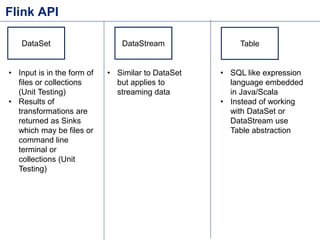
Flink API
Table
• Input is in the form of
files or collections
(Unit Testing)
• Results of
transformations are
returned as Sinks
which may be files or
command line
terminal or
collections (Unit
Testing)
DataStreamDataSet
• SQL like expression
language embedded
in Java/Scala
• Instead of working
with DataSet or
DataStream use
Table abstraction
• Similar to DataSet
but applies to
streaming data
Source Code
Source Code for examples presented can be downloaded from
https://github.com/sameeraxiomine/FlinkMeetup
Flink DataSet API – Word Count
public class WordCount {
public static void main(String[] args) throws Exception {
final ExecutionEnvironment env = ExecutionEnvironment.getExecutionEnvironment();
DataSet<String> text = getLines(env); //Create DataSet from lines in file
DataSet<Tuple2<String, Integer>> wordCounts = text
.flatMap(new LineSplitter())
.groupBy(0) //Group by first element of the Tuple
.aggregate(Aggregations.SUM, 1);
wordCounts.print();//Execute the WordCount job
}
/*FlatMap implantation which converts each line to many <Word,1> pairs*/
public static class LineSplitter implements
FlatMapFunction<String, Tuple2<String, Integer>> {
@Override
public void flatMap(String line, Collector<Tuple2<String, Integer>> out) {
for (String word : line.split(" ")) {
out.collect(new Tuple2<String, Integer>(word, 1));
}
}
}
Source Code -
https://github.com/sameeraxiomine/FlinkMeetup/blob/master/src/main/java/org/a
pache/flink/examples/WordCount.java
Flink Batch API (Table API)
public class WordCountUsingTableAPI {
public static void main(String[] args) throws Exception {
final ExecutionEnvironment env = ExecutionEnvironment
.getExecutionEnvironment();
TableEnvironment tableEnv = new TableEnvironment();
DataSet<Word> words = getWords(env);
Table table = tableEnv.fromDataSet(words);
Table filtered = table
.groupBy("word")
.select("word.count as wrdCnt, word")
.filter(" wrdCnt = 2");
DataSet<Word> result = tableEnv.toDataSet(filtered, Word.class);
result.print();
}
public static DataSet<Word> getWords(ExecutionEnvironment env) { //Return DataSet of Word}
public static class Word {
public String word;
public int wrdCnt;
public Word(String word, int wrdCnt) {
this.word = word; this.wrdCnt = wrdCnt;
}
public Word() {} // empty constructor to satisfy POJO requirements
@Override
public String toString() {
return "Word [word=" + word + ", count=" + wrdCnt + "]";
}
}
}
Source Code -
https://github.com/sameeraxiomine/FlinkMeetup/blob/master/src/main/java/org/apach
e/flink/examples/WordCountUsingTableAPI.java
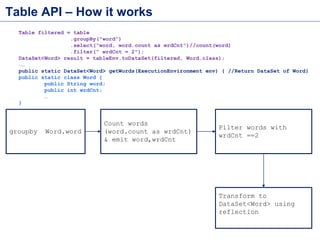
Table API – How it works
Table filtered = table
.groupBy("word")
.select(“word, word.count as wrdCnt")//count(word)
.filter(" wrdCnt = 2");
DataSet<Word> result = tableEnv.toDataSet(filtered, Word.class);
……
public static DataSet<Word> getWords(ExecutionEnvironment env) { //Return DataSet of Word}
public static class Word {
public String word;
public int wrdCnt;
…
}
groupby Word.word
Count words
(word.count as wrdCnt)
& emit word,wrdCnt
Transform to
DataSet<Word> using
reflection
Filter words with
wrdCnt ==2
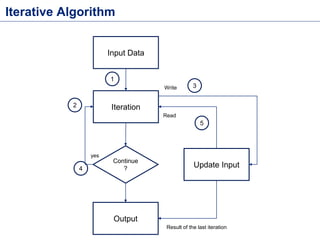
Iterative Algorithm
Input Data
Update Input
yes
Output
Read
Write
1
Iteration
Continue
?
2
3
5
4
Result of the last iteration
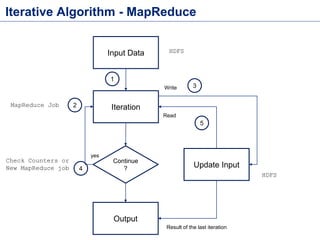
Iterative Algorithm - MapReduce
Input Data
Update Input
Output
Read
Write
1
Iteration
Continue
?
2
3
5
4
Result of the last iteration
HDFS
HDFS
MapReduce Job
Check Counters or
New MapReduce job
yes
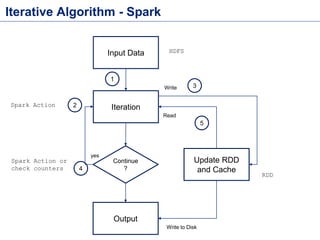
Iterative Algorithm - Spark
Input Data
Update RDD
and Cache
Output
Read
Write
1
Iteration
Continue
?
2
3
5
4
Write to Disk
HDFS
RDD
Spark Action
Spark Action or
check counters
yes
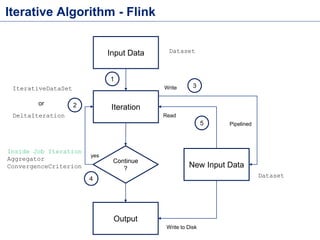
Iterative Algorithm - Flink
Input Data
New Input Data
Output
Read
Write
1
Iteration
Continue
?
2
3
5
4
Write to Disk
Dataset
IterativeDataSet
DeltaIteration
or
Inside Job Iteration
Aggregator
ConvergenceCriterion
Dataset
Pipelined
yes
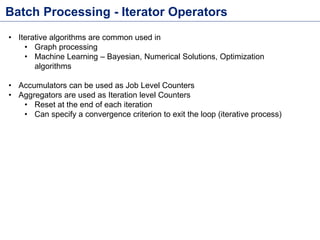
Batch Processing - Iterator Operators
• Iterative algorithms are common used in
• Graph processing
• Machine Learning – Bayesian, Numerical Solutions, Optimization
algorithms
• Accumulators can be used as Job Level Counters
• Aggregators are used as Iteration level Counters
• Reset at the end of each iteration
• Can specify a convergence criterion to exit the loop (iterative process)
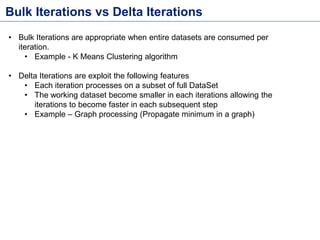
Bulk Iterations vs Delta Iterations
• Bulk Iterations are appropriate when entire datasets are consumed per
iteration.
• Example - K Means Clustering algorithm
• Delta Iterations are exploit the following features
• Each iteration processes on a subset of full DataSet
• The working dataset become smaller in each iterations allowing the
iterations to become faster in each subsequent step
• Example – Graph processing (Propagate minimum in a graph)
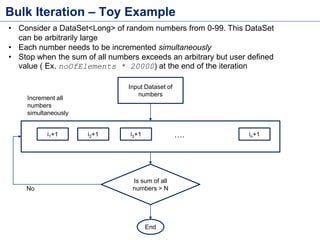
Bulk Iteration – Toy Example
• Consider a DataSet<Long> of random numbers from 0-99. This DataSet
can be arbitrarily large
• Each number needs to be incremented simultaneously
• Stop when the sum of all numbers exceeds an arbitrary but user defined
value ( Ex. noOfElements * 20000) at the end of the iteration
i1+1 i2+1 i3+1 in+1….
Increment all
numbers
simultaneously
Input Dataset of
numbers
Is sum of all
numbers > NNo
End
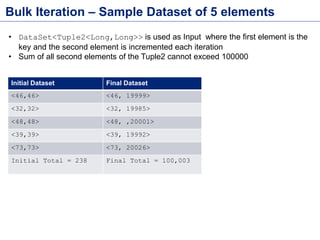
Bulk Iteration – Sample Dataset of 5 elements
Initial Dataset Final Dataset
<46,46> <46, 19999>
<32,32> <32, 19985>
<48,48> <48, ,20001>
<39,39> <39, 19992>
<73,73> <73, 20026>
Initial Total = 238 Final Total = 100,003
• DataSet<Tuple2<Long,Long>> is used as Input where the first element is the
key and the second element is incremented each iteration
• Sum of all second elements of the Tuple2 cannot exceed 100000
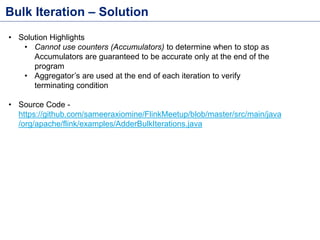
Bulk Iteration – Solution
• Solution Highlights
• Cannot use counters (Accumulators) to determine when to stop.
Accumulators are guaranteed to be accurate only at the end of the
program
• Aggregator’s are used at the end of each iteration to verify
terminating condition
• Source Code -
https://github.com/sameeraxiomine/FlinkMeetup/blob/master/src/main/java
/org/apache/flink/examples/AdderBulkIterations.java
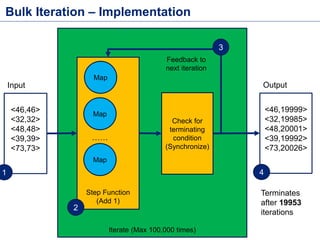
Bulk Iteration – Implementation
<46,46>
<32,32>
<48,48>
<39,39>
<73,73>
Input
1
Map
Map
Map
……
Step Function
(Add 1)
2
Iterate (Max 100,000 times)
Check for
terminating
condition
(Synchronize)
Feedback to
next iteration
3
<46,19999>
<32,19985>
<48,20001>
<39,19992>
<73,20026>
Output
4
Terminates
after 19953
iterations
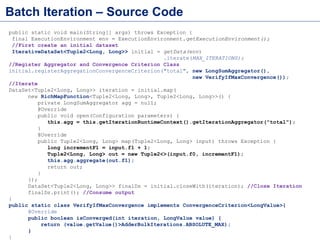
Bulk Iteration – Source Code
public static void main(String[] args) throws Exception {
final ExecutionEnvironment env = ExecutionEnvironment.getExecutionEnvironment();
//First create an initial dataset
IterativeDataSet<Tuple2<Long, Long>> initial = getData(env)
.iterate(MAX_ITERATIONS);
//Register Aggregator and Convergence Criterion Class
initial.registerAggregationConvergenceCriterion("total", new LongSumAggregator(),
new VerifyIfMaxConvergence());
//Iterate
DataSet<Tuple2<Long, Long>> iteration = initial.map(
new RichMapFunction<Tuple2<Long, Long>, Tuple2<Long, Long>>() {
private LongSumAggregator agg = null;
@Override
public void open(Configuration parameters) {
this.agg = this.getIterationRuntimeContext().getIterationAggregator("total");
}
@Override
public Tuple2<Long, Long> map(Tuple2<Long, Long> input) throws Exception {
long incrementF1 = input.f1 + 1;
Tuple2<Long, Long> out = new Tuple2<>(input.f0, incrementF1);
this.agg.aggregate(out.f1);
return out;
}
});
DataSet<Tuple2<Long, Long>> finalDs = initial.closeWith(iteration); //Close Iteration
finalDs.print(); //Consume output
}
public static class VerifyIfMaxConvergence implements ConvergenceCriterion<LongValue>{
@Override
public boolean isConverged(int iteration, LongValue value) {
return (value.getValue()>AdderBulkIterations.ABSOLUTE_MAX);
}
}
Bulk Iteration – Steps
Create intial Dataset
(IterativeDataSet)
And define max iterations
IterativeDataSet<Tuple2<Long, Long>> initial = getData(
env).iterate(MAX_ITERATIONS);
Register Convergence Criterion
initial.registerAggregationConvergenceCriterion("total",
new LongSumAggregator(), new VerifyIfMaxConvergence());
Execute Iterations and update
aggregator and check for
convergence at end of each
iteration
End Iteration by executing
closewith(DataSet) on the
IterativeDataSet
DataSet<Tuple2<Long, Long>> iteration = initial.map(new
RichMapFunction<Tuple2<Long, Long>, Tuple2<Long, Long>>() {
return new Tuple2<>(input.f0, input.f1+1);
});
class VerifyIfMaxConvergence implements ConvergenceCriterion{
public boolean isConverged(int iteration, LongValue value) {
return (value.getValue()>AdderBulkIterations.ABSOLUTE_MAX);
}
}
DataSet<Tuple2<Long, Long>> finalDs =
initial.closeWith(iteration);
finalDs.print();//Consume results
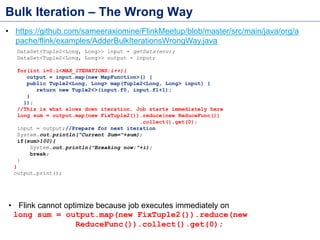
Bulk Iteration – The Wrong Way
DataSet<Tuple2<Long, Long>> input = getData(env);
DataSet<Tuple2<Long, Long>> output = input;
for(int i=0;i<MAX_ITERATIONS;i++){
output = input.map(new MapFunction>() {
public Tuple2<Long, Long> map(Tuple2<Long, Long> input) {
return new Tuple2<>(input.f0, input.f1+1);
}
});
//This is what slows down iteration. Job starts immediately here
long sum = output.map(new FixTuple2()).reduce(new ReduceFunc())
.collect().get(0);
input = output;//Prepare for next iteration
System.out.println("Current Sum="+sum);
if(sum>100){
System.out.println("Breaking now:"+i);
break;
}
}
output.print();
• Flink cannot optimize because job executes immediately on
long sum = output.map(new FixTuple2()).reduce(new
ReduceFunc()).collect().get(0);
• https://github.com/sameeraxiomine/FlinkMeetup/blob/master/src/main/java/org/a
pache/flink/examples/AdderBulkIterationsWrongWay.java
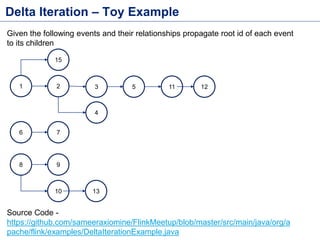
Delta Iteration – Example
1 2 3
4
5
6 7
11 12
8 9
10 13
15
Given the following events and their relationships propagate root id of each event
to its children
Source Code -
https://github.com/sameeraxiomine/FlinkMeetup/blob/master/src/main/java/org/a
pache/flink/examples/DeltaIterationExample.java
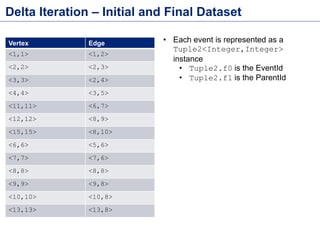
Delta Iteration – Initial and Final Dataset
• Each event is represented as a
Tuple2<Integer,Integer>
instance
• Tuple2.f0 is the EventId
• Tuple2.f1 is the ParentId
Vertex Edge
<1,1> <1,2>
<2,2> <2,3>
<3,3> <2,4>
<4,4> <3,5>
<11,11> <6,7>
<12,12> <8,9>
<15,15> <8,10>
<6,6> <5,6>
<7,7> <7,6>
<8,8> <8,8>
<9,9> <9,8>
<10,10> <10,8>
<13,13> <13,8>
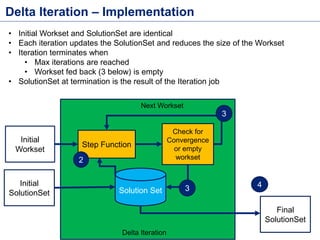
Delta Iteration – Implementation
Step Function
2
Check for
Convergence
or empty
workset
Next Workset
3
Initial
Workset
Initial
SolutionSet Solution Set 3 4
Final
SolutionSet
Delta Iteration
• Initial Workset and SolutionSet are identical
• Each iteration updates the SolutionSet and reduces the size of the Workset
• Iteration terminates when
• Max iterations are reached
• Workset fed back (3 below) is empty
• SolutionSet at termination is the result of the Iteration job
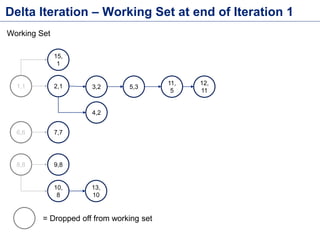
Delta Iteration – Working Set at end of Iteration 1
1,1 2,1 3,2
4,2
5,3
6,6 7,7
11,
5
12,
11
8,8 9,8
10,
8
13,
10
15,
1
Working Set
= Dropped off from working set
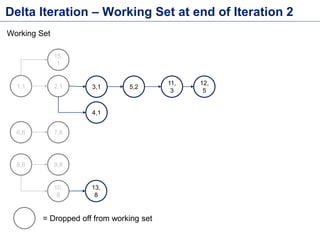
Delta Iteration – Working Set at end of Iteration 2
1,1 2,1 3,1
4,1
5,2
6,6 7,6
11,
3
12,
5
8,8 9,8
10,
8
13,
8
15,
1
Working Set
= Dropped off from working set
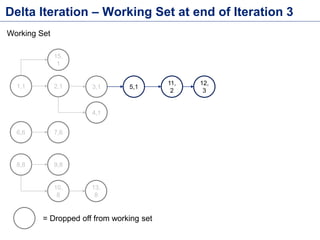
Delta Iteration – Working Set at end of Iteration 3
1,1 2,1 3,1
4,1
5,1
6,6 7,6
11,
2
12,
3
8,8 9,8
10,
8
13,
8
15,
1
Working Set
= Dropped off from working set
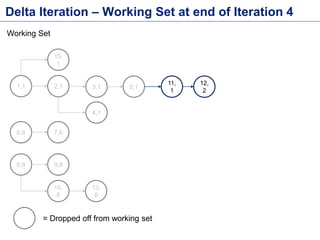
Delta Iteration – Working Set at end of Iteration 4
1,1 2,1 3,1
4,1
5,1
6,6 7,6
11,
1
12,
2
8,8 9,8
10,
8
13,
8
15,
1
Working Set
= Dropped off from working set
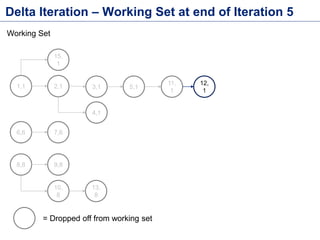
Delta Iteration – Working Set at end of Iteration 5
1,1 2,1 3,1
4,1
5,1
6,6 7,6
11,
1
12,
1
8,8 9,8
10,
8
13,
8
15,
1
Working Set
= Dropped off from working set
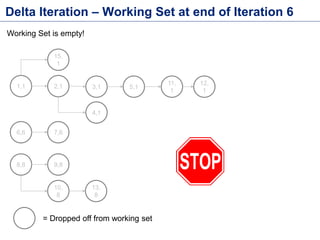
Delta Iteration – Working Set at end of Iteration 6
1,1 2,1 3,1
4,1
5,1
6,6 7,6
11,
1
12,
1
8,8 9,8
10,
8
13,
8
15,
1
Working Set is empty!
= Dropped off from working set
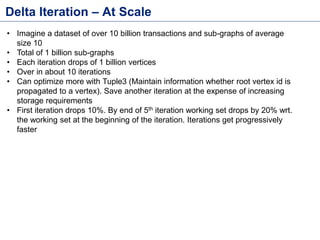
Delta Iteration – At Scale
• Imagine a dataset of over 10 billion transactions and sub-graphs of average
size 10
• Total of 1 billion sub-graphs
• Each iteration drops of 1 billion vertices
• Over in about 10 iterations
• Can optimize more with Tuple3 (Maintain information whether root vertex id is
propagated to a vertex). Save another iteration at the expense of increasing
storage requirements
• First iteration drops 10%. By end of 5th iteration working set drops by 20% wrt.
the working set at the beginning of the iteration. Iterations get progressively
faster
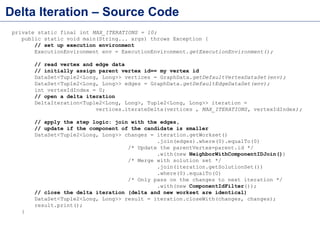
Delta Iteration – Source Code
private static final int MAX_ITERATIONS = 10;
public static void main(String... args) throws Exception {
// set up execution environment
ExecutionEnvironment env = ExecutionEnvironment.getExecutionEnvironment();
// read vertex and edge data
// initially assign parent vertex id== my vertex id
DataSet<Tuple2<Long, Long>> vertices = GraphData.getDefaultVertexDataSet(env);
DataSet<Tuple2<Long, Long>> edges = GraphData.getDefaultEdgeDataSet(env);
int vertexIdIndex = 0;
// open a delta iteration
DeltaIteration<Tuple2<Long, Long>, Tuple2<Long, Long>> iteration =
vertices.iterateDelta(vertices , MAX_ITERATIONS, vertexIdIndex);
// apply the step logic: join with the edges,
// update if the component of the candidate is smaller
DataSet<Tuple2<Long, Long>> changes = iteration.getWorkset()
.join(edges).where(0).equalTo(0)
/* Update the parentVertex=parent.id */
.with(new NeighborWithComponentIDJoin())
/* Merge with solution set */
.join(iteration.getSolutionSet())
.where(0).equalTo(0)
/* Only pass on the changes to next iteration */
.with(new ComponentIdFilter());
// close the delta iteration (delta and new workset are identical)
DataSet<Tuple2<Long, Long>> result = iteration.closeWith(changes, changes);
result.print();
}
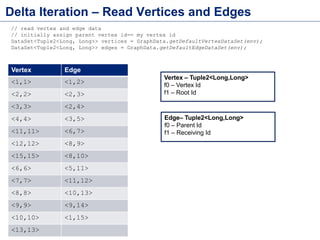
Delta Iteration – Read Vertices and Edges
// read vertex and edge data
// initially assign parent vertex id== my vertex id
DataSet<Tuple2<Long, Long>> vertices = GraphData.getDefaultVertexDataSet(env);
DataSet<Tuple2<Long, Long>> edges = GraphData.getDefaultEdgeDataSet(env);
Vertex Edge
<1,1> <1,2>
<2,2> <2,3>
<3,3> <2,4>
<4,4> <3,5>
<11,11> <6,7>
<12,12> <8,9>
<15,15> <8,10>
<6,6> <5,11>
<7,7> <11,12>
<8,8> <10,13>
<9,9> <9,14>
<10,10> <1,15>
<13,13>
Vertex – Tuple2<Long,Long>
f0 – Vertex Id
f1 – Root Id
Edge– Tuple2<Long,Long>
f0 – Parent Id
f1 – Receiving Id
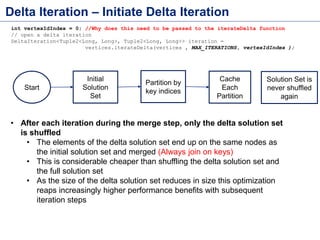
Delta Iteration – Initiate Delta Iteration
int vertexIdIndex = 0; //Why does this need to be passed to the iterateDelta function
// open a delta iteration
DeltaIteration<Tuple2<Long, Long>, Tuple2<Long, Long>> iteration =
vertices.iterateDelta(vertices , MAX_ITERATIONS, vertexIdIndex );
• After each iteration during the merge step, only the delta solution set
is shuffled
• The elements of the delta solution set end up on the same nodes as
the initial solution set and merged (Always join on keys)
• This is considerable cheaper than shuffling the delta solution set and
the full solution set
• As the size of the delta solution set reduces in size this optimization
reaps increasingly higher performance benefits with subsequent
iteration steps
Initial
Solution
Set
Partition by
key indices
Cache
Each
Partition
Start
Solution Set is
never shuffled
again
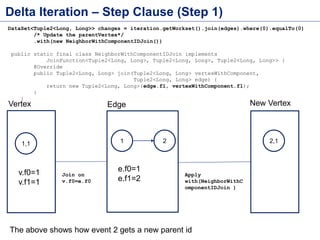
Delta Iteration – Step Clause (Step 1)
DataSet<Tuple2<Long, Long>> changes = iteration.getWorkset().join(edges).where(0).equalTo(0)
/* Update the parentVertex*/
.with(new NeighborWithComponentIDJoin())
public static final class NeighborWithComponentIDJoin implements
JoinFunction<Tuple2<Long, Long>, Tuple2<Long, Long>, Tuple2<Long, Long>> {
@Override
public Tuple2<Long, Long> join(Tuple2<Long, Long> vertexWithComponent,
Tuple2<Long, Long> edge) {
return new Tuple2<Long, Long>(edge.f1, vertexWithComponent.f1);
}
}
1,1 1 2
e.f0=1
e.f1=2
v.f0=1
v.f1=1
Join on
v.f0=e.f0
Vertex Edge New Vertex
2,1
Apply
with(NeighborWithC
omponentIDJoin )
The above shows how event 2 gets a new parent id
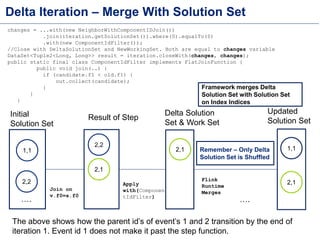
Delta Iteration – Merge With Solution Set
changes = ...with(new NeighborWithComponentIDJoin())
.join(iteration.getSolutionSet()).where(0).equalTo(0)
.with(new ComponentIdFilter());
//Close with DeltaSolutionSet and NewWorkingSet. Both are equal to changes variable
DataSet<Tuple2<Long, Long>> result = iteration.closeWith(changes, changes);
public static final class ComponentIdFilter implements FlatJoinFunction {
public void join(..) {
if (candidate.f1 < old.f1) {
out.collect(candidate);
}
}
}
2,2
Join on
v.f0=s.f0
Initial
Solution Set
Result of Step
Delta Solution
Set & Work Set
2,1
Apply
with(Componen
tIdFilter)
1,1
2,1
Updated
Solution Set
2,1
1,1
The above shows how the parent id’s of event’s 1 and 2 transition by the end of
iteration 1. Event id 1 does not make it past the step function.
….….
2,2
Flink
Runtime
Merges
Framework merges Delta
Solution Set with Solution Set
on Index Indices
Remember – Only Delta
Solution Set is Shuffled
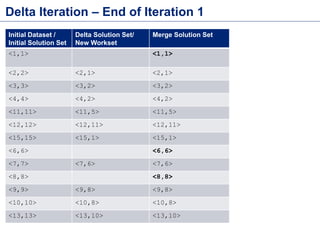
Delta Iteration – End of Iteration 1
Initial Dataset /
Initial Solution Set
Delta Solution Set/
New Workset
Merge Solution Set
<1,1> <1,1>
<2,2> <2,1> <2,1>
<3,3> <3,2> <3,2>
<4,4> <4,2> <4,2>
<11,11> <11,5> <11,5>
<12,12> <12,11> <12,11>
<15,15> <15,1> <15,1>
<6,6> <6,6>
<7,7> <7,6> <7,6>
<8,8> <8,8>
<9,9> <9,8> <9,8>
<10,10> <10,8> <10,8>
<13,13> <13,10> <13,10>
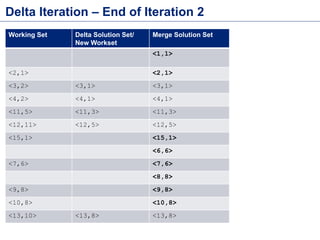
Delta Iteration – End of Iteration 2
Working Set Delta Solution Set/
New Workset
Merge Solution Set
<1,1>
<2,1> <2,1>
<3,2> <3,1> <3,1>
<4,2> <4,1> <4,1>
<11,5> <11,3> <11,3>
<12,11> <12,5> <12,5>
<15,1> <15,1>
<6,6>
<7,6> <7,6>
<8,8>
<9,8> <9,8>
<10,8> <10,8>
<13,10> <13,8> <13,8>
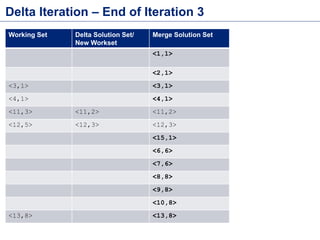
Delta Iteration – End of Iteration 3
Working Set Delta Solution Set/
New Workset
Merge Solution Set
<1,1>
<2,1>
<3,1> <3,1>
<4,1> <4,1>
<11,3> <11,2> <11,2>
<12,5> <12,3> <12,3>
<15,1>
<6,6>
<7,6>
<8,8>
<9,8>
<10,8>
<13,8> <13,8>
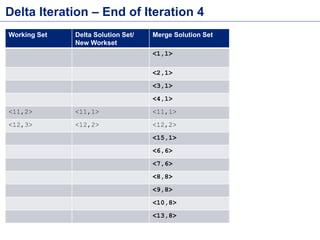
Delta Iteration – End of Iteration 4
Working Set Delta Solution Set/
New Workset
Merge Solution Set
<1,1>
<2,1>
<3,1>
<4,1>
<11,2> <11,1> <11,1>
<12,3> <12,2> <12,2>
<15,1>
<6,6>
<7,6>
<8,8>
<9,8>
<10,8>
<13,8>
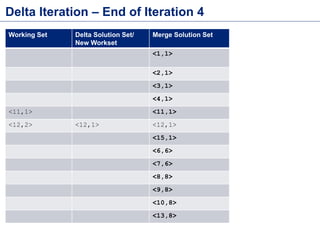
Delta Iteration – End of Iteration 4
Working Set Delta Solution Set/
New Workset
Merge Solution Set
<1,1>
<2,1>
<3,1>
<4,1>
<11,1> <11,1>
<12,2> <12,1> <12,1>
<15,1>
<6,6>
<7,6>
<8,8>
<9,8>
<10,8>
<13,8>
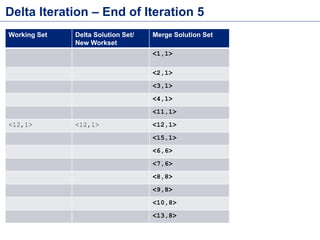
Delta Iteration – End of Iteration 5
Working Set Delta Solution Set/
New Workset
Merge Solution Set
<1,1>
<2,1>
<3,1>
<4,1>
<11,1>
<12,1> <12,1> <12,1>
<15,1>
<6,6>
<7,6>
<8,8>
<9,8>
<10,8>
<13,8>
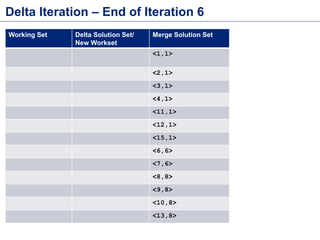
Delta Iteration – End of Iteration 6
Working Set Delta Solution Set/
New Workset
Merge Solution Set
<1,1>
<2,1>
<3,1>
<4,1>
<11,1>
<12,1>
<15,1>
<6,6>
<7,6>
<8,8>
<9,8>
<10,8>
<13,8>

Flink Batch Processing and Iterations

  • 1.
    Batch Processing usingApache Flink By - Sameer Wadkar
  • 2.
    Flink API Table • Inputis in the form of files or collections (Unit Testing) • Results of transformations are returned as Sinks which may be files or command line terminal or collections (Unit Testing) DataStreamDataSet • SQL like expression language embedded in Java/Scala • Instead of working with DataSet or DataStream use Table abstraction • Similar to DataSet but applies to streaming data
  • 3.
    Source Code Source Codefor examples presented can be downloaded from https://github.com/sameeraxiomine/FlinkMeetup
  • 4.
    Flink DataSet API– Word Count public class WordCount { public static void main(String[] args) throws Exception { final ExecutionEnvironment env = ExecutionEnvironment.getExecutionEnvironment(); DataSet<String> text = getLines(env); //Create DataSet from lines in file DataSet<Tuple2<String, Integer>> wordCounts = text .flatMap(new LineSplitter()) .groupBy(0) //Group by first element of the Tuple .aggregate(Aggregations.SUM, 1); wordCounts.print();//Execute the WordCount job } /*FlatMap implantation which converts each line to many <Word,1> pairs*/ public static class LineSplitter implements FlatMapFunction<String, Tuple2<String, Integer>> { @Override public void flatMap(String line, Collector<Tuple2<String, Integer>> out) { for (String word : line.split(" ")) { out.collect(new Tuple2<String, Integer>(word, 1)); } } } Source Code - https://github.com/sameeraxiomine/FlinkMeetup/blob/master/src/main/java/org/a pache/flink/examples/WordCount.java
  • 5.
    Flink Batch API(Table API) public class WordCountUsingTableAPI { public static void main(String[] args) throws Exception { final ExecutionEnvironment env = ExecutionEnvironment .getExecutionEnvironment(); TableEnvironment tableEnv = new TableEnvironment(); DataSet<Word> words = getWords(env); Table table = tableEnv.fromDataSet(words); Table filtered = table .groupBy("word") .select("word.count as wrdCnt, word") .filter(" wrdCnt = 2"); DataSet<Word> result = tableEnv.toDataSet(filtered, Word.class); result.print(); } public static DataSet<Word> getWords(ExecutionEnvironment env) { //Return DataSet of Word} public static class Word { public String word; public int wrdCnt; public Word(String word, int wrdCnt) { this.word = word; this.wrdCnt = wrdCnt; } public Word() {} // empty constructor to satisfy POJO requirements @Override public String toString() { return "Word [word=" + word + ", count=" + wrdCnt + "]"; } } } Source Code - https://github.com/sameeraxiomine/FlinkMeetup/blob/master/src/main/java/org/apach e/flink/examples/WordCountUsingTableAPI.java
  • 6.
    Table API –How it works Table filtered = table .groupBy("word") .select(“word, word.count as wrdCnt")//count(word) .filter(" wrdCnt = 2"); DataSet<Word> result = tableEnv.toDataSet(filtered, Word.class); …… public static DataSet<Word> getWords(ExecutionEnvironment env) { //Return DataSet of Word} public static class Word { public String word; public int wrdCnt; … } groupby Word.word Count words (word.count as wrdCnt) & emit word,wrdCnt Transform to DataSet<Word> using reflection Filter words with wrdCnt ==2
  • 7.
    Iterative Algorithm Input Data UpdateInput yes Output Read Write 1 Iteration Continue ? 2 3 5 4 Result of the last iteration
  • 8.
    Iterative Algorithm -MapReduce Input Data Update Input Output Read Write 1 Iteration Continue ? 2 3 5 4 Result of the last iteration HDFS HDFS MapReduce Job Check Counters or New MapReduce job yes
  • 9.
    Iterative Algorithm -Spark Input Data Update RDD and Cache Output Read Write 1 Iteration Continue ? 2 3 5 4 Write to Disk HDFS RDD Spark Action Spark Action or check counters yes
  • 10.
    Iterative Algorithm -Flink Input Data New Input Data Output Read Write 1 Iteration Continue ? 2 3 5 4 Write to Disk Dataset IterativeDataSet DeltaIteration or Inside Job Iteration Aggregator ConvergenceCriterion Dataset Pipelined yes
  • 11.
    Batch Processing -Iterator Operators • Iterative algorithms are common used in • Graph processing • Machine Learning – Bayesian, Numerical Solutions, Optimization algorithms • Accumulators can be used as Job Level Counters • Aggregators are used as Iteration level Counters • Reset at the end of each iteration • Can specify a convergence criterion to exit the loop (iterative process)
  • 12.
    Bulk Iterations vsDelta Iterations • Bulk Iterations are appropriate when entire datasets are consumed per iteration. • Example - K Means Clustering algorithm • Delta Iterations are exploit the following features • Each iteration processes on a subset of full DataSet • The working dataset become smaller in each iterations allowing the iterations to become faster in each subsequent step • Example – Graph processing (Propagate minimum in a graph)
  • 13.
    Bulk Iteration –Toy Example • Consider a DataSet<Long> of random numbers from 0-99. This DataSet can be arbitrarily large • Each number needs to be incremented simultaneously • Stop when the sum of all numbers exceeds an arbitrary but user defined value ( Ex. noOfElements * 20000) at the end of the iteration i1+1 i2+1 i3+1 in+1…. Increment all numbers simultaneously Input Dataset of numbers Is sum of all numbers > NNo End
  • 14.
    Bulk Iteration –Sample Dataset of 5 elements Initial Dataset Final Dataset <46,46> <46, 19999> <32,32> <32, 19985> <48,48> <48, ,20001> <39,39> <39, 19992> <73,73> <73, 20026> Initial Total = 238 Final Total = 100,003 • DataSet<Tuple2<Long,Long>> is used as Input where the first element is the key and the second element is incremented each iteration • Sum of all second elements of the Tuple2 cannot exceed 100000
  • 15.
    Bulk Iteration –Solution • Solution Highlights • Cannot use counters (Accumulators) to determine when to stop. Accumulators are guaranteed to be accurate only at the end of the program • Aggregator’s are used at the end of each iteration to verify terminating condition • Source Code - https://github.com/sameeraxiomine/FlinkMeetup/blob/master/src/main/java /org/apache/flink/examples/AdderBulkIterations.java
  • 16.
    Bulk Iteration –Implementation <46,46> <32,32> <48,48> <39,39> <73,73> Input 1 Map Map Map …… Step Function (Add 1) 2 Iterate (Max 100,000 times) Check for terminating condition (Synchronize) Feedback to next iteration 3 <46,19999> <32,19985> <48,20001> <39,19992> <73,20026> Output 4 Terminates after 19953 iterations
  • 17.
    Bulk Iteration –Source Code public static void main(String[] args) throws Exception { final ExecutionEnvironment env = ExecutionEnvironment.getExecutionEnvironment(); //First create an initial dataset IterativeDataSet<Tuple2<Long, Long>> initial = getData(env) .iterate(MAX_ITERATIONS); //Register Aggregator and Convergence Criterion Class initial.registerAggregationConvergenceCriterion("total", new LongSumAggregator(), new VerifyIfMaxConvergence()); //Iterate DataSet<Tuple2<Long, Long>> iteration = initial.map( new RichMapFunction<Tuple2<Long, Long>, Tuple2<Long, Long>>() { private LongSumAggregator agg = null; @Override public void open(Configuration parameters) { this.agg = this.getIterationRuntimeContext().getIterationAggregator("total"); } @Override public Tuple2<Long, Long> map(Tuple2<Long, Long> input) throws Exception { long incrementF1 = input.f1 + 1; Tuple2<Long, Long> out = new Tuple2<>(input.f0, incrementF1); this.agg.aggregate(out.f1); return out; } }); DataSet<Tuple2<Long, Long>> finalDs = initial.closeWith(iteration); //Close Iteration finalDs.print(); //Consume output } public static class VerifyIfMaxConvergence implements ConvergenceCriterion<LongValue>{ @Override public boolean isConverged(int iteration, LongValue value) { return (value.getValue()>AdderBulkIterations.ABSOLUTE_MAX); } }
  • 18.
    Bulk Iteration –Steps Create intial Dataset (IterativeDataSet) And define max iterations IterativeDataSet<Tuple2<Long, Long>> initial = getData( env).iterate(MAX_ITERATIONS); Register Convergence Criterion initial.registerAggregationConvergenceCriterion("total", new LongSumAggregator(), new VerifyIfMaxConvergence()); Execute Iterations and update aggregator and check for convergence at end of each iteration End Iteration by executing closewith(DataSet) on the IterativeDataSet DataSet<Tuple2<Long, Long>> iteration = initial.map(new RichMapFunction<Tuple2<Long, Long>, Tuple2<Long, Long>>() { return new Tuple2<>(input.f0, input.f1+1); }); class VerifyIfMaxConvergence implements ConvergenceCriterion{ public boolean isConverged(int iteration, LongValue value) { return (value.getValue()>AdderBulkIterations.ABSOLUTE_MAX); } } DataSet<Tuple2<Long, Long>> finalDs = initial.closeWith(iteration); finalDs.print();//Consume results
  • 19.
    Bulk Iteration –The Wrong Way DataSet<Tuple2<Long, Long>> input = getData(env); DataSet<Tuple2<Long, Long>> output = input; for(int i=0;i<MAX_ITERATIONS;i++){ output = input.map(new MapFunction>() { public Tuple2<Long, Long> map(Tuple2<Long, Long> input) { return new Tuple2<>(input.f0, input.f1+1); } }); //This is what slows down iteration. Job starts immediately here long sum = output.map(new FixTuple2()).reduce(new ReduceFunc()) .collect().get(0); input = output;//Prepare for next iteration System.out.println("Current Sum="+sum); if(sum>100){ System.out.println("Breaking now:"+i); break; } } output.print(); • Flink cannot optimize because job executes immediately on long sum = output.map(new FixTuple2()).reduce(new ReduceFunc()).collect().get(0); • https://github.com/sameeraxiomine/FlinkMeetup/blob/master/src/main/java/org/a pache/flink/examples/AdderBulkIterationsWrongWay.java
  • 20.
    Delta Iteration –Example 1 2 3 4 5 6 7 11 12 8 9 10 13 15 Given the following events and their relationships propagate root id of each event to its children Source Code - https://github.com/sameeraxiomine/FlinkMeetup/blob/master/src/main/java/org/a pache/flink/examples/DeltaIterationExample.java
  • 21.
    Delta Iteration –Initial and Final Dataset • Each event is represented as a Tuple2<Integer,Integer> instance • Tuple2.f0 is the EventId • Tuple2.f1 is the ParentId Vertex Edge <1,1> <1,2> <2,2> <2,3> <3,3> <2,4> <4,4> <3,5> <11,11> <6,7> <12,12> <8,9> <15,15> <8,10> <6,6> <5,6> <7,7> <7,6> <8,8> <8,8> <9,9> <9,8> <10,10> <10,8> <13,13> <13,8>
  • 22.
    Delta Iteration –Implementation Step Function 2 Check for Convergence or empty workset Next Workset 3 Initial Workset Initial SolutionSet Solution Set 3 4 Final SolutionSet Delta Iteration • Initial Workset and SolutionSet are identical • Each iteration updates the SolutionSet and reduces the size of the Workset • Iteration terminates when • Max iterations are reached • Workset fed back (3 below) is empty • SolutionSet at termination is the result of the Iteration job
  • 23.
    Delta Iteration –Working Set at end of Iteration 1 1,1 2,1 3,2 4,2 5,3 6,6 7,7 11, 5 12, 11 8,8 9,8 10, 8 13, 10 15, 1 Working Set = Dropped off from working set
  • 24.
    Delta Iteration –Working Set at end of Iteration 2 1,1 2,1 3,1 4,1 5,2 6,6 7,6 11, 3 12, 5 8,8 9,8 10, 8 13, 8 15, 1 Working Set = Dropped off from working set
  • 25.
    Delta Iteration –Working Set at end of Iteration 3 1,1 2,1 3,1 4,1 5,1 6,6 7,6 11, 2 12, 3 8,8 9,8 10, 8 13, 8 15, 1 Working Set = Dropped off from working set
  • 26.
    Delta Iteration –Working Set at end of Iteration 4 1,1 2,1 3,1 4,1 5,1 6,6 7,6 11, 1 12, 2 8,8 9,8 10, 8 13, 8 15, 1 Working Set = Dropped off from working set
  • 27.
    Delta Iteration –Working Set at end of Iteration 5 1,1 2,1 3,1 4,1 5,1 6,6 7,6 11, 1 12, 1 8,8 9,8 10, 8 13, 8 15, 1 Working Set = Dropped off from working set
  • 28.
    Delta Iteration –Working Set at end of Iteration 6 1,1 2,1 3,1 4,1 5,1 6,6 7,6 11, 1 12, 1 8,8 9,8 10, 8 13, 8 15, 1 Working Set is empty! = Dropped off from working set
  • 29.
    Delta Iteration –At Scale • Imagine a dataset of over 10 billion transactions and sub-graphs of average size 10 • Total of 1 billion sub-graphs • Each iteration drops of 1 billion vertices • Over in about 10 iterations • Can optimize more with Tuple3 (Maintain information whether root vertex id is propagated to a vertex). Save another iteration at the expense of increasing storage requirements • First iteration drops 10%. By end of 5th iteration working set drops by 20% wrt. the working set at the beginning of the iteration. Iterations get progressively faster
  • 30.
    Delta Iteration –Source Code private static final int MAX_ITERATIONS = 10; public static void main(String... args) throws Exception { // set up execution environment ExecutionEnvironment env = ExecutionEnvironment.getExecutionEnvironment(); // read vertex and edge data // initially assign parent vertex id== my vertex id DataSet<Tuple2<Long, Long>> vertices = GraphData.getDefaultVertexDataSet(env); DataSet<Tuple2<Long, Long>> edges = GraphData.getDefaultEdgeDataSet(env); int vertexIdIndex = 0; // open a delta iteration DeltaIteration<Tuple2<Long, Long>, Tuple2<Long, Long>> iteration = vertices.iterateDelta(vertices , MAX_ITERATIONS, vertexIdIndex); // apply the step logic: join with the edges, // update if the component of the candidate is smaller DataSet<Tuple2<Long, Long>> changes = iteration.getWorkset() .join(edges).where(0).equalTo(0) /* Update the parentVertex=parent.id */ .with(new NeighborWithComponentIDJoin()) /* Merge with solution set */ .join(iteration.getSolutionSet()) .where(0).equalTo(0) /* Only pass on the changes to next iteration */ .with(new ComponentIdFilter()); // close the delta iteration (delta and new workset are identical) DataSet<Tuple2<Long, Long>> result = iteration.closeWith(changes, changes); result.print(); }
  • 31.
    Delta Iteration –Read Vertices and Edges // read vertex and edge data // initially assign parent vertex id== my vertex id DataSet<Tuple2<Long, Long>> vertices = GraphData.getDefaultVertexDataSet(env); DataSet<Tuple2<Long, Long>> edges = GraphData.getDefaultEdgeDataSet(env); Vertex Edge <1,1> <1,2> <2,2> <2,3> <3,3> <2,4> <4,4> <3,5> <11,11> <6,7> <12,12> <8,9> <15,15> <8,10> <6,6> <5,11> <7,7> <11,12> <8,8> <10,13> <9,9> <9,14> <10,10> <1,15> <13,13> Vertex – Tuple2<Long,Long> f0 – Vertex Id f1 – Root Id Edge– Tuple2<Long,Long> f0 – Parent Id f1 – Receiving Id
  • 32.
    Delta Iteration –Initiate Delta Iteration int vertexIdIndex = 0; //Why does this need to be passed to the iterateDelta function // open a delta iteration DeltaIteration<Tuple2<Long, Long>, Tuple2<Long, Long>> iteration = vertices.iterateDelta(vertices , MAX_ITERATIONS, vertexIdIndex ); • After each iteration during the merge step, only the delta solution set is shuffled • The elements of the delta solution set end up on the same nodes as the initial solution set and merged (Always join on keys) • This is considerable cheaper than shuffling the delta solution set and the full solution set • As the size of the delta solution set reduces in size this optimization reaps increasingly higher performance benefits with subsequent iteration steps Initial Solution Set Partition by key indices Cache Each Partition Start Solution Set is never shuffled again
  • 33.
    Delta Iteration –Step Clause (Step 1) DataSet<Tuple2<Long, Long>> changes = iteration.getWorkset().join(edges).where(0).equalTo(0) /* Update the parentVertex*/ .with(new NeighborWithComponentIDJoin()) public static final class NeighborWithComponentIDJoin implements JoinFunction<Tuple2<Long, Long>, Tuple2<Long, Long>, Tuple2<Long, Long>> { @Override public Tuple2<Long, Long> join(Tuple2<Long, Long> vertexWithComponent, Tuple2<Long, Long> edge) { return new Tuple2<Long, Long>(edge.f1, vertexWithComponent.f1); } } 1,1 1 2 e.f0=1 e.f1=2 v.f0=1 v.f1=1 Join on v.f0=e.f0 Vertex Edge New Vertex 2,1 Apply with(NeighborWithC omponentIDJoin ) The above shows how event 2 gets a new parent id
  • 34.
    Delta Iteration –Merge With Solution Set changes = ...with(new NeighborWithComponentIDJoin()) .join(iteration.getSolutionSet()).where(0).equalTo(0) .with(new ComponentIdFilter()); //Close with DeltaSolutionSet and NewWorkingSet. Both are equal to changes variable DataSet<Tuple2<Long, Long>> result = iteration.closeWith(changes, changes); public static final class ComponentIdFilter implements FlatJoinFunction { public void join(..) { if (candidate.f1 < old.f1) { out.collect(candidate); } } } 2,2 Join on v.f0=s.f0 Initial Solution Set Result of Step Delta Solution Set & Work Set 2,1 Apply with(Componen tIdFilter) 1,1 2,1 Updated Solution Set 2,1 1,1 The above shows how the parent id’s of event’s 1 and 2 transition by the end of iteration 1. Event id 1 does not make it past the step function. ….…. 2,2 Flink Runtime Merges Framework merges Delta Solution Set with Solution Set on Index Indices Remember – Only Delta Solution Set is Shuffled
  • 35.
    Delta Iteration –End of Iteration 1 Initial Dataset / Initial Solution Set Delta Solution Set/ New Workset Merge Solution Set <1,1> <1,1> <2,2> <2,1> <2,1> <3,3> <3,2> <3,2> <4,4> <4,2> <4,2> <11,11> <11,5> <11,5> <12,12> <12,11> <12,11> <15,15> <15,1> <15,1> <6,6> <6,6> <7,7> <7,6> <7,6> <8,8> <8,8> <9,9> <9,8> <9,8> <10,10> <10,8> <10,8> <13,13> <13,10> <13,10>
  • 36.
    Delta Iteration –End of Iteration 2 Working Set Delta Solution Set/ New Workset Merge Solution Set <1,1> <2,1> <2,1> <3,2> <3,1> <3,1> <4,2> <4,1> <4,1> <11,5> <11,3> <11,3> <12,11> <12,5> <12,5> <15,1> <15,1> <6,6> <7,6> <7,6> <8,8> <9,8> <9,8> <10,8> <10,8> <13,10> <13,8> <13,8>
  • 37.
    Delta Iteration –End of Iteration 3 Working Set Delta Solution Set/ New Workset Merge Solution Set <1,1> <2,1> <3,1> <3,1> <4,1> <4,1> <11,3> <11,2> <11,2> <12,5> <12,3> <12,3> <15,1> <6,6> <7,6> <8,8> <9,8> <10,8> <13,8> <13,8>
  • 38.
    Delta Iteration –End of Iteration 4 Working Set Delta Solution Set/ New Workset Merge Solution Set <1,1> <2,1> <3,1> <4,1> <11,2> <11,1> <11,1> <12,3> <12,2> <12,2> <15,1> <6,6> <7,6> <8,8> <9,8> <10,8> <13,8>
  • 39.
    Delta Iteration –End of Iteration 4 Working Set Delta Solution Set/ New Workset Merge Solution Set <1,1> <2,1> <3,1> <4,1> <11,1> <11,1> <12,2> <12,1> <12,1> <15,1> <6,6> <7,6> <8,8> <9,8> <10,8> <13,8>
  • 40.
    Delta Iteration –End of Iteration 5 Working Set Delta Solution Set/ New Workset Merge Solution Set <1,1> <2,1> <3,1> <4,1> <11,1> <12,1> <12,1> <12,1> <15,1> <6,6> <7,6> <8,8> <9,8> <10,8> <13,8>
  • 41.
    Delta Iteration –End of Iteration 6 Working Set Delta Solution Set/ New Workset Merge Solution Set <1,1> <2,1> <3,1> <4,1> <11,1> <12,1> <15,1> <6,6> <7,6> <8,8> <9,8> <10,8> <13,8>