WSO2 Complex Event Processor 
3.0.0 
An overview of upcoming features 
By 
S. Suhothayan 
Associate Technical Lead, 
Team Lead CEP.
About WSO2 
• Providing the only complete open source componentized cloud platform 
– Dedicated to removing all the stumbling blocks to enterprise agility 
– Enabling you to focus on business logic and business value 
• Recognized by leading analyst firms as visionaries and leaders 
– Gartner cites WSO2 as visionaries in all 3 categories of application 
infrastructure 
– Forrester places WSO2 in top 2 for API Management 
• Global corporation with offices in USA, UK & Sri Lanka 
– 200+ employees and growing 
• Business model of selling comprehensive support & maintenance for our products
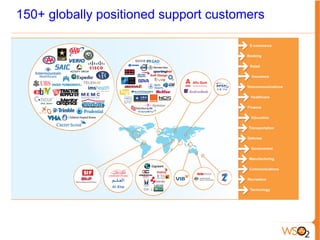
150+ globally positioned support customers
Outline 
! Scenarios of Event Processing 
! WSO2 CEP Server & SOA integrates 
! The Siddhi Runtime CEP Engine. 
! High availability, Persistence and Scalability of 
WSO2 CEP 
! How CEP can be combined with Business 
Activity Monitoring (BAM). 
! Demo
CEP Is & Is NOT! 
! Is NOT! 
o Simple filters 
• Simple Event Processing 
• E.g. Is this a gold or platinum customer? 
o Joining multiple event streams 
• Event Stream Processing 
! Is ! 
o Processing multiple event streams 
o Identify meaningful patterns among streams 
o Using temporal windows 
• E.g. Notify if there is a 10% increase in overall trading 
activity AND the average price of commodities has 
fallen 2% in the last 4 hours
WSO2 CEP Server 
! Enterprise grade server for CEP runtimes 
! Supports several transports (network access) 
! Supports several data formats 
! Support for multiple CEP runtimes 
! Governance 
! Monitoring 
! Tools (WSO2 Dev Studio)
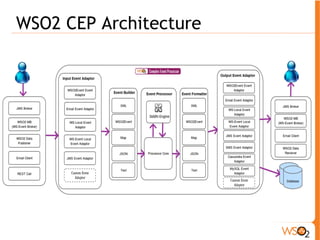
WSO2 CEP Architecture
Siddhi CEP Runtime 
! Apache License, a java library, Tuple based event model 
! Supports distributed processing 
! Supports multiple query models 
• Based on a SQL-like language 
• Supports 
! Partitions 
! Filters 
! Windows 
! Joins 
! Ordering 
! Output Rate Limiting 
! and others
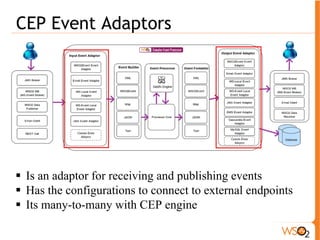
CEP Event Adaptors 
! Is an adaptor for receiving and publishing events 
! Has the configurations to connect to external endpoints 
! Its many-to-many with CEP engine
CEP Event Adaptors 
Support for several transports (network access) and data formats 
● SOAP/WS-Eventing 
XML messages 
● REST 
JSON messages 
● JMS 
Map messages 
XML messages 
Text messages 
JSON messages 
● SMTP (Email) 
Text messages 
JSON messages 
XML messages 
● Thrift - WSO2 data format High Performant Event Capturing & 
Delivery Framework supports Java/C/C++/C# via Thrift language 
bindings 
WSO2 Event
CEP Event Adaptors 
● Cassandra (from CEP 3.0.0) 
Map messages 
● Fix (from CEP 3.0.0+) 
Map messages 
● MYSQL (from CEP 3.0.0) 
Map messages 
● HBase (from CEP 3.0.0+) 
Map messages 
& Event adaptors are pluggable !
CEP Event Builders 
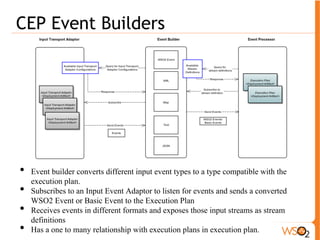
• Event builder converts different input event types to a type compatible with the 
execution plan. • Subscribes to an Input Event Adaptor to listen for events and sends a converted 
WSO2 Event or Basic Event to the Execution Plan • Receives events in different formats and exposes those input streams as stream 
definitions • Has a one to many relationship with execution plans in execution plan.
CEP Execution Plan 
● Is an isolated logical execution unit 
● Each execution plan has a set of 
Queries 
Input & Output stream mappings. 
● Its one-to-one with a CEP Backend Runtime Engine 
● It deals with Siddhi processing engine.
CEP Event Formatter 
Event formatter does the inverse – listens to events coming from event 
processor and sends converted events to Event adaptors. 
There are 5 types of output mapping types are available 
● Map 
● Text 
● WSO2Event 
● XML 
● JSON
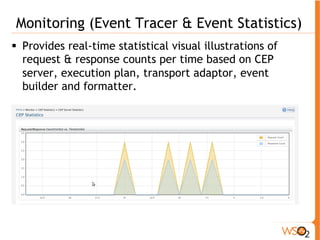
Monitoring (Event Tracer & Event Statistics) 
! Provides real-time statistical visual illustrations of 
request & response counts per time based on CEP 
server, execution plan, transport adaptor, event 
builder and formatter.
Writing CEP 
Queries (using 
Siddhi Runtime)
Siddhi Queries 
! Filters and Projection 
! Windows 
o Events are processed within temporal windows. 
(e.g. for aggregation and joins) 
Time window vs. length window. 
! Joins - Join two streams 
! Event ordering - Identify event sequences and 
patterns 
! Event Partitions 
! Event Tables
Filters 
from <stream-name> [<conditions>]* 
select <attributes> 
insert into <stream-name> 
! Filters the events by conditions, use to detect simple 
condition 
! Conditions 
o >, <, = , <=, <=, != 
o contains, instanceof 
o and, or, not 
! Example 
from cseEventStream[price >= 20 and symbol==’IBM’] 
select symbol, volume 
insert into StockQuote
Window 
from <stream-name> [<conditions>]#window.<window-name>(< 
parameters>) 
select <attributes> 
Insert into <stream-name> 
Types of Windows 
● (Time | Length) (Sliding| Batch) windows 
● Type of aggregate functions 
● sum, avg, max, min 
Example 
from cseEventStream[price >= 20]#window.lengthBatch(50) 
select symbol, avg(price) as avgPrice 
group by symbol 
having avgPrice>50 
insert into StockQuote
Join 
from <stream>#<window> [unidirectional] join <stream>#<window> 
on <condition> within <time> 
insert into <stream> 
! Use to join two streams based on a condition. There 
must be at least one window defined 
! Unidirectional – event arriving only to the 
unidirectional stream triggers join 
! Example 
from TickEvent[symbol==’IBM’]#window.length(2000) 
join NewsEvent#window.time(5 min) 
on TickEvent.symbol==NewsEvent.company 
select * 
insert into JoinStream *
Pattern 
from [every] <condition> → [every] <condition> … <condition> within 
<time> 
select <attributes> 
insert into StockQuote 
! Use to Check condition A happen before/after 
condition B. 
! Can do iterative checks via “every” keyword. 
! Here with “within <time>”, SIddhi emits only events 
that are within that time of each other 
! Example 
from every (a1 = purchase[price < 10] ) -> a2 = purchase [price >10000 and 
a1.cardNo==a2.cardNo] within 1 day 
select a1.cardNo as cardNo, a2.price as price, a2.place as place 
insert into potentialFraud 
y1 a1 x1 k5 a2 n7
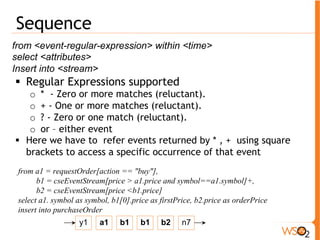
Sequence 
from <event-regular-expression> within <time> 
select <attributes> 
Insert into <stream> 
! Regular Expressions supported 
o * - Zero or more matches (reluctant). 
o + - One or more matches (reluctant). 
o ? - Zero or one match (reluctant). 
o or – either event 
! Here we have to refer events returned by * , + using square 
brackets to access a specific occurrence of that event 
from a1 = requestOrder[action == "buy"], 
b1 = cseEventStream[price > a1.price and symbol==a1.symbol]+, 
b2 = cseEventStream[price <b1.price] 
select a1. symbol as symbol, b1[0].price as firstPrice, b2.price as orderPrice 
insert into purchaseOrder 
y1 a1 b1 b1 b2 n7
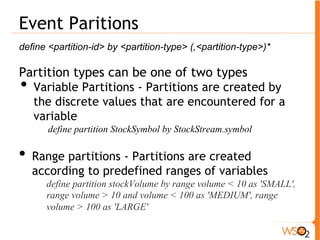
Event Paritions 
define <partition-id> by <partition-type> (,<partition-type>)* 
Partition types can be one of two types • Variable Partitions - Partitions are created by 
the discrete values that are encountered for a 
variable 
define partition StockSymbol by StockStream.symbol 
• Range partitions - Partitions are created 
according to predefined ranges of variables 
define partition stockVolume by range volume < 10 as 'SMALL', 
range volume > 10 and volume < 100 as 'MEDIUM', range 
volume > 100 as 'LARGE'
Event Tables 
define table <table-name> (<attribute-name> <type> {, 
<attribute-name> <type>}*) ( from <table-type>.<datasource-name>:< 
database-name>.<table-name>)? 
Event tables can be used in the same manner as an event stream, 
with the difference being that events sent to an event table 
being persisted to a data source. CEP supports event tables for • In Memory • Relational 
o MySQL 
o H2 
define table cseEventTable(symbol string, price int, volume float) 
from MYSQL.cepDataSource:cepdb.cepEventTable0
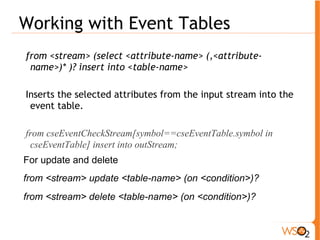
Working with Event Tables 
from <stream> (select <attribute-name> (,<attribute-name>)* 
)? insert into <table-name> 
Inserts the selected attributes from the input stream into the 
event table. 
from cseEventCheckStream[symbol==cseEventTable.symbol in 
cseEventTable] insert into outStream; 
For update and delete 
from <stream> update <table-name> (on <condition>)? 
from <stream> delete <table-name> (on <condition>)?
Performance Results 
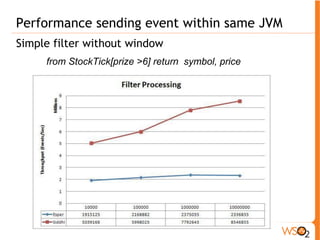
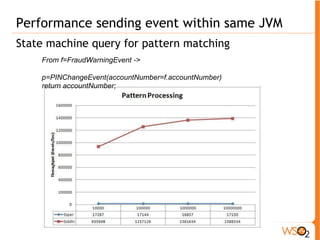
! We compared Siddhi with Esper, the widely used 
opensource CEP engine 
! For evaluation, we did setup different queries using both 
systems, push events in to the system, and measure the 
time till all of them are processed. 
! We used Intel(R) Xeon(R) X3440 @2.53GHz , 4 cores 8M 
cache 8GB RAM running Debian 2.6.32-5-amd64 Kernel
Performance sending event within same JVM 
Simple filter without window 
from StockTick[prize >6] return symbol, price
Performance sending event within same JVM 
State machine query for pattern matching 
From f=FraudWarningEvent -> 
p=PINChangeEvent(accountNumber=f.accountNumber) 
return accountNumber;
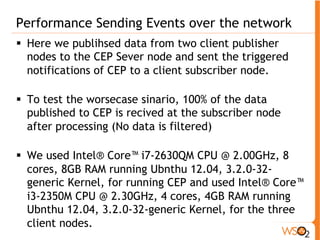
Performance Sending Events over the network 
! Here we publihsed data from two client publisher 
nodes to the CEP Sever node and sent the triggered 
notifications of CEP to a client subscriber node. 
! To test the worsecase sinario, 100% of the data 
published to CEP is recived at the subscriber node 
after processing (No data is filtered) 
! We used Intel® Core™ i7-2630QM CPU @ 2.00GHz, 8 
cores, 8GB RAM running Ubnthu 12.04, 3.2.0-32- 
generic Kernel, for running CEP and used Intel® Core™ 
i3-2350M CPU @ 2.30GHz, 4 cores, 4GB RAM running 
Ubnthu 12.04, 3.2.0-32-generic Kernel, for the three 
client nodes.
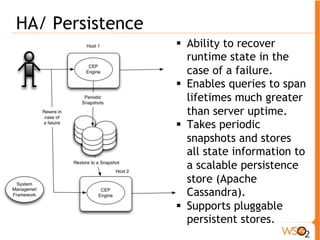
HA/ Persistence 
! Ability to recover 
runtime state in the 
case of a failure. 
! Enables queries to span 
lifetimes much greater 
than server uptime. 
! Takes periodic 
snapshots and stores 
all state information to 
a scalable persistence 
store (Apache 
Cassandra). 
! Supports pluggable 
persistent stores.
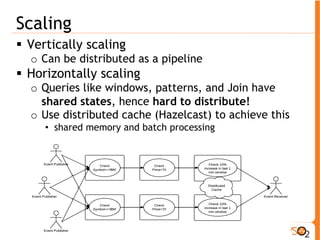
Scaling 
! Vertically scaling 
o Can be distributed as a pipeline 
! Horizontally scaling 
o Queries like windows, patterns, and Join have 
shared states, hence hard to distribute! 
o Use distributed cache (Hazelcast) to achieve this 
• shared memory and batch processing
Event Recording 
! Ability to record all/some of the events for 
future processing 
! Few options 
o Publish them to Cassandra cluster using WSO2 data 
bridge API or BAM (can process data in Cassandra 
with Hadoop using WSO2 BAM). 
o Write them to distributed cache 
o Custom thrift based event recorder
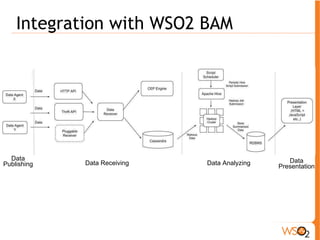
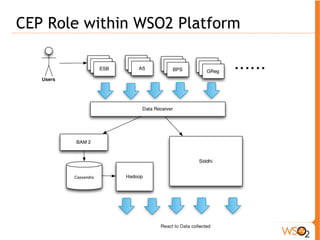
Integration with WSO2 BAM 
Data Receiving Data Analyzing Data 
Presentation 
Data 
Publishing
CEP Role within WSO2 Platform
DEMO
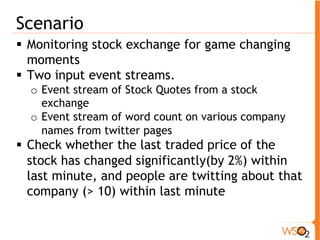
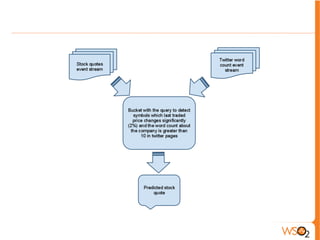
Scenario 
! Monitoring stock exchange for game changing 
moments 
! Two input event streams. 
o Event stream of Stock Quotes from a stock 
exchange 
o Event stream of word count on various company 
names from twitter pages 
! Check whether the last traded price of the 
stock has changed significantly(by 2%) within 
last minute, and people are twitting about that 
company (> 10) within last minute
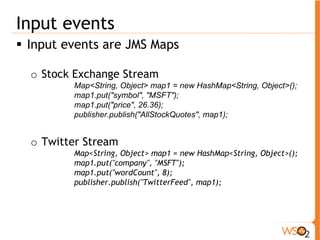
Input events 
! Input events are JMS Maps 
o Stock Exchange Stream 
Map<String, Object> map1 = new HashMap<String, Object>(); 
map1.put("symbol", "MSFT"); 
map1.put("price", 26.36); 
publisher.publish("AllStockQuotes", map1); 
o Twitter Stream 
Map<String, Object> map1 = new HashMap<String, Object>(); 
map1.put("company", "MSFT"); 
map1.put("wordCount", 8); 
publisher.publish("TwitterFeed", map1);
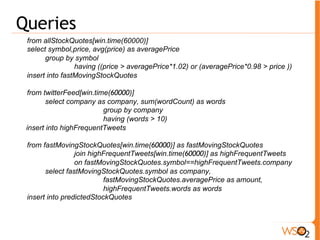
Queries
Queries 
from allStockQuotes[win.time(60000)] 
select symbol,price, avg(price) as averagePrice 
group by symbol 
having ((price > averagePrice*1.02) or (averagePrice*0.98 > price )) 
insert into fastMovingStockQuotes 
from twitterFeed[win.time(60000)] 
select company as company, sum(wordCount) as words 
group by company 
having (words > 10) 
insert into highFrequentTweets 
from fastMovingStockQuotes[win.time(60000)] as fastMovingStockQuotes 
join highFrequentTweets[win.time(60000)] as highFrequentTweets 
on fastMovingStockQuotes.symbol==highFrequentTweets.company 
select fastMovingStockQuotes.symbol as company, 
fastMovingStockQuotes.averagePrice as amount, 
highFrequentTweets.words as words 
insert into predictedStockQuotes
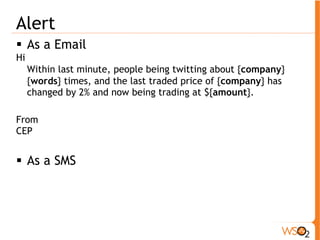
Alert 
! As a Email 
Hi 
Within last minute, people being twitting about {company} 
{words} times, and the last traded price of {company} has 
changed by 2% and now being trading at ${amount}. 
From 
CEP 
! As a SMS
Useful links 
! WSO2 CEP 3.0.0 
http://ec2-54-224-94-128.compute-1.amazonaws.com/chunk-02/ 
N-25_09_2013/wso2cep-3.0.0.zip 
! WSO2 CEP http://wso2.com/products/complex-event-processor/ 
! CEP Performance Info 
http://srinathsview.blogspot.com/2013/08/cep-performance-processing-100k-to. 
html 
! Distributed Processing Sample With Siddhi CEP 
and ActiveMQ JMS Broker. 
http://suhothayan.blogspot.com/2012/08/distributed-processing-sample-for-wso2. 
html 
! Creating Custom Data Publishers to BAM/CEP 
http://wso2.org/library/articles/2012/07/creating-custom-agents-publish-events- 
bamcep 
! WSO2 BAM 2.3.0 
http://wso2.com/products/business-activity-monitor/
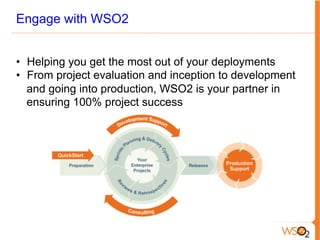
Engage with WSO2 
• Helping you get the most out of your deployments 
• From project evaluation and inception to development 
and going into production, WSO2 is your partner in 
ensuring 100% project success
Questions?
Thank you.

Complex Event Processor 3.0.0 - An overview of upcoming features

  • 1.
    WSO2 Complex EventProcessor 3.0.0 An overview of upcoming features By S. Suhothayan Associate Technical Lead, Team Lead CEP.
  • 2.
    About WSO2 •Providing the only complete open source componentized cloud platform – Dedicated to removing all the stumbling blocks to enterprise agility – Enabling you to focus on business logic and business value • Recognized by leading analyst firms as visionaries and leaders – Gartner cites WSO2 as visionaries in all 3 categories of application infrastructure – Forrester places WSO2 in top 2 for API Management • Global corporation with offices in USA, UK & Sri Lanka – 200+ employees and growing • Business model of selling comprehensive support & maintenance for our products
  • 3.
    150+ globally positionedsupport customers
  • 4.
    Outline ! Scenariosof Event Processing ! WSO2 CEP Server & SOA integrates ! The Siddhi Runtime CEP Engine. ! High availability, Persistence and Scalability of WSO2 CEP ! How CEP can be combined with Business Activity Monitoring (BAM). ! Demo
  • 5.
    CEP Is &Is NOT! ! Is NOT! o Simple filters • Simple Event Processing • E.g. Is this a gold or platinum customer? o Joining multiple event streams • Event Stream Processing ! Is ! o Processing multiple event streams o Identify meaningful patterns among streams o Using temporal windows • E.g. Notify if there is a 10% increase in overall trading activity AND the average price of commodities has fallen 2% in the last 4 hours
  • 6.
    WSO2 CEP Server ! Enterprise grade server for CEP runtimes ! Supports several transports (network access) ! Supports several data formats ! Support for multiple CEP runtimes ! Governance ! Monitoring ! Tools (WSO2 Dev Studio)
  • 7.
  • 8.
    Siddhi CEP Runtime ! Apache License, a java library, Tuple based event model ! Supports distributed processing ! Supports multiple query models • Based on a SQL-like language • Supports ! Partitions ! Filters ! Windows ! Joins ! Ordering ! Output Rate Limiting ! and others
  • 9.
    CEP Event Adaptors ! Is an adaptor for receiving and publishing events ! Has the configurations to connect to external endpoints ! Its many-to-many with CEP engine
  • 10.
    CEP Event Adaptors Support for several transports (network access) and data formats ● SOAP/WS-Eventing XML messages ● REST JSON messages ● JMS Map messages XML messages Text messages JSON messages ● SMTP (Email) Text messages JSON messages XML messages ● Thrift - WSO2 data format High Performant Event Capturing & Delivery Framework supports Java/C/C++/C# via Thrift language bindings WSO2 Event
  • 11.
    CEP Event Adaptors ● Cassandra (from CEP 3.0.0) Map messages ● Fix (from CEP 3.0.0+) Map messages ● MYSQL (from CEP 3.0.0) Map messages ● HBase (from CEP 3.0.0+) Map messages & Event adaptors are pluggable !
  • 12.
    CEP Event Builders • Event builder converts different input event types to a type compatible with the execution plan. • Subscribes to an Input Event Adaptor to listen for events and sends a converted WSO2 Event or Basic Event to the Execution Plan • Receives events in different formats and exposes those input streams as stream definitions • Has a one to many relationship with execution plans in execution plan.
  • 13.
    CEP Execution Plan ● Is an isolated logical execution unit ● Each execution plan has a set of Queries Input & Output stream mappings. ● Its one-to-one with a CEP Backend Runtime Engine ● It deals with Siddhi processing engine.
  • 14.
    CEP Event Formatter Event formatter does the inverse – listens to events coming from event processor and sends converted events to Event adaptors. There are 5 types of output mapping types are available ● Map ● Text ● WSO2Event ● XML ● JSON
  • 15.
    Monitoring (Event Tracer& Event Statistics) ! Provides real-time statistical visual illustrations of request & response counts per time based on CEP server, execution plan, transport adaptor, event builder and formatter.
  • 16.
    Writing CEP Queries(using Siddhi Runtime)
  • 17.
    Siddhi Queries !Filters and Projection ! Windows o Events are processed within temporal windows. (e.g. for aggregation and joins) Time window vs. length window. ! Joins - Join two streams ! Event ordering - Identify event sequences and patterns ! Event Partitions ! Event Tables
  • 18.
    Filters from <stream-name>[<conditions>]* select <attributes> insert into <stream-name> ! Filters the events by conditions, use to detect simple condition ! Conditions o >, <, = , <=, <=, != o contains, instanceof o and, or, not ! Example from cseEventStream[price >= 20 and symbol==’IBM’] select symbol, volume insert into StockQuote
  • 19.
    Window from <stream-name>[<conditions>]#window.<window-name>(< parameters>) select <attributes> Insert into <stream-name> Types of Windows ● (Time | Length) (Sliding| Batch) windows ● Type of aggregate functions ● sum, avg, max, min Example from cseEventStream[price >= 20]#window.lengthBatch(50) select symbol, avg(price) as avgPrice group by symbol having avgPrice>50 insert into StockQuote
  • 20.
    Join from <stream>#<window>[unidirectional] join <stream>#<window> on <condition> within <time> insert into <stream> ! Use to join two streams based on a condition. There must be at least one window defined ! Unidirectional – event arriving only to the unidirectional stream triggers join ! Example from TickEvent[symbol==’IBM’]#window.length(2000) join NewsEvent#window.time(5 min) on TickEvent.symbol==NewsEvent.company select * insert into JoinStream *
  • 21.
    Pattern from [every]<condition> → [every] <condition> … <condition> within <time> select <attributes> insert into StockQuote ! Use to Check condition A happen before/after condition B. ! Can do iterative checks via “every” keyword. ! Here with “within <time>”, SIddhi emits only events that are within that time of each other ! Example from every (a1 = purchase[price < 10] ) -> a2 = purchase [price >10000 and a1.cardNo==a2.cardNo] within 1 day select a1.cardNo as cardNo, a2.price as price, a2.place as place insert into potentialFraud y1 a1 x1 k5 a2 n7
  • 22.
    Sequence from <event-regular-expression>within <time> select <attributes> Insert into <stream> ! Regular Expressions supported o * - Zero or more matches (reluctant). o + - One or more matches (reluctant). o ? - Zero or one match (reluctant). o or – either event ! Here we have to refer events returned by * , + using square brackets to access a specific occurrence of that event from a1 = requestOrder[action == "buy"], b1 = cseEventStream[price > a1.price and symbol==a1.symbol]+, b2 = cseEventStream[price <b1.price] select a1. symbol as symbol, b1[0].price as firstPrice, b2.price as orderPrice insert into purchaseOrder y1 a1 b1 b1 b2 n7
  • 23.
    Event Paritions define<partition-id> by <partition-type> (,<partition-type>)* Partition types can be one of two types • Variable Partitions - Partitions are created by the discrete values that are encountered for a variable define partition StockSymbol by StockStream.symbol • Range partitions - Partitions are created according to predefined ranges of variables define partition stockVolume by range volume < 10 as 'SMALL', range volume > 10 and volume < 100 as 'MEDIUM', range volume > 100 as 'LARGE'
  • 24.
    Event Tables definetable <table-name> (<attribute-name> <type> {, <attribute-name> <type>}*) ( from <table-type>.<datasource-name>:< database-name>.<table-name>)? Event tables can be used in the same manner as an event stream, with the difference being that events sent to an event table being persisted to a data source. CEP supports event tables for • In Memory • Relational o MySQL o H2 define table cseEventTable(symbol string, price int, volume float) from MYSQL.cepDataSource:cepdb.cepEventTable0
  • 25.
    Working with EventTables from <stream> (select <attribute-name> (,<attribute-name>)* )? insert into <table-name> Inserts the selected attributes from the input stream into the event table. from cseEventCheckStream[symbol==cseEventTable.symbol in cseEventTable] insert into outStream; For update and delete from <stream> update <table-name> (on <condition>)? from <stream> delete <table-name> (on <condition>)?
  • 26.
    Performance Results !We compared Siddhi with Esper, the widely used opensource CEP engine ! For evaluation, we did setup different queries using both systems, push events in to the system, and measure the time till all of them are processed. ! We used Intel(R) Xeon(R) X3440 @2.53GHz , 4 cores 8M cache 8GB RAM running Debian 2.6.32-5-amd64 Kernel
  • 27.
    Performance sending eventwithin same JVM Simple filter without window from StockTick[prize >6] return symbol, price
  • 28.
    Performance sending eventwithin same JVM State machine query for pattern matching From f=FraudWarningEvent -> p=PINChangeEvent(accountNumber=f.accountNumber) return accountNumber;
  • 29.
    Performance Sending Eventsover the network ! Here we publihsed data from two client publisher nodes to the CEP Sever node and sent the triggered notifications of CEP to a client subscriber node. ! To test the worsecase sinario, 100% of the data published to CEP is recived at the subscriber node after processing (No data is filtered) ! We used Intel® Core™ i7-2630QM CPU @ 2.00GHz, 8 cores, 8GB RAM running Ubnthu 12.04, 3.2.0-32- generic Kernel, for running CEP and used Intel® Core™ i3-2350M CPU @ 2.30GHz, 4 cores, 4GB RAM running Ubnthu 12.04, 3.2.0-32-generic Kernel, for the three client nodes.
  • 30.
    HA/ Persistence !Ability to recover runtime state in the case of a failure. ! Enables queries to span lifetimes much greater than server uptime. ! Takes periodic snapshots and stores all state information to a scalable persistence store (Apache Cassandra). ! Supports pluggable persistent stores.
  • 31.
    Scaling ! Verticallyscaling o Can be distributed as a pipeline ! Horizontally scaling o Queries like windows, patterns, and Join have shared states, hence hard to distribute! o Use distributed cache (Hazelcast) to achieve this • shared memory and batch processing
  • 32.
    Event Recording !Ability to record all/some of the events for future processing ! Few options o Publish them to Cassandra cluster using WSO2 data bridge API or BAM (can process data in Cassandra with Hadoop using WSO2 BAM). o Write them to distributed cache o Custom thrift based event recorder
  • 33.
    Integration with WSO2BAM Data Receiving Data Analyzing Data Presentation Data Publishing
  • 34.
    CEP Role withinWSO2 Platform
  • 35.
  • 36.
    Scenario ! Monitoringstock exchange for game changing moments ! Two input event streams. o Event stream of Stock Quotes from a stock exchange o Event stream of word count on various company names from twitter pages ! Check whether the last traded price of the stock has changed significantly(by 2%) within last minute, and people are twitting about that company (> 10) within last minute
  • 38.
    Input events !Input events are JMS Maps o Stock Exchange Stream Map<String, Object> map1 = new HashMap<String, Object>(); map1.put("symbol", "MSFT"); map1.put("price", 26.36); publisher.publish("AllStockQuotes", map1); o Twitter Stream Map<String, Object> map1 = new HashMap<String, Object>(); map1.put("company", "MSFT"); map1.put("wordCount", 8); publisher.publish("TwitterFeed", map1);
  • 39.
  • 40.
    Queries from allStockQuotes[win.time(60000)] select symbol,price, avg(price) as averagePrice group by symbol having ((price > averagePrice*1.02) or (averagePrice*0.98 > price )) insert into fastMovingStockQuotes from twitterFeed[win.time(60000)] select company as company, sum(wordCount) as words group by company having (words > 10) insert into highFrequentTweets from fastMovingStockQuotes[win.time(60000)] as fastMovingStockQuotes join highFrequentTweets[win.time(60000)] as highFrequentTweets on fastMovingStockQuotes.symbol==highFrequentTweets.company select fastMovingStockQuotes.symbol as company, fastMovingStockQuotes.averagePrice as amount, highFrequentTweets.words as words insert into predictedStockQuotes
  • 41.
    Alert ! Asa Email Hi Within last minute, people being twitting about {company} {words} times, and the last traded price of {company} has changed by 2% and now being trading at ${amount}. From CEP ! As a SMS
  • 42.
    Useful links !WSO2 CEP 3.0.0 http://ec2-54-224-94-128.compute-1.amazonaws.com/chunk-02/ N-25_09_2013/wso2cep-3.0.0.zip ! WSO2 CEP http://wso2.com/products/complex-event-processor/ ! CEP Performance Info http://srinathsview.blogspot.com/2013/08/cep-performance-processing-100k-to. html ! Distributed Processing Sample With Siddhi CEP and ActiveMQ JMS Broker. http://suhothayan.blogspot.com/2012/08/distributed-processing-sample-for-wso2. html ! Creating Custom Data Publishers to BAM/CEP http://wso2.org/library/articles/2012/07/creating-custom-agents-publish-events- bamcep ! WSO2 BAM 2.3.0 http://wso2.com/products/business-activity-monitor/
  • 43.
    Engage with WSO2 • Helping you get the most out of your deployments • From project evaluation and inception to development and going into production, WSO2 is your partner in ensuring 100% project success
  • 44.
  • 45.