epts
                                                   event processing technical society


                                      Event Processing
                                      Language Tutorial
François Bry, Michael Eckert, Opher Etzion, Adrian Paschke, Jon Riecke
on behalf of the epts languages analysis working group
epts
    event processing technical society


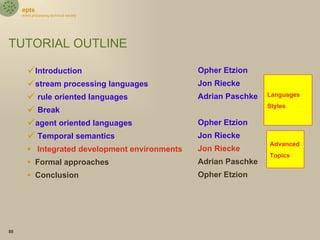
TUTORIAL OUTLINE

       •    Introduction                          Opher Etzion
       •    stream processing languages           Jon Riecke
       •    rule oriented languages               Adrian Paschke   Languages
                                                                   Styles
       Break
       •    Agent oriented languages              Opher Etzion
       •    Temporal semantics                    Jon Riecke
                                                                   Advanced
       •    Integrated development environments   Jon Riecke
                                                                   Topics
       •    Formal approaches                     Adrian Paschke
       •    Conclusion                            Opher Etzion


2
epts
    event processing technical society


TUTORIAL OUTLINE

       •    Introduction                          Opher Etzion
       •    stream processing languages           Jon Riecke
       •    rule oriented languages               Adrian Paschke   Languages
                                                                   Styles
       Break
       •    Agent oriented languages              Opher Etzion
       •    Temporal semantics                    Jon Riecke
                                                                   Advanced
       •    Integrated development environments   Jon Riecke
                                                                   Topics
       •    Formal approaches                     Adrian Paschke
       •    Conclusion                            Opher Etzion


3
epts
     event processing technical society


What is it all about?
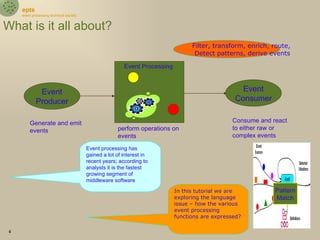
                                                                                   Filter, transform, enrich, route,
                                                                                    Detect patterns, derive events

                                                          Event Processing


              Event                                                                                 Event
             Producer                                                                             Consumer


         Generate and emit                                                                       Consume and react
         events                                        perform operations on                     to either raw or
                                                       events                                    complex events

                                          Event processing has
                                          gained a lot of interest in
                                          recent years; according to
                                          analysts it is the fastest
                                          growing segment of
                                          middleware software

                                                                             In this tutorial we are          Pattern
                                                                             exploring the language           Match
                                                                             issue – how the various
                                                                             event processing
                                                                             functions are expressed?

 4
epts
      event processing technical society

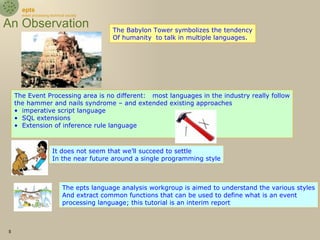
An Observation                                The Babylon Tower symbolizes the tendency
                                              Of humanity to talk in multiple languages.


    The Event Processing area is no different: most languages in the industry really follow
    the hammer and nails syndrome – and extended existing approaches
    • imperative script language
    • SQL extensions
    • Extension of inference rule language


                        It does not seem that we’ll succeed to settle
                        In the near future around a single programming style


                               The epts language analysis workgroup is aimed to understand the various styles
                               And extract common functions that can be used to define what is an event
                               processing language; this tutorial is an interim report


5
epts
       event processing technical society


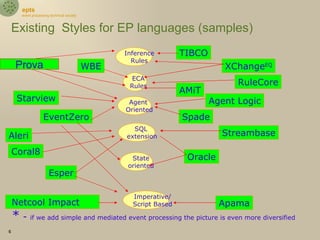
    Existing Styles for EP languages (samples)
                                                  Inference        TIBCO
                                                    Rules
     Prova                                  WBE                               XChangeEQ
                                                    ECA
                                                   Rules                         RuleCore
                                                                   AMiT
     Starview                                      Agent                   Agent Logic
                                                  Oriented
                    EventZero                                      Spade
                                                    SQL
Aleri                                             extension                  Streambase

    Coral8
                                                    State           Oracle
                                                   oriented
                       Esper

                                                    Imperative/
    Netcool Impact                                  Script Based             Apama
    * - if we add simple and mediated event processing the picture is even more diversified
6
epts
    event processing technical society


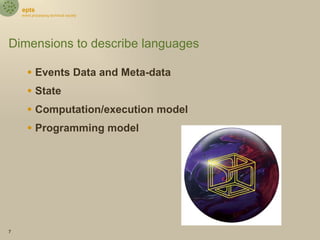
Dimensions to describe languages

       • Events Data and Meta-data
       • State
       • Computation/execution model
       • Programming model


7
epts
    event processing technical society


The event Data and meta-data dimension

       • Event structures supported (structured, semi-
            structured, unstructured)
       • Data types supported for event’s payload
       • Event identifiers/identities
       • Event time-stamps and ordering
       • Event relations
       • Other meta-data entities in the language


8
epts
    event processing technical society


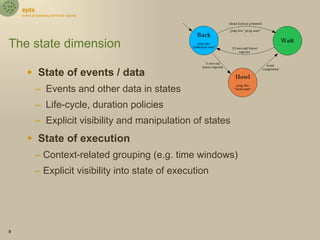
The state dimension

       •      State of events / data
            – Events and other data in states
            – Life-cycle, duration policies
            – Explicit visibility and manipulation of states
       •      State of execution
            – Context-related grouping (e.g. time windows)
            – Explicit visibility into state of execution


9
epts
     event processing technical society


The execution model dimension

        • Execution timing – immediate or deferred ?
        • Guarantees: real-time, determinism, latency ?
        • Time point or time interval semantics
        • Concurrency – implicit / explicit
        • Event at a time / set at a time processing
        • Explicit event flow


10
epts
     event processing technical society


The programming model dimension

        •      Programming style
        •      Abstractions
        •      Pattern matching
        •      Enrichment capabilities
        •      Transformation capabilities
        •      Filter capabilities


11
epts
     event processing technical society


TUTORIAL OUTLINE

        Introduction                              Opher Etzion
             stream processing languages           Jon Riecke
        •    rule oriented languages               Adrian Paschke   Languages
                                                                    Styles
        Break
        •    Agent oriented languages              Opher Etzion
        •    Temporal semantics                    Jon Riecke
                                                                    Advanced
        •    Integrated development environments   Jon Riecke
                                                                    Topics
        •    Formal approaches                     Adrian Paschke
        •    Conclusion                            Opher Etzion


12
epts
     event processing technical society


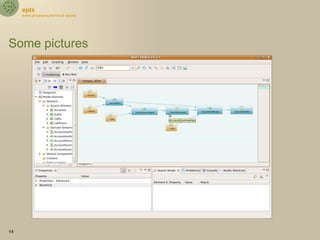
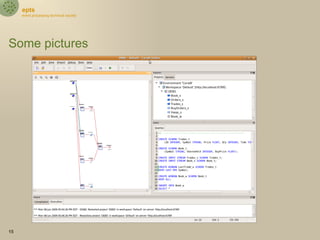
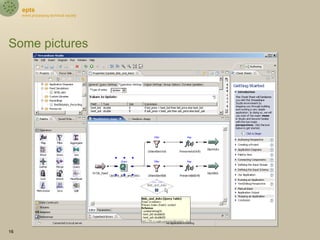
Hallmarks of Stream Processing

        •    Events are processed in a directed graph
             • Nodes = computational elements
             • Edges = communication of events between nodes
        •    Languages inspired by SQL/relational algebra (though not
             all use an extended SQL as the language)
             • Difference: write the query first
             • Results of query are updated as data flows in
        •    Academic examples: STREAM, Aurora, Cayuga, …
        •    Commercial examples: Aleri, Coral8, Esper/Nesper,
             StreamBase, System S, …


13
epts
     event processing technical society


Some pictures


14
epts
     event processing technical society


Some pictures


15
epts
     event processing technical society


Some pictures


16
epts
     event processing technical society


Historical Roots

        • Relational Databases
             • Triggers: change table when another table changes
             • Materialized view maintenance: calculate small set of
                  changes to view given set of changes to base tables
        • Signal processing
             • Control and Audio: Ptolemy, LabVIEW, …
             • Music and video: OpenMusic, jMax, Max, vvvv,


17
epts
     event processing technical society


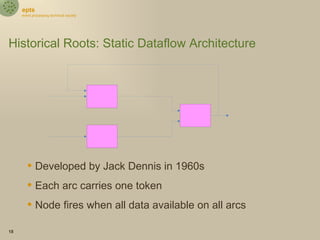
Historical Roots: Static Dataflow Architecture


        • Developed by Jack Dennis in 1960s
        • Each arc carries one token
        • Node fires when all data available on all arcs
18
epts
     event processing technical society


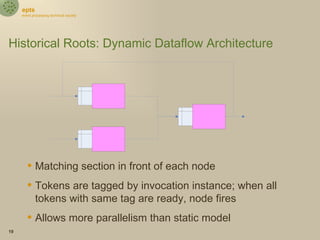
Historical Roots: Dynamic Dataflow Architecture


        • Matching section in front of each node
        • Tokens are tagged by invocation instance; when all
             tokens with same tag are ready, node fires
        • Allows more parallelism than static model
19
epts
     event processing technical society


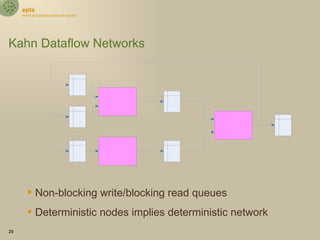
Kahn Dataflow Networks


        • Non-blocking write/blocking read queues
        • Deterministic nodes implies deterministic network
20
epts
     event processing technical society


Stream Processing versus
   Signal Processing and Dataflow Architecture

        • Events carry more information than simple data:
             records instead of, e.g., decimal numbers
        • Slightly slower data rates (up to millions of events
             per second)
        • Publish/subscribe model of input/output


21
epts
     event processing technical society


Dimension Commonalities in Stream Processing

        •    Events: Non-mutable records (fields with values)
             Values have scalar types (integer, float, string, blob, xml)
        •    Metadata: describes streams and types of records
        •    State: Unprocessed and processed events, and internal
             state of operations (e.g., aggregations)
        •    Computational model: records traverse the dataflow graph
        •    Programming model: extensions of SQL/relational algebra


22
epts
     event processing technical society


Dimension Differences

        • Events: small differences in scalar types
        • State
                  •     User-defined data structures (arrays, maps, …)?
                  •     Disk-based persistence? What is persisted?
        • Programming model
                  •     Visual programming or text-based?
                  •     Embedded in larger language, e.g., Java?
                  •     Smaller language embedded in it?


23
epts
     event processing technical society


Dimension Differences

        • Computational model
             • Cycles in dataflow graph?
             • Deterministic?
             • Consistent? What form of consistency?
             • Parallel or concurrent execution?
             • Distributed computation? Distributed data?
             • Synchronous or asynchronous communication?


24
epts
     event processing technical society


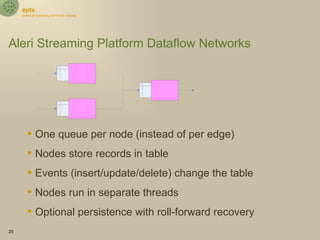
Aleri Streaming Platform Dataflow Networks


        • One queue per node (instead of per edge)
        • Nodes store records in table
        • Events (insert/update/delete) change the table
        • Nodes run in separate threads
        • Optional persistence with roll-forward recovery
25
epts
     event processing technical society


Aleri Streaming Platform Dataflow Networks


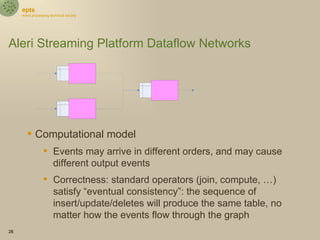
        • Computational model
                  •     Events may arrive in different orders, and may cause
                        different output events
                  •     Correctness: standard operators (join, compute, …)
                        satisfy “eventual consistency”: the sequence of
                        insert/update/deletes will produce the same table, no
                        matter how the events flow through the graph
26
epts
     event processing technical society


Aleri Streaming Platform Dataflow Networks
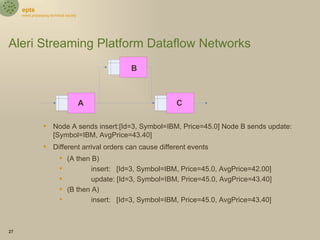
                                                    B


                                          A                       C

                  •     Node A sends insert:[Id=3, Symbol=IBM, Price=45.0] Node B sends update:
                        [Symbol=IBM, AvgPrice=43.40]
                  •     Different arrival orders can cause different events
                            •    (A then B)
                            •            insert: [Id=3, Symbol=IBM, Price=45.0, AvgPrice=42.00]
                            •            update: [Id=3, Symbol=IBM, Price=45.0, AvgPrice=43.40]
                            •    (B then A)
                            •            insert: [Id=3, Symbol=IBM, Price=45.0, AvgPrice=43.40]


27
epts
     event processing technical society


Coral8 Dataflow Networks


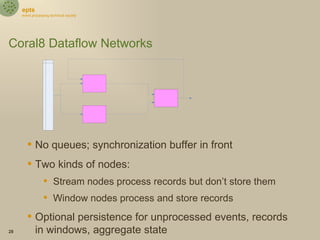
        • No queues; synchronization buffer in front
        • Two kinds of nodes:
                  •     Stream nodes process records but don’t store them
                  •     Window nodes process and store records

        • Optional persistence for unprocessed events, records
28           in windows, aggregate state
epts
     event processing technical society


Coral8 Dataflow Networks


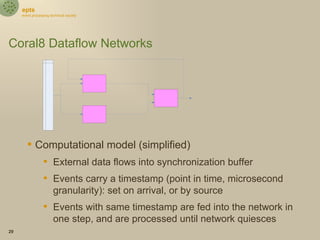
        • Computational model (simplified)
                  •     External data flows into synchronization buffer
                  •     Events carry a timestamp (point in time, microsecond
                        granularity): set on arrival, or by source
                  •     Events with same timestamp are fed into the network in
                        one step, and are processed until network quiesces
29
epts
     event processing technical society


Coral8 Dataflow Networks


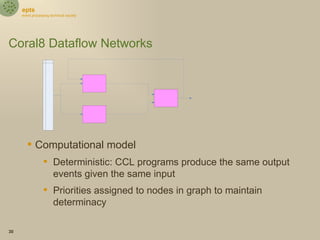
        • Computational model
                  •     Deterministic: CCL programs produce the same output
                        events given the same input
                  •     Priorities assigned to nodes in graph to maintain
                        determinacy

30
epts
     event processing technical society


Coral8 Dataflow Networks


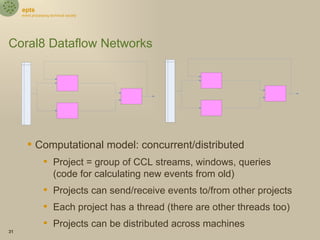
        • Computational model: concurrent/distributed
                  •     Project = group of CCL streams, windows, queries
                        (code for calculating new events from old)
                  •     Projects can send/receive events to/from other projects
                  •     Each project has a thread (there are other threads too)

31
                  •     Projects can be distributed across machines
epts
     event processing technical society


Examples in CCL: Simple Market Data

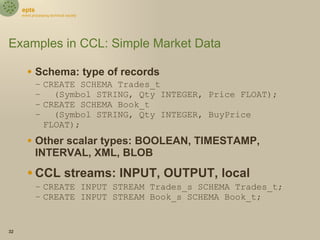
        • Schema: type of records
             – CREATE SCHEMA Trades_t
             – (Symbol STRING, Qty INTEGER, Price FLOAT);
             – CREATE SCHEMA Book_t
             – (Symbol STRING, Qty INTEGER, BuyPrice
               FLOAT);

        • Other scalar types: BOOLEAN, TIMESTAMP,
             INTERVAL, XML, BLOB

        • CCL streams: INPUT, OUTPUT, local
             – CREATE INPUT STREAM Trades_s SCHEMA Trades_t;
             – CREATE INPUT STREAM Book_s SCHEMA Book_t;


32
epts
     event processing technical society


CCL Windows

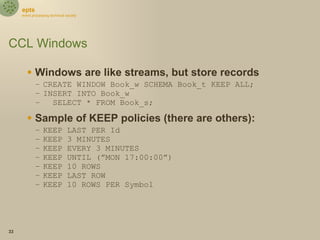
        • Windows are like streams, but store records
             – CREATE WINDOW Book_w SCHEMA Book_t KEEP ALL;
             – INSERT INTO Book_w
             –   SELECT * FROM Book_s;

        • Sample of KEEP policies (there are others):
             –    KEEP           LAST PER Id
             –    KEEP           3 MINUTES
             –    KEEP           EVERY 3 MINUTES
             –    KEEP           UNTIL (”MON 17:00:00”)
             –    KEEP           10 ROWS
             –    KEEP           LAST ROW
             –    KEEP           10 ROWS PER Symbol


33
epts
     event processing technical society


CCL Queries: SQL-based syntax

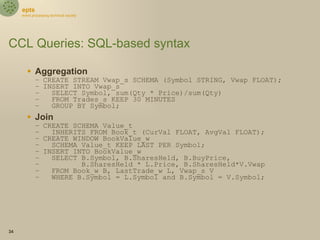
        •    Aggregation
             – CREATE STREAM Vwap_s SCHEMA (Symbol STRING, Vwap FLOAT);
             – INSERT INTO Vwap_s
             –   SELECT Symbol, sum(Qty * Price)/sum(Qty)
             –   FROM Trades_s KEEP 30 MINUTES
             –   GROUP BY Symbol;
        •    Join
             – CREATE SCHEMA Value_t
             –   INHERITS FROM Book_t (CurVal FLOAT, AvgVal FLOAT);
             – CREATE WINDOW BookValue_w
             –   SCHEMA Value_t KEEP LAST PER Symbol;
             – INSERT INTO BookValue_w
             –   SELECT B.Symbol, B.SharesHeld, B.BuyPrice,
             –          B.SharesHeld * L.Price, B.SharesHeld*V.Vwap
             –   FROM Book_w B, LastTrade_w L, Vwap_s V
             –   WHERE B.Symbol = L.Symbol and B.Symbol = V.Symbol;


34
epts
     event processing technical society


CCL Pattern Matching

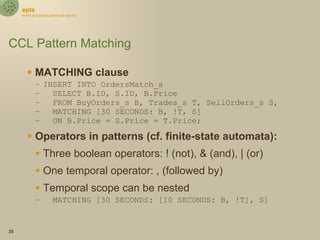
        • MATCHING clause
             – INSERT INTO OrdersMatch_s
             –   SELECT B.ID, S.ID, B.Price
             –   FROM BuyOrders_s B, Trades_s T, SellOrders_s S,
             –   MATCHING [30 SECONDS: B, !T, S]
             –   ON B.Price = S.Price = T.Price;

        • Operators in patterns (cf. finite-state automata):
          • Three boolean operators: ! (not), & (and), | (or)
          • One temporal operator: , (followed by)
          • Temporal scope can be nested
             –          MATCHING [30 SECONDS: [10 SECONDS: B, !T], S]


35
epts
     event processing technical society


Modularity
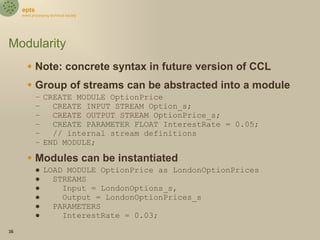
        • Note: concrete syntax in future version of CCL
        • Group of streams can be abstracted into a module
             – CREATE MODULE OptionPrice
             –   CREATE INPUT STREAM Option_s;
             –   CREATE OUTPUT STREAM OptionPrice_s;
             –   CREATE PARAMETER FLOAT InterestRate = 0.05;
             –   // internal stream definitions
             – END MODULE;

        • Modules can be instantiated
             ● LOAD MODULE OptionPrice as LondonOptionPrices
             ●   STREAMS
             ●     Input = LondonOptions_s,
             ●     Output = LondonOptionPrices_s
             ●   PARAMETERS
             ●     InterestRate = 0.03;
36
epts
     event processing technical society


Other Features from Other Languages

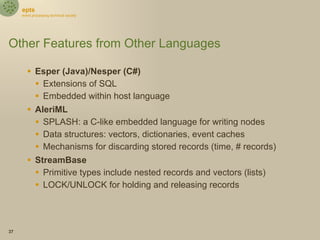
        •    Esper (Java)/Nesper (C#)
             • Extensions of SQL
             • Embedded within host language
        •    AleriML
             • SPLASH: a C-like embedded language for writing nodes
             • Data structures: vectors, dictionaries, event caches
             • Mechanisms for discarding stored records (time, # records)
        •    StreamBase
             • Primitive types include nested records and vectors (lists)
             • LOCK/UNLOCK for holding and releasing records


37
epts
     event processing technical society


TUTORIAL OUTLINE

        Introduction                              Opher Etzion
        stream processing languages               Jon Riecke
             Rule oriented languages               Adrian Paschke   Languages
                                                                    Styles
        •    Break
        •    Agent oriented languages              Opher Etzion
        •    Temporal semantics                    Jon Riecke
                                                                    Advanced
        •    Integrated development environments   Jon Riecke
                                                                    Topics
        •    Formal approaches                     Adrian Paschke
        •    Conclusion                            Opher Etzion


38
epts
     event processing technical society


Production Rules


39
epts
     event processing technical society


Production Rules and CEP
     •   Production rules react to states changes (not events)
     •   PR systems with object model and external fact updates might
         be extended to CEP
         – Event types and classes are defined in the rule declarations
         – New event data instances are added to the fact base / working
           memory
             • might be an external fact base, e.g. a event queue
         – The instances of declarations are filtered and joined in the
           conditions via typed pattern matching and if they pass the condition
           list the action part of the rule is triggered
     •   Might be further extended with mechanisms like query
         languages, state models and temporal constraints
     •   Examples: TIBCO Business Events, Drools
40
epts
     event processing technical society


Production Rules

           •    A production rules is a statement of the form:

                                          “if Condition then Action”

           •    Members, e.g. OPS5, Clips, Jess, Drools, Fair Isaac Blaze
                Advisor, ILog jRules, CA Aion, Haley, ESI Logist, …


           •    Operational semantics: forward-chaining
                     – primitive update actions (assert, retract, …);


41
epts
     event processing technical society


Operational Semantics

        •         Operational processing
             –        forward-chaining order-independent execution (e.g. based
                      on variations of the RETE algorithm)
             –        Procedural order-dependent sequential execution in a
                      (compiled) execution environment (rule engine).


        •         Conflict resolution
             –        Refraction
             –        Priority
             –        Recency
             –        Specificity
             –        …

42
epts
     event processing technical society


     The Rete Pattern-Matching Algorithm

     •   Rete Pattern-Matching Algorithm (and variations of it)
         – matches facts against the patterns in rules to determine which rule
           conditions are satisfied
         – incremental evaluation of production rules' conditions


     •   Developed by Charles L. Forgy in the late 70s for OPS5 (Official
         Production System) shell
         – stores information about the antecedents in a network
         – in every cycle, it only checks for changes in the networks
          this greatly improves efficiency


43
epts
     event processing technical society


 OMG Production Rules Representation (OMG PRR)

     • Formal model for vendor-neutral rule-model
          representation in UML for production rules
     • Consortium of developers and supporters
        – Rule vendors (including Fair Isaac, IBM/ILOG, LibRT, Pega,
          Corticon, TIBCO)
        – Academic community (RuleML Group)
        – Related vendor community (Fujitsu)
     • PRR is currently “adopted" as a standard and in
        “finalization", meaning that it is in Beta, with a final
        version 1.0 in 2009.


44
epts
     event processing technical society


OMG Production Rules Representation

        • OMG MDA PIM model
        • PRR beta spec applies to a PRR Core using OMG
             MOF defined in UML
             – Extends UML so production rules are 1st class citizens
               alongside objects
             – Spec. excludes an explicit expression language
        • Can use other standards as expression language
             – e.g. W3C Rule Interchange Format (W3C RIF) and the
              production rule language of RuleML


45
epts
     event processing technical society


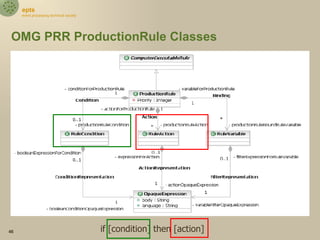
 OMG PRR ProductionRule Classes


46                                        if [condition] then [action]
epts
      event processing technical society


W3C Rule Interchange Format
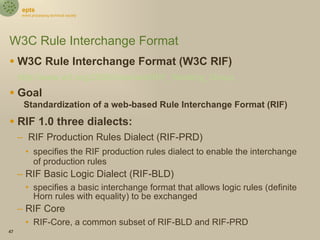
• W3C Rule Interchange Format (W3C RIF)
     http://www.w3.org/2005/rules/wiki/RIF_Working_Group
• Goal
      Standardization of a web-based Rule Interchange Format (RIF)

• RIF 1.0 three dialects:
     – RIF Production Rules Dialect (RIF-PRD)
        • specifies the RIF production rules dialect to enable the interchange
          of production rules
     – RIF Basic Logic Dialect (RIF-BLD)
        • specifies a basic interchange format that allows logic rules (definite
          Horn rules with equality) to be exchanged
     – RIF Core
        • RIF-Core, a common subset of RIF-BLD and RIF-PRD
47
epts
     event processing technical society


 W3C RIF Production Rules Dialect
• Production Rules (Condition-Action)
     – Based on RIF condition language (from RIF Core)
     – Actions: Retract, Assert, Modify, Execute
     – Negation (inflationary negation)
• Syntax
     – Normative XML syntax
       • Might be concrete representation language for OMG PRR
     – Non-normative EBNF-based presentation syntax
       • for presentation purposes


48
epts
     event processing technical society


RIF Production Rule

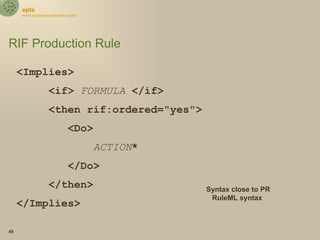
     <Implies>
                     <if> FORMULA </if>
                     <then rif:ordered="yes">
                                 <Do>
                                          ACTION*
                                 </Do>
                     </then>                        Syntax close to PR
                                                     RuleML syntax
     </Implies>

49
epts
     event processing technical society


                   Event Condition Action Rules


50
epts
     event processing technical society


Event Condition Action Rules

        •    ECA Rule
                   “on Event if Condition do Action”;
             – Explicit complex event part; separated from conditions and
               actions
               • e.g. expresses customer order (event); check if credit card is
                 valid (condition)


        •    Evolved from active databases
             – extend databases with reactions, e.g. HiPac, ACCOOD, Chimera,
               ADL, COMPOSE, NAOS
             – Composite event algebra, e.g. SAMOS, COMPOSE, Snoop
               • Sequence | Disjunction | Xor | Conjunction |
                 Concurrent | Not | Any | Aperiodic | Periodic

51
epts
     event processing technical society


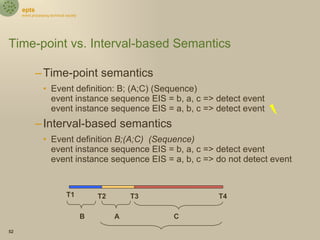
Time-point vs. Interval-based Semantics

             – Time-point semantics
                  • Event definition: B; (A;C) (Sequence)
                    event instance sequence EIS = b, a, c => detect event
                    event instance sequence EIS = a, b, c => detect event
             – Interval-based semantics
                  • Event definition B;(A;C) (Sequence)
                    event instance sequence EIS = b, a, c => detect event
                    event instance sequence EIS = a, b, c => do not detect event


                                T1            T2       T3       T4

                                          B        A        C

52
epts
     event processing technical society


Operational Semantics

        1.        Specification Phase
             –        Definition of event/action pattern e.g. by event algebra
             –        Based on declarative formalization or procedural implementation
             –        Defined over an atomic instant or an interval of time,
                      events/actions, situation, transition etc.
        2.        Selection
             –        Defines selection function to select one event from several
                      occurred events of a particular type in an event instance
                      sequence, e.g. “first”, “last”
             –        Crucial for the outcome of a reaction rule, since the events may
                      contain different (context) information, e.g. different message
                      payloads or sensing information


53
epts
      event processing technical society


Operational Semantics
     1.     Consumption
       –        Optionally defines which events are consumed after the detection of a
                composite event
       –        An event may contribute to the detection of several composite events, if
                it is not consumed
       –        Distinction in event messaging between “multiple receive” and “single
                receive”
       –        Events which can no longer contribute, e.g. are outdated, should be
                removed
     2.     Execution
       –        Actions might have an internal effect i.e. change the knowledge state
                leading to state transition from (pre)-condition state to post-condition
                state.
       –        Actions might have an external side effect


54
epts
     event processing technical society


Example: REWERSE MARS

        •    MARS (Modular Active Rules for the Semantic Web)
             – rule uses specialized heterogeneous event language (E), one
               or more query languages (Q), a test language (T), and an
               action language (A)
             – each of these languages and their constructs are described by
               metadata and an ontology of its semantics
             – well-defined interface for communication between the E, Q&T,
               and A components by variables
             – SNOOP (E), OWLQ (Q&T) and CCS - Calculus of
               Communicating Systems (A)


55
epts
     event processing technical society


Example: XChangeEQ

     •   ECA rules ON Event query IF Web query DO Action
         – the condition part is a declarative query to XML data
         – the event part is as well a declarative query to XML event
           data
              • distributed and web-based: events issued by web nodes (with both
                emission and reception times)
         – - action: simple or complex updates send to web nodes
     •   Complex events are expressed as (compound) queries to the
         event stream
         – temporal restrictions and event compositions
              • conjunction, disjunction, exclusion, quantifications, repetitions, and
                ranks
              • absolute temporal restrictions, also relative temporal restrictions
                (within)
56
epts
     event processing technical society


XChangeEQ
 •   The four dimensions of event querying are kept separated:
     – data extraction (eg oder number, book title)
     – event composition (eg oder of a dictionary and a grammar both from the same
       publisher)
     – temporal (and other) relationships (eg two orders within a week)
     – event accumulation (eg no default of paiement between the order of the two
       abovementioned buys)

 •   Equivalent Semantics:
     – Declarative semantics: Model and fixpoint theories
     – Operational semantics: CERA (Complex Event Relational Algebra)


 •   XChange^EQ operational semantics:
     – by language design, the system never wait forever for a complex event to possibly
       resume.
     – Incremental evaluation (refining RETE).
     – Built-in garbage collection of irrelevant complex events (eg events that cannot
       resume).

57
epts
     event processing technical society


Example: XChange Composite Event

        andthen [
             xchange:event {{
                            xchange:sender {"http://airline.com"},
                            cancellation-notification {{
                                          flight {{ number { var Number } }} }}
             }},
             xchange:event {{
                            xchange:sender {"http://airline.com"},
                            important {"Accomodation is not granted!"}
             }}
        ] within 2 h

58
epts
     event processing technical society


ruleCore Markup Language (rCML)

        •    XML language for ECA rules
        •    Complex Event defined in four sub-elements:
             – <detect-event>. The <detect-event> element specifies the
               event that is generated when the composite event is detected.
             – <no-detect-event>. The <no-detect-event> element specifies
               the event that is generated when the composite event can not
               be detected.
             – <event-selector> The <event-selector> element specifies a
               logical condition (or filter) for the composite event.
             – <detector>. The composite event detector consists of a number
               of event algebra operators (the SNOOP algebra operators) that
               describe the composite event.


59
epts
         event processing technical society


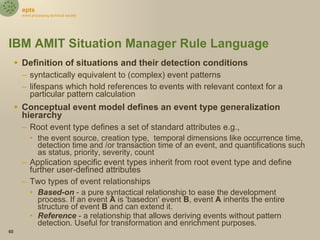
IBM AMIT Situation Manager Rule Language
     •   Definition of situations and their detection conditions
         – syntactically equivalent to (complex) event patterns
         – lifespans which hold references to events with relevant context for a
           particular pattern calculation
     •   Conceptual event model defines an event type generalization
         hierarchy
         – Root event type defines a set of standard attributes e.g.,
             • the event source, creation type, temporal dimensions like occurrence time,
               detection time and /or transaction time of an event, and quantifications such
               as status, priority, severity, count
         – Application specific event types inherit from root event type and define
           further user-defined attributes
         – Two types of event relationships
             • Based-on - a pure syntactical relationship to ease the development
               process. If an event A is 'basedon' event B, event A inherits the entire
               structure of event B and can extend it.
             • Reference - a relationship that allows deriving events without pattern
               detection. Useful for transformation and enrichment purposes.
60
epts
     event processing technical society


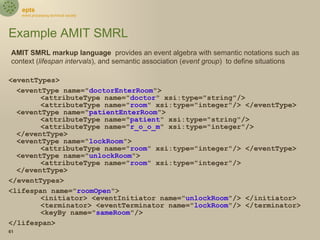
Example AMIT SMRL
 AMIT SMRL markup language provides an event algebra with semantic notations such as
 context (lifespan intervals), and semantic association (event group) to define situations

<eventTypes>
  <eventType name="doctorEnterRoom">
        <attributeType name="doctor" xsi:type="string"/>
        <attributeType name="room" xsi:type="integer"/> </eventType>
  <eventType name="patientEnterRoom">
        <attributeType name="patient" xsi:type="string"/>
        <attributeType name="r_o_o_m" xsi:type="integer"/>
  </eventType>
  <eventType name="lockRoom">
        <attributeType name="room" xsi:type="integer"/> </eventType>
  <eventType name="unlockRoom">
        <attributeType name="room" xsi:type="integer"/>
  </eventType>
</eventTypes>
<lifespan name="roomOpen">
        <initiator> <eventInitiator name="unlockRoom"/> </initiator>
        <terminator> <eventTerminator name="lockRoom"/> </terminator>
        <keyBy name="sameRoom"/>
</lifespan>
61
epts
     event processing technical society


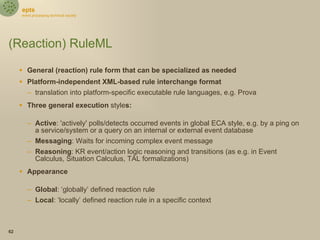
(Reaction) RuleML

     •   General (reaction) rule form that can be specialized as needed
     •   Platform-independent XML-based rule interchange format
         – translation into platform-specific executable rule languages, e.g. Prova
     •   Three general execution styles:

         – Active: 'actively' polls/detects occurred events in global ECA style, e.g. by a ping on
           a service/system or a query on an internal or external event database
         – Messaging: Waits for incoming complex event message
         – Reasoning: KR event/action logic reasoning and transitions (as e.g. in Event
           Calculus, Situation Calculus, TAL formalizations)
     •   Appearance

         – Global: ‘globally’ defined reaction rule
         – Local: ‘locally’ defined reaction rule in a specific context


62
epts
     event processing technical society


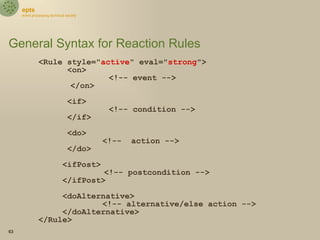
General Syntax for Reaction Rules
               <Rule style="active" eval="strong">
                     <on>
                              <!-- event -->
                      </on>
                                 <if>
                                           <!-- condition -->
                                 </if>
                                 <do>
                                          <!--   action -->
                                 </do>
                              <ifPost>
                                       <!-- postcondition -->
                              </ifPost>
                    <doAlternative>
                            <!-- alternative/else action -->
                    </doAlternative>
               </Rule>
63
epts
     event processing technical society


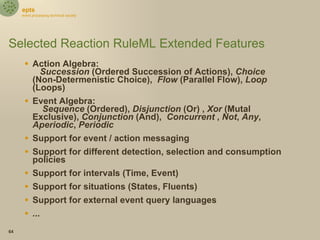
Selected Reaction RuleML Extended Features
      •    Action Algebra:
             Succession (Ordered Succession of Actions), Choice
           (Non-Determenistic Choice), Flow (Parallel Flow), Loop
           (Loops)
      •    Event Algebra:
             Sequence (Ordered), Disjunction (Or) , Xor (Mutal
           Exclusive), Conjunction (And), Concurrent , Not, Any,
           Aperiodic, Periodic
      •    Support for event / action messaging
      •    Support for different detection, selection and consumption
           policies
      •    Support for intervals (Time, Event)
      •    Support for situations (States, Fluents)
      •    Support for external event query languages
      •    ...
64
epts
     event processing technical society


                                          10 minutes break
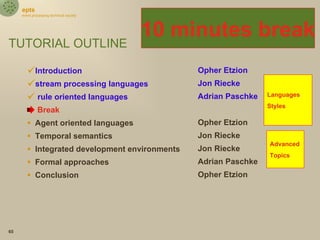
TUTORIAL OUTLINE

        Introduction                              Opher Etzion
        stream processing languages               Jon Riecke
         rule oriented languages                  Adrian Paschke   Languages
                                                                    Styles
              Break
        •    Agent oriented languages              Opher Etzion
        •    Temporal semantics                    Jon Riecke
                                                                    Advanced
        •    Integrated development environments   Jon Riecke
                                                                    Topics
        •    Formal approaches                     Adrian Paschke
        •    Conclusion                            Opher Etzion


65
epts
     event processing technical society


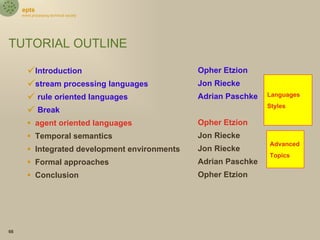
TUTORIAL OUTLINE

        Introduction                           Opher Etzion
        stream processing languages            Jon Riecke
         rule oriented languages               Adrian Paschke   Languages
                                                                 Styles
         Break
        • agent oriented languages              Opher Etzion
        • Temporal semantics                    Jon Riecke
                                                                 Advanced
        • Integrated development environments   Jon Riecke
                                                                 Topics
        • Formal approaches                     Adrian Paschke
        • Conclusion                            Opher Etzion


66
epts
     event processing technical society


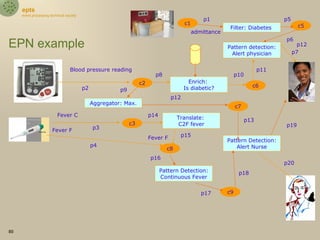
EPA and EPN

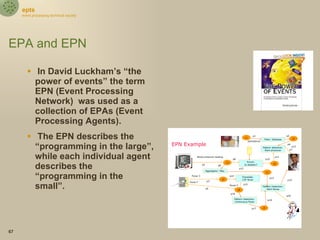
        •    In David Luckham’s “the
             power of events” the term
             EPN (Event Processing
             Network) was used as a
             collection of EPAs (Event
             Processing Agents).
        •     The EPN describes the                                                                            c1
                                                                                                                        p1

                                                                                                                    admittance
                                                                                                                                  Filter: Diabetes
                                                                                                                                                            p5
                                                                                                                                                                    c5

                                           EPN Example
             “programming in the large”,                                                                                         Pattern detection:
                                                                                                                                  Alert physician
                                                                                                                                                              p6

                                                                                                                                                                 p7
                                                                                                                                                                   p12


             while each individual agent                Blood pressure reading
                                                                                                 p8
                                                                                                                 Enrich:
                                                                                                                                      p10
                                                                                                                                                  p11


             describes the
                                                                                          c2                                                  c6
                                                              p2                p9                             Is diabetic?
                                                                                                         p12
                                                                   Aggregator: Max.


             “programming in the
                                                                                                                                      c7
                                                  Fever C                                      p14          Translate:                      p13
                                                                                     c3                     C2F fever                                         p19
                                                Fever F             p3


             small”.                                               p4
                                                                                               Fever F

                                                                                                       c8
                                                                                                             p15
                                                                                                                                 Pattern Detection:
                                                                                                                                     Alert Nurse

                                                                                               p16
                                                                                                                                                            p20
                                                                                                     Pattern Detection:                p18
                                                                                                     Continuous Fever


                                                                                                                       p17       c9


                                                 IBM Haifa Research Lab – Event Processing                                                          © 2008 IBM Corporation


67
epts
           event processing technical society


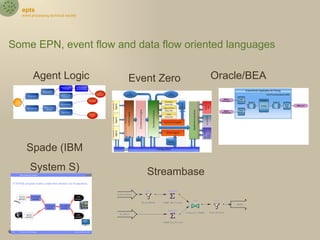
Some EPN, event flow and data flow oriented languages

                               Agent Logic                                                                                               Event Zero      Oracle/BEA


                   Spade (IBM
                          System S)
        IBM InfoSphere Streams                                                                                                              Streambase
 A SPADE program builds a data-flow network out of operators


        source     stream   processing                                                                      sink
       operator              operator                                                                     operator
                                                                                                   m
                                                      str


                                                                                                    ea
                                                         ea


                                                                                                 str
                                                        m


                                                              processing   stream   processing
                                                               operator              operator
                                                                                                   stre


                                                  m
                                               ea
                                                                                                     am


                                         str

                   source                                                                                   sink
                  operator                                                                                operator


68
 194    Tutorial on the SPADE language                                                                    © 2008, 2009 IBM Corporation
epts
     event processing technical society


What is the idea ?

        •    The EPN (event processing network) represents the event
             processing application as a directed graph:
             – The nodes represent event processing agents (and states in some
               models)
             – The edges represent either individual events or event streams
               (depends on the processing type). A generalized EPN may support
               both.
        •    The coverage of EPN varies
             – It may cover some language operator (e.g. SQL like language)
             – It may take a broader approach and cover also routing decisions, pub/
               sub etc…
             – EPN can have a specific programming model, or an hybrid
               programming model, where one or more languages represent the
               agents.


69
epts
     event processing technical society


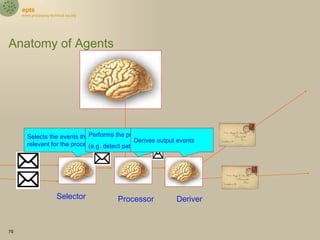
Anatomy of Agents


                               Performs the processing
        Selects the events that are
                                               Derives output events
        relevant for the processing detect patterns)
                               (e.g.


                          Selector        Processor          Deriver


70
epts
     event processing technical society


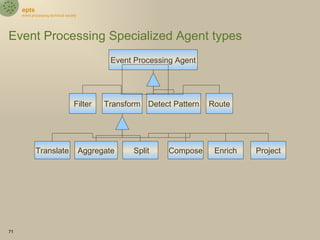
Event Processing Specialized Agent types
                                                  Event Processing Agent


                                     Filter     Transform Detect Pattern   Route


             Translate                    Aggregate    Split    Compose     Enrich   Project


71
epts
      event processing technical society


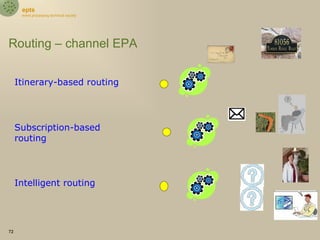
Routing – channel EPA


     Itinerary-based routing


     Subscription-based
     routing


     Intelligent routing


72
epts
     event processing technical society


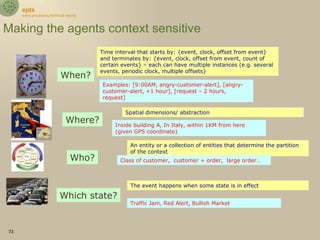
Making the agents context sensitive
                                          Time interval that starts by: {event, clock, offset from event}
                                          and terminates by: {event, clock, offset from event, count of
                                          certain events} – each can have multiple instances (e.g. several
                                          events, periodic clock, multiple offsets}
                             When?
                                          Examples: [9:00AM, angry-customer-alert], [angry-
                                          customer-alert, +1 hour], [request – 2 hours,
                                          request]

                                                   Spatial dimensions/ abstraction
                                Where?         Inside building A, In Italy, within 1KM from here
                                               (given GPS coordinate)

                                                     An entity or a collection of entities that determine the partition
                                                     of the context
                                   Who?          Class of customer, customer + order, large order…


                                                     The event happens when some state is in effect

                            Which state?
                                                     Traffic Jam, Red Alert, Bullish Market


73
epts
     event processing technical society


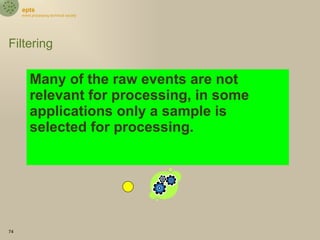
Filtering

         Many of the raw events are not
         relevant for processing, in some
         applications only a sample is
         selected for processing.


74
epts
     event processing technical society


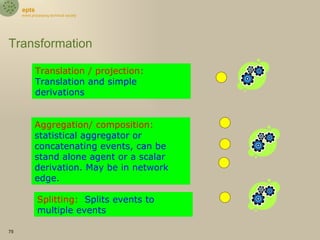
Transformation

             Translation / projection:
             Translation and simple
             derivations


            Aggregation/ composition:
            statistical aggregator or
            concatenating events, can be
            stand alone agent or a scalar
            derivation. May be in network
            edge.

              Splitting: Splits events to
              multiple events

75
epts
     event processing technical society


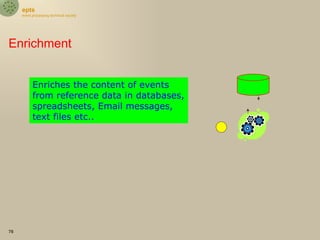
Enrichment


           Enriches the content of events
           from reference data in databases,
           spreadsheets, Email messages,
           text files etc..


76
epts
     event processing technical society


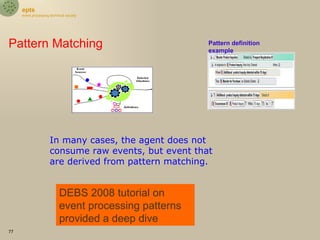
Pattern Matching                                        Pattern definition
                                                        example


                      In many cases, the agent does not
                      consume raw events, but event that
                      are derived from pattern matching.


                            DEBS 2008 tutorial on
                            event processing patterns
                            provided a deep dive
77
epts
     event processing technical society


Dimensions - I

        • Meta-data
             – EPN and agent definitions may be defined as meta-data
             – Event schema is implementation dependent
        •      State
             – State can be represented as another node in the EPN
             – Some EPAs may be state oriented, e.g. the input event is
               change in state
             – State is one of the context dimensions


78
epts
     event processing technical society


Dimensions - II

        • Execution model:
             – EPN representation is natural one for
               concurrency/parallelism since the dependencies are
               explicit
             – Since it models explicitly the end-to-end event flow, it
              serve as a convenient model for QoS related
              optimizations (latency, throughput, real-time constraints)
        • Programming model:
             – Can support multiple programming styles
             – Can support all types of event processing functionality


79
epts
     event processing technical society
                                                                                                 p1                              p5
                                                                                        c1                                              c5
                                                                                                           Filter: Diabetes
                                                                                             admittance
                                                                                                                                 p6
EPN example                                                                                               Pattern detection:            p12
                                                                                                           Alert physician            p7


                                  Blood pressure reading                                                                   p11
                                                                          p8                                   p10
                                                                   c2                     Enrich:
                                          p2                                            Is diabetic?                   c6
                                                         p9
                                                                                  p12
                                               Aggregator: Max.
                                                                                                               c7
                           Fever C                                      p14          Translate:                      p13
                                                              c3                     C2F fever                                   p19
                       Fever F                 p3
                                                                        Fever F       p15
                                                                                                          Pattern Detection:
                                               p4                                                             Alert Nurse
                                                                                c8
                                                                        p16
                                                                                                                                 p20
                                                                              Pattern Detection:                p18
                                                                              Continuous Fever


                                                                                                p17       c9


80
epts
     event processing technical society


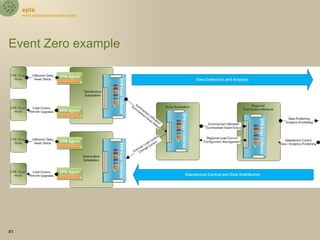
Event Zero example


81
epts
     event processing technical society


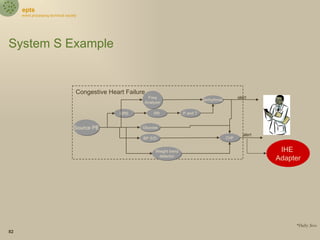
System S Example


                                      Congestive Heart Failure
                                                              Freq                                             alert
                                                                                            Arrhythmia
                                                             Analyzer

                                                     QRS          RR              P and T


                                     Source PE               Glucose
                                                                                                                  alert
                                                             BP S/D                                      CHF


                                                                   Weight trend                                            IHE
                                                                    detector
                                                                                                                          Adapter


                                                                                                                               *Daby Sow
82
epts
     event processing technical society


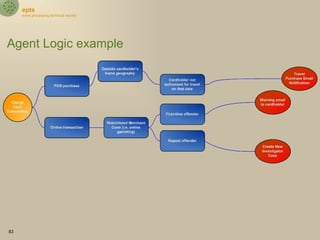
Agent Logic example


83
epts
     event processing technical society


TUTORIAL OUTLINE

        Introduction                           Opher Etzion
        stream processing languages            Jon Riecke
         rule oriented languages               Adrian Paschke   Languages
                                                                 Styles
         Break
        agent oriented languages               Opher Etzion
        • Temporal semantics                    Jon Riecke
                                                                 Advanced
        • Integrated development environments   Jon Riecke
                                                                 Topics
        • Formal approaches                     Adrian Paschke
        • Conclusion                            Opher Etzion


84
epts
     event processing technical society


Varieties of Temporal Semantics

        •    Do events carry timestamps? Where does the timestamp
             come from (CEP system or external world)?
        •    Granularity? Second, millisecond, microsecond, …?
        •    Point in time or interval of time?
        •    Can events arrive out-of-order from a single data source?
        •    Can events be reordered if they arrive out-of-order?
             • How long does the system wait?
             • What happens if system moves ahead, and old event arrives?
        •    In distributed case, is there a difference between emission
             and reception time?


85
epts
     event processing technical society


Simple Temporal Semantics

        • Events arrive in order from a single data source
        • Events have timestamps, but not reordered
        • Advantage
             • Process as soon as possible
        • Disadvantages
             • Non-deterministic
             • Hard to manage if time really matters
             • Emission times de-synchronized in distributed case


86
epts
     event processing technical society


Global Clock

        •    Events have timestamps consistent across data sources
        •    Wait for events for specified time; discard if wait too long
        •    Advantages
             •    Deterministic
             •    Time might be relevant
        •    Disadvantages
             •    Speed of processing
             •    Buffering required for reordering events


87
epts
     event processing technical society


TUTORIAL OUTLINE

        Introduction                           Opher Etzion
        stream processing languages            Jon Riecke
         rule oriented languages               Adrian Paschke   Languages
                                                                 Styles
         Break
        agent oriented languages               Opher Etzion
         Temporal semantics                    Jon Riecke
                                                                 Advanced
        • Integrated development environments   Jon Riecke
                                                                 Topics
        • Formal approaches                     Adrian Paschke
        • Conclusion                            Opher Etzion


88
epts
     event processing technical society


Integrated Development Environments (IDEs)

        • Two main forms
             • Text based
             • Visual or graphical based
        • Not an either-or; most systems have some
             combination of text and visual display of dataflow


89
epts
     event processing technical society


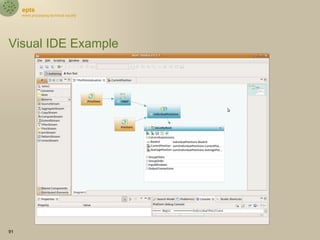
Visual IDEs

        • Streams = nodes, flows = edges
        • Drag-and-drop streams from palette onto canvas
             and wire together
        • Configure streams with property sheets or text
        • Advantages: simple metaphor; easy to see flow
        • Disadvantages: managing screen real-estate


90
epts
     event processing technical society


Visual IDE Example


91
epts
     event processing technical society


Text-based IDEs

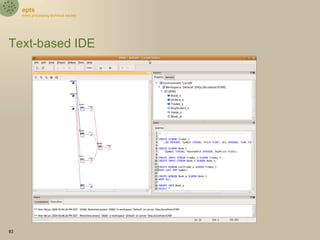
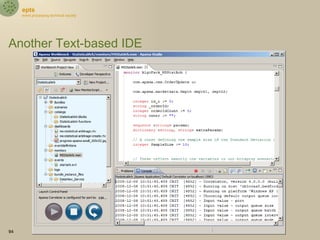
        • Streams represented in text
        • Advantages
             • Appeals to programmers
             • Can be quicker to write code
        • Disadvantages
             • Hard to see the data flow
             • Hard to find bottlenecks in program


92
epts
     event processing technical society


Text-based IDE


93
epts
     event processing technical society


Another Text-based IDE


94
epts
     event processing technical society


Advanced Features in IDEs

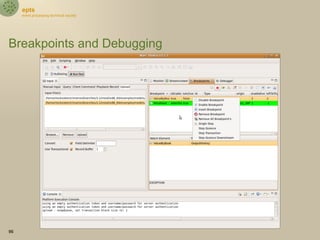
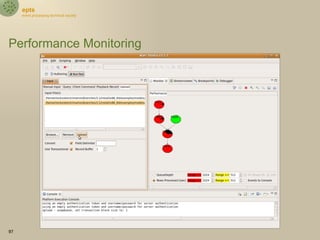
        • Ability to start/stop programs
        • Debugging, including viewing intermediate events
             and setting breakpoints
        • Tests, including ability to control data feeds
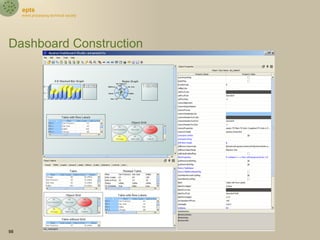
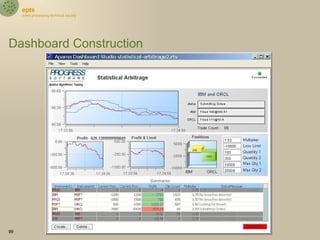
        • Dashboards for displaying results


95
epts
     event processing technical society


Breakpoints and Debugging


96
epts
     event processing technical society


Performance Monitoring


97
epts
     event processing technical society


Dashboard Construction


98
epts
     event processing technical society


Dashboard Construction


99
epts
      event processing technical society


Assessment: IDEs still have a ways to go

         • Need more features that programmers have come
              to expect
              • Single-stepping with line numbers
              • Examination of events and data
              • Forward and backward replay of time
         • Need to be integrated into more dashboards and
              other visualization tools


100