Prepared by Prof. Anand H. D., Dept. of ECE, Dr. AIT, Bengaluru-56
OPERATING SYSTEM
Mr. Anand H. D.
1
Operating System: Scheduling
Department of Electronics & Communication Engineering
Dr. Ambedkar Institute of Technology
Bengaluru-56
Prepared by Prof. Anand H. D., Dept. of ECE, Dr. AIT, Bengaluru-56 2
Operating System: Scheduling
Preliminaries Non pre-emptive scheduling policies
Pre-emptive scheduling policies Scheduling in practice
Topics to be covered:
 Preliminaries
 Non pre-emptive scheduling policies
 Pre-emptive scheduling policies
 Scheduling in practice
Preliminaries Non pre-emptive scheduling policies
Pre-emptive scheduling policies Scheduling in practice
Prepared by Prof. Anand H. D., Dept. of ECE, Dr. AIT, Bengaluru-56 3
Operating System: Process Management
Preliminaries
SCHEDULING TERMINOLOGY AND CONCEPTS
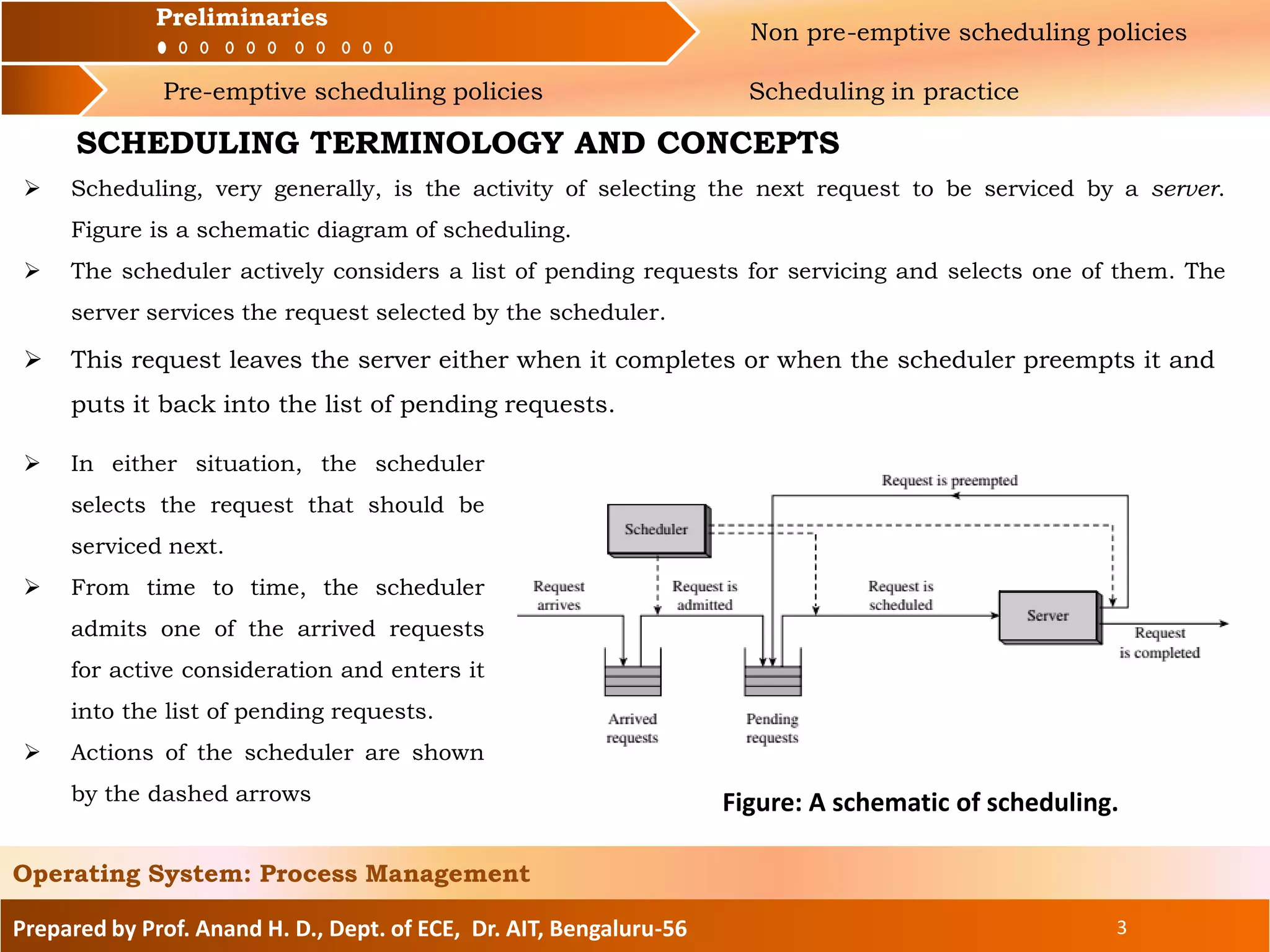
 Scheduling, very generally, is the activity of selecting the next request to be serviced by a server.
Figure is a schematic diagram of scheduling.
 The scheduler actively considers a list of pending requests for servicing and selects one of them. The
server services the request selected by the scheduler.
 In either situation, the scheduler
selects the request that should be
serviced next.
 From time to time, the scheduler
admits one of the arrived requests
for active consideration and enters it
into the list of pending requests.
 Actions of the scheduler are shown
by the dashed arrows
 This request leaves the server either when it completes or when the scheduler preempts it and
puts it back into the list of pending requests.
Figure: A schematic of scheduling.
Preliminaries Non pre-emptive scheduling policies
Pre-emptive scheduling policies Scheduling in practice
Prepared by Prof. Anand H. D., Dept. of ECE, Dr. AIT, Bengaluru-56 4
Operating System: Process Management
Preliminaries
 Events related to a request are its arrival, admission, scheduling, preemption, and
completion.
 In an operating system, a request is the execution of a job or a process, and the server is the
CPU. A job or a process is said to arrive when it is submitted by a user, and to be admitted
when the scheduler starts considering it for scheduling.
 An admitted job or process either waits in the list of pending requests, uses the CPU, or
performs I/O operations. Eventually, it completes and leaves the system.
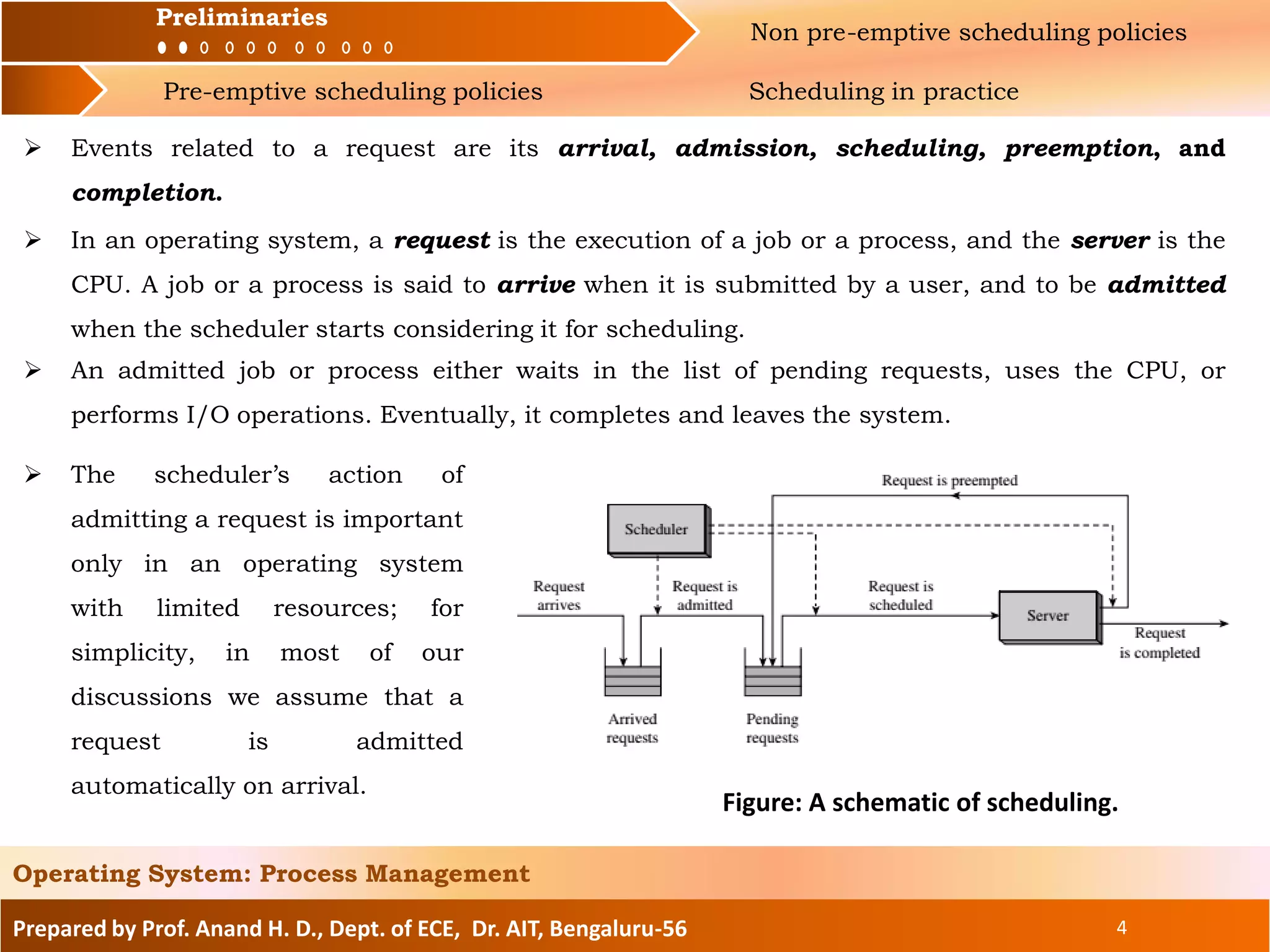
Figure: A schematic of scheduling.
 The scheduler’s action of
admitting a request is important
only in an operating system
with limited resources; for
simplicity, in most of our
discussions we assume that a
request is admitted
automatically on arrival.
Preliminaries Non pre-emptive scheduling policies
Pre-emptive scheduling policies Scheduling in practice
Prepared by Prof. Anand H. D., Dept. of ECE, Dr. AIT, Bengaluru-56 5
Operating System: Process Management
Preliminaries
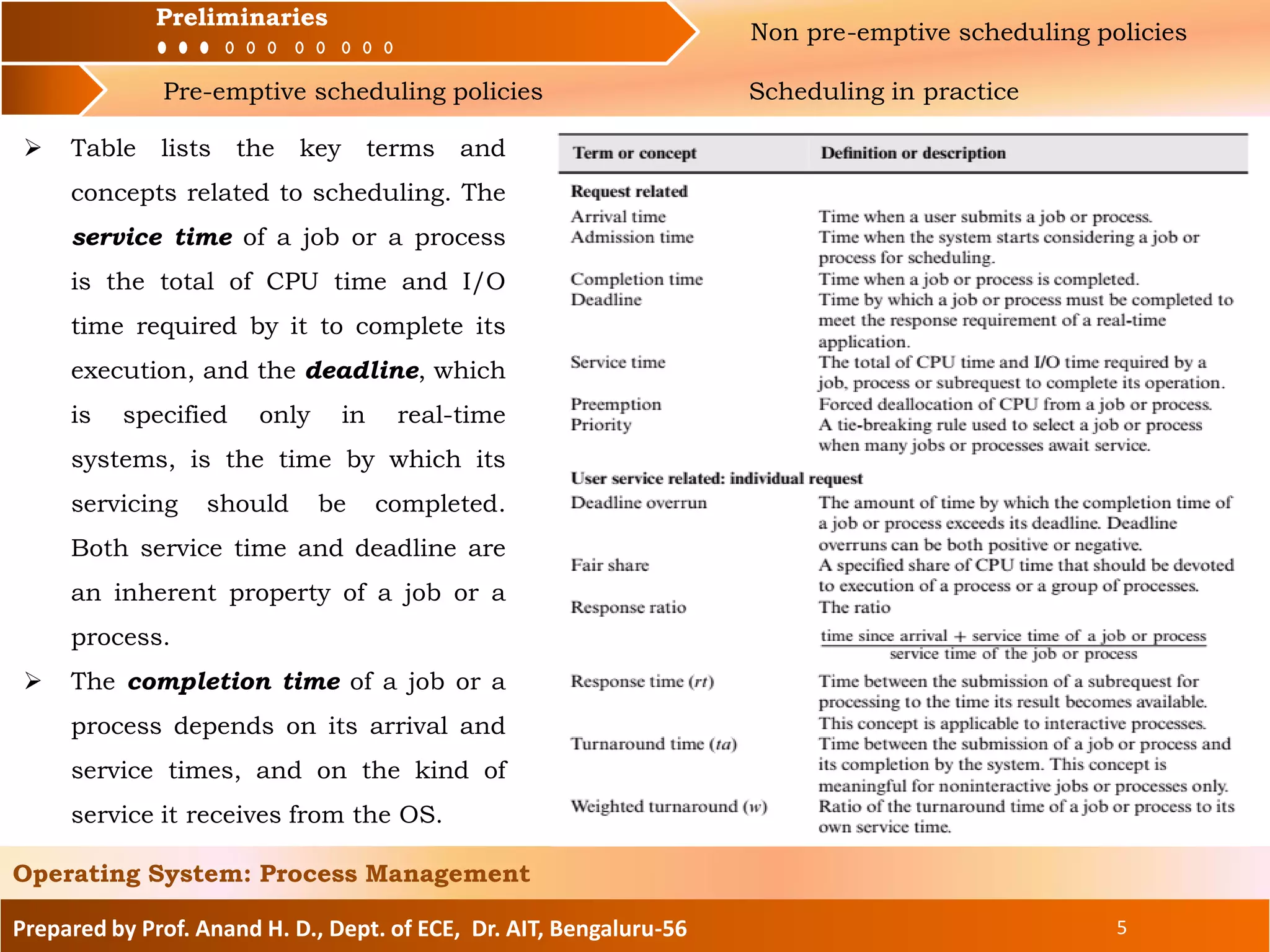
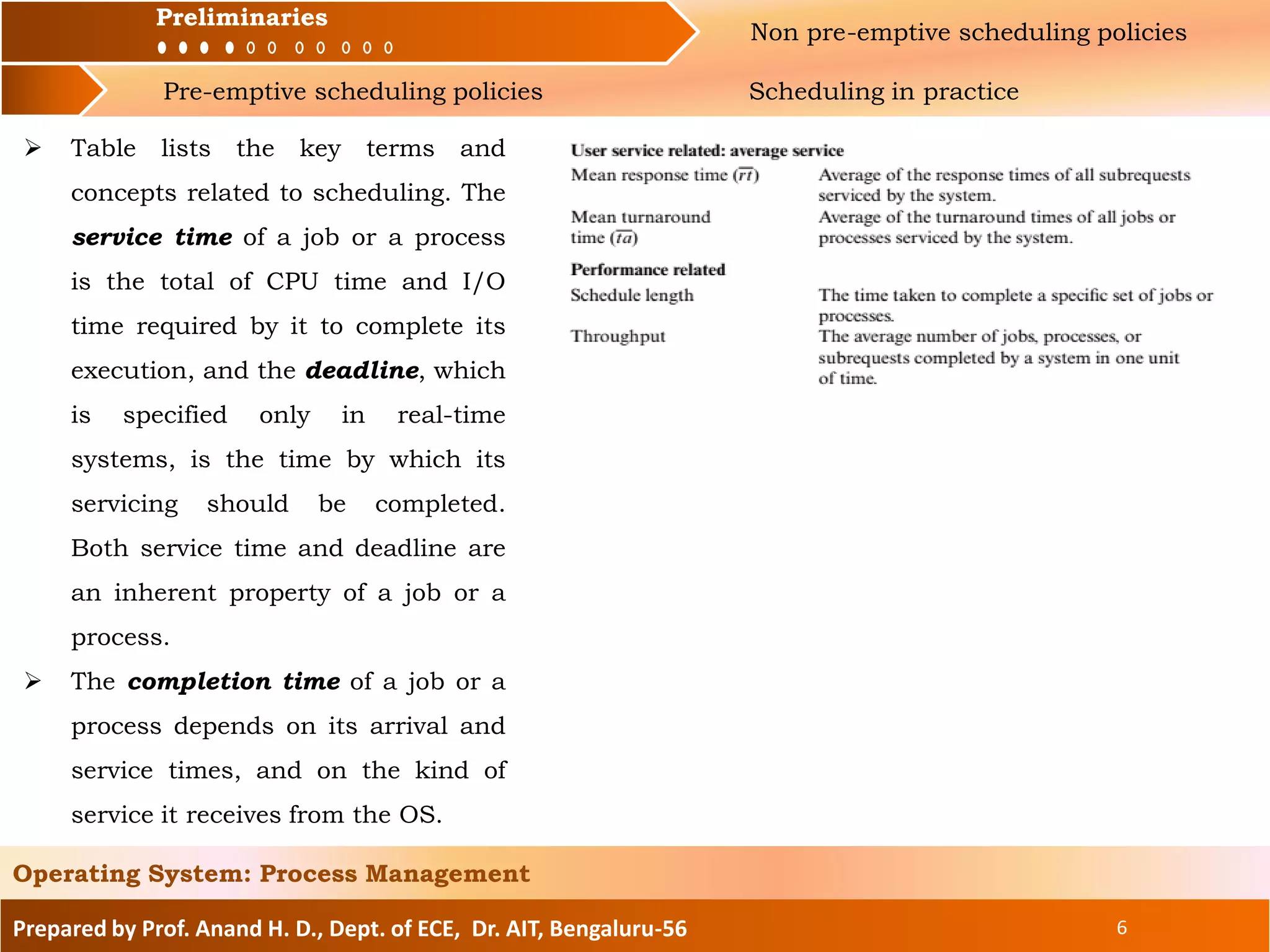
 Table lists the key terms and
concepts related to scheduling. The
service time of a job or a process
is the total of CPU time and I/O
time required by it to complete its
execution, and the deadline, which
is specified only in real-time
systems, is the time by which its
servicing should be completed.
Both service time and deadline are
an inherent property of a job or a
process.
 The completion time of a job or a
process depends on its arrival and
service times, and on the kind of
service it receives from the OS.
Preliminaries Non pre-emptive scheduling policies
Pre-emptive scheduling policies Scheduling in practice
Prepared by Prof. Anand H. D., Dept. of ECE, Dr. AIT, Bengaluru-56 6
Operating System: Process Management
Preliminaries
 Table lists the key terms and
concepts related to scheduling. The
service time of a job or a process
is the total of CPU time and I/O
time required by it to complete its
execution, and the deadline, which
is specified only in real-time
systems, is the time by which its
servicing should be completed.
Both service time and deadline are
an inherent property of a job or a
process.
 The completion time of a job or a
process depends on its arrival and
service times, and on the kind of
service it receives from the OS.
Preliminaries Non pre-emptive scheduling policies
Pre-emptive scheduling policies Scheduling in practice
Prepared by Prof. Anand H. D., Dept. of ECE, Dr. AIT, Bengaluru-56 7
Operating System: Process Management
Preliminaries
 We can group scheduling concepts into user-centric concepts and system-centric concepts
to characterize the OS’s concern for either user service or system performance.
 User-Centric Scheduling Concepts :
In an interactive environment, a user interacts with a process during its operation—the user
makes a subrequest to a process and the process responds by performing actions or by
computing results.
Response time is the time since submission of a subrequest to the time its processing is
completed. It is an absolute measure of service provided to a subrequest.
Turnaround time is an analogous absolute measure of service provided to a job or process.
 Turnaround time differs from the service time of a job or process because it also includes the
time when the job or process is neither executing on the CPU nor performing I/O
operations.
 Several other measures of user service are defined. The weighted turnaround relates the
turnaround time of a process to its own service time. For example, a weighted turnaround of 5
indicates that the turnaround received by a request is 5 times its own service time.
Preliminaries Non pre-emptive scheduling policies
Pre-emptive scheduling policies Scheduling in practice
Prepared by Prof. Anand H. D., Dept. of ECE, Dr. AIT, Bengaluru-56 8
Operating System: Process Management
Preliminaries
 Comparison of weighted turnarounds of different jobs or processes indicates the comparative
service received by them.
 Fair share is the share of CPU time that should be alloted to a process or a group of
processes.
 Response ratio of a job or process is the ratio (time since arrival + service time)/service time.
It relates the delay in the servicing of a job or process to its own service time; it can be used in
a scheduling policy to avoid starvation of processes.
 The deadline overrun is the difference between the completion time and deadline of a job or
process in a real-time application. A negative value of deadline overrun indicates that the job or
process was completed before its deadline, whereas a positive value indicates that the deadline
was missed.
 The mean response time and mean turnaround time are measures of average service
provided to subrequests and processes or jobs, respectively.
Preliminaries Non pre-emptive scheduling policies
Pre-emptive scheduling policies Scheduling in practice
Prepared by Prof. Anand H. D., Dept. of ECE, Dr. AIT, Bengaluru-56 9
Operating System: Process Management
Preliminaries
System-Centric Scheduling Concepts
 Throughput and schedule length are measures of system performance. Throughput indicates
the average number of requests or subrequests completed per unit of time. It provides a basis
for comparing performance of two or more scheduling policies, or for comparing performance of
the same scheduling policy over different periods of time.
 Schedule length indicates the total amount of time taken by a server to complete a set of
requests. Throughput and schedule length are related.
 Consider servicing of five requests r1, . . . , r5. Let mina and maxc be the earliest of the arrival
times and the latest of the completion times, respectively. The schedule length for these five
requests is (maxc - mina) and the throughput is 5/(maxc - mina).
 However, it is typically not possible to compute schedule length and throughput in this manner
because an OS may also admit and service other requests in the interval from mina to maxc, to
achieve good system performance.
 Nevertheless, schedule length is an important basis for comparing the performance of
scheduling policies when the scheduling overhead is not negligible. Throughput is related to
the mean response time and mean turnaround time in an obvious way
Preliminaries Non pre-emptive scheduling policies
Pre-emptive scheduling policies Scheduling in practice
Prepared by Prof. Anand H. D., Dept. of ECE, Dr. AIT, Bengaluru-56 10
Operating System: Process Management
Preliminaries
Fundamental Techniques of Scheduling
Schedulers use three fundamental techniques in their design to provide good user service or
high performance of the system:
• Priority-based scheduling: The process in operation should be the highest priority process
requiring use of the CPU. It is ensured by scheduling the highest-priority ready process at any
time and preempting it when a process with a higher priority becomes ready.
Recall that a multiprogramming OS assigns a high priority to I/O-bound processes; this
assignment of priorities provides high throughput of the system.
• Reordering of requests: Reordering implies servicing of requests in some order other than
their arrival order.
Reordering may be used by itself to improve user service, e.g., servicing short requests before
long ones reduces the average turnaround time of requests.
Reordering of requests is implicit in preemption, which may be used to enhance user service,
as in a time-sharing system, or to enhance the system throughput, as in a multiprogramming
system.
Preliminaries Non pre-emptive scheduling policies
Pre-emptive scheduling policies Scheduling in practice
Prepared by Prof. Anand H. D., Dept. of ECE, Dr. AIT, Bengaluru-56 11
Operating System: Process Management
Preliminaries
• Variation of time slice:
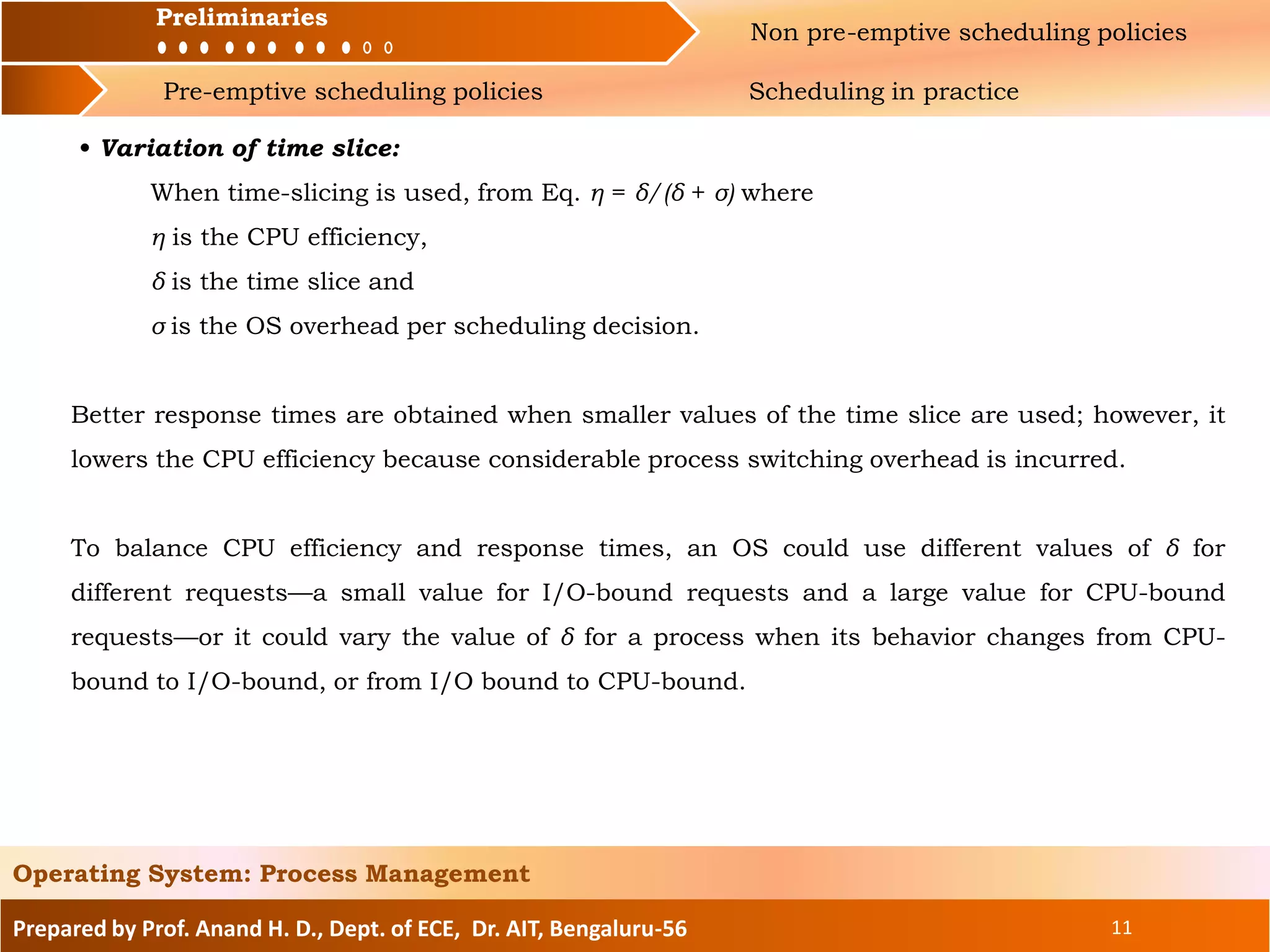
When time-slicing is used, from Eq. η = δ/(δ + σ) where
η is the CPU efficiency,
δ is the time slice and
σ is the OS overhead per scheduling decision.
Better response times are obtained when smaller values of the time slice are used; however, it
lowers the CPU efficiency because considerable process switching overhead is incurred.
To balance CPU efficiency and response times, an OS could use different values of δ for
different requests—a small value for I/O-bound requests and a large value for CPU-bound
requests—or it could vary the value of δ for a process when its behavior changes from CPU-
bound to I/O-bound, or from I/O bound to CPU-bound.
Preliminaries Non pre-emptive scheduling policies
Pre-emptive scheduling policies Scheduling in practice
Prepared by Prof. Anand H. D., Dept. of ECE, Dr. AIT, Bengaluru-56 12
Operating System: Process Management
Preliminaries
The Role of Priority:
Priority is a tie-breaking rule that is employed by a scheduler when many requests await
attention of the server. The priority of a request can be a function of several parameters, each
parameter reflecting either an inherent attribute of the request, or an aspect concerning its
service.
It is called a dynamic priority if some of its parameters change during the operation of the
request; otherwise, it called a static priority.
Some process reorderings could be obtained through priorities as well. For example, short
processes would be serviced before long processes if priority is inversely proportional to the
service time of a process, and processes that have received less CPU time would be processed
first if priority is inversely proportional to the CPU time consumed by a process.
However, complex priority functions may be needed to obtain some kinds of process
reorderings such as those obtained through time-slicing; their use would increase the overhead
of scheduling. In such situations, schedulers employ algorithms that determine the order in
which requests should be serviced.
Preliminaries Non pre-emptive scheduling policies
Pre-emptive scheduling policies Scheduling in practice
Prepared by Prof. Anand H. D., Dept. of ECE, Dr. AIT, Bengaluru-56 13
Operating System: Process Management
Preliminaries
If two or more requests have the same priority, which of them should be scheduled first? A
popular scheme is to use round-robin scheduling among such requests. This way, processes
with the same priority share the CPU among themselves when none of the higher-priority
processes is ready, which provides better user service than if one of the requests is favored over
other requests with the same priority.
Priority-based scheduling has the drawback that a low-priority request may never be serviced
if high-priority requests keep arriving. This situation is called starvation.
It could be avoided by increasing the priority of a request that does not get scheduled for a
certain period to time. This way, the priority of a low-priority request would keep increasing as
it waits to get scheduled until its priority exceeds the priority of all other pending requests.
At this time, it would get scheduled. This technique is called aging of requests
Preliminaries Non pre-emptive scheduling policies
Pre-emptive scheduling policies Scheduling in practice
Prepared by Prof. Anand H. D., Dept. of ECE, Dr. AIT, Bengaluru-56 14
Operating System: Process Management
Preliminaries Non pre-emptive scheduling policies
NONPREEMPTIVE SCHEDULING POLICIES:
In nonpreemptive scheduling, a server always services a scheduled request to
completion.
Thus, scheduling is performed only when servicing of a previously scheduled request is
completed and so preemption of a request never occurs.
Nonpreemptive scheduling is attractive because of its simplicity—the scheduler does
not have to distinguish between an unserviced request and a partially serviced one.
Since a request is never preempted, the scheduler’s only function in improving user
service or system performance is reordering of requests.
We discuss three nonpreemptive scheduling policies in this section:
• First-come, first-served (FCFS) scheduling
• Shortest request next (SRN) scheduling
• Highest response ratio next (HRN) scheduling
Preliminaries Non pre-emptive scheduling policies
Pre-emptive scheduling policies Scheduling in practice
Prepared by Prof. Anand H. D., Dept. of ECE, Dr. AIT, Bengaluru-56 15
Operating System: Process Management
Preliminaries Non pre-emptive scheduling policies
FCFS SCHEDULING:
Requests are scheduled in the order in which they arrive in the system.
The list of pending requests is organized as a queue. The scheduler always schedules
the first request in the list.
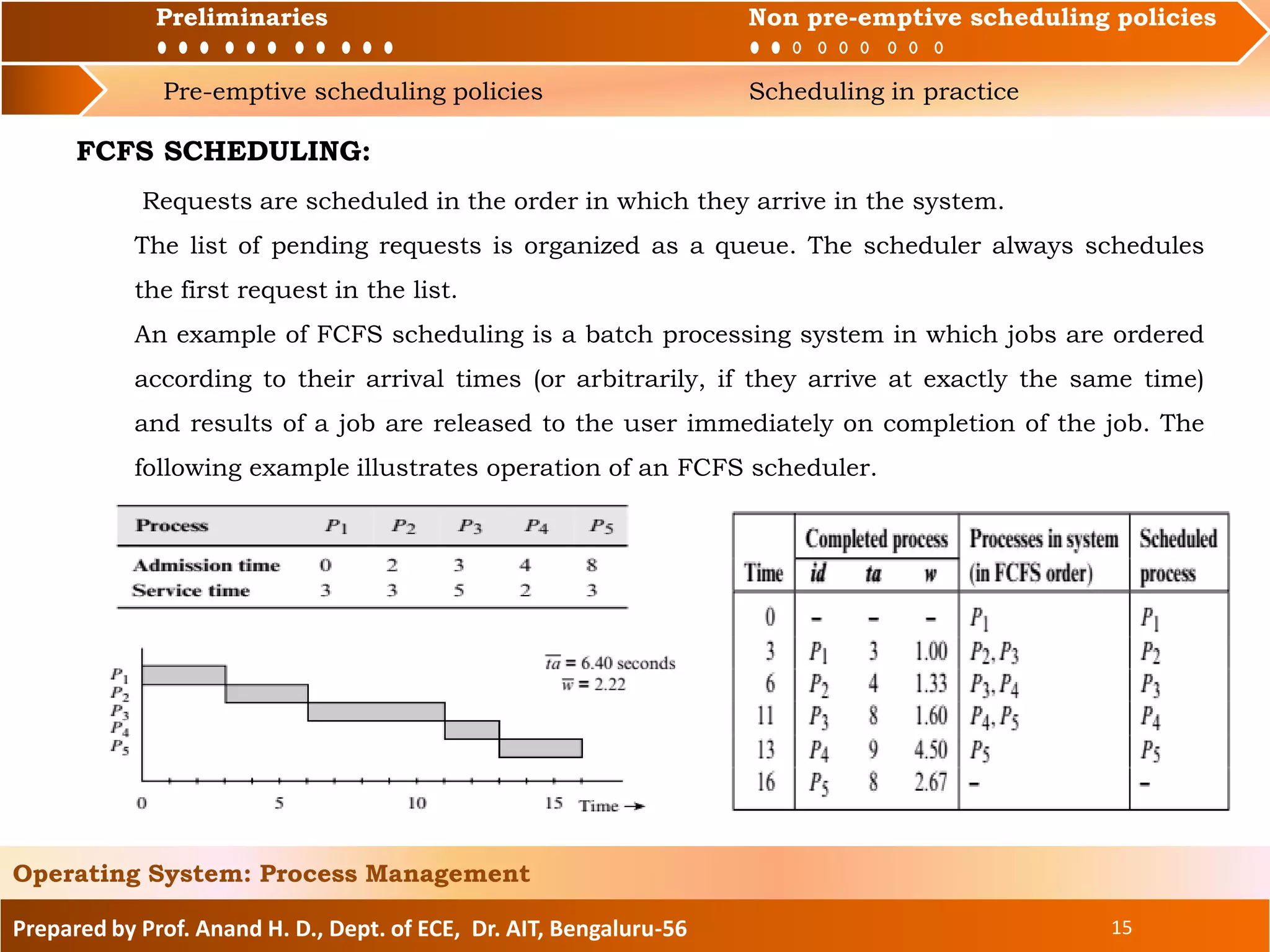
An example of FCFS scheduling is a batch processing system in which jobs are ordered
according to their arrival times (or arbitrarily, if they arrive at exactly the same time)
and results of a job are released to the user immediately on completion of the job. The
following example illustrates operation of an FCFS scheduler.
Preliminaries Non pre-emptive scheduling policies
Pre-emptive scheduling policies Scheduling in practice
Prepared by Prof. Anand H. D., Dept. of ECE, Dr. AIT, Bengaluru-56 16
Operating System: Process Management
Preliminaries Non pre-emptive scheduling policies
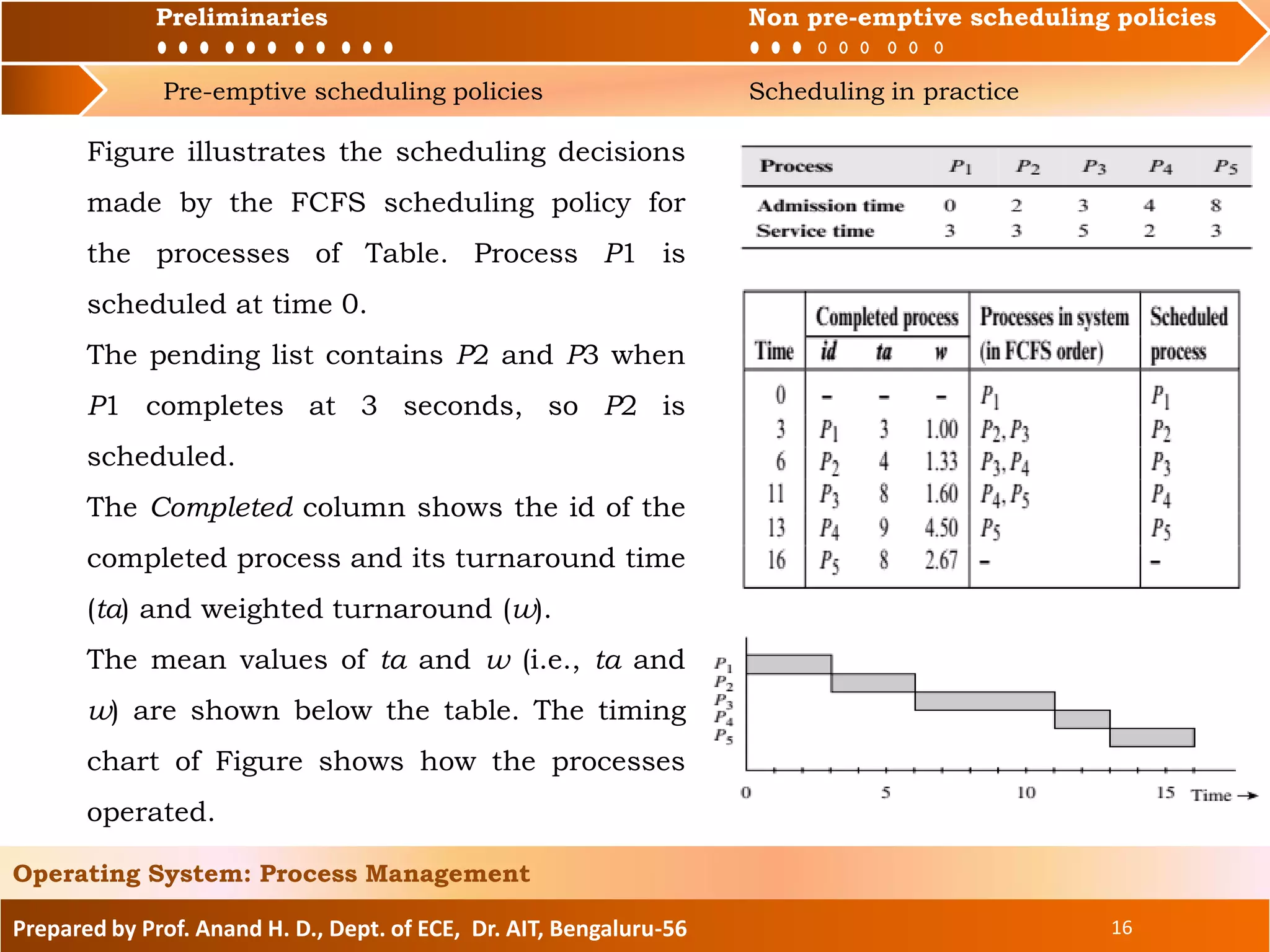
Figure illustrates the scheduling decisions
made by the FCFS scheduling policy for
the processes of Table. Process P1 is
scheduled at time 0.
The pending list contains P2 and P3 when
P1 completes at 3 seconds, so P2 is
scheduled.
The Completed column shows the id of the
completed process and its turnaround time
(ta) and weighted turnaround (w).
The mean values of ta and w (i.e., ta and
w) are shown below the table. The timing
chart of Figure shows how the processes
operated.
Preliminaries Non pre-emptive scheduling policies
Pre-emptive scheduling policies Scheduling in practice
Prepared by Prof. Anand H. D., Dept. of ECE, Dr. AIT, Bengaluru-56 17
Operating System: Process Management
Preliminaries Non pre-emptive scheduling policies
Shortest Request Next (SRN) Scheduling :
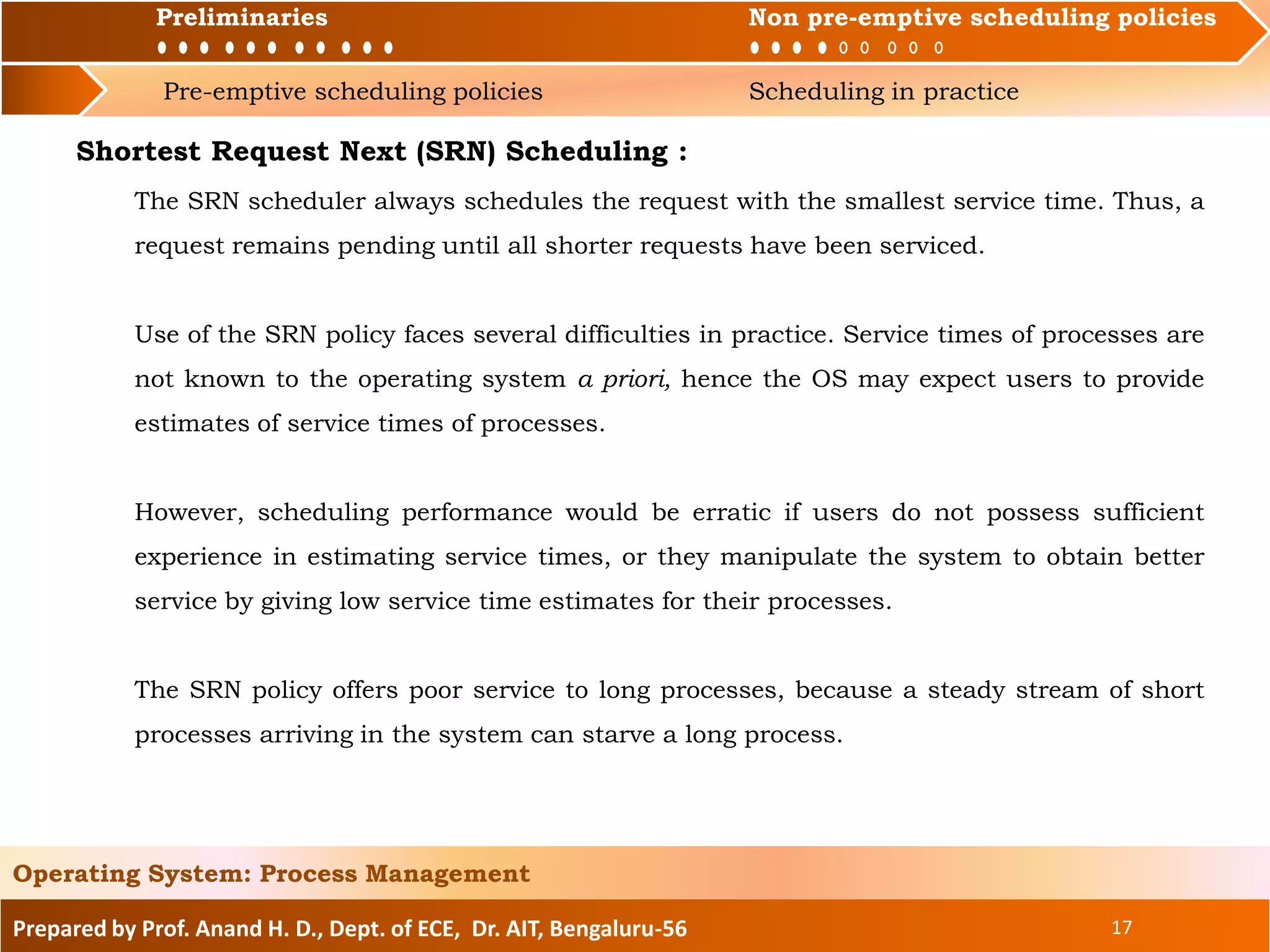
The SRN scheduler always schedules the request with the smallest service time. Thus, a
request remains pending until all shorter requests have been serviced.
Use of the SRN policy faces several difficulties in practice. Service times of processes are
not known to the operating system a priori, hence the OS may expect users to provide
estimates of service times of processes.
However, scheduling performance would be erratic if users do not possess sufficient
experience in estimating service times, or they manipulate the system to obtain better
service by giving low service time estimates for their processes.
The SRN policy offers poor service to long processes, because a steady stream of short
processes arriving in the system can starve a long process.
Preliminaries Non pre-emptive scheduling policies
Pre-emptive scheduling policies Scheduling in practice
Prepared by Prof. Anand H. D., Dept. of ECE, Dr. AIT, Bengaluru-56 18
Operating System: Process Management
Preliminaries Non pre-emptive scheduling policies
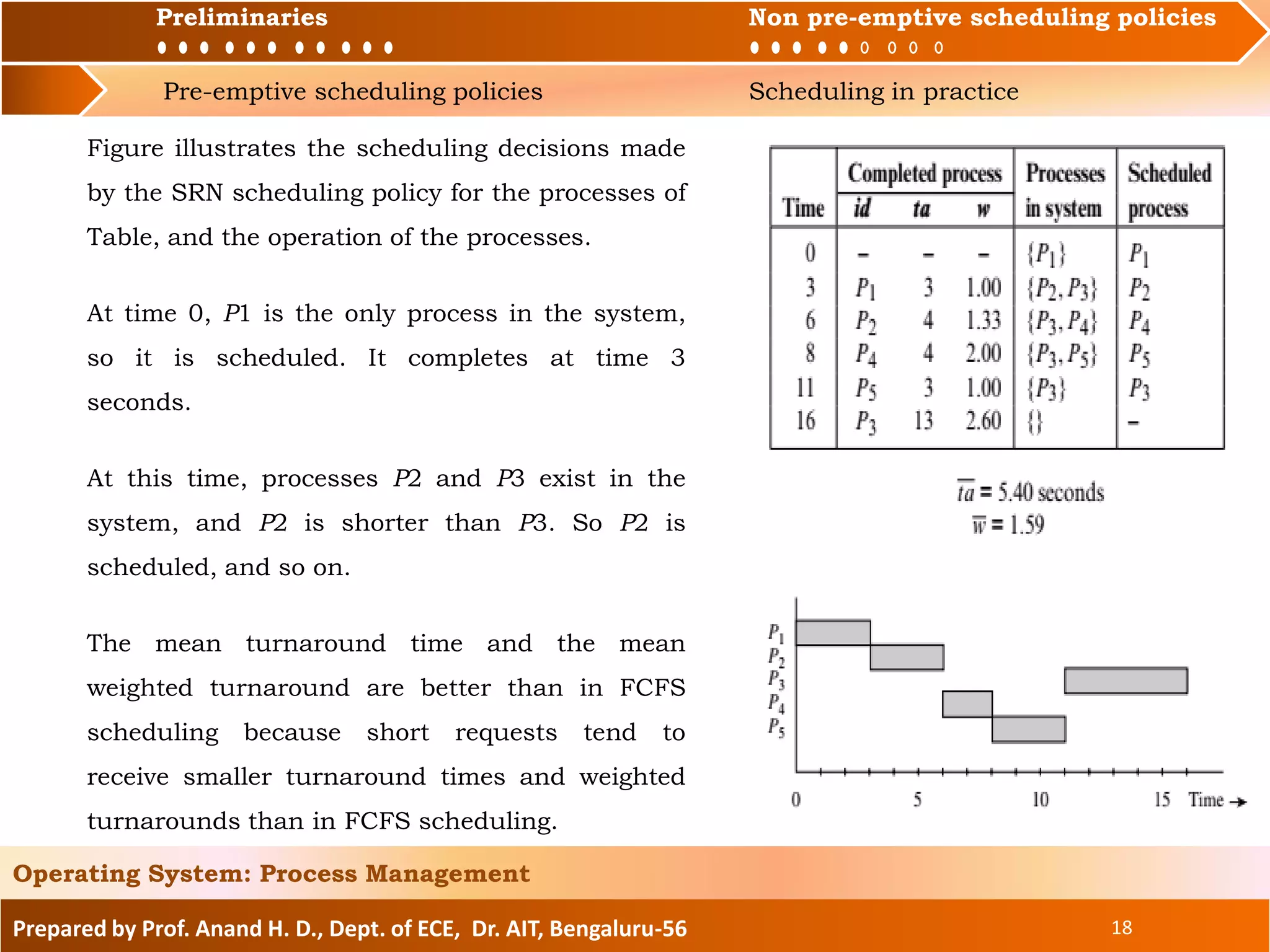
Figure illustrates the scheduling decisions made
by the SRN scheduling policy for the processes of
Table, and the operation of the processes.
At time 0, P1 is the only process in the system,
so it is scheduled. It completes at time 3
seconds.
At this time, processes P2 and P3 exist in the
system, and P2 is shorter than P3. So P2 is
scheduled, and so on.
The mean turnaround time and the mean
weighted turnaround are better than in FCFS
scheduling because short requests tend to
receive smaller turnaround times and weighted
turnarounds than in FCFS scheduling.
Preliminaries Non pre-emptive scheduling policies
Pre-emptive scheduling policies Scheduling in practice
Prepared by Prof. Anand H. D., Dept. of ECE, Dr. AIT, Bengaluru-56 19
Operating System: Process Management
Preliminaries Non pre-emptive scheduling policies
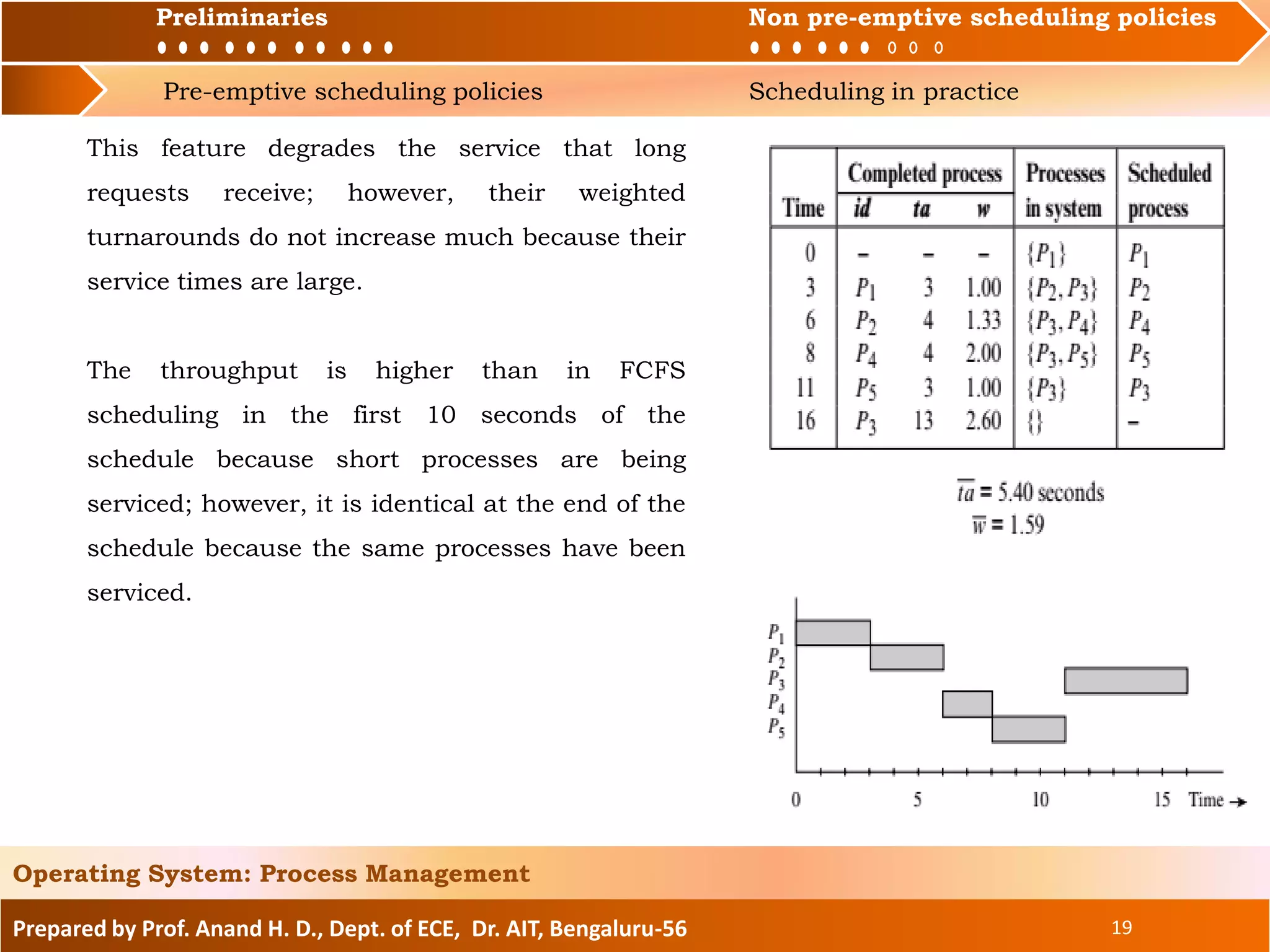
This feature degrades the service that long
requests receive; however, their weighted
turnarounds do not increase much because their
service times are large.
The throughput is higher than in FCFS
scheduling in the first 10 seconds of the
schedule because short processes are being
serviced; however, it is identical at the end of the
schedule because the same processes have been
serviced.
Preliminaries Non pre-emptive scheduling policies
Pre-emptive scheduling policies Scheduling in practice
Prepared by Prof. Anand H. D., Dept. of ECE, Dr. AIT, Bengaluru-56 20
Operating System: Process Management
Preliminaries Non pre-emptive scheduling policies
Highest Response Ratio Next (HRN) Scheduling :
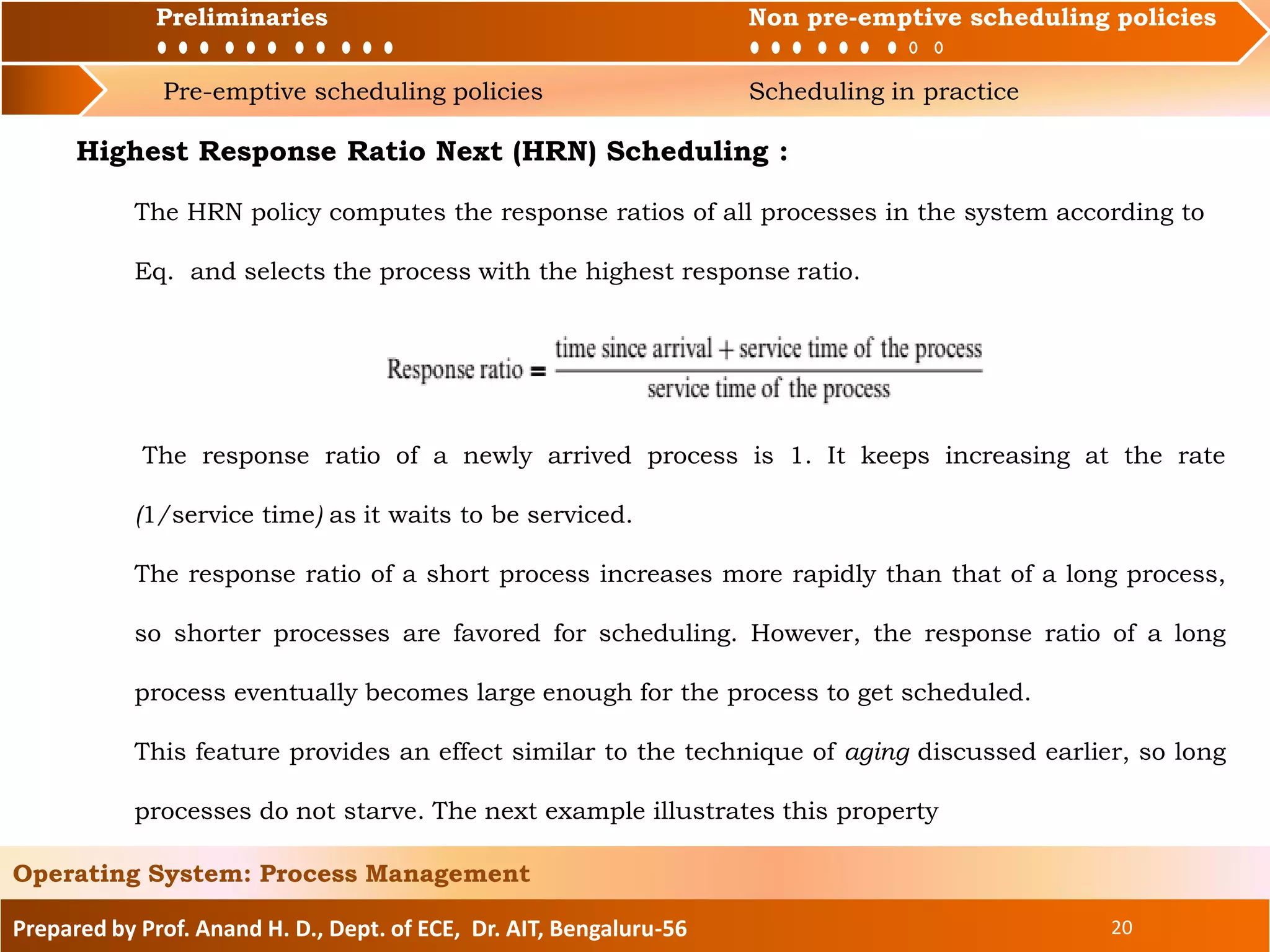
The HRN policy computes the response ratios of all processes in the system according to
Eq. and selects the process with the highest response ratio.
The response ratio of a newly arrived process is 1. It keeps increasing at the rate
(1/service time) as it waits to be serviced.
The response ratio of a short process increases more rapidly than that of a long process,
so shorter processes are favored for scheduling. However, the response ratio of a long
process eventually becomes large enough for the process to get scheduled.
This feature provides an effect similar to the technique of aging discussed earlier, so long
processes do not starve. The next example illustrates this property
Preliminaries Non pre-emptive scheduling policies
Pre-emptive scheduling policies Scheduling in practice
Prepared by Prof. Anand H. D., Dept. of ECE, Dr. AIT, Bengaluru-56 21
Operating System: Process Management
Preliminaries Non pre-emptive scheduling policies
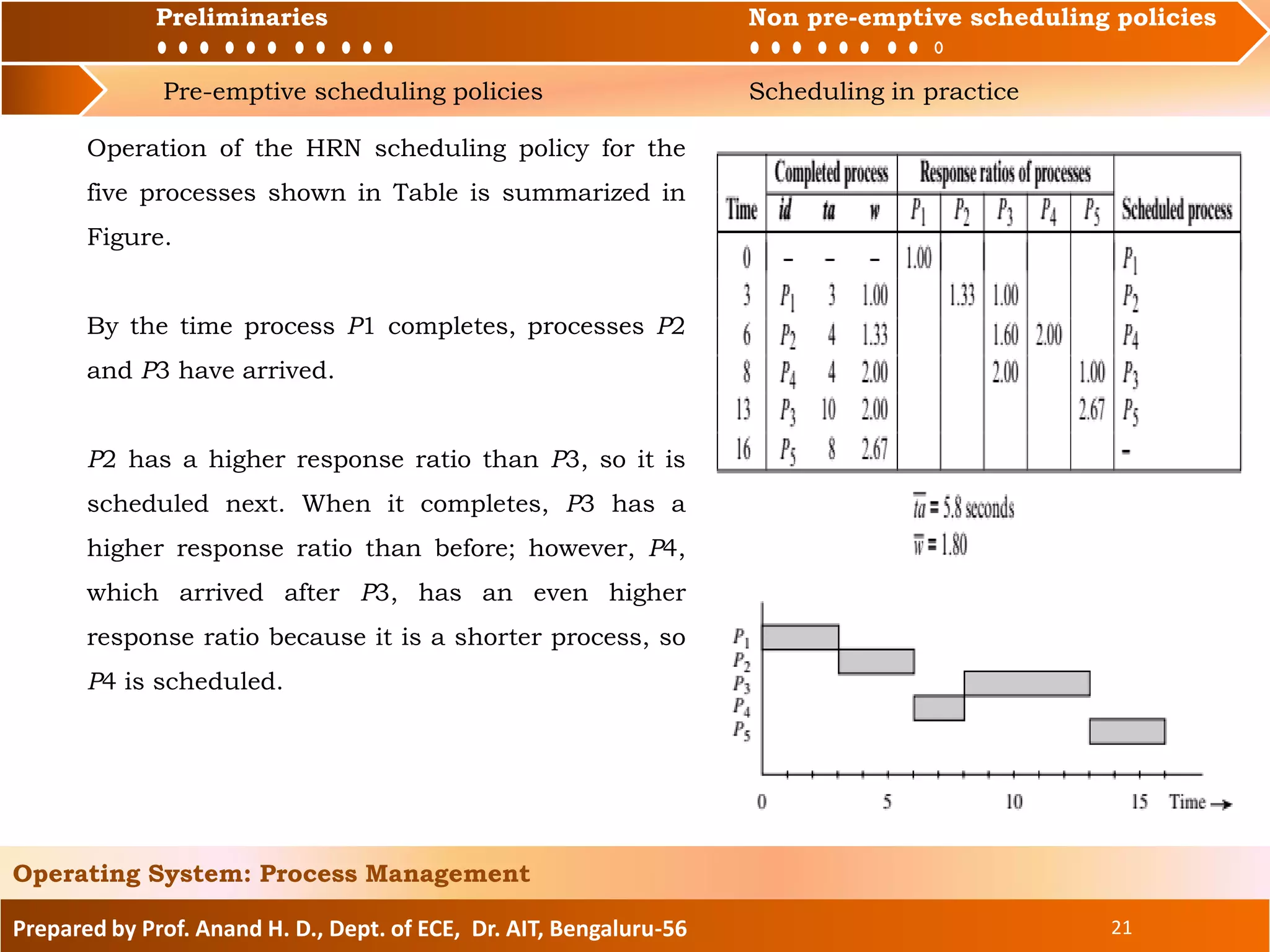
Operation of the HRN scheduling policy for the
five processes shown in Table is summarized in
Figure.
By the time process P1 completes, processes P2
and P3 have arrived.
P2 has a higher response ratio than P3, so it is
scheduled next. When it completes, P3 has a
higher response ratio than before; however, P4,
which arrived after P3, has an even higher
response ratio because it is a shorter process, so
P4 is scheduled.
Preliminaries Non pre-emptive scheduling policies
Pre-emptive scheduling policies Scheduling in practice
Prepared by Prof. Anand H. D., Dept. of ECE, Dr. AIT, Bengaluru-56 22
Operating System: Process Management
Preliminaries Non pre-emptive scheduling policies
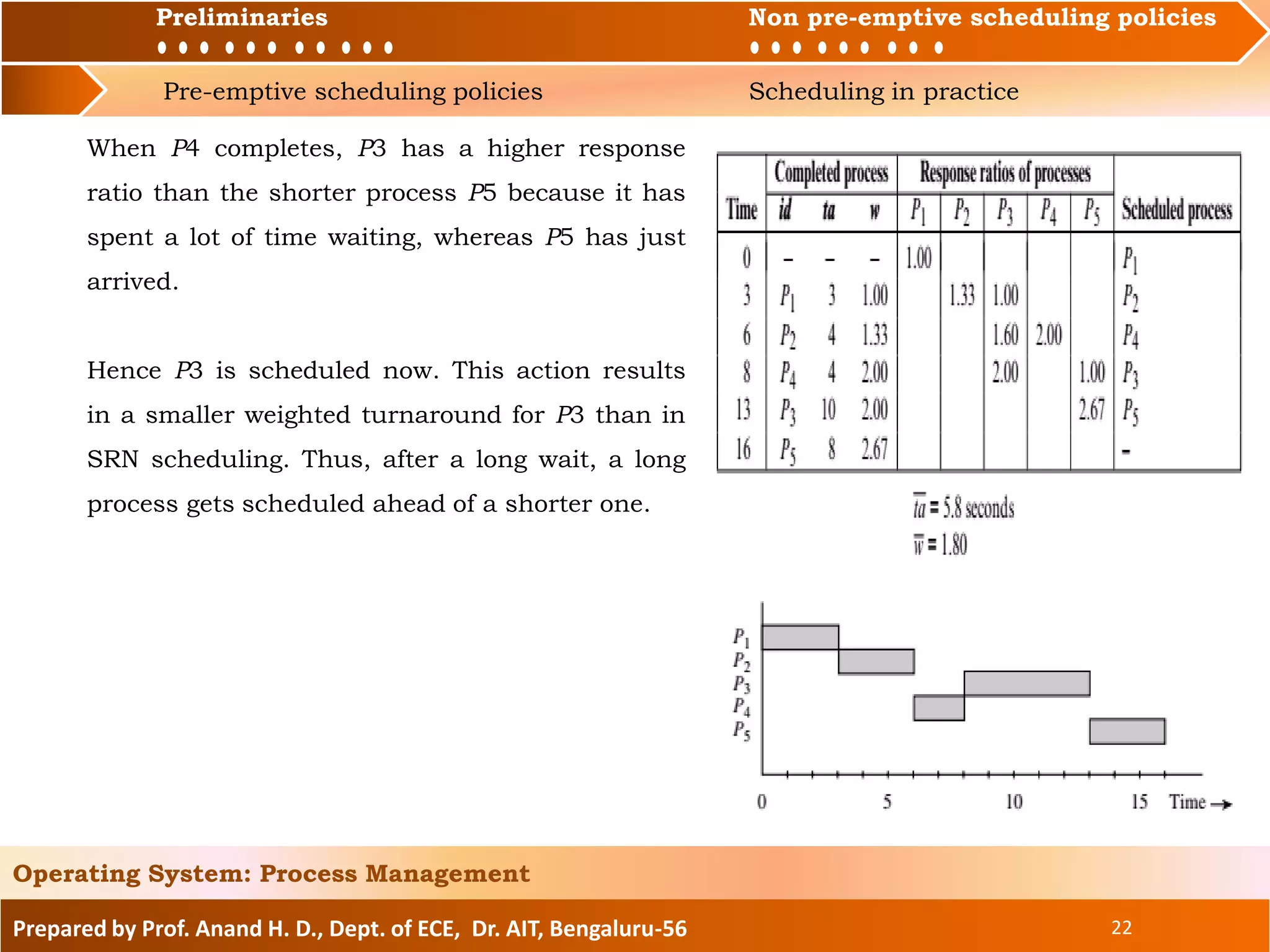
When P4 completes, P3 has a higher response
ratio than the shorter process P5 because it has
spent a lot of time waiting, whereas P5 has just
arrived.
Hence P3 is scheduled now. This action results
in a smaller weighted turnaround for P3 than in
SRN scheduling. Thus, after a long wait, a long
process gets scheduled ahead of a shorter one.
Preliminaries Non pre-emptive scheduling policies
Pre-emptive scheduling policies Scheduling in practice
Prepared by Prof. Anand H. D., Dept. of ECE, Dr. AIT, Bengaluru-56 23
Operating System: Process Management
Preliminaries Non pre-emptive scheduling policies
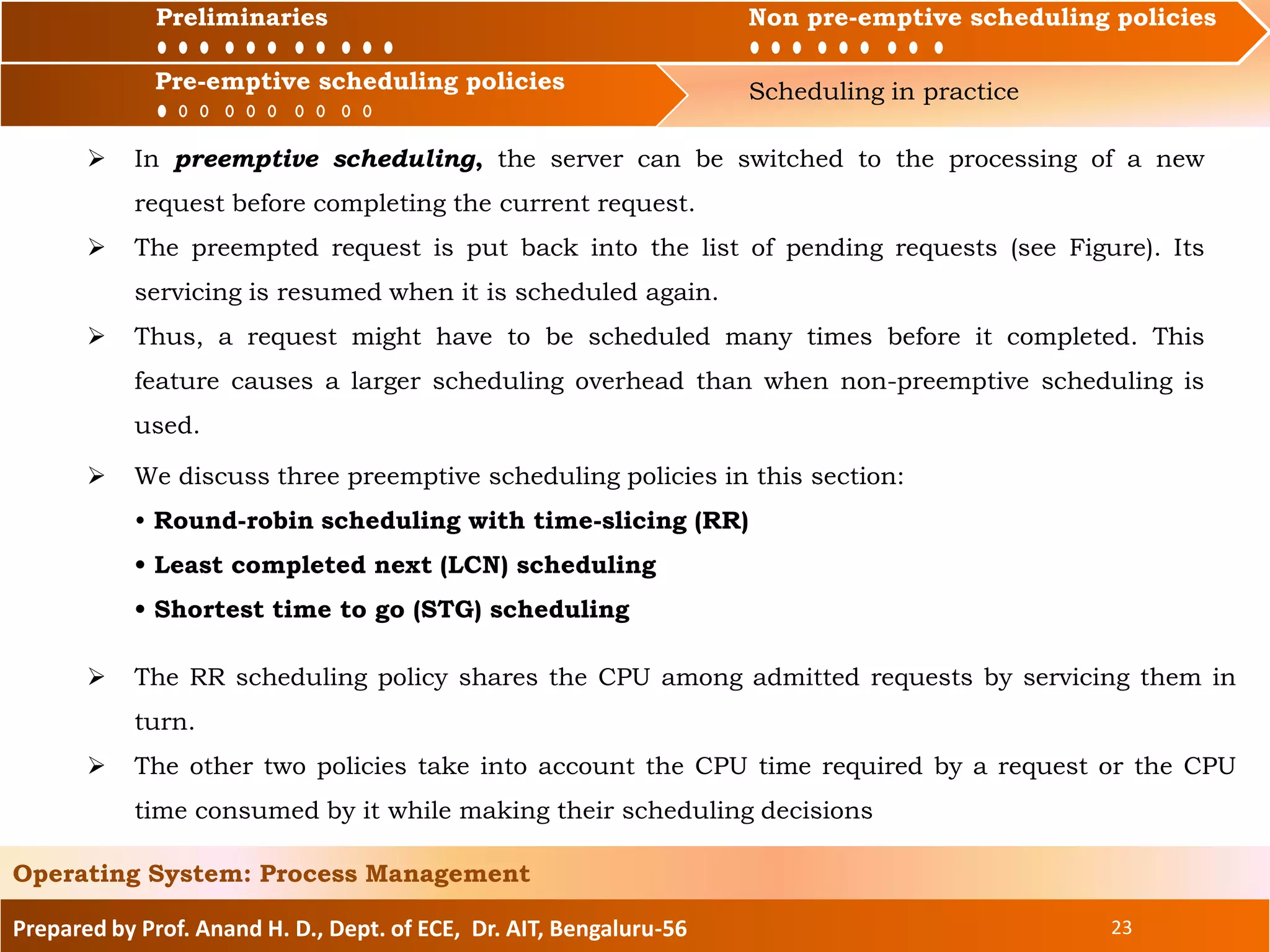
 In preemptive scheduling, the server can be switched to the processing of a new
request before completing the current request.
 The preempted request is put back into the list of pending requests (see Figure). Its
servicing is resumed when it is scheduled again.
 Thus, a request might have to be scheduled many times before it completed. This
feature causes a larger scheduling overhead than when non-preemptive scheduling is
used.
 We discuss three preemptive scheduling policies in this section:
• Round-robin scheduling with time-slicing (RR)
• Least completed next (LCN) scheduling
• Shortest time to go (STG) scheduling
Pre-emptive scheduling policies
 The RR scheduling policy shares the CPU among admitted requests by servicing them in
turn.
 The other two policies take into account the CPU time required by a request or the CPU
time consumed by it while making their scheduling decisions
Preliminaries Non pre-emptive scheduling policies
Pre-emptive scheduling policies Scheduling in practice
Prepared by Prof. Anand H. D., Dept. of ECE, Dr. AIT, Bengaluru-56 24
Operating System: Process Management
Preliminaries Non pre-emptive scheduling policies
Round-Robin Scheduling with Time-Slicing (RR) :
 The RR policy aims at providing good response times to all requests. The time slice,
which is designated as δ, is the largest amount of CPU time a request may use when
scheduled.
 A request is preempted at the end of a time slice. To facilitate this, the kernel arranges to
raise a timer interrupt when the time slice elapses.
 The RR policy provides comparable service to all CPU-bound processes. This feature is
reflected in approximately equal values of their weighted turnarounds.
 The actual value of the weighted turnaround of a process depends on the number
of processes in the system.
 Weighted turnarounds provided to processes that perform I/O operations would depend
on the durations of their I/O operations.
 The RR policy does not fare well on measures of system performance like throughput
because it does not give a favored treatment to short processes.
Pre-emptive scheduling policies
 The following example illustrates the performance of RR scheduling.
Preliminaries Non pre-emptive scheduling policies
Pre-emptive scheduling policies Scheduling in practice
Prepared by Prof. Anand H. D., Dept. of ECE, Dr. AIT, Bengaluru-56 25
Operating System: Process Management
Preliminaries Non pre-emptive scheduling policies
 A round-robin scheduler maintains a queue of processes in the ready state and simply
selects the first process in the queue.
 The running process is preempted when the time slice elapses and it is put at the end of
the queue. It is assumed that a new process that was admitted into the system at the
same instant a process was preempted will be entered into the queue before the
preempted process.
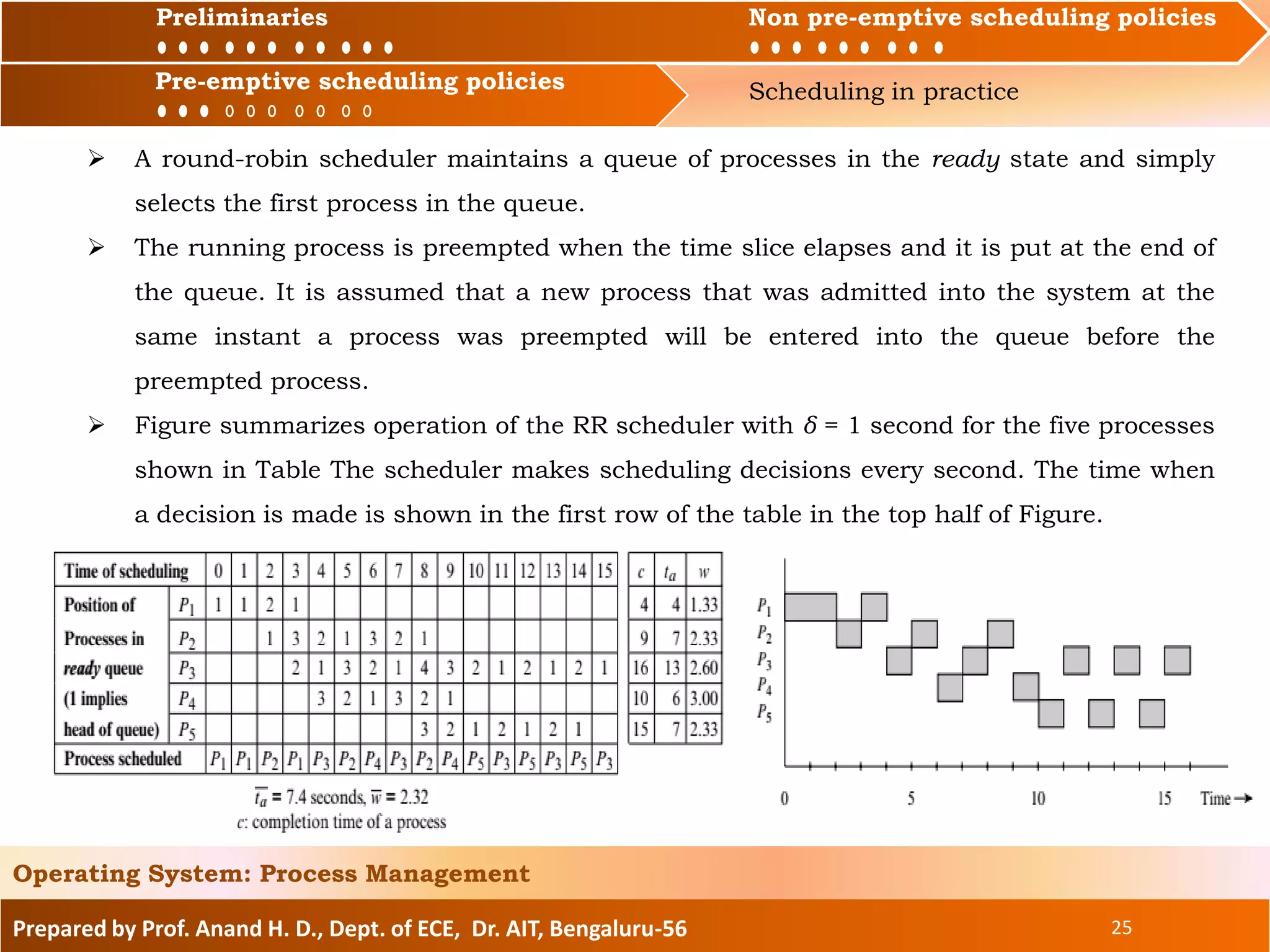
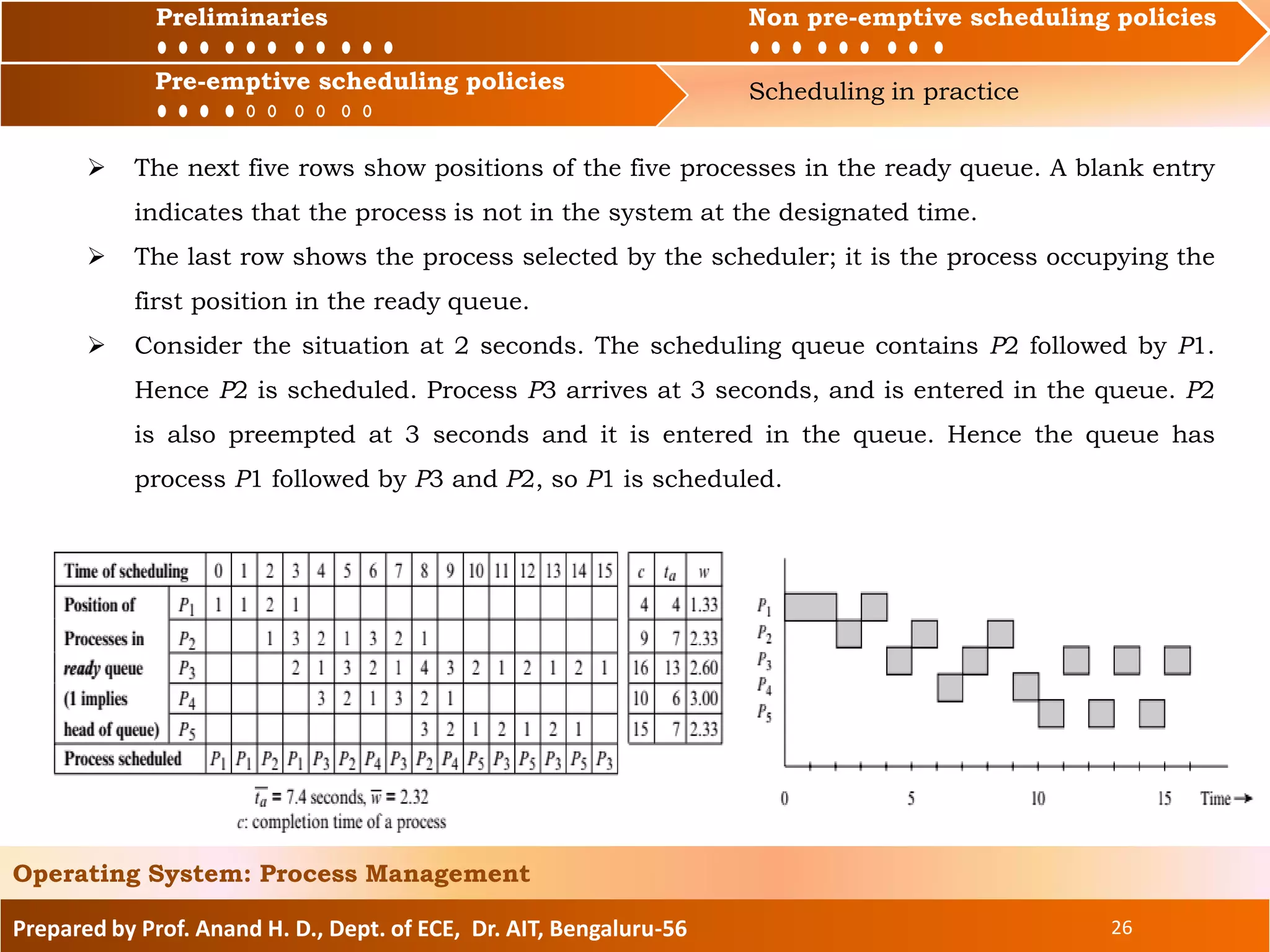
 Figure summarizes operation of the RR scheduler with δ = 1 second for the five processes
shown in Table The scheduler makes scheduling decisions every second. The time when
a decision is made is shown in the first row of the table in the top half of Figure.
Pre-emptive scheduling policies
Preliminaries Non pre-emptive scheduling policies
Pre-emptive scheduling policies Scheduling in practice
Prepared by Prof. Anand H. D., Dept. of ECE, Dr. AIT, Bengaluru-56 26
Operating System: Process Management
Preliminaries Non pre-emptive scheduling policies
 The next five rows show positions of the five processes in the ready queue. A blank entry
indicates that the process is not in the system at the designated time.
 The last row shows the process selected by the scheduler; it is the process occupying the
first position in the ready queue.
 Consider the situation at 2 seconds. The scheduling queue contains P2 followed by P1.
Hence P2 is scheduled. Process P3 arrives at 3 seconds, and is entered in the queue. P2
is also preempted at 3 seconds and it is entered in the queue. Hence the queue has
process P1 followed by P3 and P2, so P1 is scheduled.
Pre-emptive scheduling policies
Preliminaries Non pre-emptive scheduling policies
Pre-emptive scheduling policies Scheduling in practice
Prepared by Prof. Anand H. D., Dept. of ECE, Dr. AIT, Bengaluru-56 27
Operating System: Process Management
Preliminaries Non pre-emptive scheduling policies
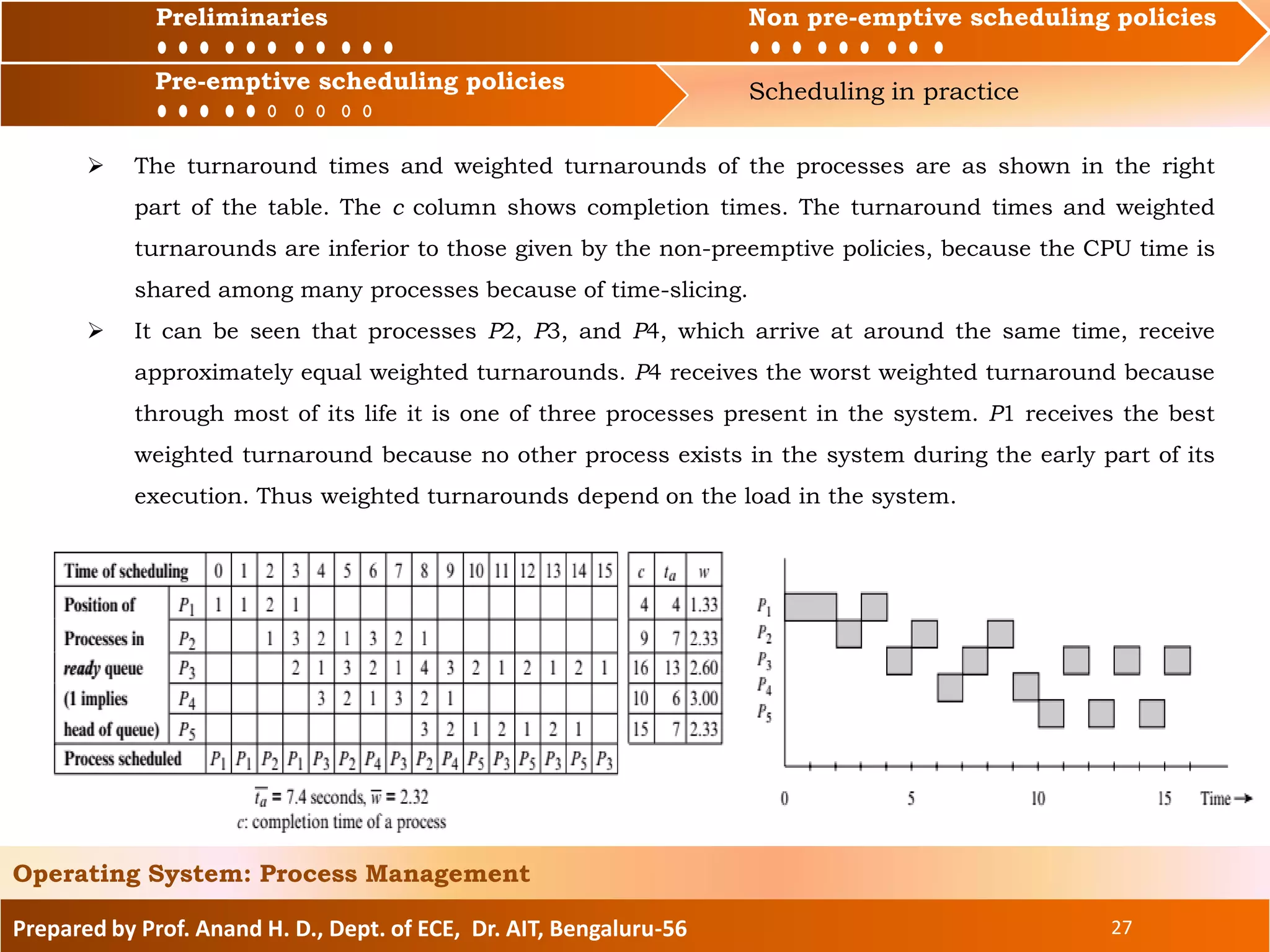
 The turnaround times and weighted turnarounds of the processes are as shown in the right
part of the table. The c column shows completion times. The turnaround times and weighted
turnarounds are inferior to those given by the non-preemptive policies, because the CPU time is
shared among many processes because of time-slicing.
 It can be seen that processes P2, P3, and P4, which arrive at around the same time, receive
approximately equal weighted turnarounds. P4 receives the worst weighted turnaround because
through most of its life it is one of three processes present in the system. P1 receives the best
weighted turnaround because no other process exists in the system during the early part of its
execution. Thus weighted turnarounds depend on the load in the system.
Pre-emptive scheduling policies
Preliminaries Non pre-emptive scheduling policies
Pre-emptive scheduling policies Scheduling in practice
Prepared by Prof. Anand H. D., Dept. of ECE, Dr. AIT, Bengaluru-56 28
Operating System: Process Management
Preliminaries Non pre-emptive scheduling policies
Least Completed Next (LCN) Scheduling :
 The LCN policy schedules the process that has so far consumed the least amount of CPU
time.
 Thus, the nature of a process, whether CPU-bound or I/O-bound, and its CPU time
requirement do not influence its progress in the system.
 Under the LCN policy, all processes will make approximately equal progress in terms of
the CPU time consumed by them, so this policy guarantees that short processes will
finish ahead of long processes.
 Ultimately, however, this policy has the familiar drawback of starving long processes of
CPU attention. It also neglects existing processes if new processes keep arriving in the
system.
 So even not-so-long processes tend to suffer starvation or large turnaround times.
Pre-emptive scheduling policies
 The following example illustrates the performance of LCN scheduling.
Preliminaries Non pre-emptive scheduling policies
Pre-emptive scheduling policies Scheduling in practice
Prepared by Prof. Anand H. D., Dept. of ECE, Dr. AIT, Bengaluru-56 29
Operating System: Process Management
Preliminaries Non pre-emptive scheduling policies
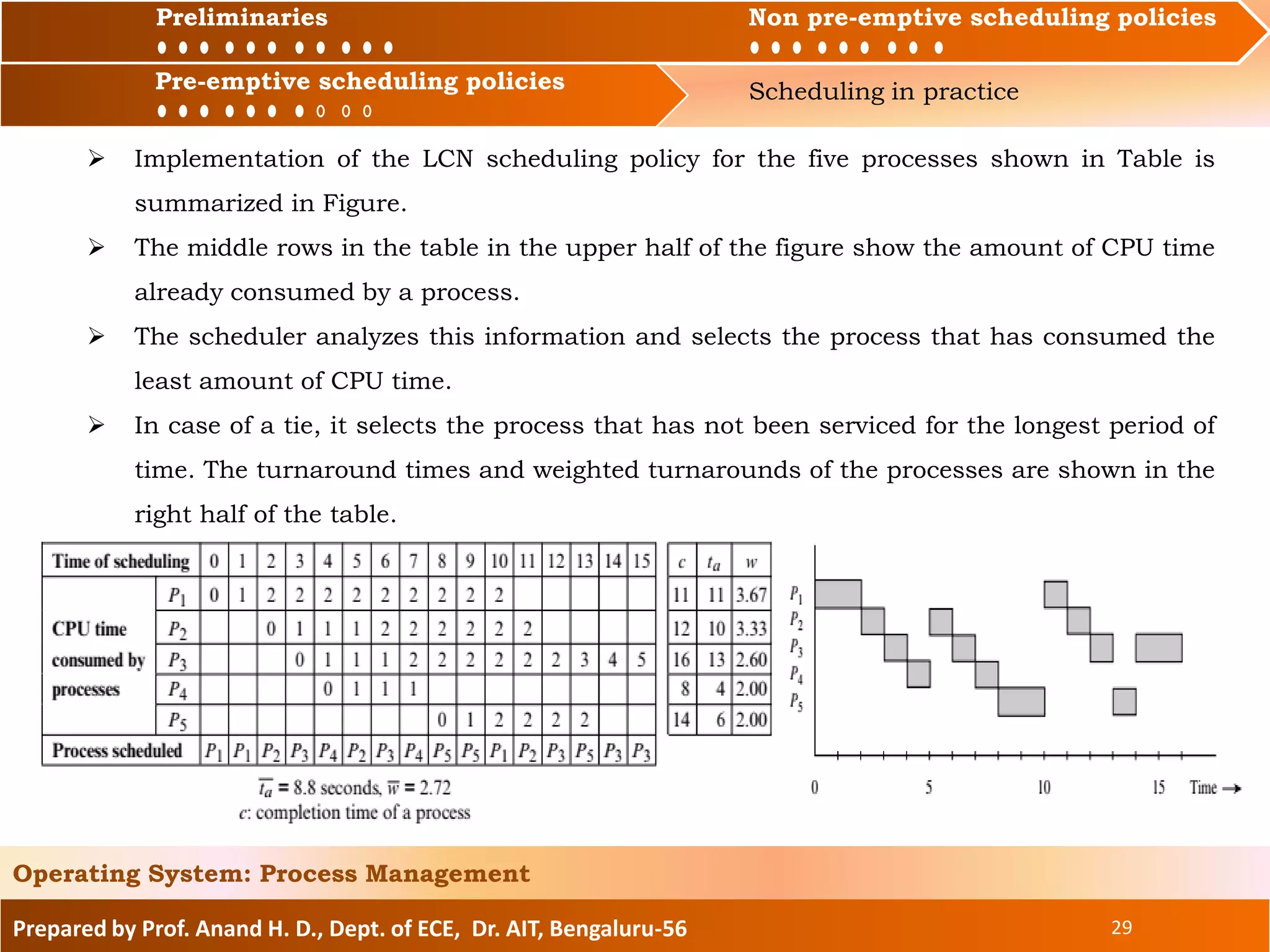
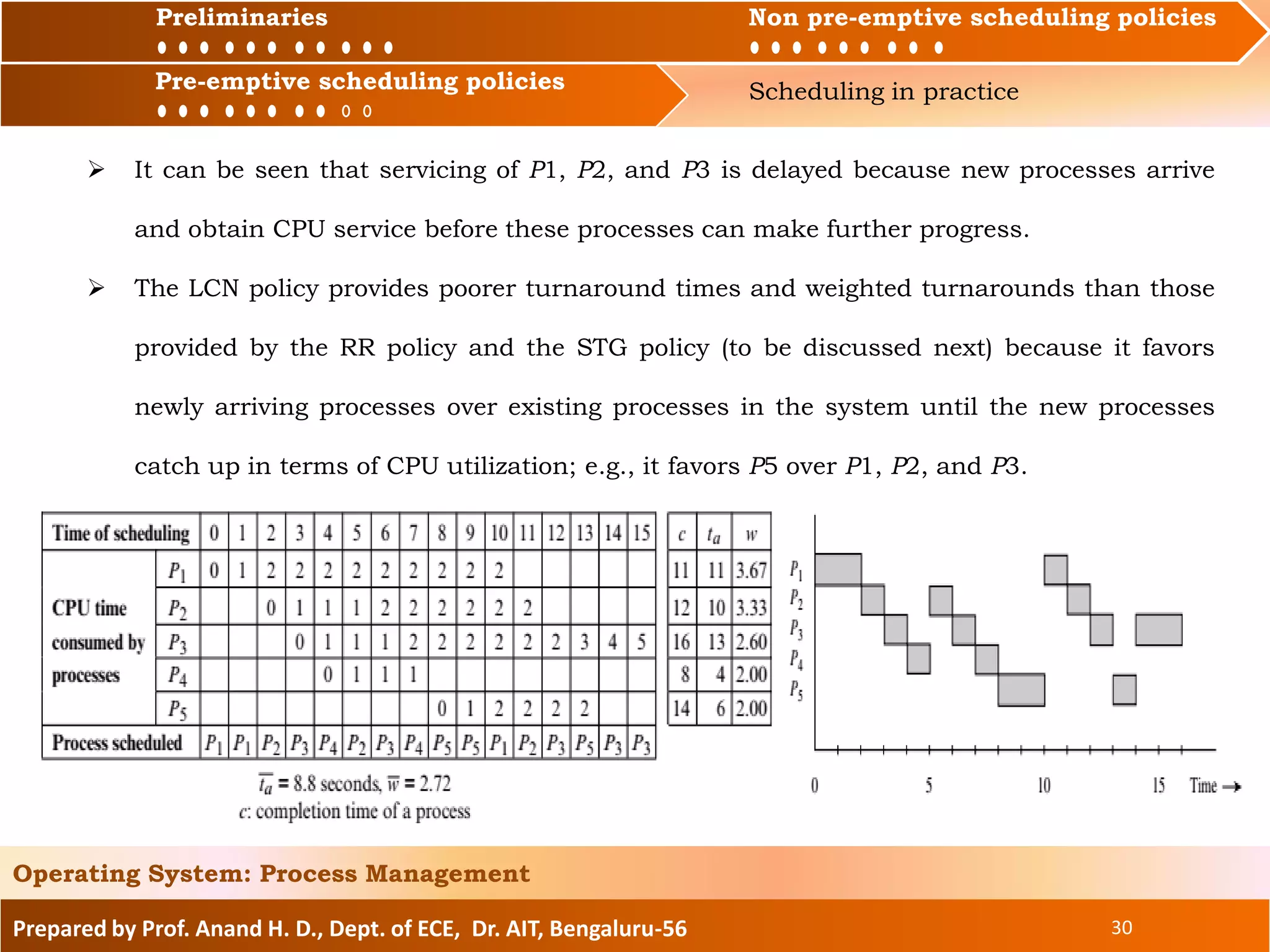
 Implementation of the LCN scheduling policy for the five processes shown in Table is
summarized in Figure.
 The middle rows in the table in the upper half of the figure show the amount of CPU time
already consumed by a process.
 The scheduler analyzes this information and selects the process that has consumed the
least amount of CPU time.
 In case of a tie, it selects the process that has not been serviced for the longest period of
time. The turnaround times and weighted turnarounds of the processes are shown in the
right half of the table.
Pre-emptive scheduling policies
Preliminaries Non pre-emptive scheduling policies
Pre-emptive scheduling policies Scheduling in practice
Prepared by Prof. Anand H. D., Dept. of ECE, Dr. AIT, Bengaluru-56 30
Operating System: Process Management
Preliminaries Non pre-emptive scheduling policies
 It can be seen that servicing of P1, P2, and P3 is delayed because new processes arrive
and obtain CPU service before these processes can make further progress.
 The LCN policy provides poorer turnaround times and weighted turnarounds than those
provided by the RR policy and the STG policy (to be discussed next) because it favors
newly arriving processes over existing processes in the system until the new processes
catch up in terms of CPU utilization; e.g., it favors P5 over P1, P2, and P3.
Pre-emptive scheduling policies
Preliminaries Non pre-emptive scheduling policies
Pre-emptive scheduling policies Scheduling in practice
Prepared by Prof. Anand H. D., Dept. of ECE, Dr. AIT, Bengaluru-56 31
Operating System: Process Management
Preliminaries Non pre-emptive scheduling policies
Shortest Time to Go (STG) Scheduling :
 The shortest time to go policy schedules a process whose remaining CPU time
requirements are the smallest in the system.
 It is a preemptive version of the shortest request next (SRN) policy, so it favors short
processes over long ones and provides good throughput.
 Additionally, the STG policy also favors a process that is nearing completion over short
processes entering the system.
 This feature helps to improve the turnaround times and weighted turnarounds of
processes.
 Since it is analogous to the SRN policy, long processes might face starvation.
Pre-emptive scheduling policies
 The following example illustrates the performance of STG scheduling.
Preliminaries Non pre-emptive scheduling policies
Pre-emptive scheduling policies Scheduling in practice
Prepared by Prof. Anand H. D., Dept. of ECE, Dr. AIT, Bengaluru-56 32
Operating System: Process Management
Preliminaries Non pre-emptive scheduling policies
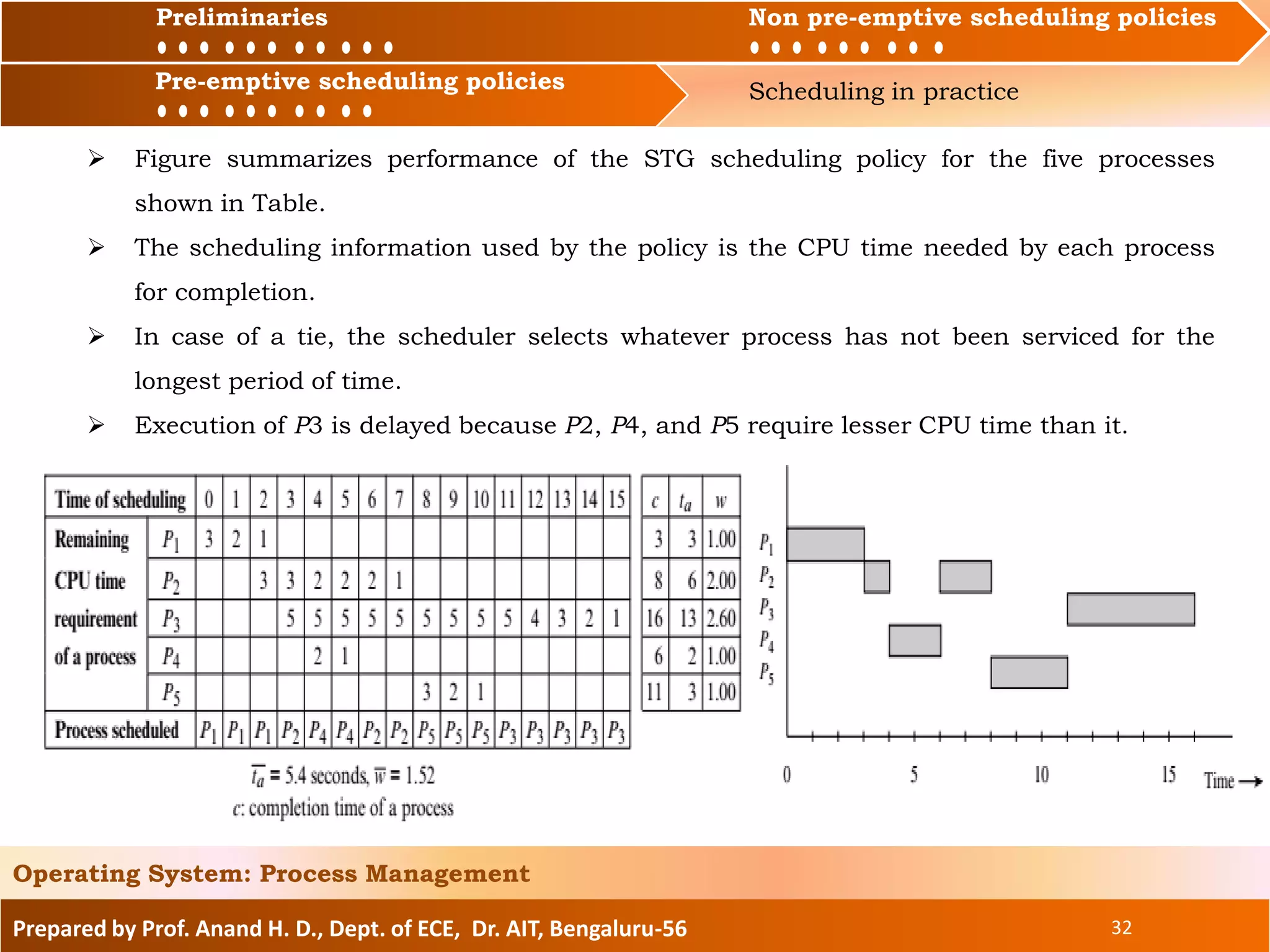
 Figure summarizes performance of the STG scheduling policy for the five processes
shown in Table.
 The scheduling information used by the policy is the CPU time needed by each process
for completion.
 In case of a tie, the scheduler selects whatever process has not been serviced for the
longest period of time.
 Execution of P3 is delayed because P2, P4, and P5 require lesser CPU time than it.
Pre-emptive scheduling policies
Preliminaries Non pre-emptive scheduling policies
Pre-emptive scheduling policies Scheduling in practice
Prepared by Prof. Anand H. D., Dept. of ECE, Dr. AIT, Bengaluru-56 33
Operating System: Process Management
Preliminaries Non pre-emptive scheduling policies
 To provide a suitable combination of system performance and user service, an operating
system has to adapt its operation to the nature and number of user requests and availability of
resources.
 A single scheduler using a classical scheduling policy cannot address all these issues
effectively. Hence, a modern OS employs several schedulers—up to three schedulers, as we
shall see later— and some of the schedulers may use a combination of different scheduling
policies.
Long-, Medium- and Short-Term Schedulers
 These schedulers perform the following functions:
• Long-term scheduler: Decides when to admit an arrived process for scheduling, depending
on its nature (whether CPU-bound or I/O-bound) and on availability of resources like kernel
data structures and disk space for swapping.
• Medium-term scheduler: Decides when to swap-out a process from memory and when to
load it back, so that a sufficient number of ready processes would exist in memory.
• Short-term scheduler: Decides which ready process to service next on the CPU and for how
long.
Pre-emptive scheduling policies Scheduling in practice
Preliminaries Non pre-emptive scheduling policies
Pre-emptive scheduling policies Scheduling in practice
Prepared by Prof. Anand H. D., Dept. of ECE, Dr. AIT, Bengaluru-56 34
Operating System: Process Management
Preliminaries Non pre-emptive scheduling policies
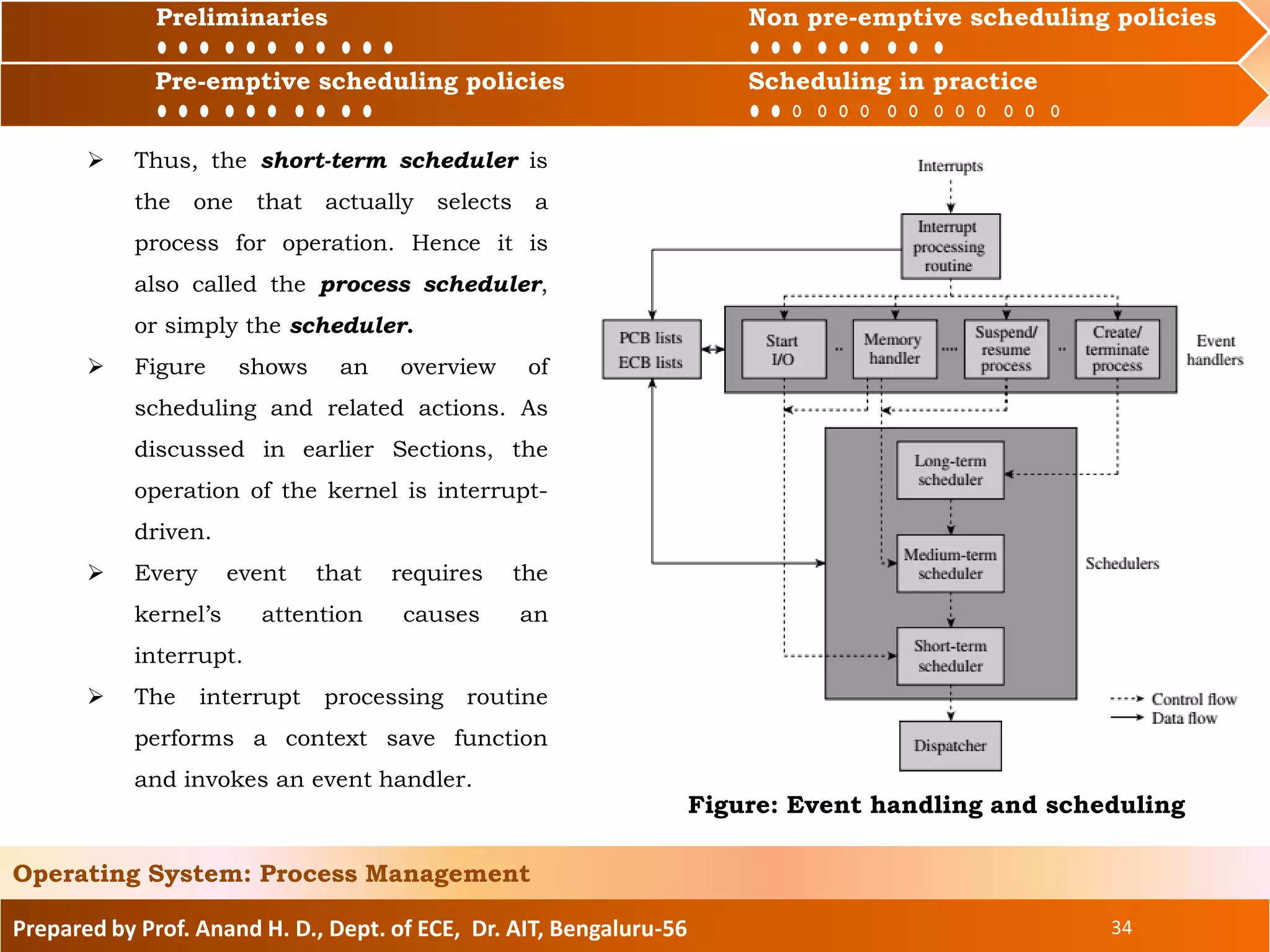
 Thus, the short-term scheduler is
the one that actually selects a
process for operation. Hence it is
also called the process scheduler,
or simply the scheduler.
 Figure shows an overview of
scheduling and related actions. As
discussed in earlier Sections, the
operation of the kernel is interrupt-
driven.
 Every event that requires the
kernel’s attention causes an
interrupt.
 The interrupt processing routine
performs a context save function
and invokes an event handler.
Pre-emptive scheduling policies Scheduling in practice
Figure: Event handling and scheduling
Preliminaries Non pre-emptive scheduling policies
Pre-emptive scheduling policies Scheduling in practice
Prepared by Prof. Anand H. D., Dept. of ECE, Dr. AIT, Bengaluru-56 35
Operating System: Process Management
Preliminaries Non pre-emptive scheduling policies
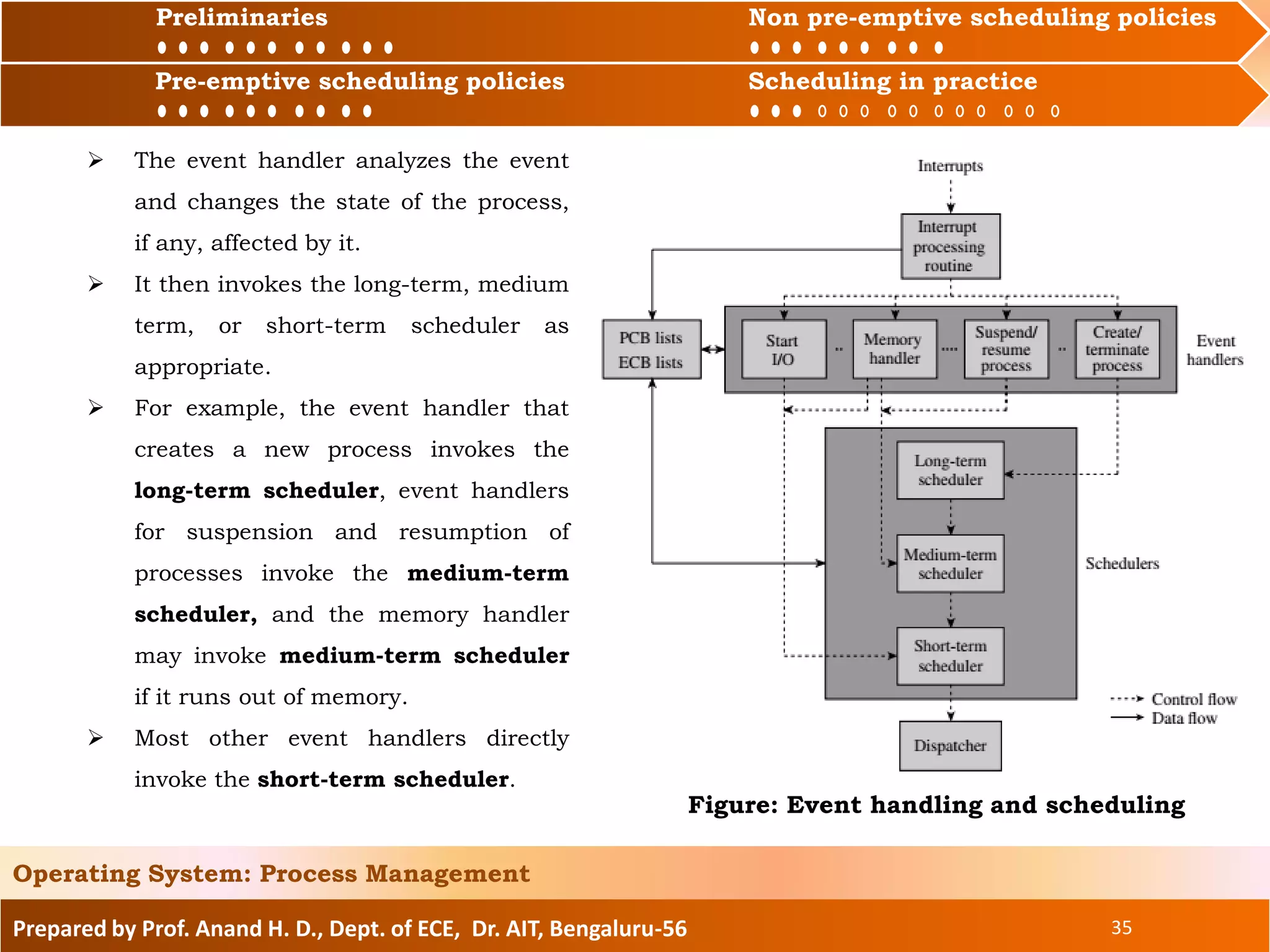
 The event handler analyzes the event
and changes the state of the process,
if any, affected by it.
 It then invokes the long-term, medium
term, or short-term scheduler as
appropriate.
 For example, the event handler that
creates a new process invokes the
long-term scheduler, event handlers
for suspension and resumption of
processes invoke the medium-term
scheduler, and the memory handler
may invoke medium-term scheduler
if it runs out of memory.
 Most other event handlers directly
invoke the short-term scheduler.
Pre-emptive scheduling policies Scheduling in practice
Figure: Event handling and scheduling
Preliminaries Non pre-emptive scheduling policies
Pre-emptive scheduling policies Scheduling in practice
Prepared by Prof. Anand H. D., Dept. of ECE, Dr. AIT, Bengaluru-56 36
Operating System: Process Management
Preliminaries Non pre-emptive scheduling policies
 The long-term scheduler may defer admission of a request for two reasons: it may not be
able to allocate sufficient resources like kernel data structures or I/O devices to a
request when it arrives, or it may find that admission of a request would affect system
performance in some way;
e.g., if the system currently contained a large number of CPU-bound requests, the
scheduler might defer admission of a new CPU-bound request, but it might admit a new
I/O-bound request right away.
Pre-emptive scheduling policies Scheduling in practice
Long-Term Scheduling
 Long-term scheduling was used in the 1960s and 1970s for job scheduling because
computer systems had limited resources, so a long-term scheduler was required to
decide whether a process could be initiated at the present time.
 It continues to be important in operating systems where resources are limited. It is also
used in systems where requests have deadlines, or a set of requests are repeated with a
known periodicity, to decide when a process should be initiated to meet response
requirements of applications.
Preliminaries Non pre-emptive scheduling policies
Pre-emptive scheduling policies Scheduling in practice
Prepared by Prof. Anand H. D., Dept. of ECE, Dr. AIT, Bengaluru-56 37
Operating System: Process Management
Preliminaries Non pre-emptive scheduling policies
 Medium-term scheduling maps the large number of requests that have been admitted to
the system into the smaller number of requests that can fit into the memory of the system
at any time.
Pre-emptive scheduling policies Scheduling in practice
Medium-Term Scheduling
 Thus its focus is on making a sufficient number of ready processes available to the short-
term scheduler by suspending or reactivating processes.
 The medium term scheduler decides when to swap out a process from memory and when
to swap it back into memory, changes the state of the process appropriately, and enters its
process control block (PCB) in the appropriate list of PCBs.
 The actual swapping-in and swapping-out operations are performed by the memory
manager. The kernel can suspend a process when a user requests suspension, when the
kernel runs out of free memory, or when it finds that the CPU is not likely to be allocated to
the process in the near future. In time-sharing systems, processes in blocked or ready
states are candidates for suspension. The decision to reactivate a process is more involved:
 The medium term scheduler considers the position occupied by a process in the scheduling
list, estimates when it is likely to be scheduled next, and swaps it in ahead of this time.
Preliminaries Non pre-emptive scheduling policies
Pre-emptive scheduling policies Scheduling in practice
Prepared by Prof. Anand H. D., Dept. of ECE, Dr. AIT, Bengaluru-56 38
Operating System: Process Management
Preliminaries Non pre-emptive scheduling policies
 Short-term scheduling is concerned with effective use of the CPU. It selects one process
from a list of ready processes and hands it to the dispatching mechanism.
Pre-emptive scheduling policies Scheduling in practice
Short-Term Scheduling
 It may also decide how long the process should be allowed to use the CPU and instruct the
kernel to produce a timer interrupt accordingly.
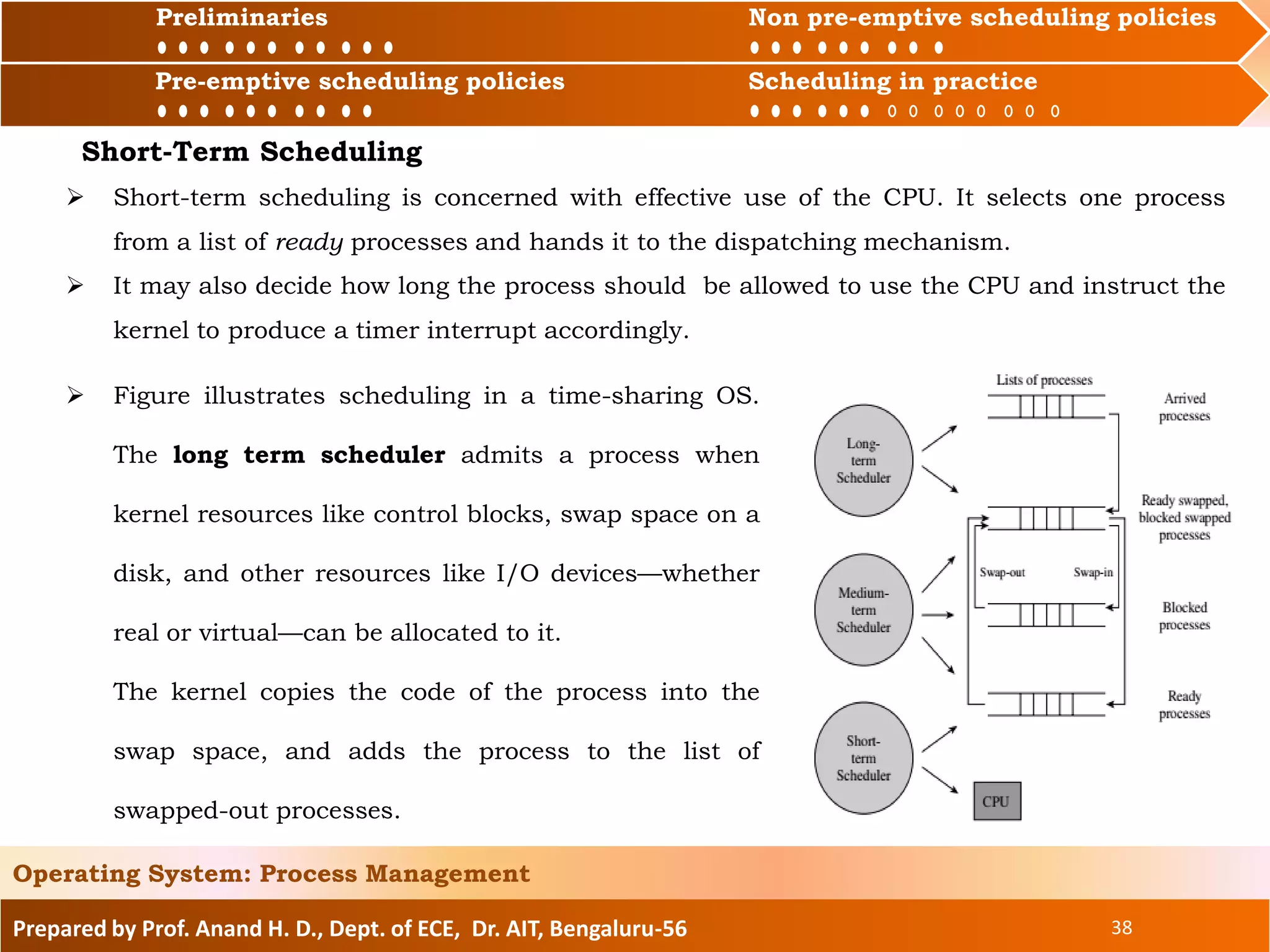
 Figure illustrates scheduling in a time-sharing OS.
The long term scheduler admits a process when
kernel resources like control blocks, swap space on a
disk, and other resources like I/O devices—whether
real or virtual—can be allocated to it.
The kernel copies the code of the process into the
swap space, and adds the process to the list of
swapped-out processes.
Preliminaries Non pre-emptive scheduling policies
Pre-emptive scheduling policies Scheduling in practice
Prepared by Prof. Anand H. D., Dept. of ECE, Dr. AIT, Bengaluru-56 39
Operating System: Process Management
Preliminaries Non pre-emptive scheduling policies
Pre-emptive scheduling policies Scheduling in practice
Short-Term Scheduling
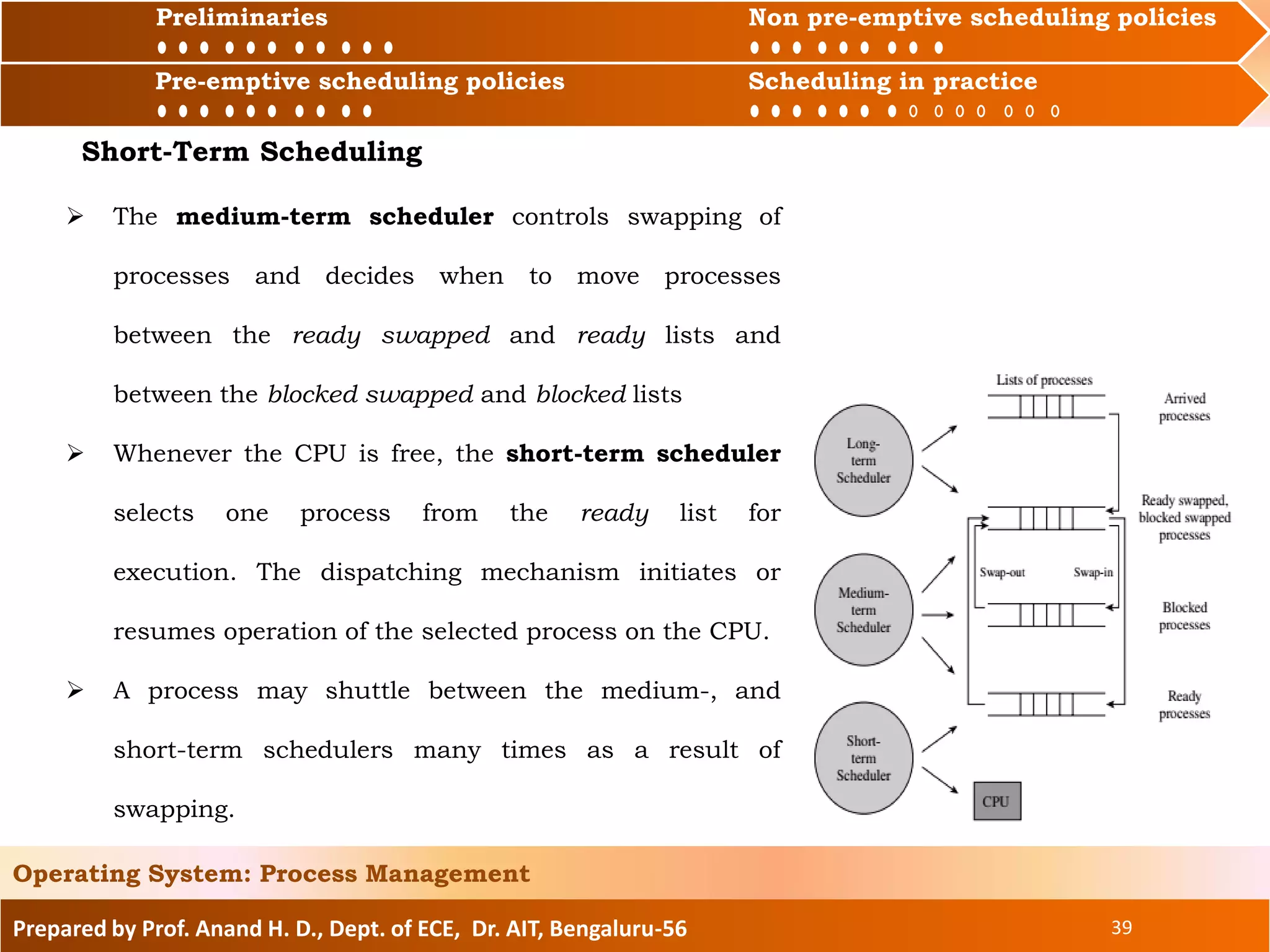
 The medium-term scheduler controls swapping of
processes and decides when to move processes
between the ready swapped and ready lists and
between the blocked swapped and blocked lists
 Whenever the CPU is free, the short-term scheduler
selects one process from the ready list for
execution. The dispatching mechanism initiates or
resumes operation of the selected process on the CPU.
 A process may shuttle between the medium-, and
short-term schedulers many times as a result of
swapping.
Preliminaries Non pre-emptive scheduling policies
Pre-emptive scheduling policies Scheduling in practice
Prepared by Prof. Anand H. D., Dept. of ECE, Dr. AIT, Bengaluru-56 40
Operating System: Process Management
Preliminaries Non pre-emptive scheduling policies
Pre-emptive scheduling policies Scheduling in practice
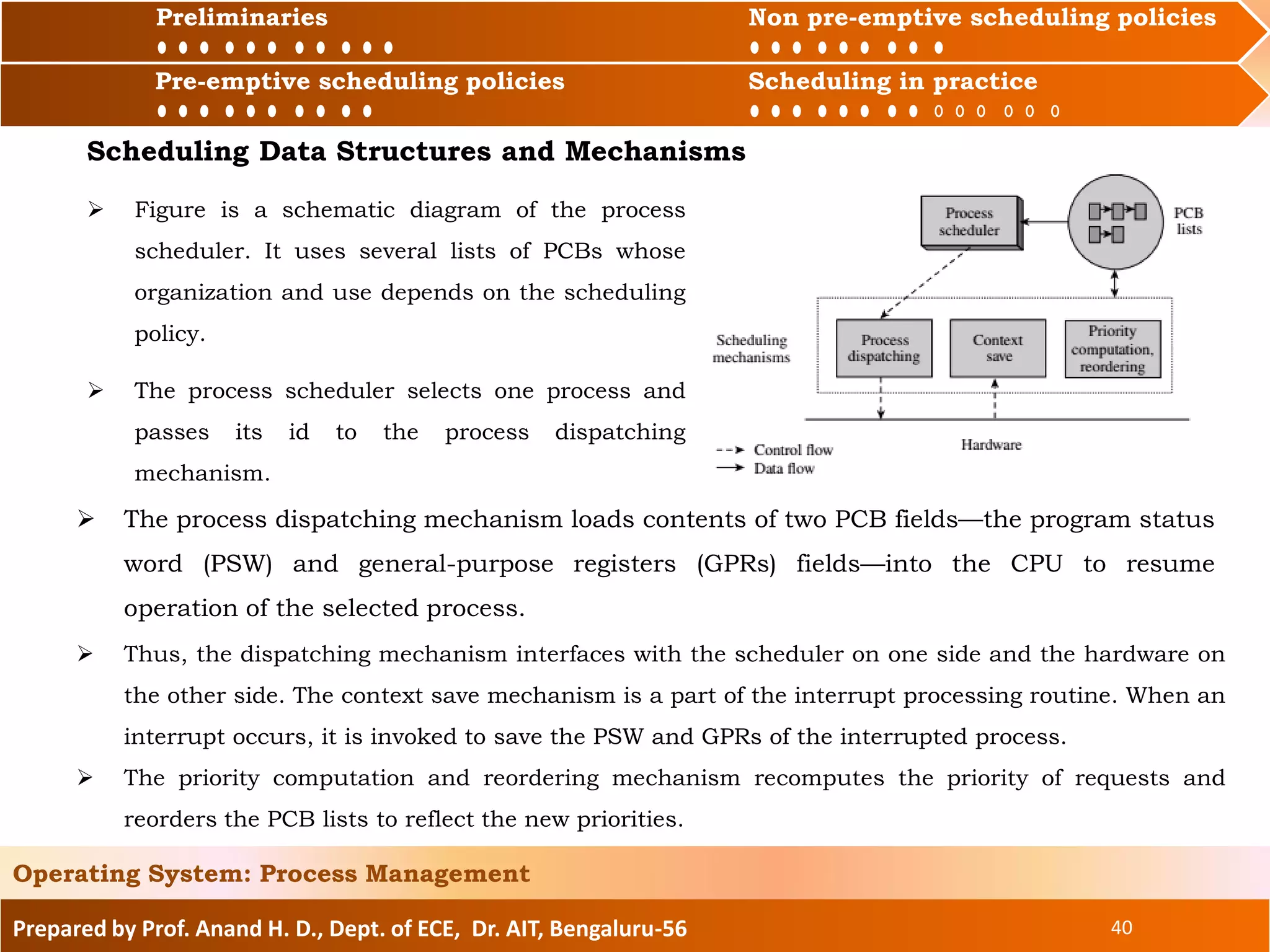
 Figure is a schematic diagram of the process
scheduler. It uses several lists of PCBs whose
organization and use depends on the scheduling
policy.
 The process scheduler selects one process and
passes its id to the process dispatching
mechanism.
 Thus, the dispatching mechanism interfaces with the scheduler on one side and the hardware on
the other side. The context save mechanism is a part of the interrupt processing routine. When an
interrupt occurs, it is invoked to save the PSW and GPRs of the interrupted process.
 The priority computation and reordering mechanism recomputes the priority of requests and
reorders the PCB lists to reflect the new priorities.
Scheduling Data Structures and Mechanisms
 The process dispatching mechanism loads contents of two PCB fields—the program status
word (PSW) and general-purpose registers (GPRs) fields—into the CPU to resume
operation of the selected process.
Preliminaries Non pre-emptive scheduling policies
Pre-emptive scheduling policies Scheduling in practice
Prepared by Prof. Anand H. D., Dept. of ECE, Dr. AIT, Bengaluru-56 41
Operating System: Process Management
Preliminaries Non pre-emptive scheduling policies
Pre-emptive scheduling policies Scheduling in practice
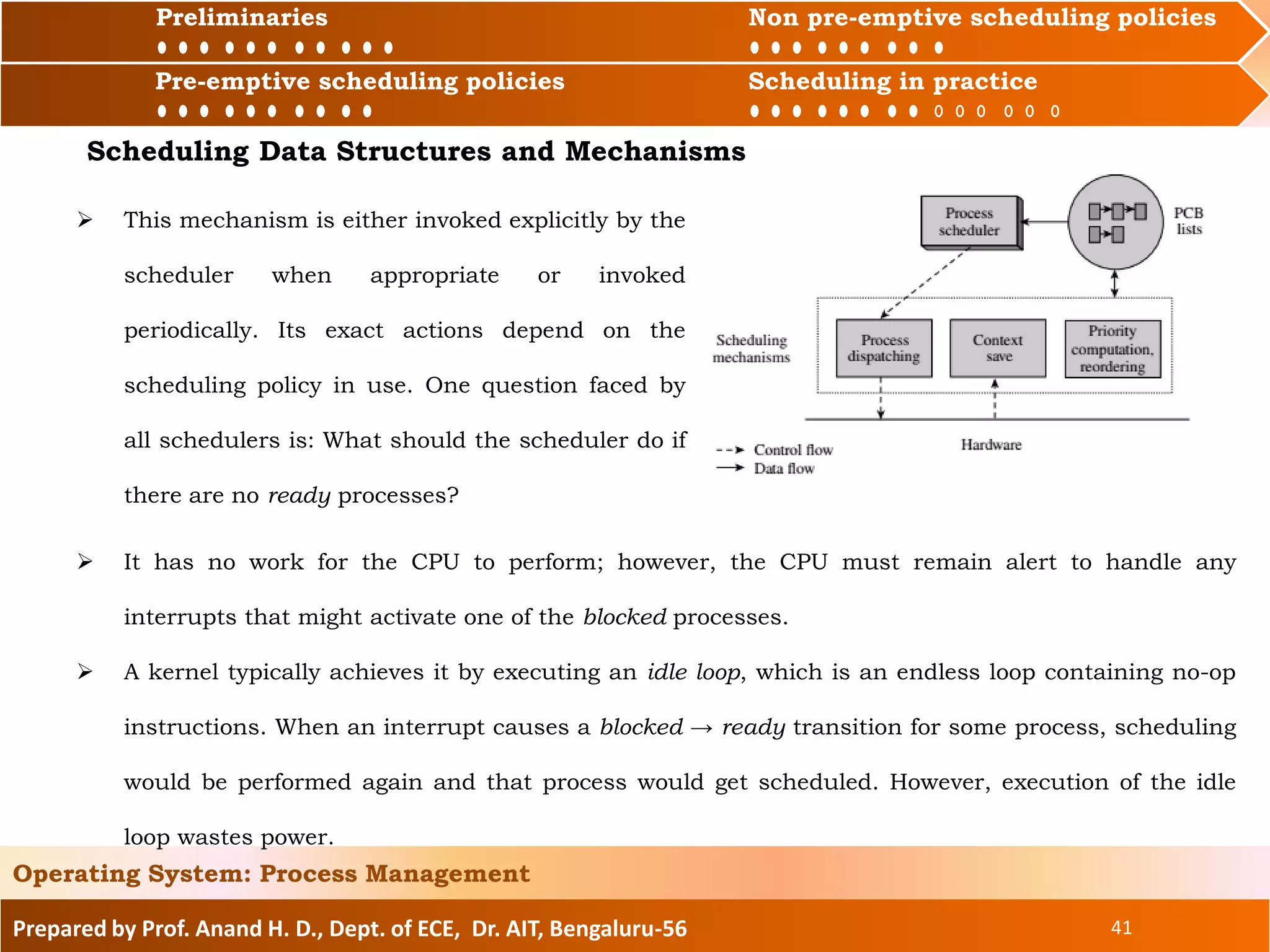
 This mechanism is either invoked explicitly by the
scheduler when appropriate or invoked
periodically. Its exact actions depend on the
scheduling policy in use. One question faced by
all schedulers is: What should the scheduler do if
there are no ready processes?
Scheduling Data Structures and Mechanisms
 It has no work for the CPU to perform; however, the CPU must remain alert to handle any
interrupts that might activate one of the blocked processes.
 A kernel typically achieves it by executing an idle loop, which is an endless loop containing no-op
instructions. When an interrupt causes a blocked → ready transition for some process, scheduling
would be performed again and that process would get scheduled. However, execution of the idle
loop wastes power.
Preliminaries Non pre-emptive scheduling policies
Pre-emptive scheduling policies Scheduling in practice
Prepared by Prof. Anand H. D., Dept. of ECE, Dr. AIT, Bengaluru-56 42
Operating System: Process Management
Preliminaries Non pre-emptive scheduling policies
Pre-emptive scheduling policies Scheduling in practice
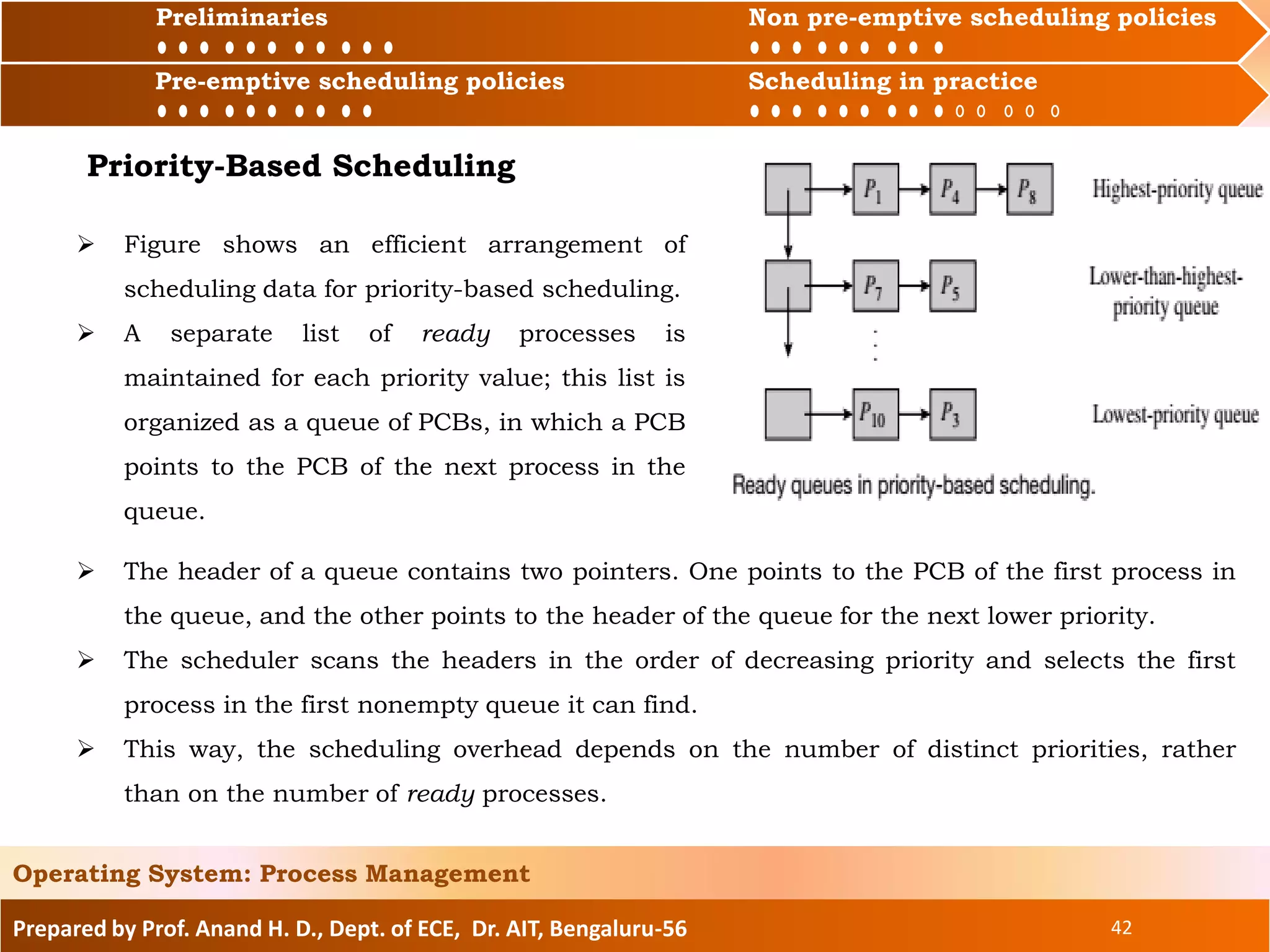
 Figure shows an efficient arrangement of
scheduling data for priority-based scheduling.
 A separate list of ready processes is
maintained for each priority value; this list is
organized as a queue of PCBs, in which a PCB
points to the PCB of the next process in the
queue.
Priority-Based Scheduling
 The header of a queue contains two pointers. One points to the PCB of the first process in
the queue, and the other points to the header of the queue for the next lower priority.
 The scheduler scans the headers in the order of decreasing priority and selects the first
process in the first nonempty queue it can find.
 This way, the scheduling overhead depends on the number of distinct priorities, rather
than on the number of ready processes.
Preliminaries Non pre-emptive scheduling policies
Pre-emptive scheduling policies Scheduling in practice
Prepared by Prof. Anand H. D., Dept. of ECE, Dr. AIT, Bengaluru-56 43
Operating System: Process Management
Preliminaries Non pre-emptive scheduling policies
Pre-emptive scheduling policies Scheduling in practice
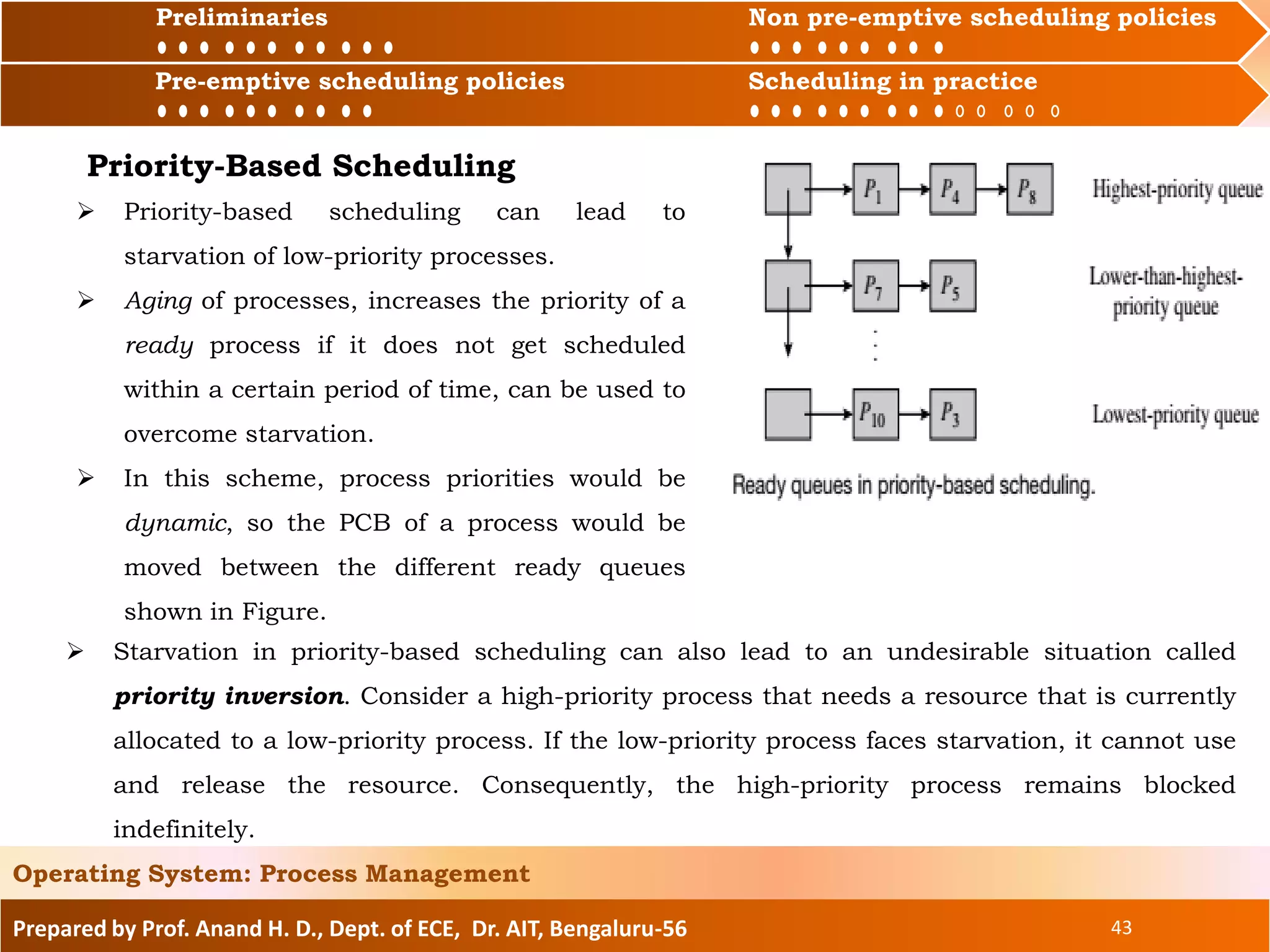
 Priority-based scheduling can lead to
starvation of low-priority processes.
 Aging of processes, increases the priority of a
ready process if it does not get scheduled
within a certain period of time, can be used to
overcome starvation.
 In this scheme, process priorities would be
dynamic, so the PCB of a process would be
moved between the different ready queues
shown in Figure.
Priority-Based Scheduling
 Starvation in priority-based scheduling can also lead to an undesirable situation called
priority inversion. Consider a high-priority process that needs a resource that is currently
allocated to a low-priority process. If the low-priority process faces starvation, it cannot use
and release the resource. Consequently, the high-priority process remains blocked
indefinitely.
Preliminaries Non pre-emptive scheduling policies
Pre-emptive scheduling policies Scheduling in practice
Prepared by Prof. Anand H. D., Dept. of ECE, Dr. AIT, Bengaluru-56 44
Operating System: Process Management
Preliminaries Non pre-emptive scheduling policies
Pre-emptive scheduling policies Scheduling in practice
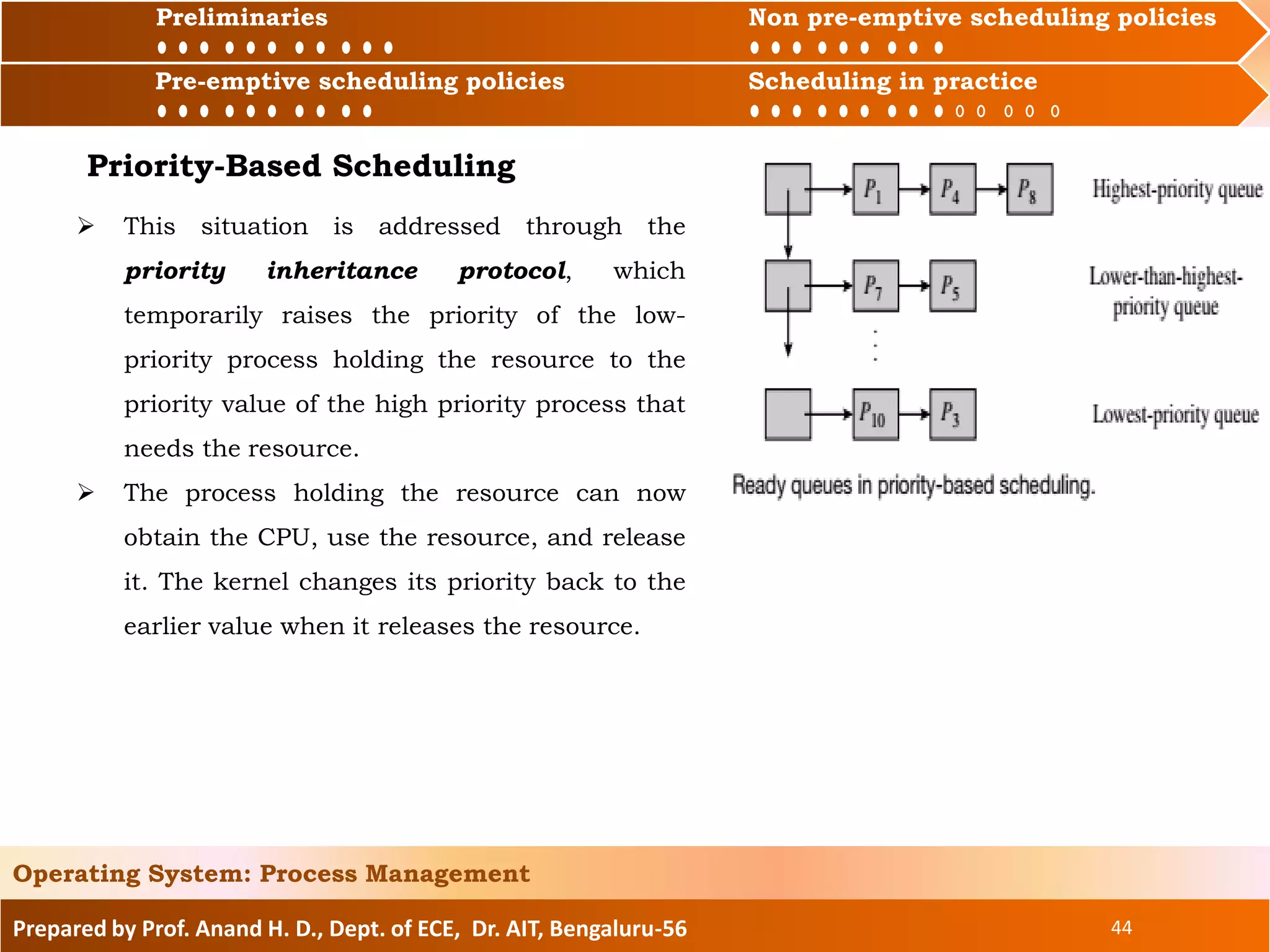
 This situation is addressed through the
priority inheritance protocol, which
temporarily raises the priority of the low-
priority process holding the resource to the
priority value of the high priority process that
needs the resource.
 The process holding the resource can now
obtain the CPU, use the resource, and release
it. The kernel changes its priority back to the
earlier value when it releases the resource.
Priority-Based Scheduling
Preliminaries Non pre-emptive scheduling policies
Pre-emptive scheduling policies Scheduling in practice
Prepared by Prof. Anand H. D., Dept. of ECE, Dr. AIT, Bengaluru-56 45
Operating System: Process Management
Preliminaries Non pre-emptive scheduling policies
Pre-emptive scheduling policies Scheduling in practice
 The multilevel scheduling policy combines priority-based scheduling and round robin scheduling
to provide a good combination of system performance and response times.
 A multilevel scheduler maintains a number of ready queues. A priority and a time slice are
associated with each ready queue, and round-robin scheduling with time-slicing is performed
within it.
 The queue at a high priority level has a small time slice associated with it, which ensures good
response times for processes in this queue, while the queue at a low priority level has a large time
slice, which ensures low process switching overhead.
 A process at the head of a queue is scheduled only if the queues for all higher priority levels are
empty.
 Scheduling is preemptive, so a process is preempted when a new process is added to a queue at a
higher priority level. As in round-robin scheduling with time-slicing, when a process makes an
I/O request, or is swapped out, its PCB is removed from the ready queue.
 When the I/O operation completes, or the process is swapped in, its PCB is added at the end of
that ready queue where it existed earlier.
Multilevel Scheduling
Preliminaries Non pre-emptive scheduling policies
Pre-emptive scheduling policies Scheduling in practice
Prepared by Prof. Anand H. D., Dept. of ECE, Dr. AIT, Bengaluru-56 46
Operating System: Process Management
Preliminaries Non pre-emptive scheduling policies
Pre-emptive scheduling policies Scheduling in practice
 To benefit from the features of multilevel scheduling, the kernel puts highly interactive processes
in the queue at the highest priority level.
 The small time slice associated with this queue is adequate for these processes, so they receive
good response times.
 Moderately interactive processes are put in a ready queue at a medium priority level where they
receive larger time slices.
 Noninteractive processes are put in a ready queue at one of the low priority levels. These
processes receive a large time slice, which reduces the scheduling overhead.
 The multilevel scheduling policy uses static priorities. Hence it inherits the fundamental
shortcoming of priority-based scheduling employed in multiprogramming systems:
A process is classified a priori into a CPU-bound process or an I/O-bound process for
assignment of priority.
Multilevel Scheduling
Preliminaries Non pre-emptive scheduling policies
Pre-emptive scheduling policies Scheduling in practice
Prepared by Prof. Anand H. D., Dept. of ECE, Dr. AIT, Bengaluru-56 47
Operating System: Process Management
Preliminaries Non pre-emptive scheduling policies
Pre-emptive scheduling policies Scheduling in practice
 If wrongly classified, an I/O bound process may receive a low priority, which would affect both
user service and system performance, or a CPU-bound process may receive a high priority, which
would affect system performance.
 As a result of static priorities, the multilevel scheduling policy also cannot handle a change in the
computational or I/O behavior of a process, cannot prevent starvation of processes in low priority
levels and cannot employ the priority inheritance protocol to overcome priority inversion
 All these problems are addressed by the multilevel adaptive scheduling policy.
Multilevel Scheduling
 In multilevel adaptive scheduling, which is also called multilevel feedback scheduling,
the scheduler varies the priority of a process such that the process receives a time slice
that is consistent with its requirement for CPU time. The scheduler determines the
“correct” priority level for a process by observing its recent CPU and I/O usage and moves
the process to this level.
 This way, a process that is I/O-bound during one phase in its operation and CPU bound
during another phase will receive an appropriate priority and time slice at all times. This
feature eliminates the problems of multilevel scheduling described earlier.
Preliminaries Non pre-emptive scheduling policies
Pre-emptive scheduling policies Scheduling in practice
Prepared by Prof. Anand H. D., Dept. of ECE, Dr. AIT, Bengaluru-56 48
Operating System: Process Management
Preliminaries Non pre-emptive scheduling policies
Pre-emptive scheduling policies Scheduling in practice
 A common criticism of all scheduling policies discussed so far is that they try to provide
equitable service to processes, rather than to users or their applications. If applications
create different numbers of processes, an application employing more processes is likely to
receive more CPU attention than an application employing fewer processes.
Fair Share Scheduling
 The notion of a fair share addresses this issue. A fair share is the fraction of CPU time that should
be devoted to a group of processes that belong to the same user or the same application; it
ensures an equitable use of the CPU by users or applications.
 The actual share of CPU time received by a group of processes may differ from the fair share of
the group if all processes in some of the groups are inactive.
 For example, consider five groups of processes, G1–G5, each having a 20 percent share of CPU
time. If all processes in G1 are blocked, processes of each of the other groups should be given 25
percent of the available CPU time so that CPU time is not wasted.
 What should the scheduler do when processes of G1 become active after some time? Should it
give them only 20 percent of CPU time after they wake up, because that is their fair share of CPU
time, or should it give them all the available CPU time until their actual CPU consumption since
inception becomes 20 percent? Lottery scheduling, and the scheduling policies used in the Unix
and Solaris operating systems differ in the way they handle this situation.
Preliminaries Non pre-emptive scheduling policies
Pre-emptive scheduling policies Scheduling in practice
Prepared by Prof. Anand H. D., Dept. of ECE, Dr. AIT, Bengaluru-56 49
Operating System: Process Management
Preliminaries Non pre-emptive scheduling policies
Pre-emptive scheduling policies Scheduling in practice
 Lottery scheduling is a novel technique proposed for sharing a resource in a
probabilistically fair manner. Lottery “tickets” are distributed to all processes sharing a
resource in such a manner that a process gets as many tickets as its fair share of the
resource.
 For example, a process would be given five tickets out of a total of 100 tickets if its fair
share of the resource is 5 percent. When the resource is to be allocated, a lottery is
conducted among the tickets held by processes that actively seek the resource.
 The process holding the winning ticket is then allocated the resource. The actual share of
the resources allocated to the process depends on contention for the resource.
 Lottery scheduling can be used for fair share CPU scheduling as follows: Tickets can be
issued to applications (or users) on the basis of their fair share of CPU time. An application
can share its tickets among its processes in any manner it desires.
 To allocate a CPU time slice, the scheduler holds a lottery in which only tickets of ready
processes participate. When the time slice is a few milliseconds, this scheduling method
provides fairness even over fractions of a second if all groups of processes are active.
Preliminaries Non pre-emptive scheduling policies
Pre-emptive scheduling policies Scheduling in practice
Prepared by Prof. Anand H. D., Dept. of ECE, Dr. AIT, Bengaluru-56 50
Operating System: Process Management
Preliminaries Non pre-emptive scheduling policies
Pre-emptive scheduling policies Scheduling in practice
Kernel Preemptibility
 Kernel preemptibility plays a vital role in ensuring effectiveness of a scheduler.
 A non interruptible kernel can handle an event without getting further interrupted, so
event handlers have a mutually exclusive access to the kernel data structures without
having to use data access synchronization.
 However, if event handlers have large running times, non interruptibility also causes a
large kernel latency, as the kernel cannot respond readily to interrupts. This latency,
which could be as much as 100 ms in computers with slow CPUs, causes a significant
degradation of response times and a slowdown of the OS operation.
 When the scheduling of a high-priority process is delayed because the kernel is handling
an event concerning a low-priority process, it even causes a situation analogous to priority
inversion.
 Making the kernel preemptible would solve this problem. Now, scheduling would be
performed more often, so a high-priority process that is activated by an interrupt would get
to execute sooner.
Preliminaries Non pre-emptive scheduling policies
Pre-emptive scheduling policies Scheduling in practice
Prepared by Prof. Anand H. D., Dept. of ECE, Dr. AIT, Bengaluru-56 51
Operating System: Process Management
Preliminaries Non pre-emptive scheduling policies
Pre-emptive scheduling policies Scheduling in practice
Scheduling Heuristics
 A time quantum is the limit on CPU time that a process may be allowed to consume over a
time interval. It is employed as follows: Each process is assigned a priority and a time
quantum.
 A process is scheduled according to its priority, provided it has not exhausted its time
quantum. As it operates, the amount of CPU time used by it is deducted from its time
quantum. After a process has exhausted its time quantum, it would not be considered for
scheduling unless the kernel grants it another time quantum, which would happen only
when all active processes have exhausted their quanta.
 This way, the time quantum of a process would control the share of CPU time used by it,
so it can be employed to implement fair share scheduling.
 Schedulers in modern operating systems use many heuristics to reduce their overhead,
and to provide good user service. These heuristics employ two main techniques:
• Use of a time quantum
• Variation of process priority
Preliminaries Non pre-emptive scheduling policies
Pre-emptive scheduling policies Scheduling in practice
Prepared by Prof. Anand H. D., Dept. of ECE, Dr. AIT, Bengaluru-56 52
Operating System: Process Management
Preliminaries Non pre-emptive scheduling policies
Pre-emptive scheduling policies Scheduling in practice
Scheduling Heuristics
 Process priority could be varied to achieve various goals. The priority of a process could be
boosted while it is executing a system call, sothat it would quickly complete execution of
the call, release any kernel resources allocated to it, and exit the kernel.
 This technique would improve response to other processes that are waiting for the kernel
resources held by the process executing the system call.
 Priority inheritance could be implemented by boosting the priority of a process holding a
resource to that of the highest-priority process waiting for the resource. Process priority
may also be varied to more accurately characterize the nature of a process.
 When the kernel initiates a new process, it has no means of knowing whether the process
is I/O-bound or CPU-bound, so it assigns a default priority to the process. As the process
operates, the kernel adjusts its priority in accordance with its behavior using a heuristic of
the following kind: When the process is activated after some period of blocking, its priority
may be boosted in accordance with the cause of blocking.
 For example, if it was blocked because of an I/O operation, its priority would be boosted to
provide it a better response time.
Preliminaries Non pre-emptive scheduling policies
Pre-emptive scheduling policies Scheduling in practice
Prepared by Prof. Anand H. D., Dept. of ECE, Dr. AIT, Bengaluru-56 53
Operating System: Process Management
Preliminaries Non pre-emptive scheduling policies
Pre-emptive scheduling policies Scheduling in practice
Scheduling Heuristics
 If it was blocked for a keyboard input, it would have waited for a long time for the user to
respond, so its priority may be given a further boost. If a process used up its time slice
completely, its priority may be reduced because it is more CPU-bound than was previously
assumed.
Power Management
 When no ready processes exist, the kernel puts the CPU into an idle loop. This solution
wastes power in executing useless instructions. In power-starved systems such as
embedded and mobile systems, it is essential to prevent this wastage of power.
 To address this requirement, computers provide special modes in the CPU. When put in
one of these modes, the CPU does not execute instructions, which conserves power;
however, it can accept interrupts, which enables it to resume normal operation when
desired. We will use the term sleep mode of the CPU generically for such modes.
Preliminaries Non pre-emptive scheduling policies
Pre-emptive scheduling policies Scheduling in practice
Prepared by Prof. Anand H. D., Dept. of ECE, Dr. AIT, Bengaluru-56 54
Operating System: Process Management
Preliminaries Non pre-emptive scheduling policies
Pre-emptive scheduling policies Scheduling in practice
Power Management
 Some computers provide several sleep modes. In the “light” sleep mode, the CPU simply stops
executing instructions. In a “heavy” sleep mode, the CPU not only stops executing instructions,
but also takes other steps that reduce its power consumption, e.g., slowing the clock and
disconnecting the CPU from the system bus. Ideally, the kernel should put the CPU into the
deepest sleep mode possible when the system does not have processes in the ready state.
 However, a CPU takes a longer time to “wake up” from a heavy sleep mode than it would from a
light sleep mode, so the kernel has to make a trade-off here. It starts by putting the CPU in the
light sleep mode. If no processes become ready for some more time, it puts the CPU into a heavier
sleep mode, and so on. This way, it provides a trade-off between the need for power saving and
responsiveness of the system.
 Operating systems like Unix and Windows have generalized power management to include all
devices. Typically, a device is put into a lower power consuming state if it has been dormant at its
present power consuming state for some time. Users are also provided with utilities through
which they can configure the power management scheme used by the OS.
Prepared by Prof. Anand H. D., Dept. of ECE, Dr. AIT, Bengaluru-56 55
Operating System: Structure of the Operating System
Reference
1. D.M.Dhamdhare, “Operating Systems”,
Second Edition, TMH, 2008
Preliminaries Non pre-emptive scheduling policies
Pre-emptive scheduling policies Scheduling in practice
Preliminaries Non pre-emptive scheduling policies
Pre-emptive scheduling policies Scheduling in practice
56
Prof. Anand H. D.
M. Tech. (PhD.)
Assistant Professor,
Department of Electronics & Communication Engineering
Dr. Ambedkar Institute of Technology, Bengaluru-56
Email: anandhdece@dr-ait.org
Phone: 9844518832

OS scheduling

  • 1.
    Prepared by Prof.Anand H. D., Dept. of ECE, Dr. AIT, Bengaluru-56 OPERATING SYSTEM Mr. Anand H. D. 1 Operating System: Scheduling Department of Electronics & Communication Engineering Dr. Ambedkar Institute of Technology Bengaluru-56
  • 2.
    Prepared by Prof.Anand H. D., Dept. of ECE, Dr. AIT, Bengaluru-56 2 Operating System: Scheduling Preliminaries Non pre-emptive scheduling policies Pre-emptive scheduling policies Scheduling in practice Topics to be covered:  Preliminaries  Non pre-emptive scheduling policies  Pre-emptive scheduling policies  Scheduling in practice
  • 3.
    Preliminaries Non pre-emptivescheduling policies Pre-emptive scheduling policies Scheduling in practice Prepared by Prof. Anand H. D., Dept. of ECE, Dr. AIT, Bengaluru-56 3 Operating System: Process Management Preliminaries SCHEDULING TERMINOLOGY AND CONCEPTS  Scheduling, very generally, is the activity of selecting the next request to be serviced by a server. Figure is a schematic diagram of scheduling.  The scheduler actively considers a list of pending requests for servicing and selects one of them. The server services the request selected by the scheduler.  In either situation, the scheduler selects the request that should be serviced next.  From time to time, the scheduler admits one of the arrived requests for active consideration and enters it into the list of pending requests.  Actions of the scheduler are shown by the dashed arrows  This request leaves the server either when it completes or when the scheduler preempts it and puts it back into the list of pending requests. Figure: A schematic of scheduling.
  • 4.
    Preliminaries Non pre-emptivescheduling policies Pre-emptive scheduling policies Scheduling in practice Prepared by Prof. Anand H. D., Dept. of ECE, Dr. AIT, Bengaluru-56 4 Operating System: Process Management Preliminaries  Events related to a request are its arrival, admission, scheduling, preemption, and completion.  In an operating system, a request is the execution of a job or a process, and the server is the CPU. A job or a process is said to arrive when it is submitted by a user, and to be admitted when the scheduler starts considering it for scheduling.  An admitted job or process either waits in the list of pending requests, uses the CPU, or performs I/O operations. Eventually, it completes and leaves the system. Figure: A schematic of scheduling.  The scheduler’s action of admitting a request is important only in an operating system with limited resources; for simplicity, in most of our discussions we assume that a request is admitted automatically on arrival.
  • 5.
    Preliminaries Non pre-emptivescheduling policies Pre-emptive scheduling policies Scheduling in practice Prepared by Prof. Anand H. D., Dept. of ECE, Dr. AIT, Bengaluru-56 5 Operating System: Process Management Preliminaries  Table lists the key terms and concepts related to scheduling. The service time of a job or a process is the total of CPU time and I/O time required by it to complete its execution, and the deadline, which is specified only in real-time systems, is the time by which its servicing should be completed. Both service time and deadline are an inherent property of a job or a process.  The completion time of a job or a process depends on its arrival and service times, and on the kind of service it receives from the OS.
  • 6.
    Preliminaries Non pre-emptivescheduling policies Pre-emptive scheduling policies Scheduling in practice Prepared by Prof. Anand H. D., Dept. of ECE, Dr. AIT, Bengaluru-56 6 Operating System: Process Management Preliminaries  Table lists the key terms and concepts related to scheduling. The service time of a job or a process is the total of CPU time and I/O time required by it to complete its execution, and the deadline, which is specified only in real-time systems, is the time by which its servicing should be completed. Both service time and deadline are an inherent property of a job or a process.  The completion time of a job or a process depends on its arrival and service times, and on the kind of service it receives from the OS.
  • 7.
    Preliminaries Non pre-emptivescheduling policies Pre-emptive scheduling policies Scheduling in practice Prepared by Prof. Anand H. D., Dept. of ECE, Dr. AIT, Bengaluru-56 7 Operating System: Process Management Preliminaries  We can group scheduling concepts into user-centric concepts and system-centric concepts to characterize the OS’s concern for either user service or system performance.  User-Centric Scheduling Concepts : In an interactive environment, a user interacts with a process during its operation—the user makes a subrequest to a process and the process responds by performing actions or by computing results. Response time is the time since submission of a subrequest to the time its processing is completed. It is an absolute measure of service provided to a subrequest. Turnaround time is an analogous absolute measure of service provided to a job or process.  Turnaround time differs from the service time of a job or process because it also includes the time when the job or process is neither executing on the CPU nor performing I/O operations.  Several other measures of user service are defined. The weighted turnaround relates the turnaround time of a process to its own service time. For example, a weighted turnaround of 5 indicates that the turnaround received by a request is 5 times its own service time.
  • 8.
    Preliminaries Non pre-emptivescheduling policies Pre-emptive scheduling policies Scheduling in practice Prepared by Prof. Anand H. D., Dept. of ECE, Dr. AIT, Bengaluru-56 8 Operating System: Process Management Preliminaries  Comparison of weighted turnarounds of different jobs or processes indicates the comparative service received by them.  Fair share is the share of CPU time that should be alloted to a process or a group of processes.  Response ratio of a job or process is the ratio (time since arrival + service time)/service time. It relates the delay in the servicing of a job or process to its own service time; it can be used in a scheduling policy to avoid starvation of processes.  The deadline overrun is the difference between the completion time and deadline of a job or process in a real-time application. A negative value of deadline overrun indicates that the job or process was completed before its deadline, whereas a positive value indicates that the deadline was missed.  The mean response time and mean turnaround time are measures of average service provided to subrequests and processes or jobs, respectively.
  • 9.
    Preliminaries Non pre-emptivescheduling policies Pre-emptive scheduling policies Scheduling in practice Prepared by Prof. Anand H. D., Dept. of ECE, Dr. AIT, Bengaluru-56 9 Operating System: Process Management Preliminaries System-Centric Scheduling Concepts  Throughput and schedule length are measures of system performance. Throughput indicates the average number of requests or subrequests completed per unit of time. It provides a basis for comparing performance of two or more scheduling policies, or for comparing performance of the same scheduling policy over different periods of time.  Schedule length indicates the total amount of time taken by a server to complete a set of requests. Throughput and schedule length are related.  Consider servicing of five requests r1, . . . , r5. Let mina and maxc be the earliest of the arrival times and the latest of the completion times, respectively. The schedule length for these five requests is (maxc - mina) and the throughput is 5/(maxc - mina).  However, it is typically not possible to compute schedule length and throughput in this manner because an OS may also admit and service other requests in the interval from mina to maxc, to achieve good system performance.  Nevertheless, schedule length is an important basis for comparing the performance of scheduling policies when the scheduling overhead is not negligible. Throughput is related to the mean response time and mean turnaround time in an obvious way
  • 10.
    Preliminaries Non pre-emptivescheduling policies Pre-emptive scheduling policies Scheduling in practice Prepared by Prof. Anand H. D., Dept. of ECE, Dr. AIT, Bengaluru-56 10 Operating System: Process Management Preliminaries Fundamental Techniques of Scheduling Schedulers use three fundamental techniques in their design to provide good user service or high performance of the system: • Priority-based scheduling: The process in operation should be the highest priority process requiring use of the CPU. It is ensured by scheduling the highest-priority ready process at any time and preempting it when a process with a higher priority becomes ready. Recall that a multiprogramming OS assigns a high priority to I/O-bound processes; this assignment of priorities provides high throughput of the system. • Reordering of requests: Reordering implies servicing of requests in some order other than their arrival order. Reordering may be used by itself to improve user service, e.g., servicing short requests before long ones reduces the average turnaround time of requests. Reordering of requests is implicit in preemption, which may be used to enhance user service, as in a time-sharing system, or to enhance the system throughput, as in a multiprogramming system.
  • 11.
    Preliminaries Non pre-emptivescheduling policies Pre-emptive scheduling policies Scheduling in practice Prepared by Prof. Anand H. D., Dept. of ECE, Dr. AIT, Bengaluru-56 11 Operating System: Process Management Preliminaries • Variation of time slice: When time-slicing is used, from Eq. η = δ/(δ + σ) where η is the CPU efficiency, δ is the time slice and σ is the OS overhead per scheduling decision. Better response times are obtained when smaller values of the time slice are used; however, it lowers the CPU efficiency because considerable process switching overhead is incurred. To balance CPU efficiency and response times, an OS could use different values of δ for different requests—a small value for I/O-bound requests and a large value for CPU-bound requests—or it could vary the value of δ for a process when its behavior changes from CPU- bound to I/O-bound, or from I/O bound to CPU-bound.
  • 12.
    Preliminaries Non pre-emptivescheduling policies Pre-emptive scheduling policies Scheduling in practice Prepared by Prof. Anand H. D., Dept. of ECE, Dr. AIT, Bengaluru-56 12 Operating System: Process Management Preliminaries The Role of Priority: Priority is a tie-breaking rule that is employed by a scheduler when many requests await attention of the server. The priority of a request can be a function of several parameters, each parameter reflecting either an inherent attribute of the request, or an aspect concerning its service. It is called a dynamic priority if some of its parameters change during the operation of the request; otherwise, it called a static priority. Some process reorderings could be obtained through priorities as well. For example, short processes would be serviced before long processes if priority is inversely proportional to the service time of a process, and processes that have received less CPU time would be processed first if priority is inversely proportional to the CPU time consumed by a process. However, complex priority functions may be needed to obtain some kinds of process reorderings such as those obtained through time-slicing; their use would increase the overhead of scheduling. In such situations, schedulers employ algorithms that determine the order in which requests should be serviced.
  • 13.
    Preliminaries Non pre-emptivescheduling policies Pre-emptive scheduling policies Scheduling in practice Prepared by Prof. Anand H. D., Dept. of ECE, Dr. AIT, Bengaluru-56 13 Operating System: Process Management Preliminaries If two or more requests have the same priority, which of them should be scheduled first? A popular scheme is to use round-robin scheduling among such requests. This way, processes with the same priority share the CPU among themselves when none of the higher-priority processes is ready, which provides better user service than if one of the requests is favored over other requests with the same priority. Priority-based scheduling has the drawback that a low-priority request may never be serviced if high-priority requests keep arriving. This situation is called starvation. It could be avoided by increasing the priority of a request that does not get scheduled for a certain period to time. This way, the priority of a low-priority request would keep increasing as it waits to get scheduled until its priority exceeds the priority of all other pending requests. At this time, it would get scheduled. This technique is called aging of requests
  • 14.
    Preliminaries Non pre-emptivescheduling policies Pre-emptive scheduling policies Scheduling in practice Prepared by Prof. Anand H. D., Dept. of ECE, Dr. AIT, Bengaluru-56 14 Operating System: Process Management Preliminaries Non pre-emptive scheduling policies NONPREEMPTIVE SCHEDULING POLICIES: In nonpreemptive scheduling, a server always services a scheduled request to completion. Thus, scheduling is performed only when servicing of a previously scheduled request is completed and so preemption of a request never occurs. Nonpreemptive scheduling is attractive because of its simplicity—the scheduler does not have to distinguish between an unserviced request and a partially serviced one. Since a request is never preempted, the scheduler’s only function in improving user service or system performance is reordering of requests. We discuss three nonpreemptive scheduling policies in this section: • First-come, first-served (FCFS) scheduling • Shortest request next (SRN) scheduling • Highest response ratio next (HRN) scheduling
  • 15.
    Preliminaries Non pre-emptivescheduling policies Pre-emptive scheduling policies Scheduling in practice Prepared by Prof. Anand H. D., Dept. of ECE, Dr. AIT, Bengaluru-56 15 Operating System: Process Management Preliminaries Non pre-emptive scheduling policies FCFS SCHEDULING: Requests are scheduled in the order in which they arrive in the system. The list of pending requests is organized as a queue. The scheduler always schedules the first request in the list. An example of FCFS scheduling is a batch processing system in which jobs are ordered according to their arrival times (or arbitrarily, if they arrive at exactly the same time) and results of a job are released to the user immediately on completion of the job. The following example illustrates operation of an FCFS scheduler.
  • 16.
    Preliminaries Non pre-emptivescheduling policies Pre-emptive scheduling policies Scheduling in practice Prepared by Prof. Anand H. D., Dept. of ECE, Dr. AIT, Bengaluru-56 16 Operating System: Process Management Preliminaries Non pre-emptive scheduling policies Figure illustrates the scheduling decisions made by the FCFS scheduling policy for the processes of Table. Process P1 is scheduled at time 0. The pending list contains P2 and P3 when P1 completes at 3 seconds, so P2 is scheduled. The Completed column shows the id of the completed process and its turnaround time (ta) and weighted turnaround (w). The mean values of ta and w (i.e., ta and w) are shown below the table. The timing chart of Figure shows how the processes operated.
  • 17.
    Preliminaries Non pre-emptivescheduling policies Pre-emptive scheduling policies Scheduling in practice Prepared by Prof. Anand H. D., Dept. of ECE, Dr. AIT, Bengaluru-56 17 Operating System: Process Management Preliminaries Non pre-emptive scheduling policies Shortest Request Next (SRN) Scheduling : The SRN scheduler always schedules the request with the smallest service time. Thus, a request remains pending until all shorter requests have been serviced. Use of the SRN policy faces several difficulties in practice. Service times of processes are not known to the operating system a priori, hence the OS may expect users to provide estimates of service times of processes. However, scheduling performance would be erratic if users do not possess sufficient experience in estimating service times, or they manipulate the system to obtain better service by giving low service time estimates for their processes. The SRN policy offers poor service to long processes, because a steady stream of short processes arriving in the system can starve a long process.
  • 18.
    Preliminaries Non pre-emptivescheduling policies Pre-emptive scheduling policies Scheduling in practice Prepared by Prof. Anand H. D., Dept. of ECE, Dr. AIT, Bengaluru-56 18 Operating System: Process Management Preliminaries Non pre-emptive scheduling policies Figure illustrates the scheduling decisions made by the SRN scheduling policy for the processes of Table, and the operation of the processes. At time 0, P1 is the only process in the system, so it is scheduled. It completes at time 3 seconds. At this time, processes P2 and P3 exist in the system, and P2 is shorter than P3. So P2 is scheduled, and so on. The mean turnaround time and the mean weighted turnaround are better than in FCFS scheduling because short requests tend to receive smaller turnaround times and weighted turnarounds than in FCFS scheduling.
  • 19.
    Preliminaries Non pre-emptivescheduling policies Pre-emptive scheduling policies Scheduling in practice Prepared by Prof. Anand H. D., Dept. of ECE, Dr. AIT, Bengaluru-56 19 Operating System: Process Management Preliminaries Non pre-emptive scheduling policies This feature degrades the service that long requests receive; however, their weighted turnarounds do not increase much because their service times are large. The throughput is higher than in FCFS scheduling in the first 10 seconds of the schedule because short processes are being serviced; however, it is identical at the end of the schedule because the same processes have been serviced.
  • 20.
    Preliminaries Non pre-emptivescheduling policies Pre-emptive scheduling policies Scheduling in practice Prepared by Prof. Anand H. D., Dept. of ECE, Dr. AIT, Bengaluru-56 20 Operating System: Process Management Preliminaries Non pre-emptive scheduling policies Highest Response Ratio Next (HRN) Scheduling : The HRN policy computes the response ratios of all processes in the system according to Eq. and selects the process with the highest response ratio. The response ratio of a newly arrived process is 1. It keeps increasing at the rate (1/service time) as it waits to be serviced. The response ratio of a short process increases more rapidly than that of a long process, so shorter processes are favored for scheduling. However, the response ratio of a long process eventually becomes large enough for the process to get scheduled. This feature provides an effect similar to the technique of aging discussed earlier, so long processes do not starve. The next example illustrates this property
  • 21.
    Preliminaries Non pre-emptivescheduling policies Pre-emptive scheduling policies Scheduling in practice Prepared by Prof. Anand H. D., Dept. of ECE, Dr. AIT, Bengaluru-56 21 Operating System: Process Management Preliminaries Non pre-emptive scheduling policies Operation of the HRN scheduling policy for the five processes shown in Table is summarized in Figure. By the time process P1 completes, processes P2 and P3 have arrived. P2 has a higher response ratio than P3, so it is scheduled next. When it completes, P3 has a higher response ratio than before; however, P4, which arrived after P3, has an even higher response ratio because it is a shorter process, so P4 is scheduled.
  • 22.
    Preliminaries Non pre-emptivescheduling policies Pre-emptive scheduling policies Scheduling in practice Prepared by Prof. Anand H. D., Dept. of ECE, Dr. AIT, Bengaluru-56 22 Operating System: Process Management Preliminaries Non pre-emptive scheduling policies When P4 completes, P3 has a higher response ratio than the shorter process P5 because it has spent a lot of time waiting, whereas P5 has just arrived. Hence P3 is scheduled now. This action results in a smaller weighted turnaround for P3 than in SRN scheduling. Thus, after a long wait, a long process gets scheduled ahead of a shorter one.
  • 23.
    Preliminaries Non pre-emptivescheduling policies Pre-emptive scheduling policies Scheduling in practice Prepared by Prof. Anand H. D., Dept. of ECE, Dr. AIT, Bengaluru-56 23 Operating System: Process Management Preliminaries Non pre-emptive scheduling policies  In preemptive scheduling, the server can be switched to the processing of a new request before completing the current request.  The preempted request is put back into the list of pending requests (see Figure). Its servicing is resumed when it is scheduled again.  Thus, a request might have to be scheduled many times before it completed. This feature causes a larger scheduling overhead than when non-preemptive scheduling is used.  We discuss three preemptive scheduling policies in this section: • Round-robin scheduling with time-slicing (RR) • Least completed next (LCN) scheduling • Shortest time to go (STG) scheduling Pre-emptive scheduling policies  The RR scheduling policy shares the CPU among admitted requests by servicing them in turn.  The other two policies take into account the CPU time required by a request or the CPU time consumed by it while making their scheduling decisions
  • 24.
    Preliminaries Non pre-emptivescheduling policies Pre-emptive scheduling policies Scheduling in practice Prepared by Prof. Anand H. D., Dept. of ECE, Dr. AIT, Bengaluru-56 24 Operating System: Process Management Preliminaries Non pre-emptive scheduling policies Round-Robin Scheduling with Time-Slicing (RR) :  The RR policy aims at providing good response times to all requests. The time slice, which is designated as δ, is the largest amount of CPU time a request may use when scheduled.  A request is preempted at the end of a time slice. To facilitate this, the kernel arranges to raise a timer interrupt when the time slice elapses.  The RR policy provides comparable service to all CPU-bound processes. This feature is reflected in approximately equal values of their weighted turnarounds.  The actual value of the weighted turnaround of a process depends on the number of processes in the system.  Weighted turnarounds provided to processes that perform I/O operations would depend on the durations of their I/O operations.  The RR policy does not fare well on measures of system performance like throughput because it does not give a favored treatment to short processes. Pre-emptive scheduling policies  The following example illustrates the performance of RR scheduling.
  • 25.
    Preliminaries Non pre-emptivescheduling policies Pre-emptive scheduling policies Scheduling in practice Prepared by Prof. Anand H. D., Dept. of ECE, Dr. AIT, Bengaluru-56 25 Operating System: Process Management Preliminaries Non pre-emptive scheduling policies  A round-robin scheduler maintains a queue of processes in the ready state and simply selects the first process in the queue.  The running process is preempted when the time slice elapses and it is put at the end of the queue. It is assumed that a new process that was admitted into the system at the same instant a process was preempted will be entered into the queue before the preempted process.  Figure summarizes operation of the RR scheduler with δ = 1 second for the five processes shown in Table The scheduler makes scheduling decisions every second. The time when a decision is made is shown in the first row of the table in the top half of Figure. Pre-emptive scheduling policies
  • 26.
    Preliminaries Non pre-emptivescheduling policies Pre-emptive scheduling policies Scheduling in practice Prepared by Prof. Anand H. D., Dept. of ECE, Dr. AIT, Bengaluru-56 26 Operating System: Process Management Preliminaries Non pre-emptive scheduling policies  The next five rows show positions of the five processes in the ready queue. A blank entry indicates that the process is not in the system at the designated time.  The last row shows the process selected by the scheduler; it is the process occupying the first position in the ready queue.  Consider the situation at 2 seconds. The scheduling queue contains P2 followed by P1. Hence P2 is scheduled. Process P3 arrives at 3 seconds, and is entered in the queue. P2 is also preempted at 3 seconds and it is entered in the queue. Hence the queue has process P1 followed by P3 and P2, so P1 is scheduled. Pre-emptive scheduling policies
  • 27.
    Preliminaries Non pre-emptivescheduling policies Pre-emptive scheduling policies Scheduling in practice Prepared by Prof. Anand H. D., Dept. of ECE, Dr. AIT, Bengaluru-56 27 Operating System: Process Management Preliminaries Non pre-emptive scheduling policies  The turnaround times and weighted turnarounds of the processes are as shown in the right part of the table. The c column shows completion times. The turnaround times and weighted turnarounds are inferior to those given by the non-preemptive policies, because the CPU time is shared among many processes because of time-slicing.  It can be seen that processes P2, P3, and P4, which arrive at around the same time, receive approximately equal weighted turnarounds. P4 receives the worst weighted turnaround because through most of its life it is one of three processes present in the system. P1 receives the best weighted turnaround because no other process exists in the system during the early part of its execution. Thus weighted turnarounds depend on the load in the system. Pre-emptive scheduling policies
  • 28.
    Preliminaries Non pre-emptivescheduling policies Pre-emptive scheduling policies Scheduling in practice Prepared by Prof. Anand H. D., Dept. of ECE, Dr. AIT, Bengaluru-56 28 Operating System: Process Management Preliminaries Non pre-emptive scheduling policies Least Completed Next (LCN) Scheduling :  The LCN policy schedules the process that has so far consumed the least amount of CPU time.  Thus, the nature of a process, whether CPU-bound or I/O-bound, and its CPU time requirement do not influence its progress in the system.  Under the LCN policy, all processes will make approximately equal progress in terms of the CPU time consumed by them, so this policy guarantees that short processes will finish ahead of long processes.  Ultimately, however, this policy has the familiar drawback of starving long processes of CPU attention. It also neglects existing processes if new processes keep arriving in the system.  So even not-so-long processes tend to suffer starvation or large turnaround times. Pre-emptive scheduling policies  The following example illustrates the performance of LCN scheduling.
  • 29.
    Preliminaries Non pre-emptivescheduling policies Pre-emptive scheduling policies Scheduling in practice Prepared by Prof. Anand H. D., Dept. of ECE, Dr. AIT, Bengaluru-56 29 Operating System: Process Management Preliminaries Non pre-emptive scheduling policies  Implementation of the LCN scheduling policy for the five processes shown in Table is summarized in Figure.  The middle rows in the table in the upper half of the figure show the amount of CPU time already consumed by a process.  The scheduler analyzes this information and selects the process that has consumed the least amount of CPU time.  In case of a tie, it selects the process that has not been serviced for the longest period of time. The turnaround times and weighted turnarounds of the processes are shown in the right half of the table. Pre-emptive scheduling policies
  • 30.
    Preliminaries Non pre-emptivescheduling policies Pre-emptive scheduling policies Scheduling in practice Prepared by Prof. Anand H. D., Dept. of ECE, Dr. AIT, Bengaluru-56 30 Operating System: Process Management Preliminaries Non pre-emptive scheduling policies  It can be seen that servicing of P1, P2, and P3 is delayed because new processes arrive and obtain CPU service before these processes can make further progress.  The LCN policy provides poorer turnaround times and weighted turnarounds than those provided by the RR policy and the STG policy (to be discussed next) because it favors newly arriving processes over existing processes in the system until the new processes catch up in terms of CPU utilization; e.g., it favors P5 over P1, P2, and P3. Pre-emptive scheduling policies
  • 31.
    Preliminaries Non pre-emptivescheduling policies Pre-emptive scheduling policies Scheduling in practice Prepared by Prof. Anand H. D., Dept. of ECE, Dr. AIT, Bengaluru-56 31 Operating System: Process Management Preliminaries Non pre-emptive scheduling policies Shortest Time to Go (STG) Scheduling :  The shortest time to go policy schedules a process whose remaining CPU time requirements are the smallest in the system.  It is a preemptive version of the shortest request next (SRN) policy, so it favors short processes over long ones and provides good throughput.  Additionally, the STG policy also favors a process that is nearing completion over short processes entering the system.  This feature helps to improve the turnaround times and weighted turnarounds of processes.  Since it is analogous to the SRN policy, long processes might face starvation. Pre-emptive scheduling policies  The following example illustrates the performance of STG scheduling.
  • 32.
    Preliminaries Non pre-emptivescheduling policies Pre-emptive scheduling policies Scheduling in practice Prepared by Prof. Anand H. D., Dept. of ECE, Dr. AIT, Bengaluru-56 32 Operating System: Process Management Preliminaries Non pre-emptive scheduling policies  Figure summarizes performance of the STG scheduling policy for the five processes shown in Table.  The scheduling information used by the policy is the CPU time needed by each process for completion.  In case of a tie, the scheduler selects whatever process has not been serviced for the longest period of time.  Execution of P3 is delayed because P2, P4, and P5 require lesser CPU time than it. Pre-emptive scheduling policies
  • 33.
    Preliminaries Non pre-emptivescheduling policies Pre-emptive scheduling policies Scheduling in practice Prepared by Prof. Anand H. D., Dept. of ECE, Dr. AIT, Bengaluru-56 33 Operating System: Process Management Preliminaries Non pre-emptive scheduling policies  To provide a suitable combination of system performance and user service, an operating system has to adapt its operation to the nature and number of user requests and availability of resources.  A single scheduler using a classical scheduling policy cannot address all these issues effectively. Hence, a modern OS employs several schedulers—up to three schedulers, as we shall see later— and some of the schedulers may use a combination of different scheduling policies. Long-, Medium- and Short-Term Schedulers  These schedulers perform the following functions: • Long-term scheduler: Decides when to admit an arrived process for scheduling, depending on its nature (whether CPU-bound or I/O-bound) and on availability of resources like kernel data structures and disk space for swapping. • Medium-term scheduler: Decides when to swap-out a process from memory and when to load it back, so that a sufficient number of ready processes would exist in memory. • Short-term scheduler: Decides which ready process to service next on the CPU and for how long. Pre-emptive scheduling policies Scheduling in practice
  • 34.
    Preliminaries Non pre-emptivescheduling policies Pre-emptive scheduling policies Scheduling in practice Prepared by Prof. Anand H. D., Dept. of ECE, Dr. AIT, Bengaluru-56 34 Operating System: Process Management Preliminaries Non pre-emptive scheduling policies  Thus, the short-term scheduler is the one that actually selects a process for operation. Hence it is also called the process scheduler, or simply the scheduler.  Figure shows an overview of scheduling and related actions. As discussed in earlier Sections, the operation of the kernel is interrupt- driven.  Every event that requires the kernel’s attention causes an interrupt.  The interrupt processing routine performs a context save function and invokes an event handler. Pre-emptive scheduling policies Scheduling in practice Figure: Event handling and scheduling
  • 35.
    Preliminaries Non pre-emptivescheduling policies Pre-emptive scheduling policies Scheduling in practice Prepared by Prof. Anand H. D., Dept. of ECE, Dr. AIT, Bengaluru-56 35 Operating System: Process Management Preliminaries Non pre-emptive scheduling policies  The event handler analyzes the event and changes the state of the process, if any, affected by it.  It then invokes the long-term, medium term, or short-term scheduler as appropriate.  For example, the event handler that creates a new process invokes the long-term scheduler, event handlers for suspension and resumption of processes invoke the medium-term scheduler, and the memory handler may invoke medium-term scheduler if it runs out of memory.  Most other event handlers directly invoke the short-term scheduler. Pre-emptive scheduling policies Scheduling in practice Figure: Event handling and scheduling
  • 36.
    Preliminaries Non pre-emptivescheduling policies Pre-emptive scheduling policies Scheduling in practice Prepared by Prof. Anand H. D., Dept. of ECE, Dr. AIT, Bengaluru-56 36 Operating System: Process Management Preliminaries Non pre-emptive scheduling policies  The long-term scheduler may defer admission of a request for two reasons: it may not be able to allocate sufficient resources like kernel data structures or I/O devices to a request when it arrives, or it may find that admission of a request would affect system performance in some way; e.g., if the system currently contained a large number of CPU-bound requests, the scheduler might defer admission of a new CPU-bound request, but it might admit a new I/O-bound request right away. Pre-emptive scheduling policies Scheduling in practice Long-Term Scheduling  Long-term scheduling was used in the 1960s and 1970s for job scheduling because computer systems had limited resources, so a long-term scheduler was required to decide whether a process could be initiated at the present time.  It continues to be important in operating systems where resources are limited. It is also used in systems where requests have deadlines, or a set of requests are repeated with a known periodicity, to decide when a process should be initiated to meet response requirements of applications.
  • 37.
    Preliminaries Non pre-emptivescheduling policies Pre-emptive scheduling policies Scheduling in practice Prepared by Prof. Anand H. D., Dept. of ECE, Dr. AIT, Bengaluru-56 37 Operating System: Process Management Preliminaries Non pre-emptive scheduling policies  Medium-term scheduling maps the large number of requests that have been admitted to the system into the smaller number of requests that can fit into the memory of the system at any time. Pre-emptive scheduling policies Scheduling in practice Medium-Term Scheduling  Thus its focus is on making a sufficient number of ready processes available to the short- term scheduler by suspending or reactivating processes.  The medium term scheduler decides when to swap out a process from memory and when to swap it back into memory, changes the state of the process appropriately, and enters its process control block (PCB) in the appropriate list of PCBs.  The actual swapping-in and swapping-out operations are performed by the memory manager. The kernel can suspend a process when a user requests suspension, when the kernel runs out of free memory, or when it finds that the CPU is not likely to be allocated to the process in the near future. In time-sharing systems, processes in blocked or ready states are candidates for suspension. The decision to reactivate a process is more involved:  The medium term scheduler considers the position occupied by a process in the scheduling list, estimates when it is likely to be scheduled next, and swaps it in ahead of this time.
  • 38.
    Preliminaries Non pre-emptivescheduling policies Pre-emptive scheduling policies Scheduling in practice Prepared by Prof. Anand H. D., Dept. of ECE, Dr. AIT, Bengaluru-56 38 Operating System: Process Management Preliminaries Non pre-emptive scheduling policies  Short-term scheduling is concerned with effective use of the CPU. It selects one process from a list of ready processes and hands it to the dispatching mechanism. Pre-emptive scheduling policies Scheduling in practice Short-Term Scheduling  It may also decide how long the process should be allowed to use the CPU and instruct the kernel to produce a timer interrupt accordingly.  Figure illustrates scheduling in a time-sharing OS. The long term scheduler admits a process when kernel resources like control blocks, swap space on a disk, and other resources like I/O devices—whether real or virtual—can be allocated to it. The kernel copies the code of the process into the swap space, and adds the process to the list of swapped-out processes.
  • 39.
    Preliminaries Non pre-emptivescheduling policies Pre-emptive scheduling policies Scheduling in practice Prepared by Prof. Anand H. D., Dept. of ECE, Dr. AIT, Bengaluru-56 39 Operating System: Process Management Preliminaries Non pre-emptive scheduling policies Pre-emptive scheduling policies Scheduling in practice Short-Term Scheduling  The medium-term scheduler controls swapping of processes and decides when to move processes between the ready swapped and ready lists and between the blocked swapped and blocked lists  Whenever the CPU is free, the short-term scheduler selects one process from the ready list for execution. The dispatching mechanism initiates or resumes operation of the selected process on the CPU.  A process may shuttle between the medium-, and short-term schedulers many times as a result of swapping.
  • 40.
    Preliminaries Non pre-emptivescheduling policies Pre-emptive scheduling policies Scheduling in practice Prepared by Prof. Anand H. D., Dept. of ECE, Dr. AIT, Bengaluru-56 40 Operating System: Process Management Preliminaries Non pre-emptive scheduling policies Pre-emptive scheduling policies Scheduling in practice  Figure is a schematic diagram of the process scheduler. It uses several lists of PCBs whose organization and use depends on the scheduling policy.  The process scheduler selects one process and passes its id to the process dispatching mechanism.  Thus, the dispatching mechanism interfaces with the scheduler on one side and the hardware on the other side. The context save mechanism is a part of the interrupt processing routine. When an interrupt occurs, it is invoked to save the PSW and GPRs of the interrupted process.  The priority computation and reordering mechanism recomputes the priority of requests and reorders the PCB lists to reflect the new priorities. Scheduling Data Structures and Mechanisms  The process dispatching mechanism loads contents of two PCB fields—the program status word (PSW) and general-purpose registers (GPRs) fields—into the CPU to resume operation of the selected process.
  • 41.
    Preliminaries Non pre-emptivescheduling policies Pre-emptive scheduling policies Scheduling in practice Prepared by Prof. Anand H. D., Dept. of ECE, Dr. AIT, Bengaluru-56 41 Operating System: Process Management Preliminaries Non pre-emptive scheduling policies Pre-emptive scheduling policies Scheduling in practice  This mechanism is either invoked explicitly by the scheduler when appropriate or invoked periodically. Its exact actions depend on the scheduling policy in use. One question faced by all schedulers is: What should the scheduler do if there are no ready processes? Scheduling Data Structures and Mechanisms  It has no work for the CPU to perform; however, the CPU must remain alert to handle any interrupts that might activate one of the blocked processes.  A kernel typically achieves it by executing an idle loop, which is an endless loop containing no-op instructions. When an interrupt causes a blocked → ready transition for some process, scheduling would be performed again and that process would get scheduled. However, execution of the idle loop wastes power.
  • 42.
    Preliminaries Non pre-emptivescheduling policies Pre-emptive scheduling policies Scheduling in practice Prepared by Prof. Anand H. D., Dept. of ECE, Dr. AIT, Bengaluru-56 42 Operating System: Process Management Preliminaries Non pre-emptive scheduling policies Pre-emptive scheduling policies Scheduling in practice  Figure shows an efficient arrangement of scheduling data for priority-based scheduling.  A separate list of ready processes is maintained for each priority value; this list is organized as a queue of PCBs, in which a PCB points to the PCB of the next process in the queue. Priority-Based Scheduling  The header of a queue contains two pointers. One points to the PCB of the first process in the queue, and the other points to the header of the queue for the next lower priority.  The scheduler scans the headers in the order of decreasing priority and selects the first process in the first nonempty queue it can find.  This way, the scheduling overhead depends on the number of distinct priorities, rather than on the number of ready processes.
  • 43.
    Preliminaries Non pre-emptivescheduling policies Pre-emptive scheduling policies Scheduling in practice Prepared by Prof. Anand H. D., Dept. of ECE, Dr. AIT, Bengaluru-56 43 Operating System: Process Management Preliminaries Non pre-emptive scheduling policies Pre-emptive scheduling policies Scheduling in practice  Priority-based scheduling can lead to starvation of low-priority processes.  Aging of processes, increases the priority of a ready process if it does not get scheduled within a certain period of time, can be used to overcome starvation.  In this scheme, process priorities would be dynamic, so the PCB of a process would be moved between the different ready queues shown in Figure. Priority-Based Scheduling  Starvation in priority-based scheduling can also lead to an undesirable situation called priority inversion. Consider a high-priority process that needs a resource that is currently allocated to a low-priority process. If the low-priority process faces starvation, it cannot use and release the resource. Consequently, the high-priority process remains blocked indefinitely.
  • 44.
    Preliminaries Non pre-emptivescheduling policies Pre-emptive scheduling policies Scheduling in practice Prepared by Prof. Anand H. D., Dept. of ECE, Dr. AIT, Bengaluru-56 44 Operating System: Process Management Preliminaries Non pre-emptive scheduling policies Pre-emptive scheduling policies Scheduling in practice  This situation is addressed through the priority inheritance protocol, which temporarily raises the priority of the low- priority process holding the resource to the priority value of the high priority process that needs the resource.  The process holding the resource can now obtain the CPU, use the resource, and release it. The kernel changes its priority back to the earlier value when it releases the resource. Priority-Based Scheduling
  • 45.
    Preliminaries Non pre-emptivescheduling policies Pre-emptive scheduling policies Scheduling in practice Prepared by Prof. Anand H. D., Dept. of ECE, Dr. AIT, Bengaluru-56 45 Operating System: Process Management Preliminaries Non pre-emptive scheduling policies Pre-emptive scheduling policies Scheduling in practice  The multilevel scheduling policy combines priority-based scheduling and round robin scheduling to provide a good combination of system performance and response times.  A multilevel scheduler maintains a number of ready queues. A priority and a time slice are associated with each ready queue, and round-robin scheduling with time-slicing is performed within it.  The queue at a high priority level has a small time slice associated with it, which ensures good response times for processes in this queue, while the queue at a low priority level has a large time slice, which ensures low process switching overhead.  A process at the head of a queue is scheduled only if the queues for all higher priority levels are empty.  Scheduling is preemptive, so a process is preempted when a new process is added to a queue at a higher priority level. As in round-robin scheduling with time-slicing, when a process makes an I/O request, or is swapped out, its PCB is removed from the ready queue.  When the I/O operation completes, or the process is swapped in, its PCB is added at the end of that ready queue where it existed earlier. Multilevel Scheduling
  • 46.
    Preliminaries Non pre-emptivescheduling policies Pre-emptive scheduling policies Scheduling in practice Prepared by Prof. Anand H. D., Dept. of ECE, Dr. AIT, Bengaluru-56 46 Operating System: Process Management Preliminaries Non pre-emptive scheduling policies Pre-emptive scheduling policies Scheduling in practice  To benefit from the features of multilevel scheduling, the kernel puts highly interactive processes in the queue at the highest priority level.  The small time slice associated with this queue is adequate for these processes, so they receive good response times.  Moderately interactive processes are put in a ready queue at a medium priority level where they receive larger time slices.  Noninteractive processes are put in a ready queue at one of the low priority levels. These processes receive a large time slice, which reduces the scheduling overhead.  The multilevel scheduling policy uses static priorities. Hence it inherits the fundamental shortcoming of priority-based scheduling employed in multiprogramming systems: A process is classified a priori into a CPU-bound process or an I/O-bound process for assignment of priority. Multilevel Scheduling
  • 47.
    Preliminaries Non pre-emptivescheduling policies Pre-emptive scheduling policies Scheduling in practice Prepared by Prof. Anand H. D., Dept. of ECE, Dr. AIT, Bengaluru-56 47 Operating System: Process Management Preliminaries Non pre-emptive scheduling policies Pre-emptive scheduling policies Scheduling in practice  If wrongly classified, an I/O bound process may receive a low priority, which would affect both user service and system performance, or a CPU-bound process may receive a high priority, which would affect system performance.  As a result of static priorities, the multilevel scheduling policy also cannot handle a change in the computational or I/O behavior of a process, cannot prevent starvation of processes in low priority levels and cannot employ the priority inheritance protocol to overcome priority inversion  All these problems are addressed by the multilevel adaptive scheduling policy. Multilevel Scheduling  In multilevel adaptive scheduling, which is also called multilevel feedback scheduling, the scheduler varies the priority of a process such that the process receives a time slice that is consistent with its requirement for CPU time. The scheduler determines the “correct” priority level for a process by observing its recent CPU and I/O usage and moves the process to this level.  This way, a process that is I/O-bound during one phase in its operation and CPU bound during another phase will receive an appropriate priority and time slice at all times. This feature eliminates the problems of multilevel scheduling described earlier.
  • 48.
    Preliminaries Non pre-emptivescheduling policies Pre-emptive scheduling policies Scheduling in practice Prepared by Prof. Anand H. D., Dept. of ECE, Dr. AIT, Bengaluru-56 48 Operating System: Process Management Preliminaries Non pre-emptive scheduling policies Pre-emptive scheduling policies Scheduling in practice  A common criticism of all scheduling policies discussed so far is that they try to provide equitable service to processes, rather than to users or their applications. If applications create different numbers of processes, an application employing more processes is likely to receive more CPU attention than an application employing fewer processes. Fair Share Scheduling  The notion of a fair share addresses this issue. A fair share is the fraction of CPU time that should be devoted to a group of processes that belong to the same user or the same application; it ensures an equitable use of the CPU by users or applications.  The actual share of CPU time received by a group of processes may differ from the fair share of the group if all processes in some of the groups are inactive.  For example, consider five groups of processes, G1–G5, each having a 20 percent share of CPU time. If all processes in G1 are blocked, processes of each of the other groups should be given 25 percent of the available CPU time so that CPU time is not wasted.  What should the scheduler do when processes of G1 become active after some time? Should it give them only 20 percent of CPU time after they wake up, because that is their fair share of CPU time, or should it give them all the available CPU time until their actual CPU consumption since inception becomes 20 percent? Lottery scheduling, and the scheduling policies used in the Unix and Solaris operating systems differ in the way they handle this situation.
  • 49.
    Preliminaries Non pre-emptivescheduling policies Pre-emptive scheduling policies Scheduling in practice Prepared by Prof. Anand H. D., Dept. of ECE, Dr. AIT, Bengaluru-56 49 Operating System: Process Management Preliminaries Non pre-emptive scheduling policies Pre-emptive scheduling policies Scheduling in practice  Lottery scheduling is a novel technique proposed for sharing a resource in a probabilistically fair manner. Lottery “tickets” are distributed to all processes sharing a resource in such a manner that a process gets as many tickets as its fair share of the resource.  For example, a process would be given five tickets out of a total of 100 tickets if its fair share of the resource is 5 percent. When the resource is to be allocated, a lottery is conducted among the tickets held by processes that actively seek the resource.  The process holding the winning ticket is then allocated the resource. The actual share of the resources allocated to the process depends on contention for the resource.  Lottery scheduling can be used for fair share CPU scheduling as follows: Tickets can be issued to applications (or users) on the basis of their fair share of CPU time. An application can share its tickets among its processes in any manner it desires.  To allocate a CPU time slice, the scheduler holds a lottery in which only tickets of ready processes participate. When the time slice is a few milliseconds, this scheduling method provides fairness even over fractions of a second if all groups of processes are active.
  • 50.
    Preliminaries Non pre-emptivescheduling policies Pre-emptive scheduling policies Scheduling in practice Prepared by Prof. Anand H. D., Dept. of ECE, Dr. AIT, Bengaluru-56 50 Operating System: Process Management Preliminaries Non pre-emptive scheduling policies Pre-emptive scheduling policies Scheduling in practice Kernel Preemptibility  Kernel preemptibility plays a vital role in ensuring effectiveness of a scheduler.  A non interruptible kernel can handle an event without getting further interrupted, so event handlers have a mutually exclusive access to the kernel data structures without having to use data access synchronization.  However, if event handlers have large running times, non interruptibility also causes a large kernel latency, as the kernel cannot respond readily to interrupts. This latency, which could be as much as 100 ms in computers with slow CPUs, causes a significant degradation of response times and a slowdown of the OS operation.  When the scheduling of a high-priority process is delayed because the kernel is handling an event concerning a low-priority process, it even causes a situation analogous to priority inversion.  Making the kernel preemptible would solve this problem. Now, scheduling would be performed more often, so a high-priority process that is activated by an interrupt would get to execute sooner.
  • 51.
    Preliminaries Non pre-emptivescheduling policies Pre-emptive scheduling policies Scheduling in practice Prepared by Prof. Anand H. D., Dept. of ECE, Dr. AIT, Bengaluru-56 51 Operating System: Process Management Preliminaries Non pre-emptive scheduling policies Pre-emptive scheduling policies Scheduling in practice Scheduling Heuristics  A time quantum is the limit on CPU time that a process may be allowed to consume over a time interval. It is employed as follows: Each process is assigned a priority and a time quantum.  A process is scheduled according to its priority, provided it has not exhausted its time quantum. As it operates, the amount of CPU time used by it is deducted from its time quantum. After a process has exhausted its time quantum, it would not be considered for scheduling unless the kernel grants it another time quantum, which would happen only when all active processes have exhausted their quanta.  This way, the time quantum of a process would control the share of CPU time used by it, so it can be employed to implement fair share scheduling.  Schedulers in modern operating systems use many heuristics to reduce their overhead, and to provide good user service. These heuristics employ two main techniques: • Use of a time quantum • Variation of process priority
  • 52.
    Preliminaries Non pre-emptivescheduling policies Pre-emptive scheduling policies Scheduling in practice Prepared by Prof. Anand H. D., Dept. of ECE, Dr. AIT, Bengaluru-56 52 Operating System: Process Management Preliminaries Non pre-emptive scheduling policies Pre-emptive scheduling policies Scheduling in practice Scheduling Heuristics  Process priority could be varied to achieve various goals. The priority of a process could be boosted while it is executing a system call, sothat it would quickly complete execution of the call, release any kernel resources allocated to it, and exit the kernel.  This technique would improve response to other processes that are waiting for the kernel resources held by the process executing the system call.  Priority inheritance could be implemented by boosting the priority of a process holding a resource to that of the highest-priority process waiting for the resource. Process priority may also be varied to more accurately characterize the nature of a process.  When the kernel initiates a new process, it has no means of knowing whether the process is I/O-bound or CPU-bound, so it assigns a default priority to the process. As the process operates, the kernel adjusts its priority in accordance with its behavior using a heuristic of the following kind: When the process is activated after some period of blocking, its priority may be boosted in accordance with the cause of blocking.  For example, if it was blocked because of an I/O operation, its priority would be boosted to provide it a better response time.
  • 53.
    Preliminaries Non pre-emptivescheduling policies Pre-emptive scheduling policies Scheduling in practice Prepared by Prof. Anand H. D., Dept. of ECE, Dr. AIT, Bengaluru-56 53 Operating System: Process Management Preliminaries Non pre-emptive scheduling policies Pre-emptive scheduling policies Scheduling in practice Scheduling Heuristics  If it was blocked for a keyboard input, it would have waited for a long time for the user to respond, so its priority may be given a further boost. If a process used up its time slice completely, its priority may be reduced because it is more CPU-bound than was previously assumed. Power Management  When no ready processes exist, the kernel puts the CPU into an idle loop. This solution wastes power in executing useless instructions. In power-starved systems such as embedded and mobile systems, it is essential to prevent this wastage of power.  To address this requirement, computers provide special modes in the CPU. When put in one of these modes, the CPU does not execute instructions, which conserves power; however, it can accept interrupts, which enables it to resume normal operation when desired. We will use the term sleep mode of the CPU generically for such modes.
  • 54.
    Preliminaries Non pre-emptivescheduling policies Pre-emptive scheduling policies Scheduling in practice Prepared by Prof. Anand H. D., Dept. of ECE, Dr. AIT, Bengaluru-56 54 Operating System: Process Management Preliminaries Non pre-emptive scheduling policies Pre-emptive scheduling policies Scheduling in practice Power Management  Some computers provide several sleep modes. In the “light” sleep mode, the CPU simply stops executing instructions. In a “heavy” sleep mode, the CPU not only stops executing instructions, but also takes other steps that reduce its power consumption, e.g., slowing the clock and disconnecting the CPU from the system bus. Ideally, the kernel should put the CPU into the deepest sleep mode possible when the system does not have processes in the ready state.  However, a CPU takes a longer time to “wake up” from a heavy sleep mode than it would from a light sleep mode, so the kernel has to make a trade-off here. It starts by putting the CPU in the light sleep mode. If no processes become ready for some more time, it puts the CPU into a heavier sleep mode, and so on. This way, it provides a trade-off between the need for power saving and responsiveness of the system.  Operating systems like Unix and Windows have generalized power management to include all devices. Typically, a device is put into a lower power consuming state if it has been dormant at its present power consuming state for some time. Users are also provided with utilities through which they can configure the power management scheme used by the OS.
  • 55.
    Prepared by Prof.Anand H. D., Dept. of ECE, Dr. AIT, Bengaluru-56 55 Operating System: Structure of the Operating System Reference 1. D.M.Dhamdhare, “Operating Systems”, Second Edition, TMH, 2008 Preliminaries Non pre-emptive scheduling policies Pre-emptive scheduling policies Scheduling in practice Preliminaries Non pre-emptive scheduling policies Pre-emptive scheduling policies Scheduling in practice
  • 56.
    56 Prof. Anand H.D. M. Tech. (PhD.) Assistant Professor, Department of Electronics & Communication Engineering Dr. Ambedkar Institute of Technology, Bengaluru-56 Email: anandhdece@dr-ait.org Phone: 9844518832