Security For Human Beings Protecting Ubuntu http://outflux.net/oscon/07/security.odp Kees Cook [email_address] [email_address] http://outflux.net/blog/ OSCON 2007
Hello... My name is Kees (pronounced “Case”). I work for Canonical and try to keep Ubuntu secure. http://ubuntu.com/ Also an Inkscape developer: http://inkscape.org/ And a kernel.org admin (just try and guess the URL to that one!)
I Love Hacking! security research == curiosity 2600 Magazine  is great for the curious DefCon is even better “most hostile network in the world” http://defcon.org/ Capture the Flag Lock-picking contest WiFi Shoot-out and so much more
Day-in-the-life protecting Ubuntu find new vulnerabilities check mailing lists, new CVEs perform code-audits triage vulnerabilities (high, med, low, not) while (sort-by-priority(unpatched_vulns)) find or develop patch test patch publish new package http://www.ubuntu.com/usn/
What is a vulnerability? A bug with special characteristics Someone can make your stuff do stuff you didn't want your stuff doing... Denial of service Crossing privilege/trust boundaries gaining unauthorized access reading someone else's information changing someone else's information
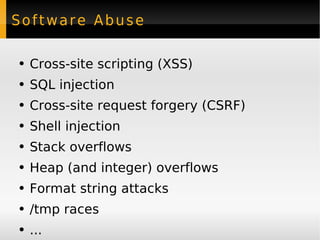
Software Abuse Cross-site scripting (XSS) SQL injection Cross-site request forgery (CSRF) Shell injection Stack overflows Heap (and integer) overflows Format string attacks /tmp races ...
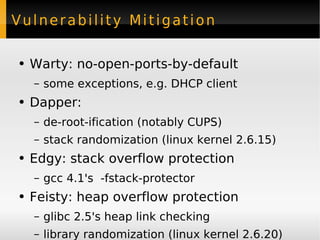
Vulnerability Mitigation Warty: no-open-ports-by-default some exceptions, e.g. DHCP client Dapper: de-root-ification (notably CUPS) stack randomization (linux kernel 2.6.15) Edgy: stack overflow protection gcc 4.1's  -fstack-protector Feisty: heap overflow protection glibc 2.5's heap link checking library randomization (linux kernel 2.6.20)
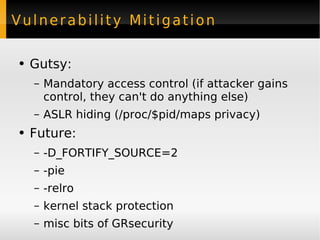
Vulnerability Mitigation Gutsy: Mandatory access control (if attacker gains control, they can't do anything else) ASLR hiding (/proc/$pid/maps privacy) Future: -D_FORTIFY_SOURCE=2 -pie -relro kernel stack protection misc bits of GRsecurity
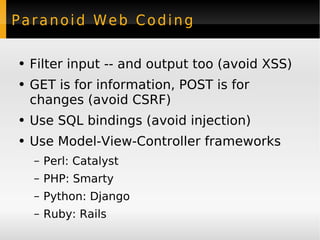
Paranoid Web Coding Filter input -- and output too (avoid XSS) GET is for information, POST is for changes (avoid CSRF) Use SQL bindings (avoid injection) Use Model-View-Controller frameworks Perl: Catalyst PHP: Smarty Python: Django Ruby: Rails
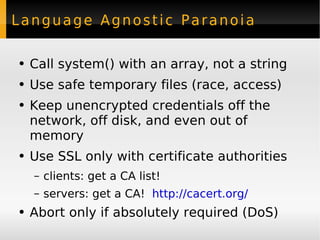
Language Agnostic Paranoia Call system() with an array, not a string Use safe temporary files (race, access) Keep unencrypted credentials off the network, off disk, and even out of memory Use SSL only with certificate authorities clients: get a CA list! servers: get a CA!  http://cacert.org/ Abort only if absolutely required (DoS)
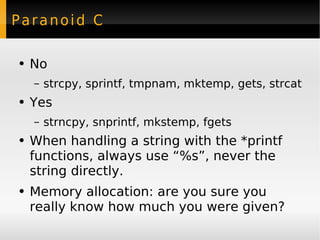
Paranoid C No strcpy, sprintf, tmpnam, mktemp, gets, strcat Yes strncpy, snprintf, mkstemp, fgets When handling a string with the *printf functions, always use “%s”, never the string directly. Memory allocation: are you sure you really know how much you were given?
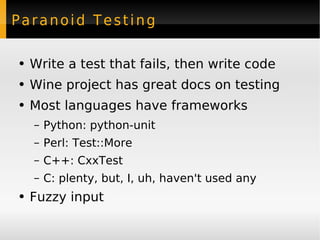
Paranoid Testing Write a test that fails, then write code Wine project has great docs on testing Most languages have frameworks Python: python-unit Perl: Test::More C++: CxxTest C: plenty, but, I, uh, haven't used any Fuzzy input
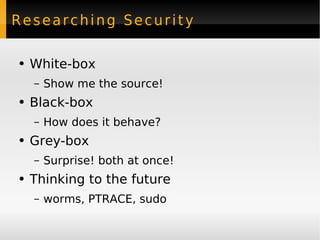
Researching Security White-box Show me the source! Black-box How does it behave? Grey-box Surprise! both at once! Thinking to the future worms, PTRACE, sudo
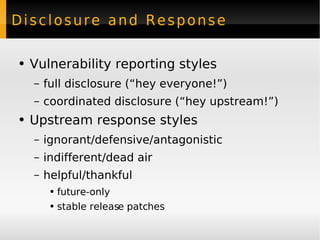
Disclosure and Response Vulnerability reporting styles full disclosure (“hey everyone!”) coordinated disclosure (“hey upstream!”) Upstream response styles ignorant/defensive/antagonistic indifferent/dead air helpful/thankful future-only stable release patches
Security Community Common Vulnerabilities and Exposures http://cve.mitre.org/cve/ The central list of all known security bugs [email_address]  private mailing list OSS distributor coordination Researchers, hackers, you name it full-disclosure mailing list bugtraq mailing list http://seclists.org/
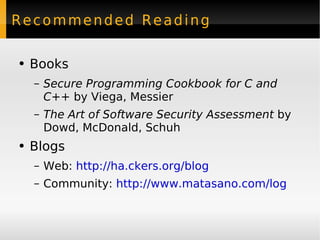
Recommended Reading Books Secure Programming Cookbook for C and C++  by Viega, Messier The Art of Software Security Assessment  by Dowd, McDonald, Schuh Blogs Web:  http://ha.ckers.org/blog Community:  http://www.matasano.com/log
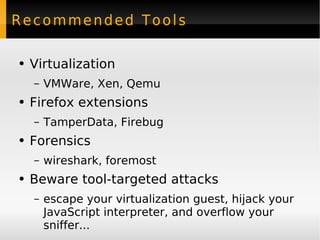
Recommended Tools Virtualization VMWare, Xen, Qemu Firefox extensions TamperData, Firebug Forensics wireshark, foremost Beware tool-targeted attacks escape your virtualization guest, hijack your JavaScript interpreter, and overflow your sniffer...
Questions? Kees Cook [email_address] [email_address] http://outflux.net/blog/

Os Cook

  • 1.
    Security For HumanBeings Protecting Ubuntu http://outflux.net/oscon/07/security.odp Kees Cook [email_address] [email_address] http://outflux.net/blog/ OSCON 2007
  • 2.
    Hello... My nameis Kees (pronounced “Case”). I work for Canonical and try to keep Ubuntu secure. http://ubuntu.com/ Also an Inkscape developer: http://inkscape.org/ And a kernel.org admin (just try and guess the URL to that one!)
  • 3.
    I Love Hacking!security research == curiosity 2600 Magazine is great for the curious DefCon is even better “most hostile network in the world” http://defcon.org/ Capture the Flag Lock-picking contest WiFi Shoot-out and so much more
  • 4.
    Day-in-the-life protecting Ubuntufind new vulnerabilities check mailing lists, new CVEs perform code-audits triage vulnerabilities (high, med, low, not) while (sort-by-priority(unpatched_vulns)) find or develop patch test patch publish new package http://www.ubuntu.com/usn/
  • 5.
    What is avulnerability? A bug with special characteristics Someone can make your stuff do stuff you didn't want your stuff doing... Denial of service Crossing privilege/trust boundaries gaining unauthorized access reading someone else's information changing someone else's information
  • 6.
    Software Abuse Cross-sitescripting (XSS) SQL injection Cross-site request forgery (CSRF) Shell injection Stack overflows Heap (and integer) overflows Format string attacks /tmp races ...
  • 7.
    Vulnerability Mitigation Warty:no-open-ports-by-default some exceptions, e.g. DHCP client Dapper: de-root-ification (notably CUPS) stack randomization (linux kernel 2.6.15) Edgy: stack overflow protection gcc 4.1's -fstack-protector Feisty: heap overflow protection glibc 2.5's heap link checking library randomization (linux kernel 2.6.20)
  • 8.
    Vulnerability Mitigation Gutsy:Mandatory access control (if attacker gains control, they can't do anything else) ASLR hiding (/proc/$pid/maps privacy) Future: -D_FORTIFY_SOURCE=2 -pie -relro kernel stack protection misc bits of GRsecurity
  • 9.
    Paranoid Web CodingFilter input -- and output too (avoid XSS) GET is for information, POST is for changes (avoid CSRF) Use SQL bindings (avoid injection) Use Model-View-Controller frameworks Perl: Catalyst PHP: Smarty Python: Django Ruby: Rails
  • 10.
    Language Agnostic ParanoiaCall system() with an array, not a string Use safe temporary files (race, access) Keep unencrypted credentials off the network, off disk, and even out of memory Use SSL only with certificate authorities clients: get a CA list! servers: get a CA! http://cacert.org/ Abort only if absolutely required (DoS)
  • 11.
    Paranoid C Nostrcpy, sprintf, tmpnam, mktemp, gets, strcat Yes strncpy, snprintf, mkstemp, fgets When handling a string with the *printf functions, always use “%s”, never the string directly. Memory allocation: are you sure you really know how much you were given?
  • 12.
    Paranoid Testing Writea test that fails, then write code Wine project has great docs on testing Most languages have frameworks Python: python-unit Perl: Test::More C++: CxxTest C: plenty, but, I, uh, haven't used any Fuzzy input
  • 13.
    Researching Security White-boxShow me the source! Black-box How does it behave? Grey-box Surprise! both at once! Thinking to the future worms, PTRACE, sudo
  • 14.
    Disclosure and ResponseVulnerability reporting styles full disclosure (“hey everyone!”) coordinated disclosure (“hey upstream!”) Upstream response styles ignorant/defensive/antagonistic indifferent/dead air helpful/thankful future-only stable release patches
  • 15.
    Security Community CommonVulnerabilities and Exposures http://cve.mitre.org/cve/ The central list of all known security bugs [email_address] private mailing list OSS distributor coordination Researchers, hackers, you name it full-disclosure mailing list bugtraq mailing list http://seclists.org/
  • 16.
    Recommended Reading BooksSecure Programming Cookbook for C and C++ by Viega, Messier The Art of Software Security Assessment by Dowd, McDonald, Schuh Blogs Web: http://ha.ckers.org/blog Community: http://www.matasano.com/log
  • 17.
    Recommended Tools VirtualizationVMWare, Xen, Qemu Firefox extensions TamperData, Firebug Forensics wireshark, foremost Beware tool-targeted attacks escape your virtualization guest, hijack your JavaScript interpreter, and overflow your sniffer...
  • 18.
    Questions? Kees Cook[email_address] [email_address] http://outflux.net/blog/

Editor's Notes

  • #2 Theme created by Sakari Koivunen and Henrik Omma Released under the LGPL license.