

2
 Recall: memory allocation with variable partitions requires mapping logical
addresses to physical addresses
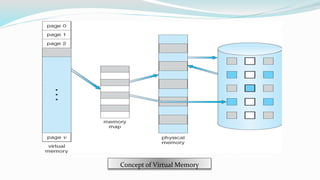
 Virtual memory achieves a complete separation of logical and physical address-
spaces
 Typically a virtual address is 32 bits, this allows a process to have 4GB of virtual
memory
 Physical memory is much smaller than this, and varies from machine to machine
 Virtual address spaces of different processes are distinct
 Structuring of virtual memory
 Paging: Divide the address space into fixed-size pages
 Segmentation: Divide the address space into variable-size segments
(corresponding to logical units)
Concept of Virtual Memory
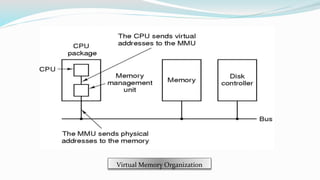
Virtual Memory Organization
 Benefits of Virtual Memory ::
 Less I/O needed to load / swap a process.
 Degree of multiprogramming can be increased.
 A program’s logical address space can be larger than physical memory.
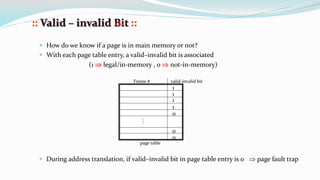
 How do we know if a page is in main memory or not?
 With each page table entry, a valid–invalid bit is associated
(1  legal/in-memory , 0  not-in-memory)
 During address translation, if valid–invalid bit in page table entry is 0  page fault trap
1
1
1
1
0
0
0

Frame # valid-invalid bit
page table
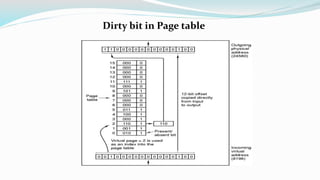
Dirty bit in Page table
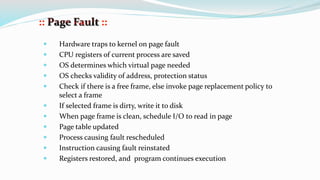
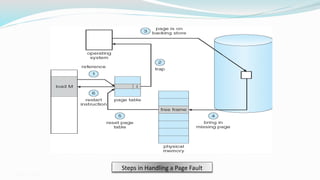
 Hardware traps to kernel on page fault
 CPU registers of current process are saved
 OS determines which virtual page needed
 OS checks validity of address, protection status
 Check if there is a free frame, else invoke page replacement policy to
select a frame
 If selected frame is dirty, write it to disk
 When page frame is clean, schedule I/O to read in page
 Page table updated
 Process causing fault rescheduled
 Instruction causing fault reinstated
 Registers restored, and program continues execution
GMU – CS 571
Steps in Handling a Page Fault
GMU – CS 571
Impact of Page Faults
 Each page fault affects the system performance negatively
 The process experiencing the page fault will not be able to continue until
the missing page is brought to the main memory
 The process will be blocked (moved to the waiting state) so its data
(registers, etc.) must be saved.
 Dealing with the page fault involves disk I/O
 Increased demand to the disk drive
 Increased waiting time for process experiencing the page fault
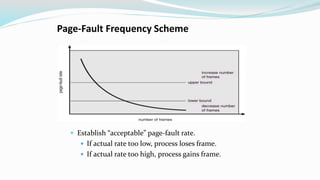
Page-Fault Frequency Scheme
 Establish “acceptable” page-fault rate.
 If actual rate too low, process loses frame.
 If actual rate too high, process gains frame.
12
 To avoid thrashing (i.e. too many page faults), a process needs “enough” pages in
the memory
 Memory accesses by a program are not spread all over its virtual memory
randomly, but show a pattern
 E.g. while executing a procedure, a program is accessing the page that contains
the code of the procedure, the local variables, and global vars.
 This is called locality of reference.
 How to exploit locality?
 PrePaging : when a process is brought into memory by the swapper, a few
pages are loaded in a priory (note: demand paging means that a page is
brought in only when needed)
 Working set: Try to keep currently used pages in memory
13
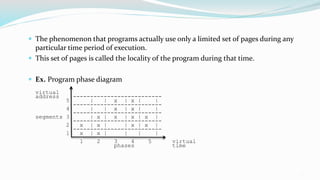
 The phenomenon that programs actually use only a limited set of pages during any
particular time period of execution.
 This set of pages is called the locality of the program during that time.
 Ex. Program phase diagram
virtual
address --------------------------
5 | | x | x | |
--------------------------
4 | | x | x | |
--------------------------
segments 3 | x | x | x | x |
--------------------------
2 x | x | | x | x |
--------------------------
1 x | x | | | |
1 2 3 4 5 virtual
phases time
14
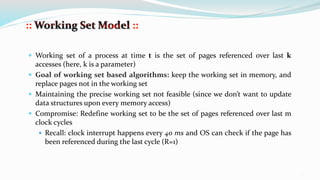
 Working set of a process at time t is the set of pages referenced over last k
accesses (here, k is a parameter)
 Goal of working set based algorithms: keep the working set in memory, and
replace pages not in the working set
 Maintaining the precise working set not feasible (since we don’t want to update
data structures upon every memory access)
 Compromise: Redefine working set to be the set of pages referenced over last m
clock cycles
 Recall: clock interrupt happens every 40 ms and OS can check if the page has
been referenced during the last cycle (R=1)
15
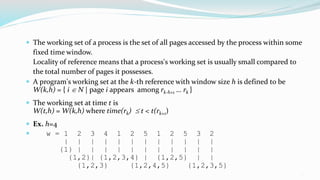
 The working set of a process is the set of all pages accessed by the process within some
fixed time window.
Locality of reference means that a process's working set is usually small compared to
the total number of pages it possesses.
 A program's working set at the k-th reference with window size h is defined to be
W(k,h) = { i  N | page i appears among rk-h+1 … rk }
 The working set at time t is
W(t,h) = W(k,h) where time(rk)  t < t(rk+1)
 Ex. h=4
 w = 1 2 3 4 1 2 5 1 2 5 3 2
| | | | | | | | | | | |
{1} | | | | | | | | | | |
{1,2}| {1,2,3,4} | {1,2,5} | |
{1,2,3} {1,2,4,5} {1,2,3,5}
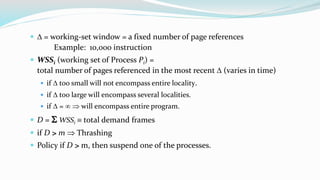
  = working-set window = a fixed number of page references
Example: 10,000 instruction
 WSSi (working set of Process Pi) =
total number of pages referenced in the most recent  (varies in time)
 if  too small will not encompass entire locality.
 if  too large will encompass several localities.
 if  =   will encompass entire program.
 D =  WSSi  total demand frames
 if D > m  Thrashing
 Policy if D > m, then suspend one of the processes.
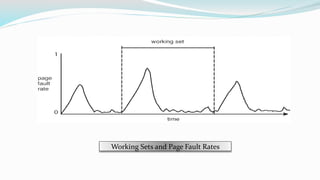
Working Sets and Page Fault Rates

basics of virtual memory

  • 2.
    2  Recall: memoryallocation with variable partitions requires mapping logical addresses to physical addresses  Virtual memory achieves a complete separation of logical and physical address- spaces  Typically a virtual address is 32 bits, this allows a process to have 4GB of virtual memory  Physical memory is much smaller than this, and varies from machine to machine  Virtual address spaces of different processes are distinct  Structuring of virtual memory  Paging: Divide the address space into fixed-size pages  Segmentation: Divide the address space into variable-size segments (corresponding to logical units)
  • 3.
  • 4.
  • 5.
     Benefits ofVirtual Memory ::  Less I/O needed to load / swap a process.  Degree of multiprogramming can be increased.  A program’s logical address space can be larger than physical memory.
  • 6.
     How dowe know if a page is in main memory or not?  With each page table entry, a valid–invalid bit is associated (1  legal/in-memory , 0  not-in-memory)  During address translation, if valid–invalid bit in page table entry is 0  page fault trap 1 1 1 1 0 0 0  Frame # valid-invalid bit page table
  • 7.
    Dirty bit inPage table
  • 8.
     Hardware trapsto kernel on page fault  CPU registers of current process are saved  OS determines which virtual page needed  OS checks validity of address, protection status  Check if there is a free frame, else invoke page replacement policy to select a frame  If selected frame is dirty, write it to disk  When page frame is clean, schedule I/O to read in page  Page table updated  Process causing fault rescheduled  Instruction causing fault reinstated  Registers restored, and program continues execution
  • 9.
    GMU – CS571 Steps in Handling a Page Fault
  • 10.
    GMU – CS571 Impact of Page Faults  Each page fault affects the system performance negatively  The process experiencing the page fault will not be able to continue until the missing page is brought to the main memory  The process will be blocked (moved to the waiting state) so its data (registers, etc.) must be saved.  Dealing with the page fault involves disk I/O  Increased demand to the disk drive  Increased waiting time for process experiencing the page fault
  • 11.
    Page-Fault Frequency Scheme Establish “acceptable” page-fault rate.  If actual rate too low, process loses frame.  If actual rate too high, process gains frame.
  • 12.
    12  To avoidthrashing (i.e. too many page faults), a process needs “enough” pages in the memory  Memory accesses by a program are not spread all over its virtual memory randomly, but show a pattern  E.g. while executing a procedure, a program is accessing the page that contains the code of the procedure, the local variables, and global vars.  This is called locality of reference.  How to exploit locality?  PrePaging : when a process is brought into memory by the swapper, a few pages are loaded in a priory (note: demand paging means that a page is brought in only when needed)  Working set: Try to keep currently used pages in memory
  • 13.
    13  The phenomenonthat programs actually use only a limited set of pages during any particular time period of execution.  This set of pages is called the locality of the program during that time.  Ex. Program phase diagram virtual address -------------------------- 5 | | x | x | | -------------------------- 4 | | x | x | | -------------------------- segments 3 | x | x | x | x | -------------------------- 2 x | x | | x | x | -------------------------- 1 x | x | | | | 1 2 3 4 5 virtual phases time
  • 14.
    14  Working setof a process at time t is the set of pages referenced over last k accesses (here, k is a parameter)  Goal of working set based algorithms: keep the working set in memory, and replace pages not in the working set  Maintaining the precise working set not feasible (since we don’t want to update data structures upon every memory access)  Compromise: Redefine working set to be the set of pages referenced over last m clock cycles  Recall: clock interrupt happens every 40 ms and OS can check if the page has been referenced during the last cycle (R=1)
  • 15.
    15  The workingset of a process is the set of all pages accessed by the process within some fixed time window. Locality of reference means that a process's working set is usually small compared to the total number of pages it possesses.  A program's working set at the k-th reference with window size h is defined to be W(k,h) = { i  N | page i appears among rk-h+1 … rk }  The working set at time t is W(t,h) = W(k,h) where time(rk)  t < t(rk+1)  Ex. h=4  w = 1 2 3 4 1 2 5 1 2 5 3 2 | | | | | | | | | | | | {1} | | | | | | | | | | | {1,2}| {1,2,3,4} | {1,2,5} | | {1,2,3} {1,2,4,5} {1,2,3,5}
  • 16.
      =working-set window = a fixed number of page references Example: 10,000 instruction  WSSi (working set of Process Pi) = total number of pages referenced in the most recent  (varies in time)  if  too small will not encompass entire locality.  if  too large will encompass several localities.  if  =   will encompass entire program.  D =  WSSi  total demand frames  if D > m  Thrashing  Policy if D > m, then suspend one of the processes.
  • 17.
    Working Sets andPage Fault Rates