M.ARCH (ENVIRONMENTAL ARCHITECTURE)
ELECTIVE – II
EA5003
RENEWABLE ENERGY SYSTEMS
SUBMITTED TO
SUBMITTED BY
PIDAPARHTI LAKSHMI PRASANNA
TADIBOINA SAMANTHA KUMAR
M.ARCH (EA) - SEMESTER 2
RENEWABLE ENERGY SYSTEMS
CONTENTS
OBJECTIVES:
1. To explain concept of various forms of renewable energy
2. To outline division aspects and utilization of renewable energy sources for both
domestic and industrial applications
3. To analysis the environmental and cost economics of using renewable energy
sources compared to fossil fuels.
UNIT I SOLAR ENERGY
➔ Solar radiation its measurements and prediction
➔ solar thermal flat plate collectors concentrating collectors –
applications - heating, cooling, desalination, power generation,drying, cooking etc
➔ principle of photovoltaic conversion of solar energy,
➔ types of solar cells and fabrication.
Photovoltaic applications:
➔ battery charger, domestic lighting, street lighting, and water pumping, power
generation schemes.
UNIT II WIND ENERGY
➔ Atmospheric circulations and classification
➔ factors influencing wind , wind shear and turbulence
➔ wind speed monitoring
➔ Betz limit
➔ Aerodynamics of wind turbine rotor
➔ site selection
➔ Wind resource assessment
wind energy conversion devices
➔ classification,
➔ characteristics,
➔ applications.
➔ Hybrid systems - safety and environmental aspects.
UNIT III BIO-ENERGY
➔ Biomass resources and their classification
➔ chemical constituents
➔ physicochemical characteristics of biomass
➔ Biomass conversion processes
➔ Thermochemical conversion
➔ direct combustion,
➔ gasification,
➔ pyrolysis and liquefaction
➔ biochemical conversion
➔ Anaerobic digestion
➔ alcohol production from biomass
➔ chemical conversion process
➔ hydrolysis and hydrogenation
➔ Biogas - generation - types of biogas Plants- applications
UNIT IV HYDROGEN AND FUEL CELLS
➔ Thermodynamics and electrochemical principles
➔ asic design, types, and applications
➔ production methods
➔ Biophotolysis
➔ Hydrogen generation from algae biological pathways
➔ Storage gaseous
➔ cryogenic and metal hydride and transportation.
➔ Fuel cell
➔ principle of working
➔ various types
➔ construction and applications.
UNIT V OTHER TYPES OF ENERGY
➔ Ocean energy resources
➔ principles of ocean thermal energy conversion systems
➔ Ocean thermal power plants
➔ principles of ocean wave energy conversion
➔ tidal energy conversion
hydropower
➔ site selection, construction, environmental issues
Geothermal energy
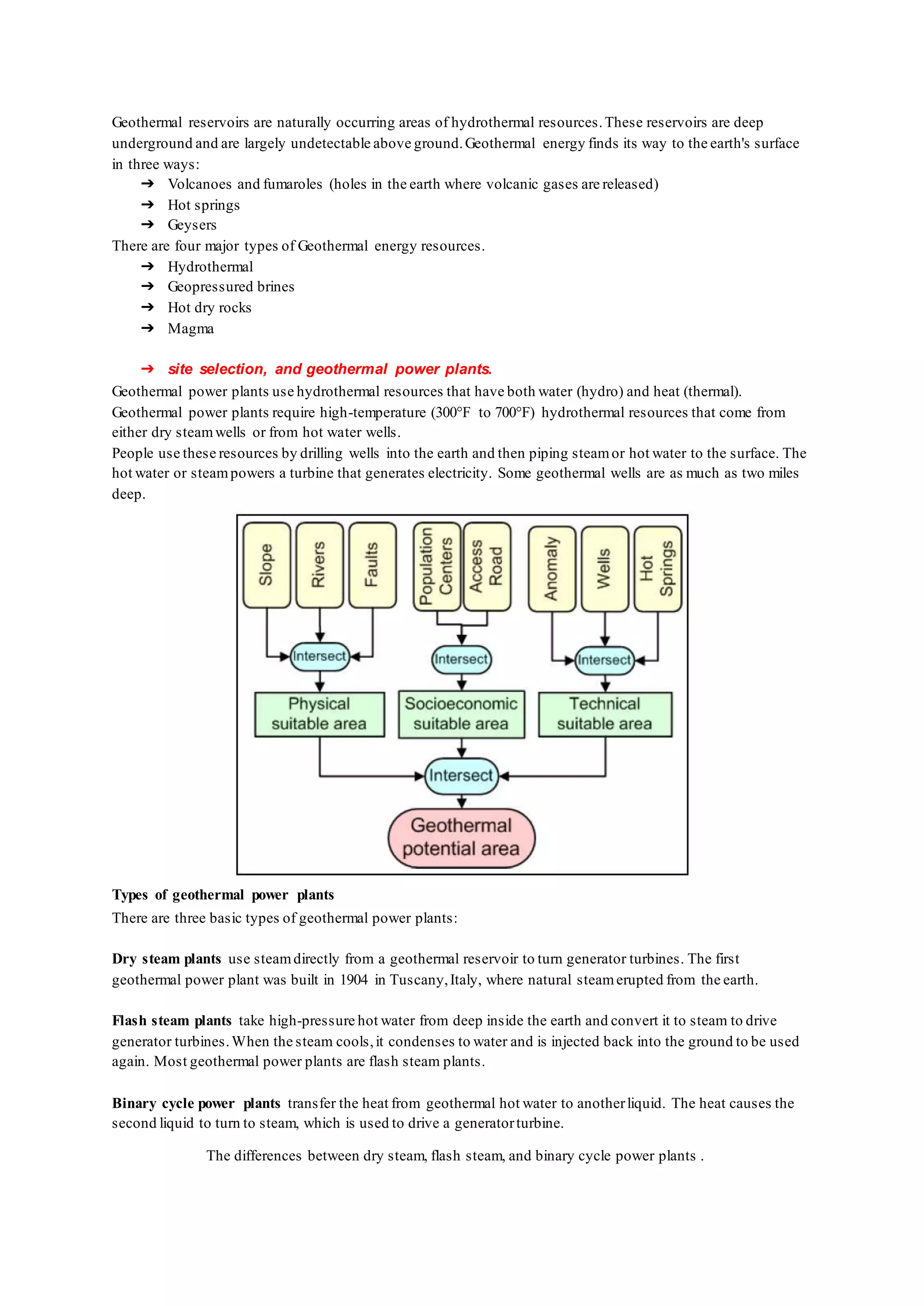
➔ types of geothermal energy sites,
➔ site selection, and geothermal power plants.
OUTCOMES:
● Understand the various types of renewable energy sources.
● Also understand the environmental and cost economics of using renewable energy
sources compared to fossil fuels.
RENEWABLE ENERGY SYSTEMS
UNIT I SOLAR ENERGY
➔ Solar radiation its measurements and prediction
Solar radiation is all of the light and energy that comes from the sun,and there are many different forms.
Solar radiation is a term used to describe visible and near-visible (ultraviolet and near-infrared) radiation emitted
from the sun.The different regions are described by their wavelength range within the broad band range of 0.20
to 4.0 µm (microns). Terrestrial radiation is a term used to describe infrared radiation emitted from the
atmosphere. The following is a list of the components of solar and terrestrial radiation and their approximate
wavelength ranges:
● Ultraviolet: 0.20 – 0.39 µm
● Visible: 0.39 – 0.78 µm
● Near-Infrared: 0.78 – 4.00 µm
● Infrared: 4.00 – 100.00 µm
Approximately 99% of solar, or shortwave, radiation at the earth’s surface is contained in the region from 0.3 to
3.0 µm while most of terrestrial, or longwave, radiation is contained in the region from 3.5 to 50 µm.
Outside the earth’s atmosphere, solar radiation has an intensity of approximately 1370 watts/meter2. This is the
value at mean earth-sun distance at the top of the atmosphere and is referred to as the Solar Constant.On the
surface of the earth on a clear day, at noon,the direct beam radiation will be approximately 1000 watts/meter2
for many locations. While the availability of energy is affected by location (including latitude and elevation),
season,and time of day, the biggest factors affecting the available energy are cloud cover and other
meteorological conditions which vary with location and time.
solar energy may use the unit watt-hours per square meter (Wh/m2).
If this energy is divided by the recording time in hours,it is then a density of power called irradiance, expressed
in watts per square meter (W/m2).
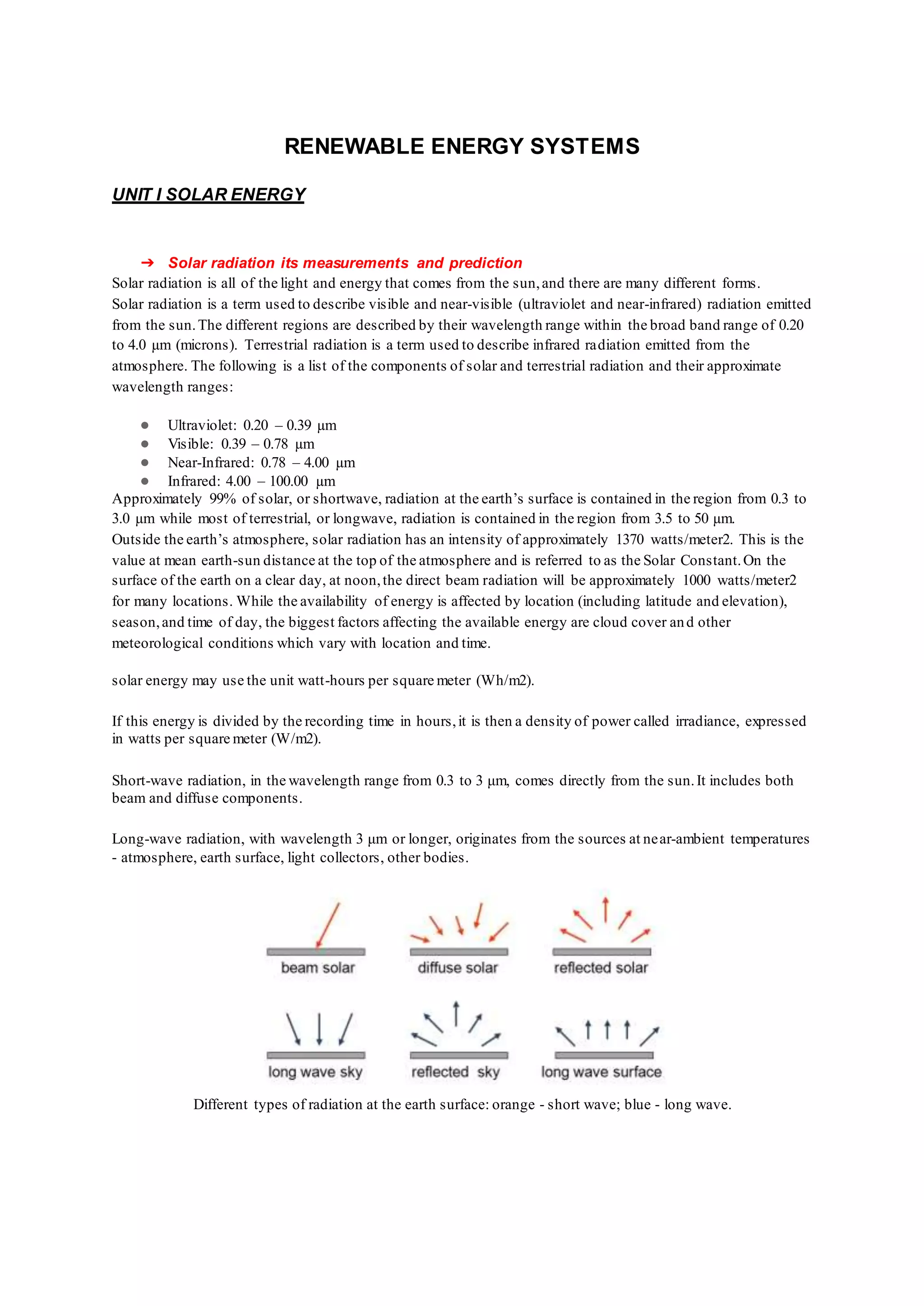
Short-wave radiation, in the wavelength range from 0.3 to 3 μm, comes directly from the sun.It includes both
beam and diffuse components.
Long-wave radiation, with wavelength 3 μm or longer, originates from the sources at near-ambient temperatures
- atmosphere, earth surface, light collectors, other bodies.
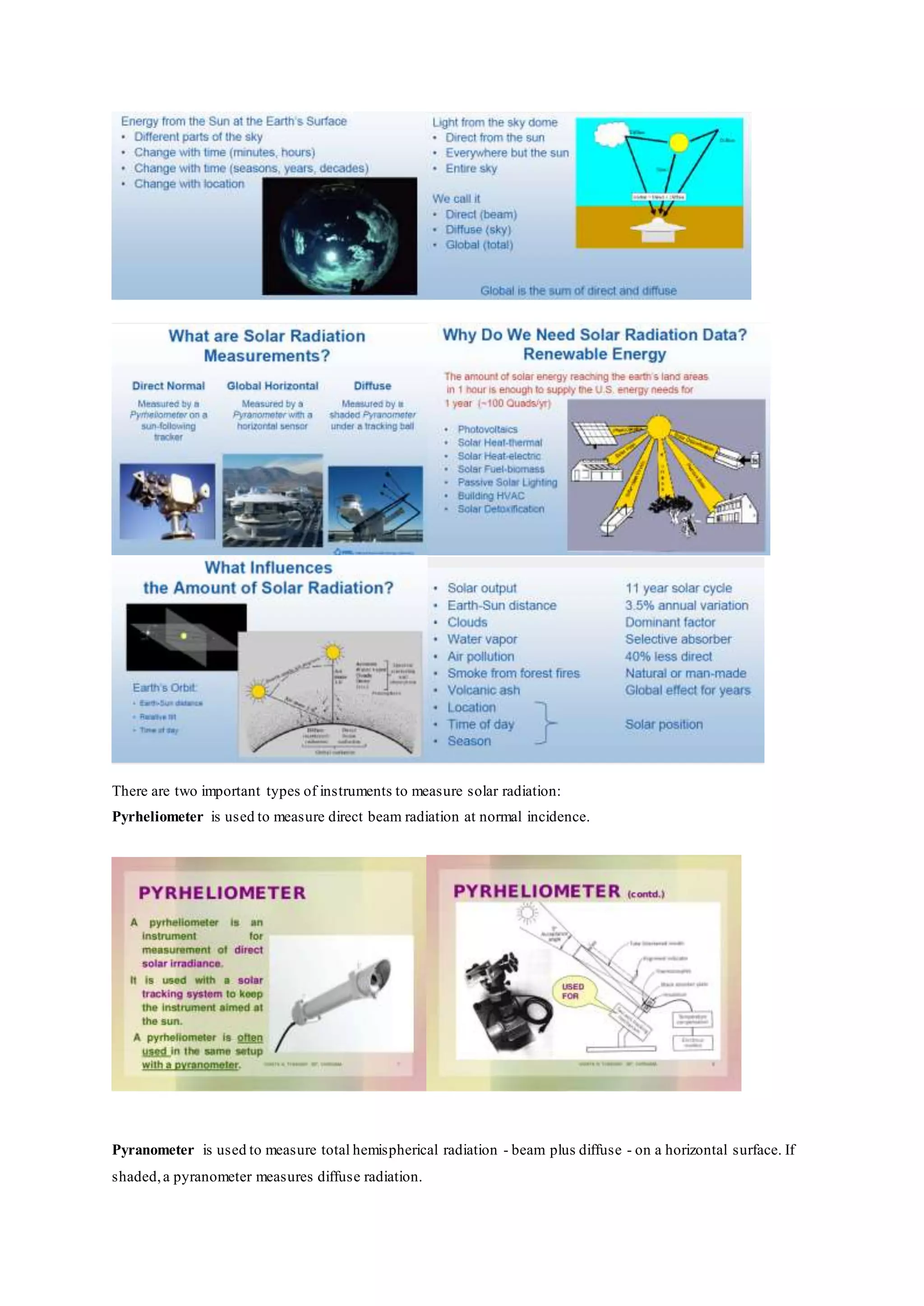
Different types of radiation at the earth surface: orange - short wave; blue - long wave.
There are two important types of instruments to measure solar radiation:
Pyrheliometer is used to measure direct beam radiation at normal incidence.
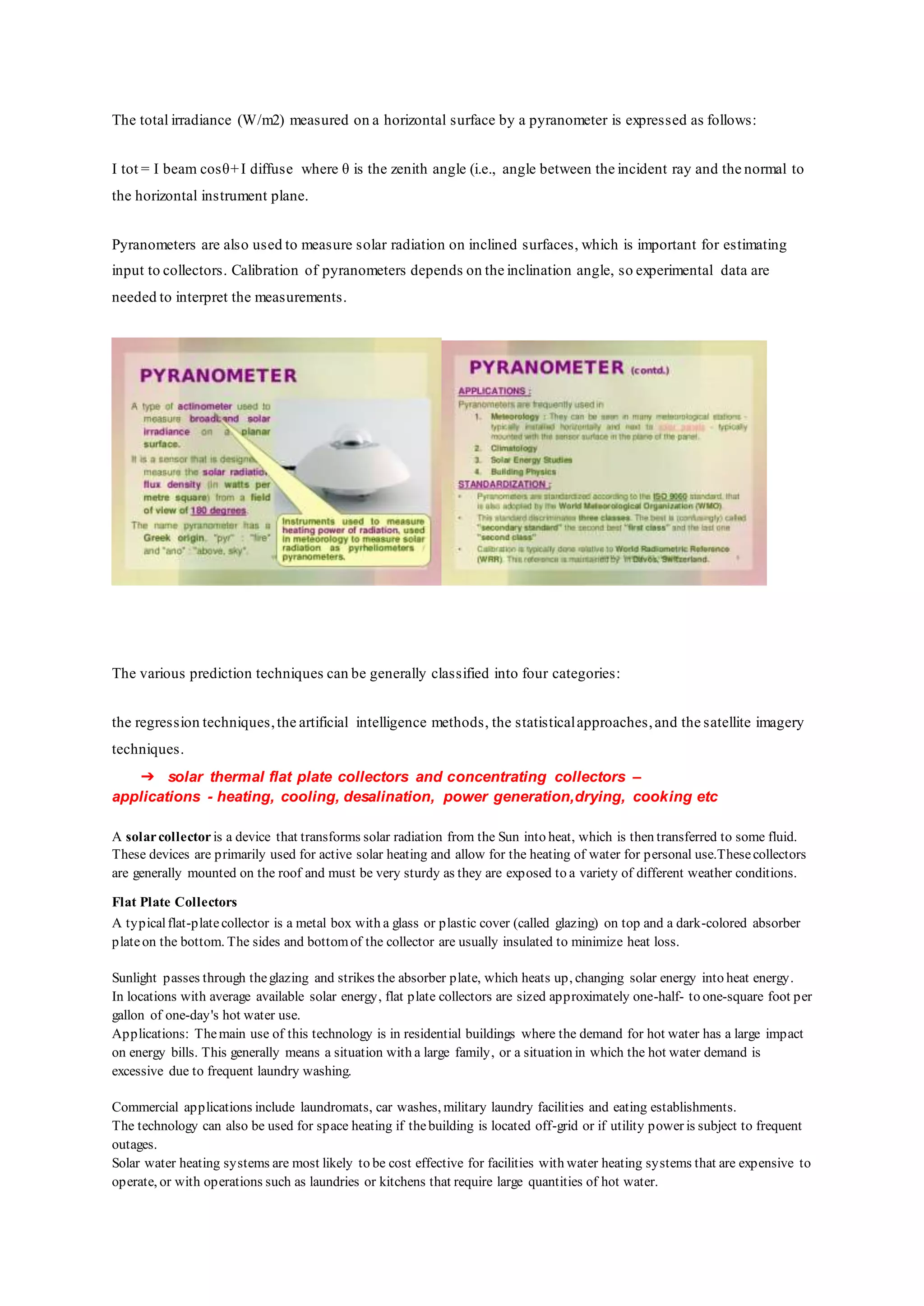
Pyranometer is used to measure total hemispherical radiation - beam plus diffuse - on a horizontal surface. If
shaded,a pyranometer measures diffuse radiation.
The total irradiance (W/m2) measured on a horizontal surface by a pyranometer is expressed as follows:
I tot = I beam cosθ+I diffuse where θ is the zenith angle (i.e., angle between the incident ray and the normal to
the horizontal instrument plane.
Pyranometers are also used to measure solar radiation on inclined surfaces, which is important for estimating
input to collectors. Calibration of pyranometers depends on the inclination angle, so experimental data are
needed to interpret the measurements.
The various prediction techniques can be generally classified into four categories:
the regression techniques,the artificial intelligence methods, the statisticalapproaches,and the satellite imagery
techniques.
➔ solar thermal flat plate collectors and concentrating collectors –
applications - heating, cooling, desalination, power generation,drying, cooking etc
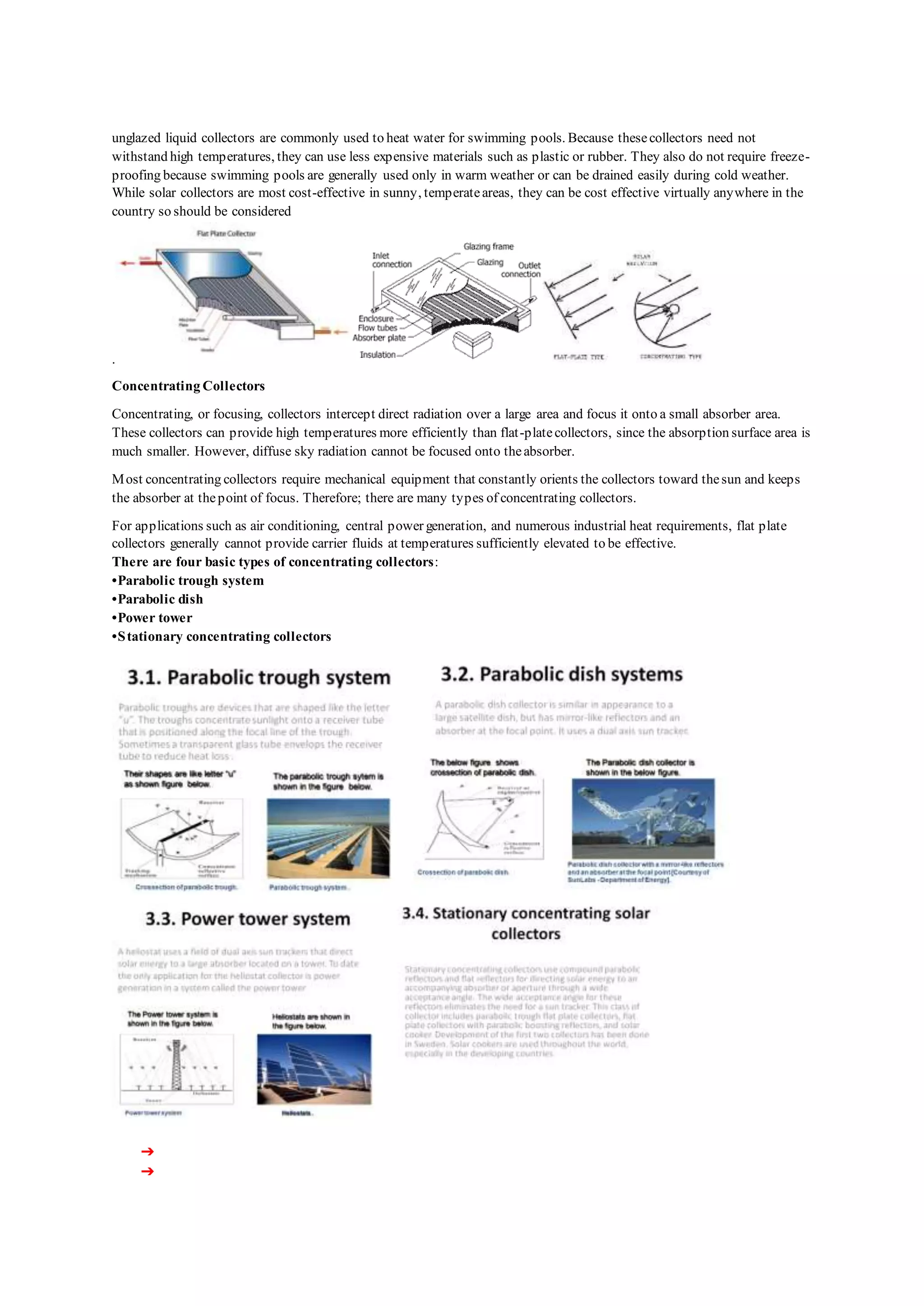
A solarcollector is a device that transforms solar radiation from the Sun into heat, which is then transferred to some fluid.
These devices are primarily used for active solar heating and allow for the heating of water for personal use.Thesecollectors
are generally mounted on the roof and must be very sturdy as they are exposed to a variety of different weather conditions.
Flat Plate Collectors
A typicalflat-platecollector is a metal box with a glass or plastic cover (called glazing) on top and a dark-colored absorber
plateon the bottom. The sides and bottomof the collector are usually insulated to minimize heat loss.
Sunlight passes through theglazing and strikes the absorber plate, which heats up, changing solar energy into heat energy.
In locations with average available solar energy, flat plate collectors are sized approximately one-half- to one-square foot per
gallon of one-day's hot water use.
Applications: Themain use of this technology is in residential buildings where the demand for hot water has a large impact
on energy bills. This generally means a situation with a large family, or a situation in which the hot water demand is
excessive due to frequent laundry washing.
Commercial applications include laundromats, car washes, military laundry facilities and eating establishments.
The technology can also be used for space heating if thebuilding is located off-grid or if utility power is subject to frequent
outages.
Solar water heating systems are most likely to be cost effective for facilities with water heating systems that are expensive to
operate, or with operations such as laundries or kitchens that require large quantities of hot water.
unglazed liquid collectors are commonly used to heat water for swimming pools. Because thesecollectors need not
withstand high temperatures, they can use less expensive materials such as plastic or rubber. They also do not require freeze-
proofing because swimming pools are generally used only in warm weather or can be drained easily during cold weather.
While solar collectors are most cost-effective in sunny, temperateareas, they can be cost effective virtually anywhere in the
country so should be considered
.
Concentrating Collectors
Concentrating, or focusing, collectors intercept direct radiation over a large area and focus it onto a small absorber area.
These collectors can provide high temperatures more efficiently than flat-platecollectors, since the absorption surface area is
much smaller. However, diffuse sky radiation cannot be focused onto theabsorber.
Most concentrating collectors require mechanical equipment that constantly orients the collectors toward thesun and keeps
the absorber at thepoint of focus. Therefore; there are many types of concentrating collectors.
For applications such as air conditioning, central power generation, and numerous industrial heat requirements, flat plate
collectors generally cannot provide carrier fluids at temperatures sufficiently elevated to be effective.
There are four basic types of concentrating collectors:
•Parabolic trough system
•Parabolic dish
•Power tower
•Stationary concentrating collectors
➔
➔
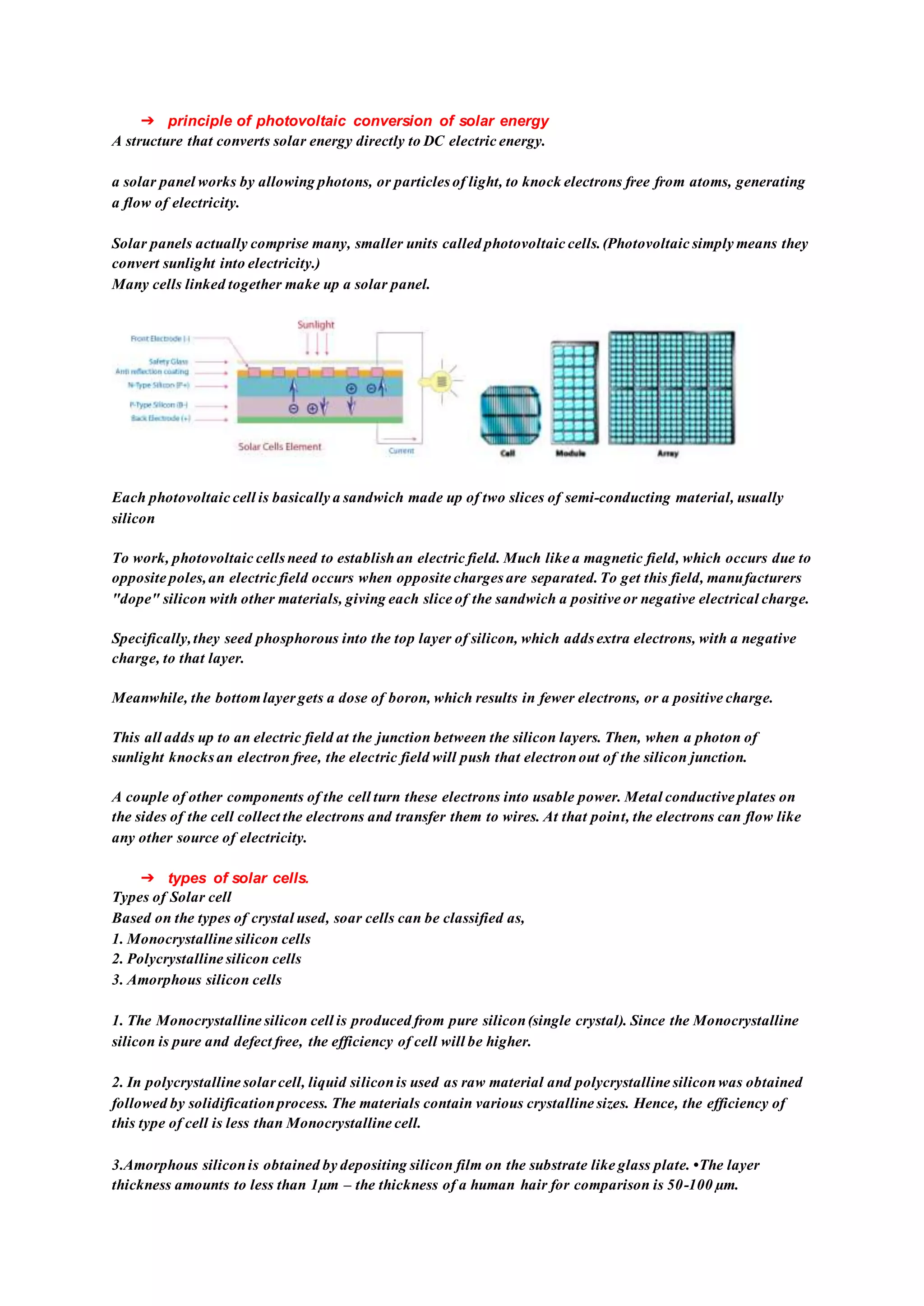
➔ principle of photovoltaic conversion of solar energy
A structure that converts solar energy directly to DC electric energy.
a solar panel works by allowing photons, or particles of light, to knock electrons free from atoms, generating
a flow of electricity.
Solar panels actually comprise many, smaller units called photovoltaic cells.(Photovoltaic simply means they
convert sunlight into electricity.)
Many cells linked together make up a solar panel.
Each photovoltaic cell is basically a sandwich made up of two slices of semi-conducting material, usually
silicon
To work, photovoltaic cellsneed to establishan electric field. Much like a magnetic field, which occurs due to
opposite poles,an electric field occurs when opposite charges are separated.To get this field, manufacturers
"dope" silicon with other materials, giving each slice of the sandwich a positive or negative electrical charge.
Specifically,they seed phosphorous into the top layer of silicon, which adds extra electrons, with a negative
charge, to that layer.
Meanwhile, the bottomlayergets a dose of boron, which results in fewer electrons, or a positive charge.
This all adds up to an electric field at the junction between the silicon layers. Then, when a photon of
sunlight knocksan electron free, the electric field will push that electronout of the silicon junction.
A couple of other components of the cell turn these electrons into usable power. Metal conductive plates on
the sides of the cell collect the electrons and transfer them to wires. At that point, the electrons can flow like
any other source of electricity.
➔ types of solar cells.
Types of Solar cell
Based on the types of crystal used, soar cells can be classified as,
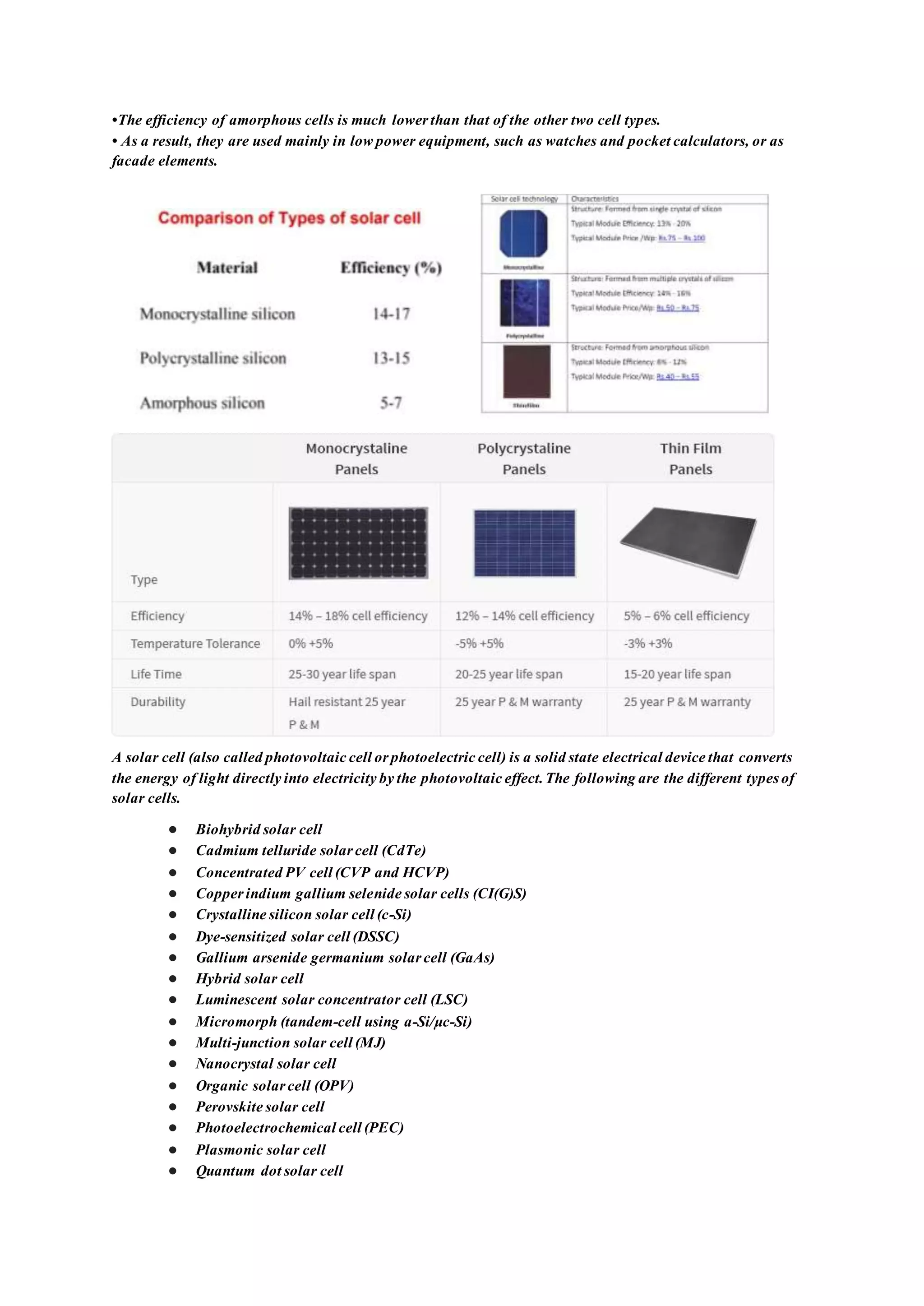
1. Monocrystalline silicon cells
2. Polycrystalline silicon cells
3. Amorphous silicon cells
1. The Monocrystalline silicon cell is produced from pure silicon(single crystal). Since the Monocrystalline
silicon is pure and defect free, the efficiency of cell will be higher.
2. In polycrystalline solarcell, liquid siliconis used as raw material and polycrystalline siliconwas obtained
followed by solidificationprocess. The materials contain various crystalline sizes. Hence, the efficiency of
this type of cell is less than Monocrystalline cell.
3.Amorphous siliconis obtained by depositing silicon film on the substrate like glass plate. •The layer
thickness amounts to less than 1µm – the thickness of a human hair for comparison is 50-100 µm.
•The efficiency of amorphous cells is much lower than that of the other two cell types.
• As a result, they are used mainly in low power equipment, such as watches and pocket calculators, or as
facade elements.
A solar cell (also called photovoltaic cell orphotoelectric cell) is a solid state electrical device that converts
the energy of light directly into electricity by the photovoltaic effect.The following are the different types of
solar cells.
● Biohybrid solar cell
● Cadmium telluride solarcell (CdTe)
● Concentrated PV cell (CVP and HCVP)
● Copperindium gallium selenide solar cells (CI(G)S)
● Crystalline silicon solar cell (c-Si)
● Dye-sensitized solar cell (DSSC)
● Gallium arsenide germanium solar cell (GaAs)
● Hybrid solar cell
● Luminescent solar concentrator cell (LSC)
● Micromorph (tandem-cell using a-Si/μc-Si)
● Multi-junction solar cell (MJ)
● Nanocrystal solar cell
● Organic solarcell (OPV)
● Perovskite solar cell
● Photoelectrochemical cell (PEC)
● Plasmonic solar cell
● Quantum dot solar cell
● Solid-state solar cell
● Thin-film solarcell (TFSC)
● Wafer solar cell, or wafer-based solar cell crystalline
➔ solar cells and fabrication.
The basic component of a solar cell is pure silicon, which is not pure in its natural state.
To make solar cells, the raw materials—silicon dioxide ofeither quartzite gravel or crushed quartz—are first
placed into an electric arc furnace, where a carbon arc is applied to release the oxygen. The products are
carbon dioxide and molten silicon. At this point, the silicon is still not pure enough to be used for solor cells
and requires further purification.
Pure silicon is derived from such silicondioxides as quartzite gravel (the purest silica) or crushed quartz. The
resulting pure siliconis then doped (treated with) with phosphorous and boron to produce an excess of
electrons and a deficiency of electrons respectively to make a semiconductor capable of conducting
electricity.The silicondisks are shiny and require an anti-reflective coating,usually titanium dioxide.
The solar module consists of the siliconsemiconductor surrounded by protective material in a metal frame.
The protective material consists of an encapsulant of transparent siliconrubber or butyryl plastic (commonly
used in automobile windshields) bonded around the cells, which are then embedded in ethylene vinyl acetate.
A polyesterfilm (such as mylar or tedlar) makes up the backing.
A glass cover is found on terrestrial arrays, a lightweight plastic cover on satellite arrays.
The electronic parts are standard and consist mostly of copper.
The frame is either steel or aluminum.
Silicon is used as the cement to put it all together.
Photovoltaic applications:
➔ battery charger, domestic lighting, street lighting, and water pumping, power
generation schemes.
UNIT II WIND ENERGY
➔ Atmospheric circulations and classification
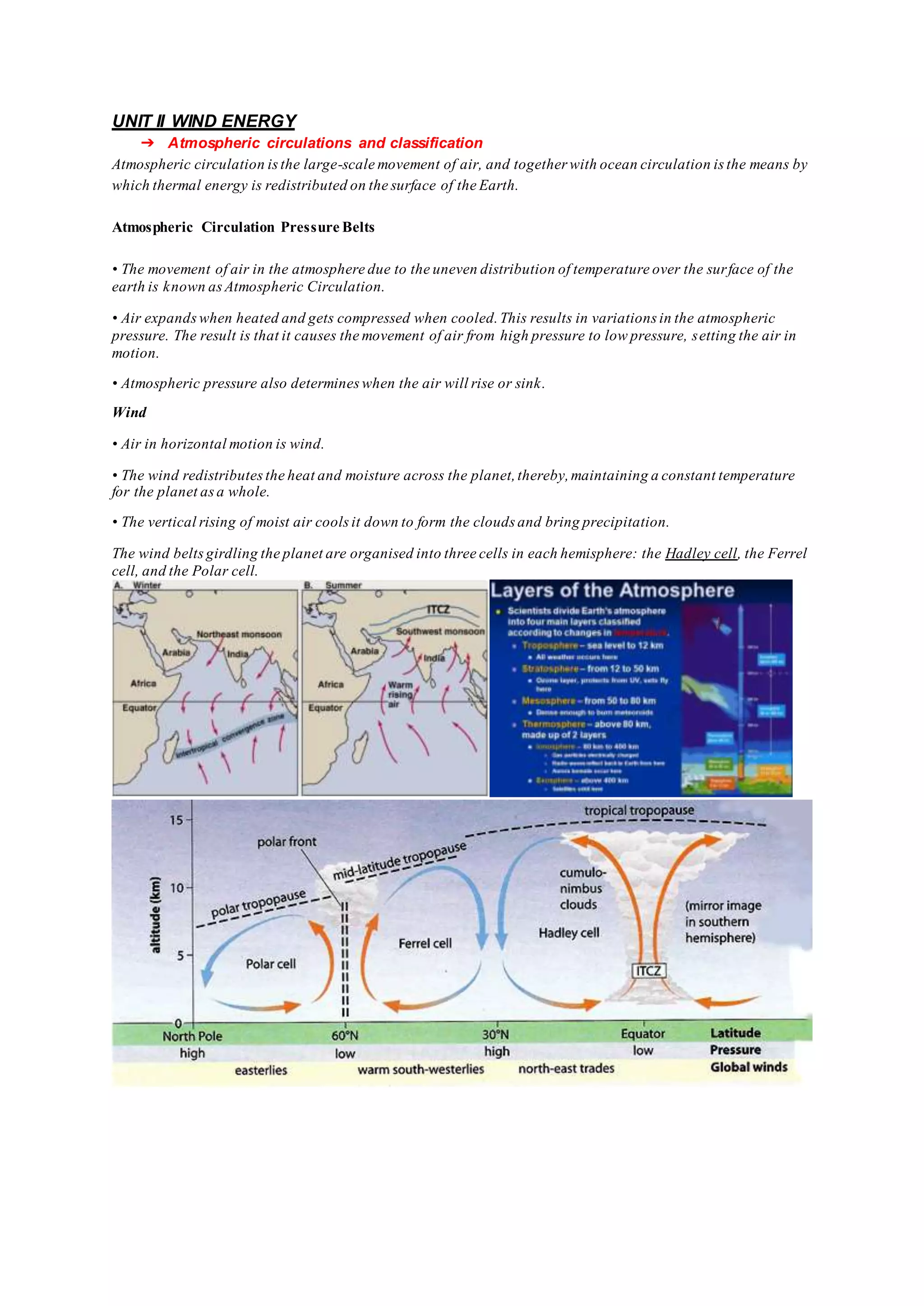
Atmospheric circulation isthe large-scale movement of air, and together with ocean circulation is the means by
which thermal energy is redistributed on the surface of the Earth.
Atmospheric Circulation Pressure Belts
• The movement of air in the atmosphere due to the uneven distribution of temperature over the surface of the
earth is known asAtmospheric Circulation.
• Air expandswhen heated and gets compressed when cooled.This results in variations in the atmospheric
pressure. The result is that it causes the movement of air from high pressure to low pressure, setting the air in
motion.
• Atmospheric pressure also determineswhen the air will rise or sink.
Wind
• Air in horizontal motion is wind.
• The wind redistributesthe heat and moisture across the planet,thereby,maintaining a constant temperature
for the planet asa whole.
• The vertical rising of moist air coolsit down to form the clouds and bring precipitation.
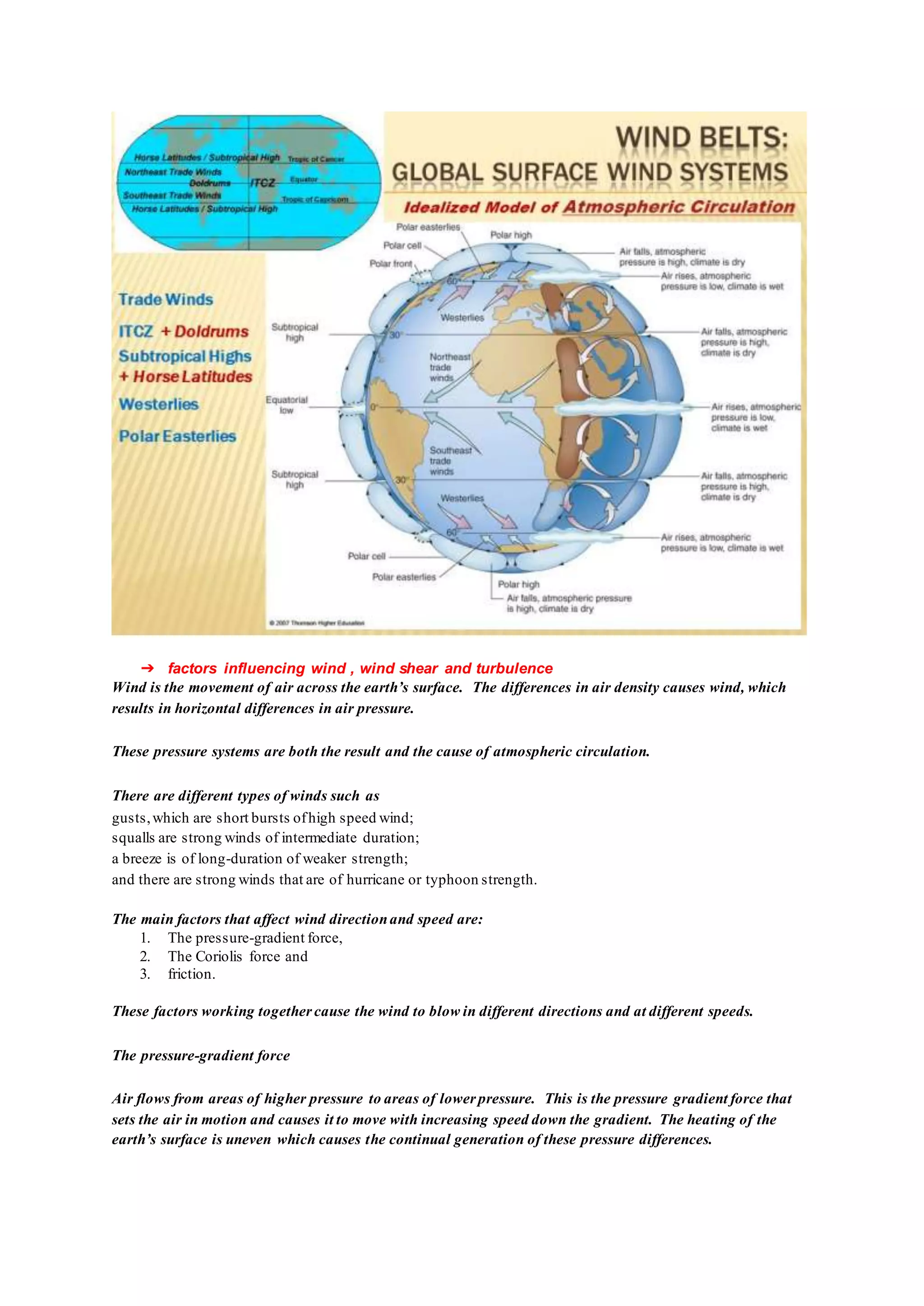
The wind beltsgirdling the planet are organised into three cells in each hemisphere: the Hadley cell, the Ferrel
cell, and the Polar cell.
➔ factors influencing wind , wind shear and turbulence
Wind is the movement of air across the earth’s surface. The differences in air density causes wind, which
results in horizontal differences in air pressure.
These pressure systems are both the result and the cause of atmospheric circulation.
There are different types of winds such as
gusts,which are short bursts ofhigh speed wind;
squalls are strong winds of intermediate duration;
a breeze is of long-duration of weaker strength;
and there are strong winds that are of hurricane or typhoon strength.
The main factors that affect wind directionand speed are:
1. The pressure-gradient force,
2. The Coriolis force and
3. friction.
These factors working togethercause the wind to blow in different directions and at different speeds.
The pressure-gradient force
Air flows from areas of higher pressure to areas of lower pressure. This is the pressure gradient force that
sets the air in motion and causes it to move with increasing speed down the gradient. The heating of the
earth’s surface is uneven which causes the continual generation of these pressure differences.
The Coriolisforce
The second force that affects the direction of the winds is the deflecting force of the rotationof earth, known
as the Coriolisforce. Winds are deflected to the right of the gradient in the Northern Hemisphere and to the
left in the Southern.
The Coriolisforce is directed at right angles to the direction of air flow. It does not affect the wind speed,
only the wind direction. However, the stronger the wind, the greater the deflecting force. There is no
deflectionof winds at the equator, but it increases to its maximum at the poles.
Friction
Friction is the third force that affects both speed and directionof winds. Friction is operative only to about
2,000 feet above the earth’s surface. This force greatly slows the speed of surface air and reduces the
Coriolisforce. This altersthe force balance which causes the pressure-gradient force to move the air at right
angles across the isobars toward the area of lower pressure.
Summary
Wind is an air movement that occurs in additionto the movement associated with rotationof the earth. The
earth’s atmosphere is fixed to the earth and moves with it in its west-to-east rotation. Wind is nature’s way of
trying to correct air pressure inequalities which are the result as well as the cause of atmospheric circulation.
➔ wind speed monitoring
Wind speed describes how fast the air is moving past a certain point. This may be an averaged over a given unit
of time, such as miles per hour, or an instantaneous speed,which is reported as a peak wind speed,wind gust or
squall.
Wind direction describes the direction on a compass from which the wind emanates, for instance, from the
North or from the West.
Why is Wind Speed and Direction Important?
Wind speed and direction are important for monitoring and predicting weather patterns and global climate.
Wind speed and direction have numerous impacts on surface water. These parameters affect rates of
evaporation, mixing of surface waters, and the development of seiches and storm surges.Each of these
processes has dramatic effects on water quality and water level.
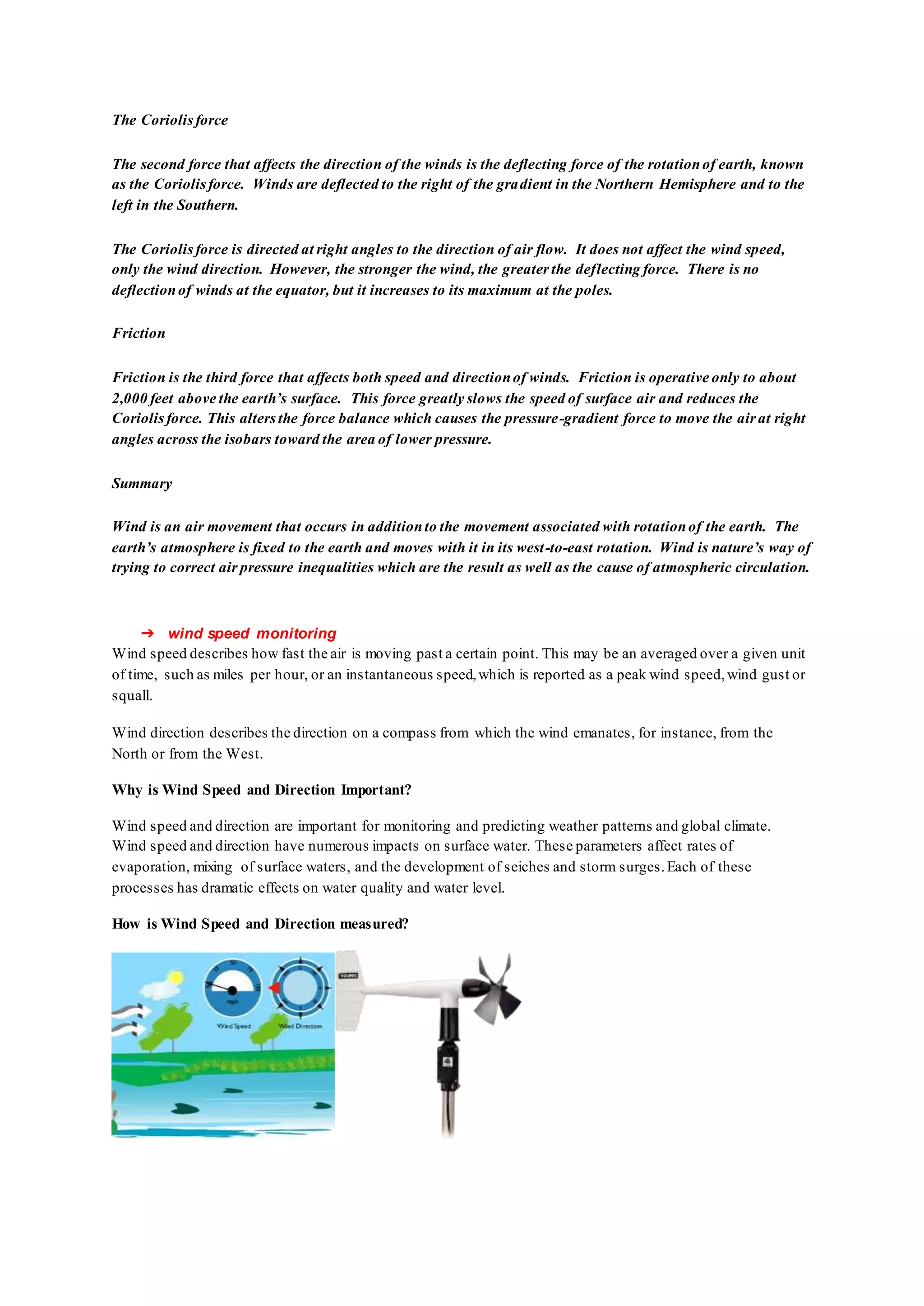
How is Wind Speed and Direction measured?
Wind speed is typically reported in miles per hour, knots, or meters per second.One mile per hour is equal to
0.45 meters per second,and 0.87 knots.
Wind direction is typically reported in degrees, and describes the direction from which the wind emanates. A
direction of 0 degrees is due North on a compass, and 180 degrees is due South. A direction of 270 degrees
would indicate a wind blowing in from the west.
Wind Speed and Direction Technology
The measurement of wind speed is usually done using a cup or propeller anemometer, which is an instrument
with three cups or propellers on a vertical axis. The force of the wind causes the cups or propellers to spin. The
spinning rate is proportional to the wind speed
Wind direction is measured by a wind vane that aligns itself with the direction of the wind.
➔ Betz limit
Betz's law indicates the maximum power that can be extracted from the wind, independent of the design of a
wind turbine in openflow. It was published in 1919, by the German physicist Albert Betz.
The law is derived from the principles of conservation ofmass and momentum of the air stream flowing through
an idealized "actuatordisk" that extracts energy from the wind stream.
According to Betz's law, no turbine can capture more than 16/27 (59.3%) of the kinetic energy in wind. The
factor 16/27 (0.593) is known as Betz's coefficient. Practical utility-scale wind turbines achieve at peak 75% to
80% of the Betz limit.
The Betz limit is based on an open disk actuator.If a diffuser is used to collect additional wind flow and direct it
through the turbine, more energy can be extracted, but the limit still applies to the cross-section ofthe entire
structure.
➔ Aerodynamics of wind turbine rotor
The primary application of wind turbines is to generate energy using the wind. Hence, the aerodynamics is a
very important aspect of wind turbines.
Though the details of the aerodynamics depend very much on the topology,some fundamental concepts apply to
all turbines.Every topology has a maximum power for a given flow, and some topologies are betterthan others.
The method used to extract power has a strong influence on this.
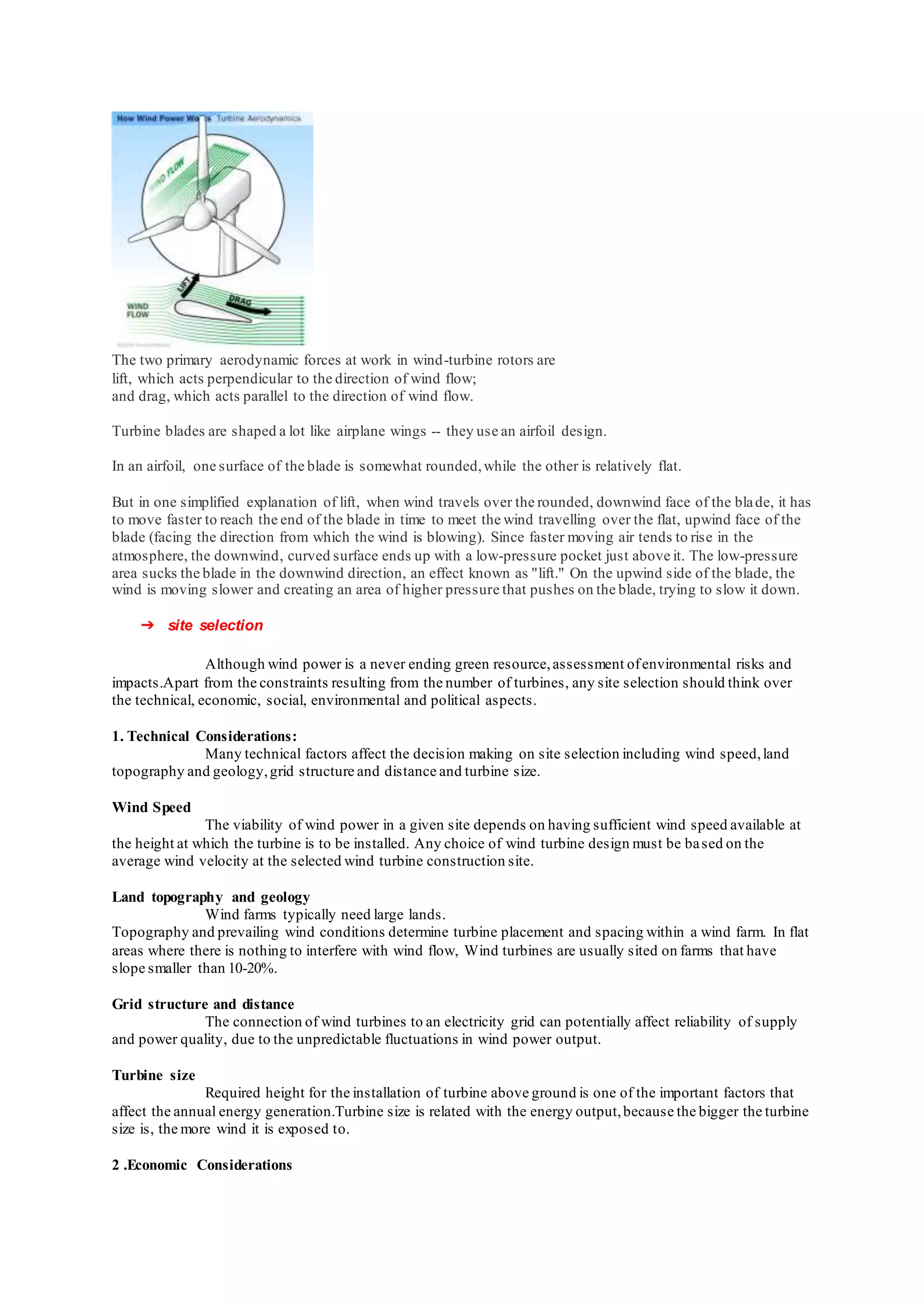
The two primary aerodynamic forces at work in wind-turbine rotors are
lift, which acts perpendicular to the direction of wind flow;
and drag, which acts parallel to the direction of wind flow.
Turbine blades are shaped a lot like airplane wings -- they use an airfoil design.
In an airfoil, one surface of the blade is somewhat rounded,while the other is relatively flat.
But in one simplified explanation of lift, when wind travels over the rounded, downwind face of the blade, it has
to move faster to reach the end of the blade in time to meet the wind travelling over the flat, upwind face of the
blade (facing the direction from which the wind is blowing). Since faster moving air tends to rise in the
atmosphere, the downwind, curved surface ends up with a low-pressure pocket just above it. The low-pressure
area sucks the blade in the downwind direction, an effect known as "lift." On the upwind side of the blade, the
wind is moving slower and creating an area of higher pressure that pushes on the blade, trying to slow it down.
➔ site selection
Although wind power is a never ending green resource,assessment ofenvironmental risks and
impacts.Apart from the constraints resulting from the number of turbines, any site selection should think over
the technical, economic, social, environmental and political aspects.
1. Technical Considerations:
Many technical factors affect the decision making on site selection including wind speed,land
topography and geology,grid structure and distance and turbine size.
Wind Speed
The viability of wind power in a given site depends on having sufficient wind speed available at
the height at which the turbine is to be installed. Any choice of wind turbine design must be based on the
average wind velocity at the selected wind turbine construction site.
Land topography and geology
Wind farms typically need large lands.
Topography and prevailing wind conditions determine turbine placement and spacing within a wind farm. In flat
areas where there is nothing to interfere with wind flow, Wind turbines are usually sited on farms that have
slope smaller than 10-20%.
Grid structure and distance
The connection of wind turbines to an electricity grid can potentially affect reliability of supply
and power quality, due to the unpredictable fluctuations in wind power output.
Turbine size
Required height for the installation of turbine above ground is one of the important factors that
affect the annual energy generation.Turbine size is related with the energy output,because the bigger the turbine
size is, the more wind it is exposed to.
2 .Economic Considerations
The economic sub factors that affect the site selection include capital cost,land cost and
operational and management costs.It is important to make economical evaluations by considering time value o f
money due to long periods of service life of wind farm projects.
Capital cost
Construction, electrical connection,grid connection,planning, wind turbines, approvals, utilities
and management are the main components of capital cost for wind farm projects.
Land cost
For the site selection, main economic factor is the cost of the land where the wind farm is
constructed; because,the cost ofland primarily depends on the region, soil condition and the distan ce from the
residential area.
Operational and management cost
There will be control functions such as supervisory control and data acquisition (SCADA) which
will provide control of each wind turbine in O&M facilities. Business rates, maintenance expenses,rents, staff
payments are main components of O&M costs.
Electricity market
Existing of an electricity market for the energy generated is an important factor affecting the economic benefits
of the project. There should be energy demand in regions close to wind farms.
3. Environmental Considerations
The environmental sub factors that affect the site selection of a wind farm include visual impact,
electromagnetic interference, wildlife and endangered species and noise impact.
Visual impact
Wind turbines are located in windy places, and most of the time, those places are highly visible.
To many people, those big towers with 2 or 3 blades create visual pollution. To minimize the impacts of visual
pollution, many investors implement the actions.
Wild life & endangered species
Wind farms affect birds mainly through collision with turbines and associated power lines,
disturbance leading to displacement including barriers to movement, and loss of habitat resulting from wind
turbines. To minimise the risk of bird collision, site selection should be done precisely.
Electromagnetic interference
Electromagnetic interference is an electromagnetic disturbance that interrupts,obstructs,or
degrades the effective performance of electronics or electrical equipment. Wind turbines may reflect, scatteror
diffract the electromagnetic waves which in turn interfere with the original signal arriving at the receiver.
Noise impact
Noise can generally be classified according to its two main sources:aerodynamic and
mechanical. Aerodynamic noise is produced when the turbine blades interact with eddies caused by atmospheric
turbulence. Mechanical noise is generated by the rotor machinery such as the gearbox and generator.
4. Social Considerations
Social factors that affect the selection of a site include public acceptance,distance from
residential area and alternative land use options of candidate wind farm site. Public may oppose projects because
of possible environmental or social effects. Distance from residential area gain importance not to interfere with
social life during wind farm construction or operation.
Regulatory boundaries
There may be some national or international level regulation related with the construction and
operation of wind farms. These regulations must be explored before evaluating the socio-political position of a
wind farm project. Most of them probably change from region to region.
Public acceptance
Public is the most vital component of a region and their opposition to issues can lead to abolish
proposed projects.Support of public for wind energy generation is expected to be high in general but proposed
wind farms have often been met with strong local opposition.
Land use
Land use affects the decision of wind farm siting from two points of view. Firstly, there are some
cases where no wind farms can be built although sufficient wind speed was detected.These cases are mainly
related with land use or condition. Land related constraints include forest area, Wetlands,Land of high
productivity, Archaeological sites,Aviation zones, Military zones etc.
Distance from the residential area
Noise and vibration stemming from the wind turbines may cause residents to suffer from sleep
disturbance,headaches,visual blurring. Those types of complaints can be avoided if the wind turbines are sited
a considerable distance from the residential area.
➔ Wind resource assessment
Wind resource assessment is the process by which wind power developers estimate the future energy production
of a wind farm. Accurate wind resource assessments are crucial to the successfuldevelopment of wind farms.
wind energy conversion devices
➔ classification, characteristics,applications.
➔ Hybrid systems - safety and environmental aspects.
Wind energy conversion devices can be broadly categorized into two types according to their axis alignment.
They are as follows
Horizontal axis wind turbine:
It can be further divided into three types:
● Dutch type grain grinding windmills
● Multi Blade water pumping windmills
● High speed propeller type windmills
1. Dutch Windmill:
Man has used Dutch windmills for a long time. In fact the grain grinding windmills that were widely used in
Europe since the middle ages were Dutch. These windmills were operated on the thrust exerted by the wind. The
blades, generally four, were inclined at an angle to the plane of rotation. The wind being deflected by the blades
exerted a force in the direction of rotation. The blades were made of sails or wooden slats.
2. Multi blade WaterPumping Windmill:
Modern water pumping windmills have a large number of blades- generally wooden or metallic- driving a
reciprocating pumps. As the mill has to be placed directly over the well, the criterion for site selection concerns
about water availability & not windiness. Therefore the mill must be able to operate at slow winds. The large
number of blades gives a high torque,required for driving a centrifugal pump, even at low wind speeds.Hence
sometimes these are called as fan mills. As these windmills are supposed to be installed at remote places, mostly
as single units,reliability, sturdiness,and low cost are the prime criteria and not efficiency. The blades are made
of flat steelplates, working on the thrust of wind. These are hinged to a metal ring to ensure structural strength,
and the low speed of rotation adds to the reliability. The orientation is generally achieved by tail vane.
3.High speed propeller type wind machines:
The horizontal axis wind turbines that are used today for electricity generation do not operate on thrust force.
They depend mainly on the aerodynamic forces that develop when wind flows around a blade of aerofoil design.
Windmills working on thrust force are inherently less efficient. So all the modern wind turbine blades are
designed based on aerofoil section.
Vertical axis wind turbines:
It comes in two different designs
● The savonius rotor
● The darrieus rotor
1.The savonius rotor:
The savonius rotoris extremely simple vertical axis device that works entirely because of the thrust force of
wind. The basic equipment is a drum cut in two halves vertically. The two parts are attached to the two opposite
sides of a vertical shaft. As the wind blowing into the structure meets with two dissimilar surfaces – one convex
and the other concave – the forces exerted on the two surfaces are different, which gives the rotor a torque.By
providing a certain amount of overlap between the two drums, the torque can be increased. This is because the
wind blowing into the concave surface turn around and give a push to the inner surface of the otherdrum, partly
cancelling the wind thrust on the convex side. It has been found that an overlap of about one third the drum
diameter gives optimum result.
2. The darrieus wind turbine:
The particularity of Darrieus rotor is that its working is not at all evident from its appearance. Two or more
flexible blades are attached to a vertical shaft. The blades bow outwards,taking approximately the shape of a
parabola and are of symmetrical airfoil section. Here the torque is zero when the rotor is stationary.It develops a
positive torque only when it is already rotating. This means that such a rotor has mo starting torque and has to
be start using some external means.
3. Giromill:
A variant of Darrieus wind turbine is the Giromill which uses the same concept.Here the blades are straigh t
resulting in simple construction.However in such a case the centrifugal force developed in the blade will
produce stress,trying to bend it. The blades have to be strong enough in the transverse direction to withstand
this stress.Moreoverthe vertical shaft cannot be secured with guywires, and so the coupling at the base has to
be strong enough to keep it vertical when subjected to strong winds. It is also called as H-Type windmill
because of its shape.
UNIT III BIO-ENERGY
➔ Biomass resources and their classification
Biomass is any organic matter—wood, crops, seaweed, animal wastes—that can be used as an energy source.
Biomass is probably our oldest source of energy after the sun.For thousands ofyears,people have burned wood
to heat their homes and cook their food. Biomass gets its energy from the sun.All organic matter contains stored
energy from the sun.During a process called photosynthesis,sunlight gives plants the energy they need to
convert water and carbon dioxide into oxygen and sugars.Biomass is a renewable energy source because its
supplies are not limited. We can always grow trees and crops, and waste will always exist.
We use four types ofbiomass today—wood and agricultural products,solid waste,landll gas and biogas,and
alcohol fuels (like Ethanol or Biodiesel).
Biomass resources include natural biomass, residual biomass and energy crops.
➔ Natural Biomass: get directly from the ecosystems.
➔ Residual Biomass: produced from the process of different industry production.
➔ Energy Crops: refer to crops plant for energy purpose of producing biomass.
Among these three sources,the most widely used ones are energy crops and residual biomass.
Biomass Classification
★ Woody biomass such as trees,shrubs and bushes;
★ Herbaceous biomass such as non-woody plant, grains and cereals;
★ Fruit biomass such as palm shell and coconut shell;
★ Mixed biomass;
BIOMASS ADVANTAGES:
➔ Sufficient biomass resources, affordable price and eco-friendly characteristic make
biomass fuel over fossil fuels. And these factors also motivate the development of
biomass fuel market. The amount of residual biomass which is produced from logging or
other industries is huge. Making biomass fuel from these waste residues is a win-win
choice. Besides, biomass-to-energy facilities such as pelletizing mill and briquette
extruder also promote the industrialization of biomass production.
➔ Use fallow lands to plant energy crops can bring incomes and benefits the water
retention of soil at the same time.
➔ Promote biomass in energy production can reduce pollution emissions such as CO. HC
and NO and better protect the environment and contribute to maintaining the
photochemistry of the atmosphere.
➔ Using agricultural biomass as biomass energy instead of burning or burying can not only
reduce the risks of forest fires but also can reduce insect plagues. Besides, the
exploitation of agricultural wastes can is also a new and promising market.
➔ Alleviating the greenhouse effect is another important reason to promote biomass
energy. Using biomass energy can greatly reduce the emission of CO2.
➔ Promoting biofuels can make up the lacking of oil resources and reduces dependence on
foreign oil.
➔ chemical constituents
Composition of Biomass
Plant cell wall is constituted by mainly 6 components:
(i) cellulose,
(ii) hemicellulose,
(iii) lignin,
(iv) water soluble sugars,amino acids and aliphatic acids,
(v) ether and alcohol-soluble constituents (e.g.fats, oils, waxes, resin and many pigments),
(iv) proteins.
These components build up plant biomass. Proportion of these constituents vary in different groups of plants and
even in the same group.
Sources of
biomass
Cellulose Hemicellulose Lignin Protein
(N x 6.25)
Birch
angiosperm*
44.9 32.7 19.3 0.5
Spruce
gymnosperm*
46.1 24.6 26.3 0.2
Crop residues ** 30-45 16-27 3-13 3.6-7.2
Wood
residues***
45-56 10-25 18-30 -
Cotton 89.0 5.0 0.0 1.3
➔ physicochemical characteristics of biomass
Biomass conversion processes
➔ Thermochemical conversion: direct combustion, gasification, pyrolysis and
liquefaction
➔ biochemical conversion: Anaerobic digestion and alcohol production
➔ chemical conversion process: hydrolysis and hydrogenation
Biomass can be converted into different forms of energy by using various processes.
Many factors affect the choice of the process like quantity of biomass feedstock, desired energy form,
environmental standards,economic conditions,and project specific factors.
Biomass can be converted into three main products:power or heat generation, transportation fuels and chemical
feedstock.
1. Thermo-chemical conversion
In thermo-chemical conversion, energy is produces by applying heat and chemical processes.
There are four thermo-chemical conversion processes,which are given below.
1.1 Combustion process
Combustion is an exothermic chemical reaction, in which biomass is burned in the presence of air. In this
process chemical energy which is stored in the biomass is converted in the
mechanical and electrical energies. This process is suitable for dry biomass containing moisture less than 50%.
Biomass is burned at the temperature of 800-1000 °C. This process is used for domestic applications as well as
commercially in biomass power plants in order to produce electricity.
1.2 Pyrolysis Process
It is the process of conversion of biomass to liquid (bio-oil), solid (charcoal) and gaseous (fuel gases)products
by heating in the absence of air at 500 °C.
There are two types of pyrolysis : Fast pyrolysis, conventional (Carbonization) pyrolysis and slow
pyrolysis. Fast pyrolysis process has high heating value and heat transfer rate and completes within seconds.
Fast
pyrolysis yields 60% bio-oil, 20% bio-char and 20% biogas.
Conventional pyrolysis process is the process in which mostly carbon (35%) is leaved as residue. Slow
pyrolysis takes more time than fast pyrolysis,it also has low temperature and heating values.
Flash pyrolysis is the type of fast pyrolysis, in which 80% bio-oil is obtained at keeping temperature low. If
flash pyrolysis is used for converting biomass to bio-crude, it has up to 80% efficiency.
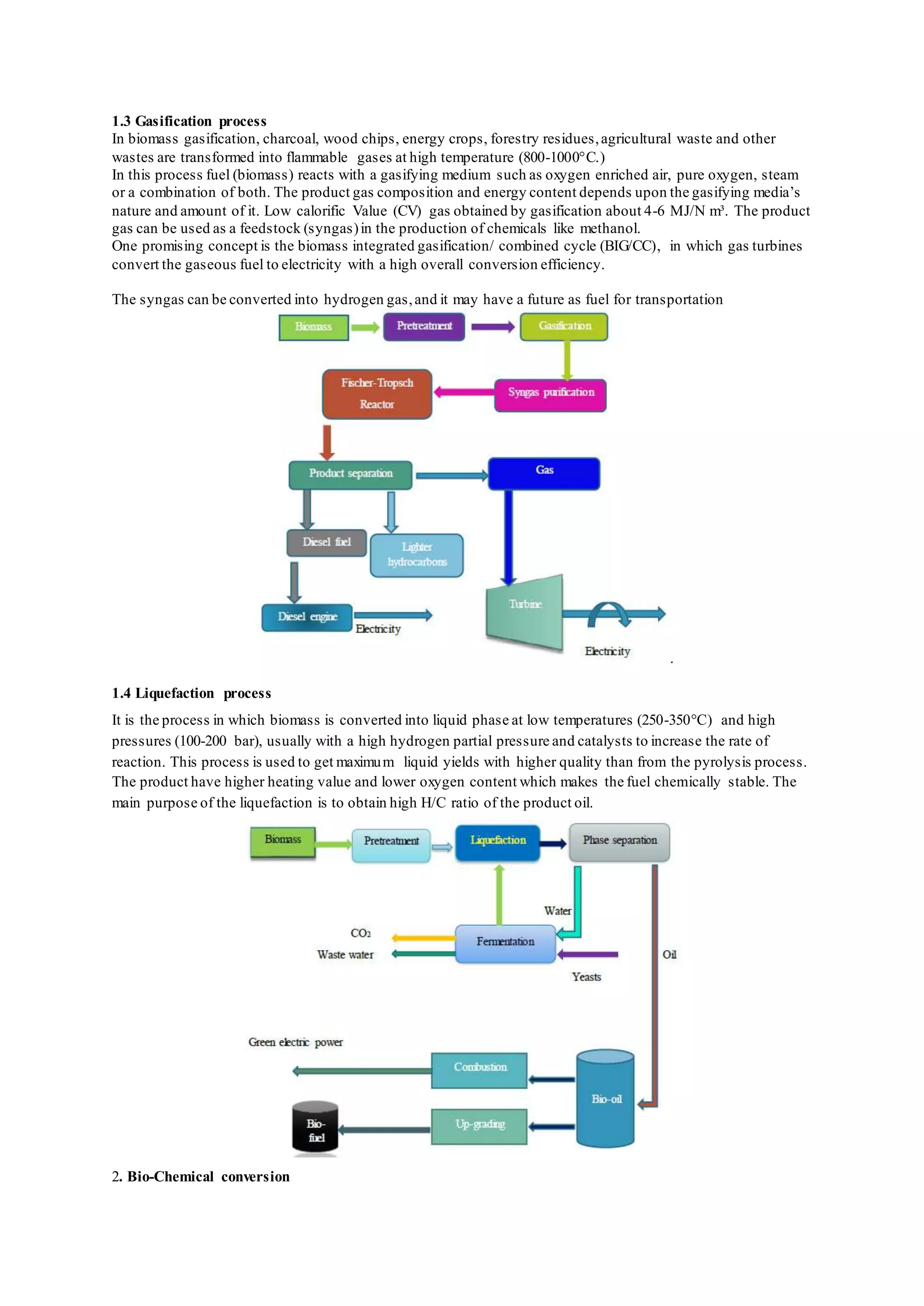
1.3 Gasification process
In biomass gasification, charcoal, wood chips, energy crops, forestry residues,agricultural waste and other
wastes are transformed into flammable gases at high temperature (800-1000°C.)
In this process fuel (biomass) reacts with a gasifying medium such as oxygen enriched air, pure oxygen, steam
or a combination of both. The product gas composition and energy content depends upon the gasifying media’s
nature and amount of it. Low calorific Value (CV) gas obtained by gasification about 4-6 MJ/N m³. The product
gas can be used as a feedstock (syngas)in the production of chemicals like methanol.
One promising concept is the biomass integrated gasification/ combined cycle (BIG/CC), in which gas turbines
convert the gaseous fuel to electricity with a high overall conversion efficiency.
The syngas can be converted into hydrogen gas,and it may have a future as fuel for transportation
.
1.4 Liquefaction process
It is the process in which biomass is converted into liquid phase at low temperatures (250-350°C) and high
pressures (100-200 bar), usually with a high hydrogen partial pressure and catalysts to increase the rate of
reaction. This process is used to get maximum liquid yields with higher quality than from the pyrolysis process.
The product have higher heating value and lower oxygen content which makes the fuel chemically stable. The
main purpose of the liquefaction is to obtain high H/C ratio of the product oil.
2. Bio-Chemical conversion
Biochemical conversion makes use of the enzymes of bacteria and other living organisms to break down
biomass and convert it into fuels. This conversion process includes anaerobic digestion and fermentation.
2.1. Anaerobic digestion process
This is a process in which organic material directly converted to a gas which is termed as biogas.It is mixture of
methane, carbon dioxide and other gases like hydrogen sulphide in small quantities.
Biomass is converted in anaerobic environment by bacteria, which produces a gas having an energy of 20-40%
of lower heating value of the feedstock. This process is suitable for organic wastes having high moisture about
80-90%. This biogas can be directly used in spark ignition gas engines and gas turbines and can be upgraded to
higher quality natural gas by removing carbon dioxide. The overall conversion efficiency of this process is 21%.
Waste heat from engines and turbines can be recovered by using combined heat and power system.
2.2. Fermentation process
Fermentation is an anaerobic process that breaks down the glucose within organic materials. It is a series of
chemical reactions that convert sugars to ethanol. The basic fermentation process involves the conversion of a
plant’s glucose (or carbohydrate)into an alcohol or acid. Yeast or bacteria are added to the biomass material,
which feed on the sugars to produce ethanol and carbon dioxide. The ethanolis distilled and dehydrated to
obtain a higher concentration of alcohol to achieve the required purity for the use as automotive fuel. The solid
residue from the fermentation process can be used as cattle-feed and in the case of sugarcane; the bagasse can
be used as a fuel for boilers or for subsequent gasification.
Chemical conversion of biomass involves use of chemical interactions to transform biomass into other forms of
usable energy.
Transesterification is the most common form of chemical-based conversion.Transesterification is a chemical
reaction through which fatty acids from oils, fats and greases are bonded to alcohol. This process reduces the
viscosity of the fatty acids and makes them combustible. Biodiesel is a common end-product of
transesterification, as are glycerin and soaps.Almost any bio-oil (such as soybean oil), animal fat or tallow, or
tree oil can be converted to biodiesel.
➔ Biogas - generation - types of biogas Plants- applications
Biogas
Biogas typically refers to a mixture of different gases produced by the breakdown of organic matter in the
absence of oxygen.
Biogas can be produced from raw materials such as agricultural waste, manure, municipal waste, plant material,
sewage, green waste or food waste.
Biogas is a renewable energy source.
Biogas can be produced by anaerobic digestion with anaerobic organisms, which digest material inside a closed
system, or fermentation of biodegradable materials.
Biogas -generation
Biogas is generated when bacteria degrade biological material in the absence of oxygen, in a process known as
anaerobic digestion. Since biogas is a mixture of methane (also known as marsh gas or natural gas, CH4) and
carbon dioxide it is a renewable fuel produced from waste treatment.
Anaerobic digestion is basically a simple process carried out in a number of steps that can use almost any
organic material as a substrate – it occurs in digestive systems,marshes, rubbish dumps, septic tanks and the
Arctic Tundra.
Conventional anaerobic digestion has been a “liquid” process,where waste is mixed with water to facilitate
digestion, but a “solid” process is also possible,as occurs in landfill sites.
It takes a lot of energy to compress the gas (this energy is usually just wasted), plus you have the hazard of high
pressure.A variable volume storage (flexible bag or floating drum are the two main variants) is much easier and
cheaper to arrange than high pressure cylinders, regulators and compressors.
Types of Biogas Plants
A total of seven different types of biogas plant have been officially recognised by the MNES.
1. the floating-drum plant with a cylindrical digester (KVIC model),
2. the fixed-dome plant with a brick reinforced, moulded dome (Janata model)
3. the floating-drum plant with a hemisphere digester(Pragati model)
4. the fixed-dome plant with a hemisphere digester(Deenbandhu model)
5. the floating-drum plant made of angular steel and plastic foil (Ganesh model)
6. the floating-drum plant made of prefabricated reinforced concrete compound units
7. the floating-drum plant made of fiberglass reinforced polyester.
Small Scale Biogas Digester
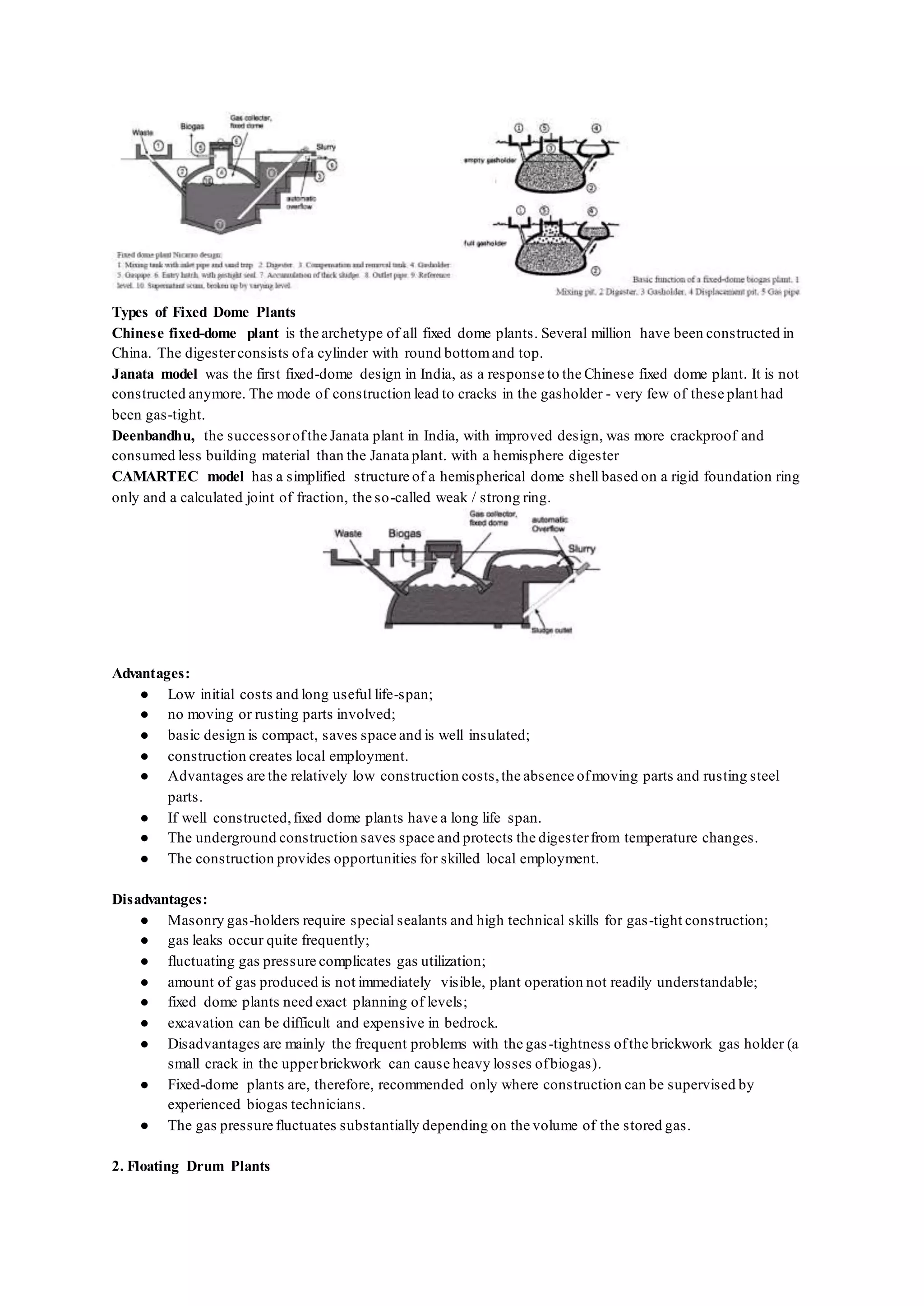
1. Fixed-dome Plants A fixed-dome plant consists ofa digester with a fixed, non-movable gas holder, which sits
on top of the digester. When gas production starts,the slurry is displaced into the compensation tank. Gas
pressure increases with the volume of gas stored and the height difference between the slurry level in the
digester and the slurry level in the compensation tank.
Types of Fixed Dome Plants
Chinese fixed-dome plant is the archetype of all fixed dome plants. Several million have been constructed in
China. The digesterconsists ofa cylinder with round bottomand top.
Janata model was the first fixed-dome design in India, as a response to the Chinese fixed dome plant. It is not
constructed anymore. The mode of construction lead to cracks in the gasholder - very few of these plant had
been gas-tight.
Deenbandhu, the successorofthe Janata plant in India, with improved design, was more crackproof and
consumed less building material than the Janata plant. with a hemisphere digester
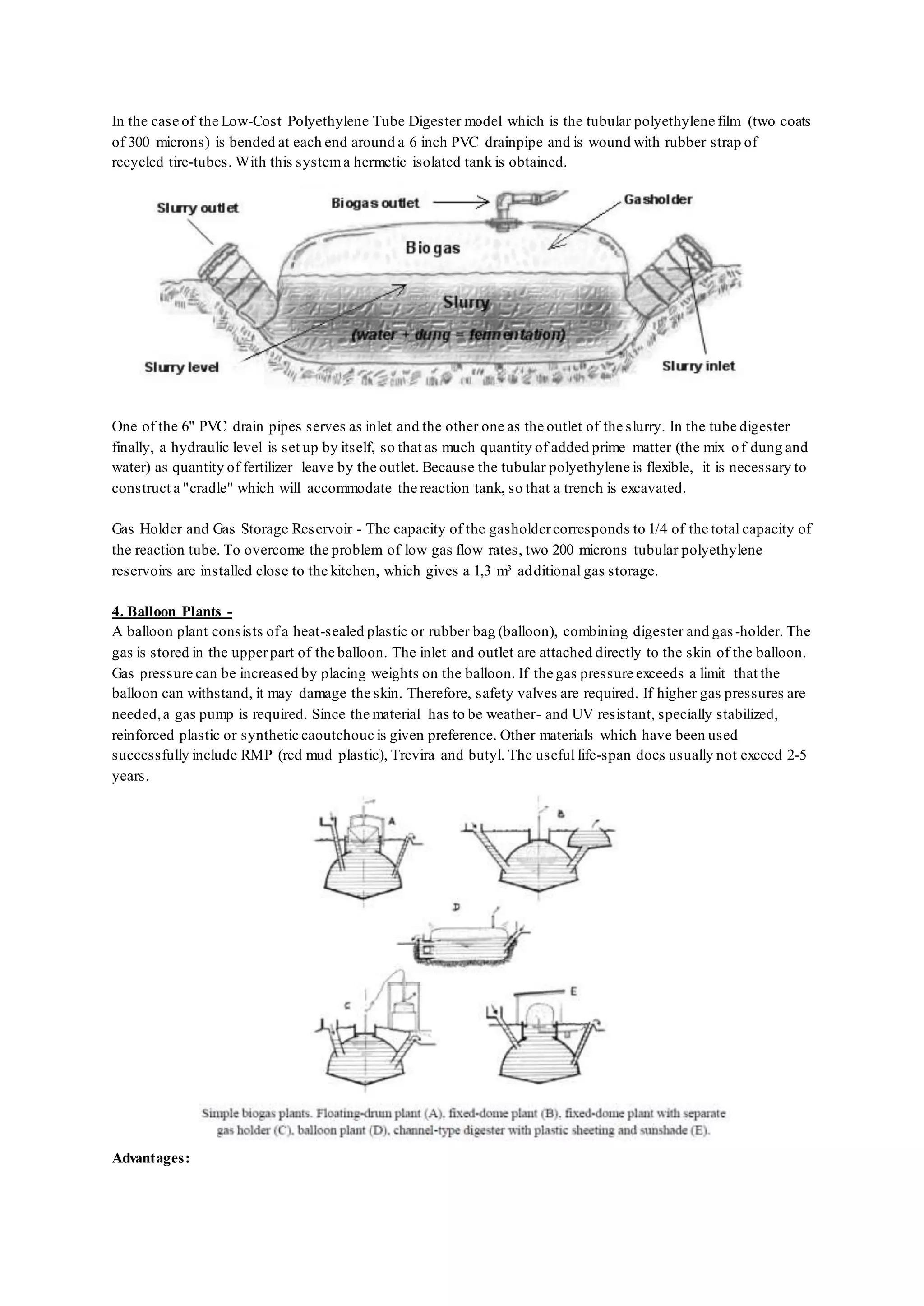
CAMARTEC model has a simplified structure of a hemispherical dome shell based on a rigid foundation ring
only and a calculated joint of fraction, the so-called weak / strong ring.
Advantages:
● Low initial costs and long useful life-span;
● no moving or rusting parts involved;
● basic design is compact, saves space and is well insulated;
● construction creates local employment.
● Advantages are the relatively low construction costs,the absence ofmoving parts and rusting steel
parts.
● If well constructed,fixed dome plants have a long life span.
● The underground construction saves space and protects the digesterfrom temperature changes.
● The construction provides opportunities for skilled local employment.
Disadvantages:
● Masonry gas-holders require special sealants and high technical skills for gas-tight construction;
● gas leaks occur quite frequently;
● fluctuating gas pressure complicates gas utilization;
● amount of gas produced is not immediately visible, plant operation not readily understandable;
● fixed dome plants need exact planning of levels;
● excavation can be difficult and expensive in bedrock.
● Disadvantages are mainly the frequent problems with the gas-tightness ofthe brickwork gas holder (a
small crack in the upperbrickwork can cause heavy losses ofbiogas).
● Fixed-dome plants are, therefore, recommended only where construction can be supervised by
experienced biogas technicians.
● The gas pressure fluctuates substantially depending on the volume of the stored gas.
2. Floating Drum Plants
Floating-drum plants consist ofan underground digesterand a moving gas -holder. The gas-holder floats either
directly on the fermentation slurry or in a water jacket of its own. The gas is collected in the gas drum, which
rises or moves down, according to the amount of gas stored.The gas drum is prevented from tilting by a guiding
frame. If the drum floats in a water jacket, it cannot get stuck, even in substrate with high solid content.
Size - They are used most frequently by small- to middle-sized farms (digester size: 5-15m3 ) or in institutions
and larger agro-industrial estates (digestersize: 20- 100m3 ).
Types of Floating Drum Plants
1. KVIC model with a cylindrical digester, the oldest and most widespread floating drum biogas plant
from India.
2. Pragati model with a hemisphere digester
3. Ganesh model made of angular steel and plastic foil
4. floating-drum plant made of prefabricated reinforced concrete compound units
5. floating-drum plant made of fiberglass reinforced polyester
6. low cost floating-drum plants made of plastic water containers or fiberglass drums: ARTI Biogas plants
7. BORDA model: The BORDA-plant combines the static advantages ofhemispherical digester with the
process-stability of the floating-drum and the longer life span of a water jacket plant.
Advantages:
● Advantages are the simple, easily understood operation - the volume of stored gas is directly visible.
● The gas pressure is constant,determined by the weight of the gas holder.
● The construction is relatively easy, construction mistakes do not lead to major problems in operation
and gas yield.
Disadvantages:
Disadvantages are high material costs ofthe steel drum, the susceptibility of steel parts to corrosion. Because of
this, floating drum plants have a shorter life span than fixed-dome plants and regular maintenance costs for the
painting of the drum.
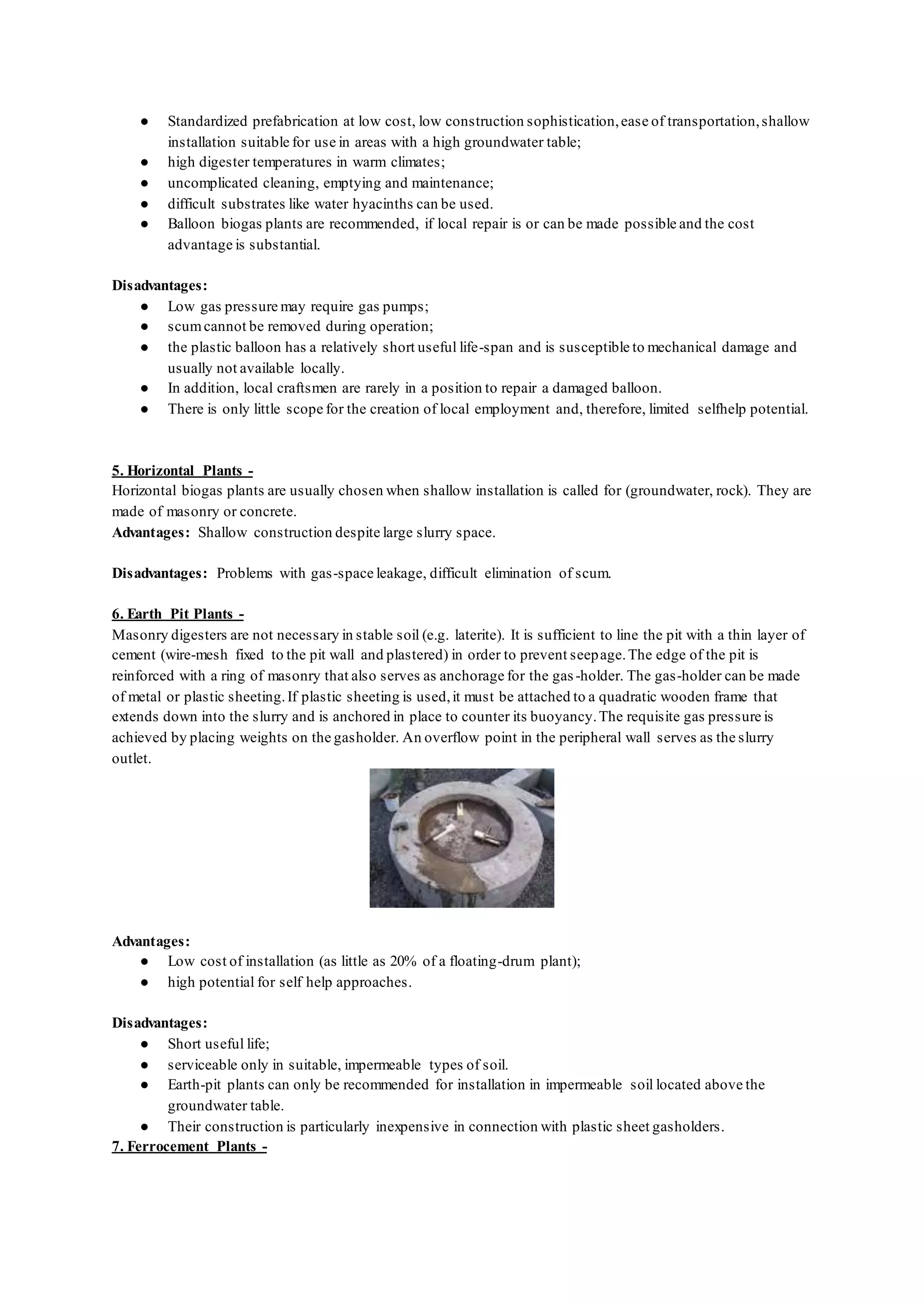
3. Low Cost Polyethylene Tube Digester Digester -
In the case of the Low-Cost Polyethylene Tube Digester model which is the tubular polyethylene film (two coats
of 300 microns) is bended at each end around a 6 inch PVC drainpipe and is wound with rubber strap of
recycled tire-tubes. With this systema hermetic isolated tank is obtained.
One of the 6" PVC drain pipes serves as inlet and the other one as the outlet of the slurry. In the tube digester
finally, a hydraulic level is set up by itself, so that as much quantity of added prime matter (the mix of dung and
water) as quantity of fertilizer leave by the outlet. Because the tubular polyethylene is flexible, it is necessary to
construct a "cradle" which will accommodate the reaction tank, so that a trench is excavated.
Gas Holder and Gas Storage Reservoir - The capacity of the gasholdercorresponds to 1/4 of the total capacity of
the reaction tube. To overcome the problem of low gas flow rates, two 200 microns tubular polyethylene
reservoirs are installed close to the kitchen, which gives a 1,3 m³ additional gas storage.
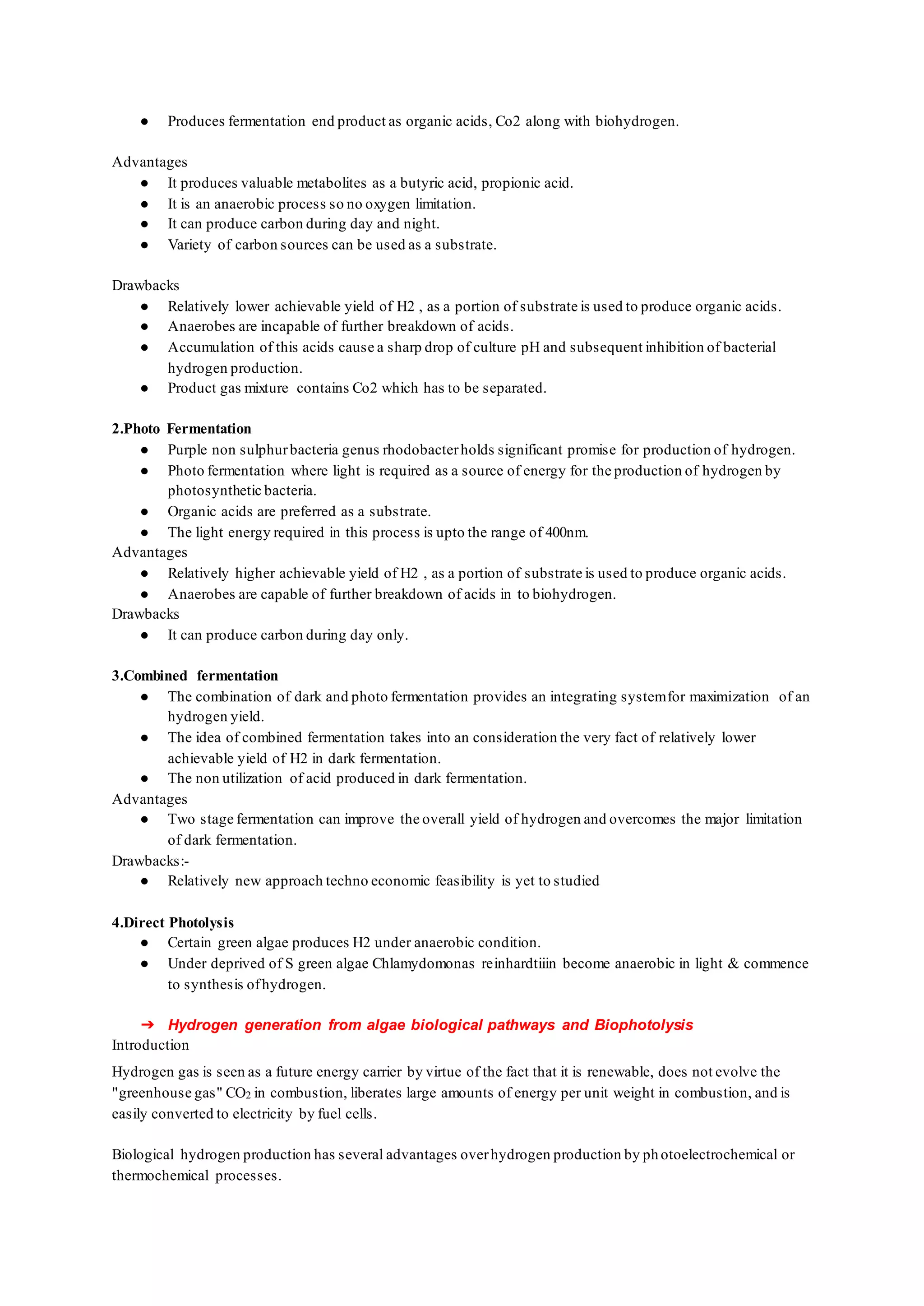
4. Balloon Plants -
A balloon plant consists ofa heat-sealed plastic or rubber bag (balloon), combining digester and gas-holder. The
gas is stored in the upperpart of the balloon. The inlet and outlet are attached directly to the skin of the balloon.
Gas pressure can be increased by placing weights on the balloon. If the gas pressure exceeds a limit that the
balloon can withstand, it may damage the skin. Therefore, safety valves are required. If higher gas pressures are
needed,a gas pump is required. Since the material has to be weather- and UV resistant, specially stabilized,
reinforced plastic or synthetic caoutchouc is given preference. Other materials which have been used
successfully include RMP (red mud plastic), Trevira and butyl. The useful life-span does usually not exceed 2-5
years.
Advantages:
● Standardized prefabrication at low cost, low construction sophistication,ease of transportation,shallow
installation suitable for use in areas with a high groundwater table;
● high digester temperatures in warm climates;
● uncomplicated cleaning, emptying and maintenance;
● difficult substrates like water hyacinths can be used.
● Balloon biogas plants are recommended, if local repair is or can be made possible and the cost
advantage is substantial.
Disadvantages:
● Low gas pressure may require gas pumps;
● scumcannot be removed during operation;
● the plastic balloon has a relatively short useful life-span and is susceptible to mechanical damage and
usually not available locally.
● In addition, local craftsmen are rarely in a position to repair a damaged balloon.
● There is only little scope for the creation of local employment and, therefore, limited selfhelp potential.
5. Horizontal Plants -
Horizontal biogas plants are usually chosen when shallow installation is called for (groundwater, rock). They are
made of masonry or concrete.
Advantages: Shallow construction despite large slurry space.
Disadvantages: Problems with gas-space leakage, difficult elimination of scum.
6. Earth Pit Plants -
Masonry digesters are not necessary in stable soil (e.g. laterite). It is sufficient to line the pit with a thin layer of
cement (wire-mesh fixed to the pit wall and plastered) in order to prevent seepage.The edge of the pit is
reinforced with a ring of masonry that also serves as anchorage for the gas -holder. The gas-holder can be made
of metal or plastic sheeting.If plastic sheeting is used,it must be attached to a quadratic wooden frame that
extends down into the slurry and is anchored in place to counter its buoyancy.The requisite gas pressure is
achieved by placing weights on the gasholder. An overflow point in the peripheral wall serves as the slurry
outlet.
Advantages:
● Low cost of installation (as little as 20% of a floating-drum plant);
● high potential for self help approaches.
Disadvantages:
● Short useful life;
● serviceable only in suitable, impermeable types of soil.
● Earth-pit plants can only be recommended for installation in impermeable soil located above the
groundwater table.
● Their construction is particularly inexpensive in connection with plastic sheet gasholders.
7. Ferrocement Plants -
The ferro-cement type of construction can be applied either as a self supporting shell or an earth-pit lining. The
vesselis usually cylindrical. Very small plants (Volume under 6 m3 ) can be prefabricated. As in the case of a
fixed-dome plant, the ferrocement gasholderrequires special sealing measures (proven reliability with
cemented-on aluminium foil).
Advantages:
● Low cost of construction,especially in comparison with potentially high cost of masonry for alternative
plants;
● mass production possible;
● low material input.
Disadvantages:
● Substantial consumption of essentially good-quality cement;
● workmanship must meet high quality standards;
● uses substantialamounts of expensive wire mesh;
● construction technique not yet adequately time-tested;
● special sealing measures for the gas-holder are necessary.
● Ferrocement biogas plants are only recommended in cases where special ferro-cement know-how is
available.
Biogas Applications:
Biogas can be used for electricity production on sewage works, in a CHP gas engine, where the waste heat from
the engine is conveniently used for heating the digester; cooking; space heating; water heating; and process
heating. If compressed, it can replace compressed natural gas for use in vehicles, where it can fuel an internal
combustion engine or fuel cells and is a much more effective displacer of carbon dioxide than the normal use in
on-site CHP plants.
Advantages of biogas:
• It can generate enough electricity to meet up-to 3% of the continent's expenditure.
• It can help reduce global climate change.
• It can produce one hundred billion kilowatt hours of electricity, enough to power millions of homes by
converting cows manure into methane biogas through anaerobic digestion. Moreover, to generate 3 Kw hours of
electricity, one cow can produce enough manure in one day.
1. Protection forests
2. Saving cooking time
3. Saving money
4. Saving fossil fuels
5. Saving time for collecting firewood
6. Using crops residues for animals fodder instead of fuel
7. Improving hygienic conditions
8. Producing high-quality fertilizer
9. Enabling local mechanization
10. Electricity production
11. Improving the rural standard of living
12. Reducing water and air pollution
UNIT IV HYDROGEN AND FUEL CELLS
Hydrogen fuel is a zero-emission fuel when burned with oxygen, if one considers water not to be an emission.
It often uses electrochemical cells, or combustion in internal engines, to power vehicles and electric devices.
It is also used in the propulsion of spacecraft and might potentially be mass-produced and commercialized for
passengervehicles and aircraft.
A fuel cell is an electrochemical cell that converts the chemical energy from a fuel into electricity through an
electrochemical reaction of hydrogen fuel with oxygen or another oxidising agent.
Fuel cells are different from batteries in requiring a continuous source offuel and oxygen (usually from air) to
sustain the chemical reaction, whereas in a battery the chemical energy comes from chemicals already pres ent in
the battery.
Fuel cells can produce electricity continuously for as long as fuel and oxygen are supplied.
Fuel cells are used for primary and backup power for commercial, industrial and residential buildings and in
remote or inaccessible areas.
They are also used to power fuel cell vehicles, including forklifts, automobiles, buses,boats,motorcycles and
submarines.
Hydrogen properties
➔ Colorless and odorless
➔ Extremely reactive with oxygen and otheroxidizers.
➔ 0.00005% in air
➔ Low ignition energy.
➔ High flame temperature.
➔ Invisible flame in daylight conditions.
➔ Small molecular size promotes leaks and diffusion.
➔ The cryogenic liquid at 20K is even colder than frozen nitrogen, oxygen or argon.
➔ Thermodynamics and electrochemical principles
➔ design, types, and applications
Thermodynamics is the branch of physics that deals with the relationships between heat and other forms of
energy. In particular, it describes how thermal energy is converted to and from otherforms of energy and how it
affects matter.
The four laws of thermodynamics
The fundamental principles of thermodynamics were originally expressed in three laws. these laws are:
The Zeroth Law states that if two bodies are in thermal equilibrium with some third body,then they are also in
equilibrium with each other. This establishes temperature as a fundamental and measurable property of matter.
The First Law states that the total increase in the energy of a systemis equal to the increase in thermal energy
plus the work done on the system.This states that heat is a form of energy and is therefore subject to the
principle of conservation.
The Second Law states that heat energy cannot be transferred from a body at a lower temperature to a body at a
higher temperature without the addition of energy. This is why it costs money to run an air conditioner.
The Third Law states that the entropy of a pure crystalat absolute zero is zero. As explained above,entropy is
sometimes called "waste energy," i.e., energy that is unable to do work, and since there is no heat energy
whatsoeverat absolute zero, there can be no waste energy.
Electrochemistry deals with the interaction between electrical energy and chemical change.
➔ Hydrogen production methods
Hydrogen Production
1. Electrolysis.
2. Steam-methane reforming process.
3. Biological process(bio-hydrogen).
Hydrogen production always requires more energy than can be retrieved from the gas as a fuel later on when
they are produced by above two process.
Biological production
Biological hydrogen production stands out as an environmentally harmless process carried out undermild
operating conditions,using renewable resources.
Several types of microorganisms such as the
1. photosynthetic bacteria,
2. cyano bacteria,
3. algae or fermentative bacteria are commonly utilized for biological hydrogen production.
Methods of Bio hydrogen Production
1.Dark Fermentation
2.Photo Fermentation
3.Combined Fermentation
4.Direct Photolysis (algae) Hydrogen
5.Indirect Photolysis (cynobacteria) nitrogen
1. Dark Fermentation
● Fermentative conversion of organic substrate to biohydrogen.
● This method doesn’t require light energy.
● The Gram+ve bacteria of Clostridium genus is of great potential in biohydrogen production.
● Require wet carbohydrate rich biomass as a substrate.
● Produces fermentation end product as organic acids, Co2 along with biohydrogen.
Advantages
● It produces valuable metabolites as a butyric acid, propionic acid.
● It is an anaerobic process so no oxygen limitation.
● It can produce carbon during day and night.
● Variety of carbon sources can be used as a substrate.
Drawbacks
● Relatively lower achievable yield of H2 , as a portion of substrate is used to produce organic acids.
● Anaerobes are incapable of further breakdown of acids.
● Accumulation of this acids cause a sharp drop of culture pH and subsequent inhibition of bacterial
hydrogen production.
● Product gas mixture contains Co2 which has to be separated.
2.Photo Fermentation
● Purple non sulphurbacteria genus rhodobacterholds significant promise for production of hydrogen.
● Photo fermentation where light is required as a source of energy for the production of hydrogen by
photosynthetic bacteria.
● Organic acids are preferred as a substrate.
● The light energy required in this process is upto the range of 400nm.
Advantages
● Relatively higher achievable yield of H2 , as a portion of substrate is used to produce organic acids.
● Anaerobes are capable of further breakdown of acids in to biohydrogen.
Drawbacks
● It can produce carbon during day only.
3.Combined fermentation
● The combination of dark and photo fermentation provides an integrating systemfor maximization of an
hydrogen yield.
● The idea of combined fermentation takes into an consideration the very fact of relatively lower
achievable yield of H2 in dark fermentation.
● The non utilization of acid produced in dark fermentation.
Advantages
● Two stage fermentation can improve the overall yield of hydrogen and overcomes the major limitation
of dark fermentation.
Drawbacks:-
● Relatively new approach techno economic feasibility is yet to studied
4.Direct Photolysis
● Certain green algae produces H2 under anaerobic condition.
● Under deprived of S green algae Chlamydomonas reinhardtiiin become anaerobic in light & commence
to synthesis ofhydrogen.
➔ Hydrogen generation from algae biological pathways and Biophotolysis
Introduction
Hydrogen gas is seen as a future energy carrier by virtue of the fact that it is renewable, does not evolve the
"greenhouse gas" CO2 in combustion, liberates large amounts of energy per unit weight in combustion, and is
easily converted to electricity by fuel cells.
Biological hydrogen production has several advantages overhydrogen production by photoelectrochemical or
thermochemical processes.
Biological hydrogen production by photosynthetic microorganisms for example, requires the use of a simple
solar reactor such as a transparent closed box, with low energy requirements. Electrochemical hydrogen
production via solar battery-based water splitting on the hand,requires the use of solar batteries with high
energy requirements.
Biophotolysis of water by microalgae and cyanobacteria
1 Hydrogenase-dependent hydrogen production
2 Nitrogenase-dependent hydrogen production
Microalgae are primitive microscopic plants living in aqueous environments.Cyanobacteria, formerly known as
blue-green algae, are now recognized as bacteria since the anatomical characteristics of their cells are
prokaryotic (bacterial type).
1 Hydrogenase-dependent hydrogen production
Gaffron and Rubin reported that a green alga, Scenedesmus,produced molecular hydrogen underlight
conditions after being kept under anaerobic and dark conditions.
A 25 to 30% sugarconcentration was obtained regardless of the sugarconcentration of the initial saccharified
solution.
2 Nitrogenase-dependent hydrogen production
Benemann and Weare demonstrated that a nitrogen-fixing cyanobacterium, Anabaena cylindrica, produced
hydrogen and oxygen gas simultaneously in an argon atmosphere for several hours.
Nitrogenase is responsible for nitrogen-fixation and is distributed mainly among prokaryotes, including
cyanobacteria, but does not occur in eukaryotes,under which microalgae are classified.
Hydrogen from organic compounds
1 Hydrogen production by photosynthetic bacteria
2 Combined photosynthetic and anaerobic and bacterial hydrogen production
1 Hydrogen production by photosynthetic bacteria
Photosynthetic bacteria undergo anoxygenic photosynthesis with organic compounds or reduced sulfur
compounds as electron donors.Some non-sulfur photosynthetic bacteria are potent hydrogen producers,
utilizing organic acids such as lactic, succinic and butyric acids, or alcohols as electron donors.
Since light energy is not required for water oxidation, the efficiency of light energy conversion to hydrogen gas
by photosynthetic bacteria,is in principle much higher than that by cyanobacteria. Hydrogen prod uction by
photosynthetic bacteria is mediated by nitrogenase activity, although hydrogenases may be active for both
hydrogen production and hydrogen uptake under some conditions.
2 Combined photosynthetic and anaerobic and bacterial hydrogen production
Anaerobic bacteria metabolize sugars to produce hydrogen gas and organic acids, but are incapable of further
breaking down the organic acids formed.
The combined use of photosynthetic and anaerobic bacteria should potentially increase the likelihood of their
application in photobiological hydrogen production.
➔ Storage gaseous
cryogenic and metal hydride and transportation.
cryogenics is the study of the production and behaviour of materials at very low temperatures.
Liquefied gases,such as liquid nitrogen and liquid helium, are used in many cryogenic applications.
Liquid nitrogen is the most commonly used element in cryogenics and is legally purchasable around the world.
Liquid helium is also commonly used and allows for the lowest attainable temperatures to be reached.
Some applications of cryogenics:
● Nuclear magnetic resonance (NMR)
NMR is one of the most common methods to determine the physical and chemical properties of atoms by
detecting the radio frequency absorbed and subsequent relaxation of nuclei in a magnetic field. This is one of the
most commonly used characterization techniques and has applications in numerous fields.
● Magnetic resonance imaging (MRI)
MRI is a complex application of NMR where the geometry of the resonances is deconvoluted and used to image
objects by detecting the relaxation of protons that have been perturbed by a radio-frequency pulse in the strong
magnetic field. This is mostly commonly used in health applications.
● Electric power transmission
in big cities It is difficult to transmit power by overhead cables in big cities, so underground cables are used. But
underground cables get heated and the resistance of the wire increases leading to waste of power.
Superconductors could be used to increase power throughput,although they would require cryogenic liquids
such as nitrogen or helium to cool special alloy-containing cables to increase power transmission. Several
feasibility studies have been performed and the field is the subject of an agreement within the International
Energy Agency.
● Frozen food
Cryogenic gases are used in transportation of large masses of frozen food. When very large quantities of food
must be transported to regions like war zones, earthquake hit regions, etc., they must be stored for a long time,
so cryogenic food freezing is used.Cryogenic food freezing is also helpful for large scale food processing
industries.
● Forward looking infrared (FLIR)
Many infra-red cameras require their detectors to be cryogenically cooled.
● Blood banking
Certain rare blood groups are stored at low temperatures, such as −165 °C.
● Special effects
Cryogenics technology using liquid nitrogen and CO2 has been built into nightclub effect systems to create a
chilling effect and white fog that can be illuminated with colored lights.
● Manufacturing process
Cryogenic cooling is used to cool the tool tip at the time of machining. It increases the tool life. Oxygen is used
to perform several important functions in the steelmanufacturing process.
● Recycling of Materials
By freezing the automobile or truck tire in Liquid nitrogen, the rubber is made brittle & can be crushed into
small particles. These particles can be used again for other items.
● Research
Experimental research on certain physics phenomena, such as spintronics and magnetotransport properties,
requires cryogenic temperatures for the effects to be observed.
Metal hydrides are metals which have been bonded to hydrogen to form a new compound.
Any hydrogen compound that is bonded to anothermetal element can effectively be called a metal hydride.
Generally, the bond is covalent in nature, but some hydrides are formed from ionic bonds.
The hydrogen has an oxidation number of -1. The metal absorbs the gas,which forms the hydride.
Examples of Metal Hydrides
The most common examples of metal hydrides include aluminum, boron, lithium borohydride and various salts.
For example, aluminum hydrides include sodium aluminum hydride.
There are also many more complex metal hydrides suitable for various uses.
Uses for Metal Hydrides
Metal hydrides are often used in fuel cell applications that use hydrogen as a fuel.
Nickel hydrides are often found in various types of batteries, particularly NiMH batteries. Nickel metal hydride
batteries rely on hydrides of rare earth intermetallic compounds,such as lanthanum or neodymium bonded with
cobalt or manganese.
Lithium hydrides and sodium borohydride both serve as reducing agents in chemistry applications.
Most hydrides behave as reducing agents in chemical reactions.
Metal hydrides (MHs) offer several advantages overhigh-pressure or cryogenic H₂ storage technologies:
Safety: MH storage systems present an unprecedented limitation of risks compared to liquid or compressed H₂ .
No boil-off: In idle mode, MHs do not release H₂ to the surroundings due to a boil-off of the gas.
Low operation pressure: MHs store hydrogen at relatively low pressures between 8 and 30 bar, which is in the
range of the outlet pressure of electrolyzers. Thus,a costly and diffcult to operate H₂ compressor can be
avoided.
Performance: Fraunhofer IFAM Dresden has strongly improved the kinetics of various MH materials achieving
charge/discharge times of a few minutes. Furthermore, our MHs offer highest volumetric H₂ storage densities.
Simplicity of use: MH storage systems are easy to install and transport.Furthermore, the materials used do not
generate any hazardous waste at the end of their life cycle.
The reaction of gaseous H₂ and a metal alloy forming a metal hydride (including the back-reaction) can be
employed for various technical applications:
● Hydrogen storage (stationary, mobile, portable)
● Hydrogen purification (purity level 7.0 and better)
● Hydrogen separation from gas mixtures (e.g. H₂ -CH₄ )
● Hydrogen gettering
● Thermochemical devices:
- Hydrogen compressors - Thermoboosters - Heat storage - Heat pumps
● Thermochemico-mechanical actuators
● Electrochemical applications (e.g. battery electrodes)
● Electronic applications (e.g. sensors)
● Optical applications (e.g. switchable mirrors)
➔ Fuel cell , principle of working, various types and construction and applications.
Introduction to Fuel Cell technology - Overview
● Fuel cell is a device that takes fuel as input and produces electricity as output
● Converts chemical energy of raw materials into electrical energy
● Different from battery - A fuel cell will keep on producing electricity as long as fuel is available
● Similar to a chemical factory which transforms raw material(fuel) into final product (electricity)
General concept of a H2-O2 fuel cell
A simple fuel cell
● Electrochemical half reactions of a H2-O2 fuel cell:
● Electrons transferred from the fuel travel through the external circuit (thus constituting an electric
current) and do useful work before they complete the reaction
● Spatial separation achieved by an electrolyte, a material which allows ions to flow but not electrons
Fuel Cell
A fuel cell is an electrochemical device which converts the free energy of a chemical reaction into electrical
energy. It is composed of a non consumable anode and a cathode,a suitable electrolyte and balance of plant.
The electrodes consist of porous gas diffusion layers, usually made of highly electronic conductive materials
such as porous graphite gas diffusion layer. One of the most common anode catalysts is platinum for low
temperature fuel cells and nickel for high temperature fuel cells.
Basic fuel cell operations
1. Reactant transport 2.Electrochemical reaction 3. (a)Ionic and (b) electronic conduction 4. Product
removal
Advantages
● More efficient than combustion engines – directly convert chemical energy to electrical energy
● Mechanically ideal – no moving parts , good reliability, long lasting systems
● Clean and silent operation
● Easy independent scaling between power (determined by fuel cell size) and capacity (determined by
fuel availability)
Disadvantages
● Cost – a major issue
● Fuel availability and storage
● Durability under stop-start cycles
● Low volumetric power densities as compared to batteries and combustion engines
Types of fuel cells
Classification based on type of electrolyte
1. Phosphoric acid fuel cell (PAFC)
2. Polymer electrolyte membrane fuel cell (PEMFC)
3. Alkaline fuel cell (AFC)
4. Molten carbonate fuel cell (MCFC)
5. Solid oxide fuel cell (SOFC)
Fuel Cell Component
Fuel Cells – Types
Proton Exchange Membrane Fuel Cells (PEMFC)
Electrolyte :Proton Exchange Membrane
Direct Alcohol Fuel Cell (DAFC)
Anode (catalyst Pt-Ru/C) Electrolyte :Proton Exchange Membrane
● Uses lighter alcohols such as methanol or ethanol instead of hydrogen
● Can be operated at lower temperatures; 40 – 80 deg C
● Might be useful for future portable devices such as laptops, calculators
● These are fuel cells are similar to PEMFC in structure
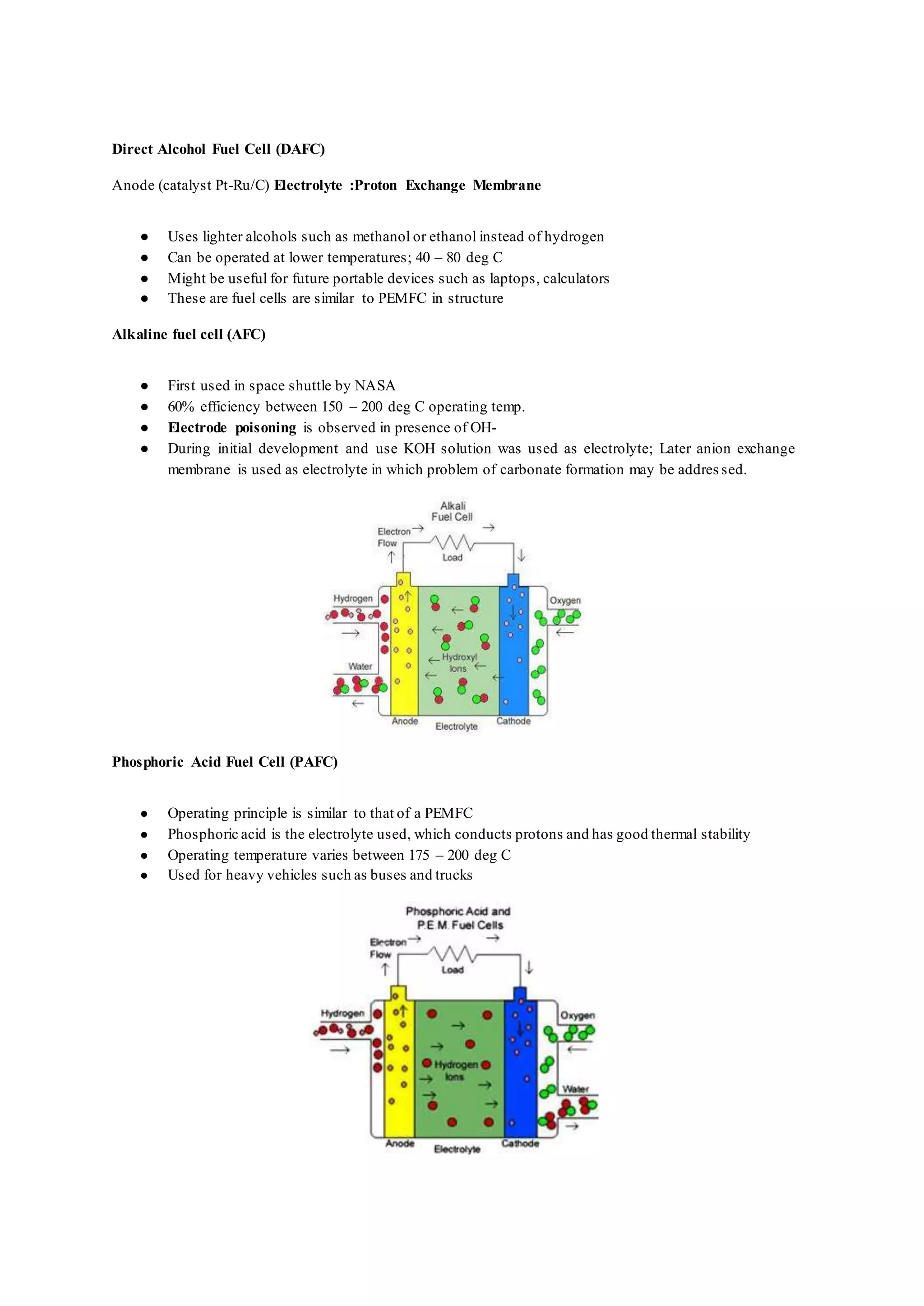
Alkaline fuel cell (AFC)
● First used in space shuttle by NASA
● 60% efficiency between 150 – 200 deg C operating temp.
● Electrode poisoning is observed in presence of OH-
● During initial development and use KOH solution was used as electrolyte; Later anion exchange
membrane is used as electrolyte in which problem of carbonate formation may be addres sed.
Phosphoric Acid Fuel Cell (PAFC)
● Operating principle is similar to that of a PEMFC
● Phosphoric acid is the electrolyte used, which conducts protons and has good thermal stability
● Operating temperature varies between 175 – 200 deg C
● Used for heavy vehicles such as buses and trucks
Electrolyte :phosphoric acid
Molten Carbonate Fuel Cell (MCFC)
● Molten carbonate salt is used as electrolyte
● Operates at higher temp., around 650 deg C
● Hydrocarbons can also be used as fuel, where internal reforming produces H2
Solid Oxide Fuel Cell (SOFC)
● Uses hard ceramic electrolyte crystal lattice
● Operates at higher temp.; 750 – 1000 deg C
● O2- migrates through crystal at this high temp.
● High efficiency upto 60% can be reached
● Natural gas can be used as a fuel due to internal reforming at this temp.
Regenerative Fuel Cell (RFC)
● In space application solar energy is not always available as spacecraft comes under the shadow of
planet (moon)
● Hence solar needs to be stored and this power will be during solar eclipse
● One of the tackle this is to use RFC in which Electrolyzer and Fuel Cell (FC) Works in tandem
● Essentially working of Fuel Cell and Electrolyzer is just opposite to each other. Thus same cell can
be used as electrolyzer and fuel cell by just changing the anode and cathode feed. These are called
unitized regenerative fuel cell
● It may noted that RFC does not come in classification of FC.
● Water is electrolysed using solar cell
● Solar energy can be stored as hydrogen,which can be used during night using fuel cells
● Can be useful for space applications Solid Oxide Electrolyser:
APPLICATIONS
● Can be used as power sources in remote areas.
● Can be used to provide off-grid power supplies.
● Can be applicable in both hybrid and electric vehicles.
● Wastewatertreatment plant and landfill.
● Cellular phone, laptop and computers.
● Hospitals, credit card centres and police stations.
● Buses, Car, Planes, Boats, Forklift, Trains Vacuum cleaner.
● Telecommunication, MP3 players, etc.
● The first commercial use of fuel cell was in NASA space program to generate power for satellites
and space capsules.
● Fuels are used for primary and backup power for commercial, industrial and residential buildings in
remote and inaccessible area.
● They are used to power fuel cell vehicles including automobiles, aeroplanes, boats and submarines.
UNIT V OTHER TYPES OF ENERGY
➔ Ocean energy resources
The ocean can produce two types of energy: thermal energy from the sun's heat,and mechanical energy from
the tides and waves.
➔ principles of ocean thermal energy and conversion systems
The operation of otec is based on thermodynamic principle.
• If a heat source is high temperature and a heat sink at lower temperature, this temperature difference can be
utilized in a machine to convert it into mechanical energy and thereby into electrical energy.
• In the otec system,the warm ocean surface is the heat source and the deep colder water provides the sink.
➔ Ocean thermal power plants
Ocean thermal energy is used for many applications, including electricity generation.
There are three types of electricity conversion systems: closed-cycle, open-cycle, and hybrid.
Closed-cycle systems use the ocean's warm surface water to vaporize a working fluid, which has a low-boiling
point, such as ammonia. The vaporexpands and turns a turbine. The turbine then activates a generatorto
produce electricity.
Open-cycle systems actually boil the seawater by operating at low pressures.This produces steamthat passes
through a turbine/generator.
And hybrid systems combine both closed-cycle and open-cycle systems.
CLOSED (ANDERSON) CYCLE:
• Closed-cycle systems(Rankine) use fluid with a low boiling point, such as ammonia, to rotate a turbine to
generate electricity.
• Warm surface seawater is pumped through a heat exchanger where the low-boiling-point fluid is vaporized.
The expanding vapor turns the turbogenerator. Then, cold deep seawater is pumped through a second heat
exchanger which condenses the vaporback into liquid, which is then recycled through the system.
OPEN (CLAUDE) CYCLE:
Open-cycle OTEC uses the tropical oceans'warm surface water to make electricity.
• When warm seawater is placed in a low-pressure container, it boils.
• The expanding steamdrives a low-pressure turbine attached to an electrical generator.
• The steam, which has left its salt behind in the low pressure container, is almost pure fresh water. It is
condensed backinto a liquid by exposure to cold temperatures from deep-ocean water.
Hybrid systems
Hybrid systems combine the features of closed-and open-cycle systems.
In a hybrid system, warm seawater enters a vacuumchamber, where it is flash-evaporated into steam, similar to
the open-cycle evaporation process.The steamvaporizes a low-boiling-point fluid (in a closed-cycle loop) that
drives a turbine to produce electricity.
➔ principles of ocean wave energy conversion
➔ tidal energy conversion
Among other types of renewable energy, oceans contain energy in the form of
– Waves
– Tidal currents
Wave Energy
Where does wave energy originate?
– Differential warming of the earth causes pressure differences in the atmosphere, which generate winds
– As winds move across the surface of open bodies of water, they transfer some of their energy to the water and
create waves
The amount of energy transferred and the size of the resulting wave depend on
– the wind speed
– the length of time for which the wind blows
– the distance over which the wind blows, or fetch
Therefore, coasts that have exposure to the prevailing wind direction and that face long expanses of open ocean
have the greatest wave energy levels.
Waves obtain energy differently depending on water depth
– Lose energy slowly in deep water
– Lose energy quickly as water becomes shallower
because of friction between the moving water particles and the sea bed
• Wave energy conversion devices are designed for optimal operation at a particular depth range
Therefore, devices can be characterized in terms of their placement or location.
– At the shoreline
– Near the shoreline
– Off-shore
One wave energy conversion systemthat has proven successfulat each of these locations is the OSCILLATING
WATER COLUMN.
An Oscillating WaterColumn (OWC) consists ofa partially submerged structure that opens to the ocean below
the water surface. This structure is called a wave collector.
This design creates a water column in the central chamber of the collector, with a volume of air trapped above it.
• As a wave enters the collector, the surface of the water column rises and compresses the volume of air above
it.
• The compressed air is forced into an aperture at the top of the chamber, moving past a turbine.
• As the wave retreats, the air is drawn back through the turbine due to the reduced pressure in the chamber.
TIDAL POWER
Tidal power, also called tidal energy, is A form of hydropower that converts the energy of tides into useful
forms of power, mainly electricity.
• Cause of tides: gravitational force of sun,moon and earth’s rotation
• Two tidal cycles per day: 12 hours,25 minutes
• Tidal range – large at coastal regions with high depth gradient
•Water can be stored in an estuary during high tide
• Release during low tide, through turbines
PLANT LOCATION
• Tidal mills built on inlets branching off tidal estuaries
• Average Tidal range : the higher, the better
• Feasibility of plant construction & basin closure
• Environmental consequences
THE TIDAL BARRAGE
It’s a huge dam built across a river estuary.When the tide goes in and out,the water flows through tunnels in the
dam.
• Tidal range has to be in excess of 5 meters for tidal power to be feasible.
• The purpose of this dam or barrage is to let water flow through it into the basin as the tide comes in. As the
tide recedes, gates in the barrage that contain turbines are opened,the hydrostatic head causes the water to come
through these gates,driving the turbines and generating power.
• Power can be generated in both directions through the barrage but this can affect efficiency and the economics
of the project.
• Components of barrage
- Caissons
- Turbines
TIDAL CURRENT TURBINES
• It makes use of kinetic energy of moving water to power turbines,in a similar way to wind turbines that use
wind to power turbines.
• Operates during floods and ebb tides.
• Consists of a gearbox, a rotor and a generator.
• These three parts are mounted on a support structure.
A barrage (dam) is typically used to convert tidal energy into electricity by forcing the water through turbines,
activating a generator. For wave energy conversion,there are three basic systems:channel systems that funnel
the waves into reservoirs; float systems that drive hydraulic pumps; and oscillating water column systems that
use the waves to compress air within a container. The mechanical power created from these systems either
directly activates a generator or transfers to a working fluid, water, or air, which then drives a turbine/generator.
hydropower
➔ site selection, construction, environmental issues
Hydro electric (Hydel) Power Plant Working principle
• Potential energy is the energy which a substance has due to its position or state. The water behind a dam has
potential energy because of its position.
The water can fall from this position and exert a force over a distance and therefore do work.
• In a Hydro-electric power plant the force is used to drive a turbine, which in turn drives the electric generator.
• Because gravity provides the force which makes the water fall, the energy stored in the water is called
gravitational potential energy.
Construction:
Water reservoir:
• In a reservoir the water collected from the catchment area is stored behind a dam.
• Catchment area gets its water from rain and streams.
• The level of water surface in the reservoir is called Head water level.
Note : Continuous availability of water is a basic necessity for a hydroelectric power plant.
Dam :
• The purpose of the dam is to store the water and to regulate the outgoing flow of water.
• The dam helps to store all the incoming water. It also helps to increase the head of the water. In order to
generate a required quantity of power it is necessary that a sufficient head is available.
Spillway:
• Excess accumulation of water endangers the stability of dam construction.Also in order to avoid the overflow
of water out of the dam especially during rainy seasons spillways are provided. This prevents the rise of water
level in the dam.
• Spillways are passages which allows the excess water to flow to a storage area away from the dam.
Gate :
• A gate is used to regulate or control the flow of water from the dam.
Pressure tunnel:
• It is a passage that carries water from the reservoir to the surge tank.
Surge tank:
• A Surge tank is a small reservoir or tank in which the water level rises or falls due to sudden changes in
pressure.
Purpose of surge tank:
• To serve as a supply tank to the turbine when the water in the pipe is accelerated during increased load
conditions and as a storage tank when the water is decelerating during reduced load conditions.
• To reduce the distance between the free water surface in the dam and the turbine, thereby reducing the water
hammer effect on penstockand also protect the upstreamtunnelfrom high pressure rise.
Water-hammer effect :
• The water hammer is defined as the change in pressure rapidly above or below normal pressure caused by
sudden change in the rate of water flow through the pipe, according to the demand of prime mover i.e. turbine.
Penstock:
• Penstock is a closed pipe of steel or concrete for supplying water underpressure to the turbine.
Inlet valve :
• Water from the penstockflows to the turbine through the inlet valve. The valve may be partially closed or open
thereby regulating the pressure of water flowing to the turbine.
Hydraulic turbine(Prime mover) :
• The hydraulic turbine converts the energy of water into mechanical energy.
The mechanical energy(rotation) available on the turbine shaft is coupled to the shaft of an electric generator
and electricity is produced. The water after performing the work on turbine blades is discharged through the
draft tube.
• The prime movers which are in common use are Pelton wheel, Francis turbine and Kaplan turbine.
Draft tube:
• It is connected to the outlet of the turbine.
• It allows the turbine to be placed above the tail water level.
Tail water level or Tail race:
• Tail water level is the water level after the discharge from the turbine. The discharged
water is sent to the river, thus the level of the river is the tail water level.
Electric generator, Step-up transformer and Pylon :
• As the water rushes through the turbine, it spins the turbine shaft, which is coupled to the electric generator.
The generator has a rotating electromagnet called a rotor and a stationary part called a stator.
The rotor creates a magnetic field that produces an electric charge in the stator.
The charge is transmitted as electricity.
The step-up transformer increases the voltage of the current coming from the stator.
The electricity is distributed through power lines also called as pylon.
➔ In site site selection of hydroelectric plant
1. Availability of water
2. Water storage
3. Geological investigation
4. Water pollution
5. Sedimentation Environmental effect
6. Aces to site
➔ environmental issues
● Hydropower does not pollute the water or the air.
● However, hydropower facilities can have large environmental impacts by changing the environment
and affecting land use,homes, and natural habitats in the dam area.
● Most hydroelectric power plants have a dam and a reservoir.
● These structures may obstruct fish migration and affect their populations.
● Operating a hydroelectric power plant may also change the water temperature and the river's flow.
● These changes may harm native plants and animals in the river and on land.
● Reservoirs may cover people's homes, important natural areas, agricultural land, and archeological
sites.
● So building dams can require relocating people. Methane,a strong greenhouse gas,may also form in
some reservoirs and be emitted to the atmosphere
Geothermal energy
Geothermal energy is the heat from the Earth. It's clean and sustainable.
Resources of geothermal energy range from the shallow ground to hot water and hot rock found a few miles
beneath the Earth's surface, and down even deeperto the extremely high temperatures of molten rock called
magma.
➔ types of geothermal energy sites,
Geothermal reservoirs are naturally occurring areas of hydrothermal resources.These reservoirs are deep
underground and are largely undetectable above ground.Geothermal energy finds its way to the earth's surface
in three ways:
➔ Volcanoes and fumaroles (holes in the earth where volcanic gases are released)
➔ Hot springs
➔ Geysers
There are four major types of Geothermal energy resources.
➔ Hydrothermal
➔ Geopressured brines
➔ Hot dry rocks
➔ Magma
➔ site selection, and geothermal power plants.
Geothermal power plants use hydrothermal resources that have both water (hydro) and heat (thermal).
Geothermal power plants require high-temperature (300°F to 700°F) hydrothermal resources that come from
either dry steamwells or from hot water wells.
People use these resources by drilling wells into the earth and then piping steamor hot water to the surface. The
hot water or steampowers a turbine that generates electricity. Some geothermal wells are as much as two miles
deep.
Types of geothermal power plants
There are three basic types of geothermal power plants:
Dry steam plants use steamdirectly from a geothermal reservoir to turn generator turbines. The first
geothermal power plant was built in 1904 in Tuscany,Italy, where natural steamerupted from the earth.
Flash steam plants take high-pressure hot water from deep inside the earth and convert it to steam to drive
generator turbines.When the steam cools,it condenses to water and is injected back into the ground to be used
again. Most geothermal power plants are flash steam plants.
Binary cycle power plants transfer the heat from geothermal hot water to anotherliquid. The heat causes the
second liquid to turn to steam, which is used to drive a generatorturbine.
The differences between dry steam, flash steam, and binary cycle power plants .
Geothermal Heat Pump Diagram
THE END.

MASTERS OF ENVIRONMENTAL ARCHITECTURE renewable energy systems

  • 1.
    M.ARCH (ENVIRONMENTAL ARCHITECTURE) ELECTIVE– II EA5003 RENEWABLE ENERGY SYSTEMS SUBMITTED TO SUBMITTED BY PIDAPARHTI LAKSHMI PRASANNA TADIBOINA SAMANTHA KUMAR M.ARCH (EA) - SEMESTER 2
  • 2.
    RENEWABLE ENERGY SYSTEMS CONTENTS OBJECTIVES: 1.To explain concept of various forms of renewable energy 2. To outline division aspects and utilization of renewable energy sources for both domestic and industrial applications 3. To analysis the environmental and cost economics of using renewable energy sources compared to fossil fuels. UNIT I SOLAR ENERGY ➔ Solar radiation its measurements and prediction ➔ solar thermal flat plate collectors concentrating collectors – applications - heating, cooling, desalination, power generation,drying, cooking etc ➔ principle of photovoltaic conversion of solar energy, ➔ types of solar cells and fabrication. Photovoltaic applications: ➔ battery charger, domestic lighting, street lighting, and water pumping, power generation schemes. UNIT II WIND ENERGY ➔ Atmospheric circulations and classification ➔ factors influencing wind , wind shear and turbulence ➔ wind speed monitoring ➔ Betz limit ➔ Aerodynamics of wind turbine rotor ➔ site selection ➔ Wind resource assessment wind energy conversion devices ➔ classification, ➔ characteristics, ➔ applications. ➔ Hybrid systems - safety and environmental aspects. UNIT III BIO-ENERGY ➔ Biomass resources and their classification ➔ chemical constituents ➔ physicochemical characteristics of biomass ➔ Biomass conversion processes ➔ Thermochemical conversion ➔ direct combustion, ➔ gasification, ➔ pyrolysis and liquefaction ➔ biochemical conversion ➔ Anaerobic digestion ➔ alcohol production from biomass ➔ chemical conversion process
  • 3.
    ➔ hydrolysis andhydrogenation ➔ Biogas - generation - types of biogas Plants- applications UNIT IV HYDROGEN AND FUEL CELLS ➔ Thermodynamics and electrochemical principles ➔ asic design, types, and applications ➔ production methods ➔ Biophotolysis ➔ Hydrogen generation from algae biological pathways ➔ Storage gaseous ➔ cryogenic and metal hydride and transportation. ➔ Fuel cell ➔ principle of working ➔ various types ➔ construction and applications. UNIT V OTHER TYPES OF ENERGY ➔ Ocean energy resources ➔ principles of ocean thermal energy conversion systems ➔ Ocean thermal power plants ➔ principles of ocean wave energy conversion ➔ tidal energy conversion hydropower ➔ site selection, construction, environmental issues Geothermal energy ➔ types of geothermal energy sites, ➔ site selection, and geothermal power plants. OUTCOMES: ● Understand the various types of renewable energy sources. ● Also understand the environmental and cost economics of using renewable energy sources compared to fossil fuels.
  • 4.
    RENEWABLE ENERGY SYSTEMS UNITI SOLAR ENERGY ➔ Solar radiation its measurements and prediction Solar radiation is all of the light and energy that comes from the sun,and there are many different forms. Solar radiation is a term used to describe visible and near-visible (ultraviolet and near-infrared) radiation emitted from the sun.The different regions are described by their wavelength range within the broad band range of 0.20 to 4.0 µm (microns). Terrestrial radiation is a term used to describe infrared radiation emitted from the atmosphere. The following is a list of the components of solar and terrestrial radiation and their approximate wavelength ranges: ● Ultraviolet: 0.20 – 0.39 µm ● Visible: 0.39 – 0.78 µm ● Near-Infrared: 0.78 – 4.00 µm ● Infrared: 4.00 – 100.00 µm Approximately 99% of solar, or shortwave, radiation at the earth’s surface is contained in the region from 0.3 to 3.0 µm while most of terrestrial, or longwave, radiation is contained in the region from 3.5 to 50 µm. Outside the earth’s atmosphere, solar radiation has an intensity of approximately 1370 watts/meter2. This is the value at mean earth-sun distance at the top of the atmosphere and is referred to as the Solar Constant.On the surface of the earth on a clear day, at noon,the direct beam radiation will be approximately 1000 watts/meter2 for many locations. While the availability of energy is affected by location (including latitude and elevation), season,and time of day, the biggest factors affecting the available energy are cloud cover and other meteorological conditions which vary with location and time. solar energy may use the unit watt-hours per square meter (Wh/m2). If this energy is divided by the recording time in hours,it is then a density of power called irradiance, expressed in watts per square meter (W/m2). Short-wave radiation, in the wavelength range from 0.3 to 3 μm, comes directly from the sun.It includes both beam and diffuse components. Long-wave radiation, with wavelength 3 μm or longer, originates from the sources at near-ambient temperatures - atmosphere, earth surface, light collectors, other bodies. Different types of radiation at the earth surface: orange - short wave; blue - long wave.
  • 5.
    There are twoimportant types of instruments to measure solar radiation: Pyrheliometer is used to measure direct beam radiation at normal incidence. Pyranometer is used to measure total hemispherical radiation - beam plus diffuse - on a horizontal surface. If shaded,a pyranometer measures diffuse radiation.
  • 6.
    The total irradiance(W/m2) measured on a horizontal surface by a pyranometer is expressed as follows: I tot = I beam cosθ+I diffuse where θ is the zenith angle (i.e., angle between the incident ray and the normal to the horizontal instrument plane. Pyranometers are also used to measure solar radiation on inclined surfaces, which is important for estimating input to collectors. Calibration of pyranometers depends on the inclination angle, so experimental data are needed to interpret the measurements. The various prediction techniques can be generally classified into four categories: the regression techniques,the artificial intelligence methods, the statisticalapproaches,and the satellite imagery techniques. ➔ solar thermal flat plate collectors and concentrating collectors – applications - heating, cooling, desalination, power generation,drying, cooking etc A solarcollector is a device that transforms solar radiation from the Sun into heat, which is then transferred to some fluid. These devices are primarily used for active solar heating and allow for the heating of water for personal use.Thesecollectors are generally mounted on the roof and must be very sturdy as they are exposed to a variety of different weather conditions. Flat Plate Collectors A typicalflat-platecollector is a metal box with a glass or plastic cover (called glazing) on top and a dark-colored absorber plateon the bottom. The sides and bottomof the collector are usually insulated to minimize heat loss. Sunlight passes through theglazing and strikes the absorber plate, which heats up, changing solar energy into heat energy. In locations with average available solar energy, flat plate collectors are sized approximately one-half- to one-square foot per gallon of one-day's hot water use. Applications: Themain use of this technology is in residential buildings where the demand for hot water has a large impact on energy bills. This generally means a situation with a large family, or a situation in which the hot water demand is excessive due to frequent laundry washing. Commercial applications include laundromats, car washes, military laundry facilities and eating establishments. The technology can also be used for space heating if thebuilding is located off-grid or if utility power is subject to frequent outages. Solar water heating systems are most likely to be cost effective for facilities with water heating systems that are expensive to operate, or with operations such as laundries or kitchens that require large quantities of hot water.
  • 7.
    unglazed liquid collectorsare commonly used to heat water for swimming pools. Because thesecollectors need not withstand high temperatures, they can use less expensive materials such as plastic or rubber. They also do not require freeze- proofing because swimming pools are generally used only in warm weather or can be drained easily during cold weather. While solar collectors are most cost-effective in sunny, temperateareas, they can be cost effective virtually anywhere in the country so should be considered . Concentrating Collectors Concentrating, or focusing, collectors intercept direct radiation over a large area and focus it onto a small absorber area. These collectors can provide high temperatures more efficiently than flat-platecollectors, since the absorption surface area is much smaller. However, diffuse sky radiation cannot be focused onto theabsorber. Most concentrating collectors require mechanical equipment that constantly orients the collectors toward thesun and keeps the absorber at thepoint of focus. Therefore; there are many types of concentrating collectors. For applications such as air conditioning, central power generation, and numerous industrial heat requirements, flat plate collectors generally cannot provide carrier fluids at temperatures sufficiently elevated to be effective. There are four basic types of concentrating collectors: •Parabolic trough system •Parabolic dish •Power tower •Stationary concentrating collectors ➔ ➔
  • 8.
    ➔ principle ofphotovoltaic conversion of solar energy A structure that converts solar energy directly to DC electric energy. a solar panel works by allowing photons, or particles of light, to knock electrons free from atoms, generating a flow of electricity. Solar panels actually comprise many, smaller units called photovoltaic cells.(Photovoltaic simply means they convert sunlight into electricity.) Many cells linked together make up a solar panel. Each photovoltaic cell is basically a sandwich made up of two slices of semi-conducting material, usually silicon To work, photovoltaic cellsneed to establishan electric field. Much like a magnetic field, which occurs due to opposite poles,an electric field occurs when opposite charges are separated.To get this field, manufacturers "dope" silicon with other materials, giving each slice of the sandwich a positive or negative electrical charge. Specifically,they seed phosphorous into the top layer of silicon, which adds extra electrons, with a negative charge, to that layer. Meanwhile, the bottomlayergets a dose of boron, which results in fewer electrons, or a positive charge. This all adds up to an electric field at the junction between the silicon layers. Then, when a photon of sunlight knocksan electron free, the electric field will push that electronout of the silicon junction. A couple of other components of the cell turn these electrons into usable power. Metal conductive plates on the sides of the cell collect the electrons and transfer them to wires. At that point, the electrons can flow like any other source of electricity. ➔ types of solar cells. Types of Solar cell Based on the types of crystal used, soar cells can be classified as, 1. Monocrystalline silicon cells 2. Polycrystalline silicon cells 3. Amorphous silicon cells 1. The Monocrystalline silicon cell is produced from pure silicon(single crystal). Since the Monocrystalline silicon is pure and defect free, the efficiency of cell will be higher. 2. In polycrystalline solarcell, liquid siliconis used as raw material and polycrystalline siliconwas obtained followed by solidificationprocess. The materials contain various crystalline sizes. Hence, the efficiency of this type of cell is less than Monocrystalline cell. 3.Amorphous siliconis obtained by depositing silicon film on the substrate like glass plate. •The layer thickness amounts to less than 1µm – the thickness of a human hair for comparison is 50-100 µm.
  • 9.
    •The efficiency ofamorphous cells is much lower than that of the other two cell types. • As a result, they are used mainly in low power equipment, such as watches and pocket calculators, or as facade elements. A solar cell (also called photovoltaic cell orphotoelectric cell) is a solid state electrical device that converts the energy of light directly into electricity by the photovoltaic effect.The following are the different types of solar cells. ● Biohybrid solar cell ● Cadmium telluride solarcell (CdTe) ● Concentrated PV cell (CVP and HCVP) ● Copperindium gallium selenide solar cells (CI(G)S) ● Crystalline silicon solar cell (c-Si) ● Dye-sensitized solar cell (DSSC) ● Gallium arsenide germanium solar cell (GaAs) ● Hybrid solar cell ● Luminescent solar concentrator cell (LSC) ● Micromorph (tandem-cell using a-Si/μc-Si) ● Multi-junction solar cell (MJ) ● Nanocrystal solar cell ● Organic solarcell (OPV) ● Perovskite solar cell ● Photoelectrochemical cell (PEC) ● Plasmonic solar cell ● Quantum dot solar cell
  • 10.
    ● Solid-state solarcell ● Thin-film solarcell (TFSC) ● Wafer solar cell, or wafer-based solar cell crystalline ➔ solar cells and fabrication. The basic component of a solar cell is pure silicon, which is not pure in its natural state. To make solar cells, the raw materials—silicon dioxide ofeither quartzite gravel or crushed quartz—are first placed into an electric arc furnace, where a carbon arc is applied to release the oxygen. The products are carbon dioxide and molten silicon. At this point, the silicon is still not pure enough to be used for solor cells and requires further purification. Pure silicon is derived from such silicondioxides as quartzite gravel (the purest silica) or crushed quartz. The resulting pure siliconis then doped (treated with) with phosphorous and boron to produce an excess of electrons and a deficiency of electrons respectively to make a semiconductor capable of conducting electricity.The silicondisks are shiny and require an anti-reflective coating,usually titanium dioxide. The solar module consists of the siliconsemiconductor surrounded by protective material in a metal frame. The protective material consists of an encapsulant of transparent siliconrubber or butyryl plastic (commonly used in automobile windshields) bonded around the cells, which are then embedded in ethylene vinyl acetate. A polyesterfilm (such as mylar or tedlar) makes up the backing. A glass cover is found on terrestrial arrays, a lightweight plastic cover on satellite arrays. The electronic parts are standard and consist mostly of copper. The frame is either steel or aluminum. Silicon is used as the cement to put it all together. Photovoltaic applications: ➔ battery charger, domestic lighting, street lighting, and water pumping, power generation schemes.
  • 11.
    UNIT II WINDENERGY ➔ Atmospheric circulations and classification Atmospheric circulation isthe large-scale movement of air, and together with ocean circulation is the means by which thermal energy is redistributed on the surface of the Earth. Atmospheric Circulation Pressure Belts • The movement of air in the atmosphere due to the uneven distribution of temperature over the surface of the earth is known asAtmospheric Circulation. • Air expandswhen heated and gets compressed when cooled.This results in variations in the atmospheric pressure. The result is that it causes the movement of air from high pressure to low pressure, setting the air in motion. • Atmospheric pressure also determineswhen the air will rise or sink. Wind • Air in horizontal motion is wind. • The wind redistributesthe heat and moisture across the planet,thereby,maintaining a constant temperature for the planet asa whole. • The vertical rising of moist air coolsit down to form the clouds and bring precipitation. The wind beltsgirdling the planet are organised into three cells in each hemisphere: the Hadley cell, the Ferrel cell, and the Polar cell.
  • 12.
    ➔ factors influencingwind , wind shear and turbulence Wind is the movement of air across the earth’s surface. The differences in air density causes wind, which results in horizontal differences in air pressure. These pressure systems are both the result and the cause of atmospheric circulation. There are different types of winds such as gusts,which are short bursts ofhigh speed wind; squalls are strong winds of intermediate duration; a breeze is of long-duration of weaker strength; and there are strong winds that are of hurricane or typhoon strength. The main factors that affect wind directionand speed are: 1. The pressure-gradient force, 2. The Coriolis force and 3. friction. These factors working togethercause the wind to blow in different directions and at different speeds. The pressure-gradient force Air flows from areas of higher pressure to areas of lower pressure. This is the pressure gradient force that sets the air in motion and causes it to move with increasing speed down the gradient. The heating of the earth’s surface is uneven which causes the continual generation of these pressure differences.
  • 13.
    The Coriolisforce The secondforce that affects the direction of the winds is the deflecting force of the rotationof earth, known as the Coriolisforce. Winds are deflected to the right of the gradient in the Northern Hemisphere and to the left in the Southern. The Coriolisforce is directed at right angles to the direction of air flow. It does not affect the wind speed, only the wind direction. However, the stronger the wind, the greater the deflecting force. There is no deflectionof winds at the equator, but it increases to its maximum at the poles. Friction Friction is the third force that affects both speed and directionof winds. Friction is operative only to about 2,000 feet above the earth’s surface. This force greatly slows the speed of surface air and reduces the Coriolisforce. This altersthe force balance which causes the pressure-gradient force to move the air at right angles across the isobars toward the area of lower pressure. Summary Wind is an air movement that occurs in additionto the movement associated with rotationof the earth. The earth’s atmosphere is fixed to the earth and moves with it in its west-to-east rotation. Wind is nature’s way of trying to correct air pressure inequalities which are the result as well as the cause of atmospheric circulation. ➔ wind speed monitoring Wind speed describes how fast the air is moving past a certain point. This may be an averaged over a given unit of time, such as miles per hour, or an instantaneous speed,which is reported as a peak wind speed,wind gust or squall. Wind direction describes the direction on a compass from which the wind emanates, for instance, from the North or from the West. Why is Wind Speed and Direction Important? Wind speed and direction are important for monitoring and predicting weather patterns and global climate. Wind speed and direction have numerous impacts on surface water. These parameters affect rates of evaporation, mixing of surface waters, and the development of seiches and storm surges.Each of these processes has dramatic effects on water quality and water level. How is Wind Speed and Direction measured?
  • 14.
    Wind speed istypically reported in miles per hour, knots, or meters per second.One mile per hour is equal to 0.45 meters per second,and 0.87 knots. Wind direction is typically reported in degrees, and describes the direction from which the wind emanates. A direction of 0 degrees is due North on a compass, and 180 degrees is due South. A direction of 270 degrees would indicate a wind blowing in from the west. Wind Speed and Direction Technology The measurement of wind speed is usually done using a cup or propeller anemometer, which is an instrument with three cups or propellers on a vertical axis. The force of the wind causes the cups or propellers to spin. The spinning rate is proportional to the wind speed Wind direction is measured by a wind vane that aligns itself with the direction of the wind. ➔ Betz limit Betz's law indicates the maximum power that can be extracted from the wind, independent of the design of a wind turbine in openflow. It was published in 1919, by the German physicist Albert Betz. The law is derived from the principles of conservation ofmass and momentum of the air stream flowing through an idealized "actuatordisk" that extracts energy from the wind stream. According to Betz's law, no turbine can capture more than 16/27 (59.3%) of the kinetic energy in wind. The factor 16/27 (0.593) is known as Betz's coefficient. Practical utility-scale wind turbines achieve at peak 75% to 80% of the Betz limit. The Betz limit is based on an open disk actuator.If a diffuser is used to collect additional wind flow and direct it through the turbine, more energy can be extracted, but the limit still applies to the cross-section ofthe entire structure. ➔ Aerodynamics of wind turbine rotor The primary application of wind turbines is to generate energy using the wind. Hence, the aerodynamics is a very important aspect of wind turbines. Though the details of the aerodynamics depend very much on the topology,some fundamental concepts apply to all turbines.Every topology has a maximum power for a given flow, and some topologies are betterthan others. The method used to extract power has a strong influence on this.
  • 15.
    The two primaryaerodynamic forces at work in wind-turbine rotors are lift, which acts perpendicular to the direction of wind flow; and drag, which acts parallel to the direction of wind flow. Turbine blades are shaped a lot like airplane wings -- they use an airfoil design. In an airfoil, one surface of the blade is somewhat rounded,while the other is relatively flat. But in one simplified explanation of lift, when wind travels over the rounded, downwind face of the blade, it has to move faster to reach the end of the blade in time to meet the wind travelling over the flat, upwind face of the blade (facing the direction from which the wind is blowing). Since faster moving air tends to rise in the atmosphere, the downwind, curved surface ends up with a low-pressure pocket just above it. The low-pressure area sucks the blade in the downwind direction, an effect known as "lift." On the upwind side of the blade, the wind is moving slower and creating an area of higher pressure that pushes on the blade, trying to slow it down. ➔ site selection Although wind power is a never ending green resource,assessment ofenvironmental risks and impacts.Apart from the constraints resulting from the number of turbines, any site selection should think over the technical, economic, social, environmental and political aspects. 1. Technical Considerations: Many technical factors affect the decision making on site selection including wind speed,land topography and geology,grid structure and distance and turbine size. Wind Speed The viability of wind power in a given site depends on having sufficient wind speed available at the height at which the turbine is to be installed. Any choice of wind turbine design must be based on the average wind velocity at the selected wind turbine construction site. Land topography and geology Wind farms typically need large lands. Topography and prevailing wind conditions determine turbine placement and spacing within a wind farm. In flat areas where there is nothing to interfere with wind flow, Wind turbines are usually sited on farms that have slope smaller than 10-20%. Grid structure and distance The connection of wind turbines to an electricity grid can potentially affect reliability of supply and power quality, due to the unpredictable fluctuations in wind power output. Turbine size Required height for the installation of turbine above ground is one of the important factors that affect the annual energy generation.Turbine size is related with the energy output,because the bigger the turbine size is, the more wind it is exposed to. 2 .Economic Considerations
  • 16.
    The economic subfactors that affect the site selection include capital cost,land cost and operational and management costs.It is important to make economical evaluations by considering time value o f money due to long periods of service life of wind farm projects. Capital cost Construction, electrical connection,grid connection,planning, wind turbines, approvals, utilities and management are the main components of capital cost for wind farm projects. Land cost For the site selection, main economic factor is the cost of the land where the wind farm is constructed; because,the cost ofland primarily depends on the region, soil condition and the distan ce from the residential area. Operational and management cost There will be control functions such as supervisory control and data acquisition (SCADA) which will provide control of each wind turbine in O&M facilities. Business rates, maintenance expenses,rents, staff payments are main components of O&M costs. Electricity market Existing of an electricity market for the energy generated is an important factor affecting the economic benefits of the project. There should be energy demand in regions close to wind farms. 3. Environmental Considerations The environmental sub factors that affect the site selection of a wind farm include visual impact, electromagnetic interference, wildlife and endangered species and noise impact. Visual impact Wind turbines are located in windy places, and most of the time, those places are highly visible. To many people, those big towers with 2 or 3 blades create visual pollution. To minimize the impacts of visual pollution, many investors implement the actions. Wild life & endangered species Wind farms affect birds mainly through collision with turbines and associated power lines, disturbance leading to displacement including barriers to movement, and loss of habitat resulting from wind turbines. To minimise the risk of bird collision, site selection should be done precisely. Electromagnetic interference Electromagnetic interference is an electromagnetic disturbance that interrupts,obstructs,or degrades the effective performance of electronics or electrical equipment. Wind turbines may reflect, scatteror diffract the electromagnetic waves which in turn interfere with the original signal arriving at the receiver. Noise impact Noise can generally be classified according to its two main sources:aerodynamic and mechanical. Aerodynamic noise is produced when the turbine blades interact with eddies caused by atmospheric turbulence. Mechanical noise is generated by the rotor machinery such as the gearbox and generator. 4. Social Considerations Social factors that affect the selection of a site include public acceptance,distance from residential area and alternative land use options of candidate wind farm site. Public may oppose projects because of possible environmental or social effects. Distance from residential area gain importance not to interfere with social life during wind farm construction or operation. Regulatory boundaries There may be some national or international level regulation related with the construction and operation of wind farms. These regulations must be explored before evaluating the socio-political position of a wind farm project. Most of them probably change from region to region. Public acceptance
  • 17.
    Public is themost vital component of a region and their opposition to issues can lead to abolish proposed projects.Support of public for wind energy generation is expected to be high in general but proposed wind farms have often been met with strong local opposition. Land use Land use affects the decision of wind farm siting from two points of view. Firstly, there are some cases where no wind farms can be built although sufficient wind speed was detected.These cases are mainly related with land use or condition. Land related constraints include forest area, Wetlands,Land of high productivity, Archaeological sites,Aviation zones, Military zones etc. Distance from the residential area Noise and vibration stemming from the wind turbines may cause residents to suffer from sleep disturbance,headaches,visual blurring. Those types of complaints can be avoided if the wind turbines are sited a considerable distance from the residential area. ➔ Wind resource assessment Wind resource assessment is the process by which wind power developers estimate the future energy production of a wind farm. Accurate wind resource assessments are crucial to the successfuldevelopment of wind farms. wind energy conversion devices ➔ classification, characteristics,applications. ➔ Hybrid systems - safety and environmental aspects. Wind energy conversion devices can be broadly categorized into two types according to their axis alignment. They are as follows Horizontal axis wind turbine: It can be further divided into three types: ● Dutch type grain grinding windmills ● Multi Blade water pumping windmills ● High speed propeller type windmills 1. Dutch Windmill: Man has used Dutch windmills for a long time. In fact the grain grinding windmills that were widely used in Europe since the middle ages were Dutch. These windmills were operated on the thrust exerted by the wind. The blades, generally four, were inclined at an angle to the plane of rotation. The wind being deflected by the blades exerted a force in the direction of rotation. The blades were made of sails or wooden slats. 2. Multi blade WaterPumping Windmill: Modern water pumping windmills have a large number of blades- generally wooden or metallic- driving a reciprocating pumps. As the mill has to be placed directly over the well, the criterion for site selection concerns about water availability & not windiness. Therefore the mill must be able to operate at slow winds. The large number of blades gives a high torque,required for driving a centrifugal pump, even at low wind speeds.Hence sometimes these are called as fan mills. As these windmills are supposed to be installed at remote places, mostly as single units,reliability, sturdiness,and low cost are the prime criteria and not efficiency. The blades are made of flat steelplates, working on the thrust of wind. These are hinged to a metal ring to ensure structural strength, and the low speed of rotation adds to the reliability. The orientation is generally achieved by tail vane.
  • 18.
    3.High speed propellertype wind machines: The horizontal axis wind turbines that are used today for electricity generation do not operate on thrust force. They depend mainly on the aerodynamic forces that develop when wind flows around a blade of aerofoil design. Windmills working on thrust force are inherently less efficient. So all the modern wind turbine blades are designed based on aerofoil section. Vertical axis wind turbines: It comes in two different designs ● The savonius rotor ● The darrieus rotor 1.The savonius rotor: The savonius rotoris extremely simple vertical axis device that works entirely because of the thrust force of wind. The basic equipment is a drum cut in two halves vertically. The two parts are attached to the two opposite sides of a vertical shaft. As the wind blowing into the structure meets with two dissimilar surfaces – one convex and the other concave – the forces exerted on the two surfaces are different, which gives the rotor a torque.By providing a certain amount of overlap between the two drums, the torque can be increased. This is because the wind blowing into the concave surface turn around and give a push to the inner surface of the otherdrum, partly cancelling the wind thrust on the convex side. It has been found that an overlap of about one third the drum diameter gives optimum result. 2. The darrieus wind turbine: The particularity of Darrieus rotor is that its working is not at all evident from its appearance. Two or more flexible blades are attached to a vertical shaft. The blades bow outwards,taking approximately the shape of a parabola and are of symmetrical airfoil section. Here the torque is zero when the rotor is stationary.It develops a positive torque only when it is already rotating. This means that such a rotor has mo starting torque and has to be start using some external means.
  • 19.
    3. Giromill: A variantof Darrieus wind turbine is the Giromill which uses the same concept.Here the blades are straigh t resulting in simple construction.However in such a case the centrifugal force developed in the blade will produce stress,trying to bend it. The blades have to be strong enough in the transverse direction to withstand this stress.Moreoverthe vertical shaft cannot be secured with guywires, and so the coupling at the base has to be strong enough to keep it vertical when subjected to strong winds. It is also called as H-Type windmill because of its shape. UNIT III BIO-ENERGY ➔ Biomass resources and their classification Biomass is any organic matter—wood, crops, seaweed, animal wastes—that can be used as an energy source. Biomass is probably our oldest source of energy after the sun.For thousands ofyears,people have burned wood to heat their homes and cook their food. Biomass gets its energy from the sun.All organic matter contains stored energy from the sun.During a process called photosynthesis,sunlight gives plants the energy they need to convert water and carbon dioxide into oxygen and sugars.Biomass is a renewable energy source because its supplies are not limited. We can always grow trees and crops, and waste will always exist. We use four types ofbiomass today—wood and agricultural products,solid waste,landll gas and biogas,and alcohol fuels (like Ethanol or Biodiesel). Biomass resources include natural biomass, residual biomass and energy crops. ➔ Natural Biomass: get directly from the ecosystems. ➔ Residual Biomass: produced from the process of different industry production. ➔ Energy Crops: refer to crops plant for energy purpose of producing biomass. Among these three sources,the most widely used ones are energy crops and residual biomass. Biomass Classification ★ Woody biomass such as trees,shrubs and bushes; ★ Herbaceous biomass such as non-woody plant, grains and cereals; ★ Fruit biomass such as palm shell and coconut shell; ★ Mixed biomass; BIOMASS ADVANTAGES:
  • 20.
    ➔ Sufficient biomassresources, affordable price and eco-friendly characteristic make biomass fuel over fossil fuels. And these factors also motivate the development of biomass fuel market. The amount of residual biomass which is produced from logging or other industries is huge. Making biomass fuel from these waste residues is a win-win choice. Besides, biomass-to-energy facilities such as pelletizing mill and briquette extruder also promote the industrialization of biomass production. ➔ Use fallow lands to plant energy crops can bring incomes and benefits the water retention of soil at the same time. ➔ Promote biomass in energy production can reduce pollution emissions such as CO. HC and NO and better protect the environment and contribute to maintaining the photochemistry of the atmosphere. ➔ Using agricultural biomass as biomass energy instead of burning or burying can not only reduce the risks of forest fires but also can reduce insect plagues. Besides, the exploitation of agricultural wastes can is also a new and promising market. ➔ Alleviating the greenhouse effect is another important reason to promote biomass energy. Using biomass energy can greatly reduce the emission of CO2. ➔ Promoting biofuels can make up the lacking of oil resources and reduces dependence on foreign oil. ➔ chemical constituents Composition of Biomass Plant cell wall is constituted by mainly 6 components: (i) cellulose, (ii) hemicellulose, (iii) lignin, (iv) water soluble sugars,amino acids and aliphatic acids, (v) ether and alcohol-soluble constituents (e.g.fats, oils, waxes, resin and many pigments), (iv) proteins. These components build up plant biomass. Proportion of these constituents vary in different groups of plants and even in the same group. Sources of biomass Cellulose Hemicellulose Lignin Protein (N x 6.25) Birch angiosperm* 44.9 32.7 19.3 0.5 Spruce gymnosperm* 46.1 24.6 26.3 0.2 Crop residues ** 30-45 16-27 3-13 3.6-7.2 Wood residues*** 45-56 10-25 18-30 - Cotton 89.0 5.0 0.0 1.3
  • 21.
    ➔ physicochemical characteristicsof biomass Biomass conversion processes ➔ Thermochemical conversion: direct combustion, gasification, pyrolysis and liquefaction ➔ biochemical conversion: Anaerobic digestion and alcohol production ➔ chemical conversion process: hydrolysis and hydrogenation Biomass can be converted into different forms of energy by using various processes. Many factors affect the choice of the process like quantity of biomass feedstock, desired energy form, environmental standards,economic conditions,and project specific factors. Biomass can be converted into three main products:power or heat generation, transportation fuels and chemical feedstock. 1. Thermo-chemical conversion In thermo-chemical conversion, energy is produces by applying heat and chemical processes. There are four thermo-chemical conversion processes,which are given below. 1.1 Combustion process Combustion is an exothermic chemical reaction, in which biomass is burned in the presence of air. In this process chemical energy which is stored in the biomass is converted in the mechanical and electrical energies. This process is suitable for dry biomass containing moisture less than 50%. Biomass is burned at the temperature of 800-1000 °C. This process is used for domestic applications as well as commercially in biomass power plants in order to produce electricity.
  • 22.
    1.2 Pyrolysis Process Itis the process of conversion of biomass to liquid (bio-oil), solid (charcoal) and gaseous (fuel gases)products by heating in the absence of air at 500 °C. There are two types of pyrolysis : Fast pyrolysis, conventional (Carbonization) pyrolysis and slow pyrolysis. Fast pyrolysis process has high heating value and heat transfer rate and completes within seconds. Fast pyrolysis yields 60% bio-oil, 20% bio-char and 20% biogas. Conventional pyrolysis process is the process in which mostly carbon (35%) is leaved as residue. Slow pyrolysis takes more time than fast pyrolysis,it also has low temperature and heating values. Flash pyrolysis is the type of fast pyrolysis, in which 80% bio-oil is obtained at keeping temperature low. If flash pyrolysis is used for converting biomass to bio-crude, it has up to 80% efficiency.
  • 23.
    1.3 Gasification process Inbiomass gasification, charcoal, wood chips, energy crops, forestry residues,agricultural waste and other wastes are transformed into flammable gases at high temperature (800-1000°C.) In this process fuel (biomass) reacts with a gasifying medium such as oxygen enriched air, pure oxygen, steam or a combination of both. The product gas composition and energy content depends upon the gasifying media’s nature and amount of it. Low calorific Value (CV) gas obtained by gasification about 4-6 MJ/N m³. The product gas can be used as a feedstock (syngas)in the production of chemicals like methanol. One promising concept is the biomass integrated gasification/ combined cycle (BIG/CC), in which gas turbines convert the gaseous fuel to electricity with a high overall conversion efficiency. The syngas can be converted into hydrogen gas,and it may have a future as fuel for transportation . 1.4 Liquefaction process It is the process in which biomass is converted into liquid phase at low temperatures (250-350°C) and high pressures (100-200 bar), usually with a high hydrogen partial pressure and catalysts to increase the rate of reaction. This process is used to get maximum liquid yields with higher quality than from the pyrolysis process. The product have higher heating value and lower oxygen content which makes the fuel chemically stable. The main purpose of the liquefaction is to obtain high H/C ratio of the product oil. 2. Bio-Chemical conversion
  • 24.
    Biochemical conversion makesuse of the enzymes of bacteria and other living organisms to break down biomass and convert it into fuels. This conversion process includes anaerobic digestion and fermentation. 2.1. Anaerobic digestion process This is a process in which organic material directly converted to a gas which is termed as biogas.It is mixture of methane, carbon dioxide and other gases like hydrogen sulphide in small quantities. Biomass is converted in anaerobic environment by bacteria, which produces a gas having an energy of 20-40% of lower heating value of the feedstock. This process is suitable for organic wastes having high moisture about 80-90%. This biogas can be directly used in spark ignition gas engines and gas turbines and can be upgraded to higher quality natural gas by removing carbon dioxide. The overall conversion efficiency of this process is 21%. Waste heat from engines and turbines can be recovered by using combined heat and power system. 2.2. Fermentation process Fermentation is an anaerobic process that breaks down the glucose within organic materials. It is a series of chemical reactions that convert sugars to ethanol. The basic fermentation process involves the conversion of a plant’s glucose (or carbohydrate)into an alcohol or acid. Yeast or bacteria are added to the biomass material, which feed on the sugars to produce ethanol and carbon dioxide. The ethanolis distilled and dehydrated to obtain a higher concentration of alcohol to achieve the required purity for the use as automotive fuel. The solid residue from the fermentation process can be used as cattle-feed and in the case of sugarcane; the bagasse can be used as a fuel for boilers or for subsequent gasification. Chemical conversion of biomass involves use of chemical interactions to transform biomass into other forms of usable energy.
  • 25.
    Transesterification is themost common form of chemical-based conversion.Transesterification is a chemical reaction through which fatty acids from oils, fats and greases are bonded to alcohol. This process reduces the viscosity of the fatty acids and makes them combustible. Biodiesel is a common end-product of transesterification, as are glycerin and soaps.Almost any bio-oil (such as soybean oil), animal fat or tallow, or tree oil can be converted to biodiesel. ➔ Biogas - generation - types of biogas Plants- applications Biogas Biogas typically refers to a mixture of different gases produced by the breakdown of organic matter in the absence of oxygen. Biogas can be produced from raw materials such as agricultural waste, manure, municipal waste, plant material, sewage, green waste or food waste. Biogas is a renewable energy source. Biogas can be produced by anaerobic digestion with anaerobic organisms, which digest material inside a closed system, or fermentation of biodegradable materials. Biogas -generation Biogas is generated when bacteria degrade biological material in the absence of oxygen, in a process known as anaerobic digestion. Since biogas is a mixture of methane (also known as marsh gas or natural gas, CH4) and carbon dioxide it is a renewable fuel produced from waste treatment. Anaerobic digestion is basically a simple process carried out in a number of steps that can use almost any organic material as a substrate – it occurs in digestive systems,marshes, rubbish dumps, septic tanks and the Arctic Tundra. Conventional anaerobic digestion has been a “liquid” process,where waste is mixed with water to facilitate digestion, but a “solid” process is also possible,as occurs in landfill sites. It takes a lot of energy to compress the gas (this energy is usually just wasted), plus you have the hazard of high pressure.A variable volume storage (flexible bag or floating drum are the two main variants) is much easier and cheaper to arrange than high pressure cylinders, regulators and compressors. Types of Biogas Plants A total of seven different types of biogas plant have been officially recognised by the MNES. 1. the floating-drum plant with a cylindrical digester (KVIC model), 2. the fixed-dome plant with a brick reinforced, moulded dome (Janata model) 3. the floating-drum plant with a hemisphere digester(Pragati model) 4. the fixed-dome plant with a hemisphere digester(Deenbandhu model) 5. the floating-drum plant made of angular steel and plastic foil (Ganesh model) 6. the floating-drum plant made of prefabricated reinforced concrete compound units 7. the floating-drum plant made of fiberglass reinforced polyester. Small Scale Biogas Digester 1. Fixed-dome Plants A fixed-dome plant consists ofa digester with a fixed, non-movable gas holder, which sits on top of the digester. When gas production starts,the slurry is displaced into the compensation tank. Gas pressure increases with the volume of gas stored and the height difference between the slurry level in the digester and the slurry level in the compensation tank.
  • 26.
    Types of FixedDome Plants Chinese fixed-dome plant is the archetype of all fixed dome plants. Several million have been constructed in China. The digesterconsists ofa cylinder with round bottomand top. Janata model was the first fixed-dome design in India, as a response to the Chinese fixed dome plant. It is not constructed anymore. The mode of construction lead to cracks in the gasholder - very few of these plant had been gas-tight. Deenbandhu, the successorofthe Janata plant in India, with improved design, was more crackproof and consumed less building material than the Janata plant. with a hemisphere digester CAMARTEC model has a simplified structure of a hemispherical dome shell based on a rigid foundation ring only and a calculated joint of fraction, the so-called weak / strong ring. Advantages: ● Low initial costs and long useful life-span; ● no moving or rusting parts involved; ● basic design is compact, saves space and is well insulated; ● construction creates local employment. ● Advantages are the relatively low construction costs,the absence ofmoving parts and rusting steel parts. ● If well constructed,fixed dome plants have a long life span. ● The underground construction saves space and protects the digesterfrom temperature changes. ● The construction provides opportunities for skilled local employment. Disadvantages: ● Masonry gas-holders require special sealants and high technical skills for gas-tight construction; ● gas leaks occur quite frequently; ● fluctuating gas pressure complicates gas utilization; ● amount of gas produced is not immediately visible, plant operation not readily understandable; ● fixed dome plants need exact planning of levels; ● excavation can be difficult and expensive in bedrock. ● Disadvantages are mainly the frequent problems with the gas-tightness ofthe brickwork gas holder (a small crack in the upperbrickwork can cause heavy losses ofbiogas). ● Fixed-dome plants are, therefore, recommended only where construction can be supervised by experienced biogas technicians. ● The gas pressure fluctuates substantially depending on the volume of the stored gas. 2. Floating Drum Plants
  • 27.
    Floating-drum plants consistofan underground digesterand a moving gas -holder. The gas-holder floats either directly on the fermentation slurry or in a water jacket of its own. The gas is collected in the gas drum, which rises or moves down, according to the amount of gas stored.The gas drum is prevented from tilting by a guiding frame. If the drum floats in a water jacket, it cannot get stuck, even in substrate with high solid content. Size - They are used most frequently by small- to middle-sized farms (digester size: 5-15m3 ) or in institutions and larger agro-industrial estates (digestersize: 20- 100m3 ). Types of Floating Drum Plants 1. KVIC model with a cylindrical digester, the oldest and most widespread floating drum biogas plant from India. 2. Pragati model with a hemisphere digester 3. Ganesh model made of angular steel and plastic foil 4. floating-drum plant made of prefabricated reinforced concrete compound units 5. floating-drum plant made of fiberglass reinforced polyester 6. low cost floating-drum plants made of plastic water containers or fiberglass drums: ARTI Biogas plants 7. BORDA model: The BORDA-plant combines the static advantages ofhemispherical digester with the process-stability of the floating-drum and the longer life span of a water jacket plant. Advantages: ● Advantages are the simple, easily understood operation - the volume of stored gas is directly visible. ● The gas pressure is constant,determined by the weight of the gas holder. ● The construction is relatively easy, construction mistakes do not lead to major problems in operation and gas yield. Disadvantages: Disadvantages are high material costs ofthe steel drum, the susceptibility of steel parts to corrosion. Because of this, floating drum plants have a shorter life span than fixed-dome plants and regular maintenance costs for the painting of the drum. 3. Low Cost Polyethylene Tube Digester Digester -
  • 28.
    In the caseof the Low-Cost Polyethylene Tube Digester model which is the tubular polyethylene film (two coats of 300 microns) is bended at each end around a 6 inch PVC drainpipe and is wound with rubber strap of recycled tire-tubes. With this systema hermetic isolated tank is obtained. One of the 6" PVC drain pipes serves as inlet and the other one as the outlet of the slurry. In the tube digester finally, a hydraulic level is set up by itself, so that as much quantity of added prime matter (the mix of dung and water) as quantity of fertilizer leave by the outlet. Because the tubular polyethylene is flexible, it is necessary to construct a "cradle" which will accommodate the reaction tank, so that a trench is excavated. Gas Holder and Gas Storage Reservoir - The capacity of the gasholdercorresponds to 1/4 of the total capacity of the reaction tube. To overcome the problem of low gas flow rates, two 200 microns tubular polyethylene reservoirs are installed close to the kitchen, which gives a 1,3 m³ additional gas storage. 4. Balloon Plants - A balloon plant consists ofa heat-sealed plastic or rubber bag (balloon), combining digester and gas-holder. The gas is stored in the upperpart of the balloon. The inlet and outlet are attached directly to the skin of the balloon. Gas pressure can be increased by placing weights on the balloon. If the gas pressure exceeds a limit that the balloon can withstand, it may damage the skin. Therefore, safety valves are required. If higher gas pressures are needed,a gas pump is required. Since the material has to be weather- and UV resistant, specially stabilized, reinforced plastic or synthetic caoutchouc is given preference. Other materials which have been used successfully include RMP (red mud plastic), Trevira and butyl. The useful life-span does usually not exceed 2-5 years. Advantages:
  • 29.
    ● Standardized prefabricationat low cost, low construction sophistication,ease of transportation,shallow installation suitable for use in areas with a high groundwater table; ● high digester temperatures in warm climates; ● uncomplicated cleaning, emptying and maintenance; ● difficult substrates like water hyacinths can be used. ● Balloon biogas plants are recommended, if local repair is or can be made possible and the cost advantage is substantial. Disadvantages: ● Low gas pressure may require gas pumps; ● scumcannot be removed during operation; ● the plastic balloon has a relatively short useful life-span and is susceptible to mechanical damage and usually not available locally. ● In addition, local craftsmen are rarely in a position to repair a damaged balloon. ● There is only little scope for the creation of local employment and, therefore, limited selfhelp potential. 5. Horizontal Plants - Horizontal biogas plants are usually chosen when shallow installation is called for (groundwater, rock). They are made of masonry or concrete. Advantages: Shallow construction despite large slurry space. Disadvantages: Problems with gas-space leakage, difficult elimination of scum. 6. Earth Pit Plants - Masonry digesters are not necessary in stable soil (e.g. laterite). It is sufficient to line the pit with a thin layer of cement (wire-mesh fixed to the pit wall and plastered) in order to prevent seepage.The edge of the pit is reinforced with a ring of masonry that also serves as anchorage for the gas -holder. The gas-holder can be made of metal or plastic sheeting.If plastic sheeting is used,it must be attached to a quadratic wooden frame that extends down into the slurry and is anchored in place to counter its buoyancy.The requisite gas pressure is achieved by placing weights on the gasholder. An overflow point in the peripheral wall serves as the slurry outlet. Advantages: ● Low cost of installation (as little as 20% of a floating-drum plant); ● high potential for self help approaches. Disadvantages: ● Short useful life; ● serviceable only in suitable, impermeable types of soil. ● Earth-pit plants can only be recommended for installation in impermeable soil located above the groundwater table. ● Their construction is particularly inexpensive in connection with plastic sheet gasholders. 7. Ferrocement Plants -
  • 30.
    The ferro-cement typeof construction can be applied either as a self supporting shell or an earth-pit lining. The vesselis usually cylindrical. Very small plants (Volume under 6 m3 ) can be prefabricated. As in the case of a fixed-dome plant, the ferrocement gasholderrequires special sealing measures (proven reliability with cemented-on aluminium foil). Advantages: ● Low cost of construction,especially in comparison with potentially high cost of masonry for alternative plants; ● mass production possible; ● low material input. Disadvantages: ● Substantial consumption of essentially good-quality cement; ● workmanship must meet high quality standards; ● uses substantialamounts of expensive wire mesh; ● construction technique not yet adequately time-tested; ● special sealing measures for the gas-holder are necessary. ● Ferrocement biogas plants are only recommended in cases where special ferro-cement know-how is available. Biogas Applications: Biogas can be used for electricity production on sewage works, in a CHP gas engine, where the waste heat from the engine is conveniently used for heating the digester; cooking; space heating; water heating; and process heating. If compressed, it can replace compressed natural gas for use in vehicles, where it can fuel an internal combustion engine or fuel cells and is a much more effective displacer of carbon dioxide than the normal use in on-site CHP plants. Advantages of biogas: • It can generate enough electricity to meet up-to 3% of the continent's expenditure. • It can help reduce global climate change. • It can produce one hundred billion kilowatt hours of electricity, enough to power millions of homes by converting cows manure into methane biogas through anaerobic digestion. Moreover, to generate 3 Kw hours of electricity, one cow can produce enough manure in one day. 1. Protection forests 2. Saving cooking time 3. Saving money 4. Saving fossil fuels 5. Saving time for collecting firewood 6. Using crops residues for animals fodder instead of fuel 7. Improving hygienic conditions 8. Producing high-quality fertilizer 9. Enabling local mechanization 10. Electricity production 11. Improving the rural standard of living 12. Reducing water and air pollution UNIT IV HYDROGEN AND FUEL CELLS
  • 31.
    Hydrogen fuel isa zero-emission fuel when burned with oxygen, if one considers water not to be an emission. It often uses electrochemical cells, or combustion in internal engines, to power vehicles and electric devices. It is also used in the propulsion of spacecraft and might potentially be mass-produced and commercialized for passengervehicles and aircraft. A fuel cell is an electrochemical cell that converts the chemical energy from a fuel into electricity through an electrochemical reaction of hydrogen fuel with oxygen or another oxidising agent. Fuel cells are different from batteries in requiring a continuous source offuel and oxygen (usually from air) to sustain the chemical reaction, whereas in a battery the chemical energy comes from chemicals already pres ent in the battery. Fuel cells can produce electricity continuously for as long as fuel and oxygen are supplied. Fuel cells are used for primary and backup power for commercial, industrial and residential buildings and in remote or inaccessible areas. They are also used to power fuel cell vehicles, including forklifts, automobiles, buses,boats,motorcycles and submarines. Hydrogen properties ➔ Colorless and odorless ➔ Extremely reactive with oxygen and otheroxidizers. ➔ 0.00005% in air ➔ Low ignition energy. ➔ High flame temperature. ➔ Invisible flame in daylight conditions. ➔ Small molecular size promotes leaks and diffusion. ➔ The cryogenic liquid at 20K is even colder than frozen nitrogen, oxygen or argon. ➔ Thermodynamics and electrochemical principles ➔ design, types, and applications Thermodynamics is the branch of physics that deals with the relationships between heat and other forms of energy. In particular, it describes how thermal energy is converted to and from otherforms of energy and how it affects matter. The four laws of thermodynamics The fundamental principles of thermodynamics were originally expressed in three laws. these laws are: The Zeroth Law states that if two bodies are in thermal equilibrium with some third body,then they are also in equilibrium with each other. This establishes temperature as a fundamental and measurable property of matter. The First Law states that the total increase in the energy of a systemis equal to the increase in thermal energy plus the work done on the system.This states that heat is a form of energy and is therefore subject to the principle of conservation. The Second Law states that heat energy cannot be transferred from a body at a lower temperature to a body at a higher temperature without the addition of energy. This is why it costs money to run an air conditioner. The Third Law states that the entropy of a pure crystalat absolute zero is zero. As explained above,entropy is sometimes called "waste energy," i.e., energy that is unable to do work, and since there is no heat energy whatsoeverat absolute zero, there can be no waste energy.
  • 32.
    Electrochemistry deals withthe interaction between electrical energy and chemical change. ➔ Hydrogen production methods Hydrogen Production 1. Electrolysis. 2. Steam-methane reforming process. 3. Biological process(bio-hydrogen). Hydrogen production always requires more energy than can be retrieved from the gas as a fuel later on when they are produced by above two process. Biological production Biological hydrogen production stands out as an environmentally harmless process carried out undermild operating conditions,using renewable resources. Several types of microorganisms such as the 1. photosynthetic bacteria, 2. cyano bacteria, 3. algae or fermentative bacteria are commonly utilized for biological hydrogen production. Methods of Bio hydrogen Production 1.Dark Fermentation 2.Photo Fermentation 3.Combined Fermentation 4.Direct Photolysis (algae) Hydrogen 5.Indirect Photolysis (cynobacteria) nitrogen 1. Dark Fermentation ● Fermentative conversion of organic substrate to biohydrogen. ● This method doesn’t require light energy. ● The Gram+ve bacteria of Clostridium genus is of great potential in biohydrogen production. ● Require wet carbohydrate rich biomass as a substrate.
  • 33.
    ● Produces fermentationend product as organic acids, Co2 along with biohydrogen. Advantages ● It produces valuable metabolites as a butyric acid, propionic acid. ● It is an anaerobic process so no oxygen limitation. ● It can produce carbon during day and night. ● Variety of carbon sources can be used as a substrate. Drawbacks ● Relatively lower achievable yield of H2 , as a portion of substrate is used to produce organic acids. ● Anaerobes are incapable of further breakdown of acids. ● Accumulation of this acids cause a sharp drop of culture pH and subsequent inhibition of bacterial hydrogen production. ● Product gas mixture contains Co2 which has to be separated. 2.Photo Fermentation ● Purple non sulphurbacteria genus rhodobacterholds significant promise for production of hydrogen. ● Photo fermentation where light is required as a source of energy for the production of hydrogen by photosynthetic bacteria. ● Organic acids are preferred as a substrate. ● The light energy required in this process is upto the range of 400nm. Advantages ● Relatively higher achievable yield of H2 , as a portion of substrate is used to produce organic acids. ● Anaerobes are capable of further breakdown of acids in to biohydrogen. Drawbacks ● It can produce carbon during day only. 3.Combined fermentation ● The combination of dark and photo fermentation provides an integrating systemfor maximization of an hydrogen yield. ● The idea of combined fermentation takes into an consideration the very fact of relatively lower achievable yield of H2 in dark fermentation. ● The non utilization of acid produced in dark fermentation. Advantages ● Two stage fermentation can improve the overall yield of hydrogen and overcomes the major limitation of dark fermentation. Drawbacks:- ● Relatively new approach techno economic feasibility is yet to studied 4.Direct Photolysis ● Certain green algae produces H2 under anaerobic condition. ● Under deprived of S green algae Chlamydomonas reinhardtiiin become anaerobic in light & commence to synthesis ofhydrogen. ➔ Hydrogen generation from algae biological pathways and Biophotolysis Introduction Hydrogen gas is seen as a future energy carrier by virtue of the fact that it is renewable, does not evolve the "greenhouse gas" CO2 in combustion, liberates large amounts of energy per unit weight in combustion, and is easily converted to electricity by fuel cells. Biological hydrogen production has several advantages overhydrogen production by photoelectrochemical or thermochemical processes.
  • 34.
    Biological hydrogen productionby photosynthetic microorganisms for example, requires the use of a simple solar reactor such as a transparent closed box, with low energy requirements. Electrochemical hydrogen production via solar battery-based water splitting on the hand,requires the use of solar batteries with high energy requirements. Biophotolysis of water by microalgae and cyanobacteria 1 Hydrogenase-dependent hydrogen production 2 Nitrogenase-dependent hydrogen production Microalgae are primitive microscopic plants living in aqueous environments.Cyanobacteria, formerly known as blue-green algae, are now recognized as bacteria since the anatomical characteristics of their cells are prokaryotic (bacterial type). 1 Hydrogenase-dependent hydrogen production Gaffron and Rubin reported that a green alga, Scenedesmus,produced molecular hydrogen underlight conditions after being kept under anaerobic and dark conditions. A 25 to 30% sugarconcentration was obtained regardless of the sugarconcentration of the initial saccharified solution. 2 Nitrogenase-dependent hydrogen production Benemann and Weare demonstrated that a nitrogen-fixing cyanobacterium, Anabaena cylindrica, produced hydrogen and oxygen gas simultaneously in an argon atmosphere for several hours. Nitrogenase is responsible for nitrogen-fixation and is distributed mainly among prokaryotes, including cyanobacteria, but does not occur in eukaryotes,under which microalgae are classified. Hydrogen from organic compounds 1 Hydrogen production by photosynthetic bacteria 2 Combined photosynthetic and anaerobic and bacterial hydrogen production 1 Hydrogen production by photosynthetic bacteria Photosynthetic bacteria undergo anoxygenic photosynthesis with organic compounds or reduced sulfur compounds as electron donors.Some non-sulfur photosynthetic bacteria are potent hydrogen producers, utilizing organic acids such as lactic, succinic and butyric acids, or alcohols as electron donors. Since light energy is not required for water oxidation, the efficiency of light energy conversion to hydrogen gas by photosynthetic bacteria,is in principle much higher than that by cyanobacteria. Hydrogen prod uction by photosynthetic bacteria is mediated by nitrogenase activity, although hydrogenases may be active for both hydrogen production and hydrogen uptake under some conditions. 2 Combined photosynthetic and anaerobic and bacterial hydrogen production Anaerobic bacteria metabolize sugars to produce hydrogen gas and organic acids, but are incapable of further breaking down the organic acids formed. The combined use of photosynthetic and anaerobic bacteria should potentially increase the likelihood of their application in photobiological hydrogen production.
  • 35.
    ➔ Storage gaseous cryogenicand metal hydride and transportation. cryogenics is the study of the production and behaviour of materials at very low temperatures. Liquefied gases,such as liquid nitrogen and liquid helium, are used in many cryogenic applications. Liquid nitrogen is the most commonly used element in cryogenics and is legally purchasable around the world. Liquid helium is also commonly used and allows for the lowest attainable temperatures to be reached. Some applications of cryogenics: ● Nuclear magnetic resonance (NMR)
  • 36.
    NMR is oneof the most common methods to determine the physical and chemical properties of atoms by detecting the radio frequency absorbed and subsequent relaxation of nuclei in a magnetic field. This is one of the most commonly used characterization techniques and has applications in numerous fields. ● Magnetic resonance imaging (MRI) MRI is a complex application of NMR where the geometry of the resonances is deconvoluted and used to image objects by detecting the relaxation of protons that have been perturbed by a radio-frequency pulse in the strong magnetic field. This is mostly commonly used in health applications. ● Electric power transmission in big cities It is difficult to transmit power by overhead cables in big cities, so underground cables are used. But underground cables get heated and the resistance of the wire increases leading to waste of power. Superconductors could be used to increase power throughput,although they would require cryogenic liquids such as nitrogen or helium to cool special alloy-containing cables to increase power transmission. Several feasibility studies have been performed and the field is the subject of an agreement within the International Energy Agency. ● Frozen food Cryogenic gases are used in transportation of large masses of frozen food. When very large quantities of food must be transported to regions like war zones, earthquake hit regions, etc., they must be stored for a long time, so cryogenic food freezing is used.Cryogenic food freezing is also helpful for large scale food processing industries. ● Forward looking infrared (FLIR) Many infra-red cameras require their detectors to be cryogenically cooled. ● Blood banking Certain rare blood groups are stored at low temperatures, such as −165 °C. ● Special effects Cryogenics technology using liquid nitrogen and CO2 has been built into nightclub effect systems to create a chilling effect and white fog that can be illuminated with colored lights. ● Manufacturing process Cryogenic cooling is used to cool the tool tip at the time of machining. It increases the tool life. Oxygen is used to perform several important functions in the steelmanufacturing process. ● Recycling of Materials By freezing the automobile or truck tire in Liquid nitrogen, the rubber is made brittle & can be crushed into small particles. These particles can be used again for other items. ● Research Experimental research on certain physics phenomena, such as spintronics and magnetotransport properties, requires cryogenic temperatures for the effects to be observed. Metal hydrides are metals which have been bonded to hydrogen to form a new compound. Any hydrogen compound that is bonded to anothermetal element can effectively be called a metal hydride. Generally, the bond is covalent in nature, but some hydrides are formed from ionic bonds. The hydrogen has an oxidation number of -1. The metal absorbs the gas,which forms the hydride. Examples of Metal Hydrides The most common examples of metal hydrides include aluminum, boron, lithium borohydride and various salts. For example, aluminum hydrides include sodium aluminum hydride. There are also many more complex metal hydrides suitable for various uses. Uses for Metal Hydrides
  • 37.
    Metal hydrides areoften used in fuel cell applications that use hydrogen as a fuel. Nickel hydrides are often found in various types of batteries, particularly NiMH batteries. Nickel metal hydride batteries rely on hydrides of rare earth intermetallic compounds,such as lanthanum or neodymium bonded with cobalt or manganese. Lithium hydrides and sodium borohydride both serve as reducing agents in chemistry applications. Most hydrides behave as reducing agents in chemical reactions. Metal hydrides (MHs) offer several advantages overhigh-pressure or cryogenic H₂ storage technologies: Safety: MH storage systems present an unprecedented limitation of risks compared to liquid or compressed H₂ . No boil-off: In idle mode, MHs do not release H₂ to the surroundings due to a boil-off of the gas. Low operation pressure: MHs store hydrogen at relatively low pressures between 8 and 30 bar, which is in the range of the outlet pressure of electrolyzers. Thus,a costly and diffcult to operate H₂ compressor can be avoided. Performance: Fraunhofer IFAM Dresden has strongly improved the kinetics of various MH materials achieving charge/discharge times of a few minutes. Furthermore, our MHs offer highest volumetric H₂ storage densities. Simplicity of use: MH storage systems are easy to install and transport.Furthermore, the materials used do not generate any hazardous waste at the end of their life cycle. The reaction of gaseous H₂ and a metal alloy forming a metal hydride (including the back-reaction) can be employed for various technical applications: ● Hydrogen storage (stationary, mobile, portable) ● Hydrogen purification (purity level 7.0 and better) ● Hydrogen separation from gas mixtures (e.g. H₂ -CH₄ ) ● Hydrogen gettering ● Thermochemical devices: - Hydrogen compressors - Thermoboosters - Heat storage - Heat pumps ● Thermochemico-mechanical actuators ● Electrochemical applications (e.g. battery electrodes) ● Electronic applications (e.g. sensors) ● Optical applications (e.g. switchable mirrors) ➔ Fuel cell , principle of working, various types and construction and applications. Introduction to Fuel Cell technology - Overview ● Fuel cell is a device that takes fuel as input and produces electricity as output ● Converts chemical energy of raw materials into electrical energy ● Different from battery - A fuel cell will keep on producing electricity as long as fuel is available ● Similar to a chemical factory which transforms raw material(fuel) into final product (electricity)
  • 38.
    General concept ofa H2-O2 fuel cell A simple fuel cell ● Electrochemical half reactions of a H2-O2 fuel cell: ● Electrons transferred from the fuel travel through the external circuit (thus constituting an electric current) and do useful work before they complete the reaction ● Spatial separation achieved by an electrolyte, a material which allows ions to flow but not electrons Fuel Cell A fuel cell is an electrochemical device which converts the free energy of a chemical reaction into electrical energy. It is composed of a non consumable anode and a cathode,a suitable electrolyte and balance of plant. The electrodes consist of porous gas diffusion layers, usually made of highly electronic conductive materials such as porous graphite gas diffusion layer. One of the most common anode catalysts is platinum for low temperature fuel cells and nickel for high temperature fuel cells. Basic fuel cell operations 1. Reactant transport 2.Electrochemical reaction 3. (a)Ionic and (b) electronic conduction 4. Product removal Advantages
  • 39.
    ● More efficientthan combustion engines – directly convert chemical energy to electrical energy ● Mechanically ideal – no moving parts , good reliability, long lasting systems ● Clean and silent operation ● Easy independent scaling between power (determined by fuel cell size) and capacity (determined by fuel availability) Disadvantages ● Cost – a major issue ● Fuel availability and storage ● Durability under stop-start cycles ● Low volumetric power densities as compared to batteries and combustion engines Types of fuel cells Classification based on type of electrolyte 1. Phosphoric acid fuel cell (PAFC) 2. Polymer electrolyte membrane fuel cell (PEMFC) 3. Alkaline fuel cell (AFC) 4. Molten carbonate fuel cell (MCFC) 5. Solid oxide fuel cell (SOFC)
  • 40.
    Fuel Cell Component FuelCells – Types Proton Exchange Membrane Fuel Cells (PEMFC) Electrolyte :Proton Exchange Membrane
  • 41.
    Direct Alcohol FuelCell (DAFC) Anode (catalyst Pt-Ru/C) Electrolyte :Proton Exchange Membrane ● Uses lighter alcohols such as methanol or ethanol instead of hydrogen ● Can be operated at lower temperatures; 40 – 80 deg C ● Might be useful for future portable devices such as laptops, calculators ● These are fuel cells are similar to PEMFC in structure Alkaline fuel cell (AFC) ● First used in space shuttle by NASA ● 60% efficiency between 150 – 200 deg C operating temp. ● Electrode poisoning is observed in presence of OH- ● During initial development and use KOH solution was used as electrolyte; Later anion exchange membrane is used as electrolyte in which problem of carbonate formation may be addres sed. Phosphoric Acid Fuel Cell (PAFC) ● Operating principle is similar to that of a PEMFC ● Phosphoric acid is the electrolyte used, which conducts protons and has good thermal stability ● Operating temperature varies between 175 – 200 deg C ● Used for heavy vehicles such as buses and trucks
  • 42.
    Electrolyte :phosphoric acid MoltenCarbonate Fuel Cell (MCFC) ● Molten carbonate salt is used as electrolyte ● Operates at higher temp., around 650 deg C ● Hydrocarbons can also be used as fuel, where internal reforming produces H2 Solid Oxide Fuel Cell (SOFC) ● Uses hard ceramic electrolyte crystal lattice ● Operates at higher temp.; 750 – 1000 deg C ● O2- migrates through crystal at this high temp. ● High efficiency upto 60% can be reached ● Natural gas can be used as a fuel due to internal reforming at this temp. Regenerative Fuel Cell (RFC)
  • 43.
    ● In spaceapplication solar energy is not always available as spacecraft comes under the shadow of planet (moon) ● Hence solar needs to be stored and this power will be during solar eclipse ● One of the tackle this is to use RFC in which Electrolyzer and Fuel Cell (FC) Works in tandem ● Essentially working of Fuel Cell and Electrolyzer is just opposite to each other. Thus same cell can be used as electrolyzer and fuel cell by just changing the anode and cathode feed. These are called unitized regenerative fuel cell ● It may noted that RFC does not come in classification of FC. ● Water is electrolysed using solar cell ● Solar energy can be stored as hydrogen,which can be used during night using fuel cells ● Can be useful for space applications Solid Oxide Electrolyser: APPLICATIONS ● Can be used as power sources in remote areas. ● Can be used to provide off-grid power supplies. ● Can be applicable in both hybrid and electric vehicles. ● Wastewatertreatment plant and landfill. ● Cellular phone, laptop and computers. ● Hospitals, credit card centres and police stations. ● Buses, Car, Planes, Boats, Forklift, Trains Vacuum cleaner. ● Telecommunication, MP3 players, etc. ● The first commercial use of fuel cell was in NASA space program to generate power for satellites and space capsules. ● Fuels are used for primary and backup power for commercial, industrial and residential buildings in remote and inaccessible area. ● They are used to power fuel cell vehicles including automobiles, aeroplanes, boats and submarines.
  • 44.
    UNIT V OTHERTYPES OF ENERGY ➔ Ocean energy resources The ocean can produce two types of energy: thermal energy from the sun's heat,and mechanical energy from the tides and waves. ➔ principles of ocean thermal energy and conversion systems The operation of otec is based on thermodynamic principle. • If a heat source is high temperature and a heat sink at lower temperature, this temperature difference can be utilized in a machine to convert it into mechanical energy and thereby into electrical energy. • In the otec system,the warm ocean surface is the heat source and the deep colder water provides the sink. ➔ Ocean thermal power plants Ocean thermal energy is used for many applications, including electricity generation. There are three types of electricity conversion systems: closed-cycle, open-cycle, and hybrid. Closed-cycle systems use the ocean's warm surface water to vaporize a working fluid, which has a low-boiling point, such as ammonia. The vaporexpands and turns a turbine. The turbine then activates a generatorto produce electricity. Open-cycle systems actually boil the seawater by operating at low pressures.This produces steamthat passes through a turbine/generator. And hybrid systems combine both closed-cycle and open-cycle systems. CLOSED (ANDERSON) CYCLE: • Closed-cycle systems(Rankine) use fluid with a low boiling point, such as ammonia, to rotate a turbine to generate electricity. • Warm surface seawater is pumped through a heat exchanger where the low-boiling-point fluid is vaporized. The expanding vapor turns the turbogenerator. Then, cold deep seawater is pumped through a second heat exchanger which condenses the vaporback into liquid, which is then recycled through the system. OPEN (CLAUDE) CYCLE: Open-cycle OTEC uses the tropical oceans'warm surface water to make electricity. • When warm seawater is placed in a low-pressure container, it boils. • The expanding steamdrives a low-pressure turbine attached to an electrical generator. • The steam, which has left its salt behind in the low pressure container, is almost pure fresh water. It is condensed backinto a liquid by exposure to cold temperatures from deep-ocean water.
  • 45.
    Hybrid systems Hybrid systemscombine the features of closed-and open-cycle systems. In a hybrid system, warm seawater enters a vacuumchamber, where it is flash-evaporated into steam, similar to the open-cycle evaporation process.The steamvaporizes a low-boiling-point fluid (in a closed-cycle loop) that drives a turbine to produce electricity. ➔ principles of ocean wave energy conversion ➔ tidal energy conversion Among other types of renewable energy, oceans contain energy in the form of – Waves – Tidal currents Wave Energy Where does wave energy originate? – Differential warming of the earth causes pressure differences in the atmosphere, which generate winds – As winds move across the surface of open bodies of water, they transfer some of their energy to the water and create waves The amount of energy transferred and the size of the resulting wave depend on – the wind speed – the length of time for which the wind blows – the distance over which the wind blows, or fetch Therefore, coasts that have exposure to the prevailing wind direction and that face long expanses of open ocean have the greatest wave energy levels. Waves obtain energy differently depending on water depth – Lose energy slowly in deep water – Lose energy quickly as water becomes shallower because of friction between the moving water particles and the sea bed
  • 46.
    • Wave energyconversion devices are designed for optimal operation at a particular depth range Therefore, devices can be characterized in terms of their placement or location. – At the shoreline – Near the shoreline – Off-shore One wave energy conversion systemthat has proven successfulat each of these locations is the OSCILLATING WATER COLUMN. An Oscillating WaterColumn (OWC) consists ofa partially submerged structure that opens to the ocean below the water surface. This structure is called a wave collector. This design creates a water column in the central chamber of the collector, with a volume of air trapped above it. • As a wave enters the collector, the surface of the water column rises and compresses the volume of air above it. • The compressed air is forced into an aperture at the top of the chamber, moving past a turbine. • As the wave retreats, the air is drawn back through the turbine due to the reduced pressure in the chamber. TIDAL POWER Tidal power, also called tidal energy, is A form of hydropower that converts the energy of tides into useful forms of power, mainly electricity. • Cause of tides: gravitational force of sun,moon and earth’s rotation • Two tidal cycles per day: 12 hours,25 minutes • Tidal range – large at coastal regions with high depth gradient •Water can be stored in an estuary during high tide • Release during low tide, through turbines PLANT LOCATION • Tidal mills built on inlets branching off tidal estuaries • Average Tidal range : the higher, the better • Feasibility of plant construction & basin closure • Environmental consequences THE TIDAL BARRAGE
  • 47.
    It’s a hugedam built across a river estuary.When the tide goes in and out,the water flows through tunnels in the dam. • Tidal range has to be in excess of 5 meters for tidal power to be feasible. • The purpose of this dam or barrage is to let water flow through it into the basin as the tide comes in. As the tide recedes, gates in the barrage that contain turbines are opened,the hydrostatic head causes the water to come through these gates,driving the turbines and generating power. • Power can be generated in both directions through the barrage but this can affect efficiency and the economics of the project. • Components of barrage - Caissons - Turbines TIDAL CURRENT TURBINES • It makes use of kinetic energy of moving water to power turbines,in a similar way to wind turbines that use wind to power turbines. • Operates during floods and ebb tides. • Consists of a gearbox, a rotor and a generator. • These three parts are mounted on a support structure. A barrage (dam) is typically used to convert tidal energy into electricity by forcing the water through turbines, activating a generator. For wave energy conversion,there are three basic systems:channel systems that funnel the waves into reservoirs; float systems that drive hydraulic pumps; and oscillating water column systems that use the waves to compress air within a container. The mechanical power created from these systems either directly activates a generator or transfers to a working fluid, water, or air, which then drives a turbine/generator. hydropower ➔ site selection, construction, environmental issues Hydro electric (Hydel) Power Plant Working principle • Potential energy is the energy which a substance has due to its position or state. The water behind a dam has potential energy because of its position. The water can fall from this position and exert a force over a distance and therefore do work. • In a Hydro-electric power plant the force is used to drive a turbine, which in turn drives the electric generator. • Because gravity provides the force which makes the water fall, the energy stored in the water is called gravitational potential energy.
  • 48.
    Construction: Water reservoir: • Ina reservoir the water collected from the catchment area is stored behind a dam. • Catchment area gets its water from rain and streams. • The level of water surface in the reservoir is called Head water level. Note : Continuous availability of water is a basic necessity for a hydroelectric power plant. Dam : • The purpose of the dam is to store the water and to regulate the outgoing flow of water. • The dam helps to store all the incoming water. It also helps to increase the head of the water. In order to generate a required quantity of power it is necessary that a sufficient head is available. Spillway: • Excess accumulation of water endangers the stability of dam construction.Also in order to avoid the overflow of water out of the dam especially during rainy seasons spillways are provided. This prevents the rise of water level in the dam. • Spillways are passages which allows the excess water to flow to a storage area away from the dam. Gate : • A gate is used to regulate or control the flow of water from the dam. Pressure tunnel: • It is a passage that carries water from the reservoir to the surge tank. Surge tank: • A Surge tank is a small reservoir or tank in which the water level rises or falls due to sudden changes in pressure. Purpose of surge tank: • To serve as a supply tank to the turbine when the water in the pipe is accelerated during increased load conditions and as a storage tank when the water is decelerating during reduced load conditions. • To reduce the distance between the free water surface in the dam and the turbine, thereby reducing the water hammer effect on penstockand also protect the upstreamtunnelfrom high pressure rise. Water-hammer effect : • The water hammer is defined as the change in pressure rapidly above or below normal pressure caused by sudden change in the rate of water flow through the pipe, according to the demand of prime mover i.e. turbine. Penstock: • Penstock is a closed pipe of steel or concrete for supplying water underpressure to the turbine. Inlet valve : • Water from the penstockflows to the turbine through the inlet valve. The valve may be partially closed or open thereby regulating the pressure of water flowing to the turbine. Hydraulic turbine(Prime mover) : • The hydraulic turbine converts the energy of water into mechanical energy.
  • 49.
    The mechanical energy(rotation)available on the turbine shaft is coupled to the shaft of an electric generator and electricity is produced. The water after performing the work on turbine blades is discharged through the draft tube. • The prime movers which are in common use are Pelton wheel, Francis turbine and Kaplan turbine. Draft tube: • It is connected to the outlet of the turbine. • It allows the turbine to be placed above the tail water level. Tail water level or Tail race: • Tail water level is the water level after the discharge from the turbine. The discharged water is sent to the river, thus the level of the river is the tail water level. Electric generator, Step-up transformer and Pylon : • As the water rushes through the turbine, it spins the turbine shaft, which is coupled to the electric generator. The generator has a rotating electromagnet called a rotor and a stationary part called a stator. The rotor creates a magnetic field that produces an electric charge in the stator. The charge is transmitted as electricity. The step-up transformer increases the voltage of the current coming from the stator. The electricity is distributed through power lines also called as pylon. ➔ In site site selection of hydroelectric plant 1. Availability of water 2. Water storage 3. Geological investigation 4. Water pollution 5. Sedimentation Environmental effect 6. Aces to site ➔ environmental issues ● Hydropower does not pollute the water or the air. ● However, hydropower facilities can have large environmental impacts by changing the environment and affecting land use,homes, and natural habitats in the dam area. ● Most hydroelectric power plants have a dam and a reservoir. ● These structures may obstruct fish migration and affect their populations. ● Operating a hydroelectric power plant may also change the water temperature and the river's flow. ● These changes may harm native plants and animals in the river and on land. ● Reservoirs may cover people's homes, important natural areas, agricultural land, and archeological sites. ● So building dams can require relocating people. Methane,a strong greenhouse gas,may also form in some reservoirs and be emitted to the atmosphere Geothermal energy Geothermal energy is the heat from the Earth. It's clean and sustainable. Resources of geothermal energy range from the shallow ground to hot water and hot rock found a few miles beneath the Earth's surface, and down even deeperto the extremely high temperatures of molten rock called magma. ➔ types of geothermal energy sites,
  • 50.
    Geothermal reservoirs arenaturally occurring areas of hydrothermal resources.These reservoirs are deep underground and are largely undetectable above ground.Geothermal energy finds its way to the earth's surface in three ways: ➔ Volcanoes and fumaroles (holes in the earth where volcanic gases are released) ➔ Hot springs ➔ Geysers There are four major types of Geothermal energy resources. ➔ Hydrothermal ➔ Geopressured brines ➔ Hot dry rocks ➔ Magma ➔ site selection, and geothermal power plants. Geothermal power plants use hydrothermal resources that have both water (hydro) and heat (thermal). Geothermal power plants require high-temperature (300°F to 700°F) hydrothermal resources that come from either dry steamwells or from hot water wells. People use these resources by drilling wells into the earth and then piping steamor hot water to the surface. The hot water or steampowers a turbine that generates electricity. Some geothermal wells are as much as two miles deep. Types of geothermal power plants There are three basic types of geothermal power plants: Dry steam plants use steamdirectly from a geothermal reservoir to turn generator turbines. The first geothermal power plant was built in 1904 in Tuscany,Italy, where natural steamerupted from the earth. Flash steam plants take high-pressure hot water from deep inside the earth and convert it to steam to drive generator turbines.When the steam cools,it condenses to water and is injected back into the ground to be used again. Most geothermal power plants are flash steam plants. Binary cycle power plants transfer the heat from geothermal hot water to anotherliquid. The heat causes the second liquid to turn to steam, which is used to drive a generatorturbine. The differences between dry steam, flash steam, and binary cycle power plants .
  • 51.
    Geothermal Heat PumpDiagram THE END.