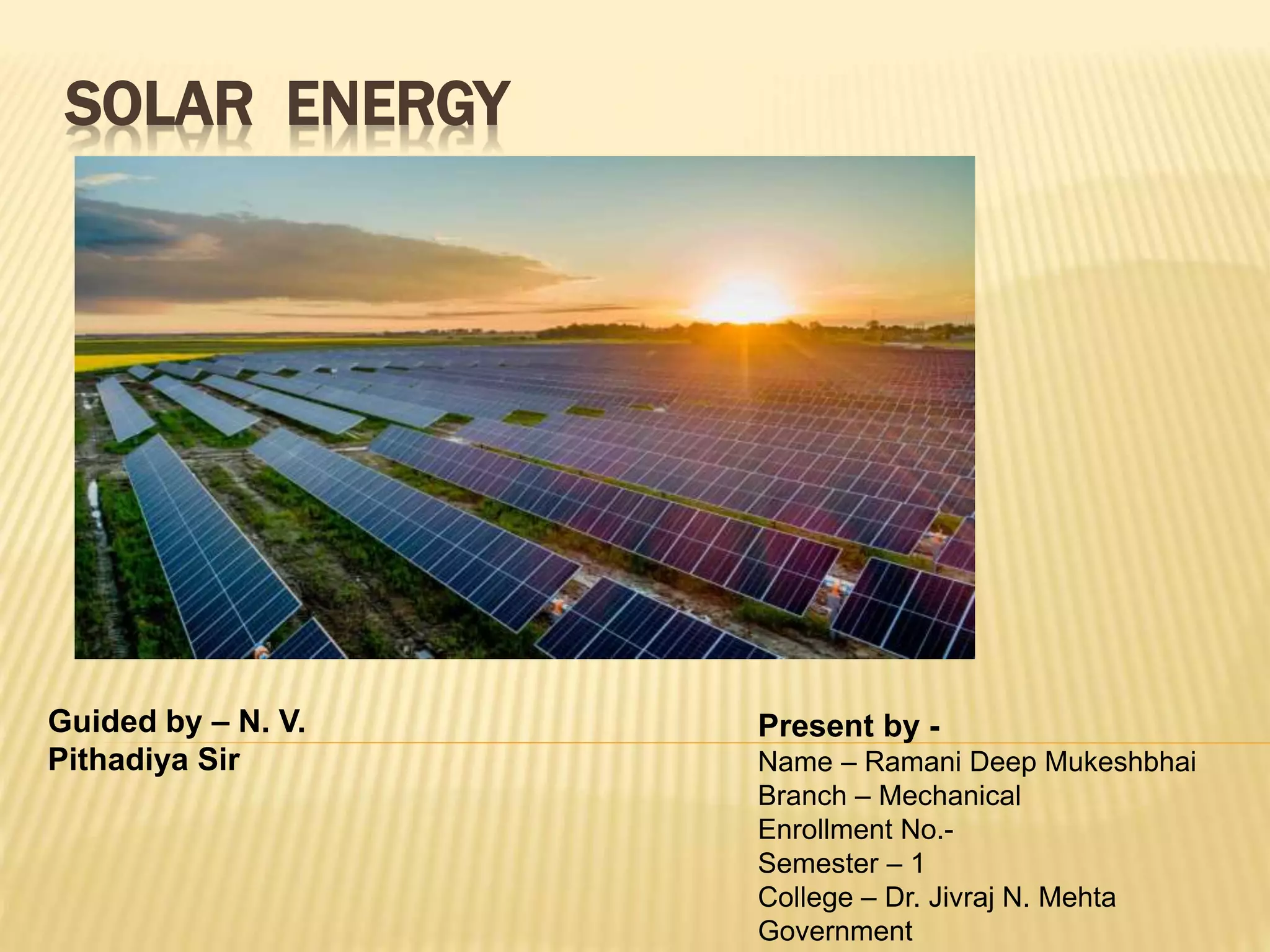
SOLAR ENERGY
Present by -
Name – Ramani Deep Mukeshbhai
Branch – Mechanical
Enrollment No.-
Semester – 1
College – Dr. Jivraj N. Mehta
Government
Guided by – N. V.
Pithadiya Sir
INDEX
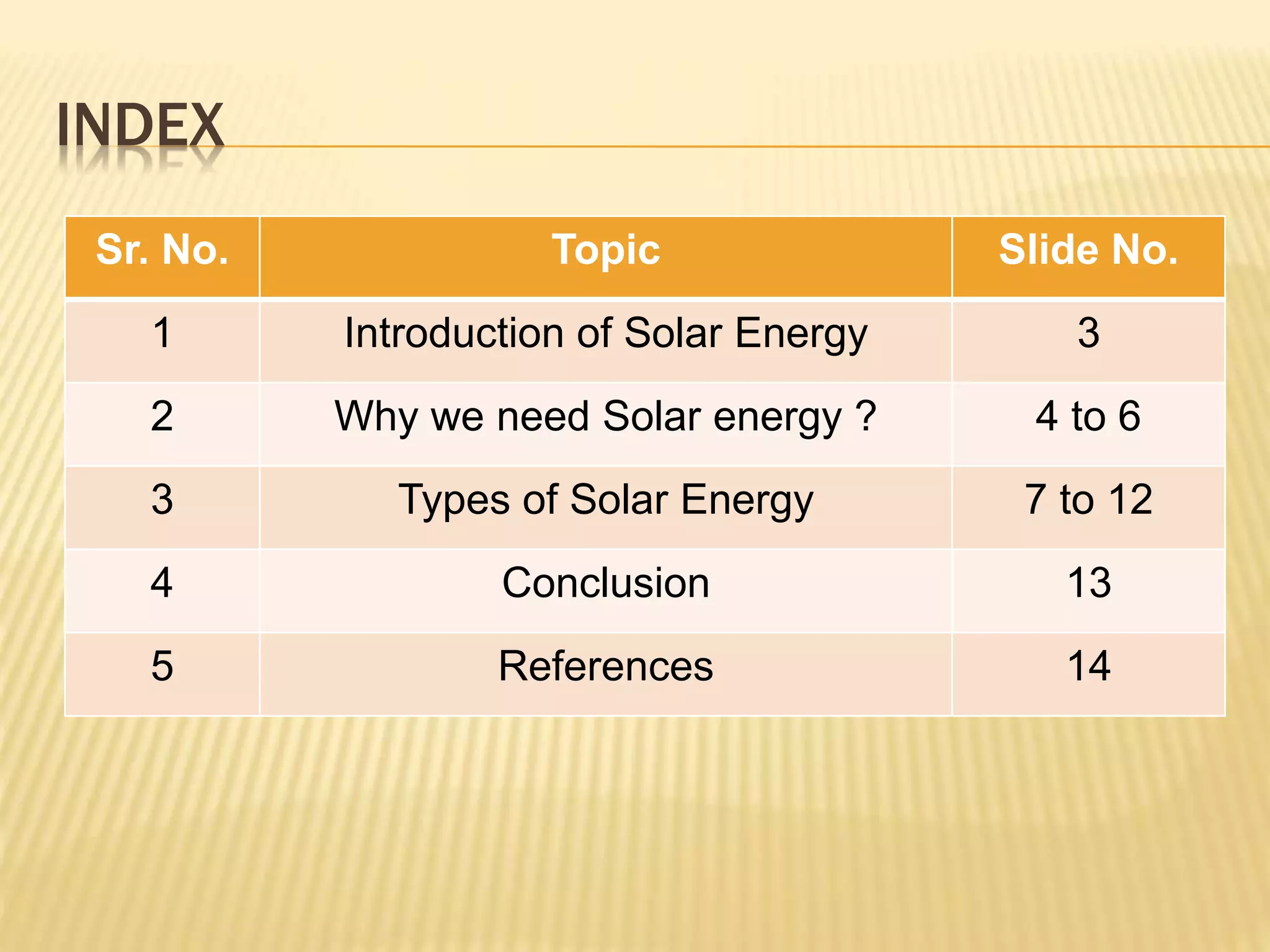
Sr. No. Topic Slide No.
1 Introduction of Solar Energy 3
2 Why we need Solar energy ? 4 to 6
3 Types of Solar Energy 7 to 12
4 Conclusion 13
5 References 14
WHAT IS SOLAR ENERGY ?
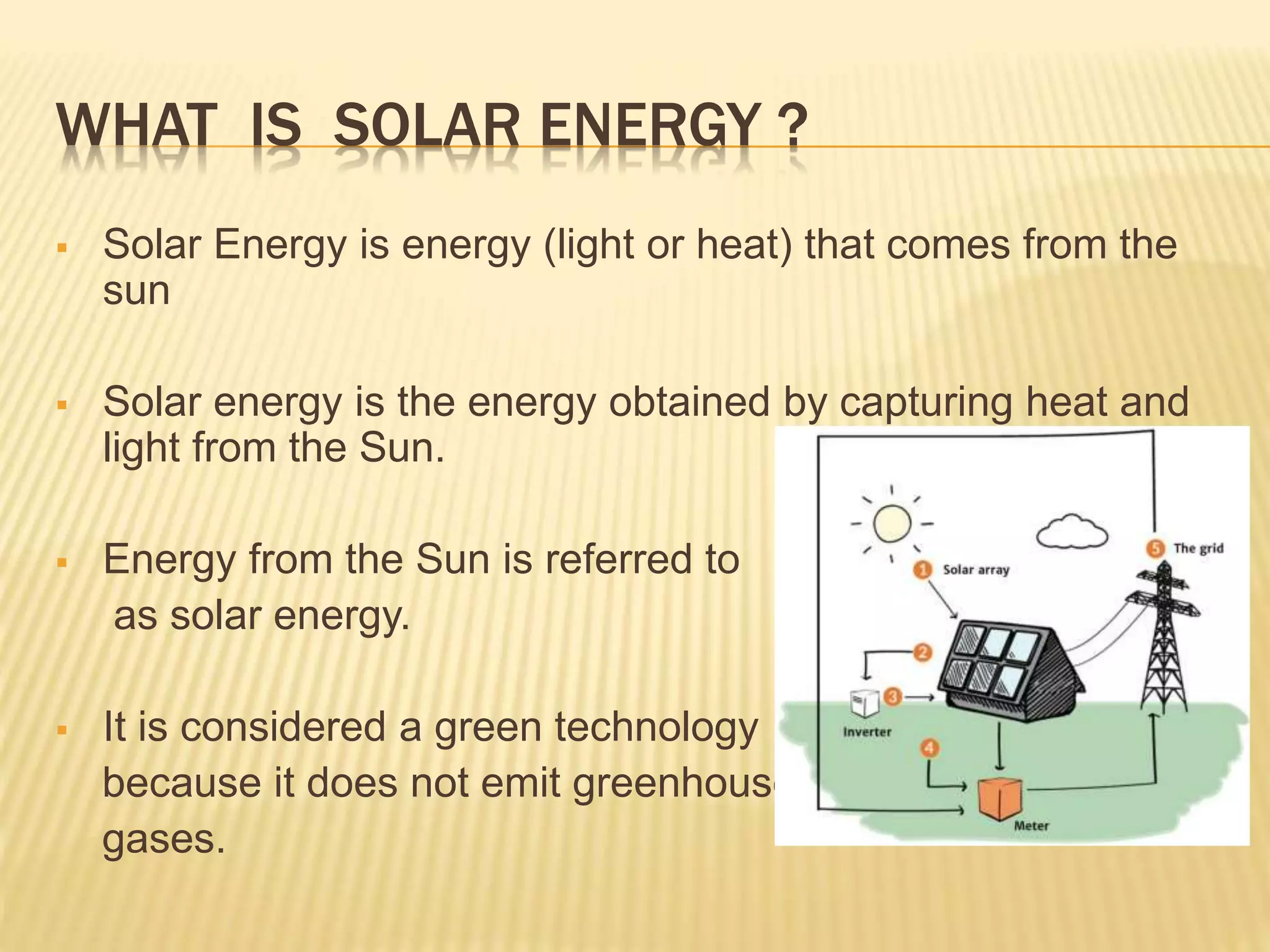
 Solar Energy is energy (light or heat) that comes from the
sun
 Solar energy is the energy obtained by capturing heat and
light from the Sun.
 Energy from the Sun is referred to
as solar energy.
 It is considered a green technology
because it does not emit greenhouse
gases.
WHY WE NEED SOLAR ENERGY ?
 Approximately 80% of the total amount of energy used
globally each year comes from fossil fuels like Petroleum,
Natural Gas and Coal
 If we do not reduce consumption, we will run out of them,
very quickly. In this case, very quickly means maybe in our
life span
 According to Worldometer, we will run out of oil in 47 years,
natural gas in 52 years, and coal in 133 years. In the long
term, if we want to use energy sources that will never run
out, there are better alternatives than fossil fuels..
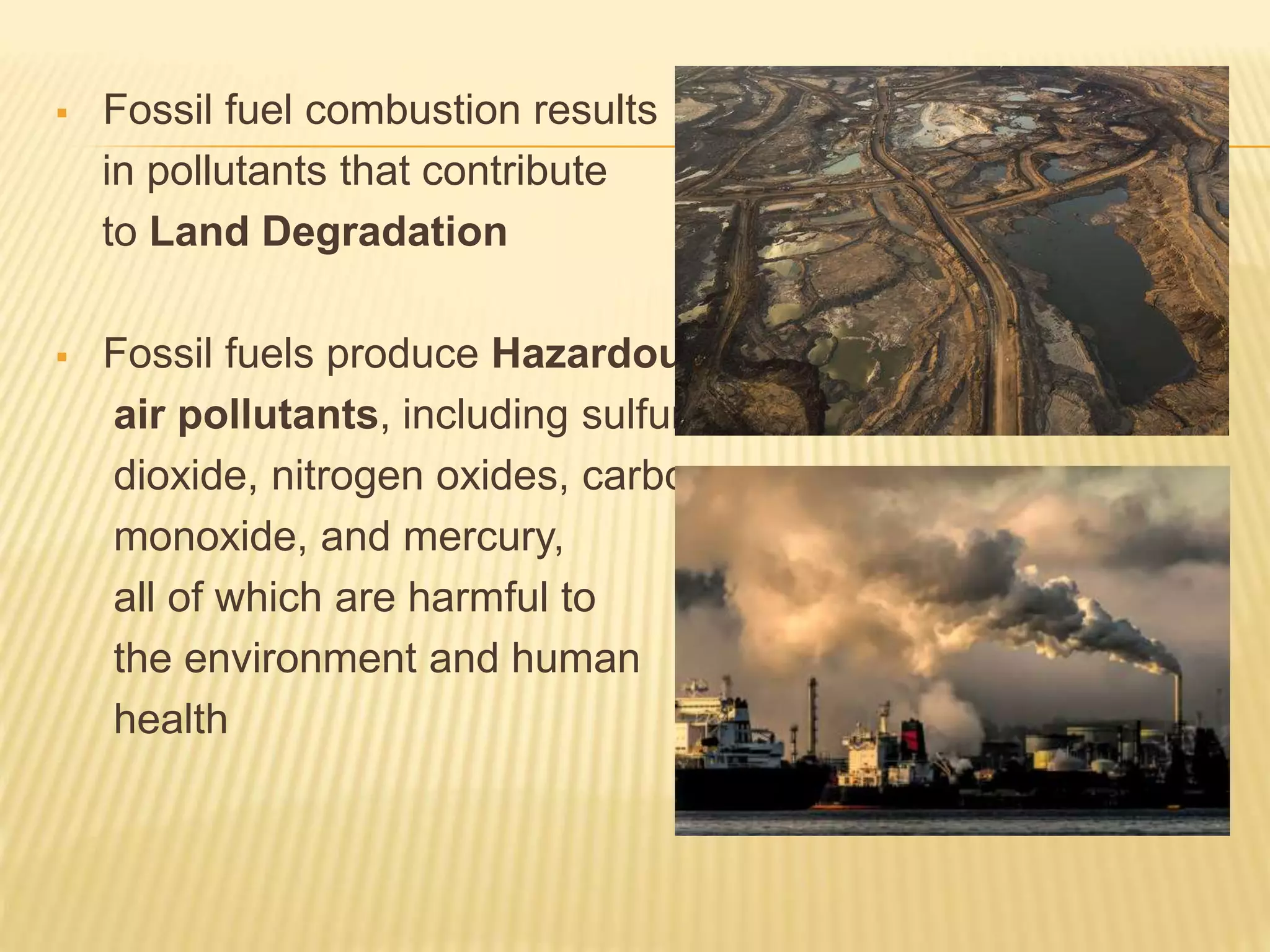
 Fossil fuel combustion results
in pollutants that contribute
to Land Degradation
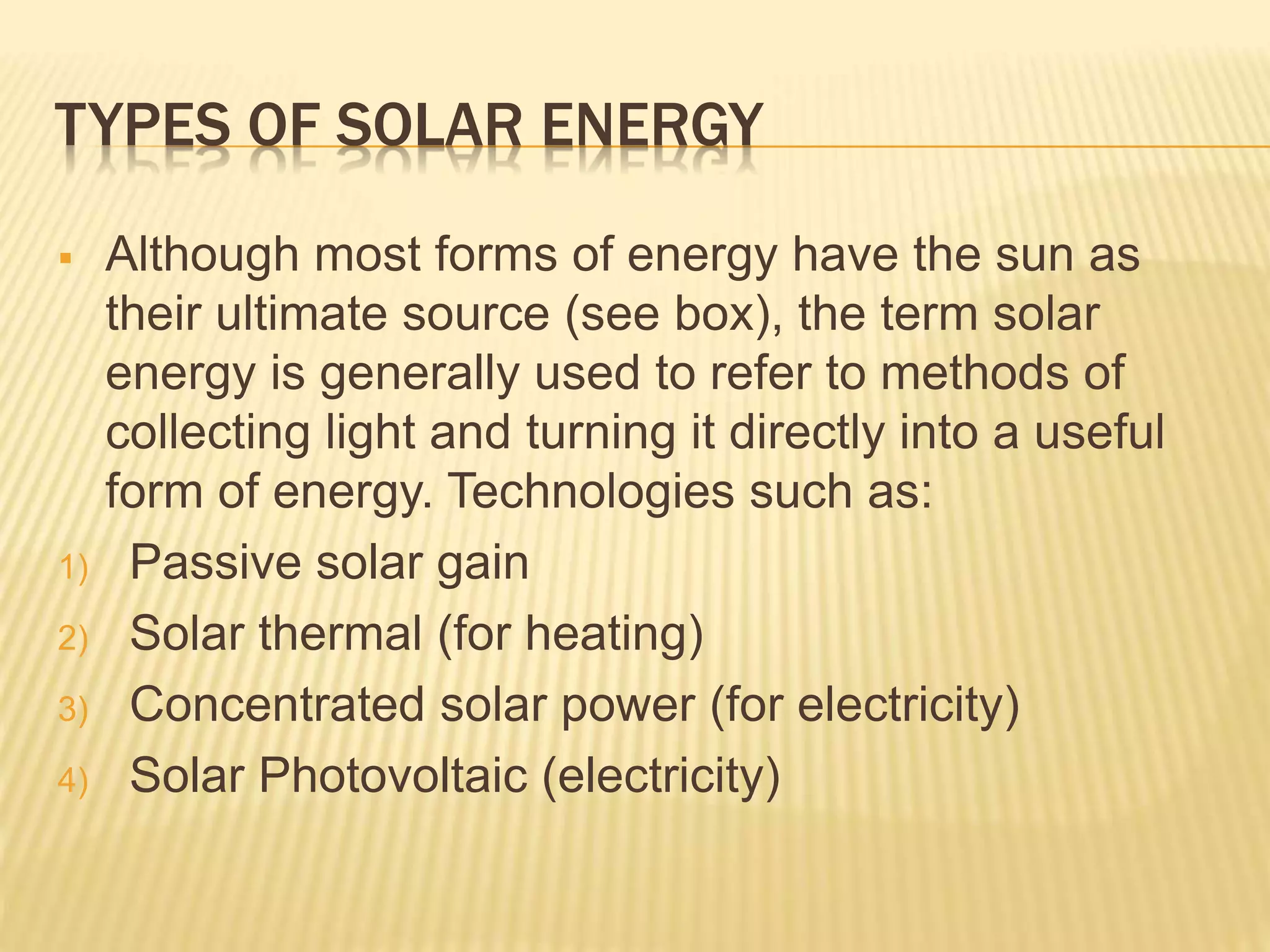
 Fossil fuels produce Hazardous
air pollutants, including sulfur
dioxide, nitrogen oxides, carbon
monoxide, and mercury,
all of which are harmful to
the environment and human
health
 New research from Harvard University found that more than
8 million people died in 2018 from fossil fuel pollution,
meaning that air pollution from burning fossil fuels like coal
and diesel was responsible for about 1 in 5 deaths
worldwide.
 Electricity use can be a significant source of air pollution and
greenhouse gas emissions. Buying renewable energy, can
help reduce environmental impact while also providing a
number of other valuable benefits.
 That is why we need renewable energy that does not
generate harmful gases and is easy to use.
 So we're moving to Solar Energy. It’s renewable, It's easy
to generate, It's silent, It's non-polluting.
TYPES OF SOLAR ENERGY
 Although most forms of energy have the sun as
their ultimate source (see box), the term solar
energy is generally used to refer to methods of
collecting light and turning it directly into a useful
form of energy. Technologies such as:
1) Passive solar gain
2) Solar thermal (for heating)
3) Concentrated solar power (for electricity)
4) Solar Photovoltaic (electricity)
1) PASSIVE SOLAR GAIN
 This form of energy is often taken for granted; but can
contribute a significant amount of the energy demands of
a well-designed building in the heating season. Sunlight
enters a building through windows, and warms the inside.
In an average house in the UK, passive solar gain
contributes 14% of the heating demand.
 Orienting the house so that the more often used rooms
face south;
 Larger windows on the south
side, smaller on the north;
 Using building materials that
store heat by adding “thermal
mass” to the house and
 Laying out housing developments
so that buildings do not
over-shadow each other
2) SOLAR THERMAL (FOR HEATING)
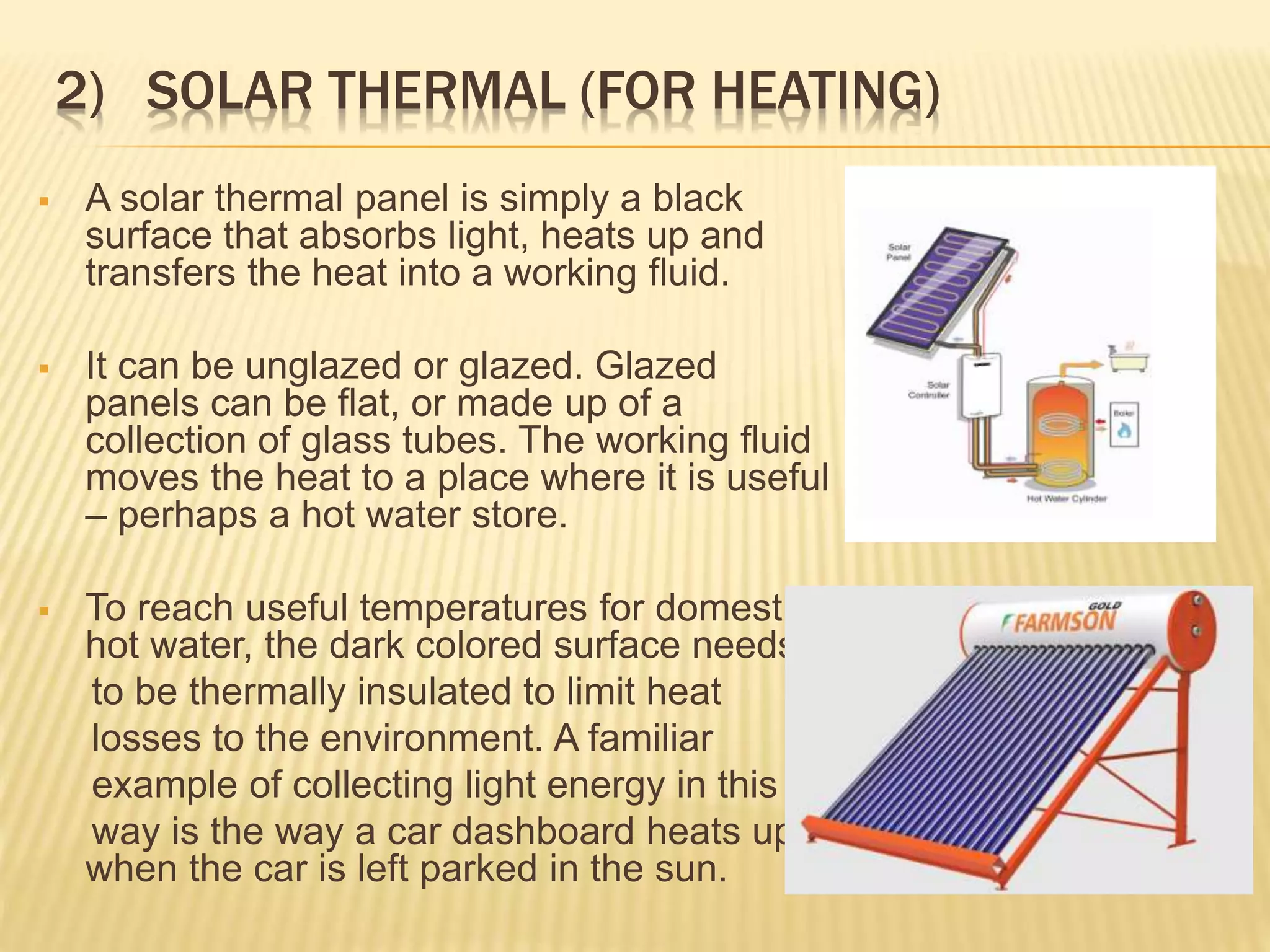
 A solar thermal panel is simply a black
surface that absorbs light, heats up and
transfers the heat into a working fluid.
 It can be unglazed or glazed. Glazed
panels can be flat, or made up of a
collection of glass tubes. The working fluid
moves the heat to a place where it is useful
– perhaps a hot water store.
 To reach useful temperatures for domestic
hot water, the dark colored surface needs
to be thermally insulated to limit heat
losses to the environment. A familiar
example of collecting light energy in this
way is the way a car dashboard heats up
when the car is left parked in the sun.
3) CONCENTRATED SOLAR POWER
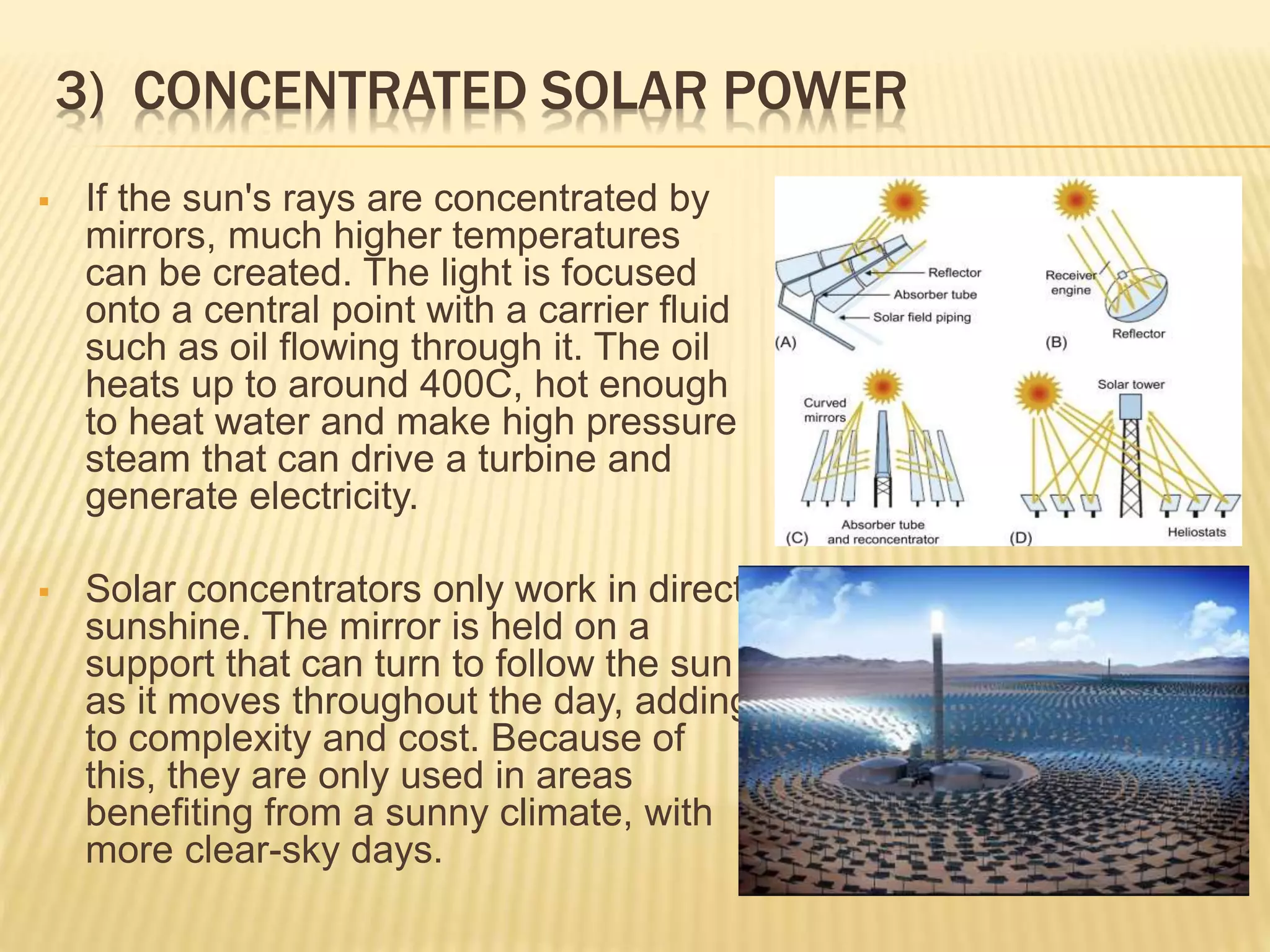
 If the sun's rays are concentrated by
mirrors, much higher temperatures
can be created. The light is focused
onto a central point with a carrier fluid
such as oil flowing through it. The oil
heats up to around 400C, hot enough
to heat water and make high pressure
steam that can drive a turbine and
generate electricity.
 Solar concentrators only work in direct
sunshine. The mirror is held on a
support that can turn to follow the sun
as it moves throughout the day, adding
to complexity and cost. Because of
this, they are only used in areas
benefiting from a sunny climate, with
more clear-sky days.
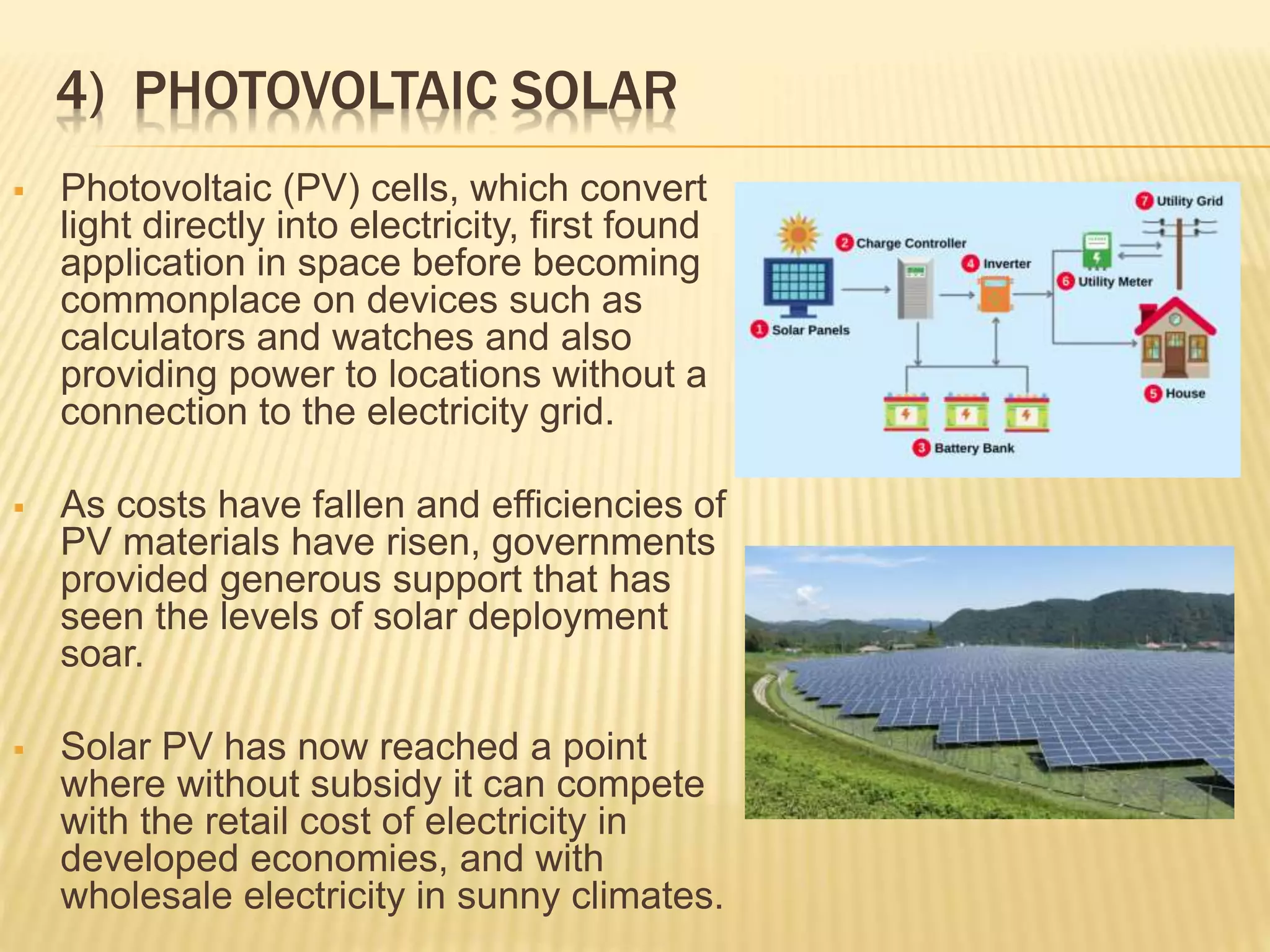
4) PHOTOVOLTAIC SOLAR
 Photovoltaic (PV) cells, which convert
light directly into electricity, first found
application in space before becoming
commonplace on devices such as
calculators and watches and also
providing power to locations without a
connection to the electricity grid.
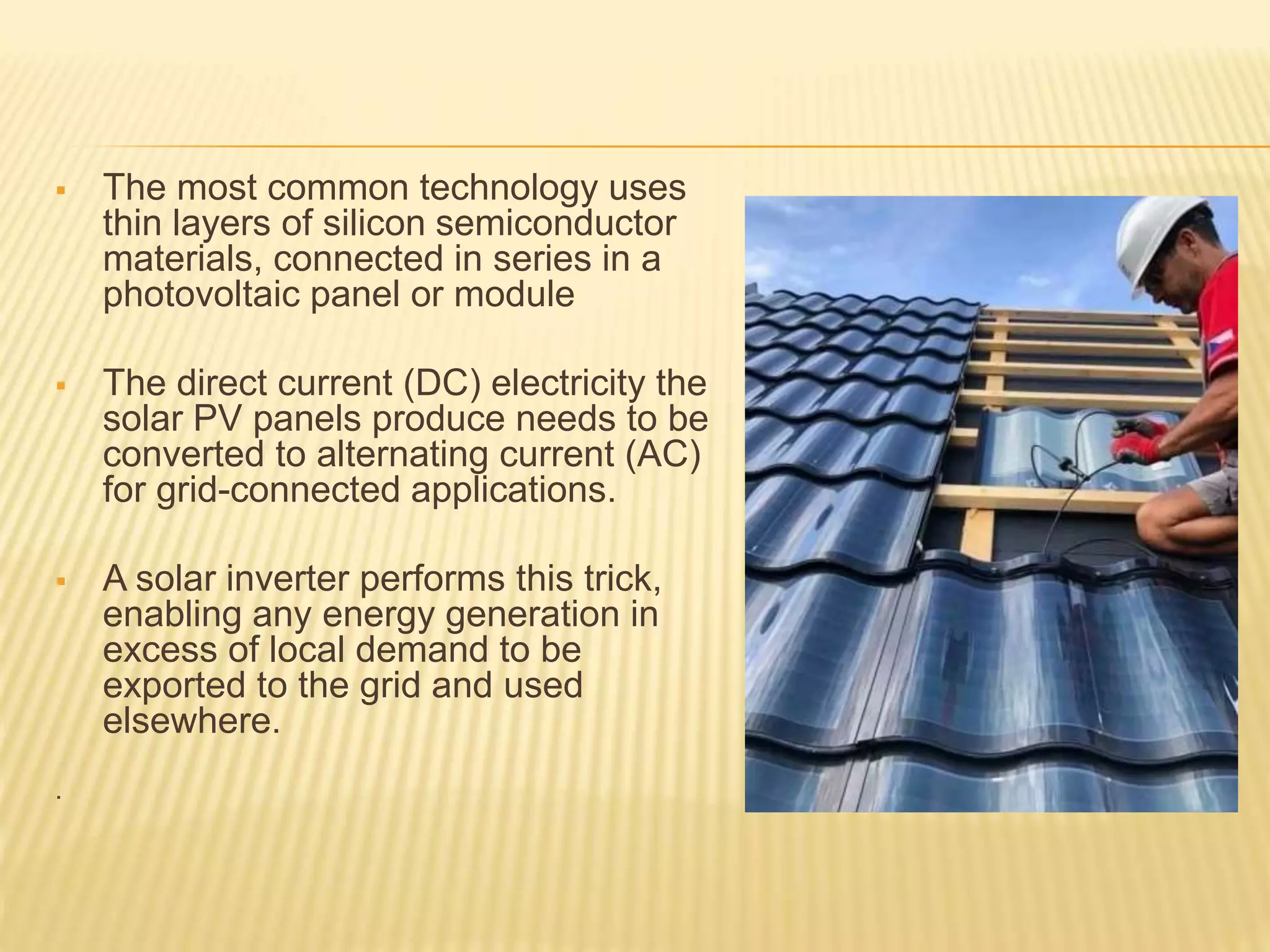
 As costs have fallen and efficiencies of
PV materials have risen, governments
provided generous support that has
seen the levels of solar deployment
soar.
 Solar PV has now reached a point
where without subsidy it can compete
with the retail cost of electricity in
developed economies, and with
wholesale electricity in sunny climates.
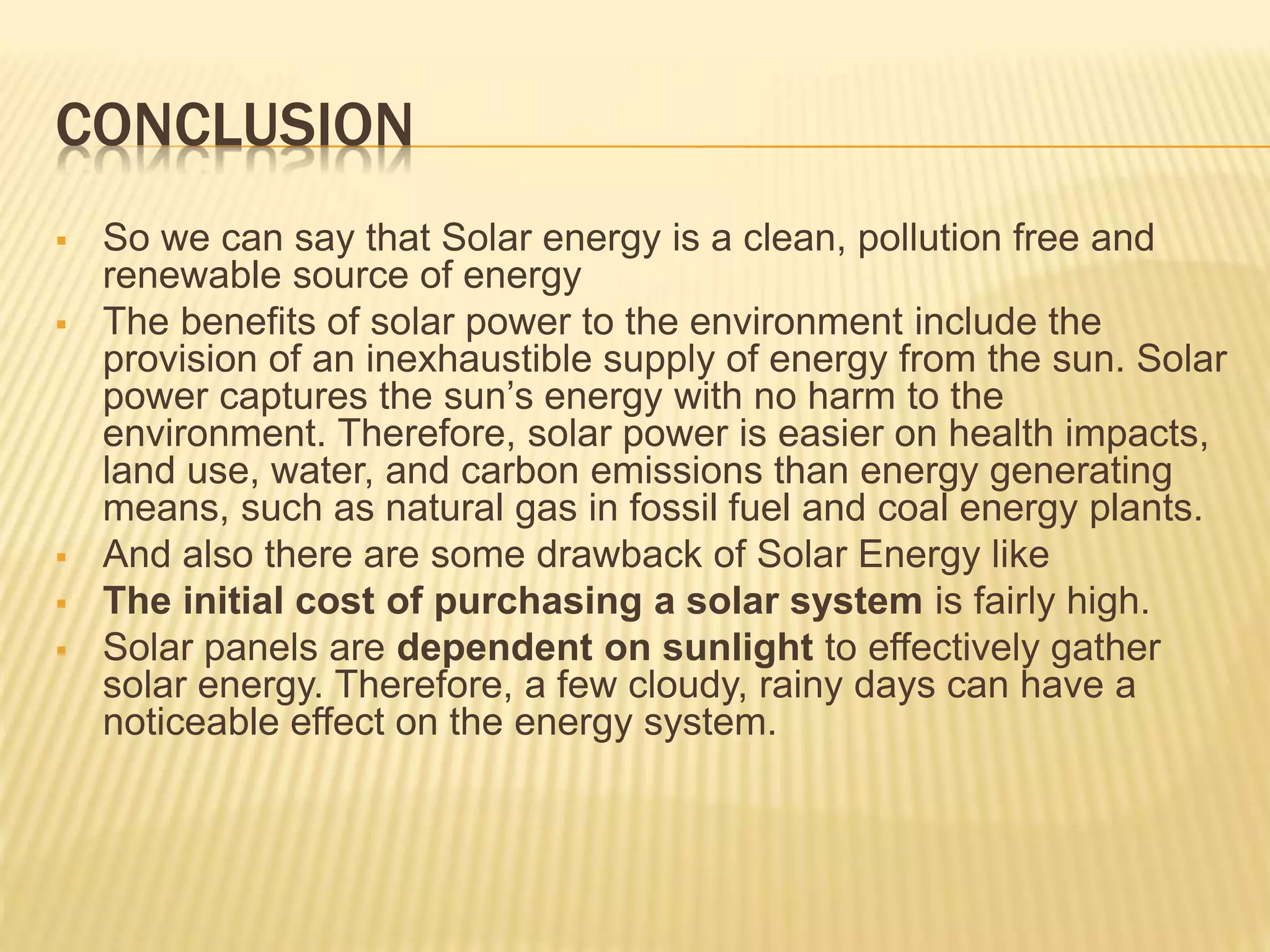
 The most common technology uses
thin layers of silicon semiconductor
materials, connected in series in a
photovoltaic panel or module
 The direct current (DC) electricity the
solar PV panels produce needs to be
converted to alternating current (AC)
for grid-connected applications.
 A solar inverter performs this trick,
enabling any energy generation in
excess of local demand to be
exported to the grid and used
elsewhere.
.
CONCLUSION
 So we can say that Solar energy is a clean, pollution free and
renewable source of energy
 The benefits of solar power to the environment include the
provision of an inexhaustible supply of energy from the sun. Solar
power captures the sun’s energy with no harm to the
environment. Therefore, solar power is easier on health impacts,
land use, water, and carbon emissions than energy generating
means, such as natural gas in fossil fuel and coal energy plants.
 And also there are some drawback of Solar Energy like
 The initial cost of purchasing a solar system is fairly high.
 Solar panels are dependent on sunlight to effectively gather
solar energy. Therefore, a few cloudy, rainy days can have a
noticeable effect on the energy system.
REFERENCES
 https://en.wikipedia.org/wiki/Solar_energy
 https://www.solarschools.net/knowledge-bank/renewable-energy/solar
 https://www.nrdc.org/stories/fossil-fuels-dirty-facts
 https://www.weforum.org/agenda/2021/08/this-is-why-we-need-a-fossil-
fuel-treaty/
 https://www.solarreviews.com/blog/dont-pass-on-passive-solar-heating
 https://www.viridiansolar.co.uk/resources-2-0-different-forms-solar-
energy.html
 https://farmsonsolar.com/
 https://www.sciencedirect.com/topics/engineering/concentrated-solar-
power
 https://www.solarreviews.com/blog/what-is-concentrated-solar-power
 https://www.hindustantimes.com/india-news/mizoram-s-first-solar-power-
plant-commissioned/story-VRqeDceY2RErHmpOCez3iN.html
Solar Energy presentation  ppt

Solar Energy presentation ppt

  • 1.
    SOLAR ENERGY Present by- Name – Ramani Deep Mukeshbhai Branch – Mechanical Enrollment No.- Semester – 1 College – Dr. Jivraj N. Mehta Government Guided by – N. V. Pithadiya Sir
  • 2.
    INDEX Sr. No. TopicSlide No. 1 Introduction of Solar Energy 3 2 Why we need Solar energy ? 4 to 6 3 Types of Solar Energy 7 to 12 4 Conclusion 13 5 References 14
  • 3.
    WHAT IS SOLARENERGY ?  Solar Energy is energy (light or heat) that comes from the sun  Solar energy is the energy obtained by capturing heat and light from the Sun.  Energy from the Sun is referred to as solar energy.  It is considered a green technology because it does not emit greenhouse gases.
  • 4.
    WHY WE NEEDSOLAR ENERGY ?  Approximately 80% of the total amount of energy used globally each year comes from fossil fuels like Petroleum, Natural Gas and Coal  If we do not reduce consumption, we will run out of them, very quickly. In this case, very quickly means maybe in our life span  According to Worldometer, we will run out of oil in 47 years, natural gas in 52 years, and coal in 133 years. In the long term, if we want to use energy sources that will never run out, there are better alternatives than fossil fuels..
  • 5.
     Fossil fuelcombustion results in pollutants that contribute to Land Degradation  Fossil fuels produce Hazardous air pollutants, including sulfur dioxide, nitrogen oxides, carbon monoxide, and mercury, all of which are harmful to the environment and human health
  • 6.
     New researchfrom Harvard University found that more than 8 million people died in 2018 from fossil fuel pollution, meaning that air pollution from burning fossil fuels like coal and diesel was responsible for about 1 in 5 deaths worldwide.  Electricity use can be a significant source of air pollution and greenhouse gas emissions. Buying renewable energy, can help reduce environmental impact while also providing a number of other valuable benefits.  That is why we need renewable energy that does not generate harmful gases and is easy to use.  So we're moving to Solar Energy. It’s renewable, It's easy to generate, It's silent, It's non-polluting.
  • 7.
    TYPES OF SOLARENERGY  Although most forms of energy have the sun as their ultimate source (see box), the term solar energy is generally used to refer to methods of collecting light and turning it directly into a useful form of energy. Technologies such as: 1) Passive solar gain 2) Solar thermal (for heating) 3) Concentrated solar power (for electricity) 4) Solar Photovoltaic (electricity)
  • 8.
    1) PASSIVE SOLARGAIN  This form of energy is often taken for granted; but can contribute a significant amount of the energy demands of a well-designed building in the heating season. Sunlight enters a building through windows, and warms the inside. In an average house in the UK, passive solar gain contributes 14% of the heating demand.  Orienting the house so that the more often used rooms face south;  Larger windows on the south side, smaller on the north;  Using building materials that store heat by adding “thermal mass” to the house and  Laying out housing developments so that buildings do not over-shadow each other
  • 9.
    2) SOLAR THERMAL(FOR HEATING)  A solar thermal panel is simply a black surface that absorbs light, heats up and transfers the heat into a working fluid.  It can be unglazed or glazed. Glazed panels can be flat, or made up of a collection of glass tubes. The working fluid moves the heat to a place where it is useful – perhaps a hot water store.  To reach useful temperatures for domestic hot water, the dark colored surface needs to be thermally insulated to limit heat losses to the environment. A familiar example of collecting light energy in this way is the way a car dashboard heats up when the car is left parked in the sun.
  • 10.
    3) CONCENTRATED SOLARPOWER  If the sun's rays are concentrated by mirrors, much higher temperatures can be created. The light is focused onto a central point with a carrier fluid such as oil flowing through it. The oil heats up to around 400C, hot enough to heat water and make high pressure steam that can drive a turbine and generate electricity.  Solar concentrators only work in direct sunshine. The mirror is held on a support that can turn to follow the sun as it moves throughout the day, adding to complexity and cost. Because of this, they are only used in areas benefiting from a sunny climate, with more clear-sky days.
  • 11.
    4) PHOTOVOLTAIC SOLAR Photovoltaic (PV) cells, which convert light directly into electricity, first found application in space before becoming commonplace on devices such as calculators and watches and also providing power to locations without a connection to the electricity grid.  As costs have fallen and efficiencies of PV materials have risen, governments provided generous support that has seen the levels of solar deployment soar.  Solar PV has now reached a point where without subsidy it can compete with the retail cost of electricity in developed economies, and with wholesale electricity in sunny climates.
  • 12.
     The mostcommon technology uses thin layers of silicon semiconductor materials, connected in series in a photovoltaic panel or module  The direct current (DC) electricity the solar PV panels produce needs to be converted to alternating current (AC) for grid-connected applications.  A solar inverter performs this trick, enabling any energy generation in excess of local demand to be exported to the grid and used elsewhere. .
  • 13.
    CONCLUSION  So wecan say that Solar energy is a clean, pollution free and renewable source of energy  The benefits of solar power to the environment include the provision of an inexhaustible supply of energy from the sun. Solar power captures the sun’s energy with no harm to the environment. Therefore, solar power is easier on health impacts, land use, water, and carbon emissions than energy generating means, such as natural gas in fossil fuel and coal energy plants.  And also there are some drawback of Solar Energy like  The initial cost of purchasing a solar system is fairly high.  Solar panels are dependent on sunlight to effectively gather solar energy. Therefore, a few cloudy, rainy days can have a noticeable effect on the energy system.
  • 14.
    REFERENCES  https://en.wikipedia.org/wiki/Solar_energy  https://www.solarschools.net/knowledge-bank/renewable-energy/solar https://www.nrdc.org/stories/fossil-fuels-dirty-facts  https://www.weforum.org/agenda/2021/08/this-is-why-we-need-a-fossil- fuel-treaty/  https://www.solarreviews.com/blog/dont-pass-on-passive-solar-heating  https://www.viridiansolar.co.uk/resources-2-0-different-forms-solar- energy.html  https://farmsonsolar.com/  https://www.sciencedirect.com/topics/engineering/concentrated-solar- power  https://www.solarreviews.com/blog/what-is-concentrated-solar-power  https://www.hindustantimes.com/india-news/mizoram-s-first-solar-power- plant-commissioned/story-VRqeDceY2RErHmpOCez3iN.html