SATELLITE ORBITS
INTRODUCTION
 Most of the satellites mentioned thus far are
called orbital satellites, which are
nonsynchronous. Nonsynchronous satellites
rotate around Earth in an elliptical or circular
pattern as shown in Figure 2 (a and b).
FIGURE 2 Satellite orbits: [a] circular; [b] elliptical
 Prograde or posigrade orbit
- If the satellite is orbiting in the same direction as
Earth’s rotation (counterclockwise) and at an angular
velocity greater than that of Earth (ωs > ωe)
 Retrograde orbit
- If the satellite is orbiting in the opposite direction as
Earth’s rotation or in the same direction with an angular
velocity less than that of Earth (ωs<ωe).
SATELLITE ELEVATION CATEGORIES
Satellites are generally classified as:
1) Low earth orbit (LEO)
- Most LEO satellites operate in the 1.0-GHz to 2.5-GHz
frequency range. Motorola’s satellite-based mobile-
telephone system, Iridium, is a LEO system utilizing a
66-satellite constellation orbiting approximately 480
miles above Earth’s surface.
 The main advantage of LEO satellites is that the
path loss between earth stations and space vehicles is
much lower than for satellites revolving in medium- or
high-altitude orbits. Less path loss equates to lower
transmit powers, smaller antennas, and less weight.
Iridium Satellite Communications
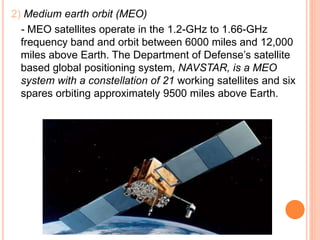
2) Medium earth orbit (MEO)
- MEO satellites operate in the 1.2-GHz to 1.66-GHz
frequency band and orbit between 6000 miles and 12,000
miles above Earth. The Department of Defense’s satellite
based global positioning system, NAVSTAR, is a MEO
system with a constellation of 21 working satellites and six
spares orbiting approximately 9500 miles above Earth.
3) Geosynchronous earth orbit (GEO)
- Geosynchronous satellites are high-altitude earth-orbit
satellites operating primarily in the 2-GHz to 18-GHz
frequency spectrum with orbits 22,300 miles above
Earth’s surface.
- Geosynchronous or geostationary satellites are those
that orbit in a circular pattern with an angular velocity
equal to that of Earth. Geostationary satellites have an
orbital time of approximately 24 hours, the same as
Earth; thus, geosynchronous satellites appear to be
stationary, as they remain in a fixed position in respect to
a given point on Earth.
 Satellites in high-elevation, nonsynchronous circular
orbits between 19,000 miles and 25,000 miles above
Earth are said to be in near-synchronous orbit.
 Sub-synchronous
– Type of near-synchronous orbit,
if the orbit is higher than 22,300 miles above Earth, the
satellite’s orbital time is longer than Earth’s rotational
period, and the satellite will appear to have a reverse
(retrograde) motion from east to west.
SATELLITE ORBITAL PATTERNS
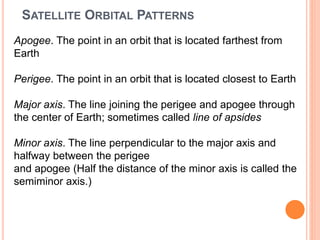
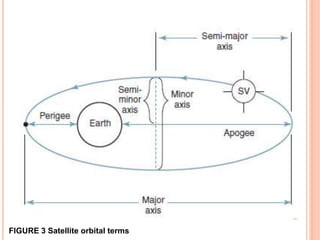
Apogee. The point in an orbit that is located farthest from
Earth
Perigee. The point in an orbit that is located closest to Earth
Major axis. The line joining the perigee and apogee through
the center of Earth; sometimes called line of apsides
Minor axis. The line perpendicular to the major axis and
halfway between the perigee
and apogee (Half the distance of the minor axis is called the
semiminor axis.)
FIGURE 3 Satellite orbital terms
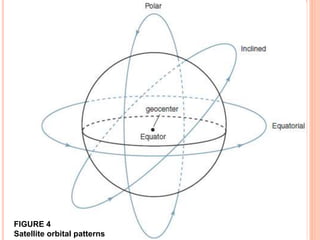
 All satellites rotate around Earth in an orbit
that forms a plane that passes through the
center of gravity of Earth called the
geocenter.
FIGURE 4
Satellite orbital patterns
 Inclined orbits are virtually all orbits except those that travel
directly above the equator or directly over the North and
South Poles.
[a] Angle of inclination
[b] ascending node, descending node,
and line of nodes
 An equatorial orbit is when the satellite rotates in an orbit
directly above the equator, usually in a circular path. With
an equatorial orbit, the angle of inclination is 0°, and
there are no ascending or descending nodes and, hence,
no line of nodes. All geosynchronous satellites are in
equatorial orbits.
 A polar orbit is when the satellite rotates in a path that
takes it over the North and South Poles in an orbit
perpendicular to the equatorial plane. Polar orbiting
satellites follow a low-altitude path that is close to Earth
and passes over and very close to both the North and
South Poles. The angle of inclination of a satellite in a
polar orbit is nearly 90°.
 An important effect of the Earth’s equatorial bulge is
causing elliptical orbits to rotate in a manner that causes
the apogee and perigee to move around the Earth. This
phenomena is called rotation of the line of apsides;
however, for an angle of inclination of 63.4°, the rotation of
the line of apsides is zero.
 One of the more interesting orbital satellite systems
currently in use is the Commonwealth of Independent
States (CIS) Molniya system of satellites, which is shown
in Figure 6. The CIS is the former Soviet Union. Molniya
can also be spelled Molnya and Molnia, which means
“lightning” in Russian (in colloquial Russian, Molniya
means “news flash”). Molniya satellites are used for
government communications, telephone, television, and
video.
FIGURE 6 Soviet Molniya satellite orbit
GEOSYNCHRONOUS
SATELLITES
INTRODUCTION
 Geosynchronous satellites orbit Earth above the equator
with the same angular velocity as Earth. Hence,
geosynchronous (sometimes called stationary or
geostationary) satellites appear to remain in a fixed
location above one spot on Earth’s surface. Since a
geosynchronous satellite appears to remain in a fixed
location, no special antenna tracking equipment is
necessary—earth station antennas are simply pointed at
the satellite. A single high-altitude geosynchronous
satellite can provide reliable communications to
approximately 40% of the earth’s surface.
 The closer to Earth a satellite rotates, the greater the
gravitational pull and the greater the velocity required to
keep it from being pulled to Earth.
 Low-altitude satellites orbiting 100 miles above Earth
travel at approximately 17,500 mph. At this speed, it takes
approximately 1.5 hours to rotate around Earth.
Consequently, the time that a satellite is in line of sight of a
particular earth station is 0.25 hour or less per orbit.
 Medium-altitude Earth-orbit satellites have a rotation
period of between 5 and 12 hours and remain in line of
sight of a particular earth station for between 2 and 4
hours per orbit.
 High-altitude earth-orbit satellites in geosynchronous
orbits travel at approximately 6840 mph and complete one
revolution of Earth in approximately 24 hours.
 Geosynchronous orbits are circular; therefore, the speed of
rotation is constant throughout the orbit. There is only one
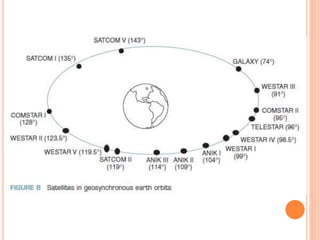
geosynchronous earth orbit; however, it is occupied by a
large number of satellites.
 Unbalanced forces cause geosynchronous satellites to drift
slowly away from their assigned locations in a figure-eight
excursion with a 24-hour period that follows a wandering
path slightly above and below the equatorial plane. In
essence, it occurs in a special type of inclined orbit
sometimes called a stationary inclined orbit.
 Geosynchronous satellites in an elliptical orbit also rift in an
east or west direction as viewed from Earth. The process of
maneuvering a satellite within a preassigned window is
called station keeping.
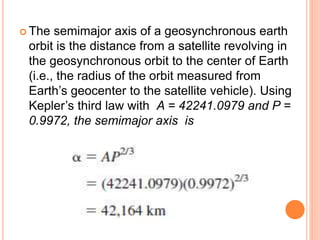
 The semimajor axis of a geosynchronous earth
orbit is the distance from a satellite revolving in
the geosynchronous orbit to the center of Earth
(i.e., the radius of the orbit measured from
Earth’s geocenter to the satellite vehicle). Using
Kepler’s third law with A = 42241.0979 and P =
0.9972, the semimajor axis is
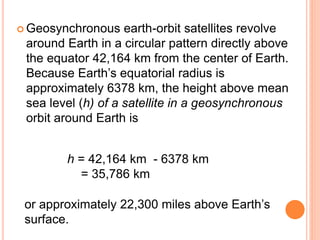
 Geosynchronous earth-orbit satellites revolve
around Earth in a circular pattern directly above
the equator 42,164 km from the center of Earth.
Because Earth’s equatorial radius is
approximately 6378 km, the height above mean
sea level (h) of a satellite in a geosynchronous
orbit around Earth is
h = 42,164 km - 6378 km
= 35,786 km
or approximately 22,300 miles above Earth’s
surface.
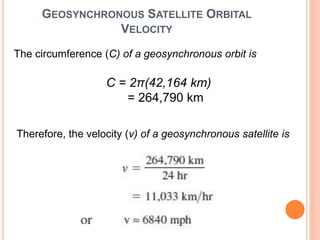
GEOSYNCHRONOUS SATELLITE ORBITAL
VELOCITY
The circumference (C) of a geosynchronous orbit is
C = 2π(42,164 km)
= 264,790 km
Therefore, the velocity (v) of a geosynchronous satellite is
ROUND-TRIP TIME DELAY OF GEOSYNCHRONOUS SATELLITES
The round-trip propagation delay between a satellite and
an earth station located directly below it is
CLARKE ORBIT
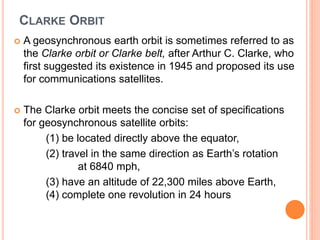
 A geosynchronous earth orbit is sometimes referred to as
the Clarke orbit or Clarke belt, after Arthur C. Clarke, who
first suggested its existence in 1945 and proposed its use
for communications satellites.
 The Clarke orbit meets the concise set of specifications
for geosynchronous satellite orbits:
(1) be located directly above the equator,
(2) travel in the same direction as Earth’s rotation
at 6840 mph,
(3) have an altitude of 22,300 miles above Earth,
(4) complete one revolution in 24 hours
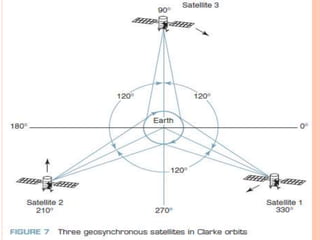
 An international agreement initially mandated that all
satellites placed in the Clarke orbit must be separated
by at least 1833 miles. This stipulation equates to an
angular separation of 4° or more, which limits the
number of satellite vehicles in a geosynchronous earth
orbit to less than 100.
ADVANTAGES AND DISADVANTAGES OF
GEOSYNCHRONOUS SATELLITES
The advantages of geosynchronous satellites are as follows:
 Geosynchronous satellites remain almost stationary in
respect to a given earth station. Consequently, expensive
tracking equipment is not required at the earth stations.
 Geosynchronous satellites are available to all earth stations
within their shadow 100% of the time. The shadow of a
satellite includes all the earth stations that have a line-of-
sight path to it and lie within the radiation pattern of the
satellite’s antennas.
 There is no need to switch from one geosynchronous
satellite to another as they orbit overhead. Consequently,
there are no transmission breaks due to switching times.
 The effects of Doppler shift are negligible.
The disadvantages of geosynchronous satellites are as
follows:
 Geosynchronous satellites require sophisticated and
heavy propulsion devices onboard to keep them in a fixed
orbit.
 High-altitude geosynchronous satellites introduce much
longer propagation delays. The round-trip propagation
delay between two earth stations through a
geosynchronous satellite is between 500 ms and 600 ms.
 Geosynchronous satellites require higher transmit powers
and more sensitive receivers because of the longer
distances and greater path losses.
 High-precision spacemanship is required to place a
geosynchronous satellite into orbit and to keep it there.
Satellite orbits/geosynchronous satellites

Satellite orbits/geosynchronous satellites

  • 1.
  • 2.
    INTRODUCTION  Most ofthe satellites mentioned thus far are called orbital satellites, which are nonsynchronous. Nonsynchronous satellites rotate around Earth in an elliptical or circular pattern as shown in Figure 2 (a and b).
  • 3.
    FIGURE 2 Satelliteorbits: [a] circular; [b] elliptical
  • 4.
     Prograde orposigrade orbit - If the satellite is orbiting in the same direction as Earth’s rotation (counterclockwise) and at an angular velocity greater than that of Earth (ωs > ωe)  Retrograde orbit - If the satellite is orbiting in the opposite direction as Earth’s rotation or in the same direction with an angular velocity less than that of Earth (ωs<ωe).
  • 5.
    SATELLITE ELEVATION CATEGORIES Satellitesare generally classified as: 1) Low earth orbit (LEO) - Most LEO satellites operate in the 1.0-GHz to 2.5-GHz frequency range. Motorola’s satellite-based mobile- telephone system, Iridium, is a LEO system utilizing a 66-satellite constellation orbiting approximately 480 miles above Earth’s surface.  The main advantage of LEO satellites is that the path loss between earth stations and space vehicles is much lower than for satellites revolving in medium- or high-altitude orbits. Less path loss equates to lower transmit powers, smaller antennas, and less weight.
  • 6.
  • 7.
    2) Medium earthorbit (MEO) - MEO satellites operate in the 1.2-GHz to 1.66-GHz frequency band and orbit between 6000 miles and 12,000 miles above Earth. The Department of Defense’s satellite based global positioning system, NAVSTAR, is a MEO system with a constellation of 21 working satellites and six spares orbiting approximately 9500 miles above Earth.
  • 8.
    3) Geosynchronous earthorbit (GEO) - Geosynchronous satellites are high-altitude earth-orbit satellites operating primarily in the 2-GHz to 18-GHz frequency spectrum with orbits 22,300 miles above Earth’s surface. - Geosynchronous or geostationary satellites are those that orbit in a circular pattern with an angular velocity equal to that of Earth. Geostationary satellites have an orbital time of approximately 24 hours, the same as Earth; thus, geosynchronous satellites appear to be stationary, as they remain in a fixed position in respect to a given point on Earth.
  • 9.
     Satellites inhigh-elevation, nonsynchronous circular orbits between 19,000 miles and 25,000 miles above Earth are said to be in near-synchronous orbit.  Sub-synchronous – Type of near-synchronous orbit, if the orbit is higher than 22,300 miles above Earth, the satellite’s orbital time is longer than Earth’s rotational period, and the satellite will appear to have a reverse (retrograde) motion from east to west.
  • 10.
    SATELLITE ORBITAL PATTERNS Apogee.The point in an orbit that is located farthest from Earth Perigee. The point in an orbit that is located closest to Earth Major axis. The line joining the perigee and apogee through the center of Earth; sometimes called line of apsides Minor axis. The line perpendicular to the major axis and halfway between the perigee and apogee (Half the distance of the minor axis is called the semiminor axis.)
  • 11.
    FIGURE 3 Satelliteorbital terms
  • 12.
     All satellitesrotate around Earth in an orbit that forms a plane that passes through the center of gravity of Earth called the geocenter.
  • 13.
  • 14.
     Inclined orbitsare virtually all orbits except those that travel directly above the equator or directly over the North and South Poles. [a] Angle of inclination
  • 15.
    [b] ascending node,descending node, and line of nodes
  • 16.
     An equatorialorbit is when the satellite rotates in an orbit directly above the equator, usually in a circular path. With an equatorial orbit, the angle of inclination is 0°, and there are no ascending or descending nodes and, hence, no line of nodes. All geosynchronous satellites are in equatorial orbits.  A polar orbit is when the satellite rotates in a path that takes it over the North and South Poles in an orbit perpendicular to the equatorial plane. Polar orbiting satellites follow a low-altitude path that is close to Earth and passes over and very close to both the North and South Poles. The angle of inclination of a satellite in a polar orbit is nearly 90°.
  • 17.
     An importanteffect of the Earth’s equatorial bulge is causing elliptical orbits to rotate in a manner that causes the apogee and perigee to move around the Earth. This phenomena is called rotation of the line of apsides; however, for an angle of inclination of 63.4°, the rotation of the line of apsides is zero.  One of the more interesting orbital satellite systems currently in use is the Commonwealth of Independent States (CIS) Molniya system of satellites, which is shown in Figure 6. The CIS is the former Soviet Union. Molniya can also be spelled Molnya and Molnia, which means “lightning” in Russian (in colloquial Russian, Molniya means “news flash”). Molniya satellites are used for government communications, telephone, television, and video.
  • 18.
    FIGURE 6 SovietMolniya satellite orbit
  • 19.
  • 20.
    INTRODUCTION  Geosynchronous satellitesorbit Earth above the equator with the same angular velocity as Earth. Hence, geosynchronous (sometimes called stationary or geostationary) satellites appear to remain in a fixed location above one spot on Earth’s surface. Since a geosynchronous satellite appears to remain in a fixed location, no special antenna tracking equipment is necessary—earth station antennas are simply pointed at the satellite. A single high-altitude geosynchronous satellite can provide reliable communications to approximately 40% of the earth’s surface.
  • 21.
     The closerto Earth a satellite rotates, the greater the gravitational pull and the greater the velocity required to keep it from being pulled to Earth.  Low-altitude satellites orbiting 100 miles above Earth travel at approximately 17,500 mph. At this speed, it takes approximately 1.5 hours to rotate around Earth. Consequently, the time that a satellite is in line of sight of a particular earth station is 0.25 hour or less per orbit.  Medium-altitude Earth-orbit satellites have a rotation period of between 5 and 12 hours and remain in line of sight of a particular earth station for between 2 and 4 hours per orbit.  High-altitude earth-orbit satellites in geosynchronous orbits travel at approximately 6840 mph and complete one revolution of Earth in approximately 24 hours.
  • 22.
     Geosynchronous orbitsare circular; therefore, the speed of rotation is constant throughout the orbit. There is only one geosynchronous earth orbit; however, it is occupied by a large number of satellites.  Unbalanced forces cause geosynchronous satellites to drift slowly away from their assigned locations in a figure-eight excursion with a 24-hour period that follows a wandering path slightly above and below the equatorial plane. In essence, it occurs in a special type of inclined orbit sometimes called a stationary inclined orbit.  Geosynchronous satellites in an elliptical orbit also rift in an east or west direction as viewed from Earth. The process of maneuvering a satellite within a preassigned window is called station keeping.
  • 23.
     The semimajoraxis of a geosynchronous earth orbit is the distance from a satellite revolving in the geosynchronous orbit to the center of Earth (i.e., the radius of the orbit measured from Earth’s geocenter to the satellite vehicle). Using Kepler’s third law with A = 42241.0979 and P = 0.9972, the semimajor axis is
  • 24.
     Geosynchronous earth-orbitsatellites revolve around Earth in a circular pattern directly above the equator 42,164 km from the center of Earth. Because Earth’s equatorial radius is approximately 6378 km, the height above mean sea level (h) of a satellite in a geosynchronous orbit around Earth is h = 42,164 km - 6378 km = 35,786 km or approximately 22,300 miles above Earth’s surface.
  • 25.
    GEOSYNCHRONOUS SATELLITE ORBITAL VELOCITY Thecircumference (C) of a geosynchronous orbit is C = 2π(42,164 km) = 264,790 km Therefore, the velocity (v) of a geosynchronous satellite is
  • 26.
    ROUND-TRIP TIME DELAYOF GEOSYNCHRONOUS SATELLITES The round-trip propagation delay between a satellite and an earth station located directly below it is
  • 27.
    CLARKE ORBIT  Ageosynchronous earth orbit is sometimes referred to as the Clarke orbit or Clarke belt, after Arthur C. Clarke, who first suggested its existence in 1945 and proposed its use for communications satellites.  The Clarke orbit meets the concise set of specifications for geosynchronous satellite orbits: (1) be located directly above the equator, (2) travel in the same direction as Earth’s rotation at 6840 mph, (3) have an altitude of 22,300 miles above Earth, (4) complete one revolution in 24 hours
  • 29.
     An internationalagreement initially mandated that all satellites placed in the Clarke orbit must be separated by at least 1833 miles. This stipulation equates to an angular separation of 4° or more, which limits the number of satellite vehicles in a geosynchronous earth orbit to less than 100.
  • 31.
    ADVANTAGES AND DISADVANTAGESOF GEOSYNCHRONOUS SATELLITES The advantages of geosynchronous satellites are as follows:  Geosynchronous satellites remain almost stationary in respect to a given earth station. Consequently, expensive tracking equipment is not required at the earth stations.  Geosynchronous satellites are available to all earth stations within their shadow 100% of the time. The shadow of a satellite includes all the earth stations that have a line-of- sight path to it and lie within the radiation pattern of the satellite’s antennas.  There is no need to switch from one geosynchronous satellite to another as they orbit overhead. Consequently, there are no transmission breaks due to switching times.  The effects of Doppler shift are negligible.
  • 32.
    The disadvantages ofgeosynchronous satellites are as follows:  Geosynchronous satellites require sophisticated and heavy propulsion devices onboard to keep them in a fixed orbit.  High-altitude geosynchronous satellites introduce much longer propagation delays. The round-trip propagation delay between two earth stations through a geosynchronous satellite is between 500 ms and 600 ms.  Geosynchronous satellites require higher transmit powers and more sensitive receivers because of the longer distances and greater path losses.  High-precision spacemanship is required to place a geosynchronous satellite into orbit and to keep it there.