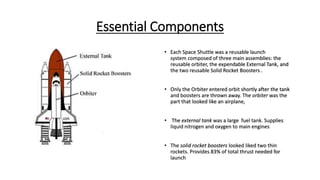
Essential Components
• Each Space Shuttle was a reusable launch
system composed of three main assemblies: the
reusable orbiter, the expendable External Tank, and
the two reusable Solid Rocket Boosters .
• Only the Orbiter entered orbit shortly after the tank
and boosters are thrown away. The orbiter was the
part that looked like an airplane,
• The external tank was a large fuel tank. Supplies
liquid nitrogen and oxygen to main engines
• The solid rocket boosters looked liked two thin
rockets. Provides 83% of total thrust needed for
launch
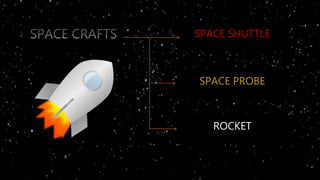
SPACE SHUTTLE
ROCKET
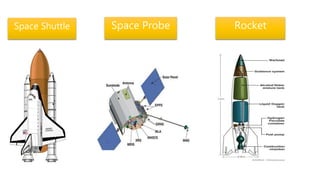
Space Shuttle Space Probe Rocket
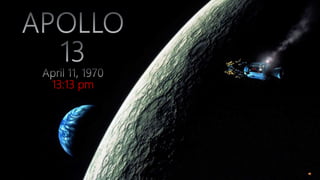
13:13 pm
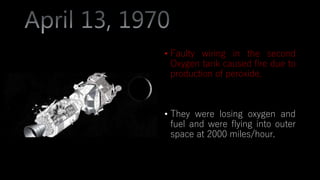
• Faulty wiring in the second
Oxygen tank caused fire due to
production of peroxide.
• They were losing oxygen and
fuel and were flying into outer
space at 2000 miles/hour.
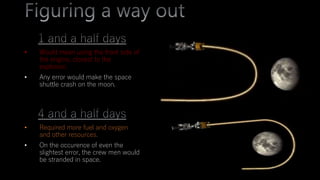
• Would mean using the front side of
the engine, closest to the
explosion.
• Any error would make the space
shuttle crash on the moon.
• Required more fuel and oxygen
and other resources.
• On the occurence of even the
slightest error, the crew men would
be stranded in space.
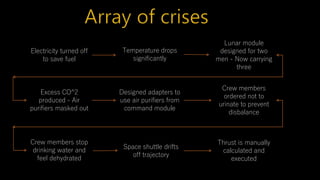
Electricity turned off
to save fuel
Temperature drops
significantly
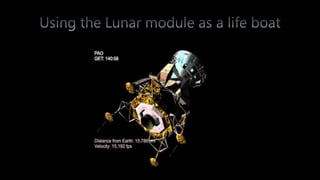
Lunar module
designed for two
men - Now carrying
three
Excess CO^2
produced - Air
purifiers masked out
Designed adapters to
use air purifiers from
command module
Crew members
ordered not to
urinate to prevent
disbalance
Crew members stop
drinking water and
feel dehydrated
Space shuttle drifts
off trajectory
Thrust is manually
calculated and
executed
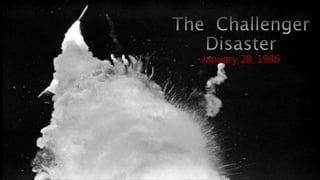
January 28, 1986
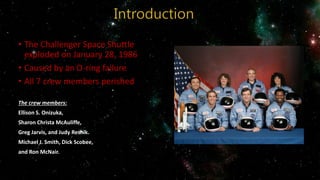
• The Challenger Space Shuttle
exploded on January 28, 1986
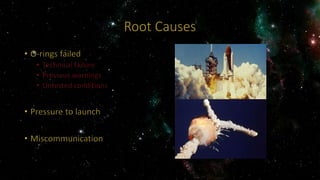
• Caused by an O-ring failure
• All 7 crew members perished
The crew members:
Ellison S. Onizuka,
Sharon Christa McAuliffe,
Greg Jarvis, and Judy Resnik.
Michael J. Smith, Dick Scobee,
and Ron McNair.
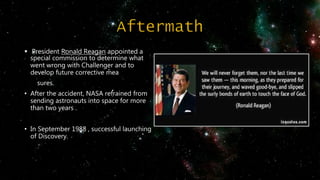
 President Ronald Reagan appointed a
special commission to determine what
went wrong with Challenger and to
develop future corrective mea
sures.
• After the accident, NASA refrained from
sending astronauts into space for more
than two years .
• In September 1988 , successful launching
of Discovery.
• Communication is key
• Only operate in tested conditions
• Safety over schedule.
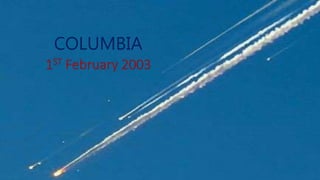
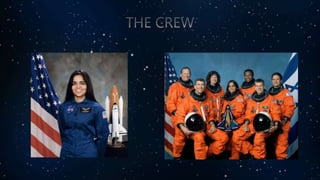
COLUMBIA
1ST February 2003
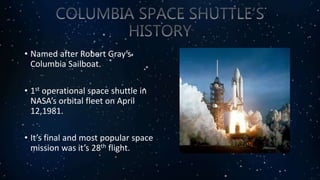
• Named after Robert Gray’s
Columbia Sailboat.
• 1st operational space shuttle in
NASA’s orbital fleet on April
12,1981.
• It’s final and most popular space
mission was it’s 28th flight.
1. 1ST February 2003.
2. STS-1:The operational orbiter.
3. About to reach the Earth within 16 minutes.
4.Control room of Florida’s Kennedy Space Center and 7 crew members
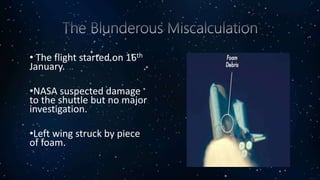
• The flight started on 16th
January.
•NASA suspected damage
to the shuttle but no major
investigation.
•Left wing struck by piece
of foam.
Future Of Space
Shuttles...
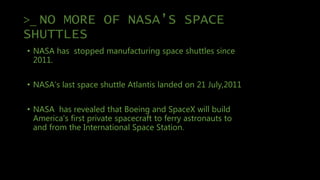
>_ NO MORE OF NASA’S SPACE
SHUTTLES
• NASA has stopped manufacturing space shuttles since
2011.
• NASA’s last space shuttle Atlantis landed on 21 July,2011
• NASA has revealed that Boeing and SpaceX will build
America's first private spacecraft to ferry astronauts to
and from the International Space Station.
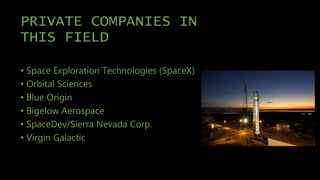
PRIVATE COMPANIES IN
THIS FIELD
• Space Exploration Technologies (SpaceX)
• Orbital Sciences
• Blue Origin
• Bigelow Aerospace
• SpaceDev/Sierra Nevada Corp.
• Virgin Galactic
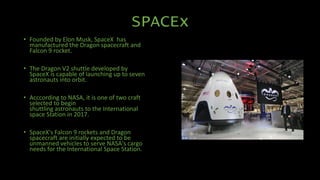
SPACEx
• Founded by Elon Musk, SpaceX has
manufactured the Dragon spacecraft and
Falcon 9 rocket.
• The Dragon V2 shuttle developed by
SpaceX is capable of launching up to seven
astronauts into orbit.
• Acccording to NASA, it is one of two craft
selected to begin
shuttling astronauts to the International
space Station in 2017.
• SpaceX's Falcon 9 rockets and Dragon
spacecraft are initially expected to be
unmanned vehicles to serve NASA's cargo
needs for the International Space Station.
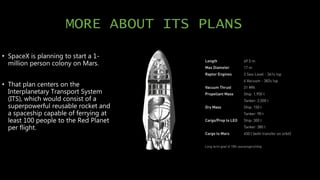
MORE ABOUT ITS PLANS
• SpaceX is planning to start a 1-
million person colony on Mars.
• That plan centers on the
Interplanetary Transport System
(ITS), which would consist of a
superpowerful reusable rocket and
a spaceship capable of ferrying at
least 100 people to the Red Planet
per flight.
Space shuttles and Disasters

Space shuttles and Disasters

  • 3.
    Essential Components • EachSpace Shuttle was a reusable launch system composed of three main assemblies: the reusable orbiter, the expendable External Tank, and the two reusable Solid Rocket Boosters . • Only the Orbiter entered orbit shortly after the tank and boosters are thrown away. The orbiter was the part that looked like an airplane, • The external tank was a large fuel tank. Supplies liquid nitrogen and oxygen to main engines • The solid rocket boosters looked liked two thin rockets. Provides 83% of total thrust needed for launch
  • 5.
  • 6.
    Space Shuttle SpaceProbe Rocket
  • 8.
  • 10.
    • Faulty wiringin the second Oxygen tank caused fire due to production of peroxide. • They were losing oxygen and fuel and were flying into outer space at 2000 miles/hour.
  • 13.
    • Would meanusing the front side of the engine, closest to the explosion. • Any error would make the space shuttle crash on the moon. • Required more fuel and oxygen and other resources. • On the occurence of even the slightest error, the crew men would be stranded in space.
  • 14.
    Electricity turned off tosave fuel Temperature drops significantly Lunar module designed for two men - Now carrying three Excess CO^2 produced - Air purifiers masked out Designed adapters to use air purifiers from command module Crew members ordered not to urinate to prevent disbalance Crew members stop drinking water and feel dehydrated Space shuttle drifts off trajectory Thrust is manually calculated and executed
  • 16.
  • 17.
    • The ChallengerSpace Shuttle exploded on January 28, 1986 • Caused by an O-ring failure • All 7 crew members perished The crew members: Ellison S. Onizuka, Sharon Christa McAuliffe, Greg Jarvis, and Judy Resnik. Michael J. Smith, Dick Scobee, and Ron McNair.
  • 19.
     President RonaldReagan appointed a special commission to determine what went wrong with Challenger and to develop future corrective mea sures. • After the accident, NASA refrained from sending astronauts into space for more than two years . • In September 1988 , successful launching of Discovery.
  • 20.
    • Communication iskey • Only operate in tested conditions • Safety over schedule.
  • 21.
  • 22.
    • Named afterRobert Gray’s Columbia Sailboat. • 1st operational space shuttle in NASA’s orbital fleet on April 12,1981. • It’s final and most popular space mission was it’s 28th flight.
  • 23.
    1. 1ST February2003. 2. STS-1:The operational orbiter. 3. About to reach the Earth within 16 minutes. 4.Control room of Florida’s Kennedy Space Center and 7 crew members
  • 25.
    • The flightstarted on 16th January. •NASA suspected damage to the shuttle but no major investigation. •Left wing struck by piece of foam.
  • 26.
  • 27.
    >_ NO MOREOF NASA’S SPACE SHUTTLES • NASA has stopped manufacturing space shuttles since 2011. • NASA’s last space shuttle Atlantis landed on 21 July,2011 • NASA has revealed that Boeing and SpaceX will build America's first private spacecraft to ferry astronauts to and from the International Space Station.
  • 28.
    PRIVATE COMPANIES IN THISFIELD • Space Exploration Technologies (SpaceX) • Orbital Sciences • Blue Origin • Bigelow Aerospace • SpaceDev/Sierra Nevada Corp. • Virgin Galactic
  • 29.
    SPACEx • Founded byElon Musk, SpaceX has manufactured the Dragon spacecraft and Falcon 9 rocket. • The Dragon V2 shuttle developed by SpaceX is capable of launching up to seven astronauts into orbit. • Acccording to NASA, it is one of two craft selected to begin shuttling astronauts to the International space Station in 2017. • SpaceX's Falcon 9 rockets and Dragon spacecraft are initially expected to be unmanned vehicles to serve NASA's cargo needs for the International Space Station.
  • 30.
    MORE ABOUT ITSPLANS • SpaceX is planning to start a 1- million person colony on Mars. • That plan centers on the Interplanetary Transport System (ITS), which would consist of a superpowerful reusable rocket and a spaceship capable of ferrying at least 100 people to the Red Planet per flight.