ORGANISING PAIR WORK
AND GROUP WORK
Prepared by:
Anhaw, Marie Joy M.
Making it work
I like/don’t like working on my own because…………………………………
………………………………………………………………………………………….
I like/don’t like working in pairs because………………………………………
………………………………………………………………………………………….
I like/don’t like speaking in front of the class because………….................
………………………………………………………………………………………....
Creating pairs and groups
1. Friendship: a key consideration when putting
students in pairs or groups. This is to make sure that
we put friends with friends, rather than risking the
possibility of people working with others whom they
find difficult or unpleasant.
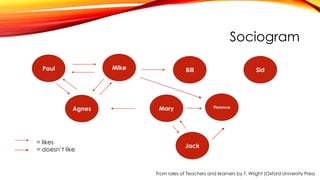
Sociogram
Paul Mike
Agnes
Bill
Mary
Sid
Florence
Jack
= likes
= doesn’t like
From roles of Teachers and learners by T. Wright (Oxford University Press
Creating pairs and groups
2. Streaming. Students are grouped according to their
ability. A group should have a mixture of weaker and
stronger students.
Apart from streaming groups by ability, teachers can also
decide to stream on the basis of participation.
Creating pairs and groups
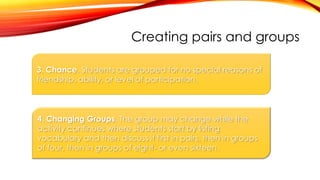
3. Chance. Students are grouped for no special reasons of
friendship, ability, or level of participation.
4. Changing Groups. The group may change while the
activity continues where students start by listing
vocabulary and then discuss it first in pairs, then in groups
of four, then in groups of eight- or even sixteen.
Success of pairwork and groupwork
The success of pairwork or groupwork task is often
helped by giving students a time when the
activity should finish – and then sticking to it. This
helps to give them a clear framework to work
within.
Success of pairwork and groupwork
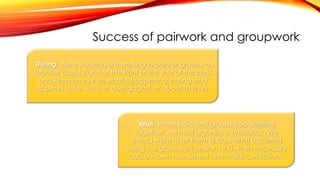
During. While students are working in pairs or groups, a
teacher could stand at the front or the side of the class
and keep an eye on what is happening, noting who
appears to be stuck or disengaged, or about to finish.
After. When pairs and groups stop working
together, we must organize a feedback. We
should want to let them discuss what occurred
during the groupwork session and when necessary,
add our own assessment and make corrections.
Troubleshooting
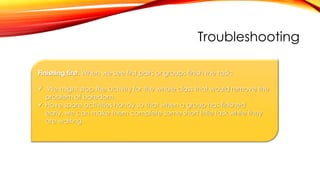
Finishing first. When we see first pairs or groups finish the task:
 We might stop the activity for the whole class that would remove the
problem of boredom.
 Have spare activities handy so that when a group has finished
early, we can make them complete some short little task while they
are waiting.
Troubleshooting
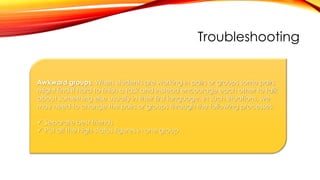
Awkward groups. When students are working in pairs or groups some pairs
might find it hard to finish a task and instead encourage each other to talk
about something else usually in their first language. In such situations, we
may need to change the pairs or groups through the following processes:
 Separate best friends
 Put all the high-status figures in one group

Organizing Pairwork and Groupwork

  • 1.
    ORGANISING PAIR WORK ANDGROUP WORK Prepared by: Anhaw, Marie Joy M.
  • 2.
    Making it work Ilike/don’t like working on my own because………………………………… …………………………………………………………………………………………. I like/don’t like working in pairs because……………………………………… …………………………………………………………………………………………. I like/don’t like speaking in front of the class because…………................. ………………………………………………………………………………………....
  • 3.
    Creating pairs andgroups 1. Friendship: a key consideration when putting students in pairs or groups. This is to make sure that we put friends with friends, rather than risking the possibility of people working with others whom they find difficult or unpleasant.
  • 4.
    Sociogram Paul Mike Agnes Bill Mary Sid Florence Jack = likes =doesn’t like From roles of Teachers and learners by T. Wright (Oxford University Press
  • 5.
    Creating pairs andgroups 2. Streaming. Students are grouped according to their ability. A group should have a mixture of weaker and stronger students. Apart from streaming groups by ability, teachers can also decide to stream on the basis of participation.
  • 6.
    Creating pairs andgroups 3. Chance. Students are grouped for no special reasons of friendship, ability, or level of participation. 4. Changing Groups. The group may change while the activity continues where students start by listing vocabulary and then discuss it first in pairs, then in groups of four, then in groups of eight- or even sixteen.
  • 7.
    Success of pairworkand groupwork The success of pairwork or groupwork task is often helped by giving students a time when the activity should finish – and then sticking to it. This helps to give them a clear framework to work within.
  • 8.
    Success of pairworkand groupwork During. While students are working in pairs or groups, a teacher could stand at the front or the side of the class and keep an eye on what is happening, noting who appears to be stuck or disengaged, or about to finish. After. When pairs and groups stop working together, we must organize a feedback. We should want to let them discuss what occurred during the groupwork session and when necessary, add our own assessment and make corrections.
  • 9.
    Troubleshooting Finishing first. Whenwe see first pairs or groups finish the task:  We might stop the activity for the whole class that would remove the problem of boredom.  Have spare activities handy so that when a group has finished early, we can make them complete some short little task while they are waiting.
  • 10.
    Troubleshooting Awkward groups. Whenstudents are working in pairs or groups some pairs might find it hard to finish a task and instead encourage each other to talk about something else usually in their first language. In such situations, we may need to change the pairs or groups through the following processes:  Separate best friends  Put all the high-status figures in one group