ESP: Approach not Product
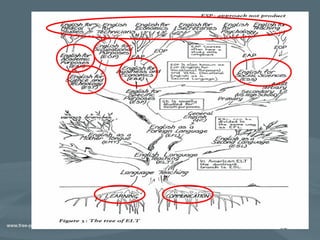
What is ESP?
…establish a context which will help us to see how
ESP at the present time relates to the rest of the
ELT.
What ESP is not…
a. ESP is not a matter of teaching ‘specialised varieties’ of English.
b. ESP is not a mater of Science words and grammar for Scientists, Hotel
words, and grammar for Hotel staff and so on.
c. ESP is not different in kind from any other form of language teaching,
in that it should be based in the first instance on principles of effective
and efficient listening .
So what is ESP?
ESP is an approach to language teaching in which all decisions as to
content and method are based on the learners reason for learning.
Course Design
What does it mean?
…Design of a course? O.o
-much of the work done by ESP teachers is
concerned with designing appropriate courses for
various groups of learners.
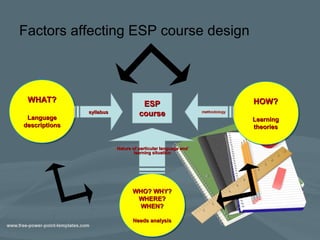
Factors affecting ESP course design
WHAT?WHAT?
LanguageLanguage
descriptionsdescriptions
WHAT?WHAT?
LanguageLanguage
descriptionsdescriptions
WHO? WHY?WHO? WHY?
WHERE?WHERE?
WHEN?WHEN?
Needs analysisNeeds analysis
WHO? WHY?WHO? WHY?
WHERE?WHERE?
WHEN?WHEN?
Needs analysisNeeds analysis
HOW?HOW?
LearningLearning
theoriestheories
HOW?HOW?
LearningLearning
theoriestheories
ESPESP
coursecoursesyllabussyllabus
Nature of particular language andNature of particular language and
learning situationlearning situation
Language Description
1.1. Classical or traditional grammarClassical or traditional grammar
-grammars of the classical languages,
Greek and Latin
Language Description
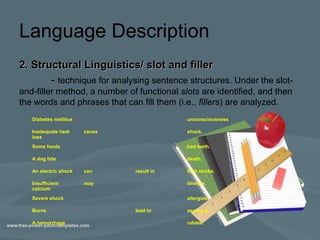
2. Structural Linguistics/ slot and filler2. Structural Linguistics/ slot and filler
- technique for analysing sentence structures. Under the slot-
and-filler method, a number of functional slots are identified, and then
the words and phrases that can fill them (i.e., fillers) are analyzed.
Diabetes mellitus unconsciousness
Inadequate heat
loss
cause shock.
Some foods bad teeth.
A dog bite death.
An electric shock can result in heat stroke.
Insufficient
calcium
may blisters.
Severe shock allergies.
Burns lead to asphyxia.
A hemorrhage rabies.
Language Description
3. Transformational Generative (TG) grammar
- an approach to the study of syntax, especially of a
natural language, that has been developed in the
Chomskyan tradition of phrase structure grammars.
Additionally, transformational grammar is the tradition that
gives rise to specific transformational grammars.
Transformational Generative (TG) grammar
2 levels of meaning:
1. Deep level- concerned with the organization of thoughts
2. Surface level- thoughts are expressed through the syntax of the
language
Performance (surface structures) vs.Performance (surface structures) vs.
Competence (deep level rules)Competence (deep level rules)
Language Description
4. Language variation and register analysis4. Language variation and register analysis
- language varies according to the
context of use that enables us to distinguish
formal from informal, written from spoken,
self-sufficient language from context-
dependent.
Language Description
5. Functional/Notional Grammar5. Functional/Notional Grammar
Functional-concerned with social
behaviour and represents the intention of
the speaker or writer
Notions –reflect the way the human mind
thinks.
Language Description
6. Discourse (Rhetorical) analysis6. Discourse (Rhetorical) analysis
- looking at how meaning is generated
between sentences.
Can I go out to play?
It’s raining.
Have you cut the grass yet?
It’s raining.
I think I’ll go out for a walk.
It’s raining.
Advice or mild warning
Refusal of a request
Reason for an excuse
Theories of Learning
Second language learning should reflect and
imitate the perceived processes of mother
tongue learning
-Never translate.
-New language should always be dealt with in the
sequence: hear, speak, read, write.
-Frequent repetition is essential to effective learning.
-All errors must be immediately corrected.
1. Behaviourism: learning as habit formation1. Behaviourism: learning as habit formation
2. Mentalism: thinking as rule-governed activity2. Mentalism: thinking as rule-governed activity
Learning consists not of forming habits but
of acquiring rules – a process in which
individual experiences are used by the
mind to formulate a hypothesis.
3. Cognitive code: learners as thinking beings3. Cognitive code: learners as thinking beings
takes the learner to be an active
processor of information
We (learners) learn by thinking about and
trying to make sense of what we see, feel,
and hear.
4. The affective factor: learners emotional beings4. The affective factor: learners emotional beings
the learners will learn easily when he or
she is actively thinking about of what they
are learning.
5. Learning and acquisition
• The conscious and subconscious way of
leaning.

English for Specific Purposes

  • 1.
  • 2.
    What is ESP? …establisha context which will help us to see how ESP at the present time relates to the rest of the ELT.
  • 4.
    What ESP isnot… a. ESP is not a matter of teaching ‘specialised varieties’ of English. b. ESP is not a mater of Science words and grammar for Scientists, Hotel words, and grammar for Hotel staff and so on. c. ESP is not different in kind from any other form of language teaching, in that it should be based in the first instance on principles of effective and efficient listening .
  • 5.
    So what isESP? ESP is an approach to language teaching in which all decisions as to content and method are based on the learners reason for learning.
  • 6.
    Course Design What doesit mean? …Design of a course? O.o -much of the work done by ESP teachers is concerned with designing appropriate courses for various groups of learners.
  • 7.
    Factors affecting ESPcourse design WHAT?WHAT? LanguageLanguage descriptionsdescriptions WHAT?WHAT? LanguageLanguage descriptionsdescriptions WHO? WHY?WHO? WHY? WHERE?WHERE? WHEN?WHEN? Needs analysisNeeds analysis WHO? WHY?WHO? WHY? WHERE?WHERE? WHEN?WHEN? Needs analysisNeeds analysis HOW?HOW? LearningLearning theoriestheories HOW?HOW? LearningLearning theoriestheories ESPESP coursecoursesyllabussyllabus Nature of particular language andNature of particular language and learning situationlearning situation
  • 8.
    Language Description 1.1. Classicalor traditional grammarClassical or traditional grammar -grammars of the classical languages, Greek and Latin
  • 9.
    Language Description 2. StructuralLinguistics/ slot and filler2. Structural Linguistics/ slot and filler - technique for analysing sentence structures. Under the slot- and-filler method, a number of functional slots are identified, and then the words and phrases that can fill them (i.e., fillers) are analyzed. Diabetes mellitus unconsciousness Inadequate heat loss cause shock. Some foods bad teeth. A dog bite death. An electric shock can result in heat stroke. Insufficient calcium may blisters. Severe shock allergies. Burns lead to asphyxia. A hemorrhage rabies.
  • 10.
    Language Description 3. TransformationalGenerative (TG) grammar - an approach to the study of syntax, especially of a natural language, that has been developed in the Chomskyan tradition of phrase structure grammars. Additionally, transformational grammar is the tradition that gives rise to specific transformational grammars.
  • 11.
    Transformational Generative (TG)grammar 2 levels of meaning: 1. Deep level- concerned with the organization of thoughts 2. Surface level- thoughts are expressed through the syntax of the language Performance (surface structures) vs.Performance (surface structures) vs. Competence (deep level rules)Competence (deep level rules)
  • 12.
    Language Description 4. Languagevariation and register analysis4. Language variation and register analysis - language varies according to the context of use that enables us to distinguish formal from informal, written from spoken, self-sufficient language from context- dependent.
  • 13.
    Language Description 5. Functional/NotionalGrammar5. Functional/Notional Grammar Functional-concerned with social behaviour and represents the intention of the speaker or writer Notions –reflect the way the human mind thinks.
  • 14.
    Language Description 6. Discourse(Rhetorical) analysis6. Discourse (Rhetorical) analysis - looking at how meaning is generated between sentences. Can I go out to play? It’s raining. Have you cut the grass yet? It’s raining. I think I’ll go out for a walk. It’s raining. Advice or mild warning Refusal of a request Reason for an excuse
  • 15.
  • 16.
    Second language learningshould reflect and imitate the perceived processes of mother tongue learning -Never translate. -New language should always be dealt with in the sequence: hear, speak, read, write. -Frequent repetition is essential to effective learning. -All errors must be immediately corrected. 1. Behaviourism: learning as habit formation1. Behaviourism: learning as habit formation
  • 17.
    2. Mentalism: thinkingas rule-governed activity2. Mentalism: thinking as rule-governed activity Learning consists not of forming habits but of acquiring rules – a process in which individual experiences are used by the mind to formulate a hypothesis.
  • 18.
    3. Cognitive code:learners as thinking beings3. Cognitive code: learners as thinking beings takes the learner to be an active processor of information We (learners) learn by thinking about and trying to make sense of what we see, feel, and hear.
  • 19.
    4. The affectivefactor: learners emotional beings4. The affective factor: learners emotional beings the learners will learn easily when he or she is actively thinking about of what they are learning.
  • 20.
    5. Learning andacquisition • The conscious and subconscious way of leaning.