



Is your life in disarray??


Do you have trouble finding things?


Do you constantly forget stuff??
Organize
Organizing and Controlling
What is the relationship between
       organizing and controlling?

 M A N A G E M E N T F U N C T I O N “ O RG A N I Z I N G ” I S
                  I M P L E M E N TAT I O N
WHICH MEANS THE OPTIMUM USE RESOURCES
            FOR ACHIEVING THE AIMS.

 M A N A G E M E N T F U N C T I O N “ C O N T RO L L I N G ” O R
M O N I TO R I N G M E A N S C H E C K I N G T H E P R O G R E S S
    O F AC H I E V I N G O B J E C T I V E S A N D G I V I N G
                         F E E D B AC K .
What is organizing?

     IS THE FUNCTION OF
MANAGEMENT WHICH FOLLOWS
PLANNING . IT IS A FUNCTION IN
WHICH THE SYNCHRONIZATION
 AND COMBINATION OF HUMAN,
   PHYSICAL AND FINANCIAL
   RESOURCES TAKES PLACE .
Why organizing is next to
       planning?

BECAUSE ONCE THE PLAN
   IS MADE, THE NEXT
 NATURAL STEP IN THE
PROGRESSION IS TO GET
ORGANIZED SO THE PLAN
  COMES TO FRUITION.
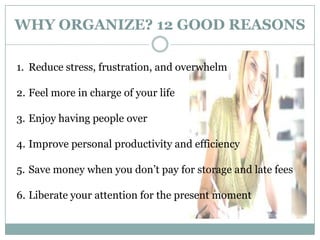
WHY ORGANIZE? 12 GOOD REASONS

1. Reduce stress, frustration, and overwhelm

2. Feel more in charge of your life

3. Enjoy having people over

4. Improve personal productivity and efficiency

5. Save money when you don’t pay for storage and late fees

6. Liberate your attention for the present moment
WHY ORGANIZE? 12 GOOD REASONS

7. Improve your credibility with those who count on you

8. Gain self-confidence from accomplishing your goals

9. Feel more ease and pleasure where you work

10. Project a better image to colleagues, clients, and friends

11. Create more free time

12. Think more clearly, improve your focus.
A manager performs organizing
    function with the help of following
                  steps:-

1. IDENTIFICATION OF ACTIVITIES - ALL THE ACTIVITIES
   WHICH HAVE TO BE PERFORMED IN A CONCERN HAVE TO
   BE IDENTIFIED FIRST.
2. DEPARTMENTALLY ORGANIZING THE ACTIVITIES , THE
   MANAGERS TRIES TO COMBINE THE GROUP SIMILAR AND
   RELATED ACTIVITIES INTO UNITS OR DEPARTMENTS.
3. CLASSIFYING THE AUTHORITY- THE MANAGER LIKES TO
   CLASSIFY THE POWERS AND ITS EXTENT TO THE
   MANAGER.
4. CO-ORDINATION BETWEEN AUTHORITY AND
   RESPONSIBILITY- EACH INDIVIDUAL IS MADE AWARE OF
   THIS AUTHORITY AND HE/SHE KNOWS WHOM THEY HAVE
   TO TAKE ORDERS FROM AND TO WHOM THEY ARE
   ACCOUNTABLE, AND TO WHOM THEY HAVE TO REPORT.
Importance of organizing

• DEFINES AUTHORITY AND RESPONSIBILITY

• NO OVER-LAPPING OF RESPONSIBILITIES

• RIGHT PERSON FOR RIGHT JOB PERSON FOR
               RIGHT JOB

• HARMONY OF WORK

• PROVISION OF TRAINING FACILITIES

• EFFECTIVE COMMUNICATION
What is controlling?

  CONSISTS OF VERIFYING
  WHETHER EVERYTHING
 OCCURS IN CONFORMITIES
WITH THE PLANS ADOPTED,
INSTRUCTIONS ISSUED AND
 PRINCIPLES ESTABLISHE D
Characteristics of controlling
       function of management-

1.CONTROLLING IS AN END FUNCTION - A FUNCTION WHICH
     COMES ONCE THE PERFORMANCES ARE MADE IN
       CONFORMITIES WITH PLANS.

2 . C O N T R O L L I N G I S A P E R VA S I V E F U N C T I O N - W H I C H
      M E A N S I T I S P E R F O R M E D B Y M A N A G E R S AT A L L L E V E L S
          AND IN ALL TYPE OF CONCERNS.

3. CONTROLLING IS FORWARD LOOKING - BECAUSE
     E F F E C T I V E C O N T R O L I S N O T P O S S I B L E W I T H O U T PA S T
     B E I N G C O N T R O L L E D . C O N T R O L L I N G A L W AY S L O O K T O
     F U T U R E S O T H AT F O L L O W - U P C A N B E M A D E
     WHENEVER REQUIRED.
4.. Controlling is a dynamic process- since
    controlling requires taking reviewed methods,
    changes have to be made wherever possible.

5. Controlling is related with planning-
    Planning and Controlling are two inseparable
    functions of management. Without planning,
    controlling is a meaningless exercise and
    without controlling, planning is useless.
Importance of controlling

• CONTROLLING HEL PS IN ACHIEVING GOAL S AND
       OBJECTIVES

• R E S O U R C E S A R E U S E D E F F I C I E N T LY

• C O N T R O L H E L P S I N D E C E N T R A L I Z AT I O N .

• H I G H M O R A L S O F E M P L OY E E S

• APPL I ED TO AL L M ANAG ERIAL F U N CTI ONS

• H E L P S I N L A R G E S C A L E O R G A N I Z AT I O N S
BEFORE
AFTER
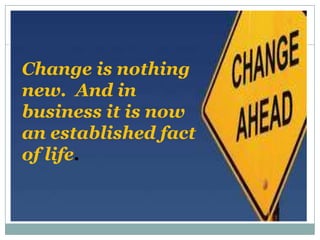
Change is nothing
new. And in
business it is now
an established fact
of life.
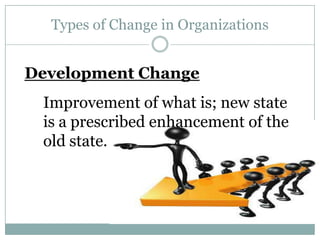
Types of Change in Organizations


Development Change
 Improvement of what is; new state
 is a prescribed enhancement of the
 old state.
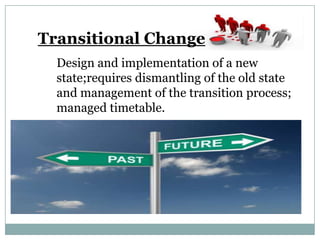
Transitional Change
  Design and implementation of a new
  state;requires dismantling of the old state
  and management of the transition process;
  managed timetable.
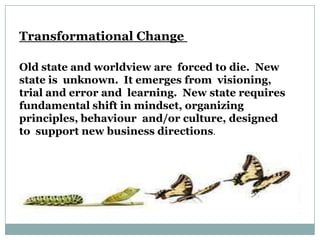
Transformational Change

Old state and worldview are forced to die. New
state is unknown. It emerges from visioning,
trial and error and learning. New state requires
fundamental shift in mindset, organizing
principles, behaviour and/or culture, designed
to support new business directions.
Change in an organization is managed by an
individual or a group of individuals. A
proper planning and execution process is
necessary for effective change.


This requires careful planning,
evaluation and implementation
to bring about the desired
change.
Organizational Change Challenges
       (Elements of change)


 Vision- This is the power to perceive and
 articulate change beyond the surface level.


 Sense of purpose and direction- The
 business should have clear objectives
 that match the vision.
Knowledge- Knowledge is the skills and
experience to create organizational strategies
and to implement them accordingly.


Rewards and recognition- Companies
must reward individuals who excel
and overcome organizational change
challenges
Steps to be followed systematically for change to occur.


1. Discussing and reaching agreement
for the on going support of the
company's direction and initiatives
2. Linking strategic initiatives to tactful
execution through planning and on going
communication.
3. Connecting and aligning
performance management,
training processes and incentive
compensation in order to yield
optimal results.

4. Emphasizing hiring, rewarding,
developing and retaining the top
talent as a key driver of sustained
business growth.
Thank You!!!
Organizing and controlling

Organizing and controlling

  • 1.
    Is your lifein disarray?? Do you have trouble finding things? Do you constantly forget stuff??
  • 3.
  • 4.
  • 5.
    What is therelationship between organizing and controlling? M A N A G E M E N T F U N C T I O N “ O RG A N I Z I N G ” I S I M P L E M E N TAT I O N WHICH MEANS THE OPTIMUM USE RESOURCES FOR ACHIEVING THE AIMS. M A N A G E M E N T F U N C T I O N “ C O N T RO L L I N G ” O R M O N I TO R I N G M E A N S C H E C K I N G T H E P R O G R E S S O F AC H I E V I N G O B J E C T I V E S A N D G I V I N G F E E D B AC K .
  • 6.
    What is organizing? IS THE FUNCTION OF MANAGEMENT WHICH FOLLOWS PLANNING . IT IS A FUNCTION IN WHICH THE SYNCHRONIZATION AND COMBINATION OF HUMAN, PHYSICAL AND FINANCIAL RESOURCES TAKES PLACE .
  • 7.
    Why organizing isnext to planning? BECAUSE ONCE THE PLAN IS MADE, THE NEXT NATURAL STEP IN THE PROGRESSION IS TO GET ORGANIZED SO THE PLAN COMES TO FRUITION.
  • 8.
    WHY ORGANIZE? 12GOOD REASONS 1. Reduce stress, frustration, and overwhelm 2. Feel more in charge of your life 3. Enjoy having people over 4. Improve personal productivity and efficiency 5. Save money when you don’t pay for storage and late fees 6. Liberate your attention for the present moment
  • 9.
    WHY ORGANIZE? 12GOOD REASONS 7. Improve your credibility with those who count on you 8. Gain self-confidence from accomplishing your goals 9. Feel more ease and pleasure where you work 10. Project a better image to colleagues, clients, and friends 11. Create more free time 12. Think more clearly, improve your focus.
  • 10.
    A manager performsorganizing function with the help of following steps:- 1. IDENTIFICATION OF ACTIVITIES - ALL THE ACTIVITIES WHICH HAVE TO BE PERFORMED IN A CONCERN HAVE TO BE IDENTIFIED FIRST. 2. DEPARTMENTALLY ORGANIZING THE ACTIVITIES , THE MANAGERS TRIES TO COMBINE THE GROUP SIMILAR AND RELATED ACTIVITIES INTO UNITS OR DEPARTMENTS. 3. CLASSIFYING THE AUTHORITY- THE MANAGER LIKES TO CLASSIFY THE POWERS AND ITS EXTENT TO THE MANAGER. 4. CO-ORDINATION BETWEEN AUTHORITY AND RESPONSIBILITY- EACH INDIVIDUAL IS MADE AWARE OF THIS AUTHORITY AND HE/SHE KNOWS WHOM THEY HAVE TO TAKE ORDERS FROM AND TO WHOM THEY ARE ACCOUNTABLE, AND TO WHOM THEY HAVE TO REPORT.
  • 11.
    Importance of organizing •DEFINES AUTHORITY AND RESPONSIBILITY • NO OVER-LAPPING OF RESPONSIBILITIES • RIGHT PERSON FOR RIGHT JOB PERSON FOR RIGHT JOB • HARMONY OF WORK • PROVISION OF TRAINING FACILITIES • EFFECTIVE COMMUNICATION
  • 12.
    What is controlling? CONSISTS OF VERIFYING WHETHER EVERYTHING OCCURS IN CONFORMITIES WITH THE PLANS ADOPTED, INSTRUCTIONS ISSUED AND PRINCIPLES ESTABLISHE D
  • 13.
    Characteristics of controlling function of management- 1.CONTROLLING IS AN END FUNCTION - A FUNCTION WHICH COMES ONCE THE PERFORMANCES ARE MADE IN CONFORMITIES WITH PLANS. 2 . C O N T R O L L I N G I S A P E R VA S I V E F U N C T I O N - W H I C H M E A N S I T I S P E R F O R M E D B Y M A N A G E R S AT A L L L E V E L S AND IN ALL TYPE OF CONCERNS. 3. CONTROLLING IS FORWARD LOOKING - BECAUSE E F F E C T I V E C O N T R O L I S N O T P O S S I B L E W I T H O U T PA S T B E I N G C O N T R O L L E D . C O N T R O L L I N G A L W AY S L O O K T O F U T U R E S O T H AT F O L L O W - U P C A N B E M A D E WHENEVER REQUIRED.
  • 14.
    4.. Controlling isa dynamic process- since controlling requires taking reviewed methods, changes have to be made wherever possible. 5. Controlling is related with planning- Planning and Controlling are two inseparable functions of management. Without planning, controlling is a meaningless exercise and without controlling, planning is useless.
  • 15.
    Importance of controlling •CONTROLLING HEL PS IN ACHIEVING GOAL S AND OBJECTIVES • R E S O U R C E S A R E U S E D E F F I C I E N T LY • C O N T R O L H E L P S I N D E C E N T R A L I Z AT I O N . • H I G H M O R A L S O F E M P L OY E E S • APPL I ED TO AL L M ANAG ERIAL F U N CTI ONS • H E L P S I N L A R G E S C A L E O R G A N I Z AT I O N S
  • 16.
  • 17.
  • 19.
    Change is nothing new.And in business it is now an established fact of life.
  • 20.
    Types of Changein Organizations Development Change Improvement of what is; new state is a prescribed enhancement of the old state.
  • 21.
    Transitional Change Design and implementation of a new state;requires dismantling of the old state and management of the transition process; managed timetable.
  • 22.
    Transformational Change Old stateand worldview are forced to die. New state is unknown. It emerges from visioning, trial and error and learning. New state requires fundamental shift in mindset, organizing principles, behaviour and/or culture, designed to support new business directions.
  • 24.
    Change in anorganization is managed by an individual or a group of individuals. A proper planning and execution process is necessary for effective change. This requires careful planning, evaluation and implementation to bring about the desired change.
  • 25.
    Organizational Change Challenges (Elements of change) Vision- This is the power to perceive and articulate change beyond the surface level. Sense of purpose and direction- The business should have clear objectives that match the vision.
  • 26.
    Knowledge- Knowledge isthe skills and experience to create organizational strategies and to implement them accordingly. Rewards and recognition- Companies must reward individuals who excel and overcome organizational change challenges
  • 27.
    Steps to befollowed systematically for change to occur. 1. Discussing and reaching agreement for the on going support of the company's direction and initiatives 2. Linking strategic initiatives to tactful execution through planning and on going communication.
  • 28.
    3. Connecting andaligning performance management, training processes and incentive compensation in order to yield optimal results. 4. Emphasizing hiring, rewarding, developing and retaining the top talent as a key driver of sustained business growth.
  • 29.