

ORGANIZATIONAL LEARNING
THEORY
Hamideh Iraj
Sahar Najafikhah
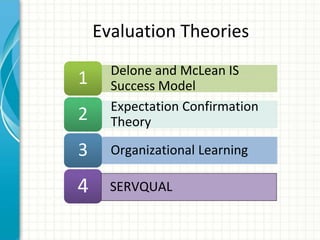
Delone and McLean IS
Success Model1
Expectation Confirmation
Theory2
Organizational Learning3
4
Evaluation Theories
SERVQUAL
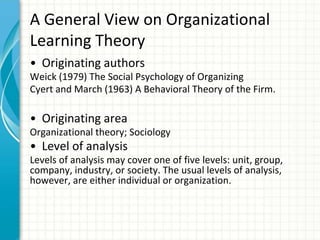
A General View on Organizational
Learning Theory
• Originating authors
Weick (1979) The Social Psychology of Organizing
Cyert and March (1963) A Behavioral Theory of the Firm.
• Originating area
Organizational theory; Sociology
• Level of analysis
Levels of analysis may cover one of five levels: unit, group,
company, industry, or society. The usual levels of analysis,
however, are either individual or organization.
The Theory
History
1960s
The theory emerged from
organizational theory and social
psychology
1970s
gained in popularity with
management researchers
following the work of Argyris and
Schon(1978)
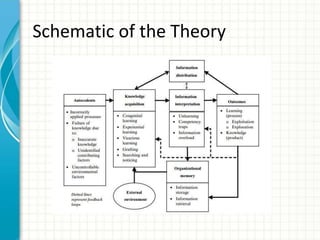
Schematic of the Theory
When OL takes place?
when the organization
(1) adds to its knowledge base or pool of potential
alternatives but does not change current
actions/processes,
(2) alters current actions to correct errors, but does so
blindly, without conscious attempts to understand or
modify the action–outcome relationship
(3) may exhibit both characteristics.
learning is a continuum, with most organizations
falling somewhere between the two extremes.
Antecedents
The concept of Reference Gap
The need to resolve an error between organizational
expectations and actual outcomes.
Incorrectly Applied Processes
Failure of knowledge due to:
• Inaccurate knowledge
• Unidentified contributing factors
Uncontrollable environmental factors
THEORY CONSTRUCTS
Theory Constructs
Knowledge Acquisition:
the organization scans both the internal and
external environment and seeks valid data and
processes
Information Distribution:
1. The likelihood that a subgroup needing
information and another subgroup possessing
that information "find each other"
2. The speed with which the match up occurs.
Theory Constructs cont.
Interpretation:
when the organization attempts to expand current
knowledge, adapt/alter current processes or detect current
or potential misfits between the organization and
environment
Outcomes:
knowledge outcomes or commercial/performance
outcomes together comprise a measure of organizational
performance.
measured by operational efficiency and performance,
spread of technology or increased competitive knowledge
Theory Constructs cont.
Organizational Memory:
The ability of the organization to encode, store and retrieve
information from past experience is created by and helps
create Organizational Learning.
RELATIONSHIP TO
OTHER MODELS
Comparison of Organizational
Learning and Absorptive Capacity
Both deal with information and learning
● OL tends to focus on environmental characteristics as
moderating known relationships
● ACAP focuses on internal characteristics
★ OL describes how an organization learns
★ ACAP examines how well an organization learns and
why it learns
OL is considered one of the necessary antecedents of
ACAP
Comparison of Organizational
Learning and Absorptive Capacity -
cont.
➔ The OL model operates at a macro level -organization
level
➔ The ACAP model operates at a micro level -detailed
explanations of learning process
Resources
1. Integrated Series in Information Systems, Volume 29, Information Systems Theory Explaining
and Predicting Our Digital Society, Vol. 2, Springer; 2012 edition
2. http://istheory.byu.edu/wiki/Organizational_learning_theory
THANK YOU FOR YOUR ATTENTION

Organizational learning - English

  • 1.
  • 2.
    Delone and McLeanIS Success Model1 Expectation Confirmation Theory2 Organizational Learning3 4 Evaluation Theories SERVQUAL
  • 3.
    A General Viewon Organizational Learning Theory • Originating authors Weick (1979) The Social Psychology of Organizing Cyert and March (1963) A Behavioral Theory of the Firm. • Originating area Organizational theory; Sociology • Level of analysis Levels of analysis may cover one of five levels: unit, group, company, industry, or society. The usual levels of analysis, however, are either individual or organization.
  • 4.
  • 5.
    1960s The theory emergedfrom organizational theory and social psychology
  • 6.
    1970s gained in popularitywith management researchers following the work of Argyris and Schon(1978)
  • 8.
  • 9.
    When OL takesplace? when the organization (1) adds to its knowledge base or pool of potential alternatives but does not change current actions/processes, (2) alters current actions to correct errors, but does so blindly, without conscious attempts to understand or modify the action–outcome relationship (3) may exhibit both characteristics. learning is a continuum, with most organizations falling somewhere between the two extremes.
  • 10.
    Antecedents The concept ofReference Gap The need to resolve an error between organizational expectations and actual outcomes. Incorrectly Applied Processes Failure of knowledge due to: • Inaccurate knowledge • Unidentified contributing factors Uncontrollable environmental factors
  • 11.
  • 12.
    Theory Constructs Knowledge Acquisition: theorganization scans both the internal and external environment and seeks valid data and processes Information Distribution: 1. The likelihood that a subgroup needing information and another subgroup possessing that information "find each other" 2. The speed with which the match up occurs.
  • 13.
    Theory Constructs cont. Interpretation: whenthe organization attempts to expand current knowledge, adapt/alter current processes or detect current or potential misfits between the organization and environment Outcomes: knowledge outcomes or commercial/performance outcomes together comprise a measure of organizational performance. measured by operational efficiency and performance, spread of technology or increased competitive knowledge
  • 14.
    Theory Constructs cont. OrganizationalMemory: The ability of the organization to encode, store and retrieve information from past experience is created by and helps create Organizational Learning.
  • 15.
  • 16.
    Comparison of Organizational Learningand Absorptive Capacity Both deal with information and learning ● OL tends to focus on environmental characteristics as moderating known relationships ● ACAP focuses on internal characteristics ★ OL describes how an organization learns ★ ACAP examines how well an organization learns and why it learns OL is considered one of the necessary antecedents of ACAP
  • 17.
    Comparison of Organizational Learningand Absorptive Capacity - cont. ➔ The OL model operates at a macro level -organization level ➔ The ACAP model operates at a micro level -detailed explanations of learning process
  • 18.
    Resources 1. Integrated Seriesin Information Systems, Volume 29, Information Systems Theory Explaining and Predicting Our Digital Society, Vol. 2, Springer; 2012 edition 2. http://istheory.byu.edu/wiki/Organizational_learning_theory
  • 19.
    THANK YOU FORYOUR ATTENTION