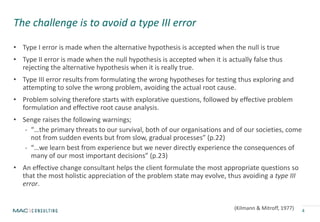
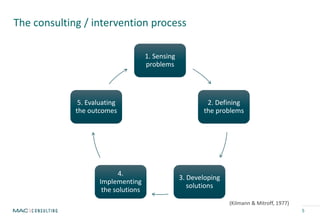
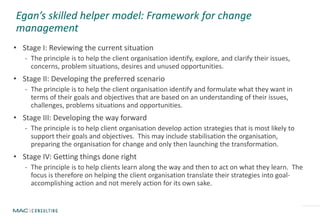
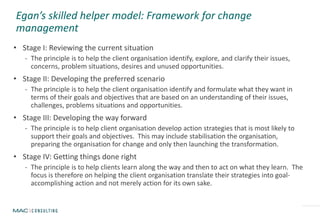
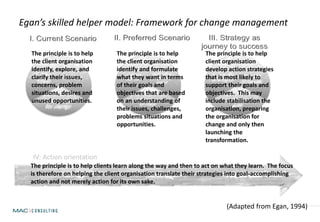
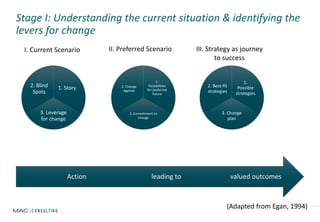
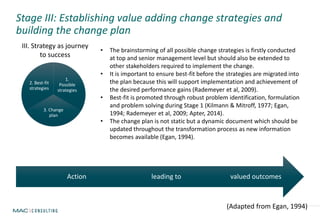
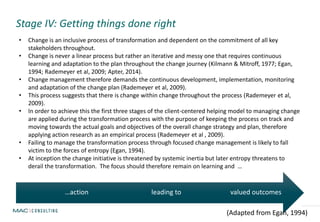
1. The document discusses an approach to client-centered change management based on Egan's skilled helper model. It involves 4 stages: (1) understanding the current situation, (2) crafting a preferred scenario, (3) establishing change strategies and building a plan, and (4) continuous learning and adaptation throughout implementation.
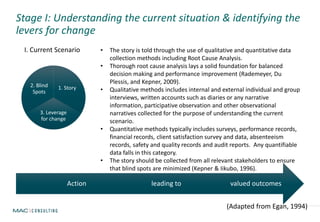
2. The first stage involves collecting qualitative and quantitative data through interviews and surveys to understand issues from all stakeholders' perspectives. This ensures all aspects of the problem are acknowledged to avoid type III errors.
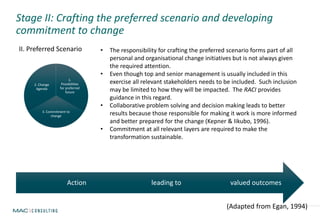
3. Stage 2 involves crafting a shared vision of the preferred future through collaborative problem solving and gaining commitment to change from those impacted. The change plan is then developed and refined iteratively