Organizational
Behaviour
Dr Shivani Agarwal
What Managers DoWhat Managers Do
Managerial Activities
• Make decisions
• Allocate resources
• Direct activities of others
to attain goals
Managerial Activities
• Make decisions
• Allocate resources
• Direct activities of others
to attain goals
Managers (or administrators)
Individuals who achieve goals through other people.
Where Managers WorkWhere Managers Work
Organization
A consciously coordinated social unit, composed of
two or more people, that functions on a relatively
continuous basis to achieve a common goal or set of
goals.
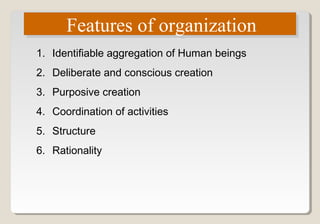
Features of organizationFeatures of organization
1. Identifiable aggregation of Human beings
2. Deliberate and conscious creation
3. Purposive creation
4. Coordination of activities
5. Structure
6. Rationality
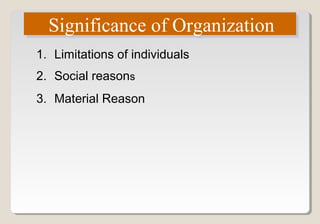
Significance of OrganizationSignificance of Organization
1. Limitations of individuals
2. Social reasons
3. Material Reason
What Managers DoWhat Managers Do
Management Functions
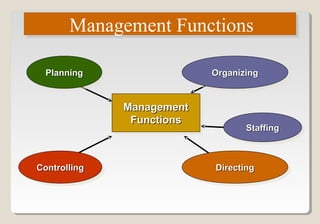
Management FunctionsManagement Functions
PlanningPlanningPlanningPlanning OrganizingOrganizingOrganizingOrganizing
DirectingDirectingDirectingDirectingControllingControllingControllingControlling
ManagementManagement
FunctionsFunctions
ManagementManagement
FunctionsFunctions
StaffingStaffingStaffingStaffing
Nature of Management
Functions
Nature of Management
Functions
1. Universal
2. Iterative characteristics
3. Sequential arrangement
4. Relative importance
Management RolesManagement Roles
•Interpersonal roles
•Figurehead
•Leadership
•Liaison
•Informational roles
•Monitor
•Disseminator
•Spokesperson
Decisional roles
•Entrepreneur
•Disturbance handlers
•Resource allocators
•Negotiator role
Mintzberg’s Managerial RolesMintzberg’s Managerial Roles
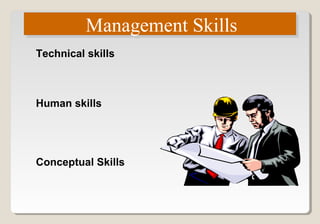
Management SkillsManagement Skills
Technical skills
Human skills
Conceptual Skills
Enter Organizational BehaviorEnter Organizational Behavior
Organizational behavior (OB)
A field of study that investigates the
impact that individuals, groups, and
structure have on behavior within
organizations, for the purpose of
applying such knowledge toward
improving an organization’s
effectiveness.
Stephen P. Robbins
According to Keith Davis -"Organizational
behaviour is the study and application at
knowledge about the how people - as
individuals and a groups - act within
organization. It strives to identify ways in
which people can act more effectively."
-
According to Luthans -"Organizational
behaviour can be defined as the
understanding, prediction and management of
the human behaviour affect the performance
of the organizations.”
Nature and Scope of OBNature and Scope of OB
1. A field of study and not a discipline
2. Interdisciplinary Approach
3. An Applied Science
4. Normative and Valued Centred
5. Humanistic and optimistic
6. Oriented towards organizational objective
7. A total system approach
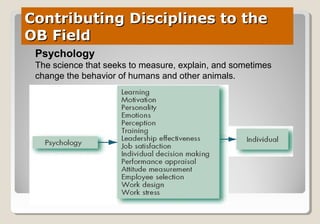
Contributing Disciplines to theContributing Disciplines to the
OB FieldOB Field
Psychology
The science that seeks to measure, explain, and sometimes
change the behavior of humans and other animals.
Contributing Disciplines to theContributing Disciplines to the
OB Field (cont’d)OB Field (cont’d)
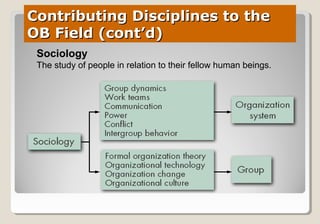
Sociology
The study of people in relation to their fellow human beings.
Contributing Disciplines toContributing Disciplines to
the OB Field (cont’d)the OB Field (cont’d)
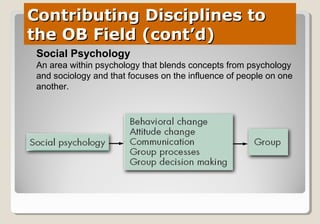
Social Psychology
An area within psychology that blends concepts from psychology
and sociology and that focuses on the influence of people on one
another.
Contributing Disciplines toContributing Disciplines to
the OB Field (cont’d)the OB Field (cont’d)
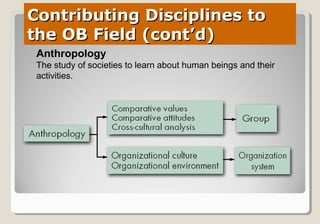
Anthropology
The study of societies to learn about human beings and their
activities.
There Are Few Absolutes inThere Are Few Absolutes in
OBOB
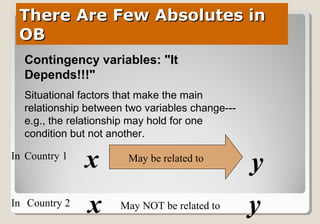
x y
Contingency variables: "It
Depends!!!"
Situational factors that make the main
relationship between two variables change---
e.g., the relationship may hold for one
condition but not another.
Country 1
x yCountry 2
May be related to
May NOT be related to
In
In
Key Elements of OBKey Elements of OB
1. Individual and group
2. Organization structure
3. Technology
4. Environment
Challenges and OpportunitiesChallenges and Opportunities
for OBfor OB
1. Responding to Globalization
◦ Increased foreign assignments
◦ Working with people from different cultures
◦ Coping with anti-capitalism backlash
◦ Overseeing movement of jobs to countries with
low-cost labor
◦ Managing people during the war on terror.
2. Managing Workforce Diversity
◦ Embracing diversity
◦ Changing demographics
◦ Implications for managers
 Recognizing and responding to differences
Challenges and OpportunitiesChallenges and Opportunities
for OB (cont’d)for OB (cont’d)
3. Improving Quality and Productivity
◦ Quality management (QM)
◦ Process reengineering
Responding to the Labor Shortage
◦ Changing work force demographics
◦ Fewer skilled laborers
◦ Early retirements and older workers
Improving Customer Service
◦ Increased expectation of service quality
◦ Customer-responsive cultures
Challenges and Opportunity forChallenges and Opportunity for
OB (cont’d)OB (cont’d)
4. Improving People Skills
5. Empowering People
6. Stimulating Innovation and Change
7. Working in Networked Organizations
8. Helping Employees Balance Work/Life
Conflicts
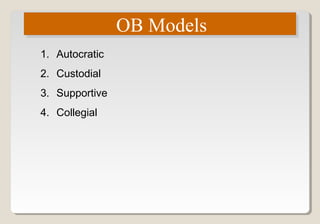
OB ModelsOB Models
1. Autocratic
2. Custodial
3. Supportive
4. Collegial
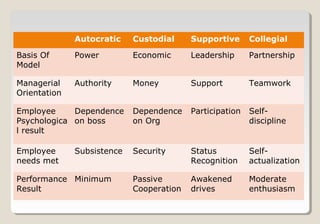
Autocratic Custodial Supportive Collegial
Basis Of
Model
Power Economic Leadership Partnership
Managerial
Orientation
Authority Money Support Teamwork
Employee
Psychologica
l result
Dependence
on boss
Dependence
on Org
Participation Self-
discipline
Employee
needs met
Subsistence Security Status
Recognition
Self-
actualization
Performance
Result
Minimum Passive
Cooperation
Awakened
drives
Moderate
enthusiasm
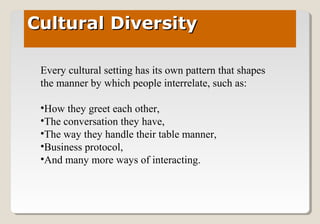
Cultural DiversityCultural Diversity
Every cultural setting has its own pattern that shapes
the manner by which people interrelate, such as:
•How they greet each other,
•The conversation they have,
•The way they handle their table manner,
•Business protocol,
•And many more ways of interacting.
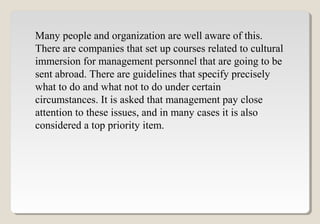
Many people and organization are well aware of this.
There are companies that set up courses related to cultural
immersion for management personnel that are going to be
sent abroad. There are guidelines that specify precisely
what to do and what not to do under certain
circumstances. It is asked that management pay close
attention to these issues, and in many cases it is also
considered a top priority item.
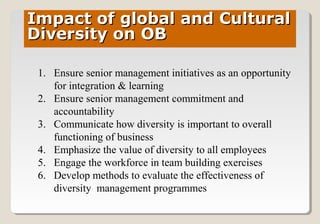
Impact of global and CulturalImpact of global and Cultural
Diversity on OBDiversity on OB
1. Ensure senior management initiatives as an opportunity
for integration & learning
2. Ensure senior management commitment and
accountability
3. Communicate how diversity is important to overall
functioning of business
4. Emphasize the value of diversity to all employees
5. Engage the workforce in team building exercises
6. Develop methods to evaluate the effectiveness of
diversity management programmes

Ob ch 1

  • 1.
  • 2.
    What Managers DoWhatManagers Do Managerial Activities • Make decisions • Allocate resources • Direct activities of others to attain goals Managerial Activities • Make decisions • Allocate resources • Direct activities of others to attain goals Managers (or administrators) Individuals who achieve goals through other people.
  • 3.
    Where Managers WorkWhereManagers Work Organization A consciously coordinated social unit, composed of two or more people, that functions on a relatively continuous basis to achieve a common goal or set of goals.
  • 4.
    Features of organizationFeaturesof organization 1. Identifiable aggregation of Human beings 2. Deliberate and conscious creation 3. Purposive creation 4. Coordination of activities 5. Structure 6. Rationality
  • 5.
    Significance of OrganizationSignificanceof Organization 1. Limitations of individuals 2. Social reasons 3. Material Reason
  • 6.
    What Managers DoWhatManagers Do Management Functions
  • 7.
    Management FunctionsManagement Functions PlanningPlanningPlanningPlanningOrganizingOrganizingOrganizingOrganizing DirectingDirectingDirectingDirectingControllingControllingControllingControlling ManagementManagement FunctionsFunctions ManagementManagement FunctionsFunctions StaffingStaffingStaffingStaffing
  • 8.
    Nature of Management Functions Natureof Management Functions 1. Universal 2. Iterative characteristics 3. Sequential arrangement 4. Relative importance
  • 9.
  • 10.
    •Interpersonal roles •Figurehead •Leadership •Liaison •Informational roles •Monitor •Disseminator •Spokesperson Decisionalroles •Entrepreneur •Disturbance handlers •Resource allocators •Negotiator role Mintzberg’s Managerial RolesMintzberg’s Managerial Roles
  • 11.
    Management SkillsManagement Skills Technicalskills Human skills Conceptual Skills
  • 12.
    Enter Organizational BehaviorEnterOrganizational Behavior Organizational behavior (OB) A field of study that investigates the impact that individuals, groups, and structure have on behavior within organizations, for the purpose of applying such knowledge toward improving an organization’s effectiveness. Stephen P. Robbins
  • 13.
    According to KeithDavis -"Organizational behaviour is the study and application at knowledge about the how people - as individuals and a groups - act within organization. It strives to identify ways in which people can act more effectively." - According to Luthans -"Organizational behaviour can be defined as the understanding, prediction and management of the human behaviour affect the performance of the organizations.”
  • 14.
    Nature and Scopeof OBNature and Scope of OB 1. A field of study and not a discipline 2. Interdisciplinary Approach 3. An Applied Science 4. Normative and Valued Centred 5. Humanistic and optimistic 6. Oriented towards organizational objective 7. A total system approach
  • 15.
    Contributing Disciplines totheContributing Disciplines to the OB FieldOB Field Psychology The science that seeks to measure, explain, and sometimes change the behavior of humans and other animals.
  • 16.
    Contributing Disciplines totheContributing Disciplines to the OB Field (cont’d)OB Field (cont’d) Sociology The study of people in relation to their fellow human beings.
  • 17.
    Contributing Disciplines toContributingDisciplines to the OB Field (cont’d)the OB Field (cont’d) Social Psychology An area within psychology that blends concepts from psychology and sociology and that focuses on the influence of people on one another.
  • 18.
    Contributing Disciplines toContributingDisciplines to the OB Field (cont’d)the OB Field (cont’d) Anthropology The study of societies to learn about human beings and their activities.
  • 19.
    There Are FewAbsolutes inThere Are Few Absolutes in OBOB x y Contingency variables: "It Depends!!!" Situational factors that make the main relationship between two variables change--- e.g., the relationship may hold for one condition but not another. Country 1 x yCountry 2 May be related to May NOT be related to In In
  • 20.
    Key Elements ofOBKey Elements of OB 1. Individual and group 2. Organization structure 3. Technology 4. Environment
  • 21.
    Challenges and OpportunitiesChallengesand Opportunities for OBfor OB 1. Responding to Globalization ◦ Increased foreign assignments ◦ Working with people from different cultures ◦ Coping with anti-capitalism backlash ◦ Overseeing movement of jobs to countries with low-cost labor ◦ Managing people during the war on terror. 2. Managing Workforce Diversity ◦ Embracing diversity ◦ Changing demographics ◦ Implications for managers  Recognizing and responding to differences
  • 22.
    Challenges and OpportunitiesChallengesand Opportunities for OB (cont’d)for OB (cont’d) 3. Improving Quality and Productivity ◦ Quality management (QM) ◦ Process reengineering Responding to the Labor Shortage ◦ Changing work force demographics ◦ Fewer skilled laborers ◦ Early retirements and older workers Improving Customer Service ◦ Increased expectation of service quality ◦ Customer-responsive cultures
  • 23.
    Challenges and OpportunityforChallenges and Opportunity for OB (cont’d)OB (cont’d) 4. Improving People Skills 5. Empowering People 6. Stimulating Innovation and Change 7. Working in Networked Organizations 8. Helping Employees Balance Work/Life Conflicts
  • 24.
    OB ModelsOB Models 1.Autocratic 2. Custodial 3. Supportive 4. Collegial
  • 25.
    Autocratic Custodial SupportiveCollegial Basis Of Model Power Economic Leadership Partnership Managerial Orientation Authority Money Support Teamwork Employee Psychologica l result Dependence on boss Dependence on Org Participation Self- discipline Employee needs met Subsistence Security Status Recognition Self- actualization Performance Result Minimum Passive Cooperation Awakened drives Moderate enthusiasm
  • 26.
    Cultural DiversityCultural Diversity Everycultural setting has its own pattern that shapes the manner by which people interrelate, such as: •How they greet each other, •The conversation they have, •The way they handle their table manner, •Business protocol, •And many more ways of interacting.
  • 27.
    Many people andorganization are well aware of this. There are companies that set up courses related to cultural immersion for management personnel that are going to be sent abroad. There are guidelines that specify precisely what to do and what not to do under certain circumstances. It is asked that management pay close attention to these issues, and in many cases it is also considered a top priority item.
  • 28.
    Impact of globaland CulturalImpact of global and Cultural Diversity on OBDiversity on OB 1. Ensure senior management initiatives as an opportunity for integration & learning 2. Ensure senior management commitment and accountability 3. Communicate how diversity is important to overall functioning of business 4. Emphasize the value of diversity to all employees 5. Engage the workforce in team building exercises 6. Develop methods to evaluate the effectiveness of diversity management programmes