by: Dr Nitin Sharma
Dr. NITIN
SHARMA
ASSISTANT
PROFESSOR-HR,
TIMSR
MUMBAI
PERCEPTION
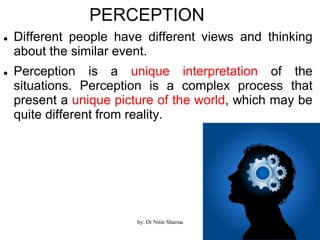
 Different people have different views and thinking
about the similar event.
 Perception is a unique interpretation of the
situations. Perception is a complex process that
present a unique picture of the world, which may be
quite different from reality.
by: Dr Nitin Sharma
by: Dr Nitin Sharma
Perception is the process of selecting, organizing
and interpreting meaning of the events happening
in environment.
-Luthans
by: Dr Nitin Sharma
 Perception is an intellectual process through which a
person selects the data from the environment,
organizes it and obtains, meaning from it.
by: Dr Nitin Sharma
by: Dr Nitin Sharma
Nature of Perception
 Perception Input : Subject, event or people.
 Perception Process : Selection,
organizaion(whatever data we select now we
organize them or arrenge them all in proper
order to make it meaningful) and interpretation.
 Perception Output : Opinions, Feelings,
Attitutude, which ultimately influence out
behaviour. (Action)by: Dr Nitin Sharma
by: Dr Nitin Sharma
PERCEPTUAL BARRIERS
 Some errors and problems may arise in the
perceptual interpretation of individuals:
a) Stereotyping : Judging people on the basis of the
nature of the GROUP, to which they belong is
called stereotyping. Ex: Fat men are jolly, older
women are motherly, japanese are goal oriented.
b) Impression : It is seen that people genarally form
impression about others on the first sight, even
before knowing any of their other weaknesses.
First impression is not always last impressions.
by: Dr Nitin Sharma
 Halo Effect : Stereotyping the person is perceived
according to a single category. Under the halo effect
the person is perceived on the basis of his
characteristics or traits.
 Projection : Projection means one's own feelings to
see in some other one and behave according to that,
if one may be dishonest will always be suspicious
and not do trust any one.
 Attribution : Attribution refers how an individual
explain the situation.
 Inference : Inference means to take the decisions
against some one on the basis of limited
informations.
by: Dr Nitin Sharma
by: Dr Nitin Sharma
• Developing Perceptual Skills in Managers
who is interested to perceive things or others properly
must be that he must understand himself well. That
means know yourself well to know others well. As it
goes in this poetic way of an Urdupoet,” Padi jab
Apne Gunaho par Nazar, toh Nigah mai Koi Bura
Na Raha.” The words to that effect are: when I
looked into my sins, I found no other sinner but
me. This leads one to understand oneself by means
of self-appraisal. by: Dr Nitin Sharma
(1) Knowing Oneself Accurately,
(2) Empathize with Others,
(3) Having a Positive Attitude,
(4) Positive Impression Formation,
(5) Communicating Openly,
(6) Comparing One’s Perception with that of Others,
and
(7) Improving Diversity Management Programmes.
by: Dr Nitin Sharma

Organizational Behaviour : Perception

  • 1.
    by: Dr NitinSharma Dr. NITIN SHARMA ASSISTANT PROFESSOR-HR, TIMSR MUMBAI
  • 2.
    PERCEPTION  Different peoplehave different views and thinking about the similar event.  Perception is a unique interpretation of the situations. Perception is a complex process that present a unique picture of the world, which may be quite different from reality. by: Dr Nitin Sharma
  • 3.
  • 4.
    Perception is theprocess of selecting, organizing and interpreting meaning of the events happening in environment. -Luthans by: Dr Nitin Sharma
  • 5.
     Perception isan intellectual process through which a person selects the data from the environment, organizes it and obtains, meaning from it. by: Dr Nitin Sharma
  • 6.
  • 7.
    Nature of Perception Perception Input : Subject, event or people.  Perception Process : Selection, organizaion(whatever data we select now we organize them or arrenge them all in proper order to make it meaningful) and interpretation.  Perception Output : Opinions, Feelings, Attitutude, which ultimately influence out behaviour. (Action)by: Dr Nitin Sharma
  • 8.
  • 9.
    PERCEPTUAL BARRIERS  Someerrors and problems may arise in the perceptual interpretation of individuals: a) Stereotyping : Judging people on the basis of the nature of the GROUP, to which they belong is called stereotyping. Ex: Fat men are jolly, older women are motherly, japanese are goal oriented. b) Impression : It is seen that people genarally form impression about others on the first sight, even before knowing any of their other weaknesses. First impression is not always last impressions. by: Dr Nitin Sharma
  • 10.
     Halo Effect: Stereotyping the person is perceived according to a single category. Under the halo effect the person is perceived on the basis of his characteristics or traits.  Projection : Projection means one's own feelings to see in some other one and behave according to that, if one may be dishonest will always be suspicious and not do trust any one.  Attribution : Attribution refers how an individual explain the situation.  Inference : Inference means to take the decisions against some one on the basis of limited informations. by: Dr Nitin Sharma
  • 11.
  • 12.
    • Developing PerceptualSkills in Managers who is interested to perceive things or others properly must be that he must understand himself well. That means know yourself well to know others well. As it goes in this poetic way of an Urdupoet,” Padi jab Apne Gunaho par Nazar, toh Nigah mai Koi Bura Na Raha.” The words to that effect are: when I looked into my sins, I found no other sinner but me. This leads one to understand oneself by means of self-appraisal. by: Dr Nitin Sharma
  • 13.
    (1) Knowing OneselfAccurately, (2) Empathize with Others, (3) Having a Positive Attitude, (4) Positive Impression Formation, (5) Communicating Openly, (6) Comparing One’s Perception with that of Others, and (7) Improving Diversity Management Programmes. by: Dr Nitin Sharma