
ATTITUDES
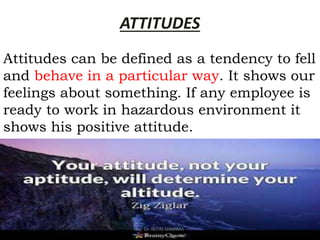
Attitudes can be defined as a tendency to fell
and behave in a particular way. It shows our
feelings about something. If any employee is
ready to work in hazardous environment it
shows his positive attitude.
by: Dr. NITIN SHARMA
Nature of Attitudes
• Attitudes may vary in relation to the needs.
• Those people who are pessimistic, irresponsible,
and aggressive they have negative attitude.
by: Dr. NITIN SHARMA
• Attitude remains unchanged unless something is
done to change them.
• Change in attitude may be up to any level it may be
changed from highly unfavorable to highly
favorable.
by: Dr. NITIN SHARMA
Components of Attitudes
• Informational Components: The informational
component of an attitude is, what a person believes
about an object.
• Emotional Components: It involves the person’s
feelings about an object.
• Behavior Component: Consist of a person’s
tendencies to behave in a particular way towards
object. Ex. If a person has a negative feeling he will
be likely to behave negative towards the object.
by: Dr. NITIN SHARMA
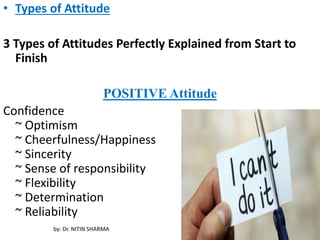
• Types of Attitude
3 Types of Attitudes Perfectly Explained from Start to
Finish
POSITIVE Attitude
Confidence
~ Optimism
~ Cheerfulness/Happiness
~ Sincerity
~ Sense of responsibility
~ Flexibility
~ Determination
~ Reliability
by: Dr. NITIN SHARMA
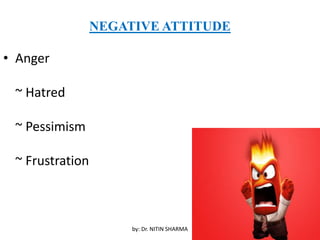
NEGATIVE ATTITUDE
• Anger
~ Hatred
~ Pessimism
~ Frustration
by: Dr. NITIN SHARMA
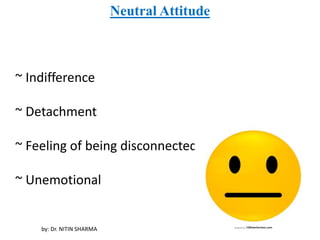
Neutral Attitude
~ Indifference
~ Detachment
~ Feeling of being disconnected
~ Unemotional
by: Dr. NITIN SHARMA
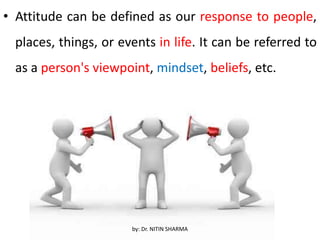
• Attitude can be defined as our response to people,
places, things, or events in life. It can be referred to
as a person's viewpoint, mindset, beliefs, etc.
by: Dr. NITIN SHARMA
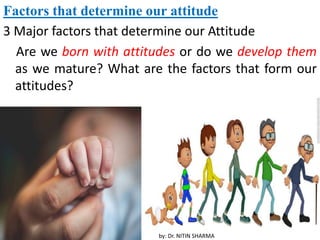
Factors that determine our attitude
3 Major factors that determine our Attitude
Are we born with attitudes or do we develop them
as we mature? What are the factors that form our
attitudes?
by: Dr. NITIN SHARMA
• Environment
Experience
Education
These are called the triple Es of attitude. Let’s
evaluate each of the factors individually.
by: Dr. NITIN SHARMA
Environment
Environment consists of the following:
• Home: positive or negative influences
• School: peer pressure
• Work: supportive or over critical supervisor
• Media: television, newspapers, magazines, radio,
movies
• Cultural background
• Religious background
• Traditions and beliefs
• Social environment
• Political environment
by: Dr. NITIN SHARMA
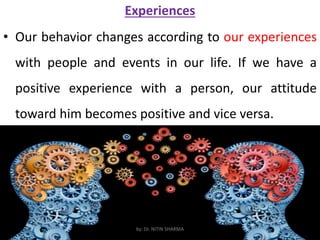
Experiences
• Our behavior changes according to our experiences
with people and events in our life. If we have a
positive experience with a person, our attitude
toward him becomes positive and vice versa.
by: Dr. NITIN SHARMA
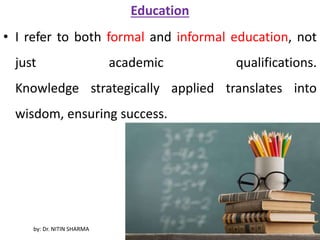
Education
• I refer to both formal and informal education, not
just academic qualifications.
Knowledge strategically applied translates into
wisdom, ensuring success.
by: Dr. NITIN SHARMA
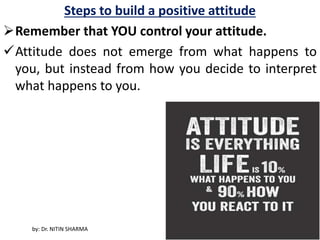
Steps to build a positive attitude
Remember that YOU control your attitude.
Attitude does not emerge from what happens to
you, but instead from how you decide to interpret
what happens to you.
by: Dr. NITIN SHARMA
Tell yourself you can change
• Try this: “Write down the three greatest moments
of change in your life that have brought you to
being the person you like being today
Did you know listening to music can bring back
positive memories?
• (play song of lakshya-Kandho se milte hai kandhe)
by: Dr. NITIN SHARMA
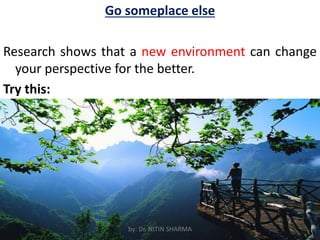
Go someplace else
Research shows that a new environment can change
your perspective for the better.
Try this:
by: Dr. NITIN SHARMA
Refuel and re-energize
• Everyone knows that tired plus hungry equals
unhappy, but this combination might be more
damaging than you think. Your brain interprets lack
of sleep as a threat to the central nervous system.
• Missing one night of sleep can cause you to
remember 59 percent fewer positive words, which
could make you overly focus on the negative.
Try this: If your attitude is chronically cranky, look at
your eating and sleeping habits.
by: Dr. NITIN SHARMA
Talk to the right people for support
by: Dr. NITIN SHARMA
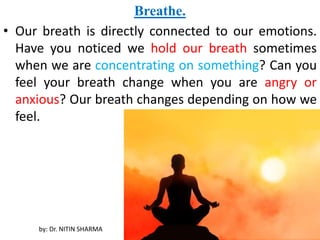
Breathe.
• Our breath is directly connected to our emotions.
Have you noticed we hold our breath sometimes
when we are concentrating on something? Can you
feel your breath change when you are angry or
anxious? Our breath changes depending on how we
feel.
by: Dr. NITIN SHARMA
situations
• Situation 1 :-
Suppose that you are new to the organization,
and not familiar to your colleague. You get a chance to
interact with them in this party.
What will you do in this situation?
a) You will take the initiative to talk
b) Feel strange and nervous so will not talk with others
c) You will wait for someone else to talk to you
d) you will stand and smile to others.
by: Dr. NITIN SHARMA
Situation 2 :-
• If you go in a shopping mall, and you like one t-shirt,
• What would be your action?
a) You will immediately buy it
b) You will take a trial before purchasing.
c) You will match the price with your budget and if it
matches than only you will purchase it.
d) You will look out for the discount shceme
by: Dr. NITIN SHARMA
Situation 3 :-
• If you are going for an important meeting . On the way
to the office, you see an accident.
• How will you react in this situation?
a) you will take the victim to the hospital
b) you will call the victim’s family member and inform about the
accident and will go away from there.
C) you will feel scared about it and will move away from there.
d) Seen such critical situation, you start crying up.
e) you wont even notice about the accident.
by: Dr. NITIN SHARMA
Situation 4 :-
• If girl is crossing the road, a group of boys
starts harassing her by whistling or by passing
comments or by making faces. If you are that
girl how will you react that time?
a) you will go and slap that boy
b) you will complaint to the police authority
c) you wouldn’t react and pass by
d) you will call your brother or friend or boyfriend to threaten that
group by: Dr. NITIN SHARMA

Organizational Behaviour :Attitude

  • 1.
    ATTITUDES Attitudes can bedefined as a tendency to fell and behave in a particular way. It shows our feelings about something. If any employee is ready to work in hazardous environment it shows his positive attitude. by: Dr. NITIN SHARMA
  • 2.
    Nature of Attitudes •Attitudes may vary in relation to the needs. • Those people who are pessimistic, irresponsible, and aggressive they have negative attitude. by: Dr. NITIN SHARMA
  • 3.
    • Attitude remainsunchanged unless something is done to change them. • Change in attitude may be up to any level it may be changed from highly unfavorable to highly favorable. by: Dr. NITIN SHARMA
  • 4.
    Components of Attitudes •Informational Components: The informational component of an attitude is, what a person believes about an object. • Emotional Components: It involves the person’s feelings about an object. • Behavior Component: Consist of a person’s tendencies to behave in a particular way towards object. Ex. If a person has a negative feeling he will be likely to behave negative towards the object. by: Dr. NITIN SHARMA
  • 5.
    • Types ofAttitude 3 Types of Attitudes Perfectly Explained from Start to Finish POSITIVE Attitude Confidence ~ Optimism ~ Cheerfulness/Happiness ~ Sincerity ~ Sense of responsibility ~ Flexibility ~ Determination ~ Reliability by: Dr. NITIN SHARMA
  • 6.
    NEGATIVE ATTITUDE • Anger ~Hatred ~ Pessimism ~ Frustration by: Dr. NITIN SHARMA
  • 7.
    Neutral Attitude ~ Indifference ~Detachment ~ Feeling of being disconnected ~ Unemotional by: Dr. NITIN SHARMA
  • 8.
    • Attitude canbe defined as our response to people, places, things, or events in life. It can be referred to as a person's viewpoint, mindset, beliefs, etc. by: Dr. NITIN SHARMA
  • 9.
    Factors that determineour attitude 3 Major factors that determine our Attitude Are we born with attitudes or do we develop them as we mature? What are the factors that form our attitudes? by: Dr. NITIN SHARMA
  • 10.
    • Environment Experience Education These arecalled the triple Es of attitude. Let’s evaluate each of the factors individually. by: Dr. NITIN SHARMA
  • 11.
    Environment Environment consists ofthe following: • Home: positive or negative influences • School: peer pressure • Work: supportive or over critical supervisor • Media: television, newspapers, magazines, radio, movies • Cultural background • Religious background • Traditions and beliefs • Social environment • Political environment by: Dr. NITIN SHARMA
  • 12.
    Experiences • Our behaviorchanges according to our experiences with people and events in our life. If we have a positive experience with a person, our attitude toward him becomes positive and vice versa. by: Dr. NITIN SHARMA
  • 13.
    Education • I referto both formal and informal education, not just academic qualifications. Knowledge strategically applied translates into wisdom, ensuring success. by: Dr. NITIN SHARMA
  • 14.
    Steps to builda positive attitude Remember that YOU control your attitude. Attitude does not emerge from what happens to you, but instead from how you decide to interpret what happens to you. by: Dr. NITIN SHARMA
  • 15.
    Tell yourself youcan change • Try this: “Write down the three greatest moments of change in your life that have brought you to being the person you like being today Did you know listening to music can bring back positive memories? • (play song of lakshya-Kandho se milte hai kandhe) by: Dr. NITIN SHARMA
  • 16.
    Go someplace else Researchshows that a new environment can change your perspective for the better. Try this: by: Dr. NITIN SHARMA
  • 17.
    Refuel and re-energize •Everyone knows that tired plus hungry equals unhappy, but this combination might be more damaging than you think. Your brain interprets lack of sleep as a threat to the central nervous system. • Missing one night of sleep can cause you to remember 59 percent fewer positive words, which could make you overly focus on the negative. Try this: If your attitude is chronically cranky, look at your eating and sleeping habits. by: Dr. NITIN SHARMA
  • 18.
    Talk to theright people for support by: Dr. NITIN SHARMA
  • 19.
    Breathe. • Our breathis directly connected to our emotions. Have you noticed we hold our breath sometimes when we are concentrating on something? Can you feel your breath change when you are angry or anxious? Our breath changes depending on how we feel. by: Dr. NITIN SHARMA
  • 20.
    situations • Situation 1:- Suppose that you are new to the organization, and not familiar to your colleague. You get a chance to interact with them in this party. What will you do in this situation? a) You will take the initiative to talk b) Feel strange and nervous so will not talk with others c) You will wait for someone else to talk to you d) you will stand and smile to others. by: Dr. NITIN SHARMA
  • 21.
    Situation 2 :- •If you go in a shopping mall, and you like one t-shirt, • What would be your action? a) You will immediately buy it b) You will take a trial before purchasing. c) You will match the price with your budget and if it matches than only you will purchase it. d) You will look out for the discount shceme by: Dr. NITIN SHARMA
  • 22.
    Situation 3 :- •If you are going for an important meeting . On the way to the office, you see an accident. • How will you react in this situation? a) you will take the victim to the hospital b) you will call the victim’s family member and inform about the accident and will go away from there. C) you will feel scared about it and will move away from there. d) Seen such critical situation, you start crying up. e) you wont even notice about the accident. by: Dr. NITIN SHARMA
  • 23.
    Situation 4 :- •If girl is crossing the road, a group of boys starts harassing her by whistling or by passing comments or by making faces. If you are that girl how will you react that time? a) you will go and slap that boy b) you will complaint to the police authority c) you wouldn’t react and pass by d) you will call your brother or friend or boyfriend to threaten that group by: Dr. NITIN SHARMA