FORENSIC ACCOUNTING
FRAUDS
FORENSIC ACCOUNTING:
• In response to an event
• Financial investigation
• Findings used as evidence in court or to resolve disputes
Audit
• Mandatory
• Measures compliance with reporting standards
• Obtain reasonable assurance that financial statements are free of material misstatement
In practice, there are differences in mindset between forensic accounting and audit:
• “Investigative mentality” vs. “professional skepticism”. A forensic accountant will often
require more extensive corroboration.
• A forensic accountant may focus more on seemingly immaterial transactions.
A forensic accountant will often look for indications of fraud that are not subject to the scope of a
financial statement audit.
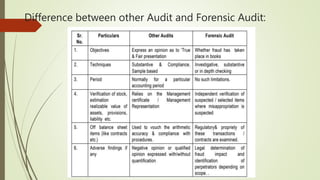
Difference between other Audit and Forensic Audit:
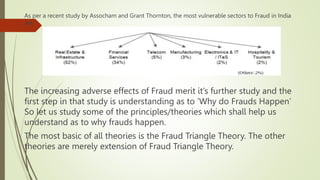
As per a recent study by Assocham and Grant Thornton, the most vulnerable sectors to Fraud in India
are:
The increasing adverse effects of Fraud merit it’s further study and the
first step in that study is understanding as to ‘Why do Frauds Happen’
So let us study some of the principles/theories which shall help us
understand as to why frauds happen.
The most basic of all theories is the Fraud Triangle Theory. The other
theories are merely extension of Fraud Triangle Theory.
Fraud Triangle
Donald Cressey, a sociologist and criminologist in the 1940s, was one of the first persons to specialize in the
field of understanding fraudsters and why they do what they do. Cressey wrote "Theft of the Nation," a treatise
on La Cosa Nostra- a hierarchically structured view of the Organizational Crime and he was widely known for
his studies in organized crime. Cressey first gained public recognition in this field while completing his PhD
dissertation on embezzlers, at Indiana University. Cressey interviewed nearly 200 incarcerated individuals
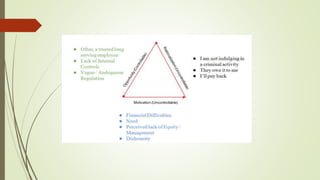
charged with embezzlement. From his research, Cressey developed "The Fraud Triangle” which was a model he
used to explain what caused some people to become fraudsters by analyzing the circumstances in which the
subjects of his research were drawn into fraud The fraud triangle, developed by Donald Cressey, is a model for
explaining the factors that cause someone to commit occupational fraud. It consists of three components which,
together, lead to fraudulent behavior:
1. Perceived Pressure
2. Perceived opportunity
3. Rationalization
Fraud Diamond
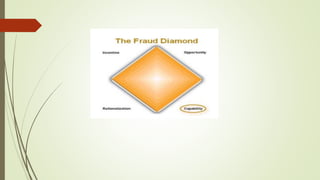
Wolf and Hermanson (2004) introduced the fraud diamond model where they presented another view of the
factors to fraud. The theory adds fourth variable “Capability” to the three factor theory of fraud triangle.
Wolf and Hermanson believed many frauds would not have occurred without the right person with right
capabilities implementing the details of the fraud.
They also suggested four observation traits for committing fraud:
• Authoritative position or function within the organization.
• Capacity to understand and exploit accounting systems and internal control
• Confidence that he/she will not be detected, or if caught, he/she will get out ofit easily.
• Capability to deal with the stress created within and otherwise good person
• when he orshe commits bad act.
The Fraud Diamond theory states that all these 3 ingredients are essential but the critical
component in turning the fraud opportunity into reality is “Capability”. The fraudster should
have the necessary traits and abilities to be the right person to pull it off and also the
confidence and ego that he will not be detected or he will be able to talk himself out of trouble
if detected.
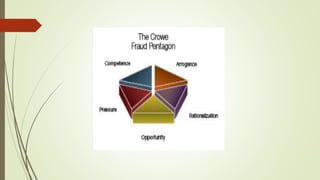
Fraud Pentagon
Cressey’s classic fraud triangle helps to explain many situations, but today’s fraudster is more
independent-minded and armed with more information and access than were available to
perpetrators in the 1950s. In addition, few would deny there have been significant cultural
changes in the past 60 years. The fraud triangle can be expanded further to a Crowe
Horwath’s Fraud Pentagon, where an employee’s competence and arrogance are factored into
the 3 conditions generally present when fraud occurs. The two additional aspects in the Fraud
Pentagon are:
1. Competence: It is an extension on the element of opportunity to include an individual’s
ability to override internal controls and to socially control the situation to his advantage
2. Arrogance (lack of conscience): It is an attitude of superiority and entitlement or greed
on the part of the perpetrator who believes that company policies and procedures do not apply
to him.
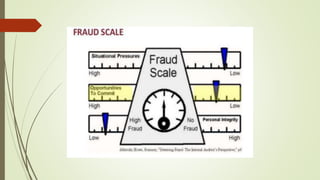
Fraud Scale
This is another theory on Frauds propounded by Steve Albrecht which states -
• Situational pressures, perceived opportunities& personal integrity are the 3 factors that
lead to frauds–
• When situational pressures & perceived opportunities are high & personal integrity is
low, occupational fraud is much more likely to happen than when the opposite is true.
• It also states that perpetrators hard to profile & fraud difficult to predict.
Fraud Circle
Another notable theory relating to Fraud is of ‘Fraud Circle’. This theory recognizes the fact
that fraud is Omni-present everywhere and wherever there will be money there will always be
Frauds

Forensic Accounting Frauds and Fraud theories

  • 1.
  • 2.
    FORENSIC ACCOUNTING: • Inresponse to an event • Financial investigation • Findings used as evidence in court or to resolve disputes Audit • Mandatory • Measures compliance with reporting standards • Obtain reasonable assurance that financial statements are free of material misstatement In practice, there are differences in mindset between forensic accounting and audit: • “Investigative mentality” vs. “professional skepticism”. A forensic accountant will often require more extensive corroboration. • A forensic accountant may focus more on seemingly immaterial transactions. A forensic accountant will often look for indications of fraud that are not subject to the scope of a financial statement audit.
  • 3.
    Difference between otherAudit and Forensic Audit:
  • 4.
    As per arecent study by Assocham and Grant Thornton, the most vulnerable sectors to Fraud in India are: The increasing adverse effects of Fraud merit it’s further study and the first step in that study is understanding as to ‘Why do Frauds Happen’ So let us study some of the principles/theories which shall help us understand as to why frauds happen. The most basic of all theories is the Fraud Triangle Theory. The other theories are merely extension of Fraud Triangle Theory.
  • 5.
    Fraud Triangle Donald Cressey,a sociologist and criminologist in the 1940s, was one of the first persons to specialize in the field of understanding fraudsters and why they do what they do. Cressey wrote "Theft of the Nation," a treatise on La Cosa Nostra- a hierarchically structured view of the Organizational Crime and he was widely known for his studies in organized crime. Cressey first gained public recognition in this field while completing his PhD dissertation on embezzlers, at Indiana University. Cressey interviewed nearly 200 incarcerated individuals charged with embezzlement. From his research, Cressey developed "The Fraud Triangle” which was a model he used to explain what caused some people to become fraudsters by analyzing the circumstances in which the subjects of his research were drawn into fraud The fraud triangle, developed by Donald Cressey, is a model for explaining the factors that cause someone to commit occupational fraud. It consists of three components which, together, lead to fraudulent behavior: 1. Perceived Pressure 2. Perceived opportunity 3. Rationalization
  • 7.
    Fraud Diamond Wolf andHermanson (2004) introduced the fraud diamond model where they presented another view of the factors to fraud. The theory adds fourth variable “Capability” to the three factor theory of fraud triangle. Wolf and Hermanson believed many frauds would not have occurred without the right person with right capabilities implementing the details of the fraud. They also suggested four observation traits for committing fraud: • Authoritative position or function within the organization. • Capacity to understand and exploit accounting systems and internal control • Confidence that he/she will not be detected, or if caught, he/she will get out ofit easily. • Capability to deal with the stress created within and otherwise good person • when he orshe commits bad act. The Fraud Diamond theory states that all these 3 ingredients are essential but the critical component in turning the fraud opportunity into reality is “Capability”. The fraudster should have the necessary traits and abilities to be the right person to pull it off and also the confidence and ego that he will not be detected or he will be able to talk himself out of trouble if detected.
  • 9.
    Fraud Pentagon Cressey’s classicfraud triangle helps to explain many situations, but today’s fraudster is more independent-minded and armed with more information and access than were available to perpetrators in the 1950s. In addition, few would deny there have been significant cultural changes in the past 60 years. The fraud triangle can be expanded further to a Crowe Horwath’s Fraud Pentagon, where an employee’s competence and arrogance are factored into the 3 conditions generally present when fraud occurs. The two additional aspects in the Fraud Pentagon are: 1. Competence: It is an extension on the element of opportunity to include an individual’s ability to override internal controls and to socially control the situation to his advantage 2. Arrogance (lack of conscience): It is an attitude of superiority and entitlement or greed on the part of the perpetrator who believes that company policies and procedures do not apply to him.
  • 11.
    Fraud Scale This isanother theory on Frauds propounded by Steve Albrecht which states - • Situational pressures, perceived opportunities& personal integrity are the 3 factors that lead to frauds– • When situational pressures & perceived opportunities are high & personal integrity is low, occupational fraud is much more likely to happen than when the opposite is true. • It also states that perpetrators hard to profile & fraud difficult to predict.
  • 13.
    Fraud Circle Another notabletheory relating to Fraud is of ‘Fraud Circle’. This theory recognizes the fact that fraud is Omni-present everywhere and wherever there will be money there will always be Frauds