 Money laundering is the process whereby
the proceeds of crime are transformed into
ostensibly legitimate money or other assets.
 Money obtained from certain crimes, such as
extortion, insider trading, drug trafficking,
illegal gambling and tax evasion is "dirty". It
needs to be cleaned to appear to have
derived from non-criminal activities so that
banks and other financial institutions will deal
with it without suspicion.
 crime that are laundered using a variety of
monetary instruments including securities,
digital currencies such as bit coin, credit
cards, and traditional currency. Money can
be laundered by many methods, which
vary in complexity and sophistication.
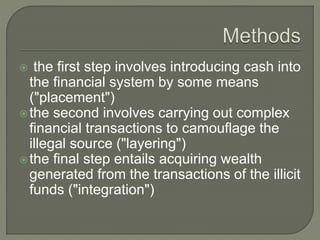
 the first step involves introducing cash into
the financial system by some means
("placement")
the second involves carrying out complex
financial transactions to camouflage the
illegal source ("layering")
the final step entails acquiring wealth
generated from the transactions of the illicit
funds ("integration")
Structuring: Often known as smurfing, this
is a method of placement whereby cash is
broken into smaller deposits of money,
used to defeat suspicion of money
laundering and to avoid anti-money
laundering reporting requirements
Depositing again and again in small
amounts.
Bulk cash smuggling: This involves
physically smuggling cash to another
jurisdiction and depositing it in a financial
institution, such as an offshore bank
Black salaries: A company may have
unregistered employees without a written
contract and pay them cash salaries
Anti-money laundering (AML) is a term
mainly used in the financial and legal
industries to describe the legal controls
that require financial institutions and other
regulated entities to prevent, detect, and
report money laundering activities
The approach in the United States to
stopping money laundering is usually
broken into two areas: preventive
(regulatory) measures and criminal
measures.
 Cash transactions in excess of
US$10,000 must be reported on
a currency transaction report (CTR),
identifying the individual making the
transaction as well as the source of the
cash
Thank You.

Money laundering

  • 2.
     Money launderingis the process whereby the proceeds of crime are transformed into ostensibly legitimate money or other assets.  Money obtained from certain crimes, such as extortion, insider trading, drug trafficking, illegal gambling and tax evasion is "dirty". It needs to be cleaned to appear to have derived from non-criminal activities so that banks and other financial institutions will deal with it without suspicion.
  • 3.
     crime thatare laundered using a variety of monetary instruments including securities, digital currencies such as bit coin, credit cards, and traditional currency. Money can be laundered by many methods, which vary in complexity and sophistication.
  • 4.
     the firststep involves introducing cash into the financial system by some means ("placement") the second involves carrying out complex financial transactions to camouflage the illegal source ("layering") the final step entails acquiring wealth generated from the transactions of the illicit funds ("integration")
  • 5.
    Structuring: Often knownas smurfing, this is a method of placement whereby cash is broken into smaller deposits of money, used to defeat suspicion of money laundering and to avoid anti-money laundering reporting requirements Depositing again and again in small amounts.
  • 6.
    Bulk cash smuggling:This involves physically smuggling cash to another jurisdiction and depositing it in a financial institution, such as an offshore bank Black salaries: A company may have unregistered employees without a written contract and pay them cash salaries
  • 7.
    Anti-money laundering (AML)is a term mainly used in the financial and legal industries to describe the legal controls that require financial institutions and other regulated entities to prevent, detect, and report money laundering activities
  • 8.
    The approach inthe United States to stopping money laundering is usually broken into two areas: preventive (regulatory) measures and criminal measures.  Cash transactions in excess of US$10,000 must be reported on a currency transaction report (CTR), identifying the individual making the transaction as well as the source of the cash
  • 9.