Josefina B. Bitonio, DPA
Resource Person
Effective Organization and
Management with Focus on Human
Resources and Development - Part I
Organization are defined differently by
different authors. There are, however, certain
essential elements that can be discerned
from them. In other words, organizations
consist of people who, more or less, share
common objectives or purpose. The
behavior of the organization is directed
towards the attainment of these objectives
It is an association of
several to many people
who are attempting to fulfill;
the common goals
The members who compromise the organization work
jointly in groups and cooperate together in interdependent
relationships. This suggests that organizations structure and
integrate their activities. Furthermore, organizations use
knowledge and techniques to accomplish their goals.
Organizations and Management focuses on
the study of two things: how individuals and
groups interact within organizations, and how
firms interact with one another and with
consumers, employees, communities, and
institutions.
https://som.yale.edu/programs/phd/overview/organizations-and-management
The Nature of Organization and
Management is twin terms that exist
side by side with each other, each
one needs and supports the other.
Organizations will be motionless
and useless if there is no
management that will steer it;
management will be hollow and
meaningless if there’s no
organization to manage.
https://www.slideshare.net/jobitonio/o-m-27141569
The Nature of Organization and
Management. In the real world of
administration, organization and
management are essential elements through
which human actions and objectives are
carried out and accomplished. In a manner
of speaking, organization and management
become a means to an end.
Historical
Perspective
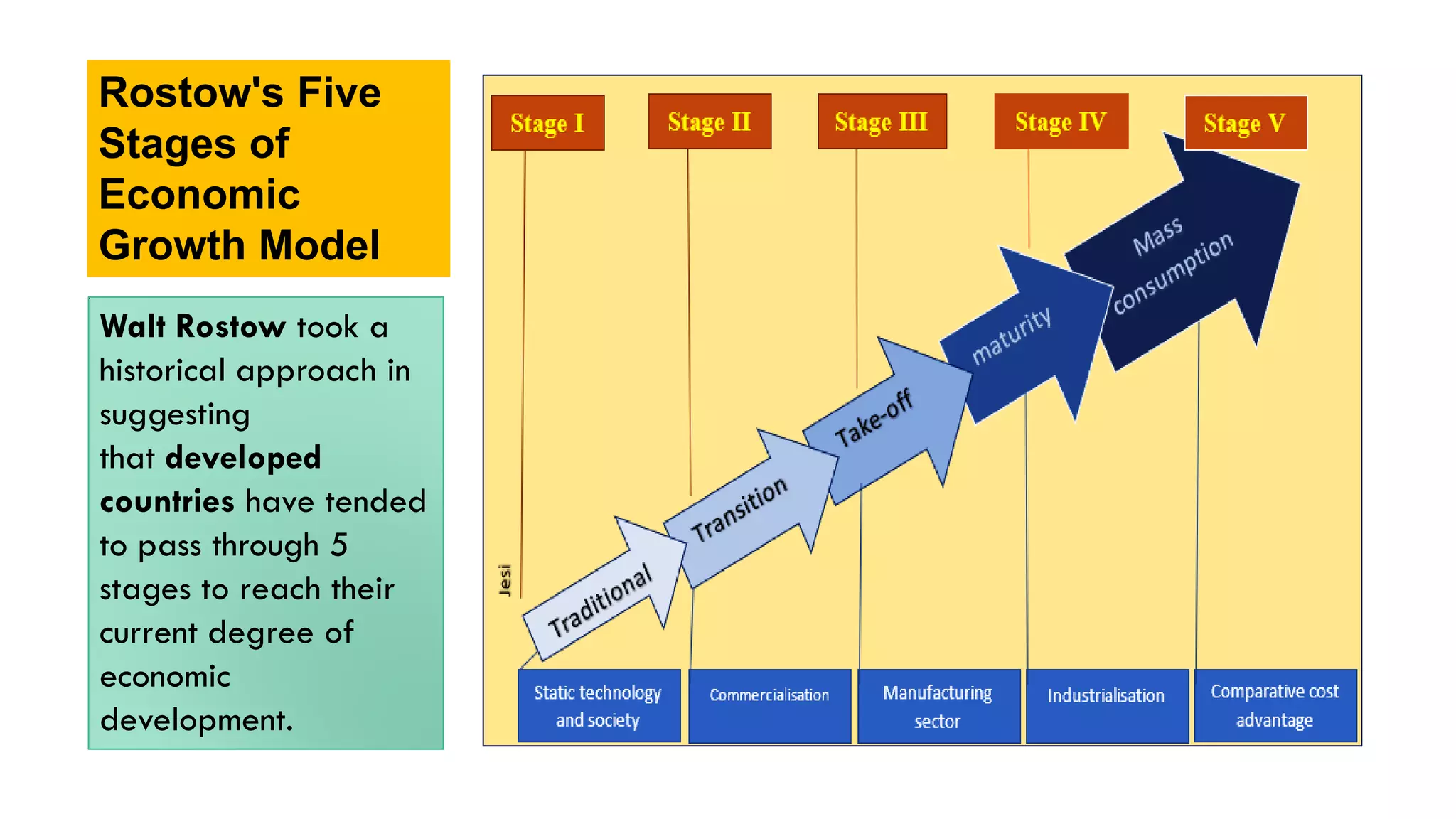
Walt Rostow took a
historical approach in
suggesting
that developed
countries have tended
to pass through 5
stages to reach their
current degree of
economic
development.
Rostow's Five
Stages of
Economic
Growth Model
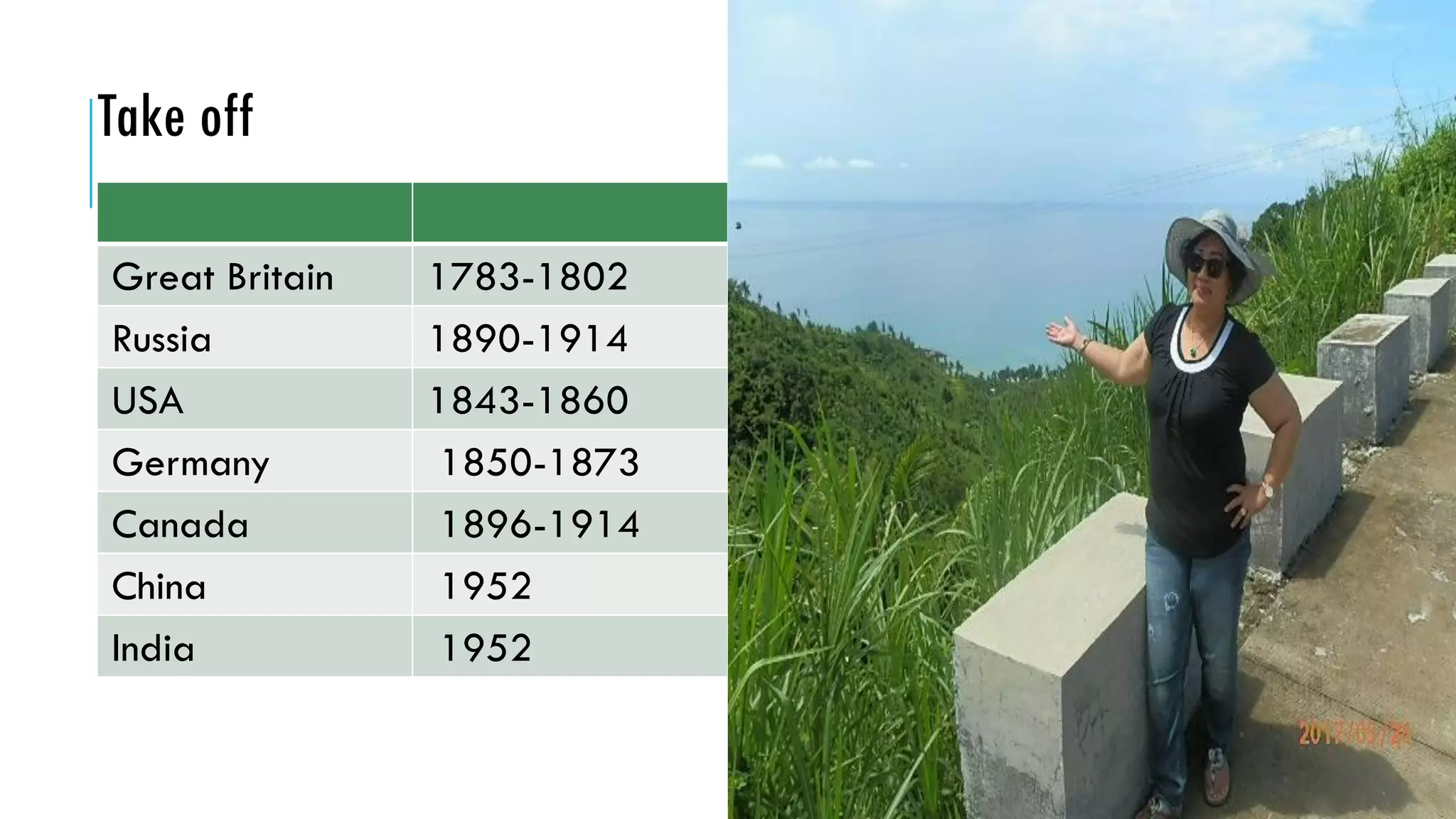
Take off
Great Britain 1783-1802
Russia 1890-1914
USA 1843-1860
Germany 1850-1873
Canada 1896-1914
China 1952
India 1952
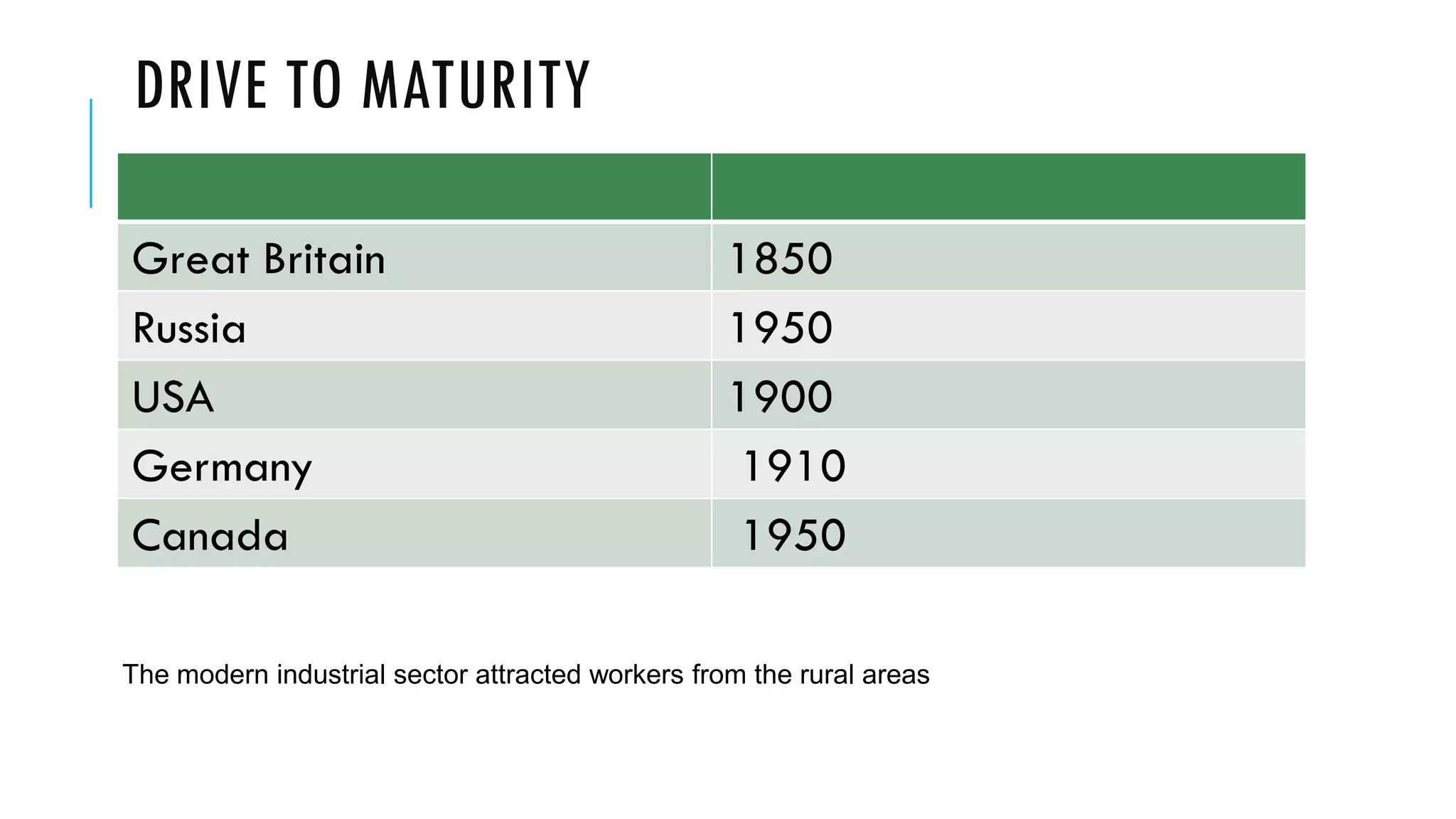
DRIVE TO MATURITY
Great Britain 1850
Russia 1950
USA 1900
Germany 1910
Canada 1950
The modern industrial sector attracted workers from the rural areas
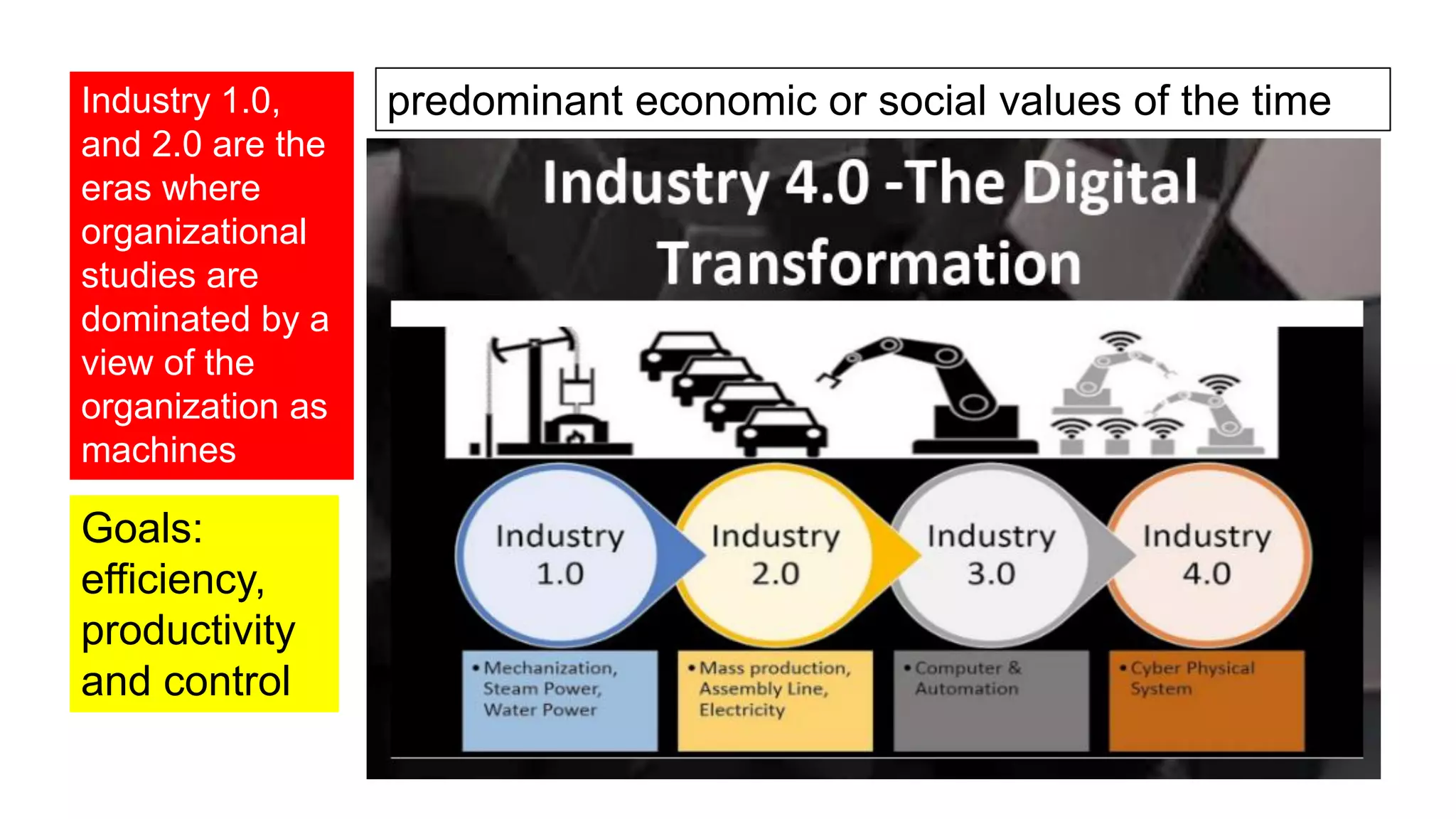
Industry 1.0,
and 2.0 are the
eras where
organizational
studies are
dominated by a
view of the
organization as
machines
Goals:
efficiency,
productivity
and control
predominant economic or social values of the time
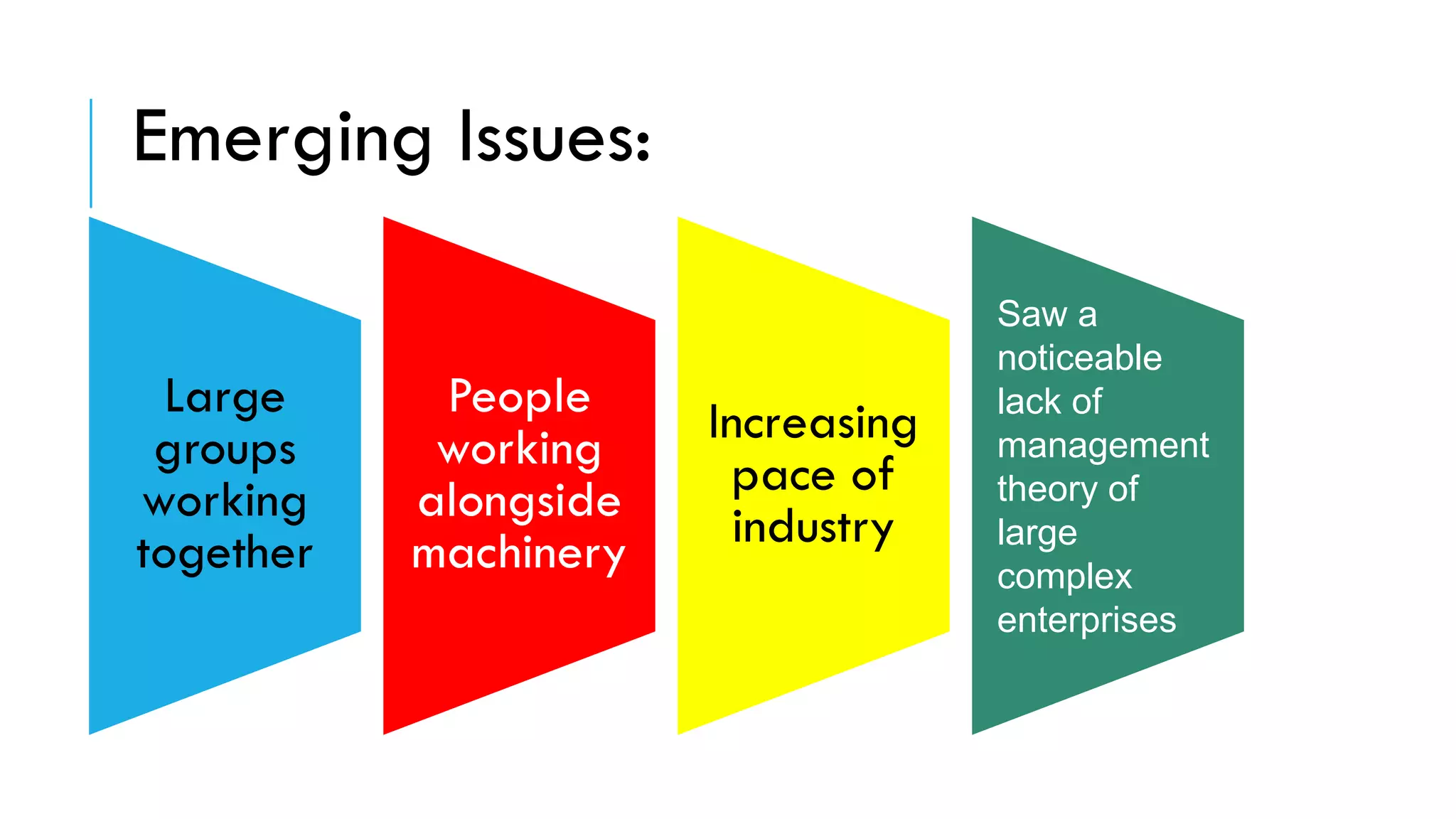
Emerging Issues:
Large
groups
working
together
People
working
alongside
machinery
Increasing
pace of
industry
Saw a
noticeable
lack of
management
theory of
large
complex
enterprises
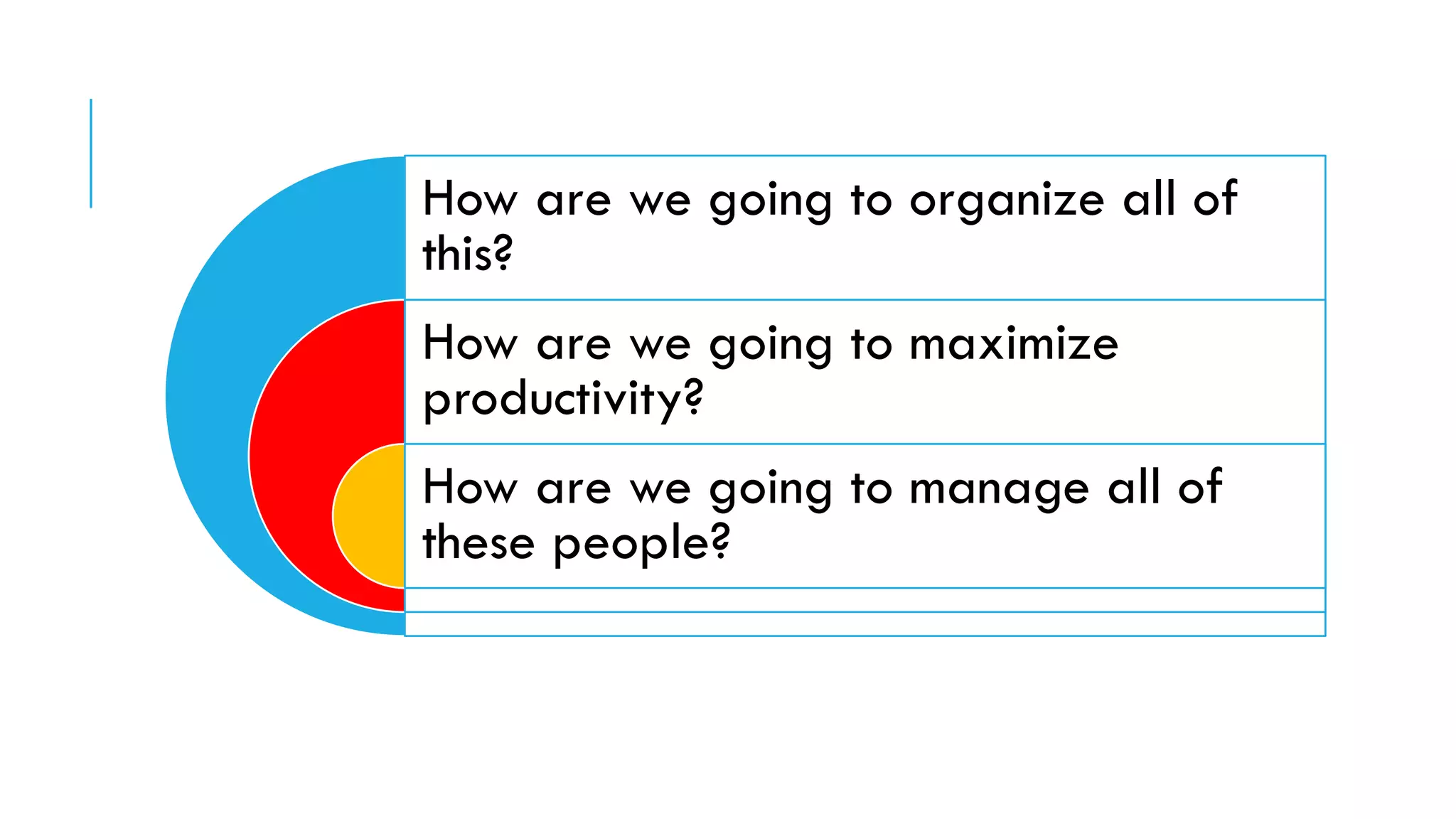
How are we going to organize all of
this?
How are we going to maximize
productivity?
How are we going to manage all of
these people?
Assumptions
Proponents of earlier
approaches made quite a
few assumptions that
were grounded on the
predominant economic or
social values of the time
and the perceived needs
of management of labor
The theory consists of principles that describe
relationships observed in association with phenomenon. The
primary role of theory is to provide a description as well
as explanation of the phenomenon. This means that
organization theory can help us in understanding people
within the organization (us) ; what is organizations, how
organization behaves in a given environment and how
they may behave in a different set of circumstances
Organizational Theories
1. Classical Organization Theory
• Scientific Management Approach
• Weber‟s Bureaucratic Approach
• Administrative Theory
2. Neo Classical Theory
3. Modern Organizational Theory
How did current
management
theories develop?
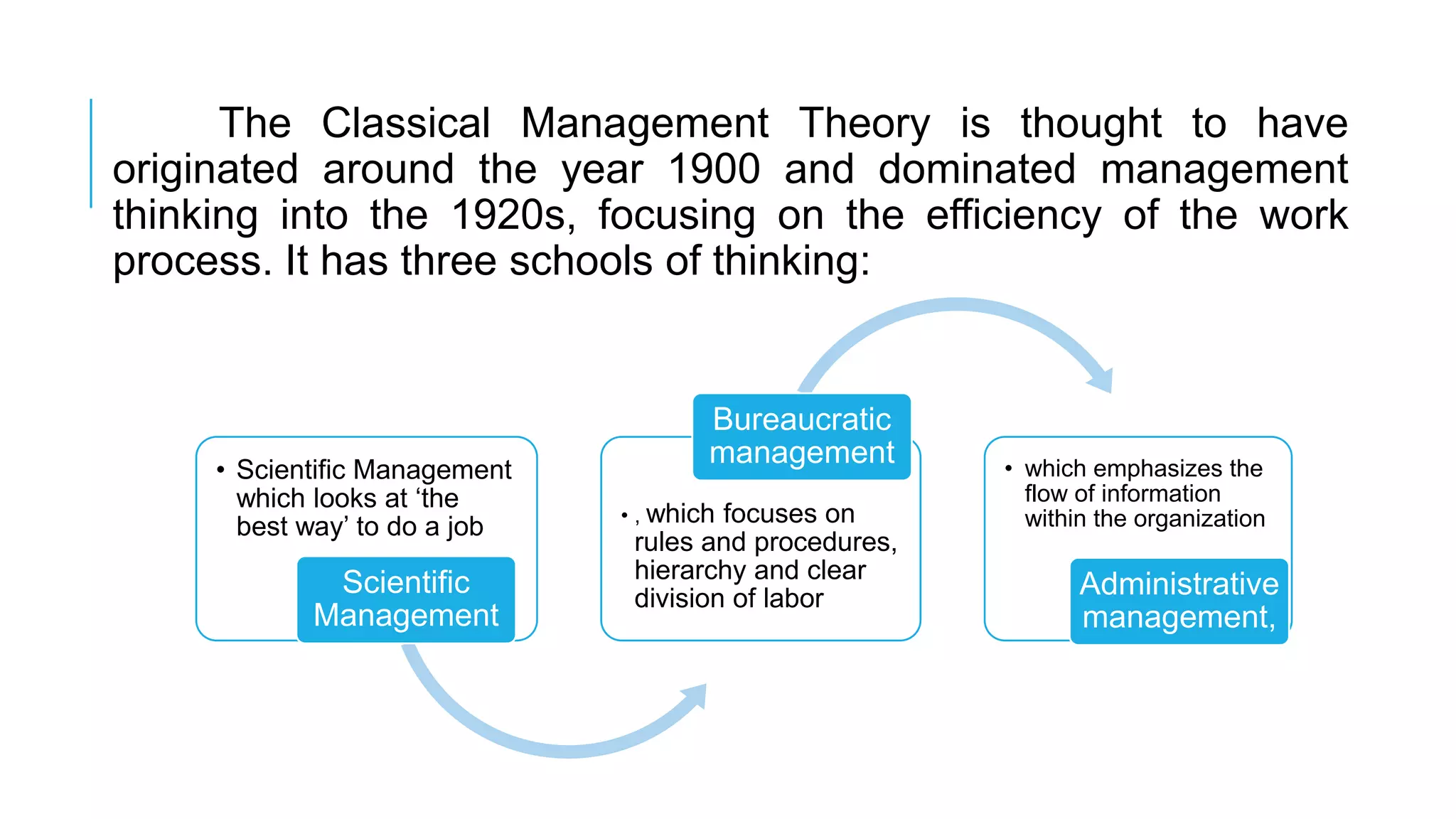
The Classical Management Theory is thought to have
originated around the year 1900 and dominated management
thinking into the 1920s, focusing on the efficiency of the work
process. It has three schools of thinking:
• Scientific Management
which looks at „the
best way‟ to do a job
Scientific
Management
• , which focuses on
rules and procedures,
hierarchy and clear
division of labor
Bureaucratic
management • which emphasizes the
flow of information
within the organization
Administrative
management,
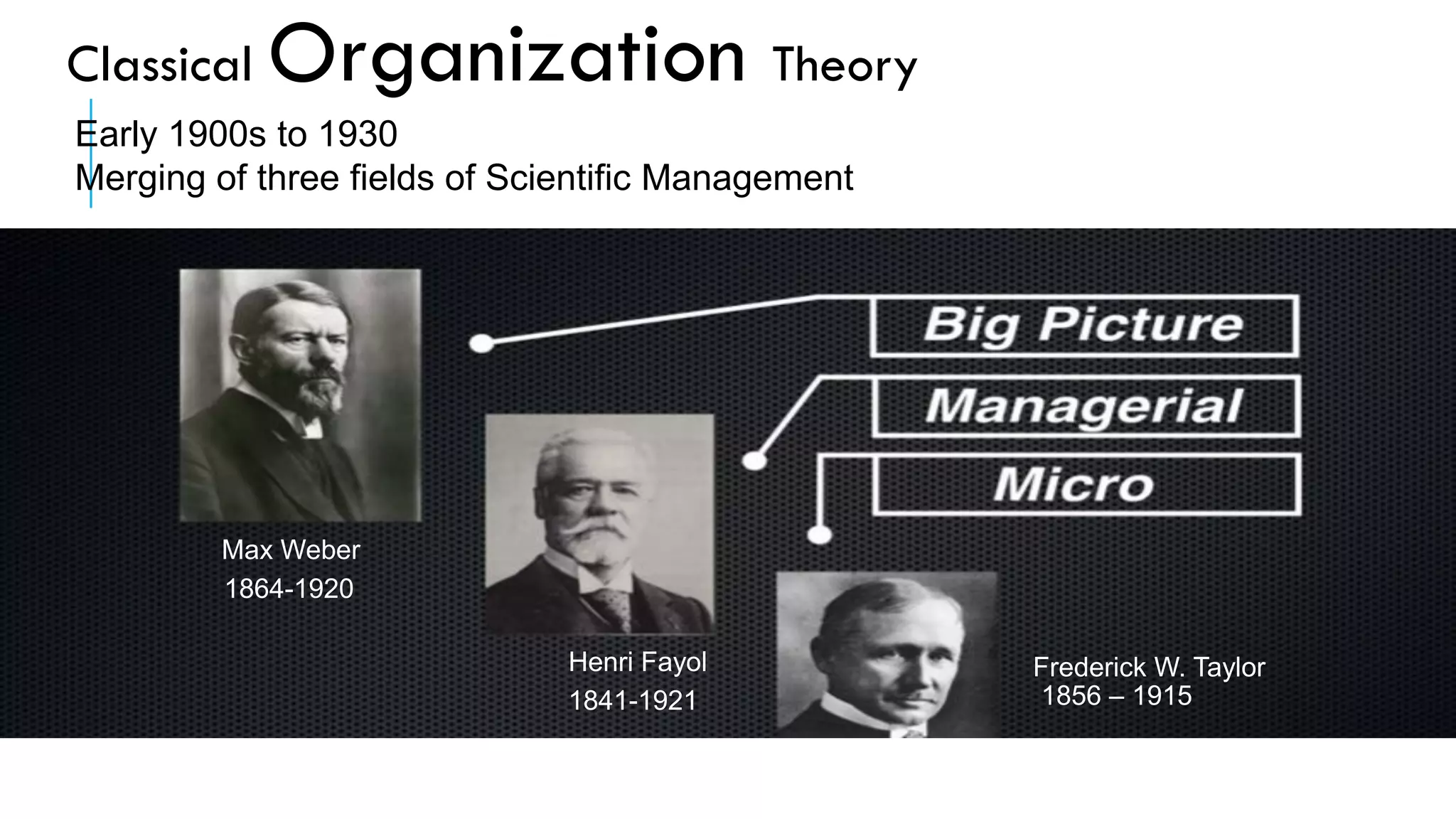
Classical Organization Theory
Early 1900s to 1930
Merging of three fields of Scientific Management
Frederick W. Taylor
Max Weber
Henri Fayol
1864-1920
1841-1921 1856 – 1915
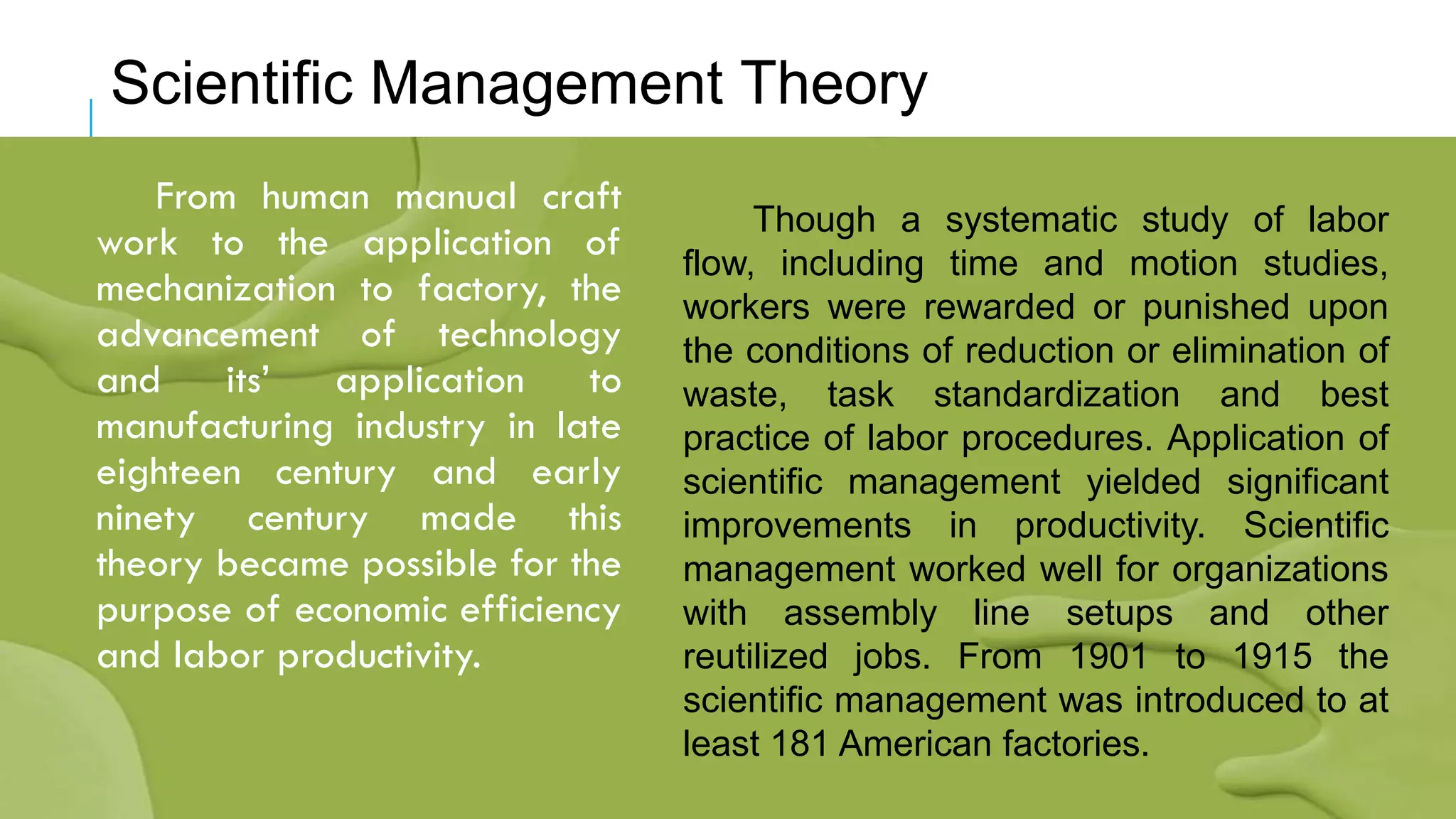
From human manual craft
work to the application of
mechanization to factory, the
advancement of technology
and its’ application to
manufacturing industry in late
eighteen century and early
ninety century made this
theory became possible for the
purpose of economic efficiency
and labor productivity.
Scientific Management Theory
Though a systematic study of labor
flow, including time and motion studies,
workers were rewarded or punished upon
the conditions of reduction or elimination of
waste, task standardization and best
practice of labor procedures. Application of
scientific management yielded significant
improvements in productivity. Scientific
management worked well for organizations
with assembly line setups and other
reutilized jobs. From 1901 to 1915 the
scientific management was introduced to at
least 181 American factories.
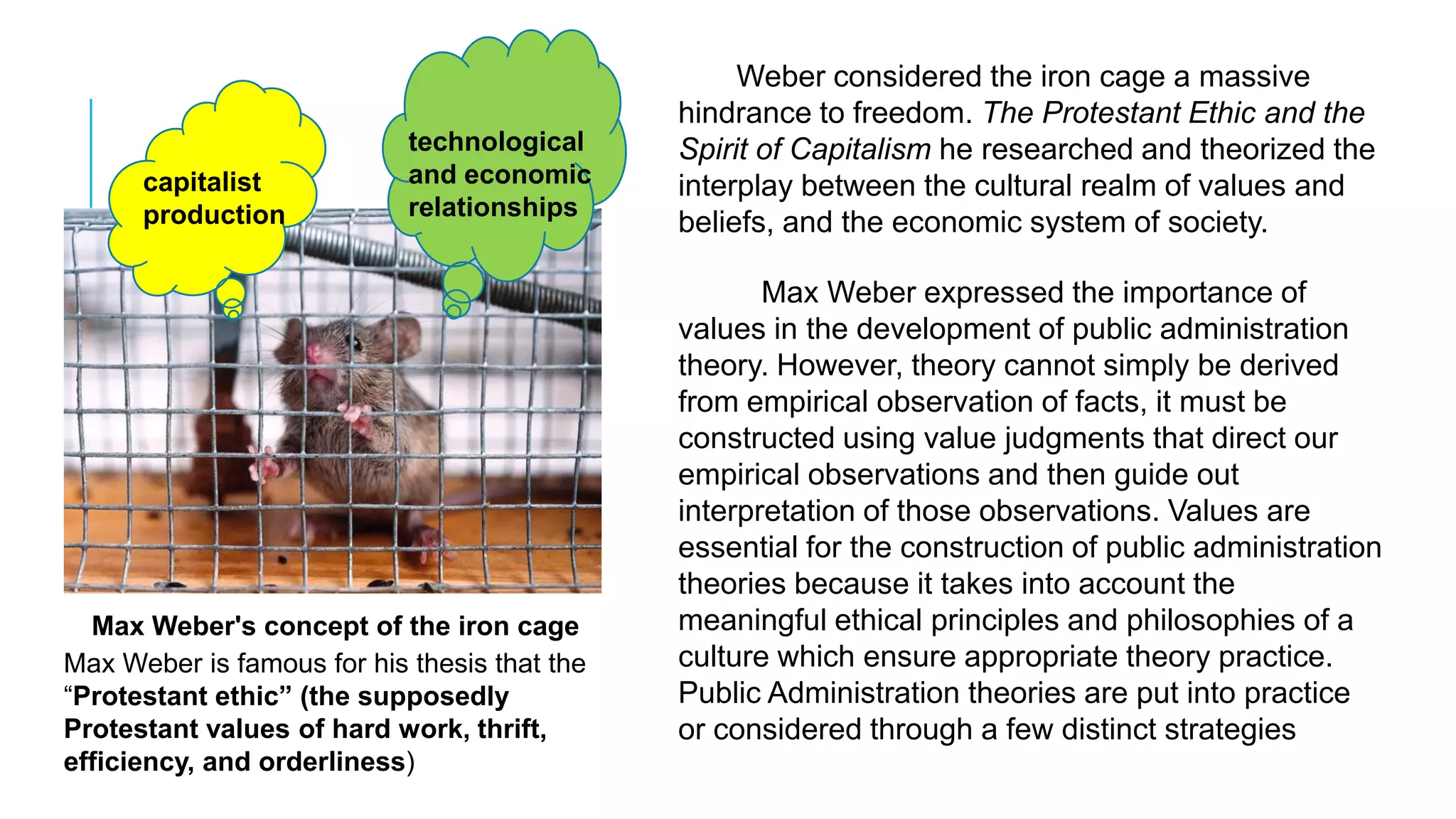
Max Weber's concept of the iron cage
capitalist
production
technological
and economic
relationships
Weber considered the iron cage a massive
hindrance to freedom. The Protestant Ethic and the
Spirit of Capitalism he researched and theorized the
interplay between the cultural realm of values and
beliefs, and the economic system of society.
Max Weber expressed the importance of
values in the development of public administration
theory. However, theory cannot simply be derived
from empirical observation of facts, it must be
constructed using value judgments that direct our
empirical observations and then guide out
interpretation of those observations. Values are
essential for the construction of public administration
theories because it takes into account the
meaningful ethical principles and philosophies of a
culture which ensure appropriate theory practice.
Public Administration theories are put into practice
or considered through a few distinct strategies
Max Weber is famous for his thesis that the
“Protestant ethic” (the supposedly
Protestant values of hard work, thrift,
efficiency, and orderliness)
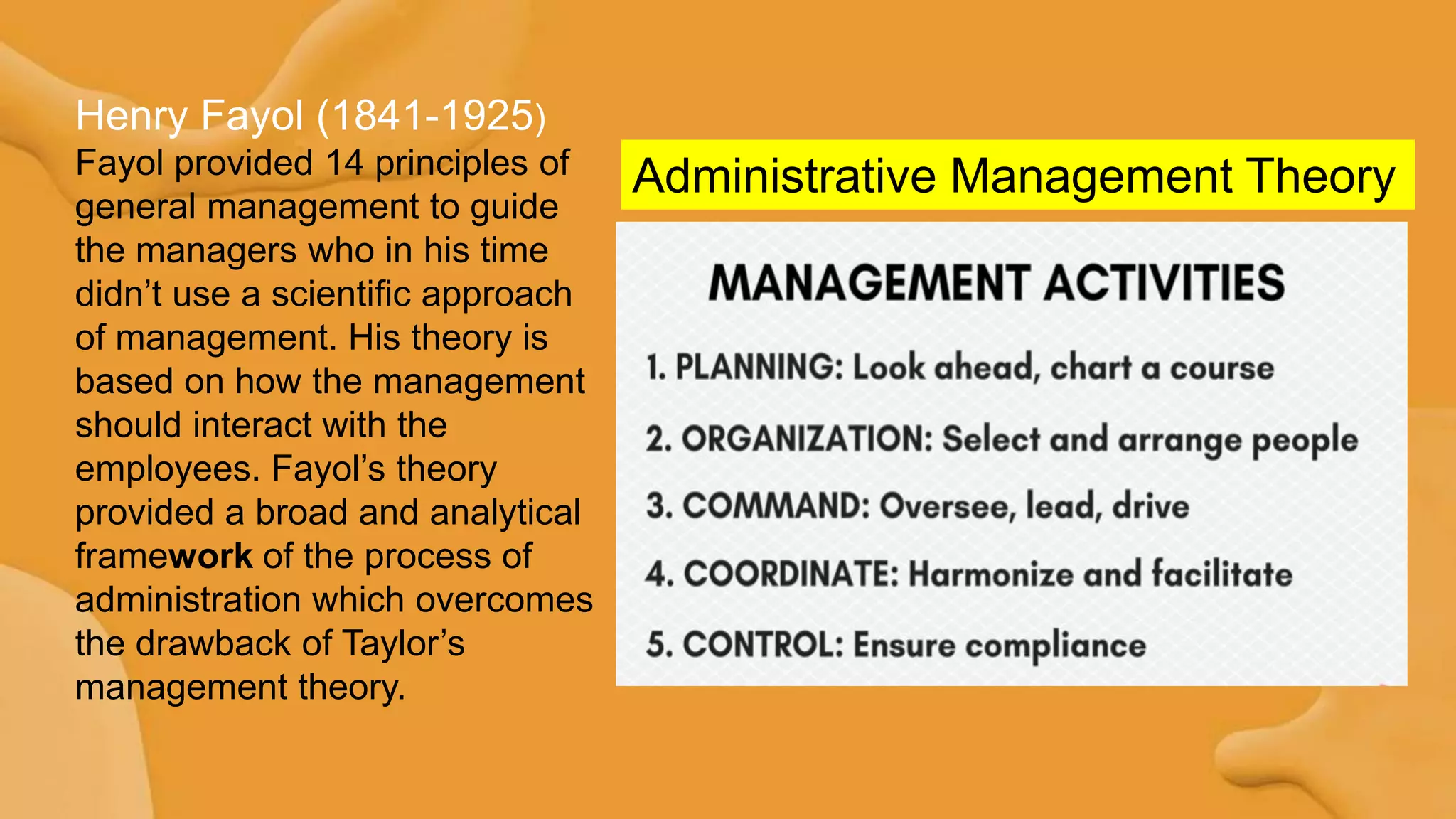
Administrative Management Theory
Henry Fayol (1841-1925)
Fayol provided 14 principles of
general management to guide
the managers who in his time
didn‟t use a scientific approach
of management. His theory is
based on how the management
should interact with the
employees. Fayol‟s theory
provided a broad and analytical
framework of the process of
administration which overcomes
the drawback of Taylor‟s
management theory.
Hierarchy
Standardized approach to work
Centralization of authority
Separation of personal and work life
Wanted to select the best employee
People paid fairly
it is more appropriate for stable and simple
organization
Commonalities & Overlap
Classical management theory was introduced in the late 19th century. It
became widespread in the first half of the 20th century, as organizations
tried to address issues of industrial management, including specialization,
efficiency, higher quality, cost reduction and management-worker
relationships.
Contributions:
1. Increased production, Decreased cost, Improvement in or Maintenance of Quality,
Speedy Production and Accurate Delivery and the Power and Stimulus of Knowledge
(Farquhar)
2. Made a significant contribution to the development of management theories
3. Administrative theory focused on the total organization and on way to make it
more efficient
4. Classical approach highlighted the universal character of management principles
(Berdayes V, 2002).
5. it often prescribed the universal procedures that are not appropriate in some
setting. Henry H. Farquhar, 1919 https://www.jstor.org/stable/pdf/1885947.pdf
Criticism
• Rigid and mechanistic. It follows an assembly
line approach where the social and self-
actualization needs of the employees are not
taken into consideration.
• Too formal
• Authoritarian -deliberately promote a „yes-
boss‟ culture
• Limit on individual discretion
• Does not satisfy the need of
belongingness and community
• Applicable to factories where typically
routine work happens
1. Definitely very valuable today.
2. The classical management approaches are
still used today by many small-business
owners to build their companies and to
succeed. This has since led to the development
of further theories
3. The key underlying principles remain
unchanged. Management today, like it was
100 years ago, is still very much about
planning, organizing, controlling, influencing.
4. Public organizations were molded on the
classical organizational management
theoretical perspectives and have proven
remarkably stable in different circumstances
around the world.
Relevance
today
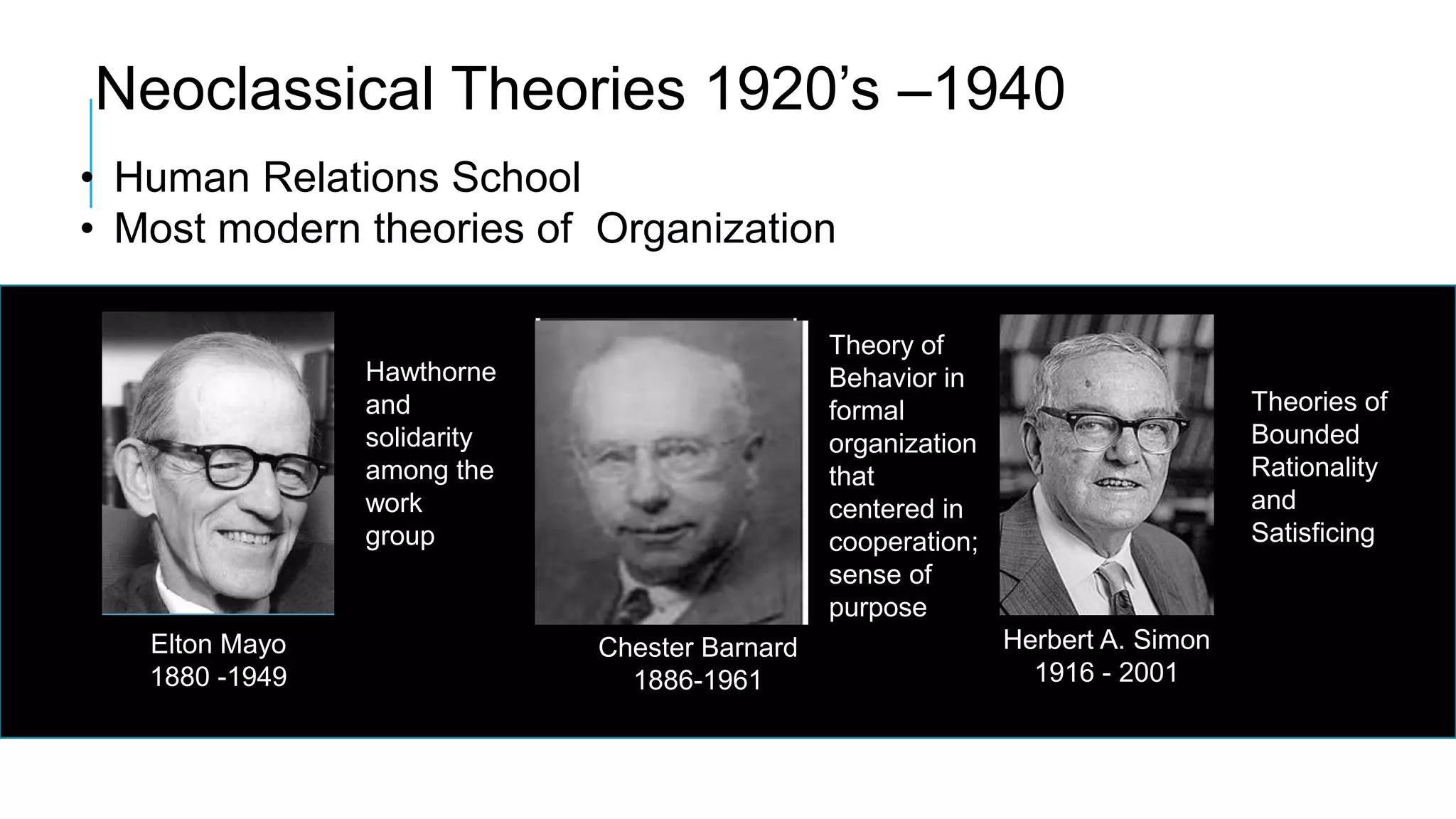
Neoclassical Theories 1920‟s –1940
• Human Relations School
• Most modern theories of Organization
Elton Mayo
1880 -1949
Chester Barnard
1886-1961
Herbert A. Simon
1916 - 2001
Theories of
Bounded
Rationality
and
Satisficing
Hawthorne
and
solidarity
among the
work
group
Studies
Solidarity
Theory of
Behavior in
formal
organization
that
centered in
cooperation;
sense of
purpose
The classical approach stressed the formal organization. It was mechanistic and
ignored major aspects of human nature. In contrast, the neoclassical approach introduced
an informal organization structure and emphasized the following principles:
The individual is not a mechanical tool but a distinct social being, with aspirations
beyond mere fulfilment of a few economic and security works. Individuals differ from
each other in pursuing these desires. Thus, an individual should be recognized as
interacting with social and economic factors.·
The work group highlighted the social facets of work groups or informal organizations
that operate within a formal organization. The concept of 'group' and its synergistic
benefits were considered important.
Participative management or decision making permits workers to participate in the
decision making process. This was a new form of management to ensure increases in
productivity.
Principles of the Neoclassical Approach
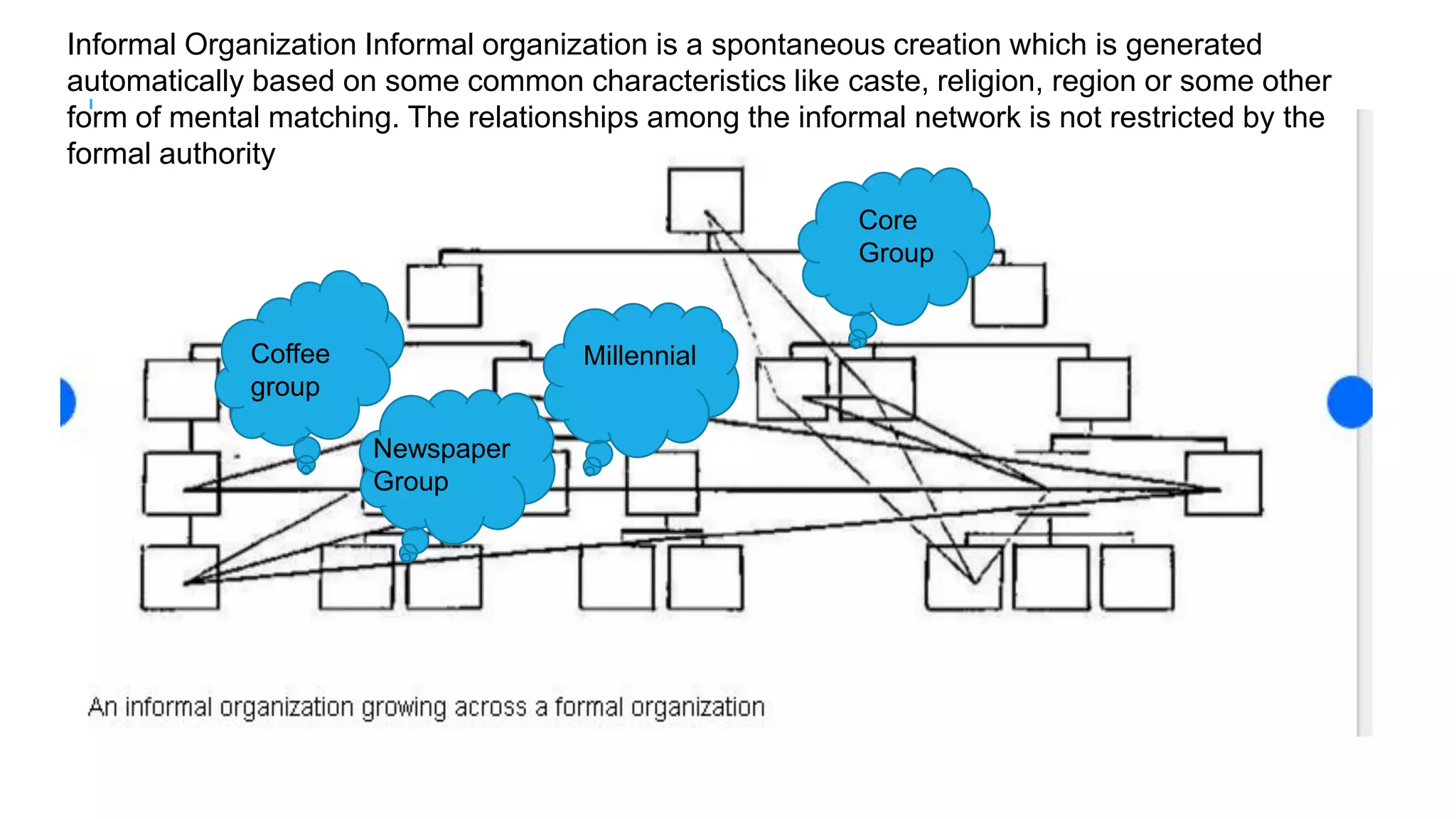
Informal Organization Informal organization is a spontaneous creation which is generated
automatically based on some common characteristics like caste, religion, region or some other
form of mental matching. The relationships among the informal network is not restricted by the
formal authority
Coffee
group
Newspaper
Group
Millennial
Core
Group
Contributions of Neo Classical Theory
• Organization exists to serve human needs
• People and organization need each other
• When the fit between individual and system is poor,
both suffer
• A good fit profits both the individual and organization
• Organizations can not exist independently and
isolated
• Opened up the door to an explosion of studies in
organization
Neoclassical theorists recognized the importance of individual or
group behavior and emphasized human relations. Based on the
Hawthorne experiments, the neoclassical approach emphasized
social or human relationships among the operators, researchers
and supervisors (Roethlisberger and Dickson, 1943). It was argued
that these considerations were more consequential in determining
productivity than mere changes in working conditions. Productivity
increases were achieved as a result of high morale, which was
influenced by the amount of individual, personal and intimate
attention workers received.
Contributions of Neo Classical Theory
Criticism
1. The assumptions on which this theory is based are sometimes not true. A
thinking that there is always a possibility of finding a solution acceptable to all
is not true. There are conflicting interests among various groups that are
structural in character and not merely psychological. This aspect has not been
discussed in the theory.
2. No particular organizational structure can be suitable for all the organizations.
Various organizational formats given by neo- classists are not applicable in all
situations.
3. Neo-classical theory is only a modification of classical organization theory. It
suffers from nearly same drawbacks from which classical theory suffered. It
lacks unified approach of organization. This theory has also been criticized on
the ground that it is nothing more than “a trifling body of empirical and
descriptive information as it was mainly based on Hawthorne Studies.”
Organizational theories are
useful in explaining many
aspects of human behavior
within the organization
Modern Organizational Theories
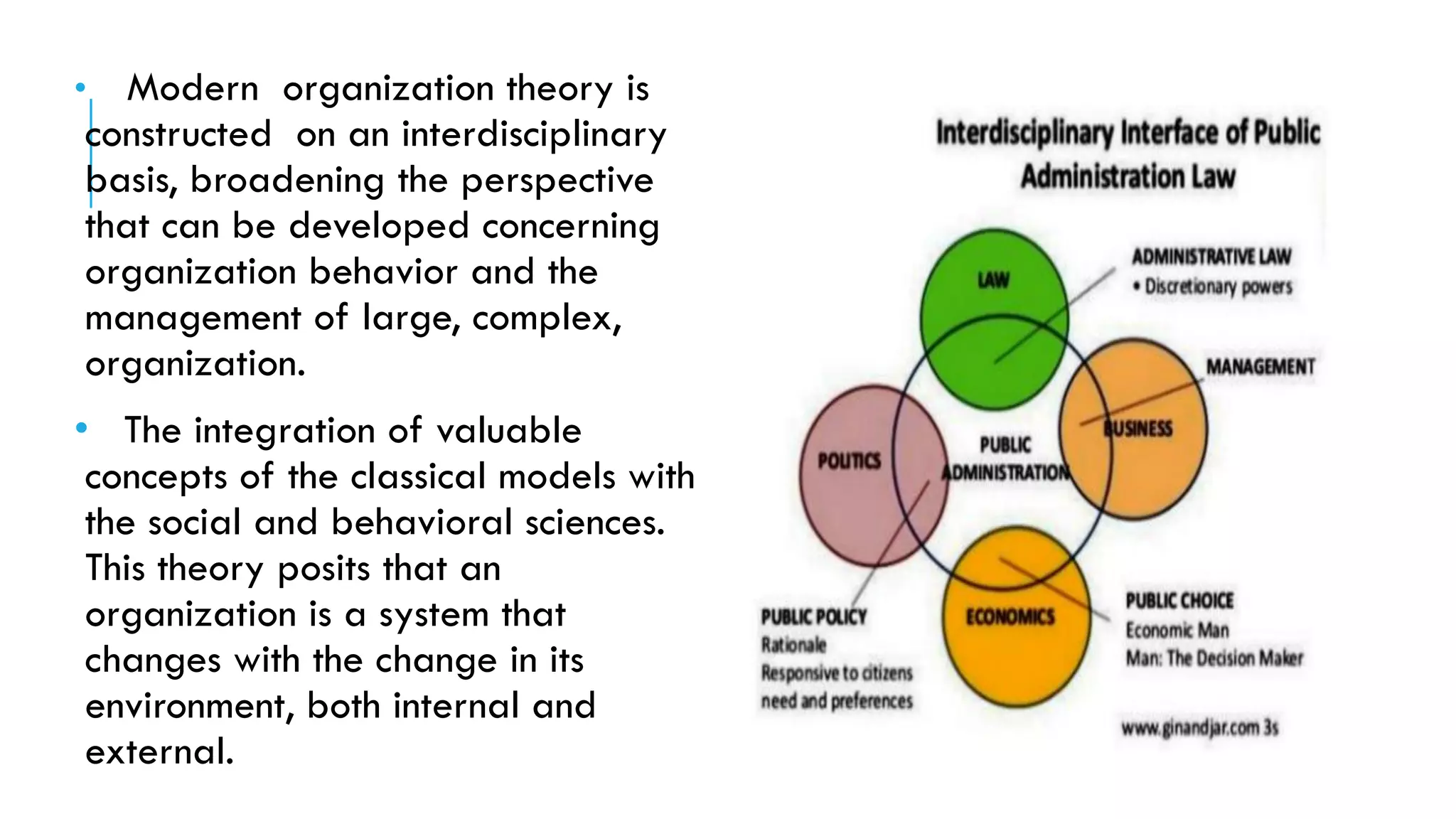
• Modern organization theory is
constructed on an interdisciplinary
basis, broadening the perspective
that can be developed concerning
organization behavior and the
management of large, complex,
organization.
• The integration of valuable
concepts of the classical models with
the social and behavioral sciences.
This theory posits that an
organization is a system that
changes with the change in its
environment, both internal and
external.
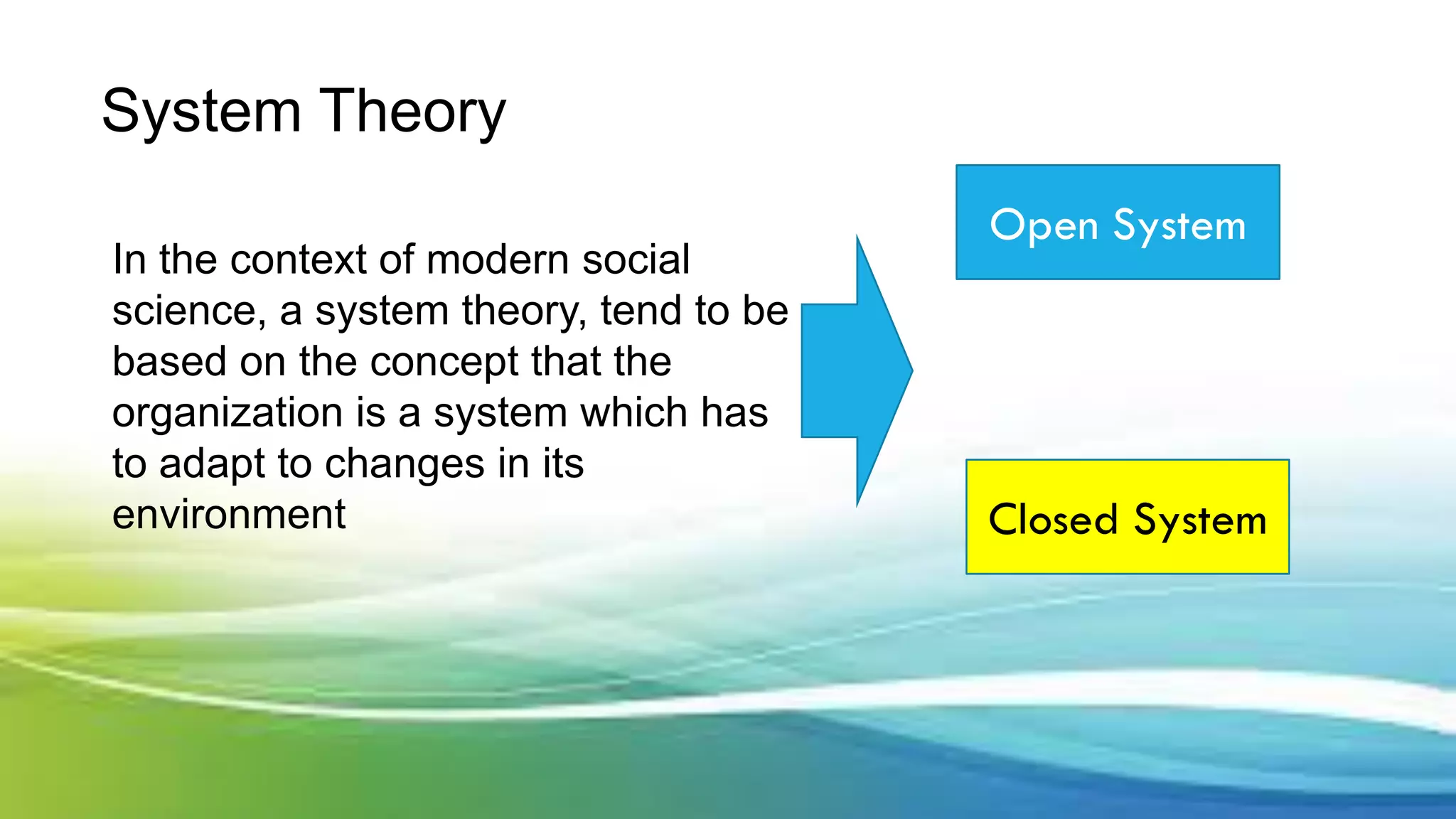
System Theory
In the context of modern social
science, a system theory, tend to be
based on the concept that the
organization is a system which has
to adapt to changes in its
environment
Open System
Closed System
Open systems
continuously interact with
their environment, there
is a constant need to
balancing pressures and
responses, demands and
resources and worker
incentives and
contributions
Open System
Closed System
which have no interaction with
their environment. Closed
systems have the advantage of
being efficient because there
are clear procedures that are
not affected by outside
influences. The best way to
understand closed systems is
to see how they are used in
organizations.
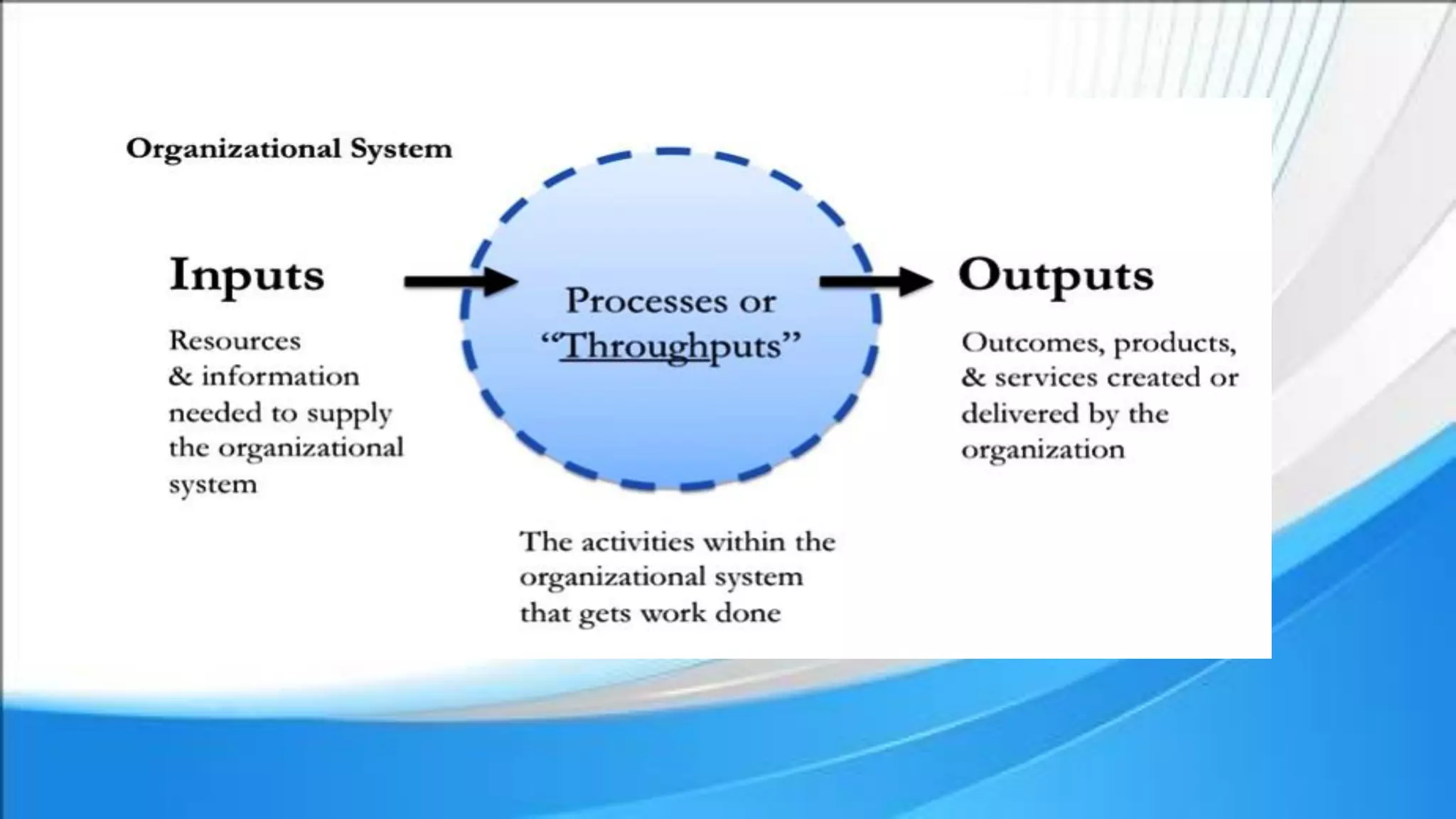
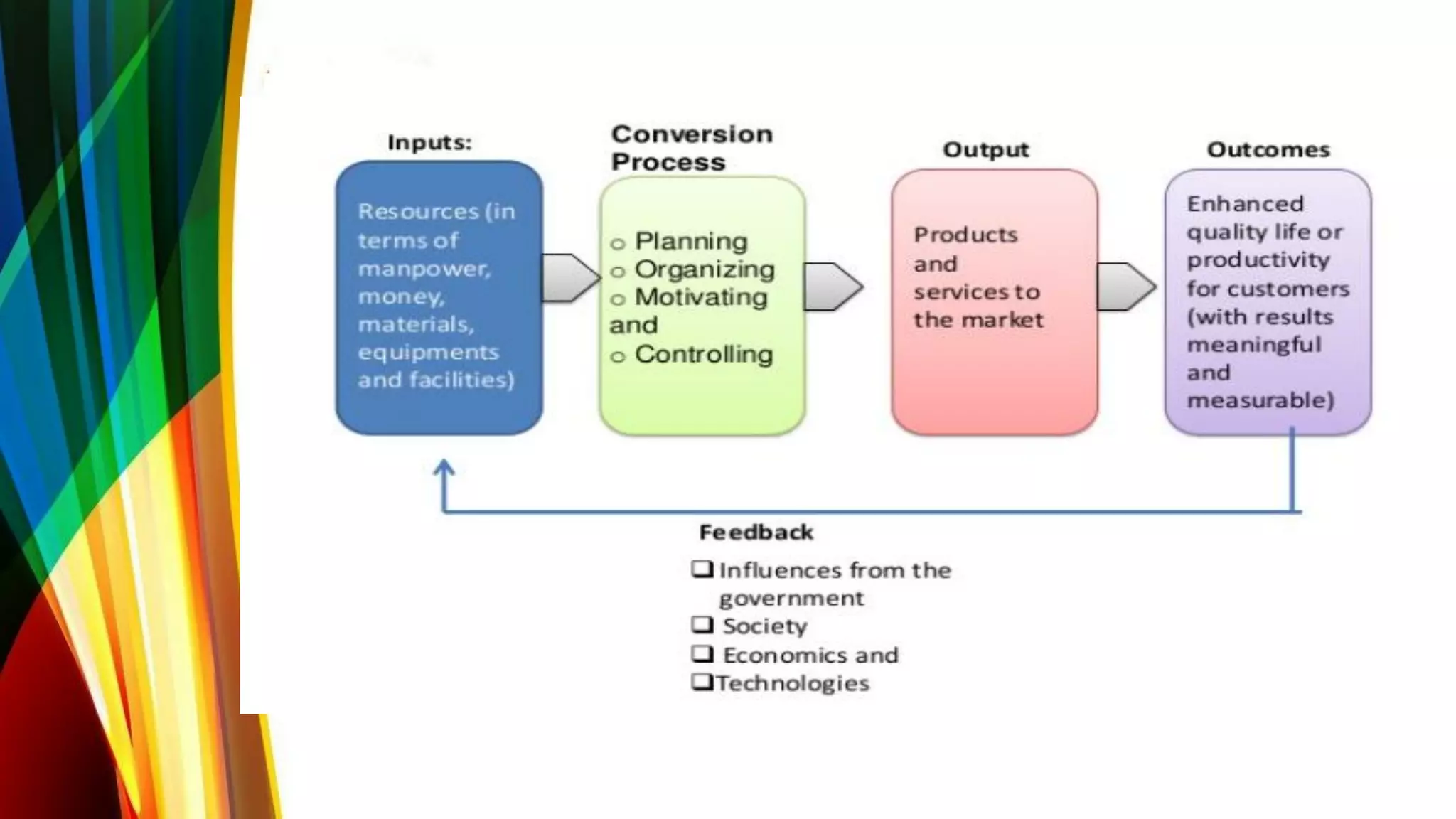
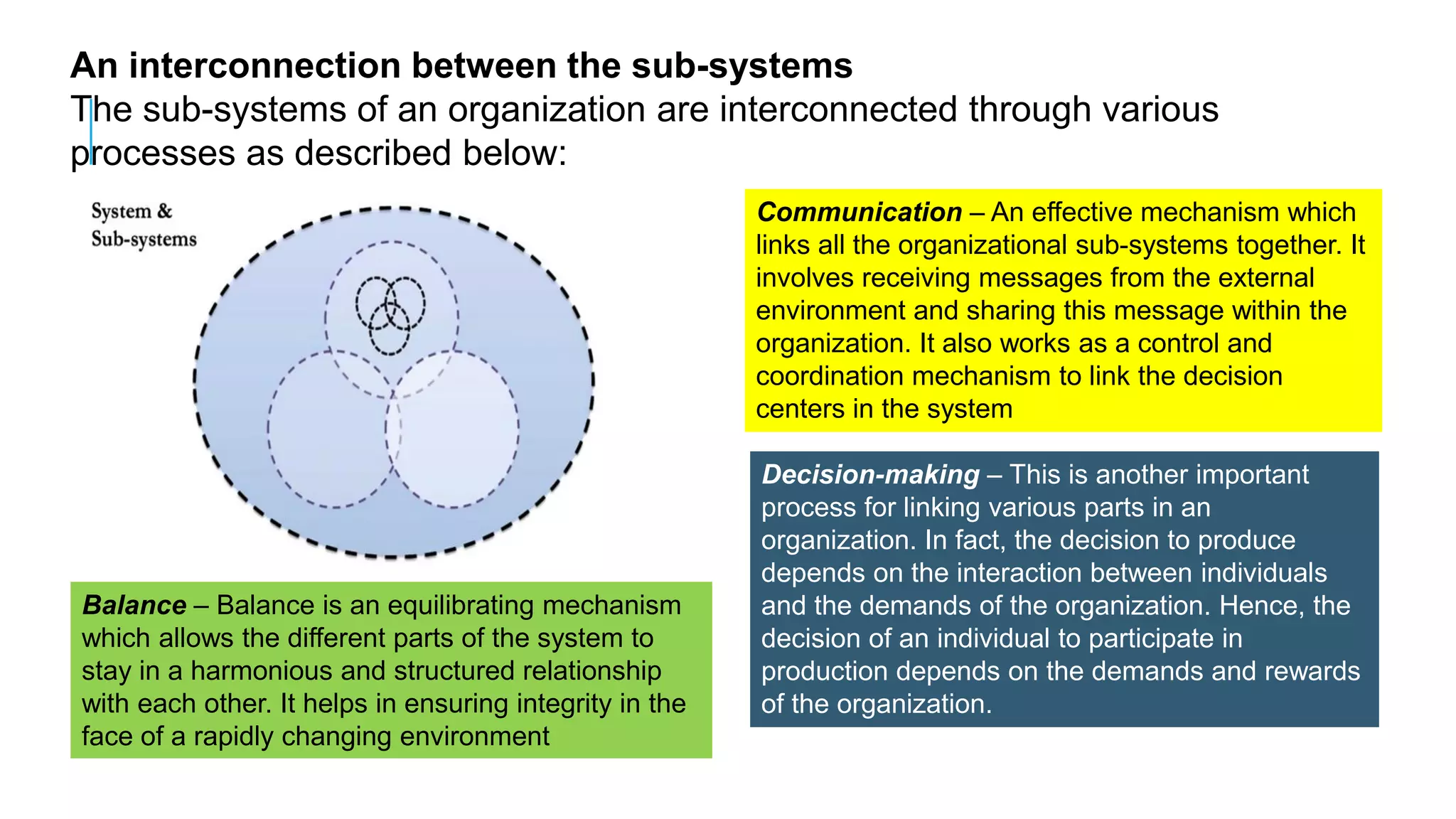
An interconnection between the sub-systems
The sub-systems of an organization are interconnected through various
processes as described below:
Communication – An effective mechanism which
links all the organizational sub-systems together. It
involves receiving messages from the external
environment and sharing this message within the
organization. It also works as a control and
coordination mechanism to link the decision
centers in the system
Decision-making – This is another important
process for linking various parts in an
organization. In fact, the decision to produce
depends on the interaction between individuals
and the demands of the organization. Hence, the
decision of an individual to participate in
production depends on the demands and rewards
of the organization.
Balance – Balance is an equilibrating mechanism
which allows the different parts of the system to
stay in a harmonious and structured relationship
with each other. It helps in ensuring integrity in the
face of a rapidly changing environment
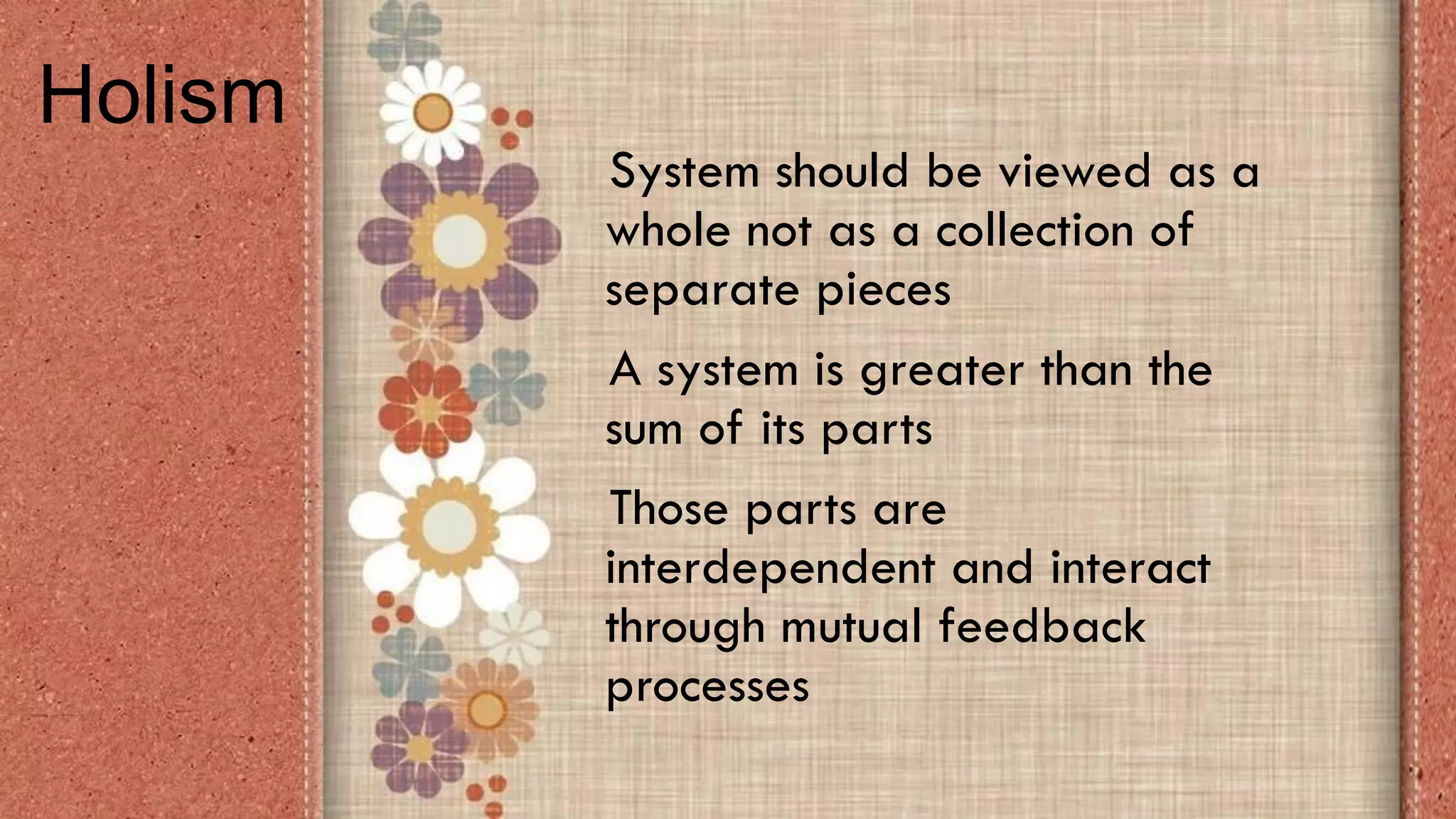
System should be viewed as a
whole not as a collection of
separate pieces
A system is greater than the
sum of its parts
Those parts are
interdependent and interact
through mutual feedback
processes
Holism
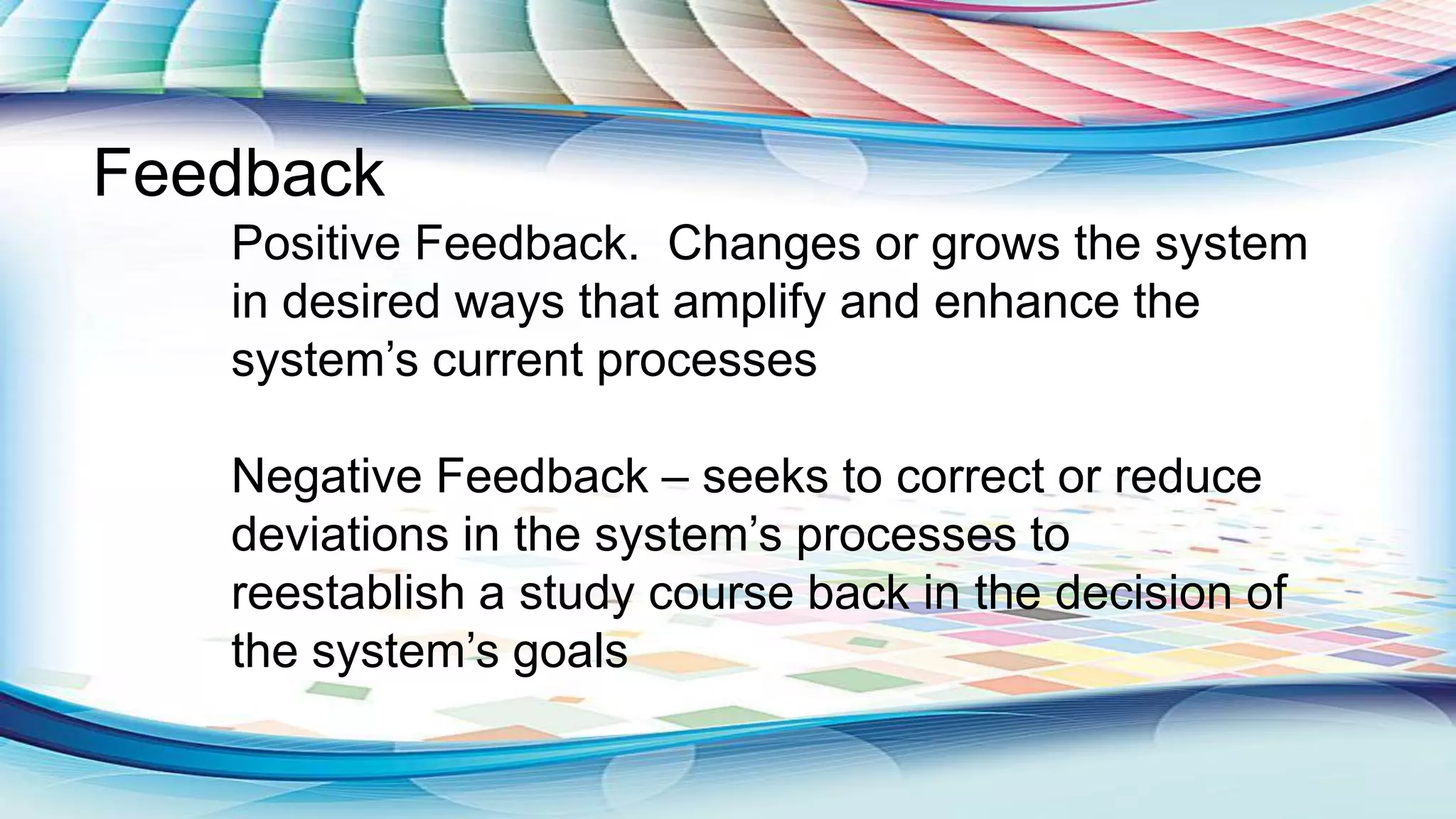
Positive Feedback. Changes or grows the system
in desired ways that amplify and enhance the
system‟s current processes
Negative Feedback – seeks to correct or reduce
deviations in the system‟s processes to
reestablish a study course back in the decision of
the system‟s goals
Feedback
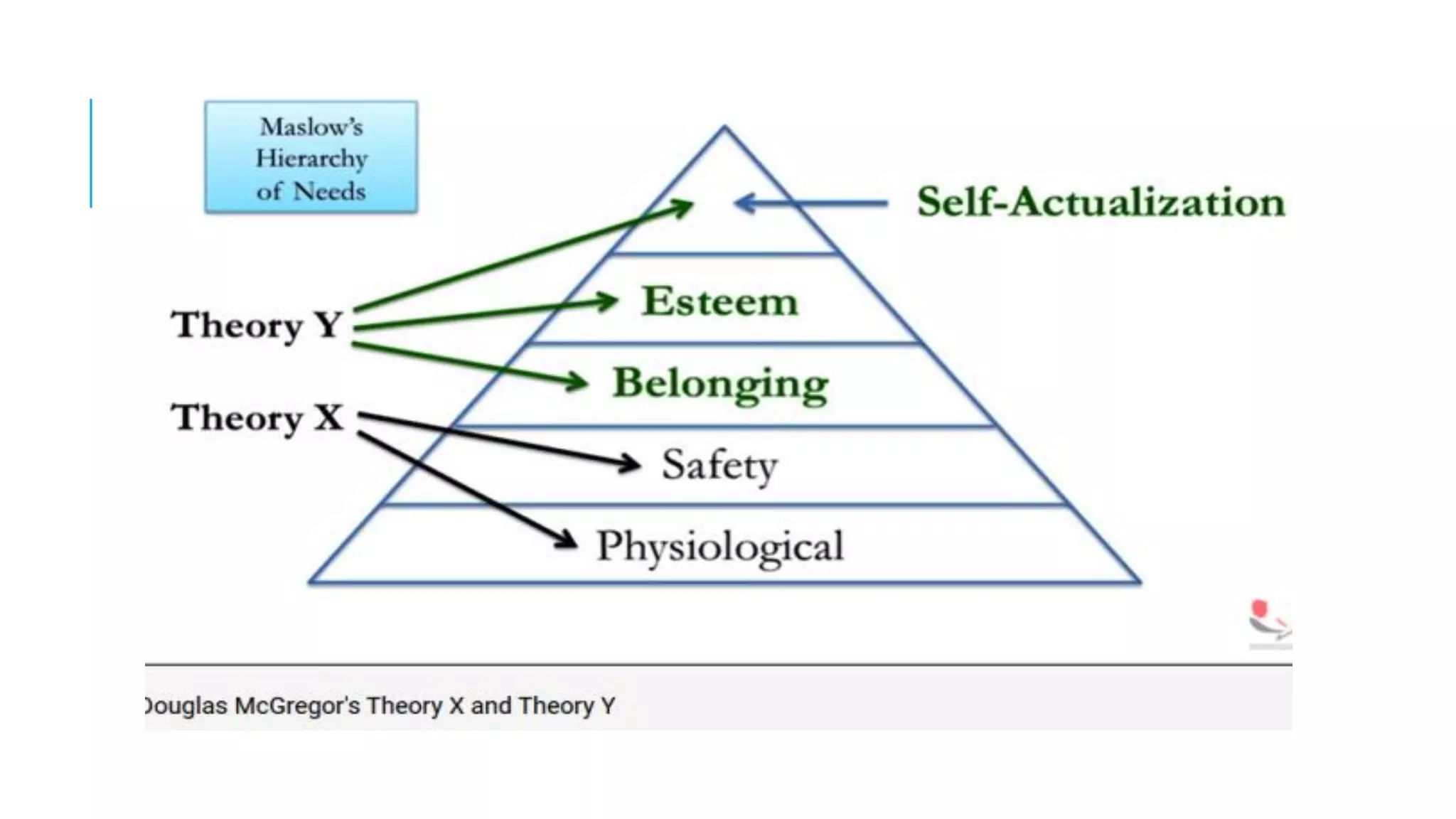
Theory X and Theory Y
Our
behavior
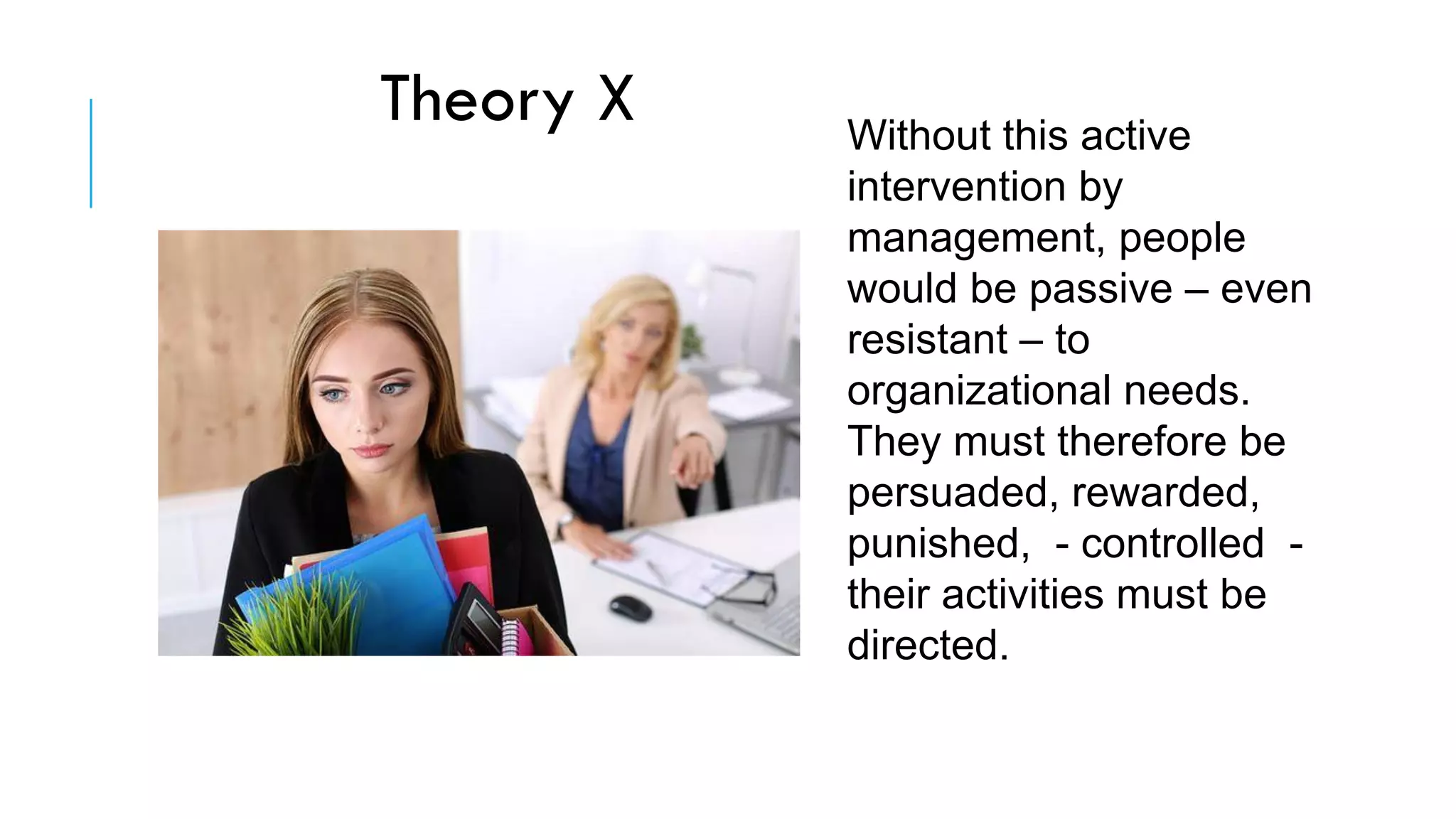
Without this active
intervention by
management, people
would be passive – even
resistant – to
organizational needs.
They must therefore be
persuaded, rewarded,
punished, - controlled -
their activities must be
directed.
Theory X
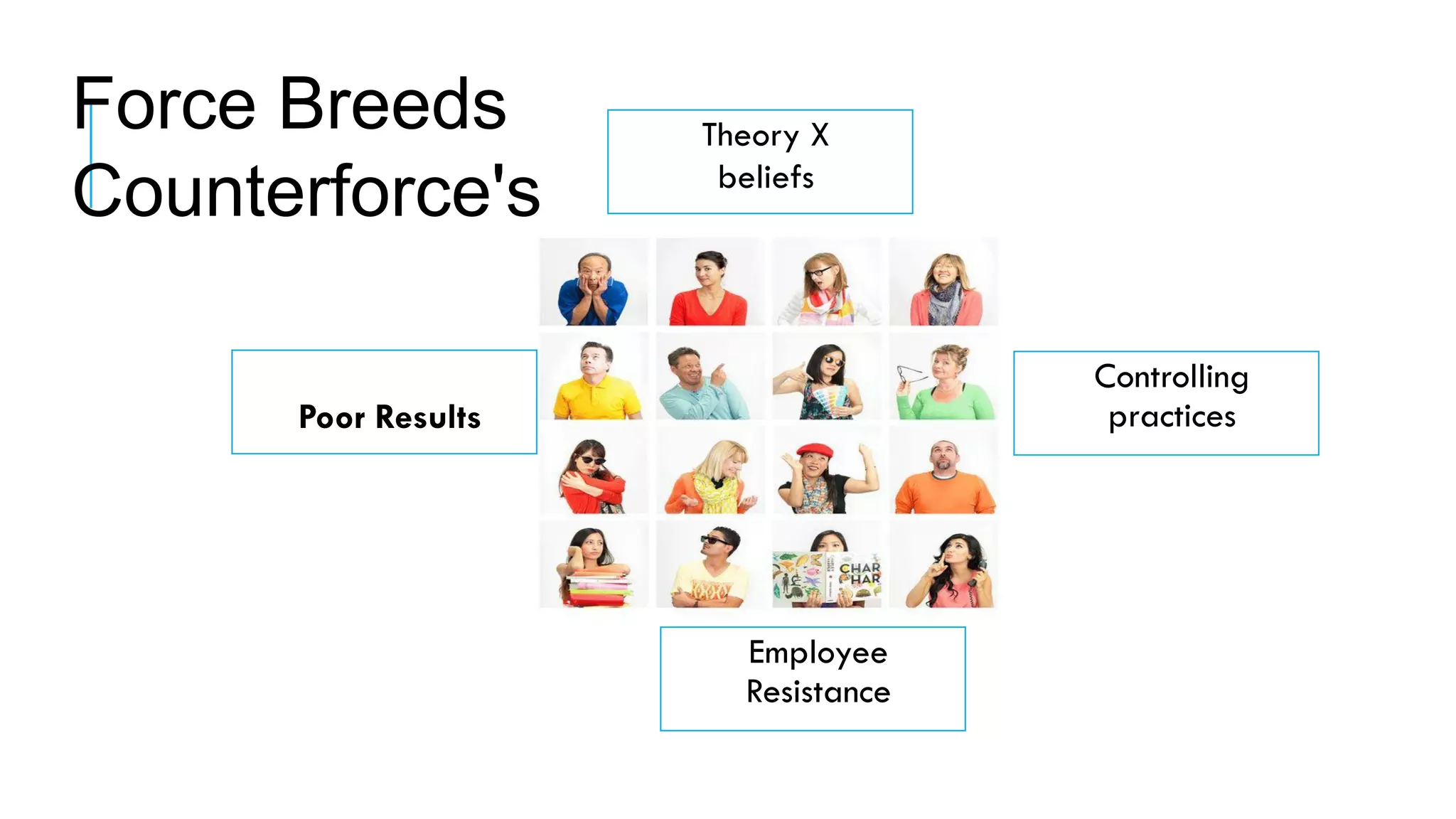
Theory X
beliefs
Controlling
practices
Poor Results
Employee
Resistance
Force Breeds
Counterforce's
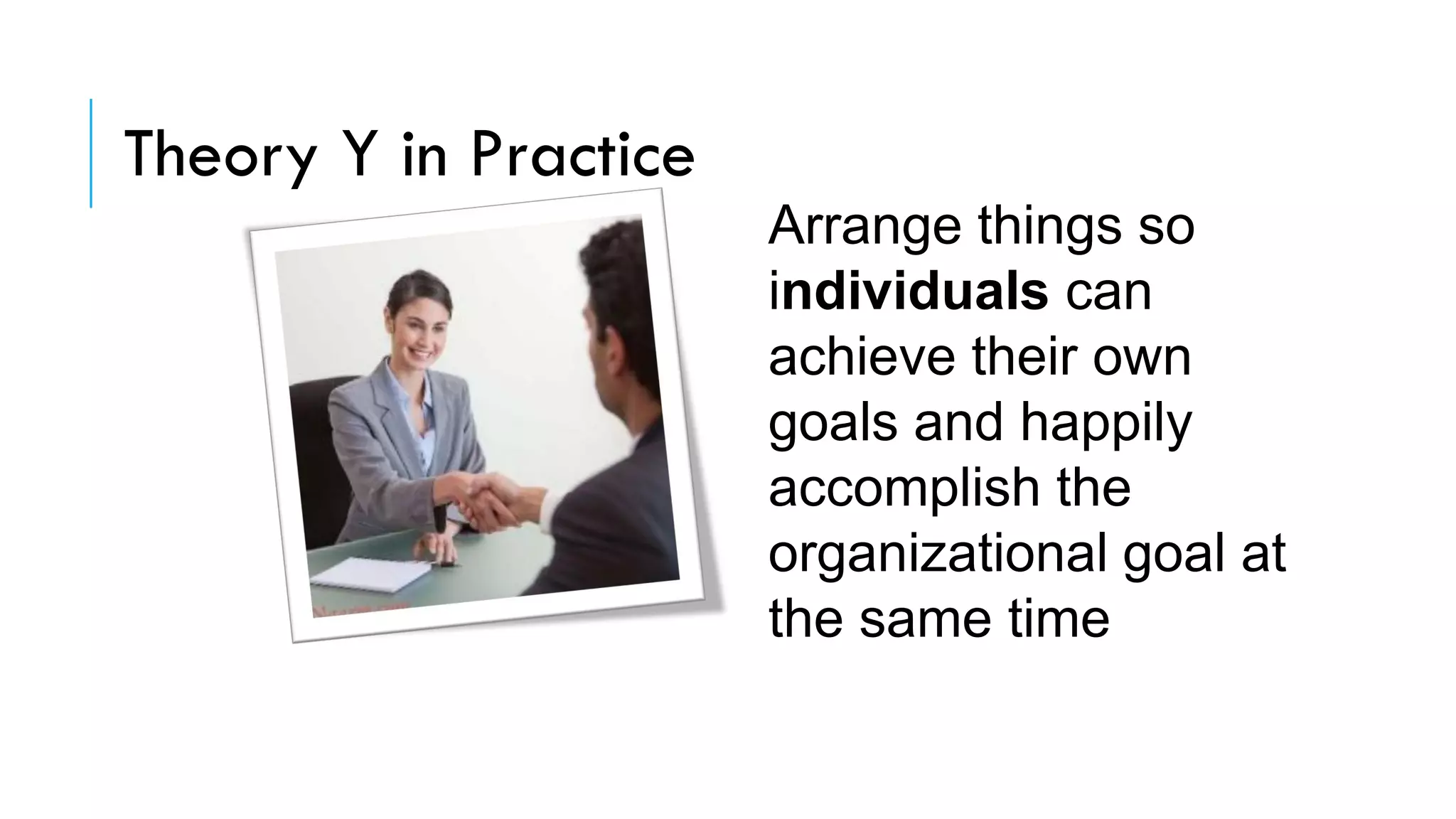
Theory Y in Practice
Arrange things so
individuals can
achieve their own
goals and happily
accomplish the
organizational goal at
the same time
The socio-technical systems approach is based on the premise that
every organization consists of the people, the technical system and
the environment (Patmore, 1988). People (the social system) use
tools, techniques and knowledge (the technical system) to produce
goods or services valued by consumers or users (who are part of
the organization's external environment). Therefore, an equilibrium
among the social system, the technical system and the environment
is necessary to make the organization more effective
Socio - Technical Approach
The situational approach (Selznick, 1949; Burns and Stalker, 1961;
Woodward, 1965; Lawrence and Borsch, 1967) is based on the
belief that there cannot be universal guidelines which are suitable
for all situations. Organizational systems are inter-related with the
environment. The contingency approach (Hellriegel and Slocum,
1973) suggests that different environments require different
organizational relationships for optimum effectiveness, taking into
consideration various social, legal, political, technical and economic
factors.
The contingency or Situational Approach
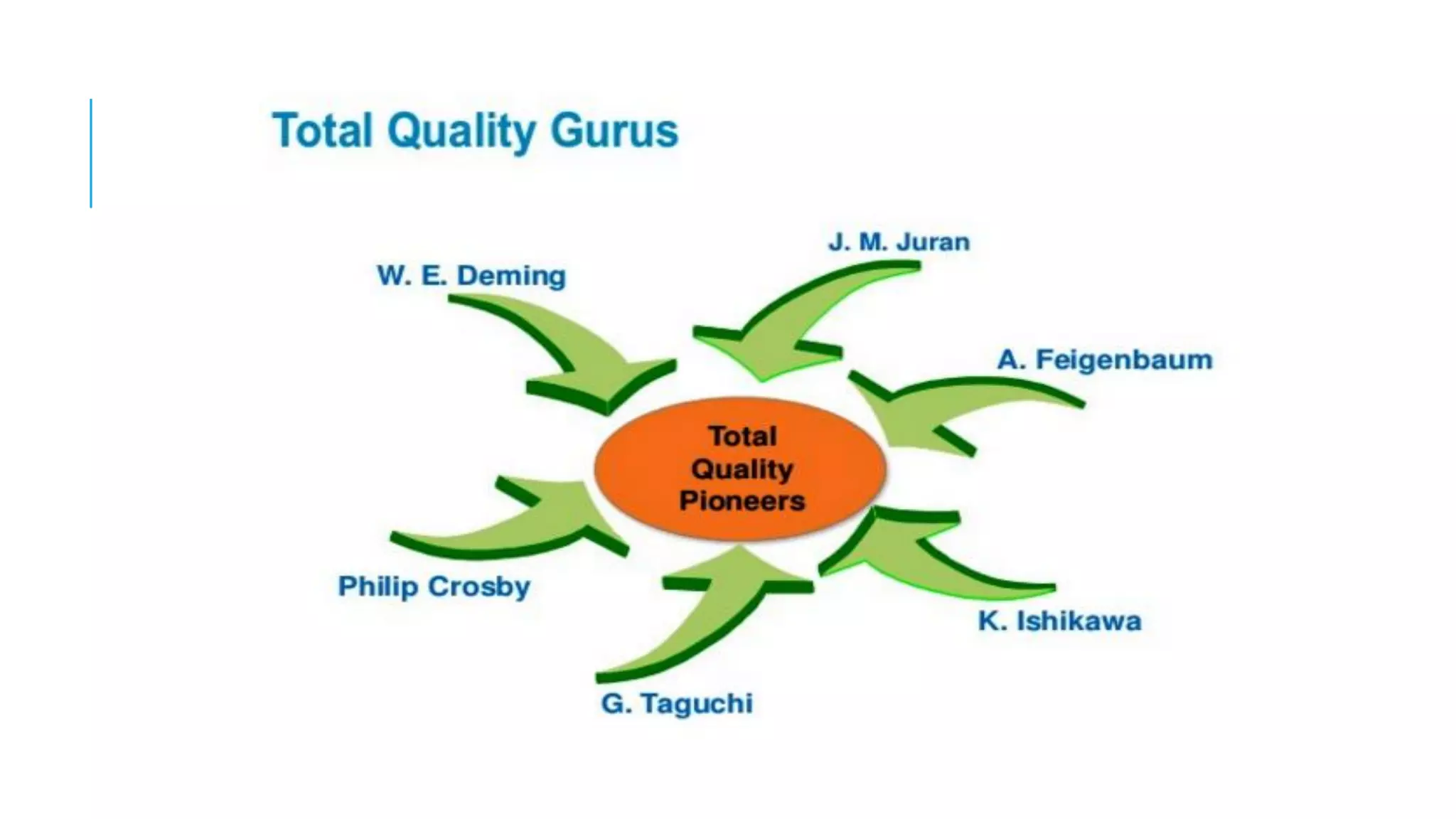
Total Quality Management is a
management approach that originated in
the 1950s and has steadily become more
popular since the early 1980s. Total Quality
is a description of the culture, attitude and
organization of a company that strives to
provide customers with products and
services that satisfy their needs. The
culture requires quality in all aspects of the
company‟s operations, with processes
being done right the first time and defects
and waste eradicated from operations
In public administration, quality
management is communicated as an attitude
that stresses customer satisfaction, improves
internal processes and empowers employees to
make decisions
Josefina B. Bitonio, DPA
Resource Person
Effective Organization and
Management with Focus on
Human Resources and
Development - Part II
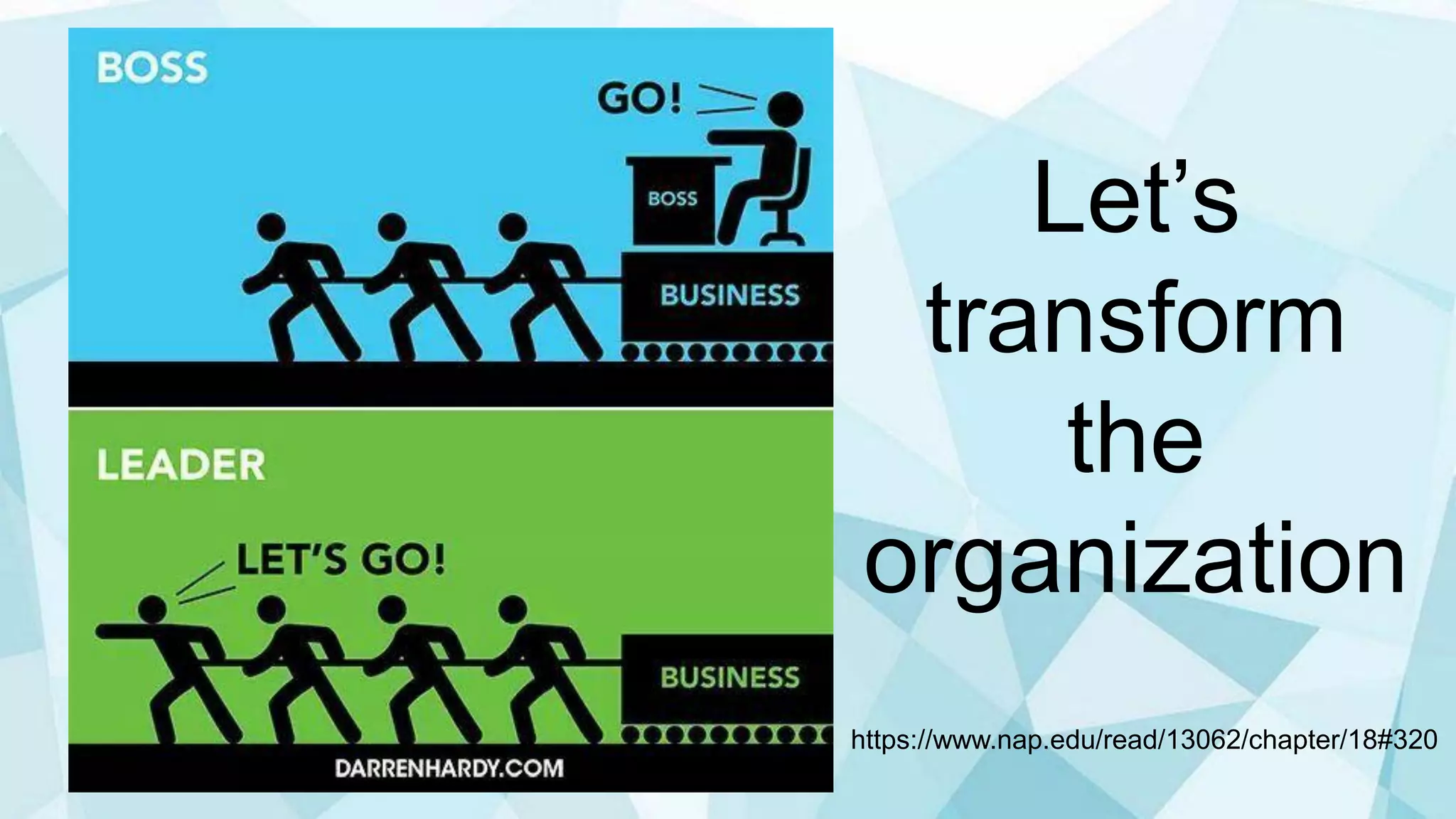
Let‟s
transform
the
organization
https://www.nap.edu/read/13062/chapter/18#320
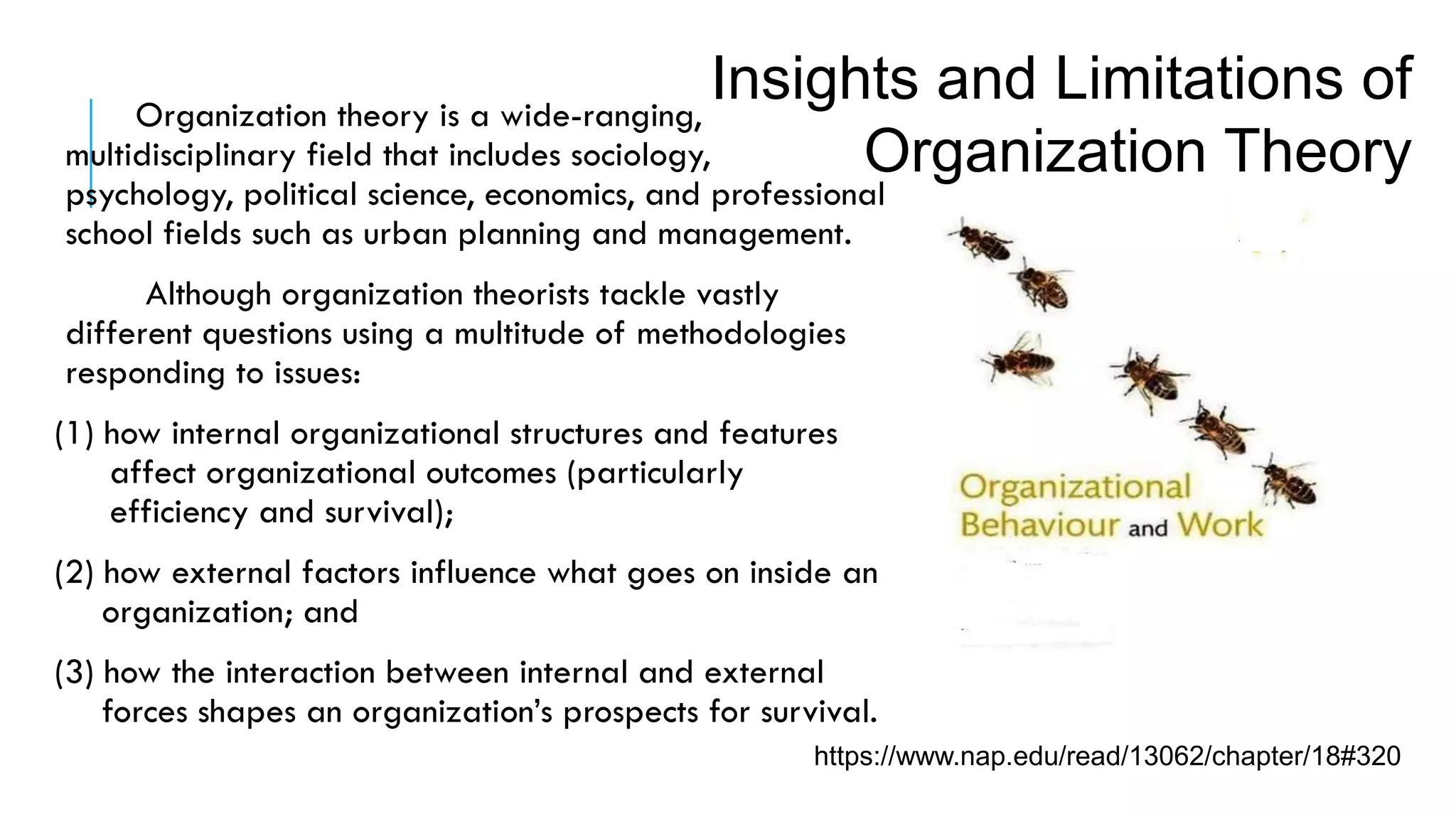
Organization theory is a wide-ranging,
multidisciplinary field that includes sociology,
psychology, political science, economics, and professional
school fields such as urban planning and management.
Although organization theorists tackle vastly
different questions using a multitude of methodologies
responding to issues:
(1) how internal organizational structures and features
affect organizational outcomes (particularly
efficiency and survival);
(2) how external factors influence what goes on inside an
organization; and
(3) how the interaction between internal and external
forces shapes an organization’s prospects for survival.
Insights and Limitations of
Organization Theory
The most serious limitation of
organization theory is its focus on firms.
As Steve Kelman (2007, p. 226) writes,
“Improving government performance is a
topic worthy of significant research
attention, yet dramatically insufficient
scholarly firepower is directed at it.” The
result is that organization theory pays
relatively little attention to political
incentives, institutions, and power, forces
that are crucial for understanding
adaptation challenges in government
agencies (Zegart, 2007).
Limitations
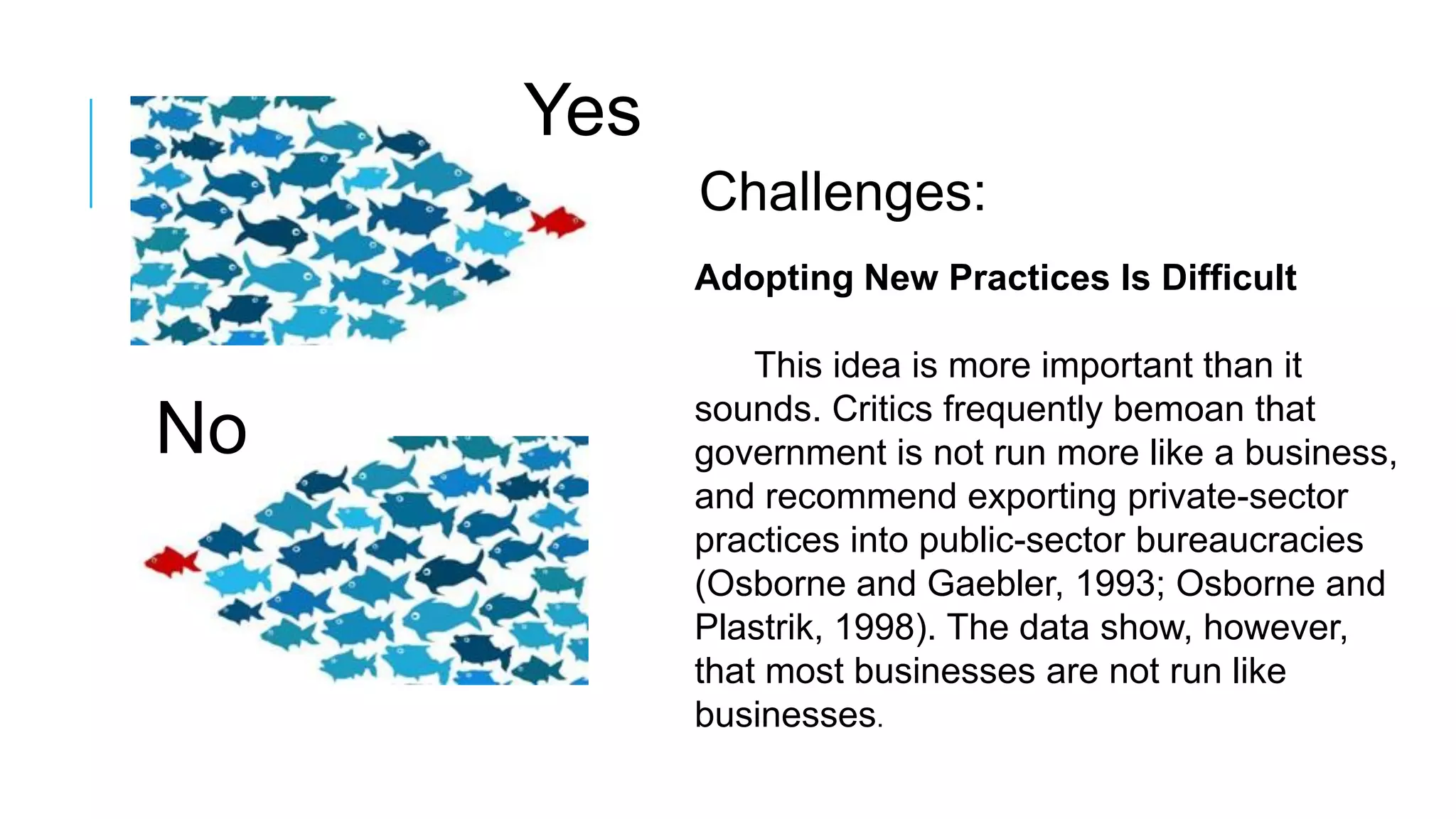
Yes
No
Challenges:
Adopting New Practices Is Difficult
This idea is more important than it
sounds. Critics frequently bemoan that
government is not run more like a business,
and recommend exporting private-sector
practices into public-sector bureaucracies
(Osborne and Gaebler, 1993; Osborne and
Plastrik, 1998). The data show, however,
that most businesses are not run like
businesses.
Organizational Structure
Matters More Than We Think
The second insight focuses on the relationship
between an organization’s structure and its ability
to learn. Cyert and March’s 1963 classic, A
Behavioral Theory of the Firm, first introduced the
idea that organizations were not fixed and rigid,
but adaptive learning systems. Four important
points:
(1) organizational learning involves acquiring,
processing, and integrating information important
to the functioning of the organization;
(2) organizational learning positively affects future
performance (Fiol and Lyles, 1985; Levitt and
March,
(3) organizations learn
in a host of directed
and spontaneous
ways; and
(4) organizational structure
can influence learning in
profound and often hidden
ways.
Social science research finds what i
insiders already know to be true:
employees become wedded to
organizational routines, thinking, norms,
ideas, and identities and these
attachments make change difficult
Resistance to innovation stems more from
the everyday aspects of organizational
life than from a few old-timers or old-
thinkers. Levitt and March argue that
organizational performance often falls
victim to “competency traps,” which are
routines that were once beneficial, but
have become obsolete over time (Levitt
and March, 1988; March, 1981).
competency traps
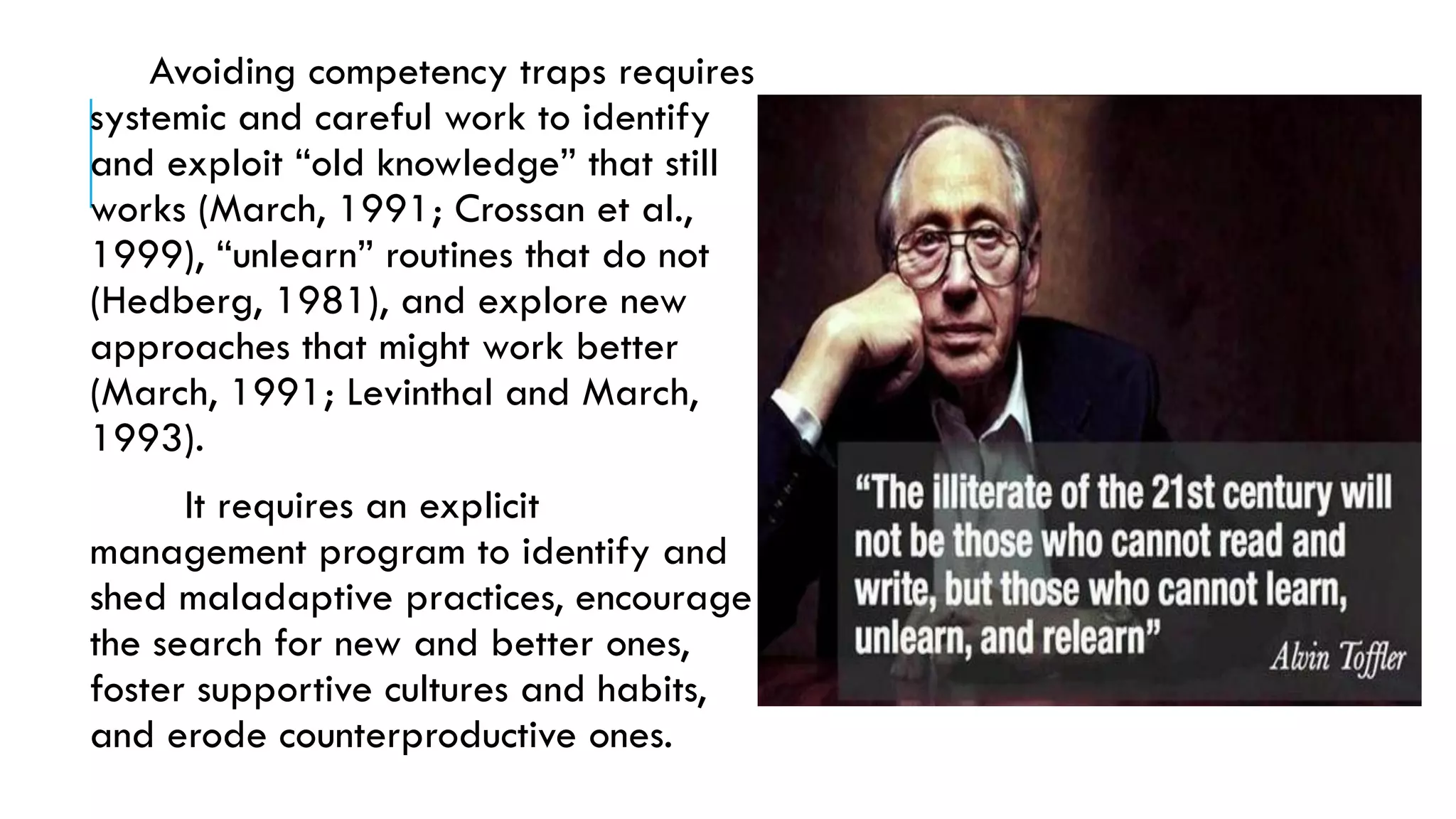
Avoiding competency traps requires
systemic and careful work to identify
and exploit “old knowledge” that still
works (March, 1991; Crossan et al.,
1999), “unlearn” routines that do not
(Hedberg, 1981), and explore new
approaches that might work better
(March, 1991; Levinthal and March,
1993).
It requires an explicit
management program to identify and
shed maladaptive practices, encourage
the search for new and better ones,
foster supportive cultures and habits,
and erode counterproductive ones.
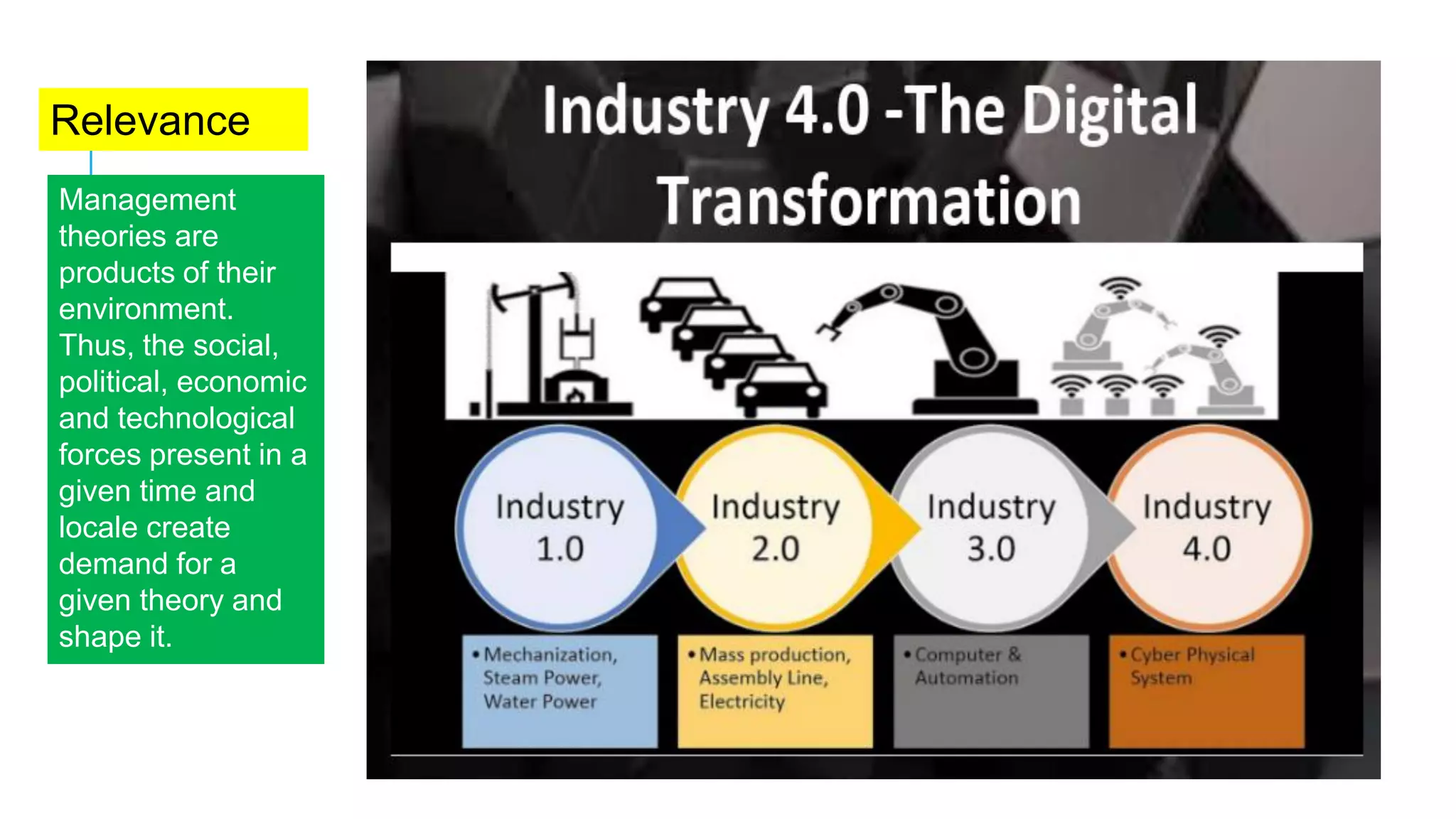
Relevance
Management
theories are
products of their
environment.
Thus, the social,
political, economic
and technological
forces present in a
given time and
locale create
demand for a
given theory and
shape it.
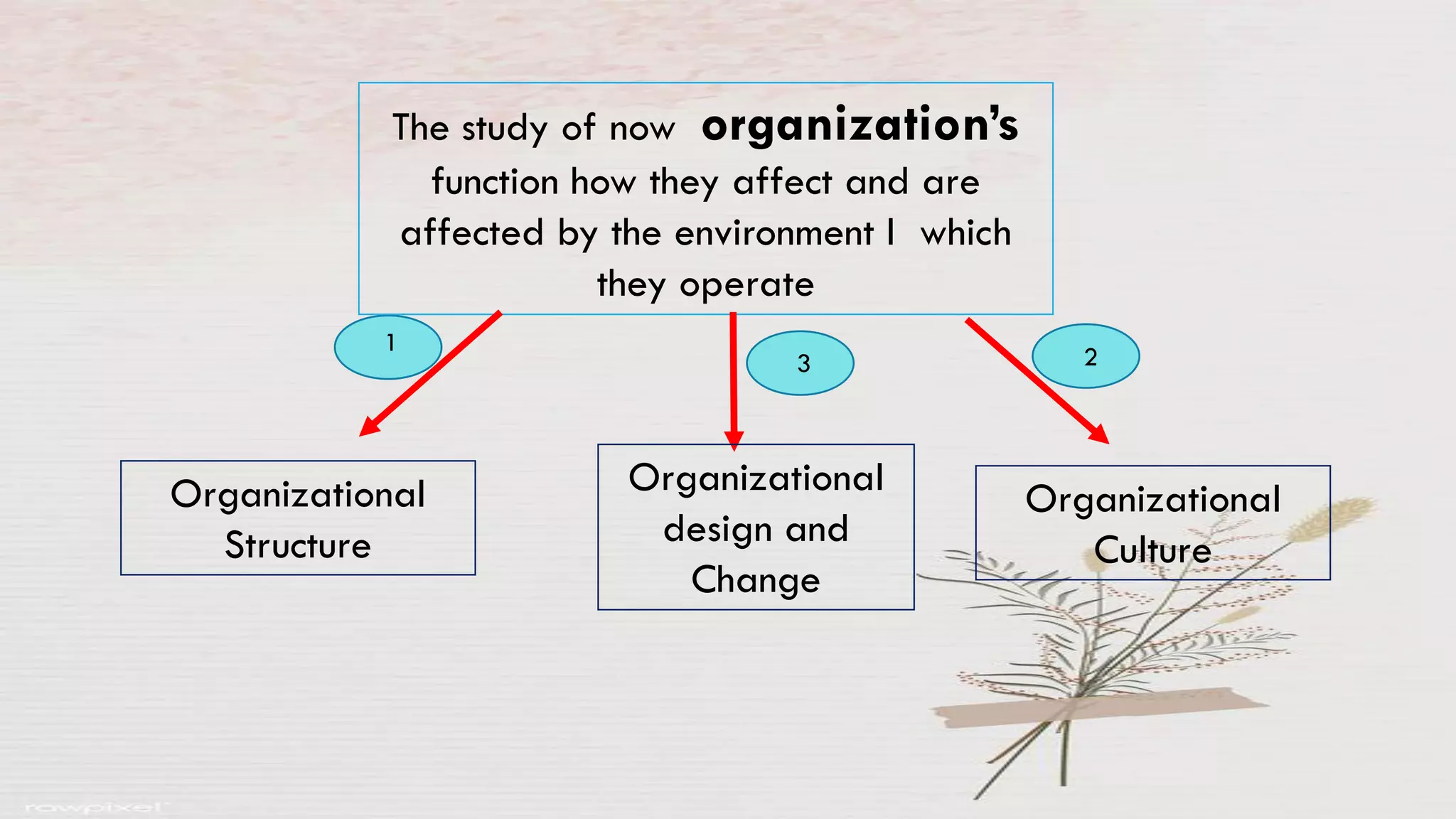
The study of now organization’s
function how they affect and are
affected by the environment I which
they operate
Organizational
design and
Change
Organizational
Structure
Organizational
Culture
1
2
3
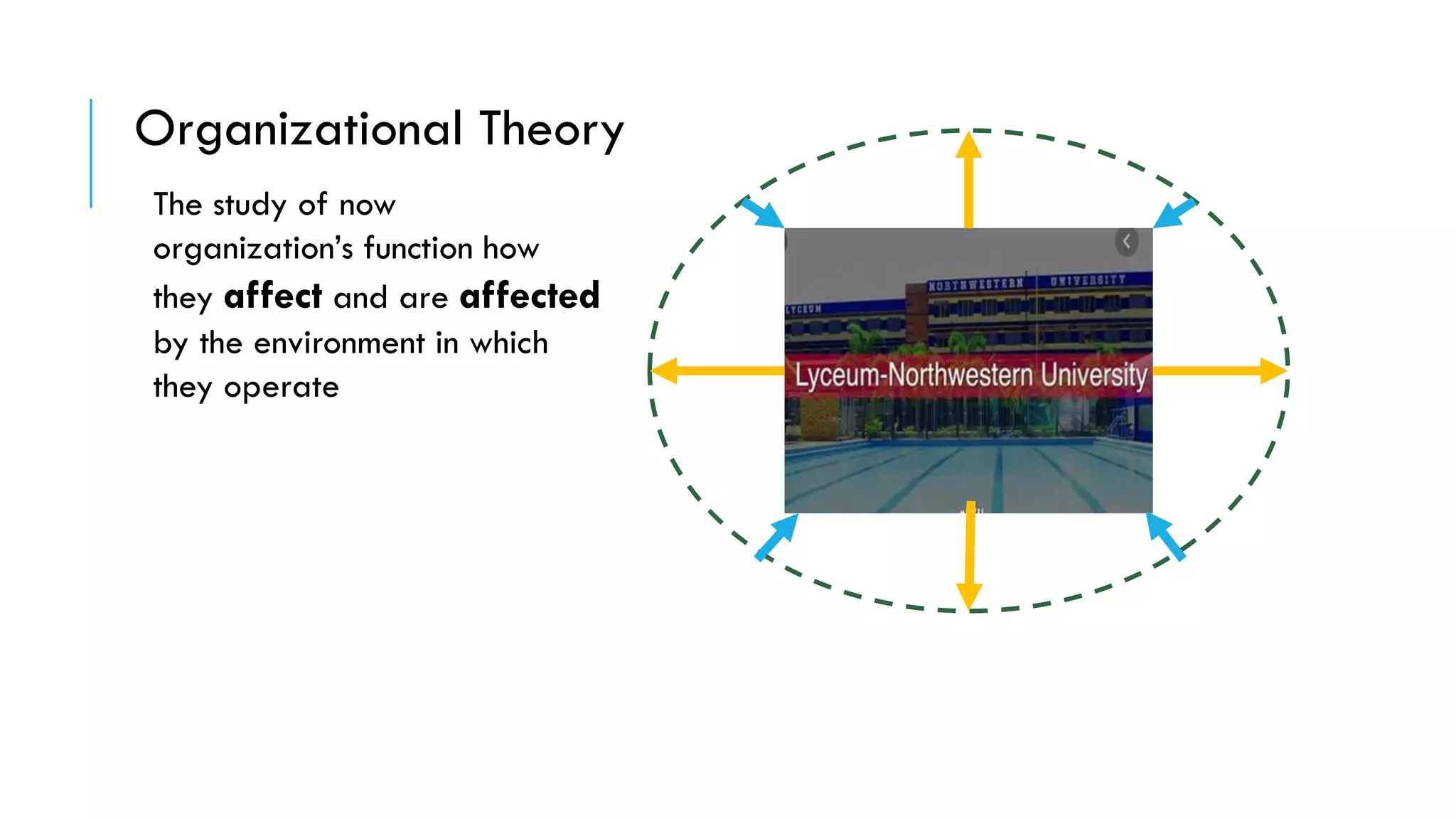
The study of now
organization’s function how
they affect and are affected
by the environment in which
they operate
Organizational Theory
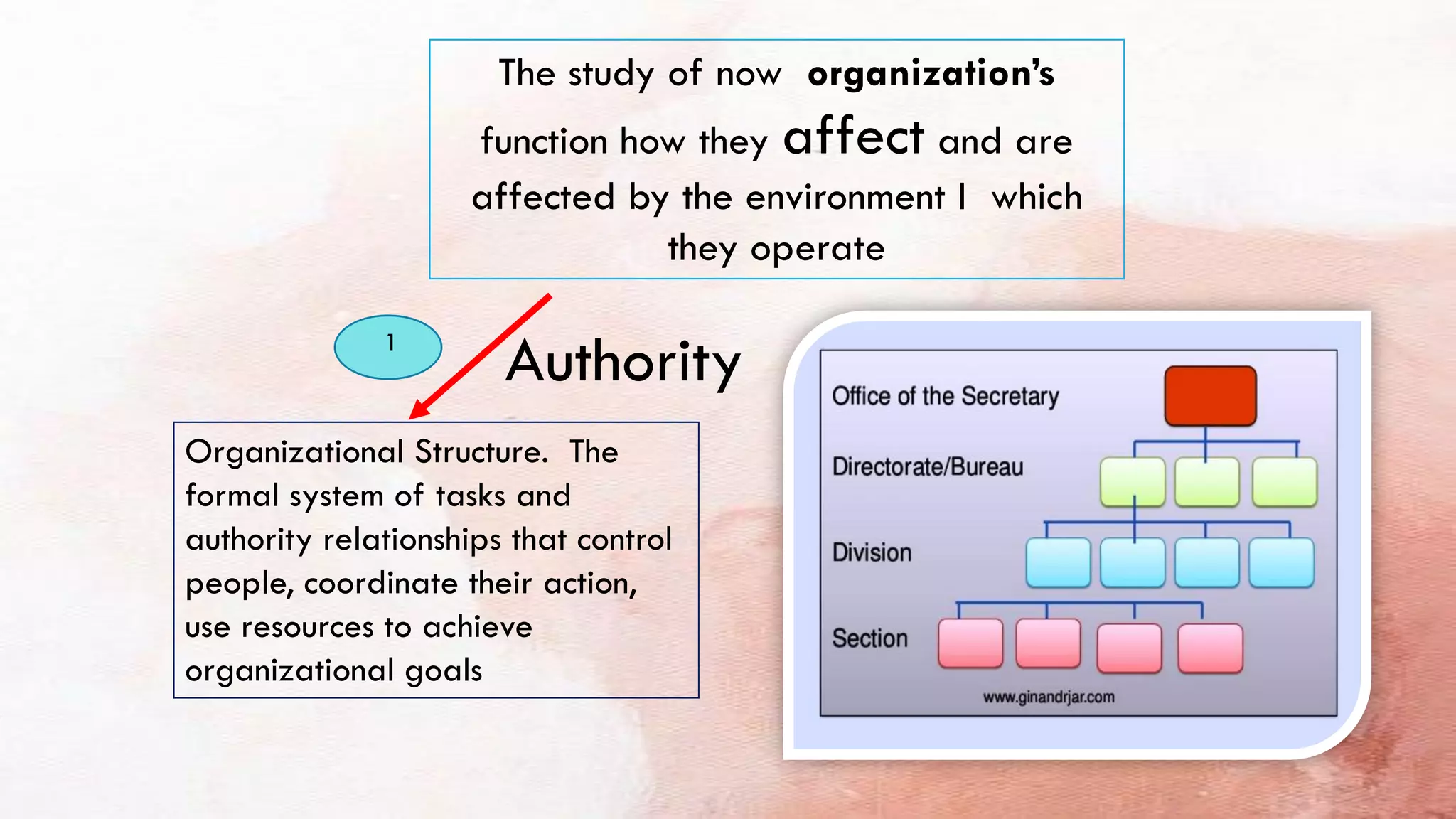
The study of now organization’s
function how they affect and are
affected by the environment I which
they operate
Organizational Structure. The
formal system of tasks and
authority relationships that control
people, coordinate their action,
use resources to achieve
organizational goals
1
Authority
The study of now organization’s
function how they affect and are
affected by the environment I which
they operate
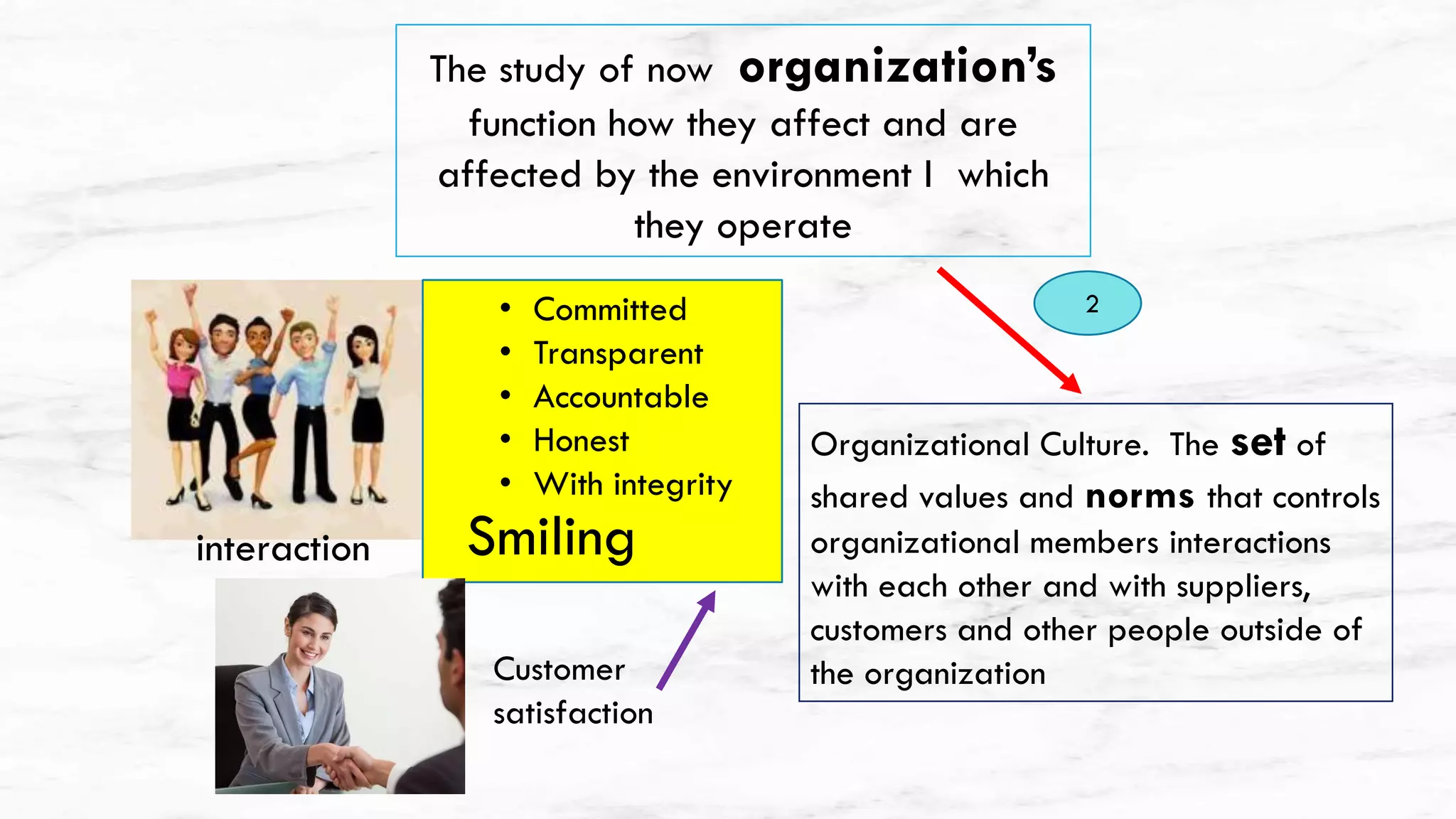
Organizational Culture. The set of
shared values and norms that controls
organizational members interactions
with each other and with suppliers,
customers and other people outside of
the organization
2
• Committed
• Transparent
• Accountable
• Honest
• With integrity
Smiling
Customer
satisfaction
interaction
The study of now organization’s
function how they affect and are
affected by the environment I which
they operate
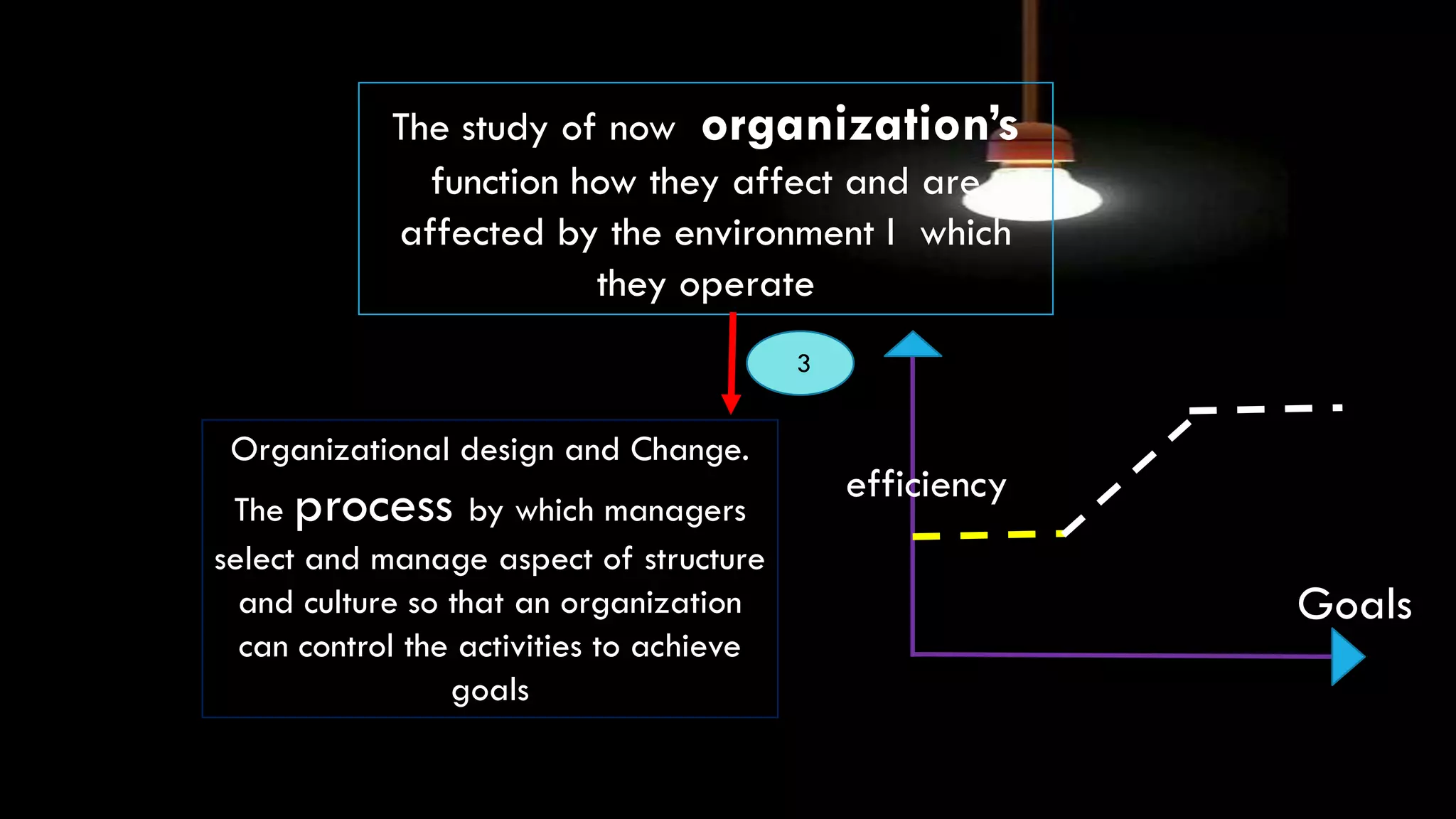
Organizational design and Change.
The process by which managers
select and manage aspect of structure
and culture so that an organization
can control the activities to achieve
goals
3
efficiency
Goals
The study of now organization’s
function how they affect and are
affected by the environment I which
they operate
1
2
3
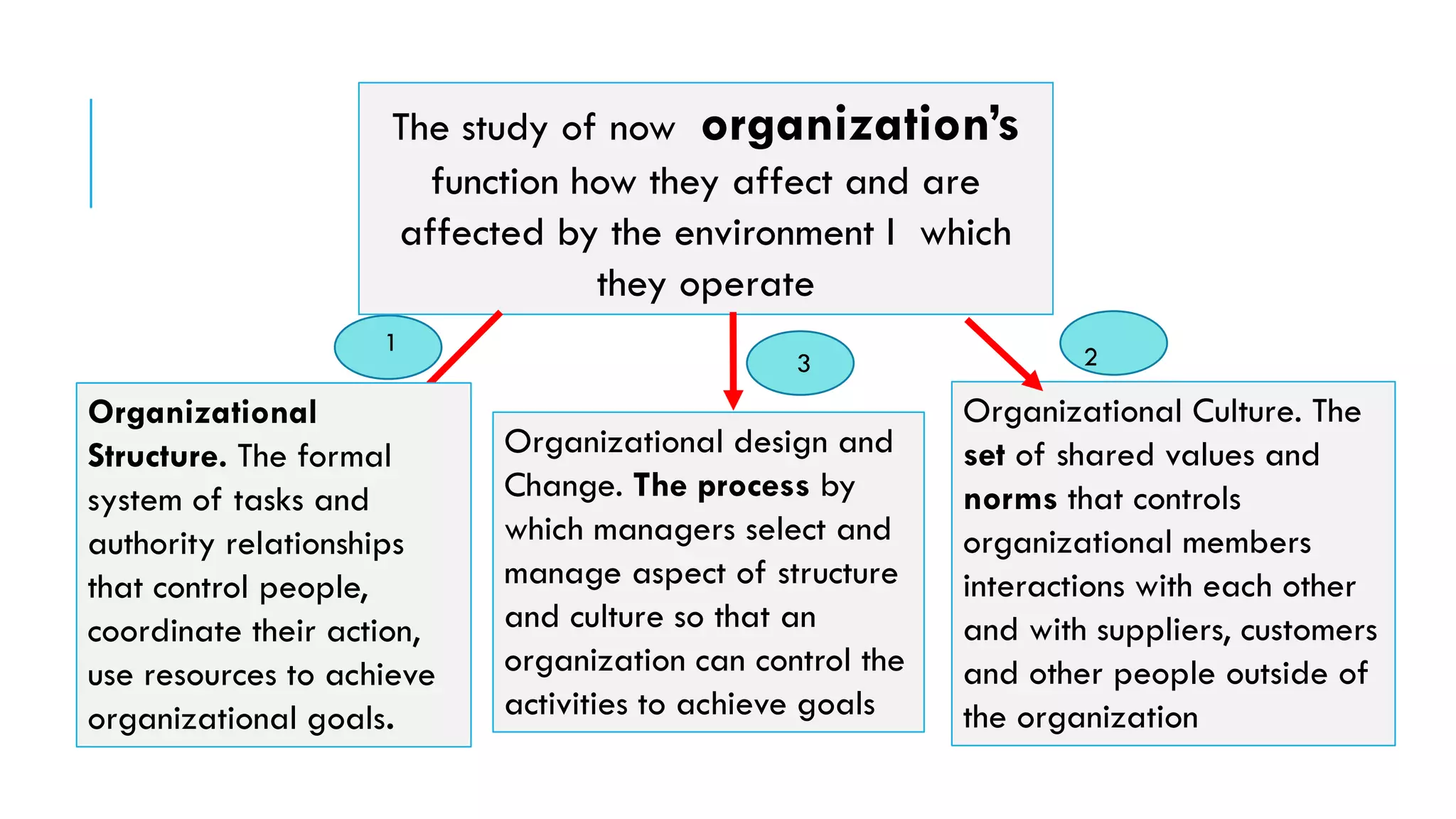
Organizational
Structure. The formal
system of tasks and
authority relationships
that control people,
coordinate their action,
use resources to achieve
organizational goals.
Organizational design and
Change. The process by
which managers select and
manage aspect of structure
and culture so that an
organization can control the
activities to achieve goals
Organizational Culture. The
set of shared values and
norms that controls
organizational members
interactions with each other
and with suppliers, customers
and other people outside of
the organization
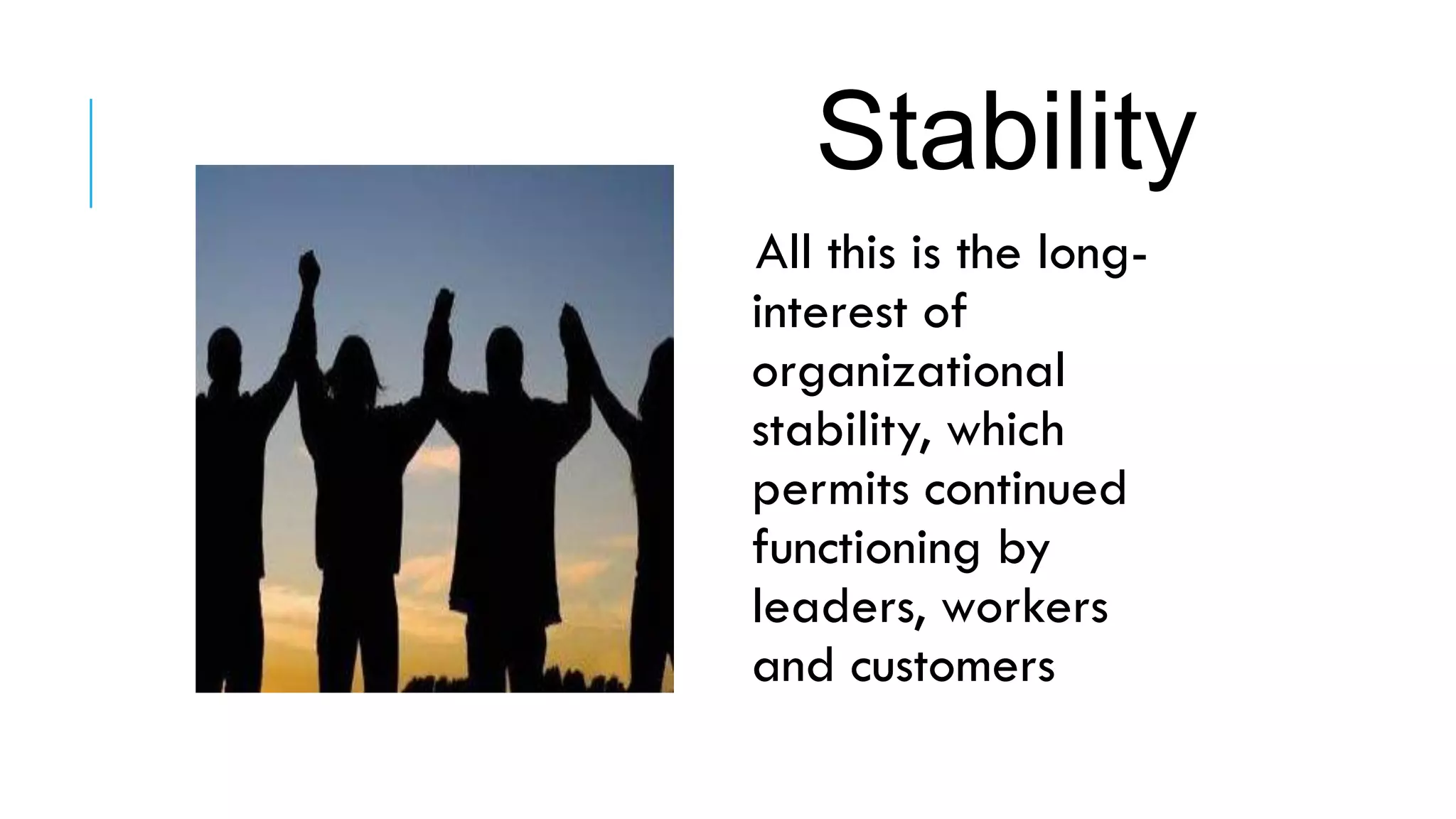
All this is the long-
interest of
organizational
stability, which
permits continued
functioning by
leaders, workers
and customers
Stability
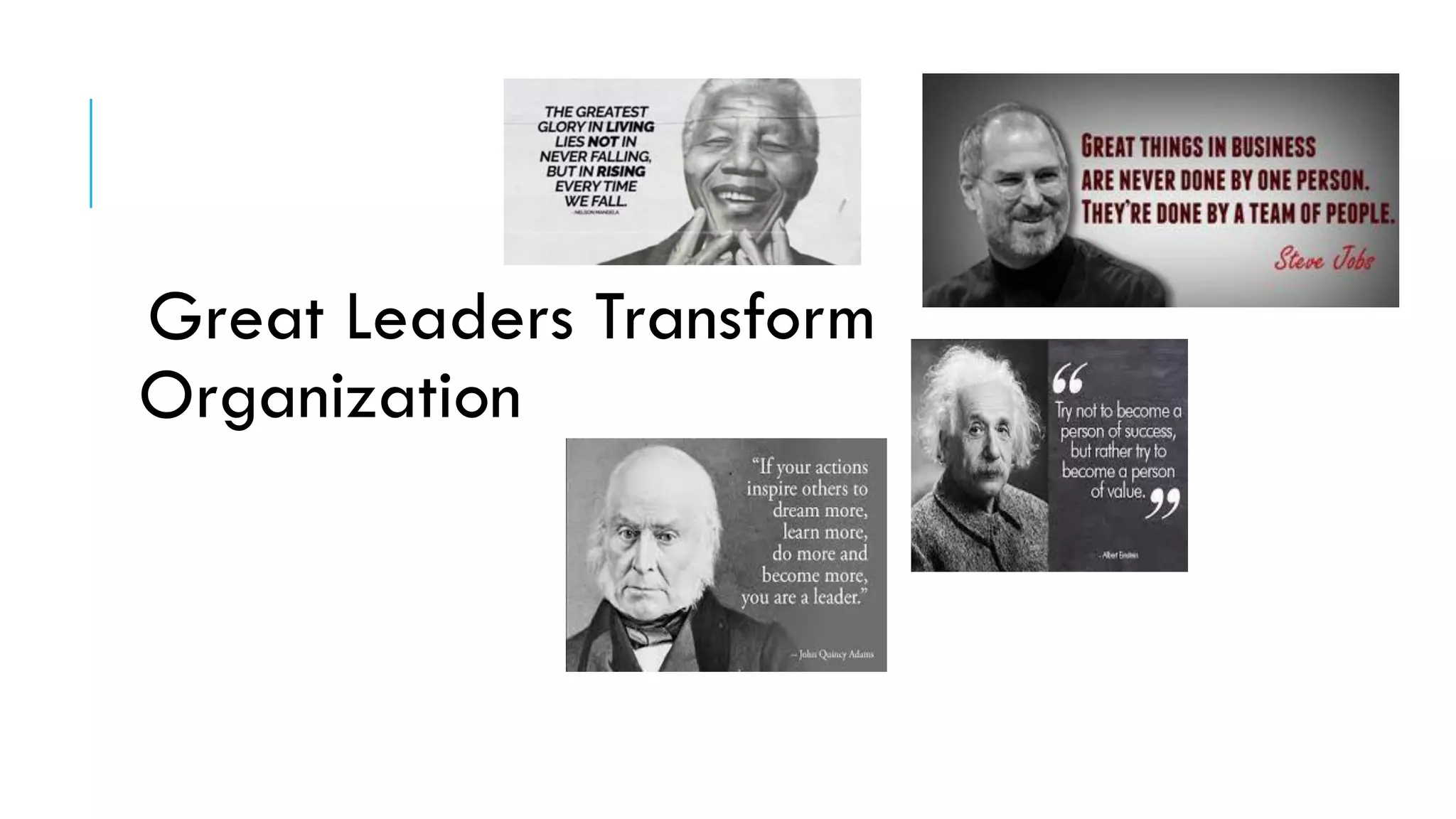
Great Leaders Transform
Organization
Organization and Management with focus on Human Resources and Development

Organization and Management with focus on Human Resources and Development

  • 1.
    Josefina B. Bitonio,DPA Resource Person Effective Organization and Management with Focus on Human Resources and Development - Part I
  • 2.
    Organization are defineddifferently by different authors. There are, however, certain essential elements that can be discerned from them. In other words, organizations consist of people who, more or less, share common objectives or purpose. The behavior of the organization is directed towards the attainment of these objectives
  • 3.
    It is anassociation of several to many people who are attempting to fulfill; the common goals
  • 4.
    The members whocompromise the organization work jointly in groups and cooperate together in interdependent relationships. This suggests that organizations structure and integrate their activities. Furthermore, organizations use knowledge and techniques to accomplish their goals.
  • 5.
    Organizations and Managementfocuses on the study of two things: how individuals and groups interact within organizations, and how firms interact with one another and with consumers, employees, communities, and institutions. https://som.yale.edu/programs/phd/overview/organizations-and-management
  • 6.
    The Nature ofOrganization and Management is twin terms that exist side by side with each other, each one needs and supports the other. Organizations will be motionless and useless if there is no management that will steer it; management will be hollow and meaningless if there’s no organization to manage. https://www.slideshare.net/jobitonio/o-m-27141569
  • 7.
    The Nature ofOrganization and Management. In the real world of administration, organization and management are essential elements through which human actions and objectives are carried out and accomplished. In a manner of speaking, organization and management become a means to an end.
  • 9.
  • 10.
    Walt Rostow tooka historical approach in suggesting that developed countries have tended to pass through 5 stages to reach their current degree of economic development. Rostow's Five Stages of Economic Growth Model
  • 11.
    Take off Great Britain1783-1802 Russia 1890-1914 USA 1843-1860 Germany 1850-1873 Canada 1896-1914 China 1952 India 1952
  • 12.
    DRIVE TO MATURITY GreatBritain 1850 Russia 1950 USA 1900 Germany 1910 Canada 1950 The modern industrial sector attracted workers from the rural areas
  • 13.
    Industry 1.0, and 2.0are the eras where organizational studies are dominated by a view of the organization as machines Goals: efficiency, productivity and control predominant economic or social values of the time
  • 14.
  • 15.
    How are wegoing to organize all of this? How are we going to maximize productivity? How are we going to manage all of these people?
  • 16.
    Assumptions Proponents of earlier approachesmade quite a few assumptions that were grounded on the predominant economic or social values of the time and the perceived needs of management of labor
  • 17.
    The theory consistsof principles that describe relationships observed in association with phenomenon. The primary role of theory is to provide a description as well as explanation of the phenomenon. This means that organization theory can help us in understanding people within the organization (us) ; what is organizations, how organization behaves in a given environment and how they may behave in a different set of circumstances Organizational Theories
  • 18.
    Organizational Theories 1. ClassicalOrganization Theory • Scientific Management Approach • Weber‟s Bureaucratic Approach • Administrative Theory 2. Neo Classical Theory 3. Modern Organizational Theory How did current management theories develop?
  • 19.
    The Classical ManagementTheory is thought to have originated around the year 1900 and dominated management thinking into the 1920s, focusing on the efficiency of the work process. It has three schools of thinking: • Scientific Management which looks at „the best way‟ to do a job Scientific Management • , which focuses on rules and procedures, hierarchy and clear division of labor Bureaucratic management • which emphasizes the flow of information within the organization Administrative management,
  • 20.
    Classical Organization Theory Early1900s to 1930 Merging of three fields of Scientific Management Frederick W. Taylor Max Weber Henri Fayol 1864-1920 1841-1921 1856 – 1915
  • 21.
    From human manualcraft work to the application of mechanization to factory, the advancement of technology and its’ application to manufacturing industry in late eighteen century and early ninety century made this theory became possible for the purpose of economic efficiency and labor productivity. Scientific Management Theory Though a systematic study of labor flow, including time and motion studies, workers were rewarded or punished upon the conditions of reduction or elimination of waste, task standardization and best practice of labor procedures. Application of scientific management yielded significant improvements in productivity. Scientific management worked well for organizations with assembly line setups and other reutilized jobs. From 1901 to 1915 the scientific management was introduced to at least 181 American factories.
  • 22.
    Max Weber's conceptof the iron cage capitalist production technological and economic relationships Weber considered the iron cage a massive hindrance to freedom. The Protestant Ethic and the Spirit of Capitalism he researched and theorized the interplay between the cultural realm of values and beliefs, and the economic system of society. Max Weber expressed the importance of values in the development of public administration theory. However, theory cannot simply be derived from empirical observation of facts, it must be constructed using value judgments that direct our empirical observations and then guide out interpretation of those observations. Values are essential for the construction of public administration theories because it takes into account the meaningful ethical principles and philosophies of a culture which ensure appropriate theory practice. Public Administration theories are put into practice or considered through a few distinct strategies Max Weber is famous for his thesis that the “Protestant ethic” (the supposedly Protestant values of hard work, thrift, efficiency, and orderliness)
  • 23.
    Administrative Management Theory HenryFayol (1841-1925) Fayol provided 14 principles of general management to guide the managers who in his time didn‟t use a scientific approach of management. His theory is based on how the management should interact with the employees. Fayol‟s theory provided a broad and analytical framework of the process of administration which overcomes the drawback of Taylor‟s management theory.
  • 24.
    Hierarchy Standardized approach towork Centralization of authority Separation of personal and work life Wanted to select the best employee People paid fairly it is more appropriate for stable and simple organization Commonalities & Overlap
  • 25.
    Classical management theorywas introduced in the late 19th century. It became widespread in the first half of the 20th century, as organizations tried to address issues of industrial management, including specialization, efficiency, higher quality, cost reduction and management-worker relationships. Contributions: 1. Increased production, Decreased cost, Improvement in or Maintenance of Quality, Speedy Production and Accurate Delivery and the Power and Stimulus of Knowledge (Farquhar) 2. Made a significant contribution to the development of management theories 3. Administrative theory focused on the total organization and on way to make it more efficient 4. Classical approach highlighted the universal character of management principles (Berdayes V, 2002). 5. it often prescribed the universal procedures that are not appropriate in some setting. Henry H. Farquhar, 1919 https://www.jstor.org/stable/pdf/1885947.pdf
  • 26.
    Criticism • Rigid andmechanistic. It follows an assembly line approach where the social and self- actualization needs of the employees are not taken into consideration. • Too formal • Authoritarian -deliberately promote a „yes- boss‟ culture • Limit on individual discretion • Does not satisfy the need of belongingness and community • Applicable to factories where typically routine work happens
  • 27.
    1. Definitely veryvaluable today. 2. The classical management approaches are still used today by many small-business owners to build their companies and to succeed. This has since led to the development of further theories 3. The key underlying principles remain unchanged. Management today, like it was 100 years ago, is still very much about planning, organizing, controlling, influencing. 4. Public organizations were molded on the classical organizational management theoretical perspectives and have proven remarkably stable in different circumstances around the world. Relevance today
  • 28.
    Neoclassical Theories 1920‟s–1940 • Human Relations School • Most modern theories of Organization Elton Mayo 1880 -1949 Chester Barnard 1886-1961 Herbert A. Simon 1916 - 2001 Theories of Bounded Rationality and Satisficing Hawthorne and solidarity among the work group Studies Solidarity Theory of Behavior in formal organization that centered in cooperation; sense of purpose
  • 29.
    The classical approachstressed the formal organization. It was mechanistic and ignored major aspects of human nature. In contrast, the neoclassical approach introduced an informal organization structure and emphasized the following principles: The individual is not a mechanical tool but a distinct social being, with aspirations beyond mere fulfilment of a few economic and security works. Individuals differ from each other in pursuing these desires. Thus, an individual should be recognized as interacting with social and economic factors.· The work group highlighted the social facets of work groups or informal organizations that operate within a formal organization. The concept of 'group' and its synergistic benefits were considered important. Participative management or decision making permits workers to participate in the decision making process. This was a new form of management to ensure increases in productivity. Principles of the Neoclassical Approach
  • 30.
    Informal Organization Informalorganization is a spontaneous creation which is generated automatically based on some common characteristics like caste, religion, region or some other form of mental matching. The relationships among the informal network is not restricted by the formal authority Coffee group Newspaper Group Millennial Core Group
  • 31.
    Contributions of NeoClassical Theory • Organization exists to serve human needs • People and organization need each other • When the fit between individual and system is poor, both suffer • A good fit profits both the individual and organization • Organizations can not exist independently and isolated • Opened up the door to an explosion of studies in organization
  • 32.
    Neoclassical theorists recognizedthe importance of individual or group behavior and emphasized human relations. Based on the Hawthorne experiments, the neoclassical approach emphasized social or human relationships among the operators, researchers and supervisors (Roethlisberger and Dickson, 1943). It was argued that these considerations were more consequential in determining productivity than mere changes in working conditions. Productivity increases were achieved as a result of high morale, which was influenced by the amount of individual, personal and intimate attention workers received. Contributions of Neo Classical Theory
  • 33.
    Criticism 1. The assumptionson which this theory is based are sometimes not true. A thinking that there is always a possibility of finding a solution acceptable to all is not true. There are conflicting interests among various groups that are structural in character and not merely psychological. This aspect has not been discussed in the theory. 2. No particular organizational structure can be suitable for all the organizations. Various organizational formats given by neo- classists are not applicable in all situations. 3. Neo-classical theory is only a modification of classical organization theory. It suffers from nearly same drawbacks from which classical theory suffered. It lacks unified approach of organization. This theory has also been criticized on the ground that it is nothing more than “a trifling body of empirical and descriptive information as it was mainly based on Hawthorne Studies.”
  • 34.
    Organizational theories are usefulin explaining many aspects of human behavior within the organization Modern Organizational Theories
  • 35.
    • Modern organizationtheory is constructed on an interdisciplinary basis, broadening the perspective that can be developed concerning organization behavior and the management of large, complex, organization. • The integration of valuable concepts of the classical models with the social and behavioral sciences. This theory posits that an organization is a system that changes with the change in its environment, both internal and external.
  • 36.
    System Theory In thecontext of modern social science, a system theory, tend to be based on the concept that the organization is a system which has to adapt to changes in its environment Open System Closed System
  • 37.
    Open systems continuously interactwith their environment, there is a constant need to balancing pressures and responses, demands and resources and worker incentives and contributions Open System Closed System which have no interaction with their environment. Closed systems have the advantage of being efficient because there are clear procedures that are not affected by outside influences. The best way to understand closed systems is to see how they are used in organizations.
  • 39.
    An interconnection betweenthe sub-systems The sub-systems of an organization are interconnected through various processes as described below: Communication – An effective mechanism which links all the organizational sub-systems together. It involves receiving messages from the external environment and sharing this message within the organization. It also works as a control and coordination mechanism to link the decision centers in the system Decision-making – This is another important process for linking various parts in an organization. In fact, the decision to produce depends on the interaction between individuals and the demands of the organization. Hence, the decision of an individual to participate in production depends on the demands and rewards of the organization. Balance – Balance is an equilibrating mechanism which allows the different parts of the system to stay in a harmonious and structured relationship with each other. It helps in ensuring integrity in the face of a rapidly changing environment
  • 41.
    System should beviewed as a whole not as a collection of separate pieces A system is greater than the sum of its parts Those parts are interdependent and interact through mutual feedback processes Holism
  • 42.
    Positive Feedback. Changesor grows the system in desired ways that amplify and enhance the system‟s current processes Negative Feedback – seeks to correct or reduce deviations in the system‟s processes to reestablish a study course back in the decision of the system‟s goals Feedback
  • 43.
    Theory X andTheory Y Our behavior
  • 44.
    Without this active interventionby management, people would be passive – even resistant – to organizational needs. They must therefore be persuaded, rewarded, punished, - controlled - their activities must be directed. Theory X
  • 45.
  • 46.
    Theory Y inPractice Arrange things so individuals can achieve their own goals and happily accomplish the organizational goal at the same time
  • 48.
    The socio-technical systemsapproach is based on the premise that every organization consists of the people, the technical system and the environment (Patmore, 1988). People (the social system) use tools, techniques and knowledge (the technical system) to produce goods or services valued by consumers or users (who are part of the organization's external environment). Therefore, an equilibrium among the social system, the technical system and the environment is necessary to make the organization more effective Socio - Technical Approach
  • 49.
    The situational approach(Selznick, 1949; Burns and Stalker, 1961; Woodward, 1965; Lawrence and Borsch, 1967) is based on the belief that there cannot be universal guidelines which are suitable for all situations. Organizational systems are inter-related with the environment. The contingency approach (Hellriegel and Slocum, 1973) suggests that different environments require different organizational relationships for optimum effectiveness, taking into consideration various social, legal, political, technical and economic factors. The contingency or Situational Approach
  • 50.
    Total Quality Managementis a management approach that originated in the 1950s and has steadily become more popular since the early 1980s. Total Quality is a description of the culture, attitude and organization of a company that strives to provide customers with products and services that satisfy their needs. The culture requires quality in all aspects of the company‟s operations, with processes being done right the first time and defects and waste eradicated from operations
  • 52.
    In public administration,quality management is communicated as an attitude that stresses customer satisfaction, improves internal processes and empowers employees to make decisions
  • 54.
    Josefina B. Bitonio,DPA Resource Person Effective Organization and Management with Focus on Human Resources and Development - Part II
  • 55.
  • 56.
    https://www.nap.edu/read/13062/chapter/18#320 Organization theory isa wide-ranging, multidisciplinary field that includes sociology, psychology, political science, economics, and professional school fields such as urban planning and management. Although organization theorists tackle vastly different questions using a multitude of methodologies responding to issues: (1) how internal organizational structures and features affect organizational outcomes (particularly efficiency and survival); (2) how external factors influence what goes on inside an organization; and (3) how the interaction between internal and external forces shapes an organization’s prospects for survival. Insights and Limitations of Organization Theory
  • 57.
    The most seriouslimitation of organization theory is its focus on firms. As Steve Kelman (2007, p. 226) writes, “Improving government performance is a topic worthy of significant research attention, yet dramatically insufficient scholarly firepower is directed at it.” The result is that organization theory pays relatively little attention to political incentives, institutions, and power, forces that are crucial for understanding adaptation challenges in government agencies (Zegart, 2007). Limitations
  • 58.
    Yes No Challenges: Adopting New PracticesIs Difficult This idea is more important than it sounds. Critics frequently bemoan that government is not run more like a business, and recommend exporting private-sector practices into public-sector bureaucracies (Osborne and Gaebler, 1993; Osborne and Plastrik, 1998). The data show, however, that most businesses are not run like businesses.
  • 59.
    Organizational Structure Matters MoreThan We Think The second insight focuses on the relationship between an organization’s structure and its ability to learn. Cyert and March’s 1963 classic, A Behavioral Theory of the Firm, first introduced the idea that organizations were not fixed and rigid, but adaptive learning systems. Four important points: (1) organizational learning involves acquiring, processing, and integrating information important to the functioning of the organization; (2) organizational learning positively affects future performance (Fiol and Lyles, 1985; Levitt and March, (3) organizations learn in a host of directed and spontaneous ways; and (4) organizational structure can influence learning in profound and often hidden ways.
  • 60.
    Social science researchfinds what i insiders already know to be true: employees become wedded to organizational routines, thinking, norms, ideas, and identities and these attachments make change difficult Resistance to innovation stems more from the everyday aspects of organizational life than from a few old-timers or old- thinkers. Levitt and March argue that organizational performance often falls victim to “competency traps,” which are routines that were once beneficial, but have become obsolete over time (Levitt and March, 1988; March, 1981). competency traps
  • 61.
    Avoiding competency trapsrequires systemic and careful work to identify and exploit “old knowledge” that still works (March, 1991; Crossan et al., 1999), “unlearn” routines that do not (Hedberg, 1981), and explore new approaches that might work better (March, 1991; Levinthal and March, 1993). It requires an explicit management program to identify and shed maladaptive practices, encourage the search for new and better ones, foster supportive cultures and habits, and erode counterproductive ones.
  • 62.
    Relevance Management theories are products oftheir environment. Thus, the social, political, economic and technological forces present in a given time and locale create demand for a given theory and shape it.
  • 65.
    The study ofnow organization’s function how they affect and are affected by the environment I which they operate Organizational design and Change Organizational Structure Organizational Culture 1 2 3
  • 66.
    The study ofnow organization’s function how they affect and are affected by the environment in which they operate Organizational Theory
  • 67.
    The study ofnow organization’s function how they affect and are affected by the environment I which they operate Organizational Structure. The formal system of tasks and authority relationships that control people, coordinate their action, use resources to achieve organizational goals 1 Authority
  • 68.
    The study ofnow organization’s function how they affect and are affected by the environment I which they operate Organizational Culture. The set of shared values and norms that controls organizational members interactions with each other and with suppliers, customers and other people outside of the organization 2 • Committed • Transparent • Accountable • Honest • With integrity Smiling Customer satisfaction interaction
  • 69.
    The study ofnow organization’s function how they affect and are affected by the environment I which they operate Organizational design and Change. The process by which managers select and manage aspect of structure and culture so that an organization can control the activities to achieve goals 3 efficiency Goals
  • 70.
    The study ofnow organization’s function how they affect and are affected by the environment I which they operate 1 2 3 Organizational Structure. The formal system of tasks and authority relationships that control people, coordinate their action, use resources to achieve organizational goals. Organizational design and Change. The process by which managers select and manage aspect of structure and culture so that an organization can control the activities to achieve goals Organizational Culture. The set of shared values and norms that controls organizational members interactions with each other and with suppliers, customers and other people outside of the organization
  • 71.
    All this isthe long- interest of organizational stability, which permits continued functioning by leaders, workers and customers Stability
  • 72.