Organizational
Behavior
The classical theory is a traditional theory,
wherein more emphasis is on the organization
rather then the employees working therein.
Focus on process.
According to theory, the organization is
considered as a machine and the human
beings as different parts of machine.
Scientific Management Theory.
Webbers Bureaucratic Theory.
Administrative Theory.
Classification Of Classical
Theories
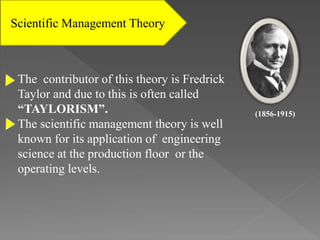
Scientific Management Theory
The contributor of this theory is Fredrick
Taylor and due to this is often called
“TAYLORISM”.
The scientific management theory is well
known for its application of engineering
science at the production floor or the
operating levels.
(1856-1915)
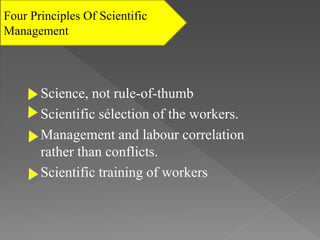
Science, not rule-of-thumb
Scientific sélection of the workers.
Management and labour correlation
rather than conflicts.
Scientific training of workers
Four Principles Of Scientific
Management
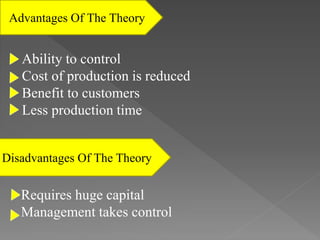
Ability to control
Cost of production is reduced
Benefit to customers
Less production time
Advantages Of The Theory
Disadvantages Of The Theory
Requires huge capital
Management takes control
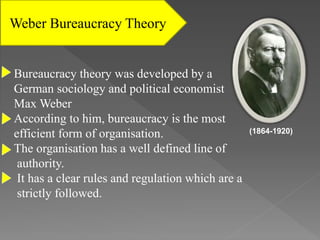
Weber Bureaucracy Theory
Bureaucracy theory was developed by a
German sociology and political economist
Max Weber
According to him, bureaucracy is the most
efficient form of organisation.
The organisation has a well defined line of
authority.
It has a clear rules and regulation which are a
strictly followed.
(1864-1920)
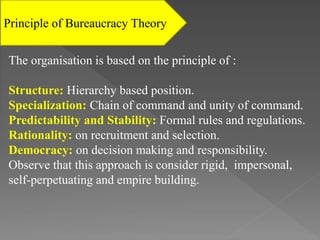
Principle of Bureaucracy Theory
The organisation is based on the principle of :
Structure: Hierarchy based position.
Specialization: Chain of command and unity of command.
Predictability and Stability: Formal rules and regulations.
Rationality: on recruitment and selection.
Democracy: on decision making and responsibility.
Observe that this approach is consider rigid, impersonal,
self-perpetuating and empire building.
Criticism On Theory
Too much emphasis in rules and regulations.
Bureaucracy involves a lots of paper work. This
result in lot of wastage of time and money.
There will be unnecessary delay in decision
making.
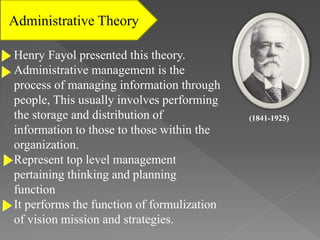
Administrative Theory
Henry Fayol presented this theory.
Administrative management is the
process of managing information through
people, This usually involves performing
the storage and distribution of
information to those to those within the
organization.
Represent top level management
pertaining thinking and planning
function
It performs the function of formulization
of vision mission and strategies.
(1841-1925)
Advantages Of The Theory
Disadvantages Of The Theory
Henry Fayol’s Theory is extremely
comprehensive as a way to deal with management
techniques
It is also the most used because it has been proven
to work
It is still based on human application As human
are naturally going to mistakes
The theory is based on the basic of having
harmony in which unity form to create strong
strength team
Criticism On Theory
Gave more Attention to functional aspect and
neglected structural aspect.
Unity of command and coordination may
conflict
Lack of importance to informal Organization
Neo classical theory was an attempt at
incorporating the behavioral Sciences in to
Managerial thought in order to solve the
problem caused by classic theory
Focus on people
Classification Of Neo Classical
Theories
Human relationship Approach
Behavioral Science Approach
Human Relationship
Approach
Human relation Management theory is a
researched belief that people desire to be part of
a supportive team that facilities development
and growth
Human resources are made up of living human
beings
Behavioral Sciences
Approach
Behavioral science is a systematic controlled
empirical and critical investigation of behavior
of the organism through controlled and rigorous
formulation
Behavioral science approach concentrates more
on the nature of or it self and the degree to which
it can fulfill the human need to use skills and
ability
Modern organization theory is of
recent origin, having developed in
early 1960’s. These theory has tried to
overcome the drawbacks of earlier
theories.
Focus on Process, People,
Environment.
Classification Of Modern
Theories
System Approach
Socio-Technical System
Contingency/Situational Approach
System Approach
Set of inter-related and inter-connected sub-
system
Composed of number of sub-system
Linked through communication decision,
authority
More utilization as compare to other
approaches.
Socio-Technical System
Interact with technical system
Governed by organizational policies
Depend upon human operator
Complex relationship with organizational
objectives.
Contingency Approach
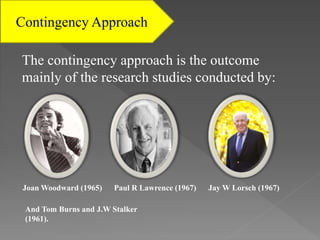
The contingency approach is the outcome
mainly of the research studies conducted by:
Joan Woodward (1965) Paul R Lawrence (1967) Jay W Lorsch (1967)
And Tom Burns and J.W Stalker
(1961).
Experts analyzed the relationship between the structure of
an organization and environmental conditions.
Organizations have to cope with different situations in
different ways.
There is no single best way that is applicable to all the
situations, there is no best way to design organizational
structure.
Leader should look at the contingencies of the
environment, and assess whether or not the organization is
capable of handling the uncertainties of environment.
Basic Theme Of This Theory
Technology
Suppliers and Distributors
Consumer Interest Groups
Customers and Competitors
Government
Unions
Some Important Contingencies for
Companies
Findings of Theorists
Joan Woodward
Technologies directly determine organizational attributes
such as spam of control, centralization of authority, and the
formalization of rules and procedures.
P.R.Lawrence and J.W. Lorsch
Companies operating in less stable environment operated
more effectively if organizational structure was less
formalized, more decentralized and more reliant on mutual
adjustments between various departments in the company.
On the other hand companies operating in more stable
and certain environments functioned more effectively if
the organization was more formalized, centralized in the
decision making and less reliant on mutual adjustments
between departments.
Toms Burns and G.M. Stalker
Organizations operating in more stable environments tend
to exhibit a more mechanistic organizational structure.
Companies operating in more dynamic and uncertain
environments tend to show a more organic organizational.

Organization Behavior ppt

  • 1.
  • 2.
    The classical theoryis a traditional theory, wherein more emphasis is on the organization rather then the employees working therein. Focus on process. According to theory, the organization is considered as a machine and the human beings as different parts of machine.
  • 3.
    Scientific Management Theory. WebbersBureaucratic Theory. Administrative Theory. Classification Of Classical Theories
  • 4.
    Scientific Management Theory Thecontributor of this theory is Fredrick Taylor and due to this is often called “TAYLORISM”. The scientific management theory is well known for its application of engineering science at the production floor or the operating levels. (1856-1915)
  • 5.
    Science, not rule-of-thumb Scientificsélection of the workers. Management and labour correlation rather than conflicts. Scientific training of workers Four Principles Of Scientific Management
  • 6.
    Ability to control Costof production is reduced Benefit to customers Less production time Advantages Of The Theory Disadvantages Of The Theory Requires huge capital Management takes control
  • 7.
    Weber Bureaucracy Theory Bureaucracytheory was developed by a German sociology and political economist Max Weber According to him, bureaucracy is the most efficient form of organisation. The organisation has a well defined line of authority. It has a clear rules and regulation which are a strictly followed. (1864-1920)
  • 8.
    Principle of BureaucracyTheory The organisation is based on the principle of : Structure: Hierarchy based position. Specialization: Chain of command and unity of command. Predictability and Stability: Formal rules and regulations. Rationality: on recruitment and selection. Democracy: on decision making and responsibility. Observe that this approach is consider rigid, impersonal, self-perpetuating and empire building.
  • 9.
    Criticism On Theory Toomuch emphasis in rules and regulations. Bureaucracy involves a lots of paper work. This result in lot of wastage of time and money. There will be unnecessary delay in decision making.
  • 10.
    Administrative Theory Henry Fayolpresented this theory. Administrative management is the process of managing information through people, This usually involves performing the storage and distribution of information to those to those within the organization. Represent top level management pertaining thinking and planning function It performs the function of formulization of vision mission and strategies. (1841-1925)
  • 11.
    Advantages Of TheTheory Disadvantages Of The Theory Henry Fayol’s Theory is extremely comprehensive as a way to deal with management techniques It is also the most used because it has been proven to work It is still based on human application As human are naturally going to mistakes The theory is based on the basic of having harmony in which unity form to create strong strength team
  • 12.
    Criticism On Theory Gavemore Attention to functional aspect and neglected structural aspect. Unity of command and coordination may conflict Lack of importance to informal Organization
  • 13.
    Neo classical theorywas an attempt at incorporating the behavioral Sciences in to Managerial thought in order to solve the problem caused by classic theory Focus on people
  • 14.
    Classification Of NeoClassical Theories Human relationship Approach Behavioral Science Approach
  • 15.
    Human Relationship Approach Human relationManagement theory is a researched belief that people desire to be part of a supportive team that facilities development and growth Human resources are made up of living human beings
  • 16.
    Behavioral Sciences Approach Behavioral scienceis a systematic controlled empirical and critical investigation of behavior of the organism through controlled and rigorous formulation Behavioral science approach concentrates more on the nature of or it self and the degree to which it can fulfill the human need to use skills and ability
  • 17.
    Modern organization theoryis of recent origin, having developed in early 1960’s. These theory has tried to overcome the drawbacks of earlier theories. Focus on Process, People, Environment.
  • 18.
    Classification Of Modern Theories SystemApproach Socio-Technical System Contingency/Situational Approach
  • 19.
    System Approach Set ofinter-related and inter-connected sub- system Composed of number of sub-system Linked through communication decision, authority More utilization as compare to other approaches.
  • 20.
    Socio-Technical System Interact withtechnical system Governed by organizational policies Depend upon human operator Complex relationship with organizational objectives.
  • 21.
    Contingency Approach The contingencyapproach is the outcome mainly of the research studies conducted by: Joan Woodward (1965) Paul R Lawrence (1967) Jay W Lorsch (1967) And Tom Burns and J.W Stalker (1961).
  • 22.
    Experts analyzed therelationship between the structure of an organization and environmental conditions. Organizations have to cope with different situations in different ways. There is no single best way that is applicable to all the situations, there is no best way to design organizational structure. Leader should look at the contingencies of the environment, and assess whether or not the organization is capable of handling the uncertainties of environment. Basic Theme Of This Theory
  • 23.
    Technology Suppliers and Distributors ConsumerInterest Groups Customers and Competitors Government Unions Some Important Contingencies for Companies
  • 24.
    Findings of Theorists JoanWoodward Technologies directly determine organizational attributes such as spam of control, centralization of authority, and the formalization of rules and procedures. P.R.Lawrence and J.W. Lorsch Companies operating in less stable environment operated more effectively if organizational structure was less formalized, more decentralized and more reliant on mutual adjustments between various departments in the company.
  • 25.
    On the otherhand companies operating in more stable and certain environments functioned more effectively if the organization was more formalized, centralized in the decision making and less reliant on mutual adjustments between departments. Toms Burns and G.M. Stalker Organizations operating in more stable environments tend to exhibit a more mechanistic organizational structure. Companies operating in more dynamic and uncertain environments tend to show a more organic organizational.