ORGANISING
ANOOP SAINI
Chapter: 5
Meaning of Organising: "Organising is the process
of defining and grouping the activities of the
enterprise and establishing the authority
relationships among them."
In simpler words, Organising is something you do
before you do something, so that when you do it,
is not all mixed up.
Meaning of Organising
 Organising ensures that efforts are directed towards the attainment of goals
in such a manner that resources are used optimally and people are able to
work collectively and effectively for a common purpose. In short, organising is
way to translating plans into actions.
Example of coordination: Your plan to conduct
sports Day or annual function. All the teachers and
students are assigned different duties, various
resource are arranged and a coordinator is
appointment whom every one reports for the work
done and pending. This whole arrangement is called
organising.
Importance of Organising
The need and importance of Organising can be
understood on the basis of following points:
1. Benefits of specialisation: Under organising all the activities are subdivided
into various works or jobs. For all the sub works, competent people are
appointed who become experts by doing a particular job again and again.
2. Clarity in working relationship: Org. establishes the working relationship,
which clarifies the line of communication and specifies who is to report to
whom.
3. Optimum Utilisation of Resources:
4. Adaptation to Change: Organising process makes the organisation capable
of adapting to any change connected with the post of the employees. This
becomes possible only because of the fact that there is a clear scalar chain
of authority for the manager’s right from the top to the lower level.
5.Expansion and Growth: The process of organising allows the
employees the freedom to take decisions which helps them to
grow. They are always ready to face new challenges. This situation
can help in the development of the enterprise.
6.Development of personnel: Under the process of organising,
delegation of authority is practiced. This is done not because
of the limited capacity of any individual, but also to discover
new techniques of work.
Steps in the process of Organising
1. Identification and division of work: The organising function
begins with the division of total work into smaller units in
accordance with the previous previously determined plans.
2. Departmentation or departmentalisation (Grouping of work):
After dividing the work in smaller jobs, related and similar jobs
are grouped together in one department. Such as: Functions
like Purchase, marketing, finance etc. Products like Clothes,
cosmetics, appliances etc.
3. Assignment of duties: After grouping various activities into
departments, it is necessary to define the work of different job
positions and allocate work to various employees.
4. Establishing reporting relationship: After assigning duties, the
next step is to clearly define the authority and responsibilities
associated with each job.
Organisational Structure
Organisational structure can be defined as “ Network of
job positions, responsibilities and authority at different
level.” Or it can be called as a framework within which
managerial and operational tasks are performed.
Spam of management gives shape to organizational
structure. Spam of management means how many
employees or subordinates can be effectively managed by
one manager or how many subordinates can be
effectively controlled by one superior.
Importance of Organisational Structure
1. Structure organizes all the operational of business properly
and ensures better flow of communication.
2. A clear idea about the working style of an enterprise can be
known from organizational structure.
3. It clearly defines the level of management and span of control
under each level.
KEYWORDS
 Determining style of working
 Skeleton of organisation
Types of Organisational Structure
A. Functional Structure/Department
B. Divisional Structure/Department
Functional Structure/Department
When the activities are grouped together under one
department according to the nature of function, then it is
called as functional, e.g. production dept, sales dept,
finance dept, HR dept.
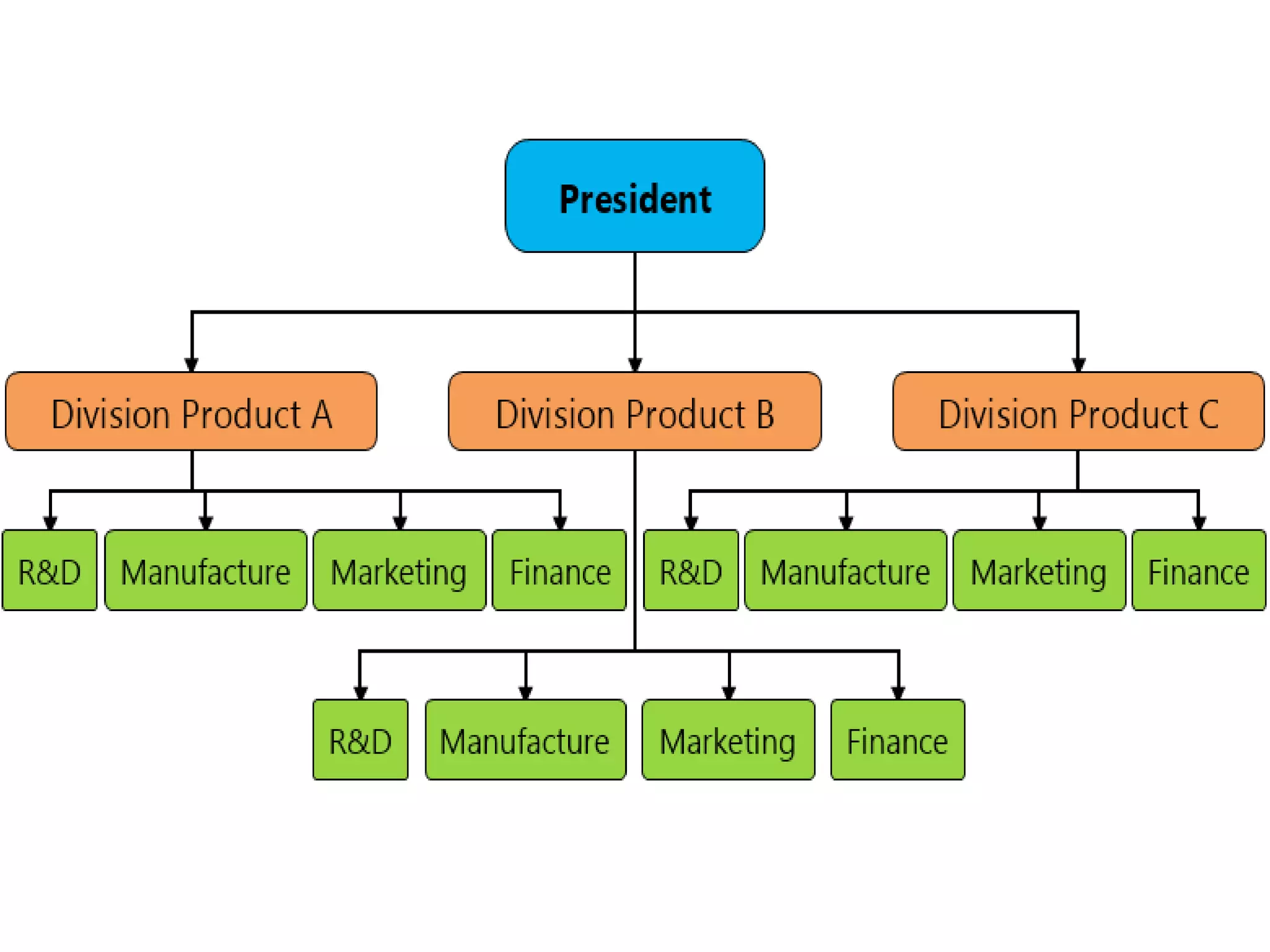
Divisional structure/Department
When activities are grouped together on the basis of
different products produced by company then it is know
as divisional structure, e.g. cosmetic dept, medicine dept,
soap dept.
Advantages and
Disadvantages of Functional
and Divisional Structure
(Homework for students)
KEYWORDS Of FUNCTIONAL STRUCTURE
 Division of work as per functions
 Specialization in every function
 Grouping of similar nature of job
KEYWORDS Of DIVISIONAL STRUCTURE
 Division of work as per product
 Specialisation in each product
 Multiproduct manufacturing companies
 Organisations adding more product line
 Organisations planning for expansion and growth
MCQs
1. Grouping activities on the basis of product line is a
part of:
a. Functional structure
b. Divisional structure
c. Formal organization
d. informal organization
2. Every divisional structure has a functional structure in
it.
a. True
b. False
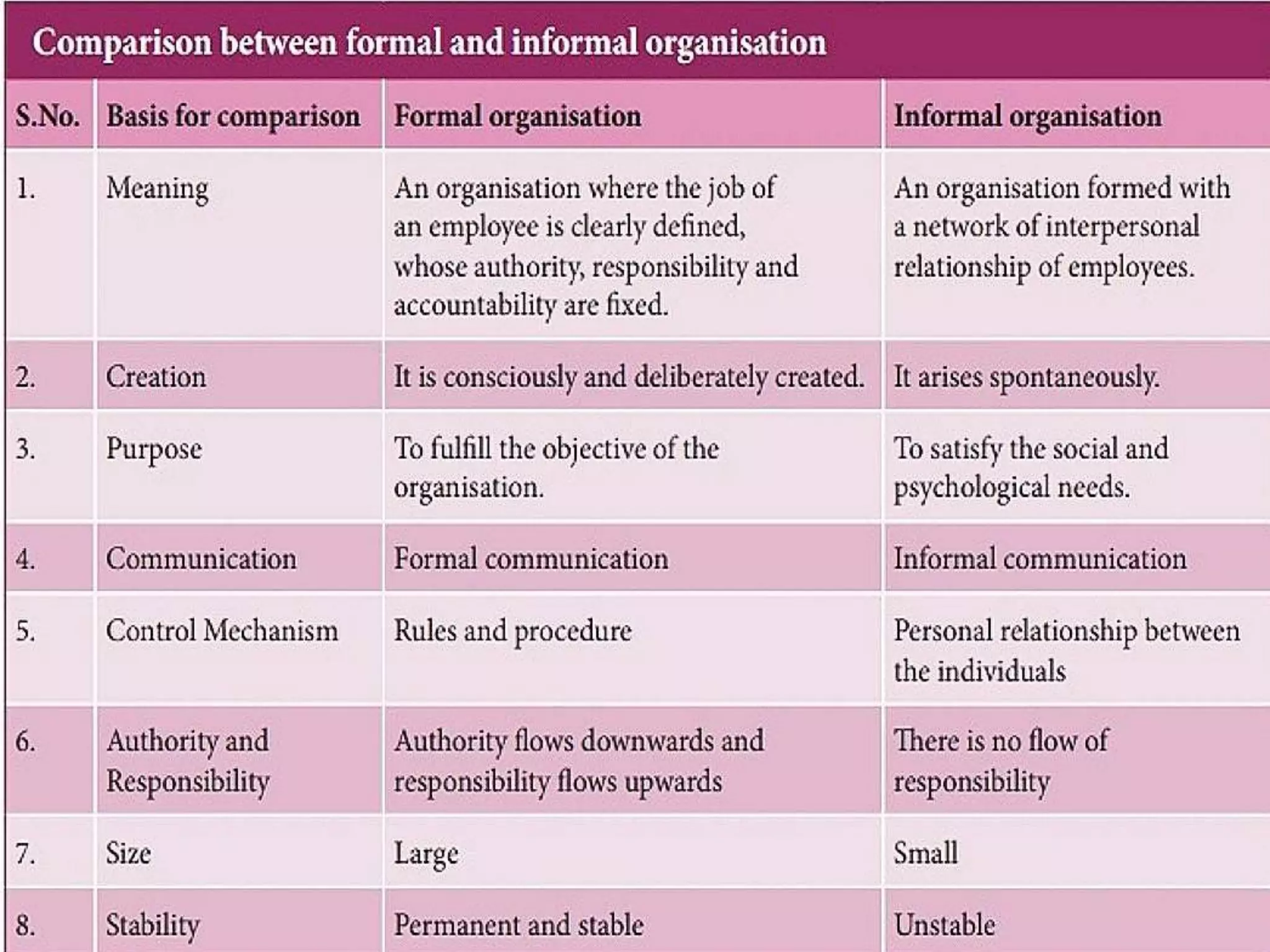
FORMAL AND INFORMAL ORGANISATIONS
Formal organisation
A formal organization is defined as an organization
that has set rules and regulations to be followed by
the employees.
Informal organisation
On the other hand, an informal organization is
defined as an organization that focuses on building
social relationships and networks.
Features of Formal organisation
 The formal organisation structure is created
intentionally by the process of organising.
 The purpose of this is to achieve the common
goals.
 In formal organisation structure, each individual
is assigned a specific job.
 Every individual is assigned a fixed authority or
decision making power.
 Formal organisation creates scalar chain of
communication.
Advantages and Disadvantages of Formal organisation
Advantages:
1. Systematic working
2. No overlapping of work
3. Coordination
4. Creation of chain of command
Disadvantages
1. Delay in action
2. Ignores social needs of employees
3. Emphasis on work only
Advantages and Disadvantages of Informal Organisation
Advantages
1. Fast communication
2. Fulfills social
Disadvantages
1. Spread rumours
2. No systematic working
3. More emphasis to individual interest
MCQs
1. The form of organisation known for giving rise to rumour is
called:
a. Centralised organisation
b. Decentralised organisation
c. Formal organisation
d. Infromal organisation
2. Name the type of organisation which is deliberately designed
by the top management to achieve a common goals.
a. Informal organisation
b. Corporate organisation
c. Formal organisation
d. Divisioanl organisational
Delegation of authority
 Delegation is the transfer of authority from superior to
subordinate. It simply means granting of authority to
subordinates to operate within prescribed limits.
 Facts about Delegation of authority
a. It is a downward transfer of authority from a
superior to a subordinate.
b. It also satisfies the subordinate’s need for
recognition and provides him an opportunity to
develop and exercise initiative.
c. The concept of delegation is based on principle of
Division of work.
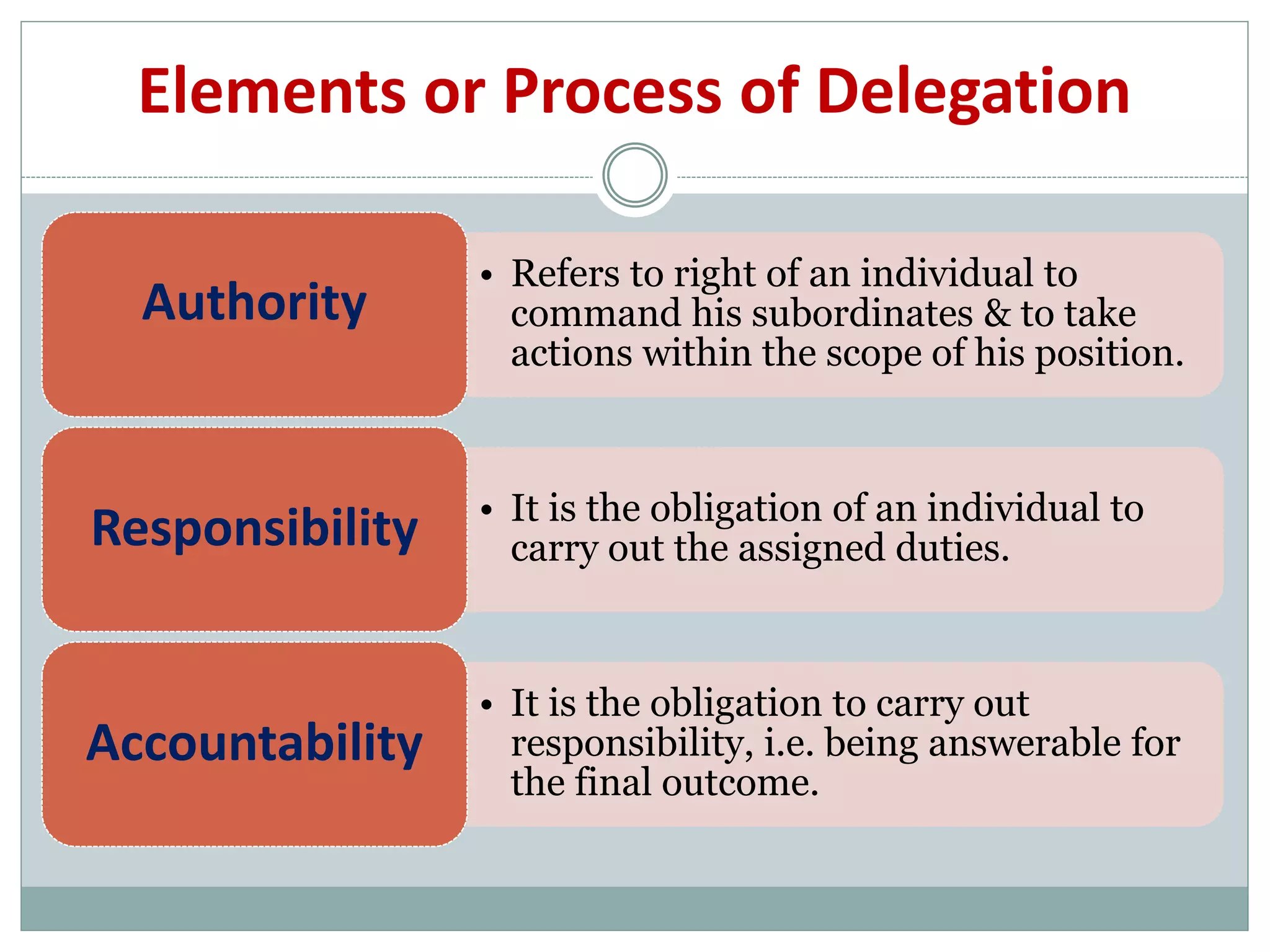
Elements or Process of Delegation
• Refers to right of an individual to
command his subordinates & to take
actions within the scope of his position.
Authority
• It is the obligation of an individual to
carry out the assigned duties.
Responsibility
• It is the obligation to carry out
responsibility, i.e. being answerable for
the final outcome.
Accountability
Importance of Delegation of authority
1. Effective management
2. Employee development
3. Motivation of employees
4. Facilitation of growth
5. Basis of management hierarchy
6. Better coordination
Centralisation and Decentralisation
Centralisation and Decentralisation refers to the extent
to which the authority and responsibility is passed to
lower levels.
Centralisation: it refers to concentration of the
decision – making power at the top levels of
management.
Decentralisation: refers to systematic delegation of
authority through all the levels of management and in
all the departments except that which can exercised
only at central point.
Every Organisation is Centralised as well as
Decentralised
 Centralisation and decentralisation are relative terms, i.e.
absolute or complete centralization and or
decentralisation is not possible.
 Complete centralization is not possible as it will remove
the need for higher managerial hierarchy.
 Complete decentralization is not possible. A manager can
not delegate all his authority without surrendering his
position as a manager.
 So in order to increase effectiveness and to improve
overall functioning, the organization must maintain
balance between both.
Importance of Decentralisation
 Develops initiative among employees
 Develops managerial talent for the future
 Quick decision making
 Relief to top management
 Facilitates growth
 Better control
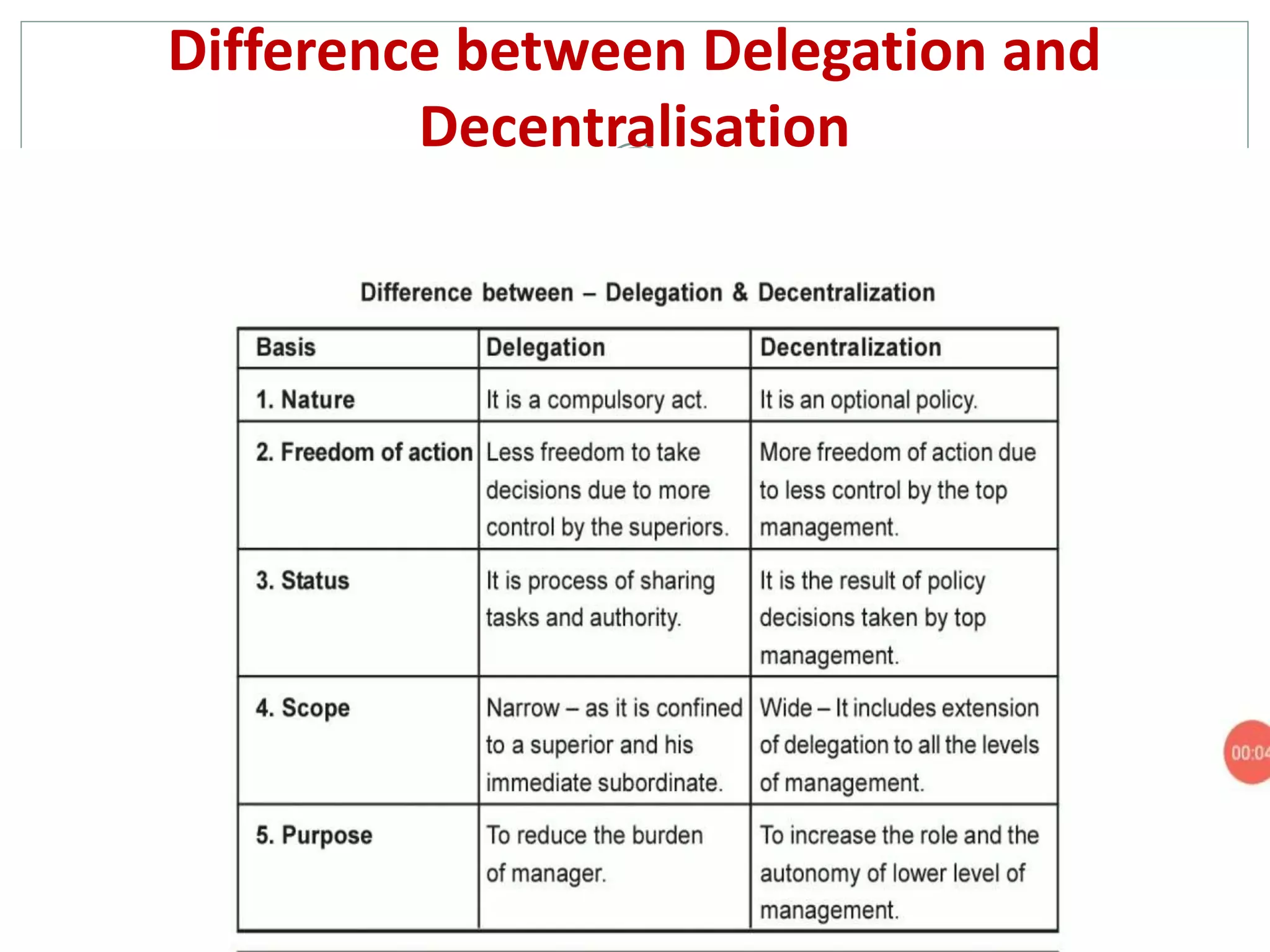
Difference between Delegation and
Decentralisation
Thank You...

Chapter 5 Organising.pptx

  • 1.
  • 2.
    Meaning of Organising:"Organising is the process of defining and grouping the activities of the enterprise and establishing the authority relationships among them." In simpler words, Organising is something you do before you do something, so that when you do it, is not all mixed up.
  • 3.
    Meaning of Organising Organising ensures that efforts are directed towards the attainment of goals in such a manner that resources are used optimally and people are able to work collectively and effectively for a common purpose. In short, organising is way to translating plans into actions.
  • 4.
    Example of coordination:Your plan to conduct sports Day or annual function. All the teachers and students are assigned different duties, various resource are arranged and a coordinator is appointment whom every one reports for the work done and pending. This whole arrangement is called organising.
  • 5.
    Importance of Organising Theneed and importance of Organising can be understood on the basis of following points: 1. Benefits of specialisation: Under organising all the activities are subdivided into various works or jobs. For all the sub works, competent people are appointed who become experts by doing a particular job again and again. 2. Clarity in working relationship: Org. establishes the working relationship, which clarifies the line of communication and specifies who is to report to whom. 3. Optimum Utilisation of Resources: 4. Adaptation to Change: Organising process makes the organisation capable of adapting to any change connected with the post of the employees. This becomes possible only because of the fact that there is a clear scalar chain of authority for the manager’s right from the top to the lower level.
  • 6.
    5.Expansion and Growth:The process of organising allows the employees the freedom to take decisions which helps them to grow. They are always ready to face new challenges. This situation can help in the development of the enterprise. 6.Development of personnel: Under the process of organising, delegation of authority is practiced. This is done not because of the limited capacity of any individual, but also to discover new techniques of work.
  • 7.
    Steps in theprocess of Organising 1. Identification and division of work: The organising function begins with the division of total work into smaller units in accordance with the previous previously determined plans. 2. Departmentation or departmentalisation (Grouping of work): After dividing the work in smaller jobs, related and similar jobs are grouped together in one department. Such as: Functions like Purchase, marketing, finance etc. Products like Clothes, cosmetics, appliances etc. 3. Assignment of duties: After grouping various activities into departments, it is necessary to define the work of different job positions and allocate work to various employees. 4. Establishing reporting relationship: After assigning duties, the next step is to clearly define the authority and responsibilities associated with each job.
  • 8.
    Organisational Structure Organisational structurecan be defined as “ Network of job positions, responsibilities and authority at different level.” Or it can be called as a framework within which managerial and operational tasks are performed. Spam of management gives shape to organizational structure. Spam of management means how many employees or subordinates can be effectively managed by one manager or how many subordinates can be effectively controlled by one superior.
  • 9.
    Importance of OrganisationalStructure 1. Structure organizes all the operational of business properly and ensures better flow of communication. 2. A clear idea about the working style of an enterprise can be known from organizational structure. 3. It clearly defines the level of management and span of control under each level. KEYWORDS  Determining style of working  Skeleton of organisation
  • 10.
    Types of OrganisationalStructure A. Functional Structure/Department B. Divisional Structure/Department Functional Structure/Department When the activities are grouped together under one department according to the nature of function, then it is called as functional, e.g. production dept, sales dept, finance dept, HR dept. Divisional structure/Department When activities are grouped together on the basis of different products produced by company then it is know as divisional structure, e.g. cosmetic dept, medicine dept, soap dept.
  • 13.
    Advantages and Disadvantages ofFunctional and Divisional Structure (Homework for students)
  • 14.
    KEYWORDS Of FUNCTIONALSTRUCTURE  Division of work as per functions  Specialization in every function  Grouping of similar nature of job KEYWORDS Of DIVISIONAL STRUCTURE  Division of work as per product  Specialisation in each product  Multiproduct manufacturing companies  Organisations adding more product line  Organisations planning for expansion and growth
  • 15.
    MCQs 1. Grouping activitieson the basis of product line is a part of: a. Functional structure b. Divisional structure c. Formal organization d. informal organization 2. Every divisional structure has a functional structure in it. a. True b. False
  • 16.
    FORMAL AND INFORMALORGANISATIONS Formal organisation A formal organization is defined as an organization that has set rules and regulations to be followed by the employees. Informal organisation On the other hand, an informal organization is defined as an organization that focuses on building social relationships and networks.
  • 18.
    Features of Formalorganisation  The formal organisation structure is created intentionally by the process of organising.  The purpose of this is to achieve the common goals.  In formal organisation structure, each individual is assigned a specific job.  Every individual is assigned a fixed authority or decision making power.  Formal organisation creates scalar chain of communication.
  • 19.
    Advantages and Disadvantagesof Formal organisation Advantages: 1. Systematic working 2. No overlapping of work 3. Coordination 4. Creation of chain of command Disadvantages 1. Delay in action 2. Ignores social needs of employees 3. Emphasis on work only
  • 20.
    Advantages and Disadvantagesof Informal Organisation Advantages 1. Fast communication 2. Fulfills social Disadvantages 1. Spread rumours 2. No systematic working 3. More emphasis to individual interest
  • 21.
    MCQs 1. The formof organisation known for giving rise to rumour is called: a. Centralised organisation b. Decentralised organisation c. Formal organisation d. Infromal organisation 2. Name the type of organisation which is deliberately designed by the top management to achieve a common goals. a. Informal organisation b. Corporate organisation c. Formal organisation d. Divisioanl organisational
  • 22.
    Delegation of authority Delegation is the transfer of authority from superior to subordinate. It simply means granting of authority to subordinates to operate within prescribed limits.  Facts about Delegation of authority a. It is a downward transfer of authority from a superior to a subordinate. b. It also satisfies the subordinate’s need for recognition and provides him an opportunity to develop and exercise initiative. c. The concept of delegation is based on principle of Division of work.
  • 23.
    Elements or Processof Delegation • Refers to right of an individual to command his subordinates & to take actions within the scope of his position. Authority • It is the obligation of an individual to carry out the assigned duties. Responsibility • It is the obligation to carry out responsibility, i.e. being answerable for the final outcome. Accountability
  • 24.
    Importance of Delegationof authority 1. Effective management 2. Employee development 3. Motivation of employees 4. Facilitation of growth 5. Basis of management hierarchy 6. Better coordination
  • 25.
    Centralisation and Decentralisation Centralisationand Decentralisation refers to the extent to which the authority and responsibility is passed to lower levels. Centralisation: it refers to concentration of the decision – making power at the top levels of management. Decentralisation: refers to systematic delegation of authority through all the levels of management and in all the departments except that which can exercised only at central point.
  • 26.
    Every Organisation isCentralised as well as Decentralised  Centralisation and decentralisation are relative terms, i.e. absolute or complete centralization and or decentralisation is not possible.  Complete centralization is not possible as it will remove the need for higher managerial hierarchy.  Complete decentralization is not possible. A manager can not delegate all his authority without surrendering his position as a manager.  So in order to increase effectiveness and to improve overall functioning, the organization must maintain balance between both.
  • 27.
    Importance of Decentralisation Develops initiative among employees  Develops managerial talent for the future  Quick decision making  Relief to top management  Facilitates growth  Better control
  • 28.
    Difference between Delegationand Decentralisation
  • 29.