Toward Organizational Behavior
A U T H O R ( S ) : L . L . C U M M I N G S
S O U R C E : T H E A C A D E M Y O F M A N A G E M E N T R E V I E W , V O L . 3 , N O . 1
( J A N . , 1 9 7 8 ) , P P . 9 0 - 9 8
P U B L I S H E D B Y : A C A D E M Y O F M A N A G E M E N T
P R E S E N T E D B Y
S A N D E E P
P H D S C H O L A R
Objectives
To define OB
Differentiate OB from OT, OP and PH&R
Discuss evolution of OB
Why describe the field of OB
◦ To provide knowledge into more understandable and convenient pack-ages. To answer Qs like What is OB? How is OB different from management? How is it
different from human relations? ("a little of everything", as "a combination of behavioral jargon and common sense", or as "touchy-feely" without content,
do not help. – to gain credibility as a field its has be well defined.
◦ Identification of themes and constructs underlying OB, or any other discipline, represents an important platform for expanding knowledge. Without
assumptions about what is included, excluded, and on the boundary, duplication among disciplines results. The efficiency of knowledge generation and
transmission is hampered. This leads to the usual awakening that parallel, and perhaps even superior, developments already have occurred in adjacent fields
about which we are ignorant.
Perspectives on OB
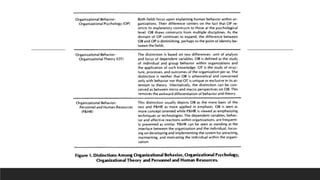
OB is defined as the study of individuals and groups within organizations. The units of analysis are individual and micro interactions among individuals.
Organizational characteristics (e.g., structure, process, climate) are seen either as "givens" which assume a constant state or as independent variables whose
variations are assumed to covary with or cause variations in the relevant dependent variables.
OB is defined as studies utilizing laboratory and, occasionally, field experimentation.
OT focus is organization as a unit of analysis. Organizational Theory (OT) is typically defined by its focus upon the organization as the unit of analysis.
Organizational structure, process, goals, technology, and, more recently, cli-mate are the relevant dependent variables, assumed to vary systematically with
variations in environmental characteristics but not with characteristics embedded within systematically clustered individuals. A comparative, cross-organizational
framework is essential for development of knowledge in OT.
OT is identified with the predominant use of survey and, occasionally, case designs.
OT was to become the reservoir of accepted and evolving constructs, and OB would emerge as the behavioral engineering function.
A Dimensional Characterization of Organizational
Behaviour
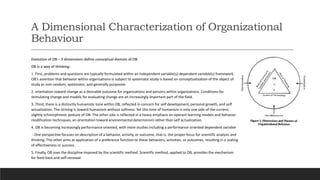
Evolution of OB – 3 dimensions define conceptual domain of OB
OB is a way of thinking:
1. First, problems and questions are typically formulated within an independent variable(s)-dependent variable(s) framework.
OB's assertion that behavior within organizations is subject to systematic study is based on conceptualization of the object of
study as non-random, systematic, and generally purposive.
2. orientation toward change as a desirable outcome for organizations and persons within organizations. Conditions for
stimulating change and models for evaluating change are an increasingly important part of the field.
3. Third, there is a distinctly humanistic tone within OB, reflected in concern for self development, personal growth, and self
actualization. The striving is toward humanism without softness. Yet this tone of humanism is only one side of the current,
slightly schizorphrenic posture of OB. The other side is reflected in a heavy emphasis on operant learning models and behavioral
modification techniques, an orientation toward environmental determinism rather than self actualization.
4. OB is becoming increasingly performance oriented, with more studies including a performance-oriented dependent variable
- One perspective focuses on description of a behavior, activity, or outcome, that is, the proper focus for scientific analysis and
thinking. The other aims at application of a preference function to these behaviors, activities, or outcomes, resulting in a scaling
of effectiveness or success.
5. Finally, OB uses the discipline imposed by the scientific method. Scientific method, applied to OB, provides the mechanism
for feed-back and self-renewal.
A body of Constructs, Models and Facts
OB Components: most treatments of the field now include coverage of constructs, models, and facts on: motivation, learning or socialization, group structure
and process, leader behavior, task design, interpersonal communication, organizational structure, interpersonal change and conflict, and material on relevant
dependent variables (e.g. satisfaction, other attitudes, participation measures, performance dimensions, and other behaviors).
A System of Technology
OB is also a system or a collection of technologies. These have evolved out of the primary areas of study identified as the independent variables of OB.
Techniques now exist for: training leaders, designing tasks, designing organizations, evaluating performances.
These technologies are largely exploratory, unvalidated and, in a few cases, under evaluation. The field has even spawned an occasional technology that has been
adopted and later found damaging to an organization and its participants. In most cases, even when the technologies work, the field's theoretical models are not
sufficiently developed to explain why they were effective.
Themes influencing Organizational Behaviour
Existentialism:
The emphasis here is upon the uncertain, contingent environment of people within organizations. Existentialism emphasizes that in the face of this type of
environment, persons must exercise self control in pursuit of their own objectives. The ultimate responsibility for designing productive and satisfying
organizational environments rests with human beings. It is their responsibility to fashion themselves to implement self control. This philosophical posture
leaves a legacy of concepts within OB - goal, purpose, expectation, expectancy, instrumental, path, and contingency.
Existentialism implies that the meaning in any act exists in its consequences, and OB seems to be moving toward this realization.
Operationalism
Operationalism is reflected in three ways
1. The grand, general, abstract models of motivation, leadership, environment-structure interaction, and change are not yielding satisfying, systematic,
cumulative data. Models are needed to describe the processes through which environment impacts structure and structure impacts attitudes and behavior
2. Emphasis is being given to the operations or behaviors through which people within organizations function. Whether describing what managers do or
analyzing the impact of leaders, the importance of formulating the issue in operational terms is being realized. The literature is beginning to be characterized by
questions like:
◦ 1. Through what operations is structure actually designed?
◦ 2. Through what operations does a leader impact a subordinate?
3. Measurement issues are impacting the field. Questions of reliability and validity must be faced, and questions of scaling and measurement confronted.
Cases in point are research on: the two-factor model of motivation (with faulty measurement procedures); expectancy formulations of motivation (with testing
of in appropriate models); and the impact of organizational design on attitudes and behaviors (with designs that confound independent variables).
Neo Behaviouralism
Many causal assumptions and models in OB are moving toward a behavioristic orientation with a cognitive overtone.
Motivation theory, under the influence of expectancy models, has moved in this direction.
Leadership studies reflect the notion of instrumental, goal-oriented behavior with a significant emphasis on leader behavior being partially a function of the
consequences which it produces.
Conclusions and implications
Implications of this perspective on the field
1. First, ultimately the definitions of the domains of OB, OT, OP, and OD are arbitrary. Definitions should be tested by their usefulness in specifying constructs and
functional relations. Definitions are needed to guide the field toward middle range and operational theory. It may prove fruitful to aim toward definition through
describing what is happening in the main streams of research within OB
2. Second, realities in organizations change so rapidly that our descriptions (ways of thinking, constructs and technologies) do not keep pace with the rate of
change in the objects of our study.
3. Third, what might this line of reasoning mean for the Academy of Management and its members? The Academy is presently the only camp which attempts to
house OB, OT, OD, and P&HR. For the moment, these fields have separate tents within the camp, but author believe that the traditional distinctions are
beginning to melt.
I believe we are moving toward an enacted field, perhaps best labeled organizational analysis or organizational science
Thank you

L.L Cummings 1978 Toward Organization behavior

  • 1.
    Toward Organizational Behavior AU T H O R ( S ) : L . L . C U M M I N G S S O U R C E : T H E A C A D E M Y O F M A N A G E M E N T R E V I E W , V O L . 3 , N O . 1 ( J A N . , 1 9 7 8 ) , P P . 9 0 - 9 8 P U B L I S H E D B Y : A C A D E M Y O F M A N A G E M E N T P R E S E N T E D B Y S A N D E E P P H D S C H O L A R
  • 2.
    Objectives To define OB DifferentiateOB from OT, OP and PH&R Discuss evolution of OB
  • 3.
    Why describe thefield of OB ◦ To provide knowledge into more understandable and convenient pack-ages. To answer Qs like What is OB? How is OB different from management? How is it different from human relations? ("a little of everything", as "a combination of behavioral jargon and common sense", or as "touchy-feely" without content, do not help. – to gain credibility as a field its has be well defined. ◦ Identification of themes and constructs underlying OB, or any other discipline, represents an important platform for expanding knowledge. Without assumptions about what is included, excluded, and on the boundary, duplication among disciplines results. The efficiency of knowledge generation and transmission is hampered. This leads to the usual awakening that parallel, and perhaps even superior, developments already have occurred in adjacent fields about which we are ignorant.
  • 4.
    Perspectives on OB OBis defined as the study of individuals and groups within organizations. The units of analysis are individual and micro interactions among individuals. Organizational characteristics (e.g., structure, process, climate) are seen either as "givens" which assume a constant state or as independent variables whose variations are assumed to covary with or cause variations in the relevant dependent variables. OB is defined as studies utilizing laboratory and, occasionally, field experimentation. OT focus is organization as a unit of analysis. Organizational Theory (OT) is typically defined by its focus upon the organization as the unit of analysis. Organizational structure, process, goals, technology, and, more recently, cli-mate are the relevant dependent variables, assumed to vary systematically with variations in environmental characteristics but not with characteristics embedded within systematically clustered individuals. A comparative, cross-organizational framework is essential for development of knowledge in OT. OT is identified with the predominant use of survey and, occasionally, case designs. OT was to become the reservoir of accepted and evolving constructs, and OB would emerge as the behavioral engineering function.
  • 6.
    A Dimensional Characterizationof Organizational Behaviour Evolution of OB – 3 dimensions define conceptual domain of OB OB is a way of thinking: 1. First, problems and questions are typically formulated within an independent variable(s)-dependent variable(s) framework. OB's assertion that behavior within organizations is subject to systematic study is based on conceptualization of the object of study as non-random, systematic, and generally purposive. 2. orientation toward change as a desirable outcome for organizations and persons within organizations. Conditions for stimulating change and models for evaluating change are an increasingly important part of the field. 3. Third, there is a distinctly humanistic tone within OB, reflected in concern for self development, personal growth, and self actualization. The striving is toward humanism without softness. Yet this tone of humanism is only one side of the current, slightly schizorphrenic posture of OB. The other side is reflected in a heavy emphasis on operant learning models and behavioral modification techniques, an orientation toward environmental determinism rather than self actualization. 4. OB is becoming increasingly performance oriented, with more studies including a performance-oriented dependent variable - One perspective focuses on description of a behavior, activity, or outcome, that is, the proper focus for scientific analysis and thinking. The other aims at application of a preference function to these behaviors, activities, or outcomes, resulting in a scaling of effectiveness or success. 5. Finally, OB uses the discipline imposed by the scientific method. Scientific method, applied to OB, provides the mechanism for feed-back and self-renewal.
  • 7.
    A body ofConstructs, Models and Facts OB Components: most treatments of the field now include coverage of constructs, models, and facts on: motivation, learning or socialization, group structure and process, leader behavior, task design, interpersonal communication, organizational structure, interpersonal change and conflict, and material on relevant dependent variables (e.g. satisfaction, other attitudes, participation measures, performance dimensions, and other behaviors).
  • 8.
    A System ofTechnology OB is also a system or a collection of technologies. These have evolved out of the primary areas of study identified as the independent variables of OB. Techniques now exist for: training leaders, designing tasks, designing organizations, evaluating performances. These technologies are largely exploratory, unvalidated and, in a few cases, under evaluation. The field has even spawned an occasional technology that has been adopted and later found damaging to an organization and its participants. In most cases, even when the technologies work, the field's theoretical models are not sufficiently developed to explain why they were effective.
  • 9.
    Themes influencing OrganizationalBehaviour Existentialism: The emphasis here is upon the uncertain, contingent environment of people within organizations. Existentialism emphasizes that in the face of this type of environment, persons must exercise self control in pursuit of their own objectives. The ultimate responsibility for designing productive and satisfying organizational environments rests with human beings. It is their responsibility to fashion themselves to implement self control. This philosophical posture leaves a legacy of concepts within OB - goal, purpose, expectation, expectancy, instrumental, path, and contingency. Existentialism implies that the meaning in any act exists in its consequences, and OB seems to be moving toward this realization.
  • 10.
    Operationalism Operationalism is reflectedin three ways 1. The grand, general, abstract models of motivation, leadership, environment-structure interaction, and change are not yielding satisfying, systematic, cumulative data. Models are needed to describe the processes through which environment impacts structure and structure impacts attitudes and behavior 2. Emphasis is being given to the operations or behaviors through which people within organizations function. Whether describing what managers do or analyzing the impact of leaders, the importance of formulating the issue in operational terms is being realized. The literature is beginning to be characterized by questions like: ◦ 1. Through what operations is structure actually designed? ◦ 2. Through what operations does a leader impact a subordinate? 3. Measurement issues are impacting the field. Questions of reliability and validity must be faced, and questions of scaling and measurement confronted. Cases in point are research on: the two-factor model of motivation (with faulty measurement procedures); expectancy formulations of motivation (with testing of in appropriate models); and the impact of organizational design on attitudes and behaviors (with designs that confound independent variables).
  • 11.
    Neo Behaviouralism Many causalassumptions and models in OB are moving toward a behavioristic orientation with a cognitive overtone. Motivation theory, under the influence of expectancy models, has moved in this direction. Leadership studies reflect the notion of instrumental, goal-oriented behavior with a significant emphasis on leader behavior being partially a function of the consequences which it produces.
  • 12.
    Conclusions and implications Implicationsof this perspective on the field 1. First, ultimately the definitions of the domains of OB, OT, OP, and OD are arbitrary. Definitions should be tested by their usefulness in specifying constructs and functional relations. Definitions are needed to guide the field toward middle range and operational theory. It may prove fruitful to aim toward definition through describing what is happening in the main streams of research within OB 2. Second, realities in organizations change so rapidly that our descriptions (ways of thinking, constructs and technologies) do not keep pace with the rate of change in the objects of our study. 3. Third, what might this line of reasoning mean for the Academy of Management and its members? The Academy is presently the only camp which attempts to house OB, OT, OD, and P&HR. For the moment, these fields have separate tents within the camp, but author believe that the traditional distinctions are beginning to melt. I believe we are moving toward an enacted field, perhaps best labeled organizational analysis or organizational science
  • 13.