Organicfarming
What is Organic Farming?
Organic farming is a production system
which avoids or largely excludes the use of
synthetically compounded fertilizers,
pesticides , etc. and uses fertilizers of
organic origin such as compost manure,
green manure, and bone meal etc. and
emphasis on techniques such as crop
rotation and companion planting.
The ultimate goal of farming is not the
growing of crops but the cultivation
and perfection of human beings.
HISTORY
• Organic cultivation is not new in India.
• Ancient agriculture has started 10,000 years ago.
• In India references in Ramayana, Mahabharata, Kautilya arthashastra, Brihad-Sanhita,
Atharva Veda, Rig Veda, holy kuran.
• Organic movement began in the year 1940s as a reaction to agriculture’s growing reliance
on synthetic fertilizers.
• The only diversion came in the mid 20th century when we blindly started using chemicals
for agricultural purposes.
• First fertilizer plant in India(SSP) was established in 1906 near Ranipet of Tamil Nadu.
Sir Albert Howard (botanist by profession) is widely considered to be the father
of organic farming. He supported traditional Indian agricultural practices. His theme was
healthy people, livestock and crops. Documented Organic training techniques.
“slow poisoning of the soil by chemical fertilizers”
Book:- Agricultural testament.
Rudolf Steiner 1924 (German)-Father of
biodynamic agriculture. balancing the interaction
of animals-plants-soils(ecology) management.
Built Biodynamic farming in Germany.
Lord Northbourne
The term organic farming was first coined
by him in his book ”look to the land”, 1939.
A treatise on holistic ecology and agriculture.
Lady eve Balfour UK
Systematically experimented on organic
and conventional farming from 1939-1943.
Book- living soil,1944.
Emphasised on the spiritual and ethical values.
Manobo Fukuoka (Japan) microbiologist Developed a model
“No-till” organic farming and practiced and preached from 1940
for thirty years. (Now known as Fukuoka farming).
Books:- one straw revolution, Road back to nature
And Natural way of farming.
.
Shree Vasant Paranjpe-Indian ,pioneered use of ancient science of homa
therapy of which agnihotra is the basic homa. Demonstrated the usefulness of
homa farming in the management of sigatoka disease of banana in Peru.
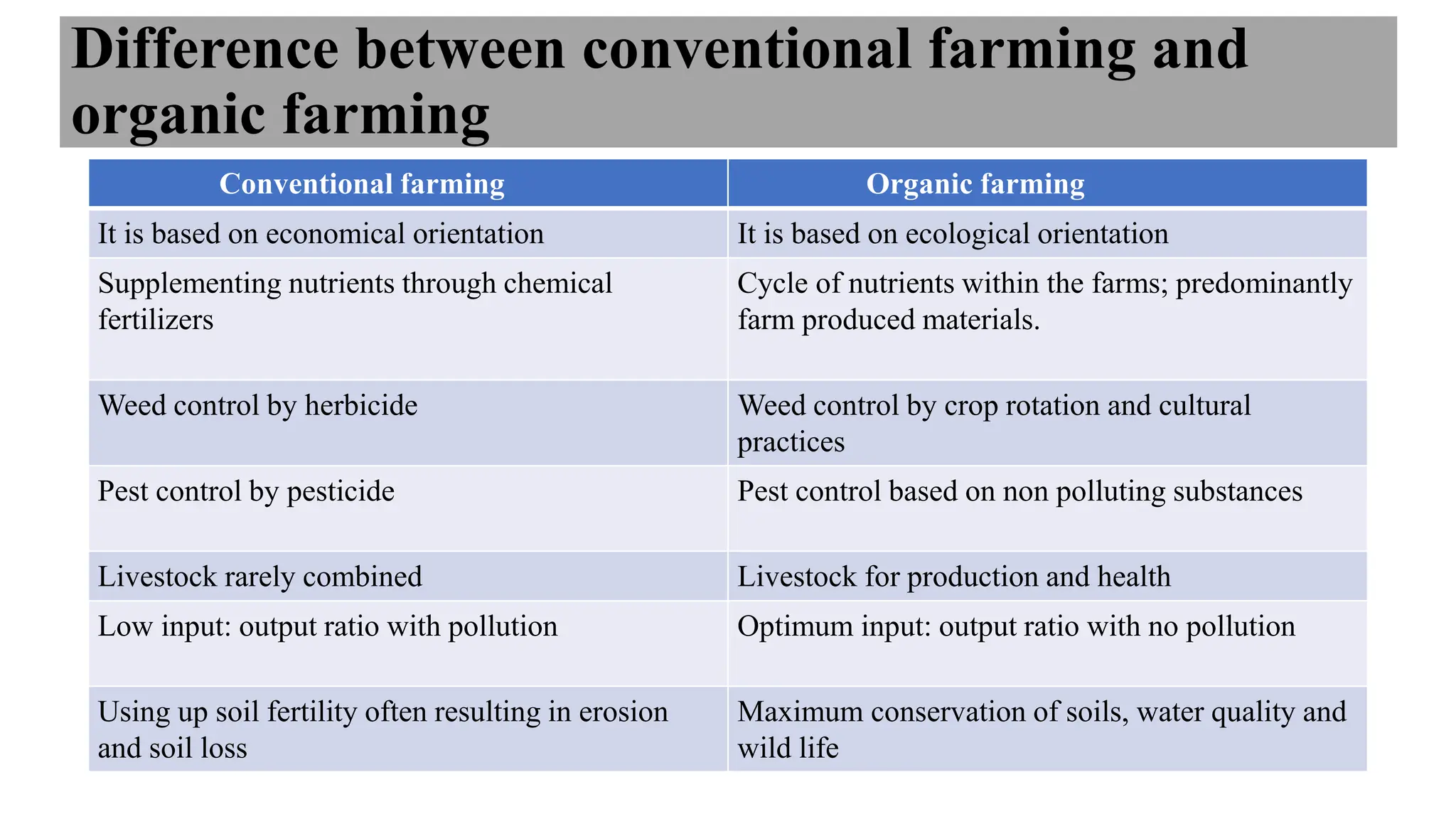
Difference between conventional farming and
organic farming
Conventional farming Organic farming
It is based on economical orientation It is based on ecological orientation
Supplementing nutrients through chemical
fertilizers
Cycle of nutrients within the farms; predominantly
farm produced materials.
Weed control by herbicide Weed control by crop rotation and cultural
practices
Pest control by pesticide Pest control based on non polluting substances
Livestock rarely combined Livestock for production and health
Low input: output ratio with pollution Optimum input: output ratio with no pollution
Using up soil fertility often resulting in erosion
and soil loss
Maximum conservation of soils, water quality and
wild life
Why organic farming is necessary?
• Sustainable and eco-friendly technology.
• It improves quality, shelf and nutritive value of the farm
produce.
• It improves the physical, chemical and biological health of the
soil.
• Promotes healthy use of the natural resources and minimizes
all forms the pollution.
• It enhances and sustains biological diversity within the system.
Concept of organic farming
Organic farming endorses the concept that the soil, plant, animals and human
beings are linked. Therefore, its goal is to create an integrated, environmentally
sound, safe and economically sustainable agriculture production system.
Soil is a living system linked to an organism with different components. Human
interact with these natural components (minerals, organic matter, micro-organisms,
animals and plants) to achieve harmony with nature and create a sustainable
agricultural production.
 A key feature of organic farming is the primary dependence on natural
resource and those developed locally (green manures, crop residues, farm
wastes etc.), rather than external inputs (especially synthetics).
 The farmer manages self-regulating ecological and biological processes for
sustainable and economic production of products. Organic farming systems
do not use toxic agrochemical inputs (pesticides, fungicides, herbicides and
fertilizers).
The principles of organic agriculture
The principles of organic agriculture serve to inspire the organic
movement in its full diversity. They are the roots from which organic
agriculture grows and develops.
They express the contribution that organic agriculture can make to the
world and a vision to improve all agriculture in a global context.
• The principle of health.
• The principle of ecology.
• The principle of fairness.
• The principle of care.
1. Principle of Health
 Organic Agriculture should sustain and enhance the health of soil, plant,
animal, human and planet as one and indivisible
 Healthy soils produce healthy crops that foster the health of animals and
people.
 Health is the wholeness and integrity of living systems.
 The role of organic agriculture, whether in farming, processing, distribution,
or consumption, is to sustain and enhance the health of ecosystems and
organisms from the smallest in the soil to human beings.
2. Principle of Ecology
 Organic Agriculture should be based on living ecological systems and cycles, work
with them, emulate them and help sustain them.
 This principle roots organic agriculture within living ecological systems.
 It states that production is to be based on ecological processes, and recycling
 Nourishment and well-being are achieved through the ecology of the specific
production environment.
 Organic management must be adapted to local conditions, ecology, culture and
scale.
Inputs should be reduced by reuse, recycling and efficient
management of materials and energy in order to maintain and
improve environmental quality and conserve resources
 Organic agriculture should attain ecological balance through
the design of farming systems, establishment of habitats and
maintenance of genetic and agricultural diversity.
3. Principle of Fairness
 Organic Agriculture should build on relationships that ensure fairness with regard to the
common environment and life opportunities.
 This principle emphasizes that those involved in organic agriculture should conduct human
relationships in a manner that ensures fairness at all levels and to all parties - farmers,
workers, processors, distributors, traders and consumers
It aims to produce a sufficient supply of good quality food and other products.
Natural and environmental resources that are used for production and consumption should be
managed in a way that is socially and ecologically just and should be held in trust for
future generations
 Fairness requires systems of production, distribution and trade that are open and equitable
and account for real environmental and social costs.
4. Principle of Care
 Organic Agriculture should be managed in a precautionary and
responsible manner to protect the health and well-being of current and
future generations and the environment.
 Organic agriculture is a living and dynamic system that responds to
internal and external demands and conditions.
 This principle states that precaution and responsibility are the key
concerns in management, development and technology choices in
organic agriculture.
Components of organic farming
Weed management
• 1. Preventive methods
• weed free crop seed
• weed free manure
• clean harvesting and ploughing equipment
• 2. Cultural methods
• smother crop (e.g.- cowpea, mustard, sorghum)
• cover crop (e.g.- lobia, groundnut, urd)
• crop rotation
• optimum plant density and line sowing
• drip irrigation
3. Mechanical methods
• Tillage
• Stale seed bed
• Hand weeding
• Hoeing
• Mulching
• Burning
4. Soil solarisation
5. Allelopathy
E.g.:- Marigold: Congress grass
Biological control of weeds
Insect Weed control
Crocidosema lantana busck
moth
Lantana camara
Cochineal scale Prickly pear
Fleabeetle larva Alligator weed
Neochetina burchii Water hyacnith
Mexican gall fly Congress grass
Mycoherbicides
Product Content Weed control
De-Vine Phytophthora palmivora Milk weed vine
Collego Colletotrichum gloeosporiodes Joint vetch
Bipolaris Bipolaris sorghicola Johnson grass
Biolophos Streptomyces hygroscopicus General vegetation
Pest management
1. Physical method
• Mechanical control
• Light trap
• Pheromone trap
• Nylon net
2. Cultural method
• Field and plant sanitation
• Crop rotation
• Trap cropping
E.g.: cabbage: mustard=diamond back moth
• Adjusting time of sowing
Fertilizer management
Bio-fertilizer
S.No. Group Example
N2 fixing bio-fertilizer
1. Free-living Azotobacter, beijerinka,
clostridium, Anabaena
2. Symbiotic Rhizobium, Azolla, Frankia
3. Associative Symbiotic Azospirrlum
P solubilising biofertilizer
1. Bacteria Bacillus sp, pseudomonas sp.
2. Fungi Penicillium sp, Aspergillus awamori
P mobilising biofertilizer
1. Arbuscular mycorrhiza Gloumus sp, Gigaspora sp
2. Ectomycorrhiza Laccaria sp, Amanita sp
3. Orchid mycorrhizae Rhizoctonia Solani
Organic certification in India
Principle of standards- The organic certification process in India follows a set of
standard guiding principals laid down by National Program for Organic Production
(NPOP). They are as follows.
1.Conversion of land for Organic Farming must be done.
2.All inputs to the farm should be natural.
3.No Genetically Modified inputs or Irradiation technology should be used.
4.Integrity of all processes (physical, biological, mechanical) must be maintained at all times.
5.No contamination from nearby farms or other means must be present.
6.Sustainable practices must be followed in the farm.
Organic certificate for any produce is valid for 3 years only. It must be renewed after expiry
of 3 years.
Procedure for organic certification
Registration of your farm
Inspection of your farm
Contract signing and reports of inspection
Quality management verification
Evaluation committee reports
Certificate committee reports
CERTIFIER( Trace-net generation of the certificate throughAPEDA and
signature of the certificate by certifier)
The field inspection is one of the most important process step in Organic certification in
India. Here is a summary of the inspection methods.
1.Visit of external inspector to fields and facilities.
2.Review of records and accounts.
3.Calculation of input and output norms and preparation of production estimate from a farm.
4.Assessment of production system
5.Interview with responsible person(s).
6.Risk assessment from neighboring farms.
7.Inspection of use of any GM products.
8.Inspection of use of off-farm inputs.
9.Analysis of residue tests by certified laboratories for pesticides, heavy metals if required.
10.Inspection of sustainable practices.
11.Inspection and study of entire production unit.
Time period and expenditure for Organic Certification in India-
The typical expenditure on getting organic certification for Individual farmers varied within
25,000/- INR to 40,000/- INR, while for farmer groups it varies between 40,000/- INR to
1,00,000/- INR.
Type of agricultural unit
Typical time period for
organic certification
Farm 24 months
Fruit Orchards 36 months
Dairy unit on certified land 90 days
Food Processing units 1 day
In India NPOP (National Program for Organic
Production) and its regulatory body APEDA
(Agricultural and processed food products export
development authority) have laid down the guidelines for
organic certification and all products that is organic
certified displays the ‘India Organic’ logo for customer
to easily identify certified products.
In 2006, India’s organic certification process under
NPOP has been granted equivalence with European
Union.
India organic logo
List of accredited certifying and inspection
agencies in India
• Association for promotion of organic farming(APOF) Bangalore
• Indian society for certification of organic production(ISCOP)-Tamil
Nadu
• Indian organic certification agency (INDOCERT)- Cochin, Kerela
• Skal inspection and certification agency- Bangalore
• IMO control Pvt. Ltd.- Bangalore
• Ecocert international – Aurangabad
• Bioinspectra –Cochin, Kerela
• SGS India Pvt Ltd – Gurgaon
• International resources for trade(IRFD)- Mumbai
• National organic certification association(NOCA)- Pune
• In HP- organic certification society, palampur.
International organic standards
 1. IFOAM-
• Established in 1972
• Headquarter in Germany
• Umbrella organisation for organic agriculture association
• Developed international basic standards of organic agriculture
• Established IFOAM accreditation programme(1992) to accredit certifying bodies.
• Set up international organic accreditation service (IOAS) in July 2001
2. CODEX-
• Codex Alimentarius commission-a joint
FAO/WHO
• Intergovernmental body
• Established in 1962
• Produced a set of guidelines for organic production
3. EU regulation
Laid out a basic regulation for European union’s organic
standards in council regulation no.2092/91 (June 1991)
Regulations give guidelines for the production of organic crops in the European community
5. JAS
A set of guidelines Japan agricultural standards
for organic production
• Produced a set of guidelines for organic production
4. Demeter
Demeter international is a world wide network of 19
international certification bodies in Africa, Australia,
Europe.
Developed guideline for biodynamic preparation.
Limitations of organic farming in India
• Small land holding.
• Poor infrastructure facilities.
• Lack of technology knowledge.
• Bio control agents are available for only few selected insect pest.
• Complicated organic certification process and high fees cost.
• Higher human population of India.
Present status of organic farming
Organic agriculture is practiced in 187 countries.
Globally, 1.5% of the farmland is organic
Worldwide, 72.3 million hectares of land is under organic farming managed by
3.1 million farmers. And India has over 1.9 million farmers as of march 2020.
Australia has maximum land under organic agriculture (35.7 mha) followed by
Argentina and China.
US has largest organic market(44.7 billion euros).
India ranks 9th in terms of certified agricultural land with1.94mha(2018-19) and
1st in terms of producers as per 2020 data.
 India’s organic food products exports rise by more than 50% in 2020-2021
despite COVID-19 challenges.
• Madhya Pradesh has covered largest area under organic certification followed by
Rajasthan, Maharashtra. And also MP is the largest producer of organic products in
India.
• During 2016, Sikkim has achieved a remarkable distinction of converting its entire
cultivable land (more than 75000 ha) under organic certification.
• After Sikkim, Lakshadweep is on its way to become 100% organic UT.
• India has produced around 34,96,800.34MT(2020-2021) of certified organic products.
• The total volume of export(2020-2021) from India was 8,88,179.68MT.
• The organic food export realization was around INR 7,07,849.52 lakhs.
• Oil cake meal has been a major commodity of the organic product exports from
the country followed by oil seeds, fruit pulp, etc.
• There are 33 organic certifying agencies in India which comes under NPOP and
in HP there is one named as organic certification agency at palampur.
• Fertilizer consumption of India increased from 12.4kg/ha in 1969 to 175kg/ha in
2018 growing at an average annual rate of 5.96%.
• All India NPK consumption per hectare was reported at 133.440 kg/ha in 2020.
• Among the major states, Punjab alone consumes about 9% of the total fertilizers
in India.
• Total organic production in Himachal Pradesh(2020-2021) – 73.57 MT
Government support to promote organic
farming
The ministry of agriculture is promoting organic farming in the country under the
following schemes:-
National project on organic farming (project implemented since October 2004)-
Under NPOF the Indian govt. has been advocating integrating the use of organic manures
including biofertilizers for increasing the production of organic crops. A total of 56 no. of
biofertilizer production units and 17 no. of fruit or vegetable waste compost units have
been established in the country.
Rashtriya Krishi vikas yojana-
RKVY is a sate plan scheme of additional central assistance launched in aug-2007 by the
Indian govt. the RKVY scheme is funded annually by a state plan scheme.
Promotes the use of organic farming practices and reduce dependence on chemical
agricultural inputs
Paramparagat Krishi vikas yojana (PKVY)- 2015
Under the PKVY scheme cluster formation, training, certification, and marketing are
supported. The assistance of Rs.50,000/ha/year is provided out of which 62% i.e. Rs.31,000
is given as farmer incentive towards organic farming inputs.
Mission organic value chain development for north eastern
region(MOVCDNER)- 2015
Under this scheme farmers are given the assistance of about Rs.25000/ha/3 years for organic
inputs. This scheme aims to certified organic products development of the entire value chain
starting from inputs, seeds, marketing, and brand-building initiative.
A total sum of 115crore has been allocated to this scheme.
Capital investment subsidy scheme(CISS) under soil health
management scheme- 2004
Under this the existing units can be considered for technological up-gradation or expansion
of existing capacity.
National mission on oilseeds and oil palm(NMOOP)- 2014
Under this, financial assistance by 50% subsidy to Rs. 300/ha is provided for some
components like biofertilizers, the supply of rhizobium culture, PSB,ZSB and
vermicomposting.
National horticulture mission- 2005
Under NHM financial assistance is provided for organic farming certification by
Rs.5 lakh for a group of farmers covering 50 hectares area.
National centre on organic farming : Ghaziabad
Regional centres:
1) Bangalore 4) Imphal
2) Bhubaneshwar 5) Jabalpur
3) Hissar 6) Nagpur
organic farming and organic certification.pptx

organic farming and organic certification.pptx

  • 1.
  • 2.
    What is OrganicFarming? Organic farming is a production system which avoids or largely excludes the use of synthetically compounded fertilizers, pesticides , etc. and uses fertilizers of organic origin such as compost manure, green manure, and bone meal etc. and emphasis on techniques such as crop rotation and companion planting. The ultimate goal of farming is not the growing of crops but the cultivation and perfection of human beings.
  • 3.
    HISTORY • Organic cultivationis not new in India. • Ancient agriculture has started 10,000 years ago. • In India references in Ramayana, Mahabharata, Kautilya arthashastra, Brihad-Sanhita, Atharva Veda, Rig Veda, holy kuran. • Organic movement began in the year 1940s as a reaction to agriculture’s growing reliance on synthetic fertilizers. • The only diversion came in the mid 20th century when we blindly started using chemicals for agricultural purposes. • First fertilizer plant in India(SSP) was established in 1906 near Ranipet of Tamil Nadu.
  • 4.
    Sir Albert Howard(botanist by profession) is widely considered to be the father of organic farming. He supported traditional Indian agricultural practices. His theme was healthy people, livestock and crops. Documented Organic training techniques. “slow poisoning of the soil by chemical fertilizers” Book:- Agricultural testament.
  • 5.
    Rudolf Steiner 1924(German)-Father of biodynamic agriculture. balancing the interaction of animals-plants-soils(ecology) management. Built Biodynamic farming in Germany. Lord Northbourne The term organic farming was first coined by him in his book ”look to the land”, 1939. A treatise on holistic ecology and agriculture.
  • 6.
    Lady eve BalfourUK Systematically experimented on organic and conventional farming from 1939-1943. Book- living soil,1944. Emphasised on the spiritual and ethical values. Manobo Fukuoka (Japan) microbiologist Developed a model “No-till” organic farming and practiced and preached from 1940 for thirty years. (Now known as Fukuoka farming). Books:- one straw revolution, Road back to nature And Natural way of farming. .
  • 7.
    Shree Vasant Paranjpe-Indian,pioneered use of ancient science of homa therapy of which agnihotra is the basic homa. Demonstrated the usefulness of homa farming in the management of sigatoka disease of banana in Peru.
  • 8.
    Difference between conventionalfarming and organic farming Conventional farming Organic farming It is based on economical orientation It is based on ecological orientation Supplementing nutrients through chemical fertilizers Cycle of nutrients within the farms; predominantly farm produced materials. Weed control by herbicide Weed control by crop rotation and cultural practices Pest control by pesticide Pest control based on non polluting substances Livestock rarely combined Livestock for production and health Low input: output ratio with pollution Optimum input: output ratio with no pollution Using up soil fertility often resulting in erosion and soil loss Maximum conservation of soils, water quality and wild life
  • 9.
    Why organic farmingis necessary? • Sustainable and eco-friendly technology. • It improves quality, shelf and nutritive value of the farm produce. • It improves the physical, chemical and biological health of the soil. • Promotes healthy use of the natural resources and minimizes all forms the pollution. • It enhances and sustains biological diversity within the system.
  • 10.
    Concept of organicfarming Organic farming endorses the concept that the soil, plant, animals and human beings are linked. Therefore, its goal is to create an integrated, environmentally sound, safe and economically sustainable agriculture production system. Soil is a living system linked to an organism with different components. Human interact with these natural components (minerals, organic matter, micro-organisms, animals and plants) to achieve harmony with nature and create a sustainable agricultural production.
  • 11.
     A keyfeature of organic farming is the primary dependence on natural resource and those developed locally (green manures, crop residues, farm wastes etc.), rather than external inputs (especially synthetics).  The farmer manages self-regulating ecological and biological processes for sustainable and economic production of products. Organic farming systems do not use toxic agrochemical inputs (pesticides, fungicides, herbicides and fertilizers).
  • 12.
    The principles oforganic agriculture The principles of organic agriculture serve to inspire the organic movement in its full diversity. They are the roots from which organic agriculture grows and develops. They express the contribution that organic agriculture can make to the world and a vision to improve all agriculture in a global context. • The principle of health. • The principle of ecology. • The principle of fairness. • The principle of care.
  • 13.
    1. Principle ofHealth  Organic Agriculture should sustain and enhance the health of soil, plant, animal, human and planet as one and indivisible  Healthy soils produce healthy crops that foster the health of animals and people.  Health is the wholeness and integrity of living systems.  The role of organic agriculture, whether in farming, processing, distribution, or consumption, is to sustain and enhance the health of ecosystems and organisms from the smallest in the soil to human beings.
  • 14.
    2. Principle ofEcology  Organic Agriculture should be based on living ecological systems and cycles, work with them, emulate them and help sustain them.  This principle roots organic agriculture within living ecological systems.  It states that production is to be based on ecological processes, and recycling  Nourishment and well-being are achieved through the ecology of the specific production environment.  Organic management must be adapted to local conditions, ecology, culture and scale.
  • 15.
    Inputs should bereduced by reuse, recycling and efficient management of materials and energy in order to maintain and improve environmental quality and conserve resources  Organic agriculture should attain ecological balance through the design of farming systems, establishment of habitats and maintenance of genetic and agricultural diversity.
  • 16.
    3. Principle ofFairness  Organic Agriculture should build on relationships that ensure fairness with regard to the common environment and life opportunities.  This principle emphasizes that those involved in organic agriculture should conduct human relationships in a manner that ensures fairness at all levels and to all parties - farmers, workers, processors, distributors, traders and consumers It aims to produce a sufficient supply of good quality food and other products. Natural and environmental resources that are used for production and consumption should be managed in a way that is socially and ecologically just and should be held in trust for future generations  Fairness requires systems of production, distribution and trade that are open and equitable and account for real environmental and social costs.
  • 17.
    4. Principle ofCare  Organic Agriculture should be managed in a precautionary and responsible manner to protect the health and well-being of current and future generations and the environment.  Organic agriculture is a living and dynamic system that responds to internal and external demands and conditions.  This principle states that precaution and responsibility are the key concerns in management, development and technology choices in organic agriculture.
  • 18.
  • 19.
    Weed management • 1.Preventive methods • weed free crop seed • weed free manure • clean harvesting and ploughing equipment • 2. Cultural methods • smother crop (e.g.- cowpea, mustard, sorghum) • cover crop (e.g.- lobia, groundnut, urd) • crop rotation • optimum plant density and line sowing • drip irrigation
  • 20.
    3. Mechanical methods •Tillage • Stale seed bed • Hand weeding • Hoeing • Mulching • Burning 4. Soil solarisation 5. Allelopathy E.g.:- Marigold: Congress grass
  • 21.
    Biological control ofweeds Insect Weed control Crocidosema lantana busck moth Lantana camara Cochineal scale Prickly pear Fleabeetle larva Alligator weed Neochetina burchii Water hyacnith Mexican gall fly Congress grass
  • 22.
    Mycoherbicides Product Content Weedcontrol De-Vine Phytophthora palmivora Milk weed vine Collego Colletotrichum gloeosporiodes Joint vetch Bipolaris Bipolaris sorghicola Johnson grass Biolophos Streptomyces hygroscopicus General vegetation
  • 23.
    Pest management 1. Physicalmethod • Mechanical control • Light trap • Pheromone trap • Nylon net 2. Cultural method • Field and plant sanitation • Crop rotation • Trap cropping E.g.: cabbage: mustard=diamond back moth • Adjusting time of sowing
  • 24.
  • 26.
    Bio-fertilizer S.No. Group Example N2fixing bio-fertilizer 1. Free-living Azotobacter, beijerinka, clostridium, Anabaena 2. Symbiotic Rhizobium, Azolla, Frankia 3. Associative Symbiotic Azospirrlum P solubilising biofertilizer 1. Bacteria Bacillus sp, pseudomonas sp. 2. Fungi Penicillium sp, Aspergillus awamori P mobilising biofertilizer 1. Arbuscular mycorrhiza Gloumus sp, Gigaspora sp 2. Ectomycorrhiza Laccaria sp, Amanita sp 3. Orchid mycorrhizae Rhizoctonia Solani
  • 27.
    Organic certification inIndia Principle of standards- The organic certification process in India follows a set of standard guiding principals laid down by National Program for Organic Production (NPOP). They are as follows. 1.Conversion of land for Organic Farming must be done. 2.All inputs to the farm should be natural. 3.No Genetically Modified inputs or Irradiation technology should be used. 4.Integrity of all processes (physical, biological, mechanical) must be maintained at all times. 5.No contamination from nearby farms or other means must be present. 6.Sustainable practices must be followed in the farm. Organic certificate for any produce is valid for 3 years only. It must be renewed after expiry of 3 years.
  • 28.
    Procedure for organiccertification Registration of your farm Inspection of your farm Contract signing and reports of inspection Quality management verification Evaluation committee reports Certificate committee reports CERTIFIER( Trace-net generation of the certificate throughAPEDA and signature of the certificate by certifier)
  • 29.
    The field inspectionis one of the most important process step in Organic certification in India. Here is a summary of the inspection methods. 1.Visit of external inspector to fields and facilities. 2.Review of records and accounts. 3.Calculation of input and output norms and preparation of production estimate from a farm. 4.Assessment of production system 5.Interview with responsible person(s). 6.Risk assessment from neighboring farms. 7.Inspection of use of any GM products. 8.Inspection of use of off-farm inputs. 9.Analysis of residue tests by certified laboratories for pesticides, heavy metals if required. 10.Inspection of sustainable practices. 11.Inspection and study of entire production unit.
  • 30.
    Time period andexpenditure for Organic Certification in India- The typical expenditure on getting organic certification for Individual farmers varied within 25,000/- INR to 40,000/- INR, while for farmer groups it varies between 40,000/- INR to 1,00,000/- INR. Type of agricultural unit Typical time period for organic certification Farm 24 months Fruit Orchards 36 months Dairy unit on certified land 90 days Food Processing units 1 day
  • 31.
    In India NPOP(National Program for Organic Production) and its regulatory body APEDA (Agricultural and processed food products export development authority) have laid down the guidelines for organic certification and all products that is organic certified displays the ‘India Organic’ logo for customer to easily identify certified products. In 2006, India’s organic certification process under NPOP has been granted equivalence with European Union. India organic logo
  • 32.
    List of accreditedcertifying and inspection agencies in India • Association for promotion of organic farming(APOF) Bangalore • Indian society for certification of organic production(ISCOP)-Tamil Nadu • Indian organic certification agency (INDOCERT)- Cochin, Kerela • Skal inspection and certification agency- Bangalore • IMO control Pvt. Ltd.- Bangalore • Ecocert international – Aurangabad • Bioinspectra –Cochin, Kerela • SGS India Pvt Ltd – Gurgaon • International resources for trade(IRFD)- Mumbai • National organic certification association(NOCA)- Pune • In HP- organic certification society, palampur.
  • 33.
    International organic standards 1. IFOAM- • Established in 1972 • Headquarter in Germany • Umbrella organisation for organic agriculture association • Developed international basic standards of organic agriculture • Established IFOAM accreditation programme(1992) to accredit certifying bodies. • Set up international organic accreditation service (IOAS) in July 2001 2. CODEX- • Codex Alimentarius commission-a joint FAO/WHO • Intergovernmental body • Established in 1962 • Produced a set of guidelines for organic production
  • 34.
    3. EU regulation Laidout a basic regulation for European union’s organic standards in council regulation no.2092/91 (June 1991) Regulations give guidelines for the production of organic crops in the European community 5. JAS A set of guidelines Japan agricultural standards for organic production • Produced a set of guidelines for organic production 4. Demeter Demeter international is a world wide network of 19 international certification bodies in Africa, Australia, Europe. Developed guideline for biodynamic preparation.
  • 35.
    Limitations of organicfarming in India • Small land holding. • Poor infrastructure facilities. • Lack of technology knowledge. • Bio control agents are available for only few selected insect pest. • Complicated organic certification process and high fees cost. • Higher human population of India.
  • 36.
    Present status oforganic farming Organic agriculture is practiced in 187 countries. Globally, 1.5% of the farmland is organic Worldwide, 72.3 million hectares of land is under organic farming managed by 3.1 million farmers. And India has over 1.9 million farmers as of march 2020. Australia has maximum land under organic agriculture (35.7 mha) followed by Argentina and China. US has largest organic market(44.7 billion euros). India ranks 9th in terms of certified agricultural land with1.94mha(2018-19) and 1st in terms of producers as per 2020 data.  India’s organic food products exports rise by more than 50% in 2020-2021 despite COVID-19 challenges.
  • 37.
    • Madhya Pradeshhas covered largest area under organic certification followed by Rajasthan, Maharashtra. And also MP is the largest producer of organic products in India. • During 2016, Sikkim has achieved a remarkable distinction of converting its entire cultivable land (more than 75000 ha) under organic certification. • After Sikkim, Lakshadweep is on its way to become 100% organic UT. • India has produced around 34,96,800.34MT(2020-2021) of certified organic products. • The total volume of export(2020-2021) from India was 8,88,179.68MT. • The organic food export realization was around INR 7,07,849.52 lakhs.
  • 38.
    • Oil cakemeal has been a major commodity of the organic product exports from the country followed by oil seeds, fruit pulp, etc. • There are 33 organic certifying agencies in India which comes under NPOP and in HP there is one named as organic certification agency at palampur. • Fertilizer consumption of India increased from 12.4kg/ha in 1969 to 175kg/ha in 2018 growing at an average annual rate of 5.96%. • All India NPK consumption per hectare was reported at 133.440 kg/ha in 2020. • Among the major states, Punjab alone consumes about 9% of the total fertilizers in India. • Total organic production in Himachal Pradesh(2020-2021) – 73.57 MT
  • 39.
    Government support topromote organic farming The ministry of agriculture is promoting organic farming in the country under the following schemes:- National project on organic farming (project implemented since October 2004)- Under NPOF the Indian govt. has been advocating integrating the use of organic manures including biofertilizers for increasing the production of organic crops. A total of 56 no. of biofertilizer production units and 17 no. of fruit or vegetable waste compost units have been established in the country. Rashtriya Krishi vikas yojana- RKVY is a sate plan scheme of additional central assistance launched in aug-2007 by the Indian govt. the RKVY scheme is funded annually by a state plan scheme. Promotes the use of organic farming practices and reduce dependence on chemical agricultural inputs
  • 40.
    Paramparagat Krishi vikasyojana (PKVY)- 2015 Under the PKVY scheme cluster formation, training, certification, and marketing are supported. The assistance of Rs.50,000/ha/year is provided out of which 62% i.e. Rs.31,000 is given as farmer incentive towards organic farming inputs. Mission organic value chain development for north eastern region(MOVCDNER)- 2015 Under this scheme farmers are given the assistance of about Rs.25000/ha/3 years for organic inputs. This scheme aims to certified organic products development of the entire value chain starting from inputs, seeds, marketing, and brand-building initiative. A total sum of 115crore has been allocated to this scheme. Capital investment subsidy scheme(CISS) under soil health management scheme- 2004 Under this the existing units can be considered for technological up-gradation or expansion of existing capacity.
  • 41.
    National mission onoilseeds and oil palm(NMOOP)- 2014 Under this, financial assistance by 50% subsidy to Rs. 300/ha is provided for some components like biofertilizers, the supply of rhizobium culture, PSB,ZSB and vermicomposting. National horticulture mission- 2005 Under NHM financial assistance is provided for organic farming certification by Rs.5 lakh for a group of farmers covering 50 hectares area. National centre on organic farming : Ghaziabad Regional centres: 1) Bangalore 4) Imphal 2) Bhubaneshwar 5) Jabalpur 3) Hissar 6) Nagpur