ORGANIC FARMING
Vinodhini.R M.Com,.MPhil.,MBA.,PGDCA.,NET.,
Head i/c Department of B.Com CA
ORGANIC FARMING
 The term organic or the concept of organic farming was founded by North bourne in the 1940s. Organic
farming can be defined as a cultivation method where no chemical fertilizers, synthetic pesticides or synthetic
compounds are used. Instead, it promotes sustainable farming practice by using natural fertilizers, biological
pest control made from plant or animal waste, organic manure etc. The main aim is to undo the damage caused
by the green revolution and restore ecological balance.
ORGANIC FARMING -DEFINITION
 It is a production system Which avoids or largely excludes the use of synthetically compounded
fertilizers, pesticides, growth regulators and livestock feed additives. To the maximum extent feasible
organic systems rely upon crop rotations. crop residues, animal manures, legumes. green manures, off
farm organic wastes, mechanical cultivation, mineral bearing rocks and aspects of biological pest control
to maintain the soil productivity and tilt, to supply the plant nutrients and to control insects, weeds and
Other pests.
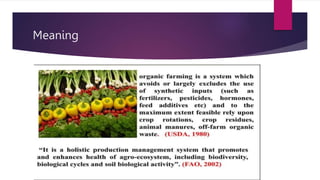
Meaning
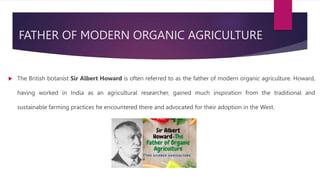
FATHER OF MODERN ORGANIC AGRICULTURE
 The British botanist Sir Albert Howard is often referred to as the father of modern organic agriculture. Howard,
having worked in India as an agricultural researcher, gained much inspiration from the traditional and
sustainable farming practices he encountered there and advocated for their adoption in the West.
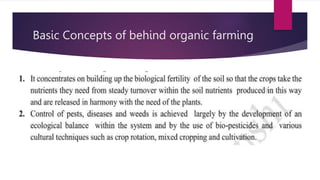
Basic Concepts of behind organic farming
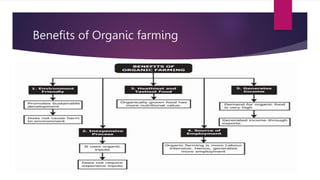
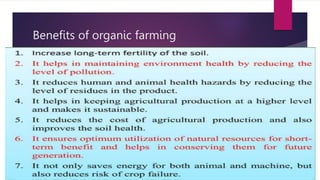
Benefits of Organic farming
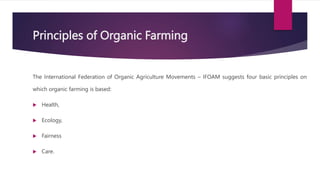
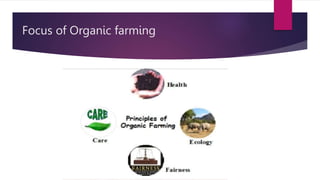
Principles of Organic Farming
The International Federation of Organic Agriculture Movements – IFOAM suggests four basic principles on
which organic farming is based:
 Health,
 Ecology,
 Fairness
 Care.
1. Principle of health
 Organic Agriculture should sustain and enhance the health of soil, plant, animal, human and planet as
one and indivisible.
 Healthy soils produce healthy crops that foster the health of animals and people.
 Health is the wholeness and integrity of living systems.
Four principles
2. Principle of ecology
 Organic Agriculture should be based on living ecological systems and cycles, work with them, emulate
them and help sustain them.
 This principle roots organic agriculture within living ecological systems,
3. Principle of fairness
 Organic Agriculture should build on relationships that ensure fan-ness with regard to the common
environment and life opportunities.
 Fairness is characterized by equity, respect; justice and stewardship of the shared world, both among people
and in their relations to other living beings
4. Principle of care
 Organic Agriculture should be managed in a precautionary and responsible manner to protect the health
and well-being of current and future generations and the environment.
 This principle states that precaution and responsibility are the key concerns in management,
development and technology choices in organic agriculture.
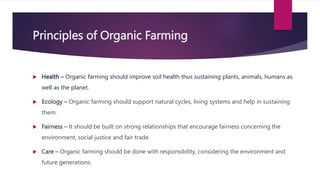
Principles of Organic Farming
 Health – Organic farming should improve soil health thus sustaining plants, animals, humans as
well as the planet.
 Ecology – Organic farming should support natural cycles, living systems and help in sustaining
them.
 Fairness – It should be built on strong relationships that encourage fairness concerning the
environment, social justice and fair trade.
 Care – Organic farming should be done with responsibility, considering the environment and
future generations.
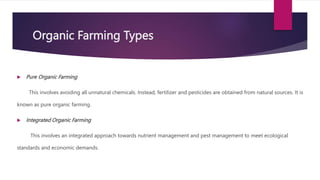
Organic Farming Types
 Pure Organic Farming
This involves avoiding all unnatural chemicals. Instead, fertilizer and pesticides are obtained from natural sources. It is
known as pure organic farming.
 Integrated Organic Farming
This involves an integrated approach towards nutrient management and pest management to meet ecological
standards and economic demands.
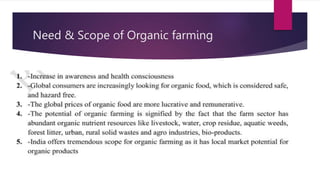
Need & Scope of Organic farming
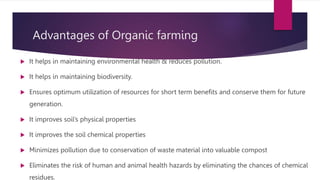
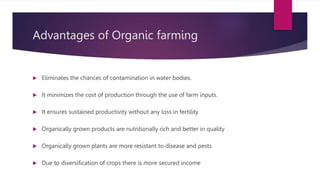
Advantages of Organic farming
 It helps in maintaining environmental health & reduces pollution.
 It helps in maintaining biodiversity.
 Ensures optimum utilization of resources for short term benefits and conserve them for future
generation.
 It improves soil’s physical properties
 It improves the soil chemical properties
 Minimizes pollution due to conservation of waste material into valuable compost
 Eliminates the risk of human and animal health hazards by eliminating the chances of chemical
residues.
Advantages of Organic farming
 Eliminates the chances of contamination in water bodies.
 It minimizes the cost of production through the use of farm inputs.
 It ensures sustained productivity without any loss in fertility
 Organically grown products are nutritionally rich and better in quality
 Organically grown plants are more resistant to disease and pests
 Due to diversification of crops there is more secured income
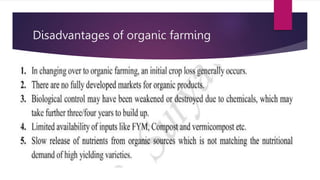
Disadvantages of organic farming
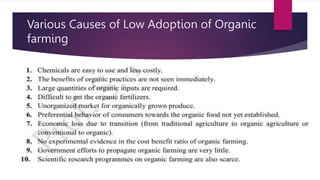
Various Causes of Low Adoption of Organic
farming
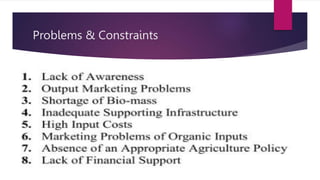
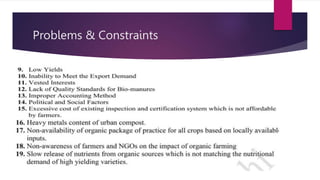
Problems & Constraints
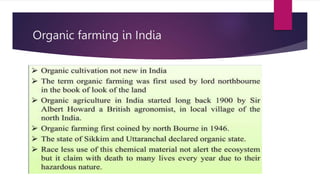
Organic farming in India
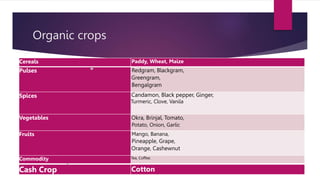
Organic crops
Cereals Paddy, Wheat, Maize
Pulses Redgram, Blackgram,
Greengram,
Bengalgram
Spices Candamon, Black pepper, Ginger,
Turmeric, Clove, Vanila
Vegetables Okra, Brinjal, Tomato,
Potato, Onion, Garlic
Fruits Mango, Banana,
Pineapple, Grape,
Orange, Cashewnut
Commodity Tea, Coffee.
Cash Crop Cotton
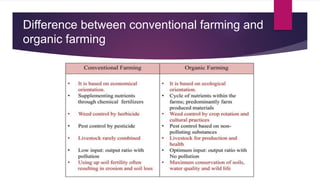
Difference between conventional farming and
organic farming
Why organic farming is necessary?
 Sustainable and eco-friendly technology.
 It improves quality, shelf and nutritive value of the farm produce.
 It encourages sustainable livelihood of the producers as well as safeguards
consumers health.
 It improves the physical, chemical and biological health of the soil.
 Promotes healthy use of the natural resources and minimizes all forms of the
pollution.
 It enhances and sustains biological diversity within the system.
Key characteristics of organic farming
 Relies primarily on local, renewable resources,
 Makes efficient use of solar energy and the production potential of biological systems.
 Maintains the fertility of the soil.
 Maximizes recycling of plant nutrients and organic matter.
 Does not use organisms or substances foreign to nature.
 Maintains diversity in the production system as well as the agricultural landscape.
 Gives farm animal's life conditions that correspond to their ecological role and allow them a
natural behavior.
 Careful attention to the impact of the farming system on the wider environment and the
conservation of wildlife and natural habitats.
Focus of Organic farming
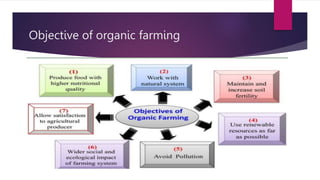
Objective of organic farming
Benefits of organic farming
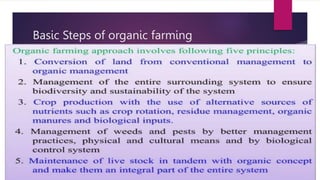
Basic Steps of organic farming
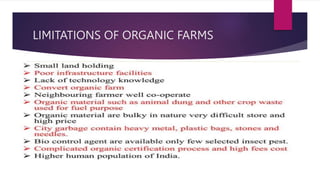
LIMITATIONS OF ORGANIC FARMS
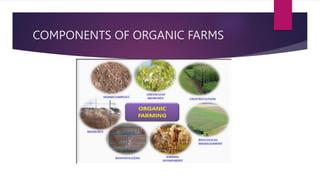
COMPONENTS OF ORGANIC FARMS
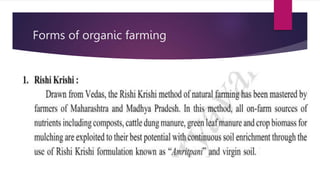
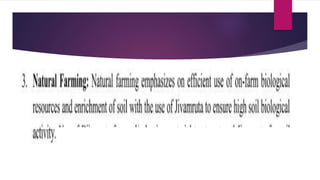
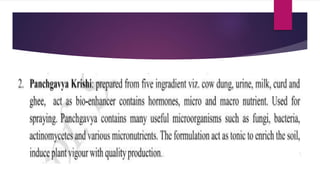
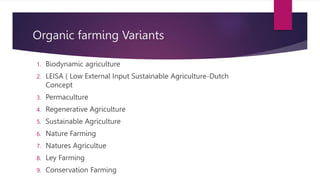
Forms of organic farming
Organic farming Variants
1. Biodynamic agriculture
2. LEISA ( Low External Input Sustainable Agriculture-Dutch
Concept
3. Permaculture
4. Regenerative Agriculture
5. Sustainable Agriculture
6. Nature Farming
7. Natures Agricultue
8. Ley Farming
9. Conservation Farming
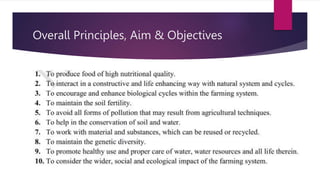
Overall Principles, Aim & Objectives
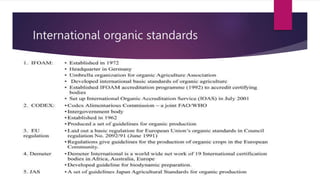
International organic standards
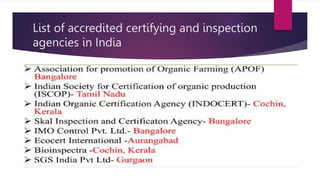
List of accredited certifying and inspection
agencies in India
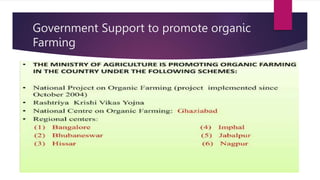
Government Support to promote organic
Farming
Conclusion
 Organic farming appears to be a sustainable, economic and eco-friendly, since there is no risk of
residual toxicity.
 It improves soil fertility and yielded quality production.
 An addition of compost prepared from farm wastes i.e FYM, Neem-cake, biogas slurry,
Vermicomposting etc. helps maintain organic matter in soil.
ORGANIC FARMING.pptx

ORGANIC FARMING.pptx

  • 1.
  • 2.
    ORGANIC FARMING  Theterm organic or the concept of organic farming was founded by North bourne in the 1940s. Organic farming can be defined as a cultivation method where no chemical fertilizers, synthetic pesticides or synthetic compounds are used. Instead, it promotes sustainable farming practice by using natural fertilizers, biological pest control made from plant or animal waste, organic manure etc. The main aim is to undo the damage caused by the green revolution and restore ecological balance.
  • 3.
    ORGANIC FARMING -DEFINITION It is a production system Which avoids or largely excludes the use of synthetically compounded fertilizers, pesticides, growth regulators and livestock feed additives. To the maximum extent feasible organic systems rely upon crop rotations. crop residues, animal manures, legumes. green manures, off farm organic wastes, mechanical cultivation, mineral bearing rocks and aspects of biological pest control to maintain the soil productivity and tilt, to supply the plant nutrients and to control insects, weeds and Other pests.
  • 4.
  • 5.
    FATHER OF MODERNORGANIC AGRICULTURE  The British botanist Sir Albert Howard is often referred to as the father of modern organic agriculture. Howard, having worked in India as an agricultural researcher, gained much inspiration from the traditional and sustainable farming practices he encountered there and advocated for their adoption in the West.
  • 6.
    Basic Concepts ofbehind organic farming
  • 7.
  • 8.
    Principles of OrganicFarming The International Federation of Organic Agriculture Movements – IFOAM suggests four basic principles on which organic farming is based:  Health,  Ecology,  Fairness  Care.
  • 9.
    1. Principle ofhealth  Organic Agriculture should sustain and enhance the health of soil, plant, animal, human and planet as one and indivisible.  Healthy soils produce healthy crops that foster the health of animals and people.  Health is the wholeness and integrity of living systems. Four principles
  • 10.
    2. Principle ofecology  Organic Agriculture should be based on living ecological systems and cycles, work with them, emulate them and help sustain them.  This principle roots organic agriculture within living ecological systems,
  • 11.
    3. Principle offairness  Organic Agriculture should build on relationships that ensure fan-ness with regard to the common environment and life opportunities.  Fairness is characterized by equity, respect; justice and stewardship of the shared world, both among people and in their relations to other living beings
  • 12.
    4. Principle ofcare  Organic Agriculture should be managed in a precautionary and responsible manner to protect the health and well-being of current and future generations and the environment.  This principle states that precaution and responsibility are the key concerns in management, development and technology choices in organic agriculture.
  • 13.
    Principles of OrganicFarming  Health – Organic farming should improve soil health thus sustaining plants, animals, humans as well as the planet.  Ecology – Organic farming should support natural cycles, living systems and help in sustaining them.  Fairness – It should be built on strong relationships that encourage fairness concerning the environment, social justice and fair trade.  Care – Organic farming should be done with responsibility, considering the environment and future generations.
  • 14.
    Organic Farming Types Pure Organic Farming This involves avoiding all unnatural chemicals. Instead, fertilizer and pesticides are obtained from natural sources. It is known as pure organic farming.  Integrated Organic Farming This involves an integrated approach towards nutrient management and pest management to meet ecological standards and economic demands.
  • 15.
    Need & Scopeof Organic farming
  • 16.
    Advantages of Organicfarming  It helps in maintaining environmental health & reduces pollution.  It helps in maintaining biodiversity.  Ensures optimum utilization of resources for short term benefits and conserve them for future generation.  It improves soil’s physical properties  It improves the soil chemical properties  Minimizes pollution due to conservation of waste material into valuable compost  Eliminates the risk of human and animal health hazards by eliminating the chances of chemical residues.
  • 17.
    Advantages of Organicfarming  Eliminates the chances of contamination in water bodies.  It minimizes the cost of production through the use of farm inputs.  It ensures sustained productivity without any loss in fertility  Organically grown products are nutritionally rich and better in quality  Organically grown plants are more resistant to disease and pests  Due to diversification of crops there is more secured income
  • 18.
  • 19.
    Various Causes ofLow Adoption of Organic farming
  • 20.
  • 21.
  • 22.
  • 23.
    Organic crops Cereals Paddy,Wheat, Maize Pulses Redgram, Blackgram, Greengram, Bengalgram Spices Candamon, Black pepper, Ginger, Turmeric, Clove, Vanila Vegetables Okra, Brinjal, Tomato, Potato, Onion, Garlic Fruits Mango, Banana, Pineapple, Grape, Orange, Cashewnut Commodity Tea, Coffee. Cash Crop Cotton
  • 24.
    Difference between conventionalfarming and organic farming
  • 25.
    Why organic farmingis necessary?  Sustainable and eco-friendly technology.  It improves quality, shelf and nutritive value of the farm produce.  It encourages sustainable livelihood of the producers as well as safeguards consumers health.  It improves the physical, chemical and biological health of the soil.  Promotes healthy use of the natural resources and minimizes all forms of the pollution.  It enhances and sustains biological diversity within the system.
  • 26.
    Key characteristics oforganic farming  Relies primarily on local, renewable resources,  Makes efficient use of solar energy and the production potential of biological systems.  Maintains the fertility of the soil.  Maximizes recycling of plant nutrients and organic matter.  Does not use organisms or substances foreign to nature.  Maintains diversity in the production system as well as the agricultural landscape.  Gives farm animal's life conditions that correspond to their ecological role and allow them a natural behavior.  Careful attention to the impact of the farming system on the wider environment and the conservation of wildlife and natural habitats.
  • 27.
  • 28.
  • 29.
  • 30.
    Basic Steps oforganic farming
  • 31.
  • 32.
  • 33.
  • 35.
    Organic farming Variants 1.Biodynamic agriculture 2. LEISA ( Low External Input Sustainable Agriculture-Dutch Concept 3. Permaculture 4. Regenerative Agriculture 5. Sustainable Agriculture 6. Nature Farming 7. Natures Agricultue 8. Ley Farming 9. Conservation Farming
  • 36.
  • 38.
  • 39.
    List of accreditedcertifying and inspection agencies in India
  • 40.
    Government Support topromote organic Farming
  • 41.
    Conclusion  Organic farmingappears to be a sustainable, economic and eco-friendly, since there is no risk of residual toxicity.  It improves soil fertility and yielded quality production.  An addition of compost prepared from farm wastes i.e FYM, Neem-cake, biogas slurry, Vermicomposting etc. helps maintain organic matter in soil.