ORGANIC FARMING
Submitted By
Kamta Prasad Pandey
ID No 2332
Department of
Agronomy
BUAT Banda
What is organic farming?
 Organic farming system in India is not new and is being followed from
ancient time.
 Organic farming is a system which avoids the use of synthetic inputs
(such as fertilizers, pesticides, hormones, feed additives etc.) and to
the maximum extent feasible rely upon crop rotations, crop residues,
animal manures, off-farm organic waste, mineral grade rock additives
and biological system of nutrient mobilization and plant protection.
(USDA 1980)
 Organic agriculture is a unique production management system
which promotes and enhances agro-ecosystem health, including
biodiversity, biological cycles and soil biological activity. (FAO 2002)
 Organic farming, also known as ecological farming or biological
farming.
Need of organic farming
 Food security needs to be addressed with the growing population and
decreasing supply of resources, so increase the production but in a
sustainable manner
 It improves quality, nutritive value of the farm produce.
 It improve the physical, chemical and biological health of the soil.
 Promotes healthy use of the natural resources and minimize all forms of the
pollution.
 Environmental sustainability needs to be maintained which can be
achieved through organic farming.
 There needs to be an improvement in the health as the consumption can
lead to many diseases such as cancer, infertility which happens when the
toxic residue remains in the body, thus the safety of humans and animals
ILL Effects of the Green Revolution
 The Green Revolution changed the whole scenario in the field of
agriculture where the farmers were introduced to high yielding seeds and
fertilizers to maintain food security.
 Increasing productivity ensured profit but ultimately the land was turning
barren due to the excessive usage of fertilizers making the soil infertile and
pesticides turning the product dangerous to consume.
 Indiscriminate killing of useful insects, microorganisms and predators that
naturally check excess crop damage by insect pests.
 Destruction of soil structure, aeration and water holding capacity of soil.
 Poisoning the food with highly toxic pesticide residues.
 High inputs increasing the agricultural expenses.
 Pollution with toxic chemicals. (In Europe 25% of the people drinking water
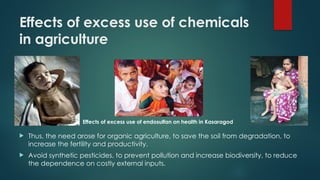
Effects of excess use of chemicals
in agriculture
 Thus, the need arose for organic agriculture, to save the soil from degradation, to
increase the fertility and productivity.
 Avoid synthetic pesticides, to prevent pollution and increase biodiversity, to reduce
the dependence on costly external inputs.
Effects of excess use of endosulfan on health in Kasaragod
Scenario of Organic Agriculture
World
 Organic agriculture is practiced in 187 countries, and 74.9 million
hectares of agricultural land were managed organically by at least
3.1 million farmers.
 Most organic agricultural land in Australia (35.69 m hectares)
followed by Argentina (3.63 m hectares) and the Spain (2.35 m
hectares).
India
 India has 2.8 million hectares of farmland was under organic
cultivation.
 16 lakh farmers in India are into certified organic farming.
 The top three states — Madhya Pradesh, Rajasthan and
Objectives of Organic Farming (as
per IFOAM)
 To produce food of high nutritional quality in sufficient quantity and
work with natural system.
 To encourage and enhance biological cycles within farming
system-involving microorganisms, soil flora and fauna, plants and
animals.
 To maintain and increase long term fertility of soil with renewable
resources.
 To maintain the genetic diversity of agricultural system and its
surroundings, including the plants and wild life habitats.
 To avoid all forms of pollution that may result from agricultural
techniques.
 To allow agricultural producers an adequate returns and
satisfaction from their work including safe drinking water.
Characteristics of Organic Farming
 Relies primarily on local, renewable resources.
 Make efficient use of solar energy and the production potential of
biological systems.
 Maintains the fertility of the soil.
 Maximizes recycling of plant nutrients and organic matter.
 Maintain diversity in the production system as well as the agricultural
landscape.
 Careful attention to the impact o the farming system on the wider
environment and the conservation of wildlife and natural habitats.
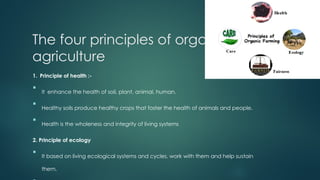
The four principles of organic
agriculture
1. Principle of health :-
 It enhance the health of soil, plant, animal, human.
 Healthy soils produce healthy crops that foster the health of animals and people.
 Health is the wholeness and integrity of living systems
2. Principle of ecology
 It based on living ecological systems and cycles, work with them and help sustain
them.
The four principles of organic
agriculture
3. Principle of fairness
 It build relationships that ensure fairness with regard to the common environment and life
opportunities.
 Fairness is characterized by equity, respect, justice of the shared world, both among
people and in their relations to other living beings.
4. Principle of care
 It managed in a precautionary and responsible manner to protect the health and well-
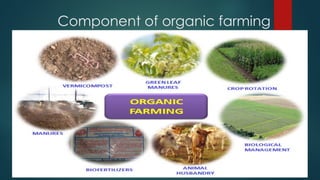
Component of organic farming
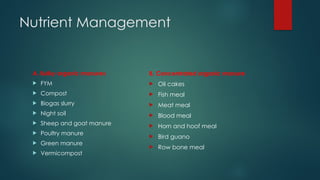
Nutrient Management
A. Bulky organic manures
 FYM
 Compost
 Biogas slurry
 Night soil
 Sheep and goat manure
 Poultry manure
 Green manure
 Vermicompost
B. Concentrated organic manure
 Oil cakes
 Fish meal
 Meat meal
 Blood meal
 Horn and hoof meal
 Bird guano
 Row bone meal
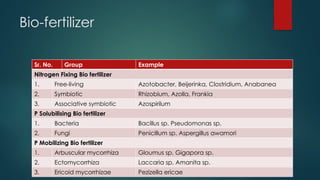
Bio-fertilizer
Sr. No. Group Example
Nitrogen Fixing Bio fertilizer
1. Free-living Azotobacter, Beijerinka, Clostridium, Anabanea
2. Symbiotic Rhizobium, Azolla, Frankia
3. Associative symbiotic Azospirilum
P Solubilising Bio fertilizer
1. Bacteria Bacillus sp. Pseudomonas sp.
2. Fungi Penicillum sp. Aspergillus awamori
P Mobilizing Bio fertilizer
1. Arbuscular mycorrhiza Gloumus sp, Gigapora sp.
2. Ectomycorrhiza Laccaria sp, Amanita sp.
3. Ericoid mycorrhizae Pezizella ericae
Weed Management in Organic
Farming
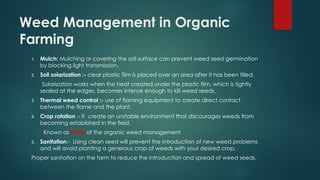
1. Mulch: Mulching or covering the soil surface can prevent weed seed germination
by blocking light transmission.
2. Soil solarization :- clear plastic film is placed over an area after it has been tilled.
Solarization works when the heat created under the plastic film, which is tightly
sealed at the edges, becomes intense enough to kill weed seeds.
3. Thermal weed control :- use of flaming equipment to create direct contact
between the flame and the plant.
4. Crop rotation :- It create an unstable environment that discourages weeds from
becoming established in the field.
Known as Heart of the organic weed management
5. Sanitation:- Using clean seed will prevent the introduction of new weed problems
and will avoid planting a generous crop of weeds with your desired crop.
Proper sanitation on the farm to reduce the introduction and spread of weed seeds.
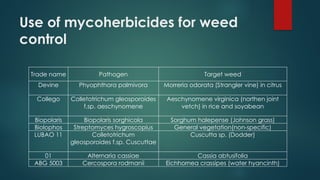
Use of mycoherbicides for weed
control
Trade name Pathogen Target weed
Devine Phyophthora palmivora Morreria odorata (Strangler vine) in citrus
Collego Colletotrichum gleosporoides
f.sp. aeschynomene
Aeschynomene virginica (northen joint
vetch) in rice and soyabean
Biopolaris Biopolaris sorghicola Sorghum halepense (Johnson grass)
Biolophos Streptomyces hygroscopius General vegetation(non-specific)
LUBAO 11 Colletotrichum
gleosporoides f.sp. Cuscuttae
Cuscutta sp. (Dodder)
01 Alternaria cassiae Cassia abtusifolia
ABG 5003 Cercospora rodmanii Eichhornea crassipes (water hyancinth)
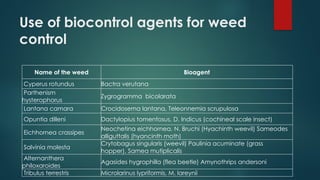
Use of biocontrol agents for weed
control
Name of the weed Bioagent
Cyperus rotundus Bactra verutana
Parthenism
hysterophorus
Zygrogramma bicolarata
Lantana camara Crocidosema lantana, Teleonnemia scrupulosa
Opuntia dilleni Dactylopius tomentosus, D. Indicus (cochineal scale insect)
Eichhornea crassipes
Neochetina eichhornea, N. Bruchi (Hyachinth weevil) Sameodes
alliguttalis (hyancinth moth)
Salvinia molesta
Crytobagus singularis (weevil) Paulinia acuminate (grass
hopper), Samea mutiplicalis
Alternanthera
philoxaroides
Agasides hygrophilla (flea beetle) Amynothrips andersoni
Tribulus terrestris Microlarinus lypriformis, M. lareynii
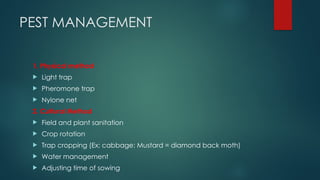
PEST MANAGEMENT
1. Physical method
 Light trap
 Pheromone trap
 Nylone net
2. Cultural Method
 Field and plant sanitation
 Crop rotation
 Trap cropping (Ex; cabbage: Mustard = diamond back moth)
 Water management
 Adjusting time of sowing
Limitations of organic farming in
India
 Small land holding.
 Poor infrastructure facilities
 Lack of technology knowledge
 Organic material such as animal dung and other crop waste used as
fuel purpose.
 Organic material are bulky in nature very difficult store and high price
 City garbage contain heavy metal, plastic bags, stones and needles.
 Bio control agent are available only few selected insect pest.
 Higher human population.
Key Facts of Organic farming in
India,
 Sikkim became the first State in the world to become fully organic.
 North East India has traditionally been organic, & the consumption of
chemicals is far less than rest of the country.
 Madhya Pradesh tops the list with 0.76 million ha of area under organic
cultivation — that is over 27 per cent of India’s total organic cultivation
area.
 The top three states, Madhya Pradesh, Rajasthan, & Maharashtra —
account for about half the area under organic cultivation.
 Major organic exports from India are flax seeds, sesame, soybean, tea,
medicinal plants, rice & pulses.
 Major exporting state – assam, mizoram, manipur and nagaland

Organic Farming Objective, Principles Components Limitations.pptx

  • 1.
    ORGANIC FARMING Submitted By KamtaPrasad Pandey ID No 2332 Department of Agronomy BUAT Banda
  • 2.
    What is organicfarming?  Organic farming system in India is not new and is being followed from ancient time.  Organic farming is a system which avoids the use of synthetic inputs (such as fertilizers, pesticides, hormones, feed additives etc.) and to the maximum extent feasible rely upon crop rotations, crop residues, animal manures, off-farm organic waste, mineral grade rock additives and biological system of nutrient mobilization and plant protection. (USDA 1980)  Organic agriculture is a unique production management system which promotes and enhances agro-ecosystem health, including biodiversity, biological cycles and soil biological activity. (FAO 2002)  Organic farming, also known as ecological farming or biological farming.
  • 3.
    Need of organicfarming  Food security needs to be addressed with the growing population and decreasing supply of resources, so increase the production but in a sustainable manner  It improves quality, nutritive value of the farm produce.  It improve the physical, chemical and biological health of the soil.  Promotes healthy use of the natural resources and minimize all forms of the pollution.  Environmental sustainability needs to be maintained which can be achieved through organic farming.  There needs to be an improvement in the health as the consumption can lead to many diseases such as cancer, infertility which happens when the toxic residue remains in the body, thus the safety of humans and animals
  • 4.
    ILL Effects ofthe Green Revolution  The Green Revolution changed the whole scenario in the field of agriculture where the farmers were introduced to high yielding seeds and fertilizers to maintain food security.  Increasing productivity ensured profit but ultimately the land was turning barren due to the excessive usage of fertilizers making the soil infertile and pesticides turning the product dangerous to consume.  Indiscriminate killing of useful insects, microorganisms and predators that naturally check excess crop damage by insect pests.  Destruction of soil structure, aeration and water holding capacity of soil.  Poisoning the food with highly toxic pesticide residues.  High inputs increasing the agricultural expenses.  Pollution with toxic chemicals. (In Europe 25% of the people drinking water
  • 5.
    Effects of excessuse of chemicals in agriculture  Thus, the need arose for organic agriculture, to save the soil from degradation, to increase the fertility and productivity.  Avoid synthetic pesticides, to prevent pollution and increase biodiversity, to reduce the dependence on costly external inputs. Effects of excess use of endosulfan on health in Kasaragod
  • 6.
    Scenario of OrganicAgriculture World  Organic agriculture is practiced in 187 countries, and 74.9 million hectares of agricultural land were managed organically by at least 3.1 million farmers.  Most organic agricultural land in Australia (35.69 m hectares) followed by Argentina (3.63 m hectares) and the Spain (2.35 m hectares). India  India has 2.8 million hectares of farmland was under organic cultivation.  16 lakh farmers in India are into certified organic farming.  The top three states — Madhya Pradesh, Rajasthan and
  • 7.
    Objectives of OrganicFarming (as per IFOAM)  To produce food of high nutritional quality in sufficient quantity and work with natural system.  To encourage and enhance biological cycles within farming system-involving microorganisms, soil flora and fauna, plants and animals.  To maintain and increase long term fertility of soil with renewable resources.  To maintain the genetic diversity of agricultural system and its surroundings, including the plants and wild life habitats.  To avoid all forms of pollution that may result from agricultural techniques.  To allow agricultural producers an adequate returns and satisfaction from their work including safe drinking water.
  • 8.
    Characteristics of OrganicFarming  Relies primarily on local, renewable resources.  Make efficient use of solar energy and the production potential of biological systems.  Maintains the fertility of the soil.  Maximizes recycling of plant nutrients and organic matter.  Maintain diversity in the production system as well as the agricultural landscape.  Careful attention to the impact o the farming system on the wider environment and the conservation of wildlife and natural habitats.
  • 9.
    The four principlesof organic agriculture 1. Principle of health :-  It enhance the health of soil, plant, animal, human.  Healthy soils produce healthy crops that foster the health of animals and people.  Health is the wholeness and integrity of living systems 2. Principle of ecology  It based on living ecological systems and cycles, work with them and help sustain them.
  • 10.
    The four principlesof organic agriculture 3. Principle of fairness  It build relationships that ensure fairness with regard to the common environment and life opportunities.  Fairness is characterized by equity, respect, justice of the shared world, both among people and in their relations to other living beings. 4. Principle of care  It managed in a precautionary and responsible manner to protect the health and well-
  • 11.
  • 12.
    Nutrient Management A. Bulkyorganic manures  FYM  Compost  Biogas slurry  Night soil  Sheep and goat manure  Poultry manure  Green manure  Vermicompost B. Concentrated organic manure  Oil cakes  Fish meal  Meat meal  Blood meal  Horn and hoof meal  Bird guano  Row bone meal
  • 13.
    Bio-fertilizer Sr. No. GroupExample Nitrogen Fixing Bio fertilizer 1. Free-living Azotobacter, Beijerinka, Clostridium, Anabanea 2. Symbiotic Rhizobium, Azolla, Frankia 3. Associative symbiotic Azospirilum P Solubilising Bio fertilizer 1. Bacteria Bacillus sp. Pseudomonas sp. 2. Fungi Penicillum sp. Aspergillus awamori P Mobilizing Bio fertilizer 1. Arbuscular mycorrhiza Gloumus sp, Gigapora sp. 2. Ectomycorrhiza Laccaria sp, Amanita sp. 3. Ericoid mycorrhizae Pezizella ericae
  • 14.
    Weed Management inOrganic Farming 1. Mulch: Mulching or covering the soil surface can prevent weed seed germination by blocking light transmission. 2. Soil solarization :- clear plastic film is placed over an area after it has been tilled. Solarization works when the heat created under the plastic film, which is tightly sealed at the edges, becomes intense enough to kill weed seeds. 3. Thermal weed control :- use of flaming equipment to create direct contact between the flame and the plant. 4. Crop rotation :- It create an unstable environment that discourages weeds from becoming established in the field. Known as Heart of the organic weed management 5. Sanitation:- Using clean seed will prevent the introduction of new weed problems and will avoid planting a generous crop of weeds with your desired crop. Proper sanitation on the farm to reduce the introduction and spread of weed seeds.
  • 15.
    Use of mycoherbicidesfor weed control Trade name Pathogen Target weed Devine Phyophthora palmivora Morreria odorata (Strangler vine) in citrus Collego Colletotrichum gleosporoides f.sp. aeschynomene Aeschynomene virginica (northen joint vetch) in rice and soyabean Biopolaris Biopolaris sorghicola Sorghum halepense (Johnson grass) Biolophos Streptomyces hygroscopius General vegetation(non-specific) LUBAO 11 Colletotrichum gleosporoides f.sp. Cuscuttae Cuscutta sp. (Dodder) 01 Alternaria cassiae Cassia abtusifolia ABG 5003 Cercospora rodmanii Eichhornea crassipes (water hyancinth)
  • 16.
    Use of biocontrolagents for weed control Name of the weed Bioagent Cyperus rotundus Bactra verutana Parthenism hysterophorus Zygrogramma bicolarata Lantana camara Crocidosema lantana, Teleonnemia scrupulosa Opuntia dilleni Dactylopius tomentosus, D. Indicus (cochineal scale insect) Eichhornea crassipes Neochetina eichhornea, N. Bruchi (Hyachinth weevil) Sameodes alliguttalis (hyancinth moth) Salvinia molesta Crytobagus singularis (weevil) Paulinia acuminate (grass hopper), Samea mutiplicalis Alternanthera philoxaroides Agasides hygrophilla (flea beetle) Amynothrips andersoni Tribulus terrestris Microlarinus lypriformis, M. lareynii
  • 17.
    PEST MANAGEMENT 1. Physicalmethod  Light trap  Pheromone trap  Nylone net 2. Cultural Method  Field and plant sanitation  Crop rotation  Trap cropping (Ex; cabbage: Mustard = diamond back moth)  Water management  Adjusting time of sowing
  • 18.
    Limitations of organicfarming in India  Small land holding.  Poor infrastructure facilities  Lack of technology knowledge  Organic material such as animal dung and other crop waste used as fuel purpose.  Organic material are bulky in nature very difficult store and high price  City garbage contain heavy metal, plastic bags, stones and needles.  Bio control agent are available only few selected insect pest.  Higher human population.
  • 19.
    Key Facts ofOrganic farming in India,  Sikkim became the first State in the world to become fully organic.  North East India has traditionally been organic, & the consumption of chemicals is far less than rest of the country.  Madhya Pradesh tops the list with 0.76 million ha of area under organic cultivation — that is over 27 per cent of India’s total organic cultivation area.  The top three states, Madhya Pradesh, Rajasthan, & Maharashtra — account for about half the area under organic cultivation.  Major organic exports from India are flax seeds, sesame, soybean, tea, medicinal plants, rice & pulses.  Major exporting state – assam, mizoram, manipur and nagaland